Presentation
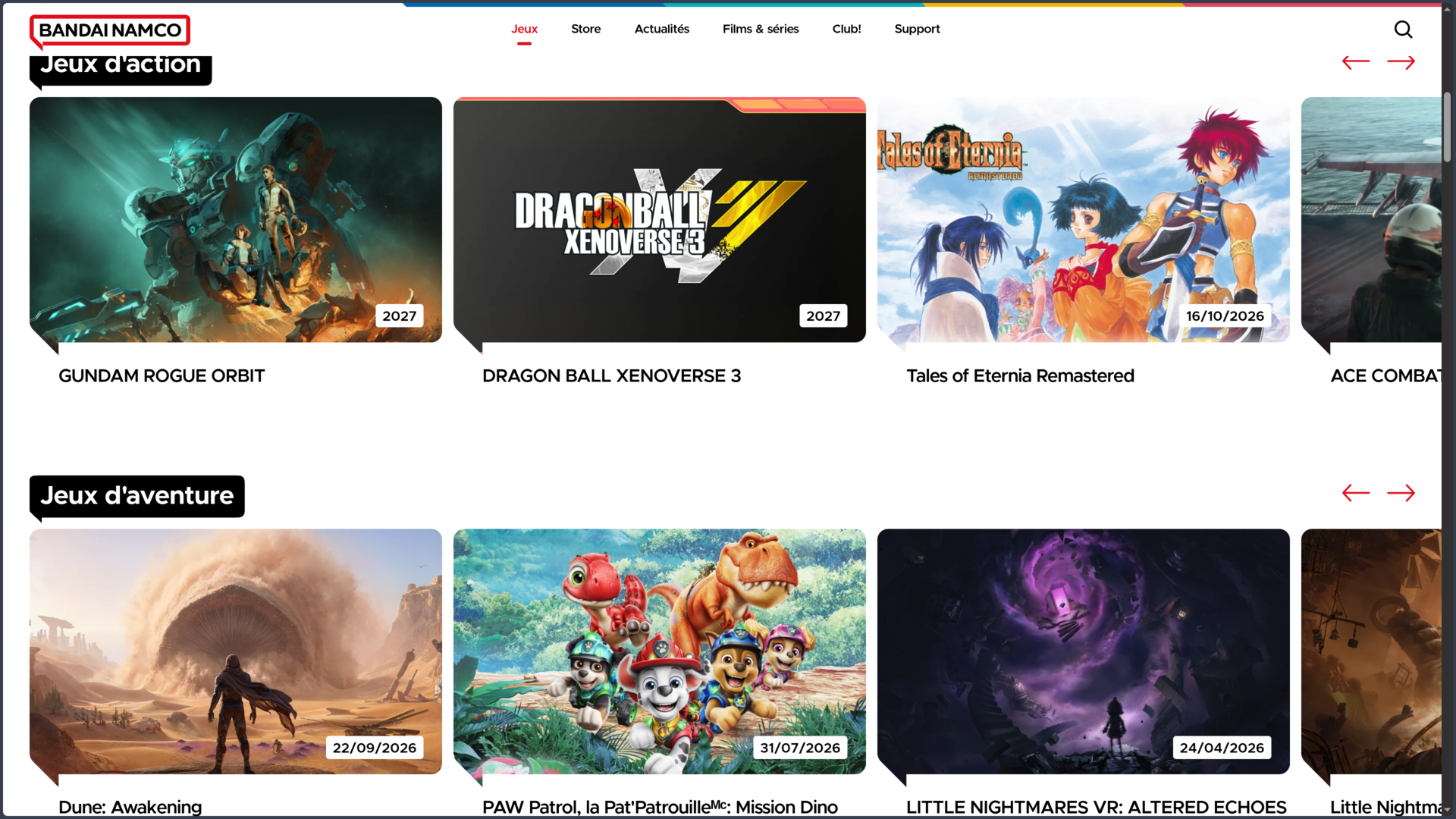
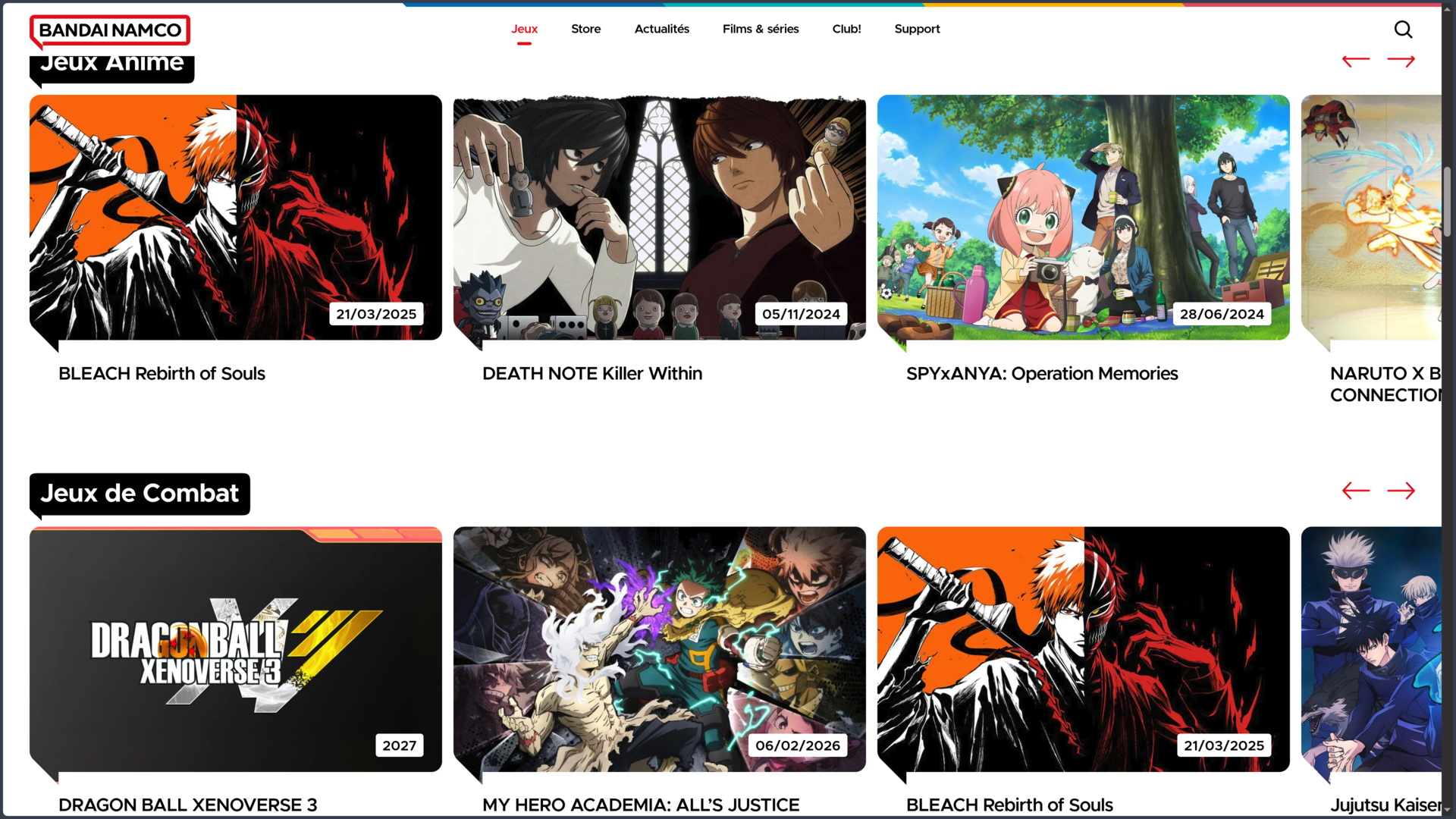
It only takes a few names associated with Bandai Namco Entertainment to understand why the company resists any simple identity: PAC-MAN, TEKKEN, Tales of, Taiko no Tatsujin, THE IDOLMASTER, but also Gundam, Dragon Ball, Naruto, or One Piece. Add to that partnerships with independent studios, of which the relationship with FromSoftware around Elden Ring is one of the most visible examples.
This diversity comes directly from its history.
The current company was born on March 31, 2006 under the name NAMCO BANDAI Games Inc., after Bandai and Namco came together. It then inherited two complementary traditions. Namco brought several decades of video game and arcade creation, with properties like PAC-MAN, Ridge Racer, TEKKEN, or Tales of. Bandai brought a culture deeply linked to characters, toys, and the exploitation of universes able to circulate between several media.
Bandai Namco Entertainment therefore does not function as a single studio with a common aesthetic. Its center of gravity is intellectual property: creating universes, making its own last, adapting those of others, working with several developers, and organizing their distribution to very different audiences.
This position also requires distinguishing several roles that are often confused. Since 2012, Bandai Namco Studios has carried an important part of internal development as a separate structure. Bandai Namco Entertainment retains a broader role around production, publishing, intellectual properties, marketing, network content, and partnerships.
Elden Ring illustrates this architecture well: FromSoftware remains the main developer and keeps its identity, while Bandai Namco Entertainment participates in the production partnership and handles international publishing. Conversely, series like TEKKEN or THE IDOLMASTER belong directly to the heritage the company evolves over time.
The common thread of Bandai Namco is therefore not a genre. It is the ability to keep alive universes coming from very different sources without requiring them all to become variations of a single formula.
History
Two legacies before a single company
The history of Bandai Namco Entertainment begins before 2006, but it really begins with two companies whose cultures do not overlap.
Namco built a large part of its identity in arcades and video games. PAC-MAN in 1980 quickly became a global symbol. In the 1990s, Ridge Racer, TEKKEN, and Tales of Phantasia showed that the company could accompany the transition to 3D while developing series in very different genres.
Bandai, for its part, had a long experience with toys, characters, and the exploitation of Japanese cultural properties. Universes like Gundam showed that a character or a franchise can exist simultaneously through several types of products and media.
When the two companies came together, they were therefore not just merging two catalogs. They brought closer a tradition of interactive creation and a tradition of managing universes and characters.
This combination would become the most useful principle for understanding Bandai Namco Entertainment.
2005-2006: organizing an already immense heritage
Bandai and Namco announced their merger in 2005, then the new group took shape around its holding. On March 31, 2006, NAMCO BANDAI Games Inc. was created, bringing together notably the games activities of Bandai and Namco.
The new company was born with an unusual problem: it immediately possessed a past older than itself.
PAC-MAN has existed since 1980. TEKKEN and Tales of come from the 1990s. Bandai brings with it long-standing relationships with major Japanese properties. The mission is therefore not only to invent new franchises, but to organize and extend several decades of already established works.
This situation explains why heritage occupies such an important place in the identity of the modern company.
Internal properties and external licenses: two coexisting logics
The merger reinforces a characteristic that has become central: Bandai Namco Entertainment can simultaneously develop its own properties and work with those of other rights holders.
On one side are universes like PAC-MAN, TEKKEN, Tales of, Taiko no Tatsujin, or THE IDOLMASTER. On the other, the company exploits licenses like Dragon Ball, Naruto, One Piece, or Gundam depending on the projects and agreements.
These activities require different skills.
An internal property can be developed over several decades with great strategic freedom. An external license requires understanding a universe, its audience, and the expectations of its holders while finding a relevant interactive form.
The diversity of the catalog comes precisely from the coexistence of these two logics.
THE IDOLMASTER: when a game becomes an ecosystem
THE IDOLMASTER constitutes a particularly clear example of how Bandai Namco can grow a property born from video games.
The franchise gradually developed through new games, music, concerts, animation, and various events. The game is no longer just an isolated product: it can become the starting point of a lasting relationship between characters, community, and several forms of entertainment.
This evolution naturally brings Namco's video game heritage closer to Bandai's intellectual property culture.
It also shows that the IP strategy is not only about exploiting already famous characters. Bandai Namco can also create an interactive universe and then extend it beyond the game.
2012-2015: clarifying the roles
In 2012, the development division of NAMCO BANDAI Games was separated to create what became Bandai Namco Studios.
This reorganization makes an important distinction more visible. Bandai Namco Entertainment can be producer, publisher, property manager, or partner without necessarily being the studio that directly develops each element of a work.
This difference becomes even more important when the company works with external developers.
In 2015, NAMCO BANDAI Games officially became Bandai Namco Entertainment. The name change accompanies a broader vision: the game remains central, but a property can now be thought of as a set of experiences, content, and relationships with the audience.
A company at home with Japanese popular culture
Bandai Namco occupies a particular place in adapting manga, anime, and other major Japanese properties.
Working on Dragon Ball, Naruto, One Piece, or Gundam is not simply a matter of putting known characters on a box. Each universe has its history, its codes, and a community able to quickly recognize what looks faithful or artificial.
The company therefore relies on different teams and partners to transform these licenses into fighting games, RPGs, action games, or mobile experiences. This skill directly links two sectors historically close to Japanese popular culture: media universes and video games.
Partnerships make it possible to expand the portfolio without absorbing the studios
The relationship with FromSoftware around Elden Ring shows another model.
FromSoftware remains the main developer and keeps its identity. Bandai Namco Entertainment intervenes in the production partnership and handles the game's publishing outside Japan.
This organization is important because it shows that a major publisher does not need to acquire a studio to build a lasting and structuring relationship with it.
The partner brings its own creative culture. Bandai Namco brings its production, publishing, distribution, and international development capabilities. The value then comes from complementarity rather than integration.
Today: making a portfolio live rather than imposing a formula
Bandai Namco Entertainment now leads the worldwide games and network content activities of the Digital Unit of the Bandai Namco group and continues to organize its activity around intellectual properties.
Its catalog contains franchises separated by several decades, licenses belonging to other groups, and projects born from partnerships with independent studios.
This structure explains why it would be misleading to look for a "Bandai Namco formula" comparable to the signature of an auteur studio.
The continuity lies elsewhere: in the ability to decide which universes should be created, adapted, extended, entrusted to partners, or brought to new audiences.
What Sets It Apart
Two legacies that produce a hybrid company
Bandai Namco Entertainment is built on a rare complementarity.
The Namco legacy brings a deep culture of video games, arcades, and the creation of original franchises. The Bandai legacy brings significant experience in managing characters, licenses, and universes likely to exist well beyond a single product.
This meeting allows the company to be comfortable in several positions: owner of a franchise, publisher, producer, partner, or operator of an external license.
Its identity therefore does not come from the uniformity of its games, but from its ability to make several ways of building a cultural property coexist.
IP before genre
PAC-MAN, TEKKEN, Tales of, Taiko no Tatsujin, and THE IDOLMASTER have almost nothing in common in terms of gameplay.
The adaptations of Dragon Ball, Naruto, or One Piece add even more forms. Elden Ring comes from a partnership with a studio whose creative method remains deeply personal.
This diversity is not an accident.
Bandai Namco organizes its activity around universes and communities more than around a central genre. Fighting games, RPGs, rhythm, action, or mobile become different ways of keeping a property alive.
Create, license, and publish without confusing the roles
The number of names associated with Bandai Namco sometimes makes it hard to know who does what.
The creation of Bandai Namco Studios in 2012 makes the distinction more readable: Bandai Namco Entertainment is not automatically the main developer of every game bearing its logo.
This nuance is particularly visible with external partners. Elden Ring remains a work developed mainly by FromSoftware even though Bandai Namco plays a major role in its production partnership and international publishing.
This ability to change roles depending on the project is a real skill. The company can own a property, work under license, publish an independent developer, or support a co-production without having to bring all these projects back to the same model.
Making time an editorial resource
Bandai Namco's portfolio spans several generations.
PAC-MAN comes from the 1980 arcade. TEKKEN and Tales of appeared in the 1990s. THE IDOLMASTER developed in the 2000s. New properties or collaborations can then join this set.
This historical depth forces the company to manage several times at once: maintaining some series, transforming others, adapting old properties to new audiences, and deciding when a universe deserves to come back.
Heritage is therefore not just a collection of old games. It becomes an active material.
Bandai Namco stands out precisely through this ability to make very different universes last without requiring them all to age in the same way.
Good to Know
- Bandai Namco Entertainment is a Japanese company based in Tokyo.
- The modern company was created on March 31, 2006 under the name NAMCO BANDAI Games Inc., after the merger of Bandai and Namco.
- Its heritage is older than the current entity: PAC-MAN was launched by Namco in 1980, while TEKKEN and Tales of appeared in the 1990s.
- Bandai Namco Studios was created in 2012 from the development division of NAMCO BANDAI Games.
- NAMCO BANDAI Games became Bandai Namco Entertainment in April 2015.
- The company exploits both internal properties and external licenses, notably around Gundam, Dragon Ball, Naruto, and One Piece.
- THE IDOLMASTER illustrates the ability of a property born from video games to then develop through music, concerts, animation, and events.
- FromSoftware is the main developer of Elden Ring, while Bandai Namco Entertainment participates in the production partnership and handles its publishing outside Japan.
- Bandai Namco Entertainment leads the worldwide games and network content activities of the Digital Unit of the Bandai Namco group.