Overview
SEGA is a Japanese video game publisher and developer whose history spans almost every major transformation of the industry: arcade machines, home consoles, online gaming, multi-platform publishing, mobile games and the global operation of major franchises.
The current company, SEGA Corporation, was officially founded in 1960 in Japan under the name Nihon Goraku Bussan. After several reorganizations and its merger with Rosen Enterprises, it adopted the name SEGA Enterprises in 1965.
The SEGA name historically comes from the expression Service Games.
Even before becoming a console manufacturer, the company built its identity in arcades. Machines such as Periscope in the 1960s, followed later by Hang-On, Out Run, After Burner, Virtua Racing, Virtua Fighter and Daytona USA, helped establish a culture built around technology, speed and spectacle.
SEGA entered the home console market with the SG-1000 in 1983, before developing the Master System and then especially the Mega Drive, released from 1988 in Japan and known as Genesis in North America.
It was during this period that SEGA became a major competitor to Nintendo.
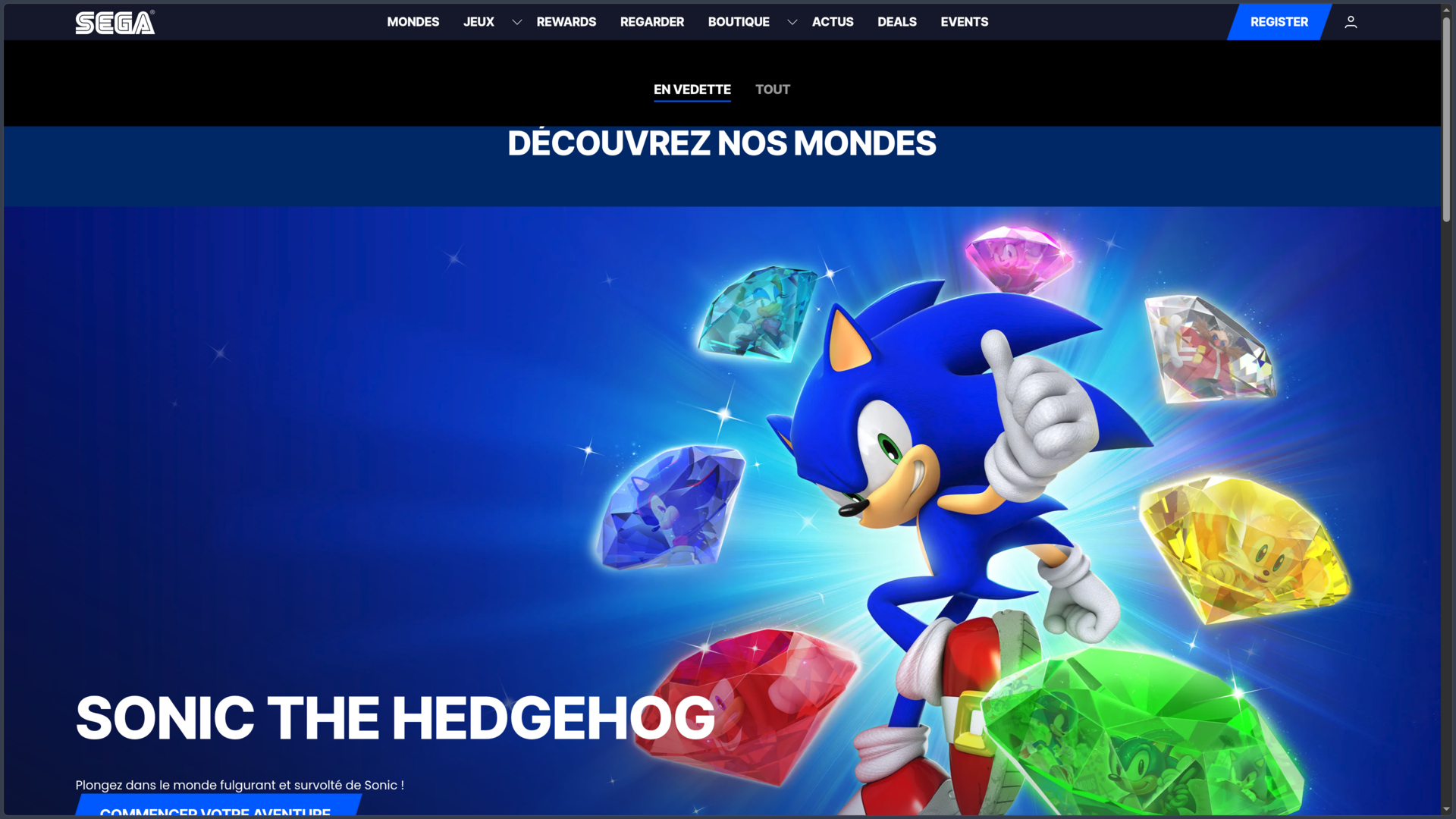
The creation of Sonic the Hedgehog in 1991 gave the company an immediately recognizable mascot. Sonic represented a faster, more energetic image aimed more directly at teenage audiences than the one traditionally associated with Nintendo.
The rivalry, however, went far beyond a simple opposition between two characters.
SEGA built a catalogue around its consoles including series such as Phantasy Star, Streets of Rage, Shinobi, Golden Axe, Virtua Fighter and Panzer Dragoon, while continuing to exploit its significant arcade expertise.
The Saturn followed the Mega Drive, then the Dreamcast.
The latter, launched in Japan in 1998, introduced several ideas ahead of their broader adoption: integrated Internet connectivity depending on the market, online gaming, connected services and experiences such as Phantasy Star Online.
But SEGA’s financial difficulties and increasing competition in the console market made its hardware business difficult to maintain.
In 2001, SEGA ended Dreamcast production.
This decision marked one of the most important transformations in its history: the company abandoned its role as a console manufacturer and became a publisher of games for the platforms of its former competitors.
PlayStation, Xbox, Nintendo and PC gradually became the new platforms for distributing its games.
SEGA did not, however, limit itself to exploiting its older franchises.
From the 2000s onward, the company built a network of studios and subsidiaries that significantly broadened its catalogue.
British studio Creative Assembly, creator of Total War, joined SEGA in 2005. Sports Interactive, the studio behind Football Manager, was acquired in 2006. Atlus, known for Persona and Shin Megami Tensei, joined the group in 2013. Two Point Studios, behind Two Point Hospital, was acquired in 2019.
In 2023, SEGA also acquired the Finnish group Rovio Entertainment, creator of Angry Birds, significantly strengthening its presence in mobile gaming and the international operation of franchises.
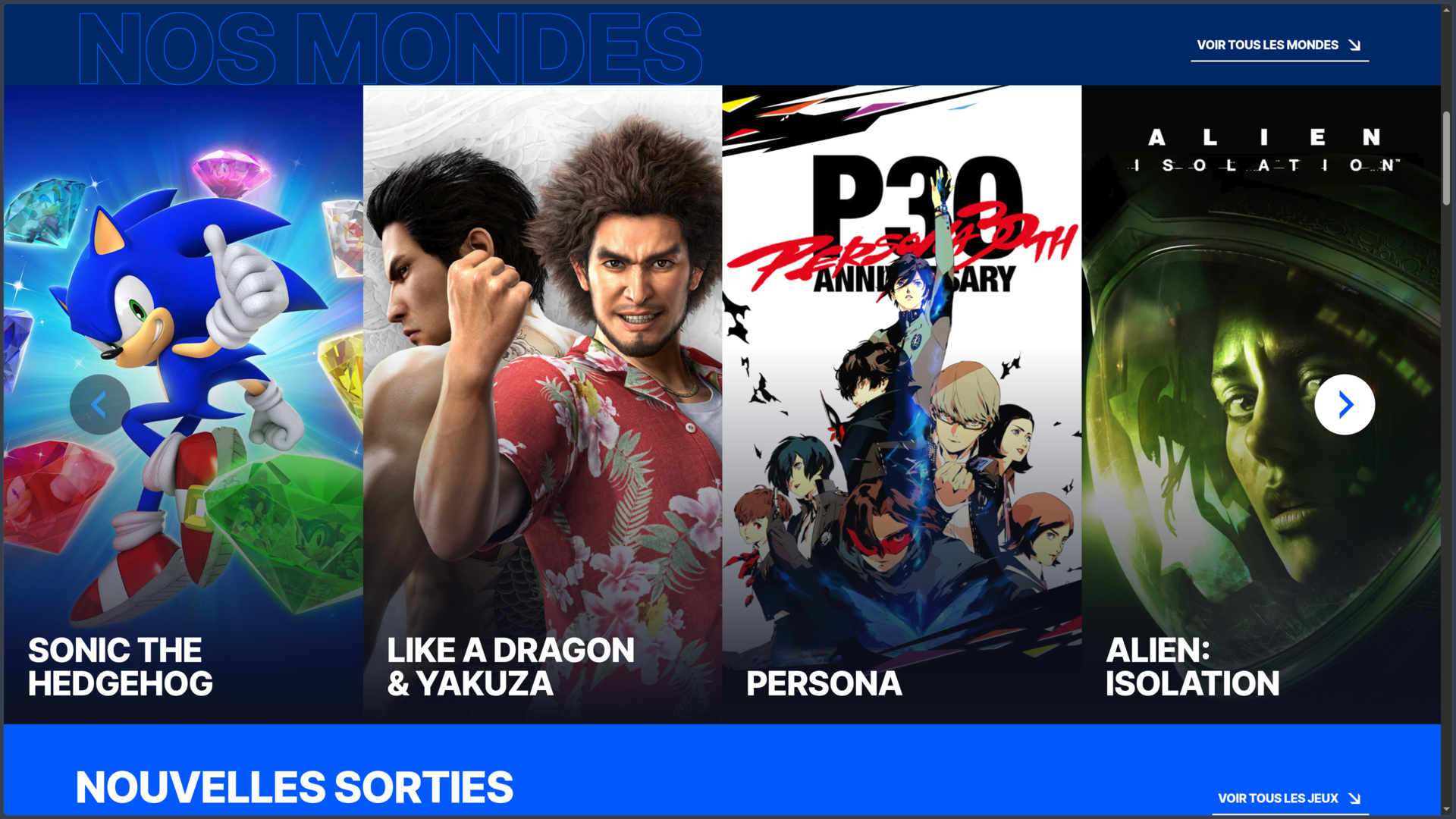
SEGA’s contemporary catalogue therefore rests on several very different families.
Sonic the Hedgehog remains its most immediately recognizable global character.
Like a Dragon, developed by Ryu Ga Gotoku Studio, has become one of the publisher’s major narrative pillars.
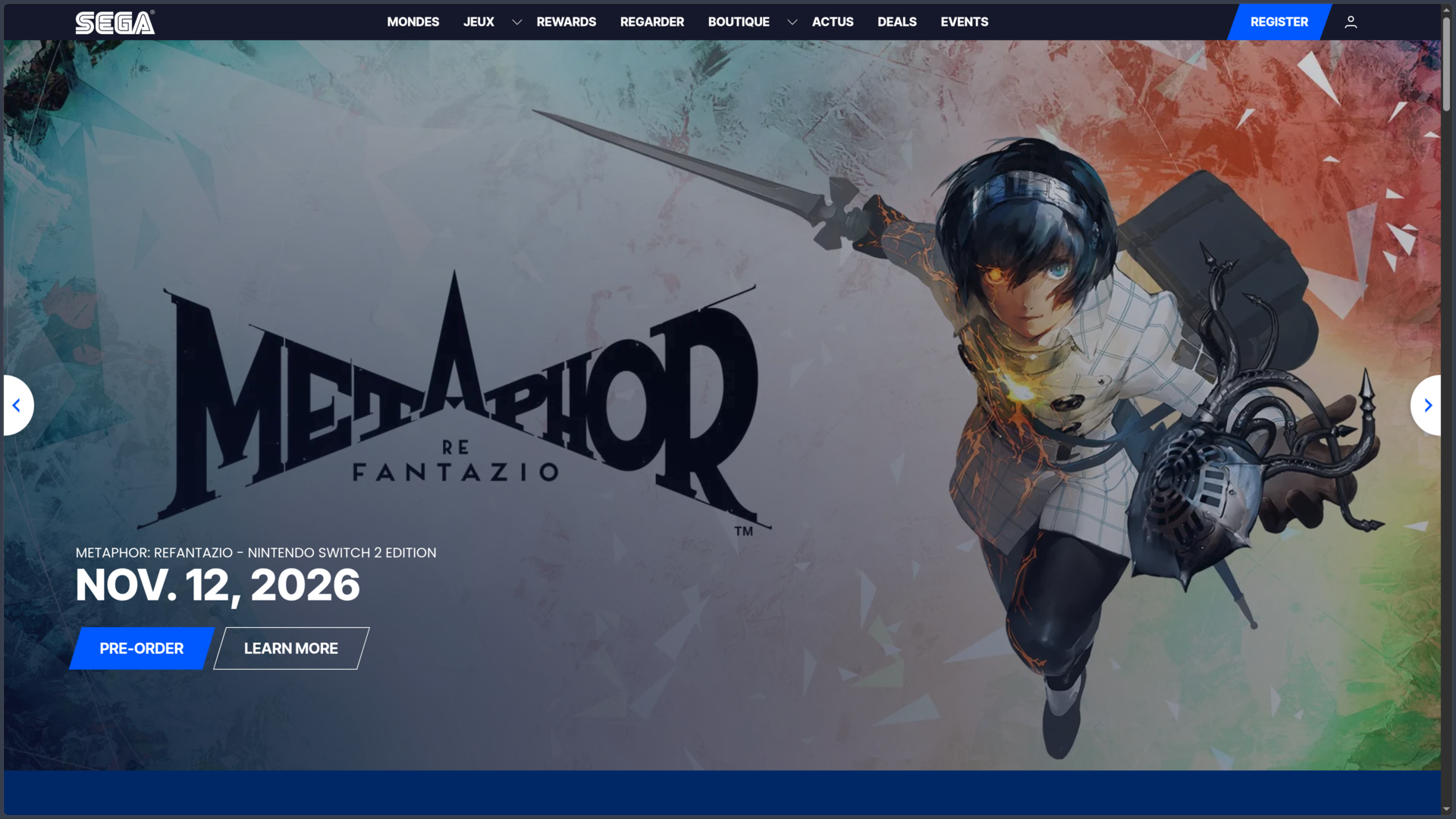
Persona, Shin Megami Tensei and Metaphor: ReFantazio represent Atlus’ activity.
In Europe, Total War and Football Manager occupy very different but particularly enduring positions in strategy and management games.
SEGA also develops Phantasy Star Online, Puyo Puyo, Virtua Fighter and several other historic franchises, while series such as Crazy Taxi, Jet Set Radio, Shinobi and Golden Axe have once again become part of its catalogue revival strategy.
This diversity makes one distinction essential.
SEGA is not the developer of every game it publishes.
A Like a Dragon title is associated with Ryu Ga Gotoku Studio, a Total War game with Creative Assembly, a Football Manager game with Sports Interactive and a Persona game with Atlus.
SEGA’s role can therefore vary between direct development, supervision, funding, publishing, international distribution, marketing and the management of intellectual property.
The company itself has belonged since 2004 to the SEGA SAMMY group, created through the combination of SEGA and Sammy.
SEGA SAMMY HOLDINGS brings together several activities extending far beyond video games, including pachislot, pachinko, animation and other forms of entertainment. SEGA Corporation, the game publisher, should therefore not be confused with the SEGA SAMMY group as a whole.
In 2026, SEGA Corporation has close to 3,000 employees and remains based in Tokyo.
Its contemporary strategy increasingly rests on a combination of major multi-platform games, global franchise management and transmedia development.
Sonic now exists far beyond games through cinema, animation and merchandise. SEGA is gradually applying this logic to other universes while reviving selected historic franchises and strengthening the circulation of its series between Japan, Europe and North America.
More than twenty years after leaving the console market, SEGA is therefore no longer defined by a machine.
Its identity now rests on a catalogue of franchises, studios and very different development cultures, brought together under one global publisher.
History
1960-1982 — From amusement machines to arcades
The company at the origin of SEGA Corporation was officially founded on June 3, 1960 under the name Nihon Goraku Bussan.
It worked in amusement machines and notably produced the SEGA 1000, presented as the first jukebox manufactured in Japan.
In 1965, following a merger with Rosen Enterprises, the company adopted the name SEGA Enterprises.
Arcades gradually became the core of its business.
Periscope, released in the 1960s, achieved international success and helped establish SEGA in the global amusement machine market.
During the following decades, the company developed a culture closely tied to hardware.
This approach became essential in the 1980s, when new technologies made it possible to create increasingly spectacular arcade cabinets.
1983-1990 — From arcades to consoles
In 1983, SEGA released the SG-1000, its first major home console.
The company thus entered directly into a Japanese market that would soon be dominated by Nintendo and its Famicom.
Several systems followed, including the Master System.
But it was the Mega Drive, launched in 1988 in Japan and later under the Genesis name in North America, that truly transformed SEGA’s international position.
The console benefited both from the company’s franchises and from a particularly aggressive commercial strategy in the United States.
SEGA still had one essential problem, however: it lacked a mascot capable of immediately representing its brand.
The answer arrived in 1991.
1991-1998 — Sonic, the Mega Drive and the golden age of SEGA consoles
Sonic the Hedgehog appeared in 1991.
His speed, design and the visual identity of his games quickly made him one of the most famous characters in video game history.
Sonic became inseparable from the Mega Drive and from the competition between SEGA and Nintendo during the 1990s.
But the period was also particularly creative in arcades.
With Virtua Racing and then Virtua Fighter, SEGA contributed to the transition toward 3D polygonal graphics.
Games such as Daytona USA continued this technical experimentation and reinforced the reputation of the company’s arcade teams.
On consoles, SEGA simultaneously developed very different series such as Streets of Rage, Phantasy Star, Shinobi and Panzer Dragoon.
The succession of hardware became more difficult to manage, however.
The Saturn, released in 1994 in Japan, achieved some important successes but struggled more in several Western markets.
SEGA then prepared a new system intended to start again on a new foundation.
1998-2001 — Dreamcast and the end of the console manufacturing business
The Dreamcast launched in Japan in 1998.
Technically ambitious, it notably sought to place online functionality at the center of the console.
Games such as Sonic Adventure, Shenmue, Jet Set Radio, Crazy Taxi and Phantasy Star Online illustrate a particularly creative period.
The quality of the catalogue was not enough, however, to resolve SEGA’s financial difficulties.
The arrival of the PlayStation 2, the significant investment required to maintain a hardware business and several financially difficult years weakened the company.
In 2001, SEGA announced the end of Dreamcast production.
The decision ended nearly twenty years of home console development.
But it did not mean the disappearance of SEGA.
The company completely transformed its business model and began actively publishing its games on PlayStation 2, Xbox, GameCube and PC.
The former console manufacturer became a multi-platform publisher.
2004-2013 — SEGA SAMMY and the construction of an international portfolio
In 2004, SEGA and Sammy came together to create SEGA SAMMY HOLDINGS.
SEGA retained its identity in video games but now operated within a broader entertainment group.
At the same time, the publisher accelerated its international expansion.
In 2005, SEGA acquired Creative Assembly, the British studio behind the Total War series.
That same year, Ryu Ga Gotoku appeared in Japan, later known internationally as Yakuza and then Like a Dragon.
In 2006, SEGA acquired Sports Interactive, developer of Football Manager.
These acquisitions profoundly changed the composition of its catalogue.
SEGA was no longer only a Japanese publisher exporting its creations: it also became the owner of major European studios with their own development cultures.
In 2013, another major step was taken when Atlus joined the SEGA group.
Series such as Persona and Shin Megami Tensei then entered its publishing ecosystem.
2014-2020 — From Japanese franchises to a global network of studios
During the second half of the 2010s, SEGA sought to make better use of its main franchises.
Persona 5 gave Atlus even greater international visibility.
The Yakuza / Like a Dragon series gradually broadened its audience outside Japan, notably through new editions of older installments and an increased presence on PC and Xbox.
Sonic also underwent several transformations, between main games, adaptations and the development of his presence beyond video games.
SEGA continued its acquisitions at the same time.
In 2019, Two Point Studios joined the group following the success of Two Point Hospital.
In 2020, another reorganization brought several Japanese activities closer together under the SEGA Corporation banner.
The company that had once been forced to abandon its consoles now possessed a catalogue very different from the Dreamcast era: Japanese games, Western strategy, management, RPGs, mobile titles and historic franchises coexisted within the same group.
2021-2026 — Globalizing franchises, Rovio and the return of SEGA’s heritage
At the beginning of the 2020s, SEGA strengthened a strategy increasingly centered on the globalization of its intellectual properties.
The success of the Sonic the Hedgehog films notably demonstrated that a game franchise could become a much broader entertainment brand.
The company therefore developed a stronger transmedia strategy combining games, cinema, animation, merchandise and partnerships.
In 2023, SEGA acquired Rovio Entertainment, the Finnish company behind Angry Birds.
The operation brought the group much greater expertise in mobile gaming and a brand already known worldwide beyond video games.
At the same time, SEGA began reviving part of its heritage.
New projects were announced around Crazy Taxi, Jet Set Radio, Shinobi, Golden Axe and Streets of Rage, while Virtua Fighter also regained an important place in the publisher’s plans.
This strategy does not simply consist of reproducing the old games.
SEGA seeks to transform historic names into franchises once again capable of existing in the contemporary global market.
Its already active series remain essential in parallel.
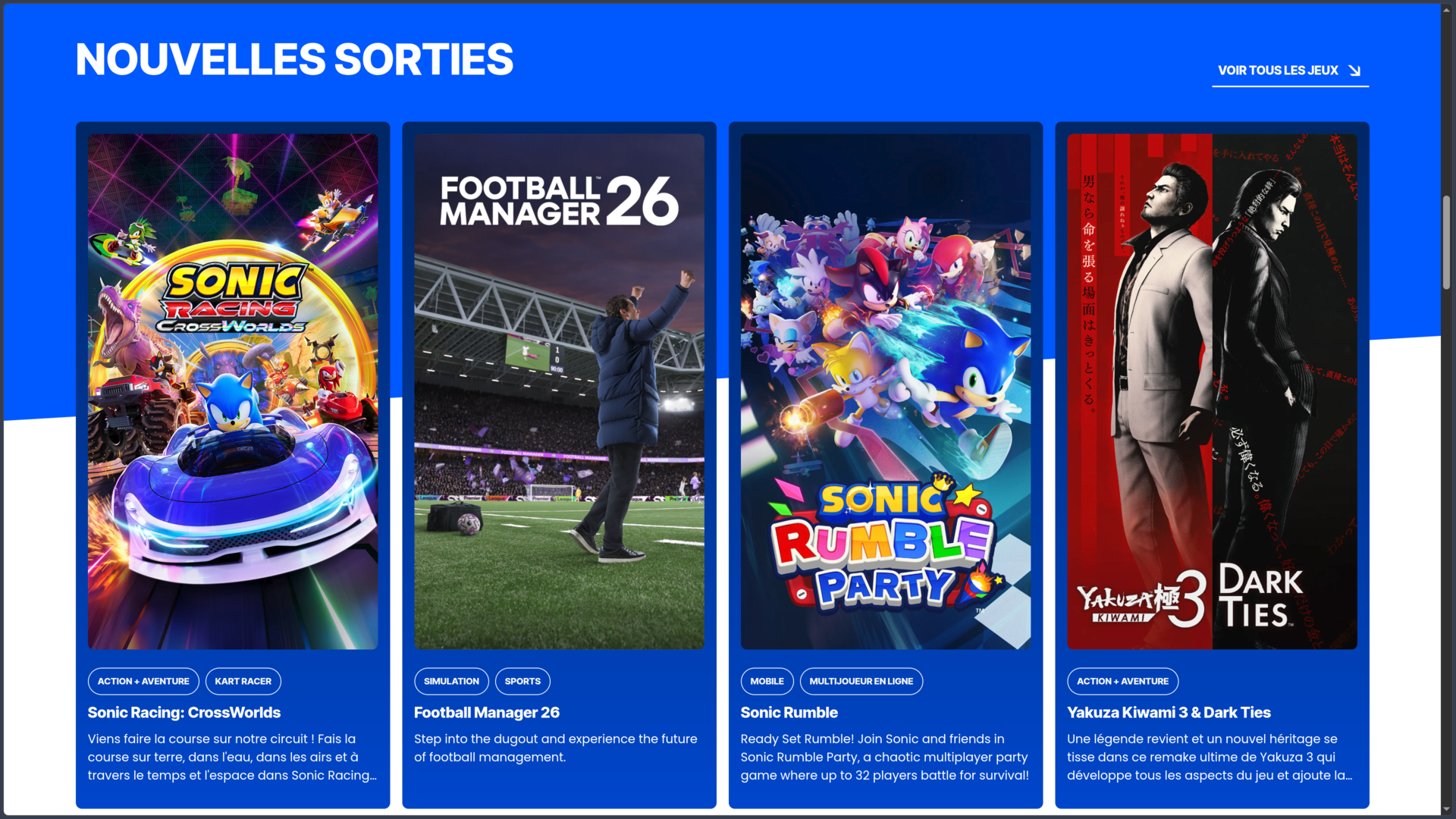
Like a Dragon multiplies its projects, Sonic continues its development with games such as Sonic Frontiers and later Sonic Racing: CrossWorlds, while Atlus achieves several international successes with Persona and Metaphor: ReFantazio.
Creative Assembly continues Total War, Sports Interactive Football Manager and Two Point Studios develops its own management games.
In 2026, this diversity now represents SEGA’s main identity.
The company that once tried to establish its own console now seeks to circulate its universes across as many relevant platforms, markets and media as possible.
What sets it apart
Having been an arcade company, a console manufacturer and a publisher
Few current publishers have a comparable history.
SEGA manufactured arcade cabinets, created its own consoles, directly challenged Nintendo in the hardware market and then abandoned that activity to become a multi-platform publisher.
These different periods remain visible in its identity.
Arcades explain part of its historic taste for immediately spectacular games and technical innovation.
Consoles created franchises such as Sonic.
The post-Dreamcast period taught the company how to develop and publish for ecosystems it no longer controls itself.
The current SEGA is the result of these three successive histories.
Owning a catalogue built in both Japan and Europe
SEGA has a particularly international organization.
Its Japanese teams are associated with Sonic, Like a Dragon, Phantasy Star, Puyo Puyo and Virtua Fighter.
Atlus retains its own identity around Persona, Shin Megami Tensei and Metaphor.
In Europe, Creative Assembly develops Total War, Sports Interactive develops Football Manager, Two Point Studios develops its management games and Rovio notably contributes Angry Birds and its mobile expertise.
Almost none of these productions resemble one another.
The strength of SEGA’s catalogue therefore comes less from a single genre than from the coexistence of several development cultures.
Keeping franchises alive across several decades
Some SEGA properties span several generations of players.
Sonic has existed since 1991.
Phantasy Star dates back to the 1980s.
Virtua Fighter, Puyo Puyo and series originating in the arcade business also have several decades of history.
SEGA alternates between continuity, periods of absence and revival.
This depth of catalogue now gives it a particular advantage: the company does not depend solely on creating new brands and can return to a large number of historic universes.
Moving from the console wars to a multi-platform approach
The contrast is particularly striking.
In the 1990s, SEGA tried to convince players to buy its own machine.
Since 2001, the objective has almost been the opposite: making its games available on as many relevant platforms as possible.
PlayStation, Xbox, Nintendo and PC can now receive the same major SEGA productions simultaneously or progressively.
This transformation is probably the most important in its entire industrial history.
Gradually turning its games into entertainment brands
SEGA’s contemporary strategy increasingly goes beyond the games themselves.
Sonic is the clearest model, with films, series, merchandise and international collaborations.
The group is now seeking to apply this approach to more franchises.
This explains both the return of older names and adaptations around properties such as Like a Dragon, Golden Axe and Crazy Taxi.
For SEGA, a franchise is therefore no longer necessarily just a series of games: it can become the starting point for a broader range of content and products.
Good to know
- SEGA Corporation was officially founded on June 3, 1960 in Japan, before adopting the SEGA Enterprises name in 1965.
- The company began primarily in amusement machines and arcades before entering the console market with the SG-1000 in 1983.
- The Mega Drive / Genesis and the creation of Sonic the Hedgehog in 1991 made SEGA one of Nintendo’s main competitors during the 1990s.
- SEGA later released the Saturn and then the Dreamcast, before ending production of the latter in 2001 and becoming a multi-platform publisher.
- Since 2004, SEGA has operated within SEGA SAMMY HOLDINGS; SEGA Corporation and SEGA SAMMY therefore do not refer to exactly the same structure.
- The gaming group notably includes Atlus, Creative Assembly, Sports Interactive, Two Point Studios and Rovio, while several series are developed directly by SEGA’s Japanese teams.
- SEGA is not the developer of every game it publishes: Total War, Football Manager and Persona, among others, retain their own studios and identities.
- As of March 2026, SEGA Corporation has 2,922 employees; Haruki Satomi serves as Chairman and CEO and Shuji Utsumi as President and COO.