Several millennia after the creation of the Great Vortex, originally designed to repel the forces of Chaos, the immense magical maelstrom dominating Ulthuan begins to lose its stability. As the world once again risks falling into catastrophe, several powers seek to influence its fate. Prince Tyrion leads the High Elves in an attempt to stabilize the Vortex, while the Slann Mage-Priest Mazdamundi mobilizes the Lizardmen to fulfill the designs of the Old Ones. From Naggaroth, the Witch King Malekith sees the weakening of the Vortex as an opportunity to pursue his own ambitions. Beneath the surface, the Skaven also begin to move. Each of these powers seeks to gather the resources required for powerful rituals capable of influencing the Great Vortex while preventing its rivals from reaching their objective first.
Total War: Warhammer II
- Creative Assembly Developer
- SEGA Publisher
- Sega Games Publisher
Four powers enter a ritual race where conquering the world is no longer enough to secure victory.
Details
- Type
- Video game
- Release
- 2017-09-28
- Genres
- Action, Fantasy, Strategy, Real-time strategy
- Platforms
- PC, Mac, Linux
- Engine
- TW Engine 3
- Game modes
- Single player, Multiplayer, Co-operative
Synopsis
Total War: Warhammer II


Trailer
Watch the trailer
Overview
Presentation
Total War: Warhammer II retains the alternation between turn-based strategy and real-time tactical battles established by the first game, but shifts its focus toward new regions of the Warhammer world. The main campaign notably explores Ulthuan, Naggaroth, Lustria and the Southlands, with four new playable races at launch and a narrative structure centered on the Great Vortex.
On the campaign map, players continue to develop settlements, construct buildings, recruit armies, research technologies and manage diplomacy, economy and territorial expansion. Pure conquest, however, is no longer the only driving force behind the main campaign. The major factions take part in a race to control the Great Vortex, introducing objectives that run alongside traditional warfare.
Progress is built around a series of rituals. Each race must accumulate a specific ritual resource before it can begin the next stage. Once a ritual starts, several settlements become critical sites that must be protected for a number of turns. Forces of Chaos may then appear to attack them, while rival powers can also attempt to disrupt the operation.
Players can respond to an opponent's progress by sending intervention armies to interfere with their rituals. The campaign therefore introduces a form of indirect competition: a faction can become a threat even from the other side of the map simply because it is advancing more quickly in the race for the Vortex.
At launch, four major races structure the campaign: the High Elves, Dark Elves, Lizardmen and Skaven. Each has its own armies, Legendary Lords, technologies and campaign systems. This asymmetry deepens a direction already established in the first Total War: Warhammer: choosing a different race is not simply a matter of replacing one set of units with another.
The High Elves field versatile armies that notably include powerful ranged units, elite warriors and several fantastical creatures. Their campaign also uses an Influence system, which can affect diplomatic relations and be spent to recruit certain characters with distinctive traits.
The Dark Elves favor a more aggressive approach and notably use slaves as an economic resource. Their Black Arks support maritime operations and campaigns conducted far from home territory. On the battlefield, their Murderous Prowess mechanic rewards armies once enough casualties have been inflicted during an engagement.
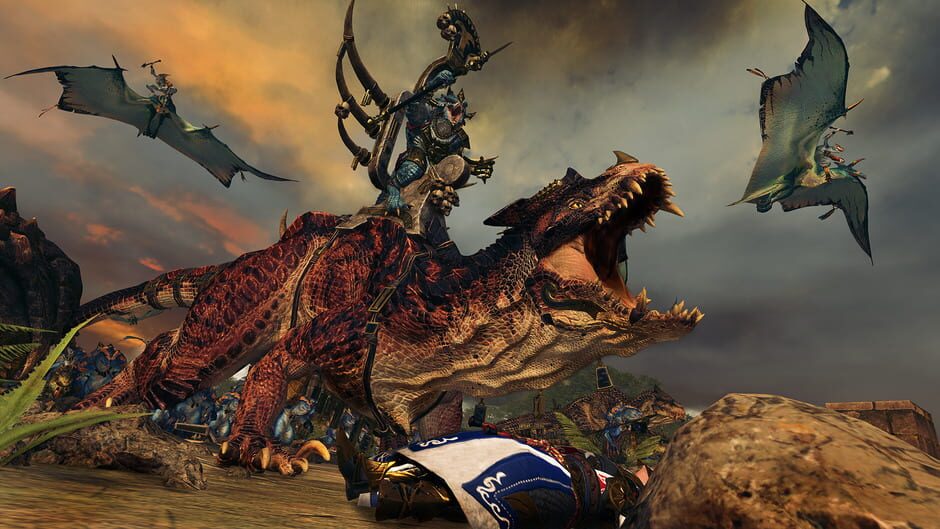
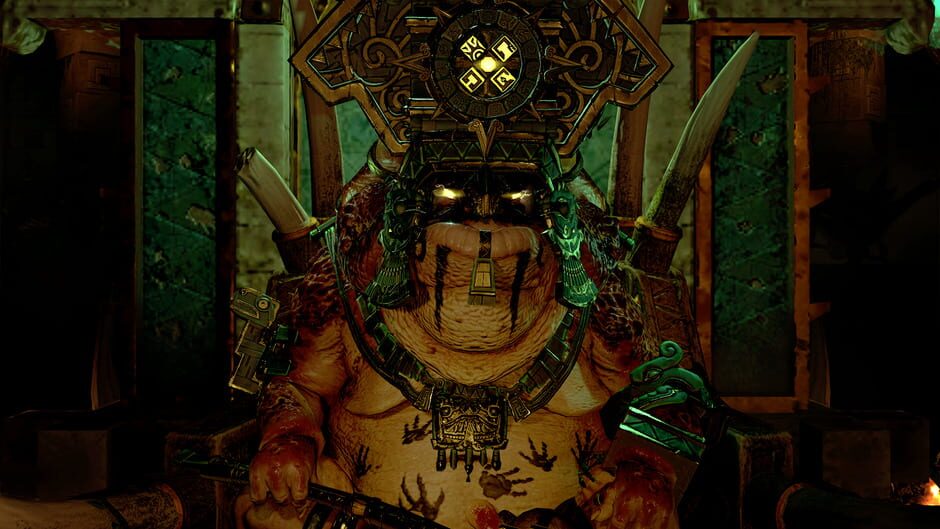
The Lizardmen combine resilient Saurus formations with imposing creatures and dinosaurs capable of disrupting enemy lines. Their territorial development notably relies on the Geomantic Web, whose effectiveness depends on the connections established between controlled provinces.
The Skaven follow an even more distinctive logic. Their settlements can appear as simple ruins to other factions until they are discovered, allowing part of their expansion to remain concealed. Their military economy must also account for Food, while their armies combine large numbers of expendable troops, war machines and Warpstone-powered technology.
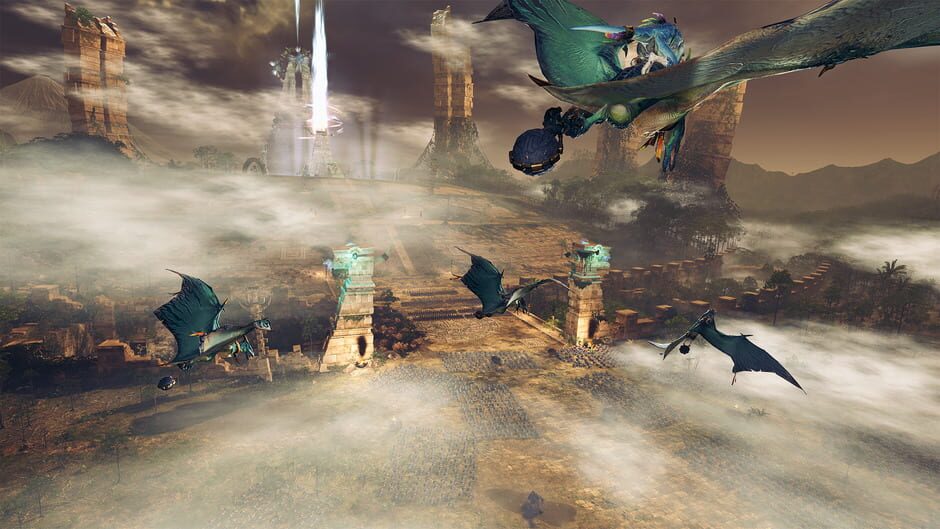
Battles retain the spectacular structure of the first game: large formations, cavalry, ranged troops, magic, monsters, flying units and Lords fight simultaneously. The new races nevertheless introduce their own silhouettes and tactical identities, from the dragons and creatures of Ulthuan to the dinosaurs of Lustria and Skaven war machines.
Legendary Lords remain at the heart of the campaigns. Eight are available across the four launch races, with different starting positions, bonuses and strategic orientations. They gain experience, develop skills and can follow quest chains leading to unique pieces of equipment.
Alongside this narrative campaign is Mortal Empires, added after launch for owners of both Total War: Warhammer and Total War: Warhammer II. This campaign combines a large portion of the territories and races from both games on a shared map and replaces the Vortex race with a structure more focused on free conquest.
Key points
- A combination of turn-based strategic campaigning and real-time tactical battles.
- A new map centered notably on Ulthuan, Naggaroth, Lustria and the Southlands.
- Four major playable races at launch: High Elves, Dark Elves, Lizardmen and Skaven.
- A narrative campaign built around the race for the Great Vortex.
- Rituals requiring specific resources and several turns to complete.
- Ritual sites that must be defended against Chaos and rival factions.
- Intervention armies that can be sent to disrupt an opponent's progress.
- Strongly differentiated race-specific campaign mechanics: Influence, slaves, the Geomantic Web and Food.
- Battles combining traditional formations, magic, monsters, flying units and powerful characters.
- Eight Legendary Lords distributed among the four main races at launch.
- The Mortal Empires campaign later combines the territories and races of the first two games for players who own both titles.
- Single-player, multiplayer and cooperative modes.
Conclusion
Total War: Warhammer II develops the formula of the first game by placing greater emphasis on campaign-specific objectives. The race for the Great Vortex requires players to monitor not only territorial expansion, but also rival progress, the resources needed for rituals and the defense of several strategic locations while those rituals are underway.
The four launch races also deepen the series' asymmetry. High Elves, Dark Elves, Lizardmen and Skaven do not merely field different armies: their economies, campaign systems and strategic priorities genuinely change the way a campaign is approached.
With Mortal Empires, the game also gains a second campaign structure focused more heavily on free conquest and encounters between the races of the first two entries. Warhammer II therefore functions both as a standalone sequel and as a progressive expansion of the larger experience built across the trilogy.
Good to know
Total War: Warhammer II was developed by Creative Assembly and published by Sega. It was originally released in 2017 for Windows, before being adapted for macOS and Linux by Feral Interactive.
It is the second entry in the Total War: Warhammer trilogy and directly follows Total War: Warhammer.
At launch, its main campaign features four races and eight Legendary Lords: High Elves, Dark Elves, Lizardmen and Skaven. Many additional factions and characters were later added through free and paid downloadable content.
The Mortal Empires campaign requires ownership of the first two Total War: Warhammer games. It combines their territories and allows players to use the races they own in a single large-scale campaign.
Over the course of its support, Total War: Warhammer II received numerous updates and expansions that greatly enriched its races and mechanics. This entry therefore focuses mainly on the game's own foundations and the Great Vortex campaign without indiscriminately attributing every later addition to the original release.
Total War: Warhammer II was followed in 2022 by Total War: Warhammer III, the third entry in the trilogy.