Overview
Creative Assembly is a British video game development studio founded in 1987 and primarily based in Horsham, West Sussex. It also has a major team in Sofia, Bulgaria.
The company is legally named The Creative Assembly Limited, but communicates publicly under the Creative Assembly brand.
Its identity is now inseparable from Total War.
Since Shogun: Total War in 2000, the series has combined two scales of play: a turn-based strategic campaign, where the player manages territories, armies, economy and diplomacy, followed by real-time battles sometimes involving thousands of soldiers.
This combination gradually became the studio’s specialty.
Creative Assembly explores different historical periods through Medieval, Rome, Empire, Napoleon, Shogun 2, Three Kingdoms and Pharaoh, but also extends its formula into fantasy through its collaboration with Games Workshop on Total War: Warhammer.
The move into Warhammer represents a major evolution.
The studio no longer has to adapt only historical armies and contexts: it translates into strategy systems a wide variety of factions, gigantic creatures, magic and rules drawn from an already highly developed tabletop universe.
The Total War: Warhammer trilogy therefore became one of Creative Assembly’s contemporary pillars without replacing the historical branch of the series.
The studio is not exclusively devoted to Total War, however.
In 2014, Alien: Isolation demonstrated a radically different side of the team. The game abandons armies and strategy in favor of a first-person survival horror experience built around vulnerability, exploration and a Xenomorph capable of adapting its behavior.
This production remains important in Creative Assembly’s history because it shows that the studio can build a strong identity outside its usual field.
A few years later, Creative Assembly also worked with 343 Industries on Halo Wars 2, this time applying its strategy expertise to the Halo universe.
These different projects do not, however, challenge the central role of Total War.
The series has gradually become a collection of branches able to operate in parallel: major historical entries, Warhammer games, more focused projects and continued updates to existing titles.
Creative Assembly also operates across several locations.
The main Horsham studio remains at the center of many productions, while Creative Assembly Sofia contributes to the Total War series and notably developed A Total War Saga: Troy and later Total War: Pharaoh.
The presence of several teams allows the studio to maintain different projects and ongoing support simultaneously, with increasingly important collaboration between the United Kingdom and Bulgaria.
Since 2005, Creative Assembly has belonged to SEGA.
The studio retains its name, teams and own development licenses, but forms part of the Japanese publisher’s Western network alongside structures such as Sports Interactive and Two Point Studios.
This relationship gives Creative Assembly a particular position within SEGA’s organization: it is one of the publisher’s main Western centers focused on PC games and strategy.
In 2026, the studio is entering a new period in its history.
After celebrating twenty-five years of Total War in 2025, Creative Assembly is preparing several major productions.
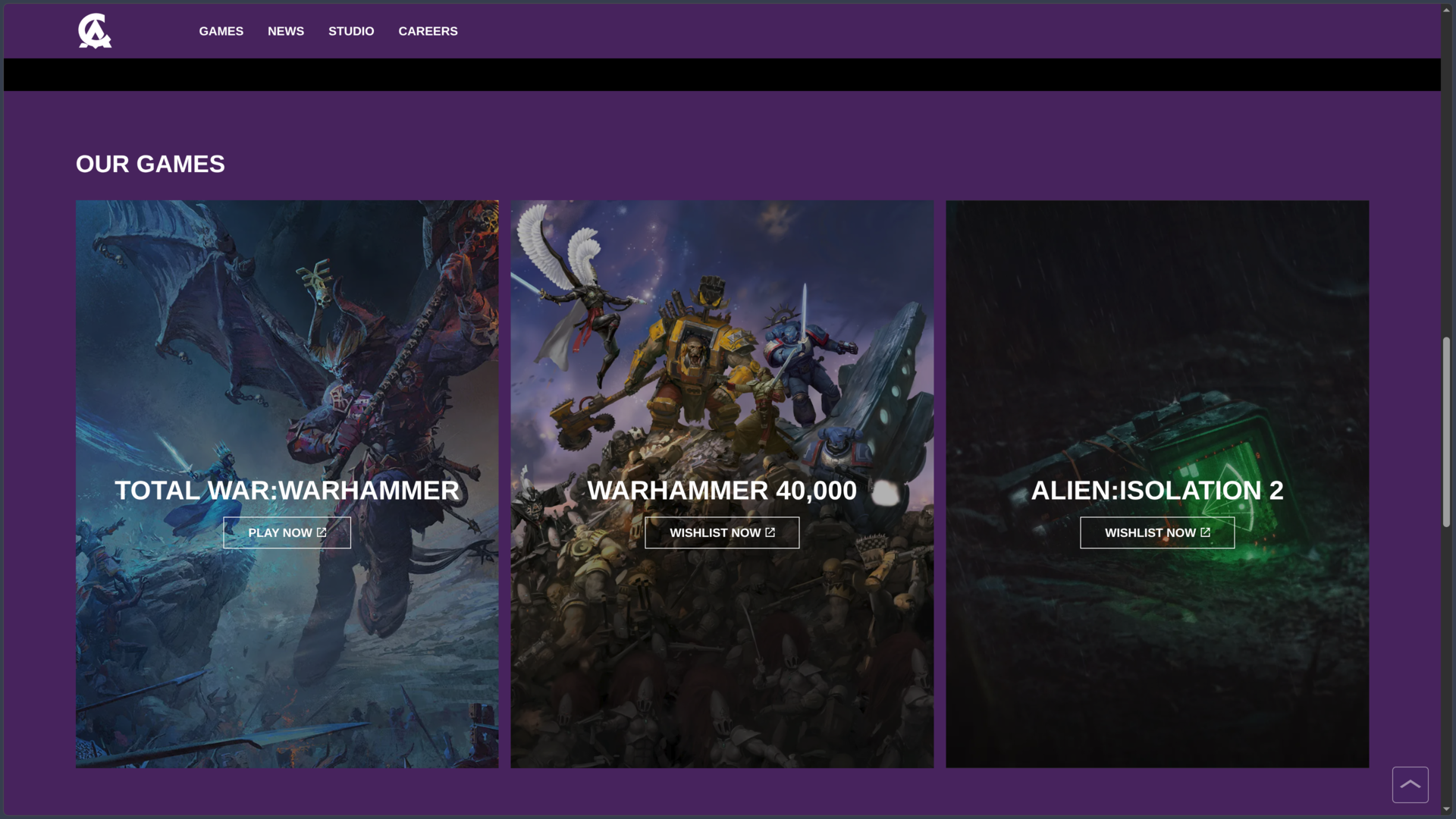
Total War: MEDIEVAL III marks the announced return to one of the series’ most requested historical settings.
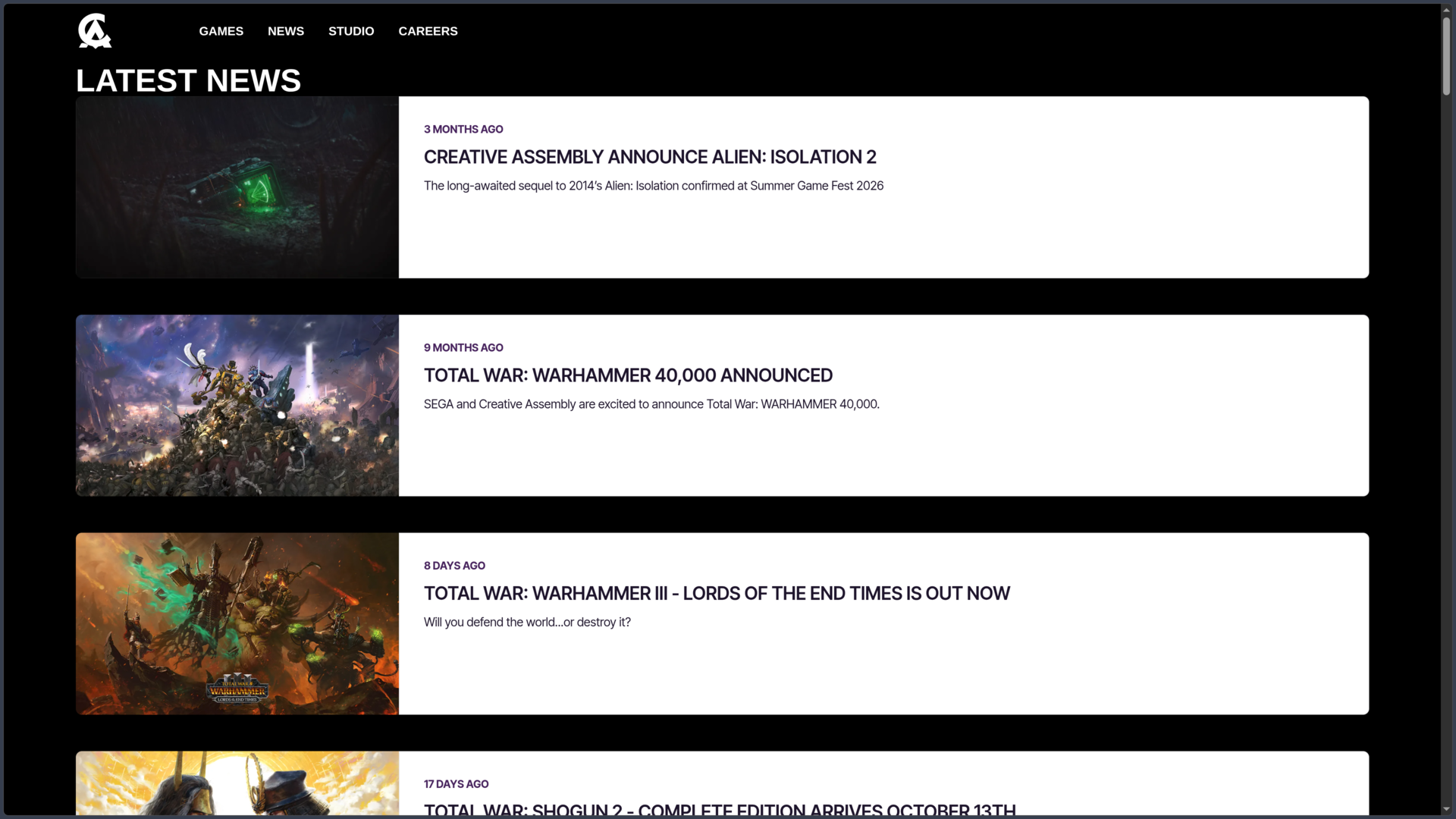
Total War: WARHAMMER 40,000 brings the core Total War formula into Games Workshop’s futuristic universe for the first time and is also expected to expand the series to PlayStation 5 and Xbox Series X|S alongside PC.
At the same time, a dedicated team is working on Alien: Isolation 2, a new survival horror production developed with 20th Century Studios.
These projects summarize contemporary Creative Assembly well: a studio still built around highly specific expertise in large-scale strategy, but capable of dedicating some teams to completely different experiences.
History
1987-1999 — Ports, sports games and building technical expertise
Creative Assembly was founded in 1987 in the United Kingdom.
During its early years, the studio worked notably on adaptations and ports of games for different platforms.
It later developed an important relationship with Electronic Arts, particularly around sports productions.
Creative Assembly contributed notably to games related to football, rugby and cricket.
This period may seem far removed from Total War, but it gradually allowed the team to build its own tools, 3D expertise and a structure stable enough to undertake a more personal project.
By the end of the 1990s, the studio had begun developing a strategy game set in feudal Japan.
That project became Shogun: Total War.
2000-2004 — The birth of Total War
Shogun: Total War was released in 2000.
The game combines a strategic campaign map with real-time battles featuring large numbers of units.
This link between large-scale decision-making and direct army command immediately established the foundations of the series.
Creative Assembly continued the idea with Medieval: Total War, followed by Rome: Total War.
Each installment expanded the campaigns, improved the representation of armies and strengthened the political, diplomatic and economic dimensions.
A studio that had previously produced various games for other publishers gradually became identifiable with a franchise it had created itself.
Total War became its central activity.
2005-2013 — SEGA acquisition and consolidation of the series
In 2005, SEGA acquired Creative Assembly.
The studio joined the Japanese group while continuing its development work in the United Kingdom.
This period saw Total War explore several directions.
Medieval II: Total War returned to the Middle Ages, while Empire: Total War expanded the series to a map spanning several continents and significantly developed naval combat.
Napoleon: Total War then narrowed the experience around the Napoleonic campaigns.
In 2011, Total War: Shogun 2 returned to Japan and revisited the setting of the very first installment with more than a decade of technical and game-design evolution.
Creative Assembly thus consolidated a method based on preserving the core principles of the series while regularly rebuilding systems according to the period being represented.
2013-2017 — Warhammer, Alien and diversification
The early 2010s opened a particularly important period of diversification.
Creative Assembly entered into a partnership with Games Workshop to work on the Warhammer universe.
This collaboration resulted in Total War: Warhammer in 2016.
The game applies the Total War structure to fantasy armies whose units, heroes and mechanics can differ radically from one another.
The success of the project led to a trilogy and a lasting collaboration with Games Workshop.
In the meantime, Creative Assembly developed Alien: Isolation, released in 2014.
The project is almost the opposite of Total War.
Where the strategy series gives players control of empires and entire armies, Alien places a vulnerable character in confined environments against a threat that cannot simply be eliminated.
This ability to move from strategy on a very large scale to an extremely focused survival horror experience became one of the clearest examples of the studio’s range.
In 2017, Creative Assembly also co-developed Halo Wars 2 with 343 Industries, once again applying its strategy expertise to a major external franchise.
2017-2024 — Sofia and the multiplication of Total War branches
Creative Assembly gradually expanded its presence in Sofia, Bulgaria.
This team took an increasingly important role within Total War.
It worked notably on content for different entries before taking charge of A Total War Saga: Troy, followed by Total War: Pharaoh.
The main series continued in parallel with productions such as Total War: Three Kingdoms and the Total War: Warhammer trilogy.
The very concept of Total War expanded.
Some games remained centered on major historical periods, others explored more focused conflicts, while Warhammer introduced continuity built across several games and extensive additional content.
The studio therefore had to manage a franchise that was no longer simply a linear succession of independent titles, but a broader set of productions developed and maintained simultaneously.
2025-2026 — A new generation of Total War and the return of Alien
In 2025, Creative Assembly celebrated 25 years of Total War.
The event also served to prepare a new phase for the series.
Total War: MEDIEVAL III was announced as a return to medieval historical strategy and entered pre-production.
A few days later, Total War: WARHAMMER 40,000 was revealed.
The move from Warhammer Fantasy to the 41st millennium represents a major transformation: futuristic armies, vehicles, ranged weapons and a galactic scale must be integrated into a formula historically built around land battles and territorial empires.
In 2026, Creative Assembly also officially confirmed Alien: Isolation 2.
More than ten years after the first game, a dedicated team is therefore returning to survival horror with a new protagonist, a new environment and a new confrontation with the Xenomorph.
The same year, the studio also continued working with its own legacy through a new edition of Total War: Shogun 2 adapted for modern PC platforms.
Creative Assembly therefore enters its fourth decade with three clearly visible directions: evolving historical Total War, expanding the series into new universes and maintaining a development branch capable of existing outside strategy.
What sets it apart
Combining turn-based strategy and real-time battles
The fundamental identity of Total War is built around the coexistence of two levels of decision-making.
The campaign asks players to manage territories, economy, diplomacy, recruitment and army movements.
Battles then shift into real time and allow direct command of the units present on the battlefield.
This structure has existed since Shogun: Total War and remains the defining principle of the series more than twenty-five years later.
Creative Assembly has built much of its expertise around this ability to connect empire management and military tactics.
Representing very large battles while giving factions their own identity
Total War has to manage large numbers of units simultaneously without making armies interchangeable.
Depending on the installment, differences are based on historical period, military organization, resources, politics or characters.
Warhammer pushes this logic even further.
A human army, Skaven, Dwarfs or Chaos forces are no longer distinguished only by statistics: their structure, units and sometimes even their campaign systems operate according to very different rules.
This search for variety gradually became as important as the scale of the battles themselves.
Being specialized without being trapped in one genre
Creative Assembly is primarily associated with strategy.
Yet Alien: Isolation demonstrates that this specialization does not define every one of its teams.
The survival horror game relies on almost the opposite principles of Total War: isolation, lack of control, confined spaces and an individual threat.
Halo Wars 2 represents another form of diversification, applying the studio’s strategy expertise to a universe and platforms different from its usual environment.
The studio can therefore move outside Total War without trying to erase what remains its main field of expertise.
Making history and licensed universes coexist
Creative Assembly develops Total War from two very different sources.
Part of the catalog seeks to interpret historical periods: feudal Japan, ancient Rome, the Middle Ages, the eighteenth century or Three Kingdoms China.
Another part works with established universes such as Warhammer.
The studio must therefore adapt its methods.
History requires work around real armies, contexts and cultures, while a fantasy license requires close collaboration with its owner in order to translate its lore into playable systems.
The coexistence of these two approaches has now become an essential component of Total War.
Good to know
- Creative Assembly was founded in 1987 in the United Kingdom, and its main headquarters are now located in Horsham.
- Its legal name is The Creative Assembly Limited, while Creative Assembly is the brand used publicly.
- The studio created Total War with Shogun: Total War in 2000.
- SEGA acquired Creative Assembly in 2005; the studio has since been part of the publisher’s Western development group.
- Creative Assembly also has a major presence in Sofia, Bulgaria, which directly contributes to Total War development.
- The studio is mainly known for Total War, but also developed Alien: Isolation and co-developed Halo Wars 2 with 343 Industries.
- In 2025, the Total War series surpassed 48.3 million copies sold and celebrated its twenty-fifth anniversary.
- In 2026, Creative Assembly is notably working on Total War: MEDIEVAL III, Total War: WARHAMMER 40,000 and Alien: Isolation 2.