In an age of endless conquest, thousands of warriors clash while entire peoples fight for domination of the Old World under the command of powerful leaders. Karl Franz gathers the forces of the Empire and seeks to unite the Elector Counts against their common enemies. The Greenskins, Orcs and Goblins hungry for battle, rally around Grimgor Ironhide. High King Thorgrim leads the Dwarfs out of their mountain strongholds to right the wrongs accumulated over millennia, while Mannfred von Carstein commands the Vampire Counts and their armies raised from the dead. As the Old World tears itself apart through war, betrayal and uncontrolled power, an even greater threat begins to stir in the north, and reality itself appears to buckle.
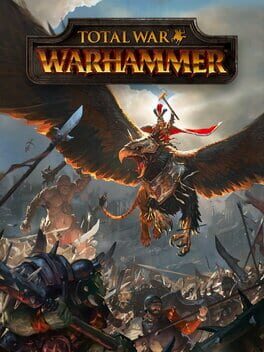
Video game
2016
Action
Fantasy
RPG
Strategy
Tactical
Real-time strategy
Total War: Warhammer
- Creative Assembly Developer
- Feral Interactive Publisher
- SEGA Publisher
- Sega Games Publisher
The Old World becomes a vast battlefield where empires, monsters and magic clash for domination.
Details
- Type
- Video game
- Release
- 2016-05-24
- Genres
- Action, Fantasy, RPG, Strategy, Tactical, Real-time strategy
- Platforms
- PC, Mac, Linux
- Engine
- TW Engine 3
- Game modes
- Single player, Multiplayer, Co-operative
Synopsis
Total War: Warhammer


Trailer
Watch the trailer
Overview
Presentation
Total War: Warhammer brings the strategic structure of the Total War series into the universe of Warhammer Fantasy Battles. The game retains its fundamental principle: a large turn-based campaign focused on managing territory and armies, interrupted by real-time tactical battles whenever opposing forces meet.
On the campaign map, the player controls a faction across the Old World. Settlements are developed, buildings constructed, troops recruited, armies moved, technologies researched and relations managed with other powers. Diplomacy, trade and warfare all contribute to progression, where military expansion must remain compatible with the resources needed to maintain armies and develop territories.
Each army is led by a Lord, while heroes can also operate on the campaign map or join forces in battle. Certain iconic characters from the setting appear as Legendary Lords, including Karl Franz, Grimgor Ironhide, Thorgrim and Mannfred von Carstein. As they progress, they can develop different skills, while specific quest chains may lead to equipment associated with their history.
The main playable races feature strongly differentiated systems. The Empire combines several troop types and operates within a fragmented political environment; the Dwarfs rely on resilient units, ranged power and fortified strongholds; the Greenskins bring Orcs and Goblins together in armies geared toward constant warfare; while the Vampire Counts command forces made up largely of the undead. These differences affect not only the available units, but also certain campaign mechanics and the way battles are fought.
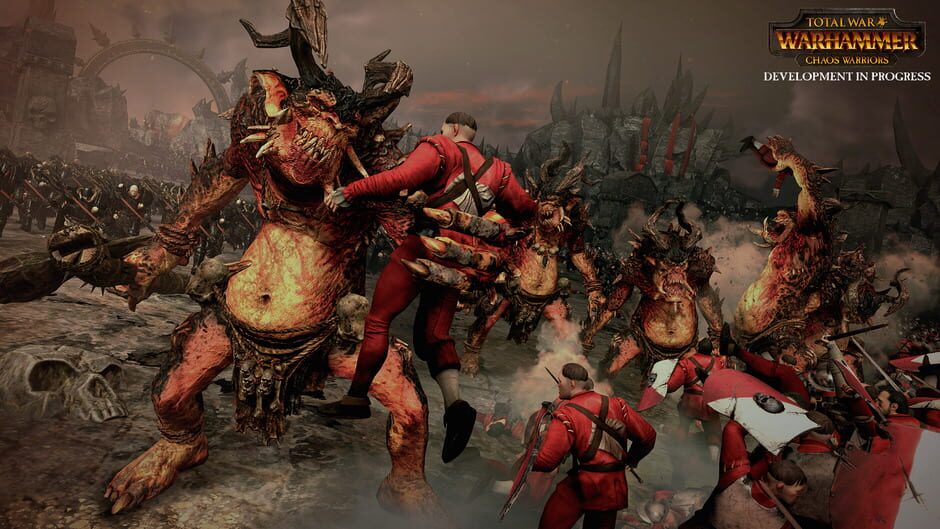
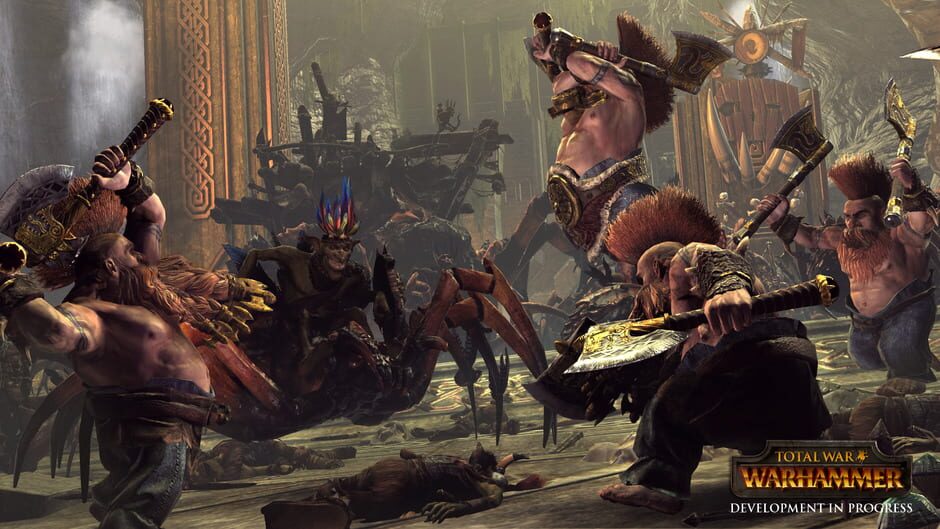
When an army encounters an opponent, the game shifts into a real-time battle where numerous units fight simultaneously. Infantry, cavalry, ranged units and war machines must be organized according to the terrain and the forces involved. Positioning, flanking, maintaining battle lines and exploiting morale remain fundamental, but the Warhammer setting introduces possibilities absent from historical Total War games.
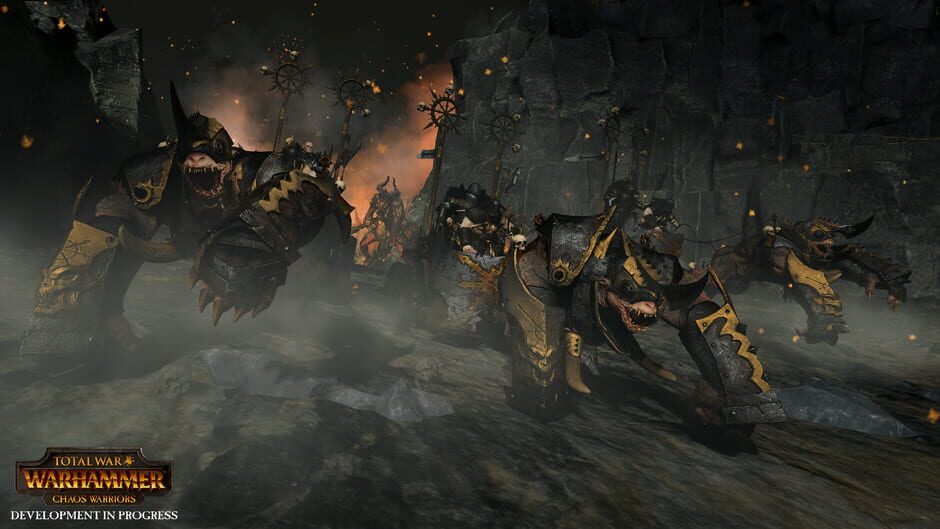
Battlefields can therefore feature giant creatures, flying units and characters capable of directly engaging enemy troops. Dragons, griffons and other monsters change the scale of combat, while certain units can bypass usual terrain constraints by fighting from the air. Battles can no longer be approached solely through conventional military formations.
Magic represents another major transformation. Certain Lords and heroes can cast spells capable of damaging formations, strengthening allies or disrupting enemy organization. Their use must be integrated into the rest of the battle: a well-placed spell can temporarily alter the balance of an engagement, but remains tied to the caster's available resources and abilities.
Campaign and battles are directly connected. An army weakened on the battlefield remains diminished when it returns to the strategic map, while capturing a settlement immediately changes territorial control. Players can also choose to automatically resolve certain encounters, but manually fought battles provide direct control over deployment and troop movements.
Finally, quest battles provide more scripted encounters associated in particular with Legendary Lords. They impose specific situations and opponents and are integrated into quest chains that develop certain characters and lead to unique items.
Key points
- A combination of turn-based strategic campaigning and real-time tactical battles.
- A campaign map where players manage territories, settlements, economy, recruitment, technology and diplomacy.
- Races with strongly differentiated units, mechanics and playstyles.
- Legendary Lords who command armies, progress and follow specific quest chains.
- Heroes capable of acting both on the strategic map and on the battlefield.
- The introduction of magic into Total War battles.
- Monsters and flying units that fundamentally change combat compared with the historical entries.
- Massive battles where formations, terrain, morale and maneuvering remain essential.
- More scripted quest battles tied to certain characters and equipment.
- Single-player, multiplayer and cooperative modes offering different ways to experience campaigns and battles.
Conclusion
Total War: Warhammer retains the alternation between strategic management and tactical battles that defines the series, but the Warhammer universe transforms the possibilities available at both levels. Differences between factions no longer depend solely on their military compositions: they also influence the campaign, their characters and the way they develop and use their armies.
On the battlefield, the presence of magic, giant creatures, flying units and Lords capable of directly taking part in combat expands a formula that had previously been built mainly around historical warfare. The game therefore combines Total War's large-scale territorial management with the military and fantastical characteristics of the Old World.
Good to know
Total War: Warhammer was developed by The Creative Assembly and released in 2016 on PC, before also becoming available on Mac and Linux.
The game uses TW Engine 3 and is the first Total War title entirely dedicated to a fantasy universe.
The original campaign notably features the Empire, Dwarfs, Greenskins and Vampire Counts. Other factions and content were added later through free and paid downloadable content.
Bretonnia was notably added later as a free playable race and was not among the four main playable races available at launch.
Total War: Warhammer is the first entry in a trilogy continued by Total War: Warhammer II and then Total War: Warhammer III. The three games were later designed to function as different parts of a larger combined experience.
This entry covers Total War: Warhammer and its own foundations without attributing to the base game the races, campaigns and mechanics introduced specifically by its sequels.