













Presentation
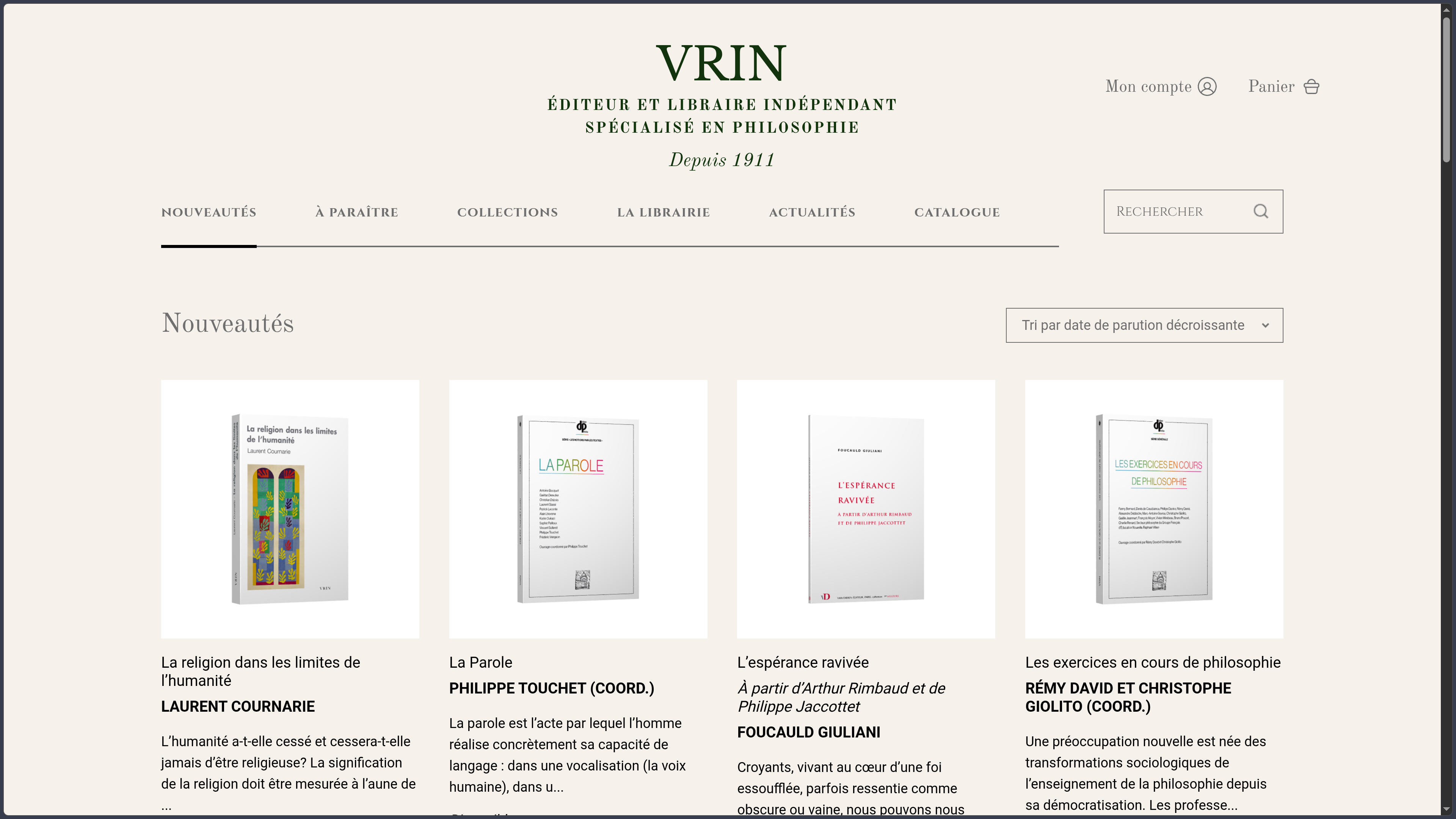
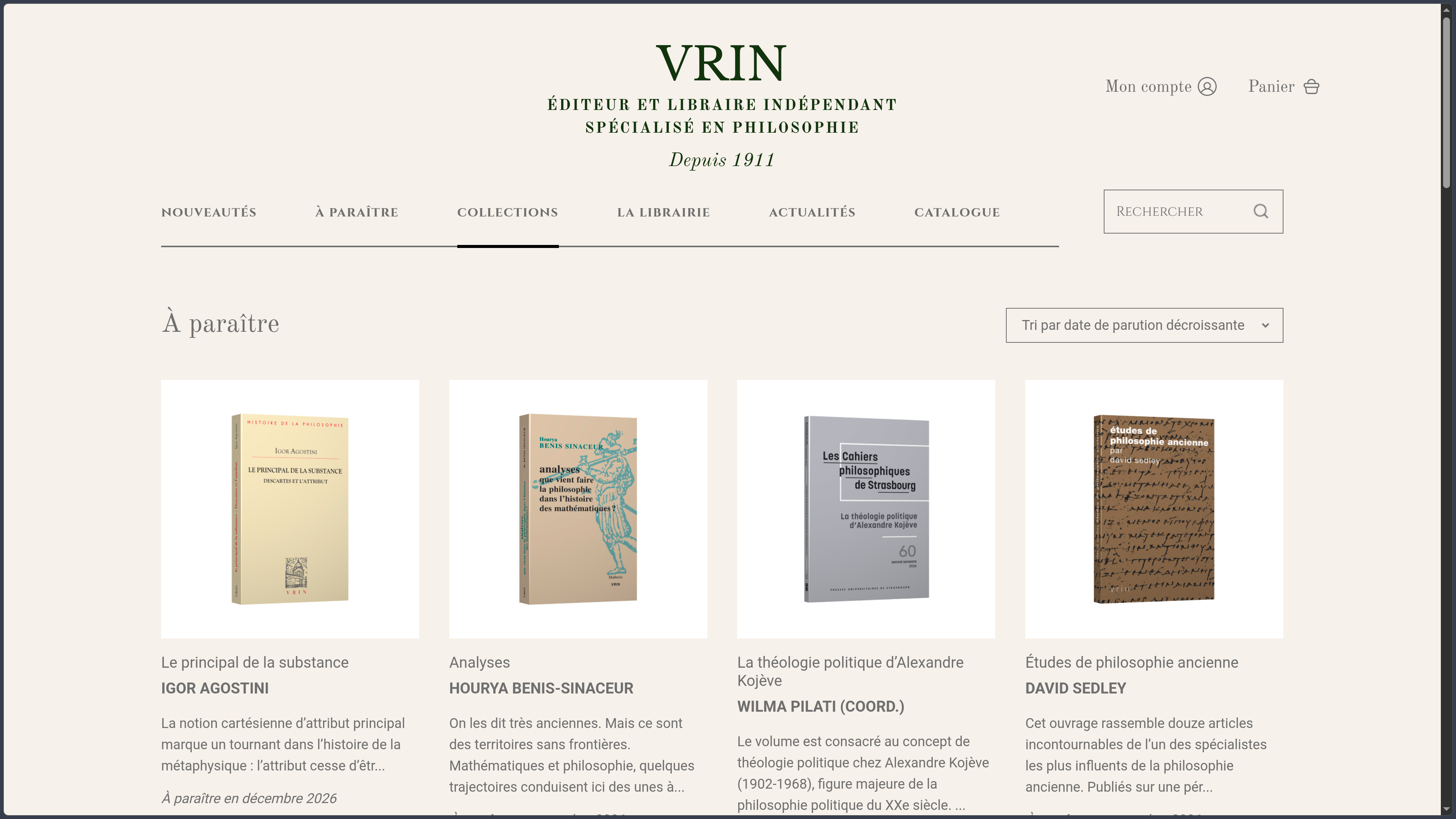
Librairie philosophique J. Vrin occupies a distinctive place in the history of French philosophical publishing. Founded in Paris in 1911 by Joseph Vrin, it combines two closely connected activities: a bookshop specialising in philosophy and a publishing house devoted to philosophical texts, translations and research. This dual identity, now relatively rare in contemporary publishing, represents one of its most important characteristics. Located at 6, place de la Sorbonne, it has maintained a privileged relationship with students, teachers, researchers and readers interested in intellectual history for more than a century.
Initially, Joseph Vrin did not immediately establish a philosophical publishing house. His business began by selling new and second-hand books, mainly devoted to subjects taught at university. His knowledge of historical collections, scholarly publications and researchers' needs gradually enabled him to develop a specialised bookshop. The decisive turning point came in the 1920s, when he established a collaboration with Étienne Gilson, a historian of medieval philosophy. This relationship led to the emergence of a structured publishing activity, generally dated to 1926, which gave rise to several important collections.
Vrin is distinguished by a particularly demanding conception of editorial work. Its publications do not merely reproduce philosophical texts: they seek to establish reliable versions, clarify their historical context and account for difficulties of interpretation. Critical editions may therefore include translations from the original languages, substantial introductions, notes, bibliographies and detailed commentaries. This work makes an essential contribution to the transmission of philosophy, particularly when texts belong to ancient traditions or present complex philological problems.
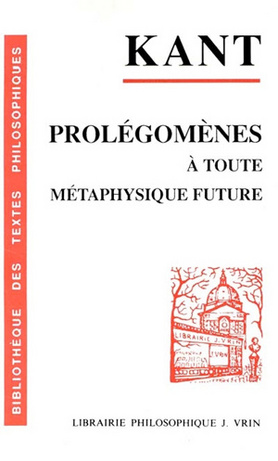
The catalogue covers all the major periods in the history of thought, from ancient philosophy to contemporary debates. It gives considerable prominence to Plato, Aristotle, Plotinus, Saint Augustine, Thomas Aquinas, Avicenna, Averroes, Descartes, Malebranche, Rousseau, Kant, Hegel, Husserl and Heidegger, alongside many lesser-known authors. This diversity makes it possible to approach philosophy not as an isolated succession of famous names, but as a history of texts, controversies, translations and intellectual traditions that respond to one another across the centuries.
The publishing house is also associated with major French figures in the history of philosophy. Étienne Gilson and Henri Gouhier played fundamental roles in shaping its catalogue. Their work on medieval thought, Descartes, Malebranche and the relationships between philosophy and theology helped establish Vrin as a reference in academic publishing. Other researchers and philosophers continued this tradition in phenomenology, metaphysics, ethics, political philosophy and the history of science.
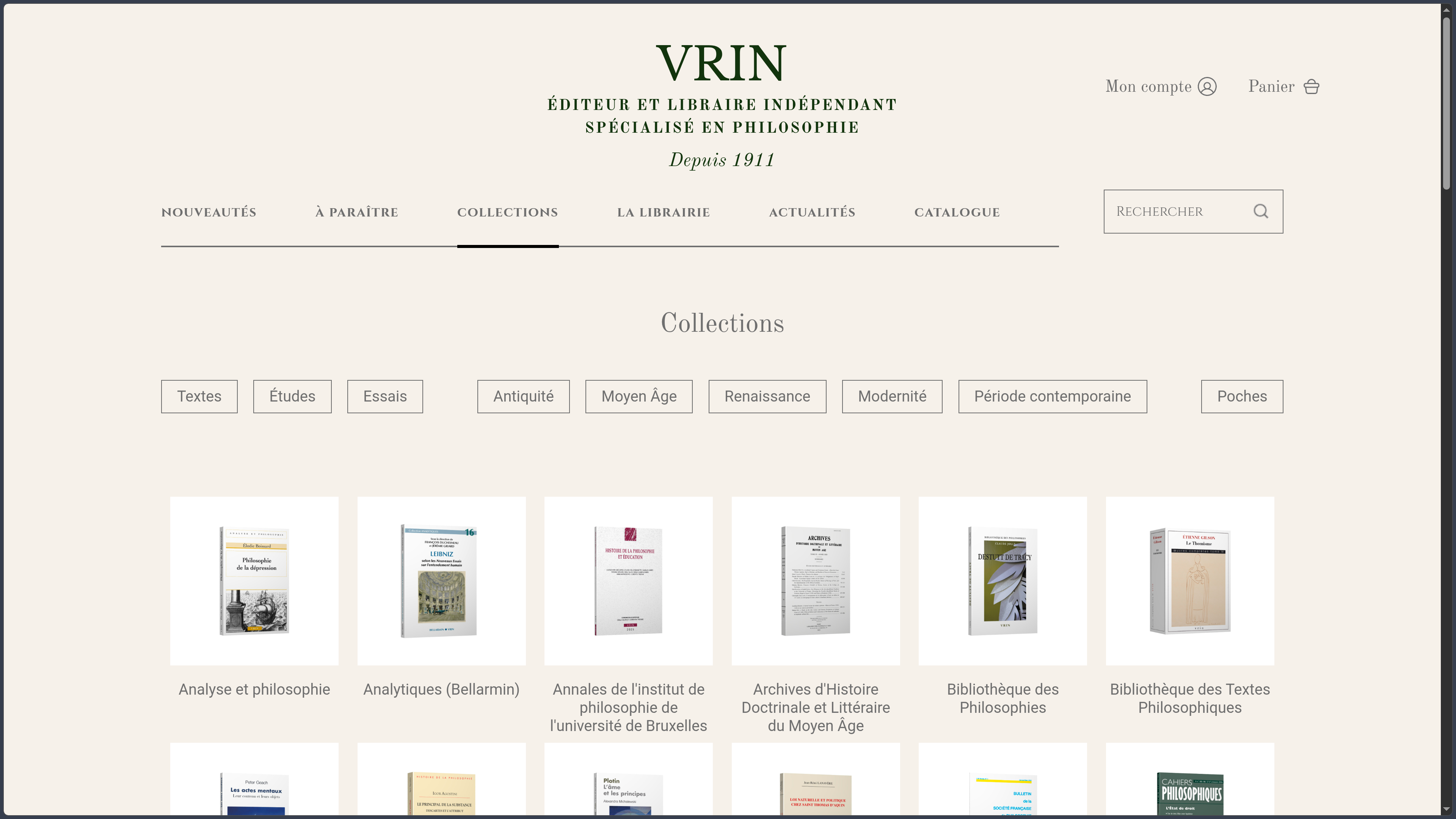
Its collections form a major part of this identity. Bibliothèque des Textes Philosophiques presents major works in French or in translation, often in critical editions. Bibliothèque d’Histoire de la Philosophie publishes studies devoted to authors, concepts and historical periods. Études de philosophie médiévale continues Gilson's intellectual legacy, while Textes & Commentaires combines philosophical works with sustained textual analysis. Other collections, such as Problèmes & Controverses, Textes et traditions and Études musulmanes, broaden the range of research and debate.
Vrin's activities nevertheless extend beyond the history of Western philosophy alone. The house also publishes research on Greek, Latin, Arabic and medieval intellectual traditions, exchanges between cultures and the transmission of texts. The humanities, epistemology, history of science, aesthetics, musicology, philosophy of cinema and contemporary ethical questions also occupy an important place. This openness reflects a conception of philosophy as a discipline in constant dialogue with other forms of knowledge.
The bookshop itself remains a particularly respected institution. Its commercial stock contains more than 10,000 titles from different publishers, organised according to historical periods and philosophical disciplines. Its staff help readers locate books that may be difficult to identify or obtain. This advisory role continues an older tradition of academic bookselling, based on knowledge of authors, editions and bibliographies rather than solely on the presentation of new releases.
Unlike large general-interest publishing groups, Vrin maintains editorial and family independence. The business has been passed down through the founder's family while preserving its philosophical specialisation. This continuity allows it to support long-term projects, particularly editions of extensive bodies of work, highly specialised research and publications whose intellectual significance does not necessarily correspond to immediate commercial success.
More than a century after its foundation, Librairie philosophique J. Vrin therefore remains associated with a particular understanding of scholarly publishing: establishing texts rigorously, preserving intellectual traditions, supporting research and making philosophical thought accessible to those who genuinely wish to study it.
History
1911: Joseph Vrin establishes a bookshop near the Sorbonne
Vrin's history began in 1911, when Joseph Vrin (1884–1957) opened his bookshop in the university district of Paris.
Originally from the Berry region of France, he studied the classics at the Petit Séminaire de Bourges before training as a bookseller in the capital. His apprenticeship took place at Librairie Blanchard, on Rue de la Sorbonne, in an environment frequented by students and academics.
He subsequently acquired Librairie Mulot, located at 6, place de la Sorbonne, and developed a business primarily devoted to new and second-hand books in the humanities.
At that time, the bookshop was not yet exclusively philosophical. It offered works related to subjects taught in neighbouring institutions: literature, history, ancient languages and different branches of knowledge.
Joseph Vrin gradually distinguished himself through his knowledge of catalogues, his ability to locate out-of-print books and the attention he paid to requests from university customers.
This specialisation in bibliographical research played an important role in shaping the house's identity. From its beginnings, Vrin was a place where books were selected for their intellectual value and usefulness in academic study.
1920: A second bookshop and the development of antiquarian collections
In 1920, Joseph Vrin expanded his activities by opening a second establishment at 71, rue Saint-Jacques.
This shop was particularly devoted to second-hand books in several fields: fine arts, Greek and Latin literature, literary studies, history and regional studies.
The expansion made it possible to offer a broader selection of specialised books and serve customers interested in older editions.
The bookshop also developed mail-order sales, issuing catalogues and bulletins presenting available works.
These tools were particularly important at a time when researchers did not have access to digital catalogues. They made it possible to advertise rare books, track acquisitions and respond to requests from readers living outside Paris.
Joseph Vrin's role therefore went beyond selling the books on his shelves. He also acted as an intermediary between libraries, researchers and collections of books circulating through the second-hand market.
This detailed knowledge of scholarly publications naturally prepared the development of a publishing business.
1922–1926: Étienne Gilson and the origins of the publishing house
The decisive turning point in Vrin's history was connected to his meeting with Étienne Gilson, one of the leading historians of medieval philosophy in the twentieth century.
Gilson was particularly interested in the relationships between ancient thought, Christian philosophy and the major intellectual systems of the Middle Ages. His research helped renew the understanding of thinkers such as Saint Augustine, Thomas Aquinas and Duns Scotus.
The collaboration between the bookseller and the philosopher gave the business a new dimension.
As early as 1922, Vrin published a new edition of Le Thomisme by Étienne Gilson, which became a major work in the history of medieval philosophy. This publication belonged to the Études de philosophie médiévale collection, directed by Gilson.
Their cooperation developed over the following years and led to the formal establishment of the philosophical publishing house in 1926.
Étienne Gilson played a decisive role in its intellectual direction. He brought extensive knowledge of academic circles, researchers and scholarly projects requiring genuine editorial support.
Their partnership was based on a remarkable complementarity: Joseph Vrin possessed experience in the book trade and its distribution networks, while Gilson helped define a publishing policy grounded in historical and philosophical rigour.
It marked the birth of a publishing house whose reputation would become closely associated with the quality of its texts and research.
1924–1927: Henri Gouhier and the creation of the major collections
Among the scholars who accompanied the publishing house's early development, Henri Gouhier occupied a fundamental position.
In 1924, Vrin published La Pensée religieuse de Descartes, one of his first major works. The book offered a historical interpretation of the philosopher, attentive to the development of his thought and the relationships between reason, religion and metaphysics.
Gouhier continued his research on modern philosophy, particularly Nicolas Malebranche, to whom he devoted several studies published by Vrin.
In 1926, he notably published La Philosophie de Malebranche et son expérience religieuse, demonstrating the importance given to studying texts within their historical context.
In 1927, Bibliothèque d’Histoire de la Philosophie further strengthened the catalogue's organisation. This collection welcomed monographs and research devoted to authors, periods and problems in the history of philosophy.
Henri Gouhier also played an important role in the development of Bibliothèque des Textes Philosophiques.
The house therefore established two complementary activities: publishing philosophical works themselves and publishing the studies needed to understand them.
This relationship between texts and interpretations would become one of Vrin's defining characteristics.
1926–1939: Medieval studies establish Vrin's international reputation
The development of philosophical publishing was accompanied by a particularly strong commitment to medieval scholarship.
In 1926, Étienne Gilson and the Dominican priest Gabriel Théry founded Archives d’Histoire Doctrinale et Littéraire du Moyen Âge.
This scholarly publication welcomed original studies devoted to the history of medieval thought, as well as previously unpublished or inadequately edited texts established from manuscripts.
Its ambition extended beyond simply presenting the doctrines of major philosophers. Research focused on sources, intellectual traditions, commentaries and exchanges between authors.
It gave considerable attention to Christian philosophy while also allowing the study of exchanges between Greek, Arabic, Jewish and Latin thought.
Étienne Gilson's international reputation helped introduce Vrin's publications to scholars abroad, particularly in European and North American universities.
The house thus contributed to the development of a history of philosophy grounded in direct knowledge of texts and philological research.
By the late 1930s, the bookshop was also continuing its physical expansion, enlarging its working spaces in the Sorbonne district.
Vrin had become both a centre of bibliographical research and a publisher recognised for the scholarly quality of its publications.
The 1940s–1950s: Continuity of publishing and the preservation of older books
Throughout the 1940s and 1950s, the house continued its activities in the history of philosophy, textual editions and specialised studies.
Research on medieval thought retained an important position, but the catalogue gradually expanded to include other periods and new philosophical problems.
Studies devoted to modern philosophy, metaphysics and the history of doctrines strengthened the collections established since the 1920s.
In 1948, the Problèmes & Controverses collection notably opened a space devoted to philosophical debate, doctrinal discussion and the examination of disputed questions.
At the same time, the bookshop maintained substantial activity in antiquarian and out-of-print books.
From 1949 onwards, its regular bulletins of second-hand books made it possible to announce acquisitions and respond to requests from researchers, libraries and collectors.
This activity complemented the work of the publishing house. It helped keep older studies, rare editions and texts necessary for academic work in circulation.
Vrin's distinctiveness therefore continued to rest on the combination of two professions: locating and distributing previously published books, and producing new editions and scholarly research.
1957–1968: Family succession and the transformation of the bookshop
In 1957, Joseph Vrin died after devoting several decades to developing his business.
Family continuity was gradually ensured by his daughter Andrée Paulhac, née Vrin, together with her husband Pierre Paulhac.
During the 1960s, the bookshop also underwent an important change in the composition of its stock.
Historically focused on second-hand books, it increasingly developed sales of new publications in order to respond to the growing production of philosophical works and the expectations of new readers.
In 1968, the opening of a space specifically devoted to new books accompanied this transformation.
The bookshop retained its traditional bibliographical research activities while giving increasing prominence to French and international publications available on the market.
This evolution allowed it to maintain its role as a reference in a period when universities were expanding and philosophical movements were becoming more diverse.
Meanwhile, the publishing house continued its work on major texts and specialised research.
Family succession therefore did not represent a break with the founding editorial choices. Rather, it accompanied the gradual adaptation of a scholarly business to changes in the university world.
The 1970s–1980s: Modern philosophy, history of science and new fields
During the 1970s and 1980s, Vrin's catalogue continued to expand.
The house extended its work on major figures in the history of philosophy, particularly Aristotle, Descartes, Malebranche, Kant and Hegel, while developing publications devoted to more specialised fields.
The history of science and epistemology became increasingly important. These disciplines made it possible to examine relationships between philosophical systems, scientific theories and changes in methods of acquiring knowledge.
The catalogue notably included works associated with Gaston Bachelard and different traditions of reflection on science.
The house also maintained an important role in publishing complete works and reference texts. The edition of the Œuvres complètes de Descartes, historically established by Charles Adam and Paul Tannery, is one of the major scholarly projects associated with its catalogue.
This edition became an essential reference in Cartesian studies, particularly for consulting original texts, correspondence and the different versions of Descartes's works.
Vrin's editorial policy therefore continued to favour projects whose value rested on textual reliability and long-term scholarly use.
The 1990s: A specialised bookshop and renewed collections
During the 1990s, Vrin continued its dual activities as a bookshop and publishing house.
In 1996, the bookshop's organisation evolved to provide approximately 140 square metres of floor space, with a particularly extensive commercial stock.
Books were arranged according to two complementary principles: the major periods of philosophical history and the disciplines or problems under study.
Readers could therefore explore ancient, medieval, Renaissance, modern or contemporary philosophy, while also searching for works devoted to ethics, logic, aesthetics or political philosophy.
This organisation reflected the diversity of a field in which the same author may belong to several intellectual traditions and be studied from different perspectives.
In publishing, the house continued developing its collections.
Bibliothèque des Philosophies, created in 1997, notably helped renew approaches and discussions surrounding fundamental philosophical problems.
In 1999, Textes & Commentaires introduced a model in which philosophical works were accompanied by sustained commentary, enabling readers to understand the progression and difficulties of the argument.
These initiatives extended Vrin's historical tradition while responding to new requirements in academic research.
The 2000s: Contemporary philosophy and openness to new questions
At the beginning of the twenty-first century, Vrin maintained its heritage publishing activities while broadening the fields covered by its catalogue.
The house published research devoted to phenomenology, analytic philosophy, ethics, political philosophy and contemporary questions.
The Chemins Philosophiques collection, established in 2003, notably contributed to the publication of books intended to clarify specific philosophical problems and approaches.
Publications gradually addressed new questions concerning language, mind, knowledge, responsibility and relationships between individuals and institutions.
Research in aesthetics, philosophy of art and philosophy of cinema also contributed to enriching the catalogue.
This diversification did not mean abandoning the history of philosophy. On the contrary, contemporary research often maintained a dialogue with older traditions.
Vrin therefore continued publishing highly specialised historical studies alongside essays examining major intellectual and social transformations of the present.
The publisher retained a strong academic identity while addressing readers interested in philosophical debate beyond university curricula alone.
The 2010s: Critical editions, paperbacks and international research
Throughout the 2010s, Vrin continued developing its catalogue of philosophical texts.
Bibliothèque des Textes Philosophiques remained one of its principal collections. It published works in French or in translation, accompanied by introductions and substantial critical scholarship.
A Poche paperback series also made certain texts available in more portable and affordable formats.
Works by Descartes, Aristotle, Malebranche, Husserl and other philosophers could therefore be discovered in editions suited to different reading practices.
Translation continued to occupy a particularly important place. The publisher sought to make works accessible while respecting their conceptual difficulties and linguistic characteristics.
Vrin also continued publishing research devoted to Greek, Arabic and Latin intellectual traditions.
The Textes et traditions collection illustrated this direction by bringing together translations, commentaries and studies of the transmission of texts between different philosophical cultures of Antiquity and the Middle Ages.
The house also maintained its international activities, particularly through translations of its own publications and the management of foreign publishing rights.
Since 2020: Philosophical heritage and contemporary debates
During the 2020s, Vrin continued an activity combining the transmission of major texts with the publication of contemporary research.
Its historical collections continued welcoming new studies and editions, while recent books addressed questions connected with democracy, ethics, political philosophy, ecology and changes in knowledge.
The house notably published works exploring relationships between philosophy and science, theories of justice, forms of life and contemporary social debates.
This direction demonstrated Vrin's ability to bring together several intellectual timescales: painstaking work on ancient manuscripts, reinterpretations of major philosophical works and research into current problems.
Paperback editions also helped widen access to the classics.
In 2024, a new edition of Écrits pour soi-même by Marcus Aurelius, accompanied by the Lettres à Fronton, illustrated the work involved in translation and historical contextualisation.
In 2025, the publication of La Paix perpétuelle ?, devoted to texts by Jean-Jacques Rousseau, continued research into modern political philosophy.
In 2026, Vrin also continued publishing works devoted to Aristotle, notably a paperback edition of the Métaphysique in the translation by Jules Tricot.
Meanwhile, the bookshop remained a venue for meetings and discussions devoted to new philosophical publications.
More than a century after its foundation, Vrin therefore retains a particularly coherent identity: that of an independent publisher whose specialisation makes it possible to work both on the historical foundations of philosophy and on its most contemporary debates.
What Sets It Apart
A dual identity as bookseller and publisher
Vrin's first distinctive characteristic lies in the continuity between its activities as a specialised bookshop and as a publishing house.
This organisation recalls an older tradition in which booksellers participated directly in the publication and circulation of works.
At Vrin, the two activities complement one another. The bookshop provides insight into readers' requests, academics' needs and books available from other publishers. The publishing business, in turn, helps produce texts and research whose circulation is of scholarly value.
This relationship provides exceptionally detailed knowledge of the philosophical field.
It also explains why the bookshop is not limited to Vrin's own publications: its stock includes books from numerous French and international publishers.
This distinction remains important for understanding the company's identity and avoiding confusion between the bookshop's commercial catalogue and the books actually published by the house.
A specialisation almost entirely devoted to philosophy
Unlike major general-interest publishers, Vrin has built its identity around a particularly strong intellectual specialisation.
Philosophy has formed the centre of its activities since the development of the publishing house in the 1920s.
This specialisation makes it possible to bring together editorial expertise suited to a field whose texts may present considerable difficulties of translation, textual establishment and interpretation.
It also encourages the development of lasting collections devoted to particular philosophical traditions.
The house publishes research that sometimes addresses a limited readership but whose scholarly significance can extend over several decades.
This policy differs from that of a publisher primarily focused on new releases and immediate commercial successes.
Vrin is therefore distinguished by the continuity of its commitments and the value it places on the intellectual quality of its publications.
Critical editing as genuine scholarly research
Vrin's philosophical editions frequently involve work extending far beyond the simple reproduction of texts.
Establishing a work may require comparing multiple manuscripts, checking older translations or resolving problems concerning vocabulary and textual variants.
Critical editions therefore provide introductions, notes, commentaries and bibliographies intended to clarify the reading.
This work is particularly important for ancient and medieval texts transmitted through sometimes complex manuscript traditions.
It is equally important for modern philosophy, whose concepts may carry different meanings depending on historical and linguistic contexts.
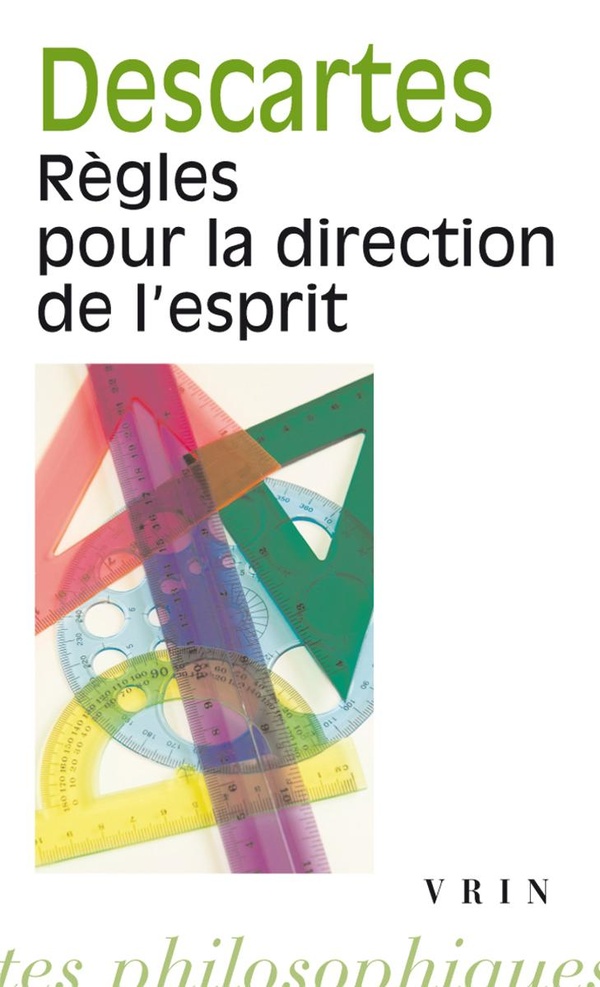
An edition of Aristotle's La Physique, Descartes's Discours de la méthode or Malebranche's De la recherche de la vérité therefore involves translation and interpretation decisions that directly influence the understanding of these works.
This attention to precision is one of the reasons Vrin publications are widely used in philosophical education and research.
A fundamental place in medieval studies
Vrin's history is particularly connected with the development of research on medieval philosophy.
The collaboration between Joseph Vrin and Étienne Gilson created a favourable editorial environment for scholarship that profoundly renewed the study of this period.
Études de philosophie médiévale and Archives d’Histoire Doctrinale et Littéraire du Moyen Âge helped bring to light texts, authors and traditions that had long received less attention than the major works of Antiquity and modern philosophy.
Research focused on Christian thought, but also on Arabic and Jewish philosophical traditions and their relationships with Greek sources.
This perspective made it possible to study the Middle Ages as a period of philosophical creativity and intellectual transmission, rather than simply a transition between Antiquity and the Renaissance.
Gilson's work, followed by that of subsequent generations of researchers, helped establish this field permanently within philosophical education and scholarship.
Collections distinguishing texts from interpretations
The organisation of Vrin's catalogue rests on an essential distinction between publishing philosophical works and publishing studies devoted to their interpretation.
Bibliothèque des Textes Philosophiques focuses on the works themselves, often accompanied by critical apparatus.
Bibliothèque d’Histoire de la Philosophie welcomes research devoted to an author, a historical period or a particular question.
Textes & Commentaires, meanwhile, offers especially detailed readings of texts through sustained commentary.
Other collections examine theoretical problems, historical controversies or specific intellectual traditions.
This organisation makes the catalogue accessible to different audiences.
A student may be looking for a reliable edition of a text, while a researcher may be more interested in a specialised monograph or a study devoted to a particular concept.
The complementary nature of these collections makes Vrin a genuine working library for philosophy.
Openness to Greek, Arabic and Latin philosophical traditions
Vrin also contributes to the study of exchanges between different intellectual traditions.
Research devoted to ancient and medieval philosophy demonstrates that texts were not transmitted solely within a single language or cultural area.
Aristotle's works, for example, were read, translated, commented upon and reinterpreted in different Greek, Arabic and Latin traditions.
Authors such as Avicenna and Averroes played fundamental roles in this history.
The Textes et traditions and Études musulmanes collections explore these transmissions through philological studies, annotated translations and historical research.
This openness encourages a fuller understanding of philosophical history by taking account of intellectual exchanges between different cultures.
It constitutes one of the most important dimensions of Vrin's scholarly work.
A significant presence in the history of science and epistemology
At Vrin, philosophy is not limited to the study of metaphysics or ethics.
The catalogue also gives considerable prominence to the history of science and epistemology, which examines the conditions, methods and limits of scientific knowledge.
Works associated with Gaston Bachelard illustrate this direction, particularly through their attention to transformations in scientific concepts.
Other publications examine relationships between mathematics, logic, physics, biology and philosophy.
Such research makes it possible to understand how scientific theories transform representations of the world and how philosophical problems, in turn, influence methods of acquiring knowledge.
Collections devoted to the history of science therefore continue Vrin's intellectual ambition: placing concepts within their historical development and analysing the conditions in which they emerge.
Contemporary philosophy as a space for debate
Vrin is not defined exclusively by its heritage publishing activities.
The house also publishes research devoted to major current questions, particularly in ethics, political philosophy and social philosophy.
The Problèmes & Controverses collection welcomes studies examining disputed philosophical questions and their theoretical or practical consequences.
Subjects may concern democracy, work, forms of life, social relationships, the environment or transformations in knowledge.
The house also offers publications on phenomenology, analytic philosophy, aesthetics and relationships between philosophy and culture.
This diversity demonstrates that philosophical research does not consist solely of interpreting ancient authors.
It also contributes to developing concepts and arguments that help explain contemporary problems.
Paperback editions without abandoning scholarly rigour
The publication of works in paperback format represents another important dimension of the catalogue.
Vrin offers certain philosophical texts in editions that are more compact and accessible than substantial academic volumes.
This policy makes fundamental works available while maintaining serious translation and editorial scholarship.
Editions of works by Aristotle, Descartes, Malebranche, Marcus Aurelius and Husserl illustrate this combination of accessibility and rigour.
The paperback format facilitates regular consultation of texts, particularly for students and readers wishing to build a personal philosophical library gradually.
It does not, however, replace all large-format scholarly editions, which may require a much more extensive critical apparatus.
Vrin therefore maintains several levels of publication suited to readers' different needs and practices.
Editorial independence and family continuity
Vrin's history is also marked by its continuity as a family business.
After Joseph Vrin, several generations continued developing the company, notably Andrée Paulhac, Pierre Paulhac, Gérard Paulhac, Anne-Marie Paulhac-Arnaud and Denis Arnaud.
This succession was accompanied by a determination to preserve the house's intellectual specialisation.
Independence notably allows it to support projects whose immediate profitability may not be particularly high, but whose scholarly usefulness can be lasting.
Critical editions, specialised historical studies and research into lesser-known authors often require significant investment in research and editorial preparation.
A commitment to such publications helps distinguish Vrin from general-interest publishing companies.
This continuity does not imply an absence of change. Collections have diversified, the bookshop has adapted and research topics have been renewed.
Rather, it reflects the persistence of an ambition: preserving a publishing space devoted to philosophy, its history and its debates.
Did You Know?
-
Founded in 1911: Joseph Vrin opened his bookshop at 6, place de la Sorbonne in Paris, after learning the bookselling profession in the university district. This date marks the historical origin of the company.
-
A publishing house established in 1926: It is important to distinguish the beginnings of the bookshop in 1911 from the formal organisation of its philosophical publishing activities in 1926. Several significant publications had already appeared under the Vrin name before that date.
-
Étienne Gilson, a decisive collaboration: The historian of medieval philosophy played a central role in defining Vrin's editorial direction. His partnership with Joseph Vrin notably contributed to the development of Études de philosophie médiévale.
-
Le Thomisme: An edition of this major work by Étienne Gilson appeared through Vrin as early as 1922. His research on Thomas Aquinas profoundly influenced the study of medieval philosophy.
-
Henri Gouhier: Vrin published La Pensée religieuse de Descartes in 1924, followed by several important studies of Malebranche and the history of modern philosophy.
-
The medieval scholarly journal: Archives d’Histoire Doctrinale et Littéraire du Moyen Âge was founded in 1926 by Étienne Gilson and the Dominican scholar Gabriel Théry. The publication continued its activities into the twenty-first century.
-
A historic address: The bookshop is still located at 6, place de la Sorbonne, 75005 Paris, in the heart of the university district where Joseph Vrin began his business.
-
A bookshop devoted entirely to philosophy: Vrin describes itself as the world's only bookshop exclusively specialising in philosophy. It welcomes an academic clientele as well as curious readers and philosophy enthusiasts.
-
More than 10,000 titles in the bookshop: This figure refers to the bookshop's commercial stock, which includes works from numerous publishers. It should not be confused with Vrin's own publishing catalogue.
-
More than 3,000 titles in its publishing backlist: Vrin reports a backlist of more than 3,000 titles within its publishing and foreign rights activities.
-
Bibliothèque des Textes Philosophiques: This collection brings together major works in French or in translation, accompanied by critical editions. It is currently directed by Emmanuel Cattin.
-
Bibliothèque d’Histoire de la Philosophie: Associated notably with Henri Gouhier's work, this collection publishes studies devoted to authors, concepts and periods in the history of philosophy.
-
Descartes and the Adam–Tannery edition: Vrin publishes the Œuvres complètes de René Descartes, historically established by Charles Adam and Paul Tannery, a reference edition in Cartesian studies.
-
An opening to Arabic philosophy: The Études musulmanes and Textes et traditions collections include studies and translations concerning Avicenna, Averroes and philosophical exchanges between Greek, Arabic and Latin traditions.
-
Contemporary debates: Problèmes & Controverses welcomes research devoted to disputed philosophical questions. The collection is directed by Franck Fischbach and Sandra Laugier.
-
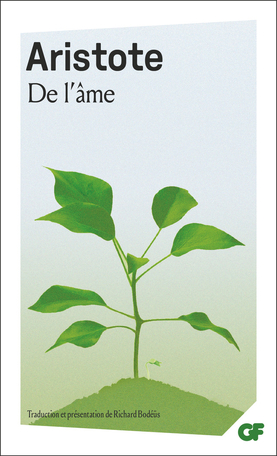
Philosophical classics in paperback: The catalogue notably includes Aristotle's La Physique and De l’âme, Descartes's Discours de la méthode, Malebranche's De la recherche de la vérité and Marcus Aurelius's Écrits pour soi-même.
-
An independent bookselling business: Vrin should not be confused with a large general-interest publishing group. The house retains its philosophical specialisation and family continuity dating back to its founder.
-
An important distinction for PANACHES CULTURE: Not every book sold on Vrin.fr is necessarily published by Éditions Vrin. The commercial catalogue also includes books from other publishers. Each work must be attributed to the publisher actually identified in the bibliographical details of the edition concerned.