How can we lead a good life, and what activity gives human existence its ultimate meaning? In Nicomachean Ethics, Aristotle investigates the highest good toward which human actions are directed: happiness, understood as the fulfillment of a life lived in accordance with virtue. He examines the formation of character, courage, temperance, justice, and practical wisdom, while exploring the roles of pleasure, friendship, and individual choice. His investigation distinguishes immediate desires from the goods that contribute to lasting human flourishing. By connecting the exercise of reason, moral conduct, and life within a community, Aristotle develops a conception of happiness grounded in action, reflection, and the cultivation of human capacities.
Aristotle: Nicomachean Ethics
Nicomachean Ethics
- Flammarion Publisher
- Librairie philosophique J. Vrin Publisher
- Hatier Publisher
- Le Livre de Poche Publisher
- Pocket Publisher
- Aristote Author
What makes a good life, and how can our choices guide us toward genuine happiness?
Details
- Type
- Book
- Original title
- Nicomachean Ethics
- Genres
- Philosophy
- ISBN
- 9782080164254
Synopsis
Aristotle: Nicomachean Ethics
Overview
Overview
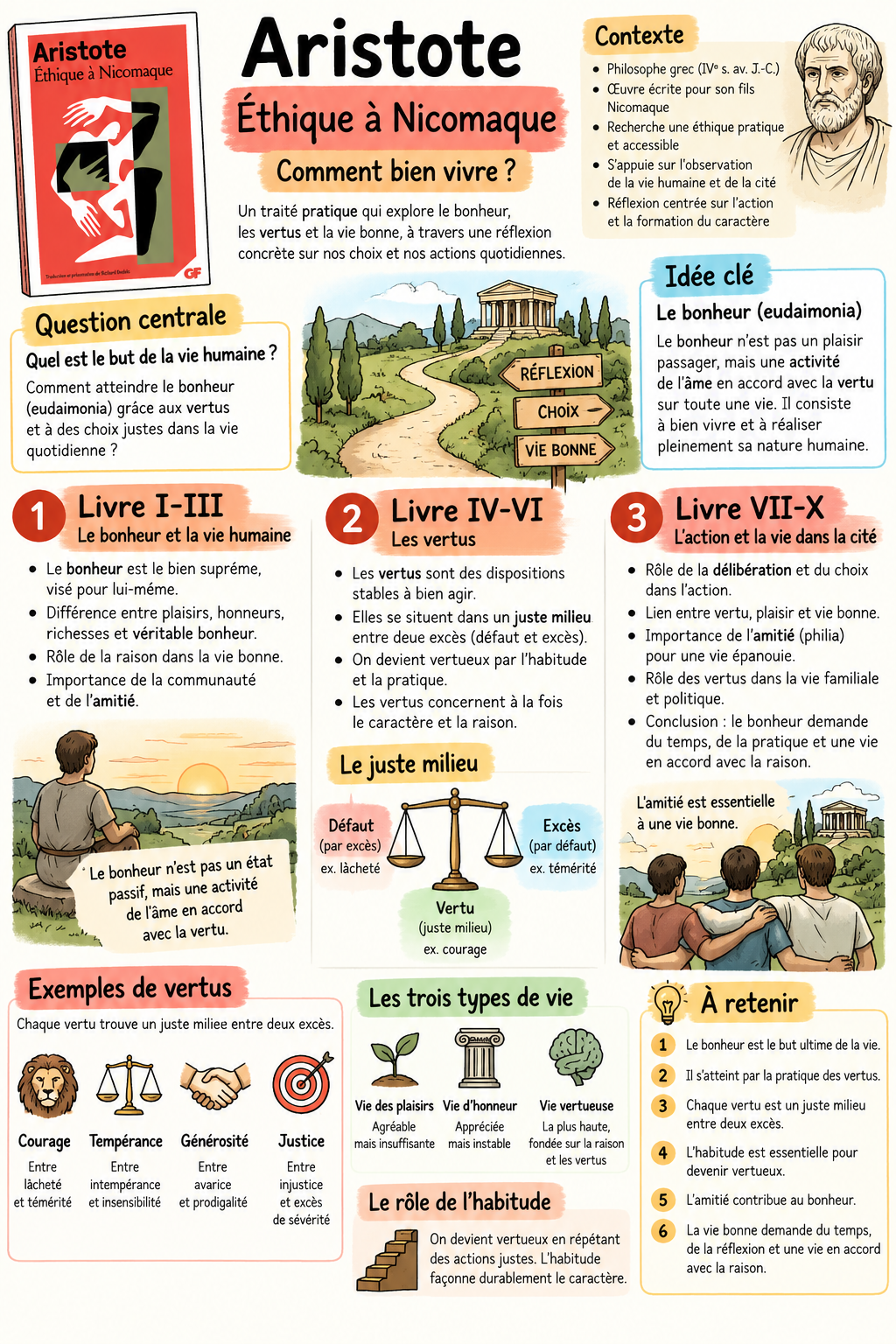
In Nicomachean Ethics, Aristotle develops one of ancient philosophy's most influential investigations into human conduct and the pursuit of happiness. His starting point is an observation: every activity, decision, and action appears to aim at some good. Yet certain goals are pursued only as means to achieving something else. Aristotle therefore seeks to identify an ultimate end, desirable for its own sake, that provides direction and meaning to human existence as a whole.
This end is eudaimonia, commonly translated as "happiness" or "flourishing." It does not refer merely to a feeling of satisfaction, but to a life fully realized. For Aristotle, happiness consists in activity of the soul in accordance with virtue, exercised over the course of a complete life. It therefore requires the development of human capacities, particularly reason, without excluding the importance of social relationships and certain material conditions.
The philosopher places the formation of character at the center of his investigation. Moral virtues, such as courage, temperance, and generosity, are not simply natural dispositions: they are gradually acquired through education, habit, and repeated action. Aristotle develops the doctrine of the mean, according to which virtue occupies an appropriate position between excess and deficiency. Courage, for example, differs from both cowardice and recklessness. This mean is not a mathematical average, however, but a form of conduct suited to particular circumstances.
The work also examines the conditions of voluntary action and deliberate choice. Aristotle distinguishes actions performed voluntarily from those resulting from compulsion or ignorance, then investigates the mechanisms of decision-making. This inquiry leads to the concept of phronesis, or practical wisdom, which makes it possible to discern the appropriate course of action in a particular situation. Moral virtue and rational judgment thus emerge as complementary dimensions of a well-lived life.
Composed of ten books, the treatise goes on to explore justice, pleasure, and friendship, before examining the place of contemplation in human happiness. Aristotle distinguishes relationships based on utility, pleasure, and mutual appreciation of virtue. He also studies justice in the distribution of goods and the correction of wrongs. Finally, he assigns a particularly elevated position to contemplative activity while acknowledging the importance of moral and political life.
Key Takeaways
The fundamental idea of Nicomachean Ethics is that happiness cannot be reduced to pleasure, wealth, or social success. It consists in activity in accordance with virtue, developed over time. This conception presents happiness as a way of living and acting rather than a temporary emotional state.
The doctrine of the mean is another major principle. Virtue involves developing an appropriate disposition between excessive and deficient forms of behavior, taking circumstances into account. Finding this balance requires experience, the regulation of desires, and practical wisdom. Aristotle thus emphasizes that acting well does not simply mean knowing moral principles, but knowing how to apply them with sound judgment.
The work also gives considerable importance to friendship and justice. A flourishing life cannot be understood independently of other people: human relationships, reciprocity, and participation in the community contribute to individual fulfillment. This social dimension directly connects Aristotle's moral philosophy with his political thought.
Finally, the last book distinguishes between a life devoted to virtuous action and one devoted to intellectual contemplation. Aristotle presents the latter as the highest form of happiness, opening a broader investigation into the relationship between the demands of practical life and the exercise of thought.
Conclusion
With Nicomachean Ethics, Aristotle establishes a conception of morality centered on character, virtue, and human flourishing. Rather than defining goodness solely through rules or prohibitions, he examines the dispositions and capacities required to act justly and lead a fulfilling life.
The treatise is one of the major foundations of virtue ethics. Its influence extends across ancient, medieval, and contemporary philosophy, particularly in discussions of responsibility, practical wisdom, moral education, and the conditions of happiness.
Good to Know
- Nicomachean Ethics, also known by its Latin title Ethica Nicomachea, consists of ten books.
- Its title is traditionally associated with Nicomachus, Aristotle's son, although the exact circumstances behind this designation remain uncertain.
- The work shares three books with the Eudemian Ethics. These common books occupy an important place in scholarship concerning the transmission of Aristotle's writings.
- The concept of phronesis, generally translated as "practical wisdom" or "prudence," refers to the capacity for sound judgment when deliberating about what contributes to a good life.
- The treatise concludes with a transition toward the study of political institutions and legislation, establishing a direct connection with the investigations developed in Politics.