What is being, and what are the fundamental principles of reality? In Metaphysics, Aristotle seeks to define a science capable of studying what exists insofar as it exists, independently of the particular domains explored by other disciplines. He examines first causes, the nature of substances, and the principles that make it possible to understand the existence of things. This investigation, which he calls first philosophy, questions the foundations shared by thought and reality. Through a reflection on the relationships between different sciences, Aristotle develops a universal conception of knowledge centered on the very conditions of existence.
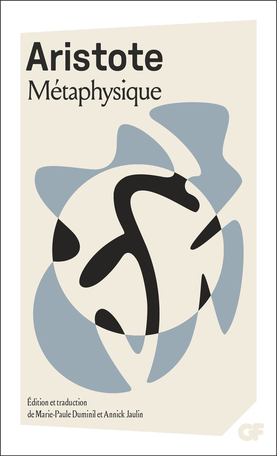
Book
Philosophy
Aristotle: Metaphysics
Metaphysics
- Flammarion Publisher
- Editions L'Harmattan Publisher
- Librairie philosophique J. Vrin Publisher
- PUF Publisher
- Pocket Publisher
- Aristote Author
What truly exists, and which fundamental principles allow us to understand reality?
Details
- Type
- Book
- Original title
- Metaphysics
- Genres
- Philosophy
- ISBN
- 9782140495991
Synopsis
Aristotle: Metaphysics
Overview
Overview
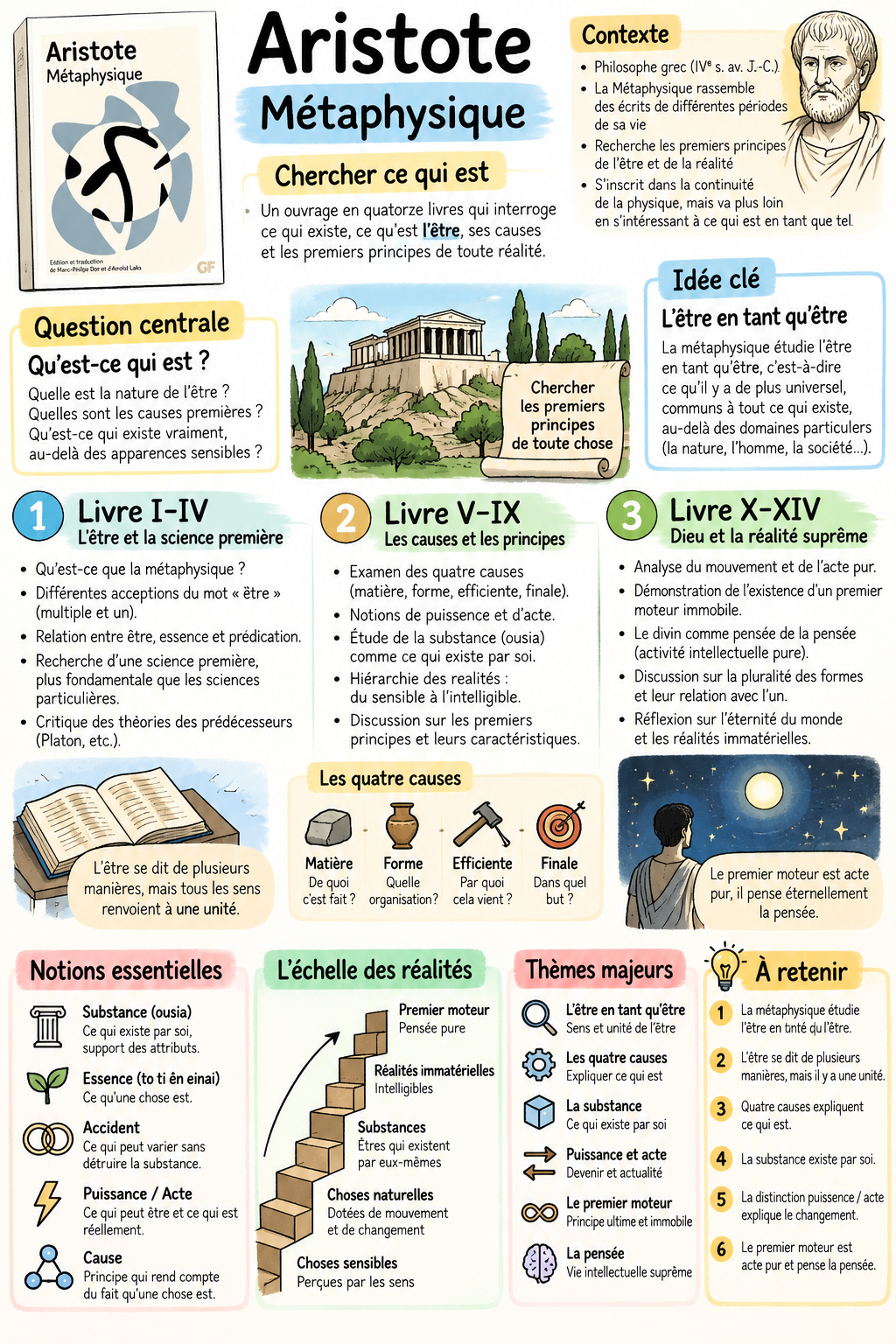
In Metaphysics, Aristotle undertakes an investigation into the most general foundations of reality. Unlike particular sciences, which study specific domains such as numbers or natural phenomena, this inquiry focuses on being qua being. Its purpose is not to acquire exhaustive knowledge of every object, but to understand the common principles that make it possible to conceive of their existence and nature.
Aristotle describes this investigation as first philosophy. It concerns first causes, fundamental principles, and what constitutes the essence of things. The philosopher examines the doctrines of his predecessors, compares their explanations of reality, and seeks to clarify what it means "to be." This approach leads him to distinguish different modes of being and to give a central role to the concept of substance, understood as a primary reality to which other determinations of being are related.
The work also develops several essential distinctions in Aristotelian thought. Matter and form help explain the constitution of beings, while potentiality and actuality clarify the possibilities of change and realization. Something may possess the capacity to become something else without having yet fulfilled that potential. These concepts help explain how things maintain their identity while undergoing transformation.
The investigation also extends to the principles of reasoning, unity and multiplicity, and the search for a first cause of motion. Aristotle notably develops the concept of an unmoved mover, an eternal and immaterial reality associated with pure actuality. These analyses connect the study of existence with a broader inquiry into the order and fundamental principles of reality.
Key Takeaways
The fundamental contribution of Metaphysics lies in its definition of a universal science devoted to being qua being. Whereas other disciplines examine things from particular perspectives, first philosophy seeks to understand what belongs to beings simply insofar as they exist. This approach constitutes one of the historical foundations of ontology.
The concept of substance occupies a decisive position. Aristotle seeks to understand what makes a thing what it is, particularly by distinguishing its essence, matter, and form. This investigation is closely connected to the concepts of potentiality and actuality, which make it possible to analyze change without reducing reality to a succession of unrelated states.
The treatise also places considerable importance on the principle of non-contradiction: the same thing cannot, at the same time and in the same respect, both possess and lack the same property. Aristotle presents this principle as a fundamental condition of rational thought and any coherent discourse about reality.
Finally, the work examines the limits and foundations of particular sciences. By investigating first causes and the most general principles, Aristotle develops a conception of knowledge in which different disciplines possess their own objects of study while resting on shared fundamental conditions.
Conclusion
With Metaphysics, Aristotle establishes a major philosophical framework for the study of existence, first causes, and the nature of beings. His analysis of substance, causality, and the relationships between potentiality and actuality profoundly influenced the development of Western philosophy.
The work occupies a central place in the history of metaphysics and ontology. Its concepts shaped ancient, medieval, and modern philosophical traditions and remain central to discussions concerning identity, change, and the foundations of reality.
Good to Know
- Metaphysics traditionally consists of fourteen books or treatises, whose compilation is associated with Andronicus of Rhodes.
- The title Metaphysics was not given by Aristotle himself. It traditionally refers to the writings placed "after the Physics" in the organization of his works.
- The edition published by L'Harmattan offers a French translation of eight principal treatises, accompanied by scholarly material allowing readers to compare significant textual variants found in Greek manuscripts and Arabic translations.
- The concepts of substance, potentiality, actuality, and the unmoved mover exerted a decisive influence on Greek, Arabic, and Latin philosophical traditions.