How is the universe organized, and what principles govern the movement of celestial bodies? In On the Heavens, Aristotle examines the structure of the cosmos, the nature of heavenly bodies, and the principles distinguishing the terrestrial world from the regions above. He defends a conception of a unique, spherical, and eternal universe, with an immobile Earth at its center. While terrestrial elements undergo change and possess natural movements upward or downward, celestial bodies are characterized by circular motion and an incorruptible nature. By exploring the relationships between the elements, motion, and the organization of the world, Aristotle develops a philosophical theory of cosmic order that would profoundly influence the history of astronomy.
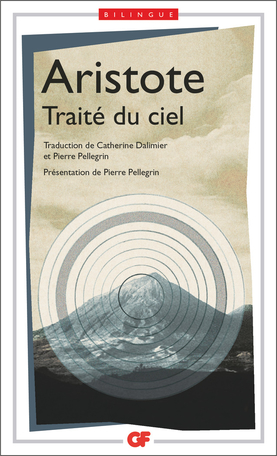
Aristotle: On the Heavens
- A. Durand Publisher
- Flammarion Publisher
- Librairie philosophique J. Vrin Publisher
- Aristote Author
Why do celestial bodies move across the sky, and what order governs the universe?
Details
- Type
- Book
- Original language
- Greek
- Genres
- Philosophy
- Information verified on
- 14 octobre 2026
Synopsis
Aristotle: On the Heavens
Overview
Overview
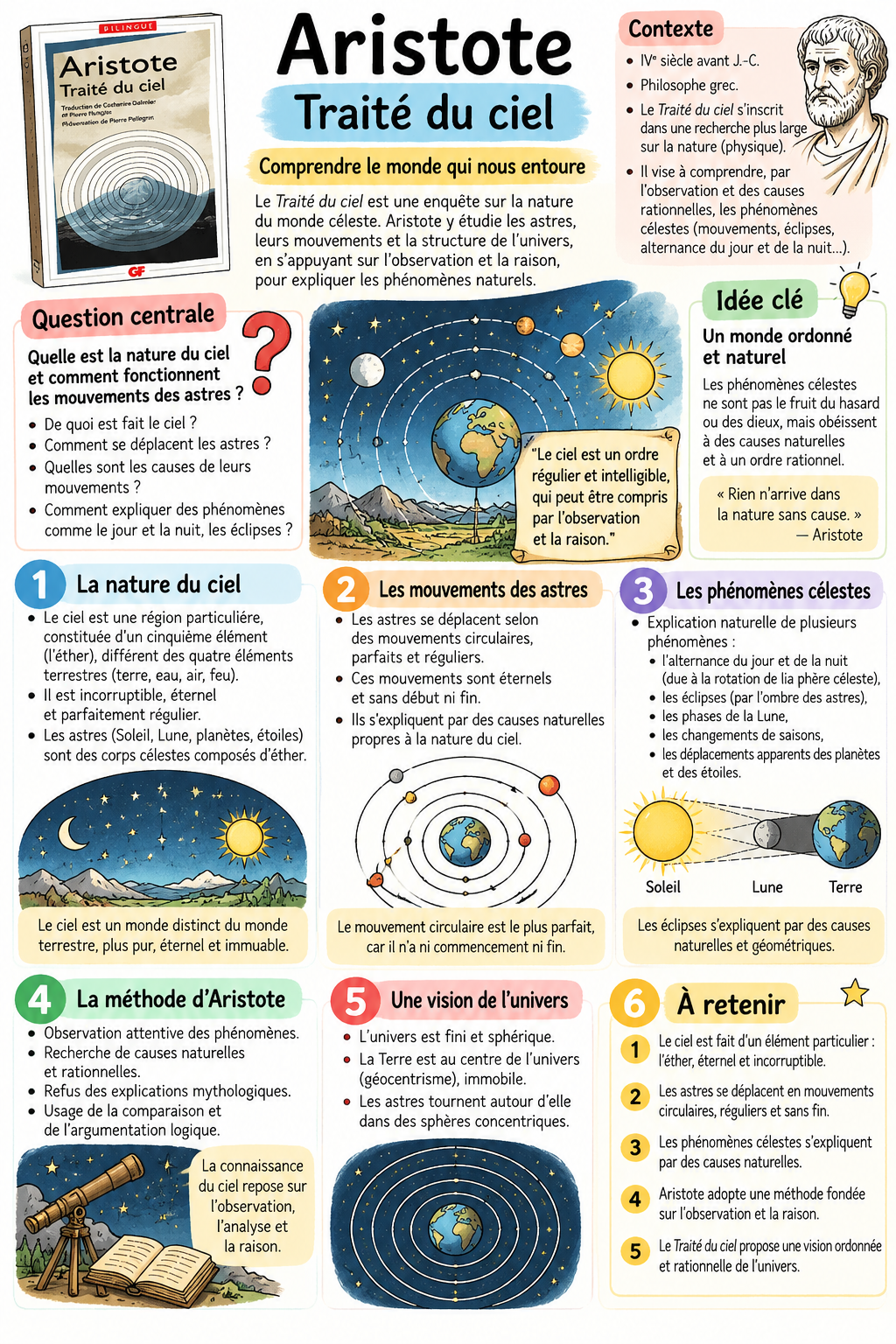
In On the Heavens, Aristotle develops a philosophical conception of the universe based on the study of motion, matter, and the organization of natural bodies. Building on the investigations undertaken in Physics, he seeks to understand the overall structure of the cosmos and explain why celestial phenomena appear to follow principles different from those observed on Earth. His approach combines observations of the natural world with reasoning about the fundamental properties of bodies.
At the heart of the treatise lies the distinction between the sublunary and celestial realms. The former, located below the Moon, consists of the four traditional elements: earth, water, air, and fire. These elements undergo change and possess natural movements directing them toward their proper places. By contrast, the celestial regions are considered eternal and incorruptible. To explain their motion, Aristotle introduces a fifth element, aether, whose nature differs from that of terrestrial bodies.
This distinction rests particularly on Aristotle's conception of motion. Terrestrial elements naturally tend to move in straight lines, either toward the center of the universe or away from it, according to their nature. Celestial bodies, however, follow circular motion, regarded as the most perfect form of movement because it can continue indefinitely without beginning or end. Aristotle thus establishes a fundamental distinction between the transformations of the terrestrial world and the permanence of celestial order.
The work also defends a geocentric representation of the universe. Aristotle considers the Earth to be a spherical and motionless body occupying the center of the cosmos. He examines the shape of celestial bodies, their movements, and the arguments supporting their organization. For him, the universe forms a unique, finite, and eternal whole, whose different parts possess specific properties and natural motions.
Composed of four books, the treatise progresses from a general investigation of the heavens and cosmic structure to an analysis of the elements and their movements. Aristotle compares his ideas with those of earlier philosophers, particularly Plato and Democritus, in order to clarify the principles governing the natural world.
Key Takeaways
One of the fundamental ideas of On the Heavens is the distinction between two regions of the cosmos possessing different properties. The terrestrial world is subject to generation, transformation, and destruction, while celestial bodies are considered eternal and incorruptible. This division constitutes a central principle of Aristotelian cosmology.
The theory of the fifth element, or aether, allows Aristotle to explain the distinctive nature of celestial bodies. Unlike earth, water, air, and fire, aether possesses a naturally circular motion. This conception associates the permanence of the heavens with the regularity of their movements and distinguishes celestial phenomena from the transformations observed in the sublunary world.
Aristotle also develops an account of heaviness, lightness, and natural places. Each element tends toward a position corresponding to its nature: earth moves toward the center of the universe, while fire moves toward its outer regions. Water and air occupy intermediate positions. Within Aristotle's physical framework, these movements explain the organization of the elements and certain terrestrial phenomena.
Finally, the treatise presents a unique, finite, and eternal universe organized around an immobile Earth. This representation rests on philosophical and physical principles that would gradually be challenged by the development of modern astronomy.
Conclusion
With On the Heavens, Aristotle offers a systematic representation of the universe in which the nature of bodies, their movements, and their positions form part of a coherent cosmic order. By distinguishing terrestrial and celestial regions, he establishes a conceptual framework intended to explain both the transformations of the elements and the apparent regularity of astronomical movements.
This cosmology exerted considerable influence on philosophical and astronomical traditions throughout Antiquity and the Middle Ages. Although its physical foundations and geocentric model were eventually abandoned by modern science, the treatise remains an important work for understanding the history of cosmological thought and the relationship between philosophy and astronomy.
Good to Know
- On the Heavens, also known as De caelo, consists of four books.
- Aristotle defends the spherical shape of the Earth, drawing in part on astronomical observations such as the shape of Earth's shadow during lunar eclipses.
- Aether is, in Aristotle's cosmology, a fifth element distinct from the four terrestrial elements. It does not correspond to a substance recognized by modern physics.
- The treatise is closely connected to Physics, which establishes the general principles of motion, and On Generation and Corruption, which examines transformations of natural bodies.
- Aristotle's conception of a geocentric cosmos profoundly influenced ancient and medieval astronomy before being challenged by the scientific transformations of the early modern period.