What constitutes a happy life, and which qualities allow human beings to achieve it? In Eudemian Ethics, Aristotle examines the conditions of happiness and the role of virtue in human existence. He explores the relationships between pleasure, courage, justice, and friendship, while considering freedom of choice, responsibility for one's actions, and the influence of external circumstances. For Aristotle, happiness is neither a passing emotion nor the mere possession of material goods: it rests on activity in accordance with virtue, developed throughout an entire life. Through this investigation, he explores the foundations of moral conduct and the conditions necessary for human flourishing.

Book
2013
Philosophy
Aristotle: Eudemian Ethics
Eudemian Ethics
- Flammarion Publisher
- Librairie philosophique J. Vrin Publisher
- Pocket Publisher
- RIVAGES Publisher
- Aristote Author
What makes a life truly fulfilling, and how can virtue guide us toward happiness?
Details
- Type
- Book
- Release
- 2013-01-01
- Original title
- Eudemian Ethics
- Genres
- Philosophy
- ISBN
- 9782080712721
Synopsis
Aristotle: Eudemian Ethics
Overview
Overview
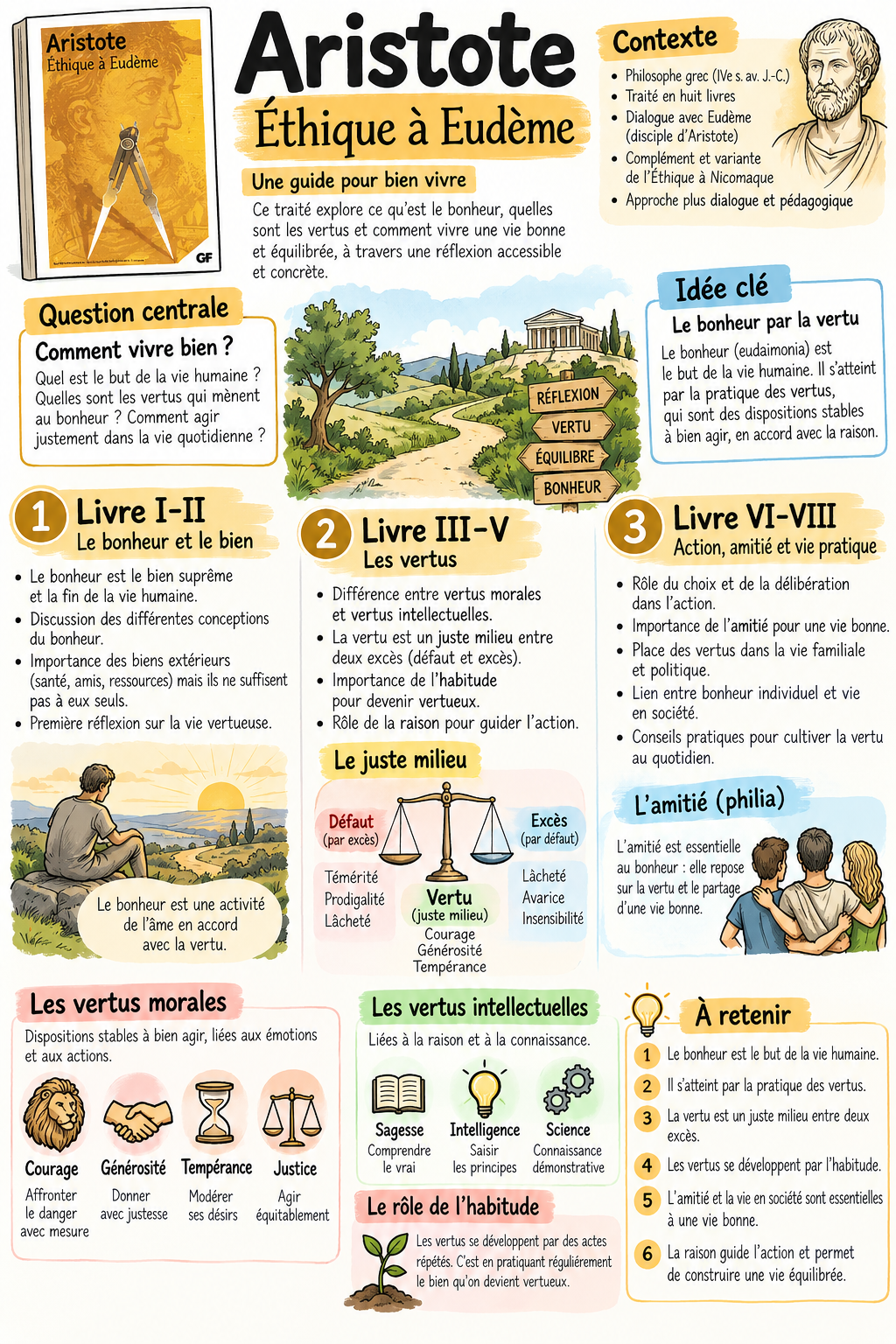
In Eudemian Ethics, Aristotle develops an investigation into happiness and the principles that allow human beings to lead fulfilling lives. As in the Nicomachean Ethics, his inquiry centers on a fundamental question: what is the highest good that people seek through their actions? For Aristotle, this good is eudaimonia, commonly translated as "happiness" or "flourishing," but more precisely referring to the successful realization of a human life considered as a whole.
The philosopher examines different conceptions of happiness, particularly those emphasizing pleasure, honor, or knowledge. He seeks to determine what makes a human life genuinely worthwhile, distinguishing goods pursued for their own sake from those valued merely as means to another end. This inquiry leads him to place virtue at the center of moral philosophy: happiness depends above all on how individuals exercise their capacities and direct their actions.
Aristotle therefore analyzes virtues of character such as courage, temperance, and generosity. These dispositions are not simply innate qualities: they develop through habit, education, and practice. Virtue involves acting appropriately in particular circumstances while avoiding excess and deficiency. Courage, for example, differs from both recklessness and cowardice. Finding the mean requires judgment suited to each situation rather than the mechanical application of universal rules.
The work also gives considerable attention to voluntary action and deliberate choice. Aristotle seeks to understand the conditions under which individuals can be held responsible for their actions. He examines the roles of desire, reasoning, and decision-making in human conduct, establishing a close relationship between the development of character and the exercise of practical reason.
Finally, the treatise explores the relationships between happiness, pleasure, and friendship. Friendship is not merely an external advantage: it contributes to the good life and the bonds connecting individuals. Aristotle also considers the role of fortune and circumstances beyond human control, showing that flourishing depends both on moral dispositions and on certain external conditions.
Key Takeaways
One of the central ideas of Eudemian Ethics is that happiness is not a temporary emotional state but an activity in accordance with virtue over the course of a complete life. Being happy therefore means more than experiencing pleasure or possessing material goods: it involves fully exercising the capacities characteristic of human existence.
Aristotle also distinguishes moral virtue from merely knowing what is good. Understanding what ought to be done does not necessarily guarantee right action. Habits, desires, and choices contribute to the formation of character, while reason helps guide decisions toward appropriate conduct. This understanding gives ethics a practical dimension grounded in experience and the exercise of virtues.
Friendship occupies an essential place in the pursuit of happiness. Aristotle examines different forms of friendship, particularly those based on utility, pleasure, or virtue. Human relationships thus emerge as a fundamental component of a flourishing life rather than a simple addition to individual achievement.
Finally, the treatise raises the question of fortune and external goods. Although virtue is a determining element of happiness, life's circumstances can support or hinder its realization. This investigation allows Aristotle to connect personal responsibility with the limitations imposed by the human condition.
Conclusion
With Eudemian Ethics, Aristotle offers a systematic investigation into the relationships between happiness, virtue, and human conduct. By examining the conditions of moral action, the formation of character, and the role of social relationships, he develops a conception of happiness grounded in activity and the fulfillment of human capacities.
Less widely known than the Nicomachean Ethics, this work nevertheless constitutes an essential expression of Aristotelian moral philosophy. It provides a deeper understanding of responsibility, choice, friendship, and the good life, concepts that have profoundly influenced the history of ethical thought.
Good to Know
- Eudemian Ethics, also known by its Latin title Ethica Eudemia, is traditionally transmitted in eight books.
- The treatise is closely connected to the Nicomachean Ethics. Three books are shared by the two works, and their place in the transmission of Aristotle's writings has been the subject of extensive scholarship.
- The title is traditionally associated with Eudemus of Rhodes, a student of Aristotle, although his precise role in the editorial history of the treatise remains uncertain.
- The Greek concept of eudaimonia goes beyond the everyday meaning of "happiness": it describes a flourishing human life considered over time and through the exercise of human capacities.
- The final book addresses, among other subjects, good fortune and kalokagathia, a concept linking moral nobility with excellence of character.