What is the soul, and what distinguishes a living being from an inanimate body? In this treatise, Aristotle examines the views of earlier philosophers before defining the soul as the fundamental principle of life. From the nutritive functions shared by plants and animals to sensation, desire, movement, and thought, he explores the faculties that characterize different forms of living beings. His investigation into the relationship between soul and body also leads to an examination of perception, imagination, and intellect, central elements of his understanding of knowledge.
Book
1982
Philosophy
Aristotle: On the Soul
On the Soul
- Flammarion Publisher
- Librairie philosophique J. Vrin Publisher
- Gallimard Publisher
- Les Belles Lettres Publisher
- Pocket Publisher
- Aristote Author
From the basic functions of life to the nature of thought, Aristotle explores what makes a body a living being.
Details
- Type
- Book
- Release
- 1982-01-01
- Original title
- On the Soul
- Genres
- Philosophy
- ISBN
- 9782711620463
Synopsis
Aristotle: On the Soul
Overview
Overview
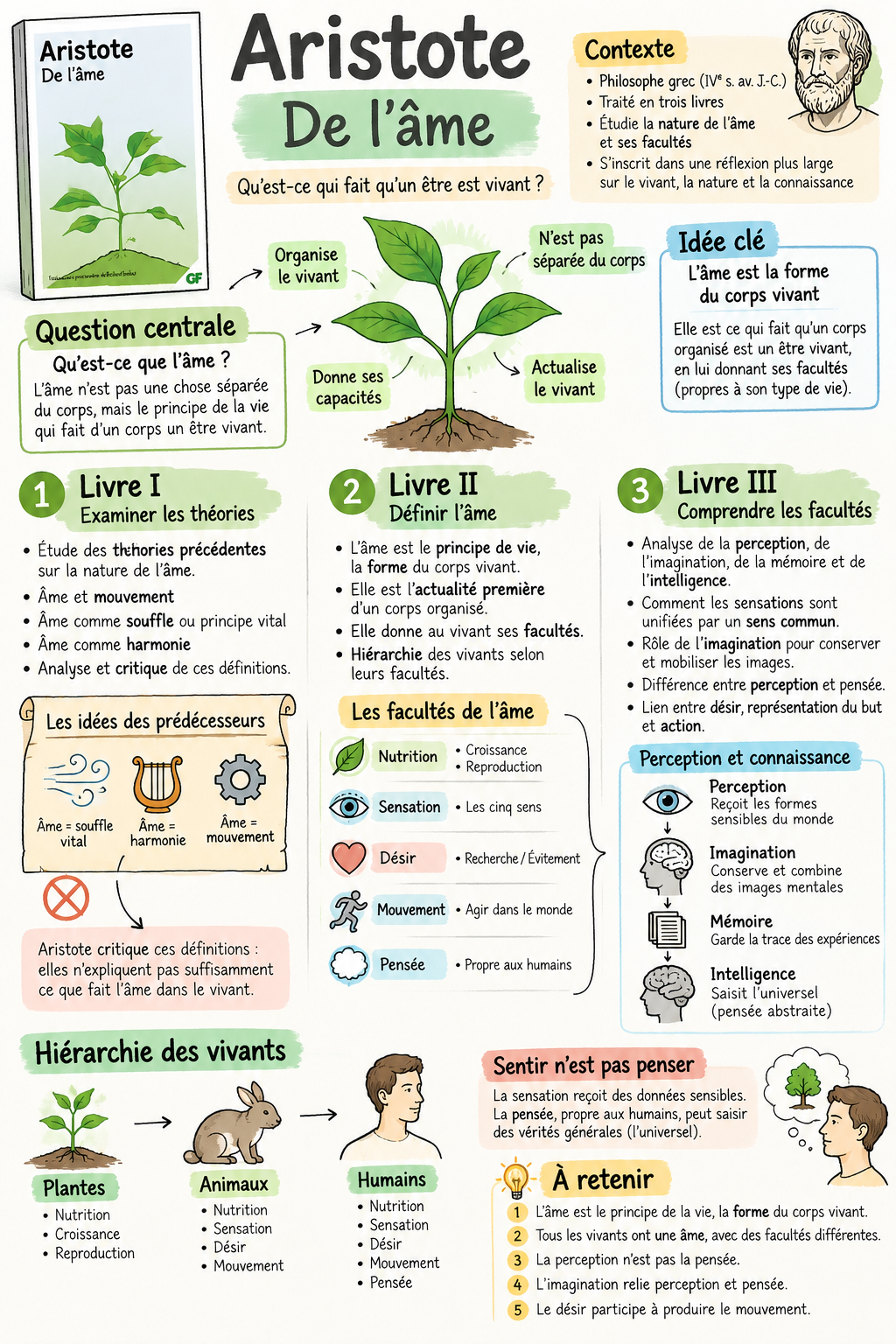
In On the Soul, Aristotle develops a fundamental investigation into the nature of living beings. His inquiry extends beyond the human mind to include plants, animals, and humans, seeking to understand what makes their different activities possible. The soul is therefore not regarded merely as the seat of thought or consciousness, but as the principle through which an organism possesses life.
This approach draws on several central concepts of Aristotelian philosophy, particularly the distinctions between matter and form, potentiality and actuality. Aristotle defines the soul as the first actuality of a natural, organized body possessing life potentially. The soul thus constitutes the form of a living being, explaining its organization and capacities without necessarily treating soul and body as two independent realities.
The treatise unfolds across three books. The first examines earlier theories concerning the nature of the soul, particularly those associating it with movement or knowledge. The second establishes Aristotle's definition and investigates vital functions and the mechanisms of sensation. The third explores perception, imagination, intellect, and animal movement in greater depth.
This progression places the study of the soul within an approach that is both philosophical and naturalistic, in which understanding human thought also requires examining the faculties of living beings.
Key Takeaways
One of the treatise's essential contributions is its distinction between several faculties of the soul. Nutrition and reproduction belong to the fundamental functions of life; sensory perception characterizes animals; and intellectual thought distinguishes human beings. These faculties form a hierarchy in which more complex capacities presuppose certain elementary functions.
Aristotle devotes particular attention to sensory perception. He seeks to explain how the sense organs receive the sensible qualities of objects without receiving their matter. This analysis allows him to distinguish the activity of the senses from imagination and, subsequently, from intellectual thought.
The question of intellect occupies a particularly important position. Aristotle distinguishes between the intellect capable of receiving intelligible forms and an intellectual principle that makes them available to thought. The interpretation of this complex distinction remains one of the major philosophical debates surrounding the treatise.
Conclusion
On the Soul is a major work of ancient philosophy, bringing together metaphysics, natural philosophy, and the theory of knowledge. By defining the soul through the functions of living beings, Aristotle establishes a conceptual framework that profoundly influenced later reflections on the relationship between body and mind.
Its legacy can be traced throughout medieval philosophy and the history of psychology, while its analyses of perception and intellect continue to occupy an important place in Aristotelian scholarship.
Good to Know
- The treatise is also known by its Latin title De anima and consists of three books.
- For Aristotle, the term "soul" has a broader meaning than in everyday usage: it applies to all living beings, not exclusively to human consciousness.
- The passages concerning intellect, particularly in the third book, have inspired divergent interpretations in Greek, Arabic, and Latin philosophical traditions.
- The edition published by Vrin includes a French translation by Jules Tricot.