How can we understand the diversity of the animal world and the characteristics that distinguish different species? In History of Animals, Aristotle undertakes an extensive investigation into living creatures, their bodily structures, behaviors, and methods of reproduction. He compares terrestrial and aquatic animals, examining their organs, movements, feeding habits, and relationships with their environments. By identifying similarities and differences between species, he develops a method of observation and classification intended to organize knowledge of nature. This exploration of living beings represents one of the earliest major systematic investigations in zoology and helps establish the foundations of biological inquiry in ancient philosophy.
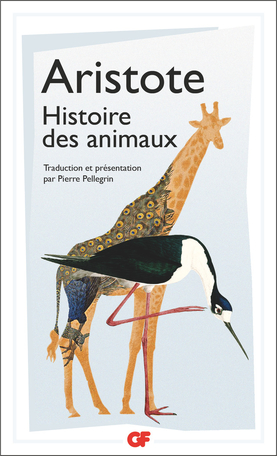
Aristotle: History of Animals
- Flammarion Publisher
- Gallimard Publisher
- Librairie philosophique J. Vrin Publisher
- Les Belles Lettres Publisher
- Denoël Publisher
- Aristote Author
How can we observe, compare, and understand the extraordinary diversity of the animal world?
Details
- Type
- Book
- Original language
- Greek
- Genres
- Philosophy
- ISBN
- 9782070387793
- Information verified on
- 14 octobre 2026
Synopsis
Aristotle: History of Animals
Overview
Overview
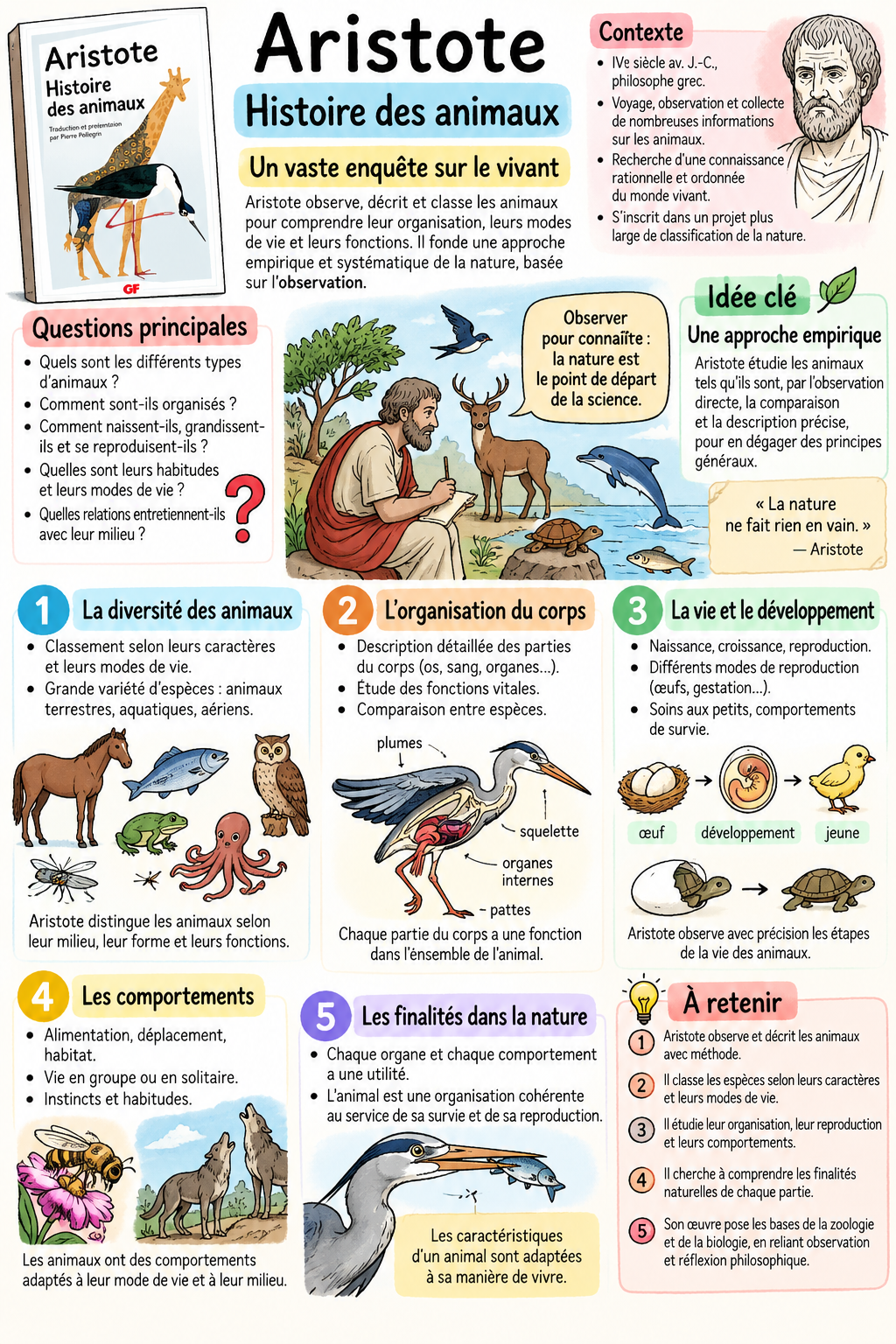
In History of Animals, Aristotle undertakes a systematic study of the diversity of living creatures. Unlike his treatises primarily devoted to the general principles of nature, this work gathers and organizes observations concerning animals, their physical characteristics, and their ways of life. His objective is to identify similarities and differences among living beings in order to better understand their organization and the phenomena that characterize them.
The investigation follows a comparative approach. Aristotle examines body parts, organs, tissues, and animal functions, distinguishing in particular between animals possessing blood and those considered bloodless according to the criteria of his time. He studies body shapes, limbs, methods of movement, and sensory organs. These observations encompass terrestrial animals as well as fish, birds, insects, and various marine species.
Considerable attention is devoted to reproduction and development. Aristotle compares the different ways animals produce offspring, particularly egg-laying and live birth, and examines the transformations accompanying their growth. He also investigates differences between males and females, reproductive seasons, and the conditions under which new generations emerge.
The work also explores animal behavior. Aristotle describes feeding habits, seasonal movements, habitats, and relationships with other species. He takes particular interest in migration, hibernation, forms of social organization, and behaviors associated with finding food. Certain observations reveal especially close attention to marine animals and insects, including bees.
This accumulation of knowledge is more than a simple collection of descriptions. Aristotle seeks to establish a method that moves from observing facts toward investigating their causes. From this perspective, History of Animals provides a descriptive foundation for the inquiries developed in other biological treatises, particularly Parts of Animals and Generation of Animals.
Key Takeaways
One of the essential contributions of History of Animals lies in its emphasis on observation and comparison. Aristotle studies living creatures through their shared characteristics and differences rather than describing them exclusively as isolated individuals. This approach contributes to the development of a systematic investigation of the animal world.
The distinction between animals with blood and those considered bloodless occupies an important place in his organization of living creatures. It allows different groups to be brought together according to anatomical characteristics, although these categories do not correspond exactly to modern biological classifications. Aristotle also examines similarities between organs performing comparable functions in different animals.
The study of reproduction, development, and behavior constitutes another fundamental aspect of the treatise. Methods of reproduction, feeding habits, movement, and relationships between species are treated as characteristics that help explain animal diversity. This approach extends the investigation beyond anatomy alone.
Finally, the work distinguishes the description of facts from their causal explanation. Aristotle first seeks to establish what characterizes animals before examining why they possess particular structures or perform certain functions. This connection between observation and explanation occupies a decisive place in his conception of scientific knowledge.
Conclusion
With History of Animals, Aristotle develops one of the earliest major systematic investigations devoted to the animal world. By organizing knowledge according to anatomical characteristics, reproductive methods, and behavior, he establishes a comparative approach that would make a lasting contribution to the history of zoology.
The treatise exerted considerable influence on ancient and medieval naturalist traditions. Although several of its descriptions and interpretations have been corrected or abandoned by modern science, the work reflects an effort to understand living beings through observation, comparison, and the investigation of natural causes.
Good to Know
- History of Animals, also known by its Latin title Historia animalium, is traditionally transmitted in ten books. However, the authenticity of the tenth book remains a subject of scholarly debate.
- Aristotle studies a wide variety of animals, including mammals, birds, fish, insects, and marine creatures, paying particular attention to their anatomical and behavioral differences.
- His biological investigations continue in several other works, particularly Parts of Animals, Generation of Animals, and Movement of Animals.
- Some descriptions are based on direct observations, while others derive from reported accounts and transmitted knowledge. Several claims have proved inaccurate in light of subsequent scientific research.
- The French edition published by Gallimard, in the Folio essais collection, features a translation from ancient Greek by Janine Bertier.