

Overview
A Bethesda Game Studios title often begins with an emergency.
An emperor has just died. A dragon threatens the world. A nuclear vault opens onto a ruined civilization. A mysterious artifact is waiting somewhere in space.
Then the player notices a cave, an abandoned house, a mountain, or simply a road heading in the wrong direction.
And suddenly, the emergency can wait.
That is probably where Bethesda Game Studios becomes easiest to recognize.
The American studio develops The Elder Scrolls, Fallout, and Starfield, three very different universes built around the same fascination: creating worlds open enough for the player to decide what deserves their attention. The official website currently presents Bethesda Game Studios as the development team behind these three major lineages, with operations spread across Rockville, Montreal, Austin, and Dallas.
The current entity was established in 2001, when development activities were separated from Bethesda Softworks, which retained the publishing role. That administrative date does not mark the true beginning of its creative history, however: the team Bethesda Game Studios descends from was already working on the first The Elder Scrolls games within Bethesda Softworks during the 1990s.
That distinction explains why Bethesda Game Studios’ official catalog traces its lineage back to The Elder Scrolls: Arena in 1994 and Daggerfall in 1996, years before the Bethesda Game Studios name existed independently. Todd Howard himself joined Bethesda Softworks in 1994 and worked notably on Daggerfall before going on to lead several of the productions that would later define the studio.
Over the decades, the scale changes dramatically. The territories of Tamriel become more detailed, Fallout brings its post-apocalyptic America, the studio experiments with mobile gaming through Fallout Shelter, turns Fallout into an online experience with Fallout 76, and eventually creates with Starfield its first new universe in more than twenty-five years.
Yet beneath all these transformations, one idea remains surprisingly stable.
Bethesda Game Studios rarely builds its worlds as a sequence of corridors leading neatly from one event to the next. Instead, it fills them with places, characters, objects, quests, and interacting systems, then lets the player generate part of the experience by deciding where to go, what to touch, and how long to ignore the main quest.
At Bethesda Game Studios, the world is not merely the backdrop for the adventure. It is often the machine that allows the player to build one of their own.
History
Before 2001: the studio exists before its name
The history of Bethesda Game Studios begins before Bethesda Game Studios.
During the 1990s, Bethesda Softworks still operated as a structure in which development and publishing were far less clearly separated. It was in this environment that The Elder Scrolls: Arena appeared in 1994, followed by The Elder Scrolls II: Daggerfall in 1996. Bethesda Game Studios’ current catalog directly includes both games in its own history.
Those early Elder Scrolls titles already establish several foundations that will endure: vast territories, character creation, numerous progression systems, and above all an unusual ambition for player freedom. Daggerfall pushes this approach toward an enormous 3D world that can be explored extensively.
The modern studio formula is not there yet, but the direction is already visible.
Bethesda is less interested in guiding the player perfectly than in giving them enough room to get lost.
That fascination will survive changes in teams, technology, and console generations.
2001: giving the developer and publisher different names
In 2001, Bethesda Game Studios becomes a distinct entity responsible for development, while Bethesda Softworks retains the publishing role. The separation helps clarify a confusion that had become deeply rooted: until then, the Bethesda name was used both for the company developing the games and the company publishing them.
The creation of Bethesda Game Studios therefore does not mean that an entirely new team suddenly appears without a past.
It gives an official identity to the development core already operating inside Bethesda Softworks.
The change arrives just as that team is preparing a decisive project.
Morrowind.
Morrowind: the project that could not really afford to fail
The Elder Scrolls III: Morrowind was released in May 2002.
The official twentieth-anniversary retrospective describes it as a particularly risky moment for the studio, presenting the project as one capable of determining its future. Bethesda was still a much smaller company, and Morrowind attempted to push technology, exploration, and environmental storytelling forward at the same time.
The island of Vvardenfell marks an important break from the more abstract immensity of Daggerfall. The territory is far more concentrated but also much more deliberately handcrafted, with recognizable cultures, architecture, towns, and landscapes.
Freedom remains central, but it becomes denser.
The player can follow the main quest, join several factions, explore ruins, manipulate the game’s systems, or simply head toward something that happened to look interesting a few minutes earlier.
Morrowind also becomes a gateway to a new audience through its release on the original Xbox. For a studio historically associated with PC, seeing such an open-ended RPG work on a console is a decisive step and begins a long relationship with Microsoft.
The studio discovers something it will continue exploring for years: a complex world can reach a much larger audience without necessarily becoming a completely different game.
Oblivion: making the world more accessible without closing it down
With The Elder Scrolls IV: Oblivion, released in 2006, Bethesda Game Studios changes scale again.
The game pushes visual presentation, characters, everyday simulation, and accessibility much further. It becomes one of the important titles of its generation and is one of the four productions the studio currently highlights among its games recognized with major Game of the Year awards.
This period reveals a balance Bethesda will repeatedly revisit.
An open RPG can easily accumulate enough rules, statistics, objects, and possibilities to become difficult to read. But simplifying too aggressively risks removing precisely what makes the player feel as though they are inhabiting a world rather than following a ride.
Bethesda therefore tries to make its systems more accessible while preserving a considerable amount of freedom.
Oblivion prepares the ground for an even larger evolution.
Not another region of Tamriel.
Another universe.
Fallout 3: becoming something else without losing the studio’s grammar
When Fallout 3 is released in 2008, Bethesda Game Studios is working with a franchise that already has a history of its own.
Fallout existed long before Bethesda. Its dark humor, retrofuturism, SPECIAL system, and moral choices already formed a strong identity.
Yet the studio does not simply reproduce the older entries using newer technology.
It applies to Fallout much of the grammar it had developed with The Elder Scrolls: first- or third-person exploration, a large open territory, freely discovered locations, and characters and quests distributed throughout the world. The official website still presents Fallout 3 as one of the studio’s major historical titles.
The result demonstrates something important.
Bethesda Game Studios is no longer simply “the team behind The Elder Scrolls.”
The studio now has a recognizable way of building an RPG that can be transported into another world without making the two universes identical.
Tamriel can remain Tamriel.
The Wasteland can remain Fallout.
Between them runs the same obsession with player freedom.
Skyrim: when a world becomes almost a cultural place
The Elder Scrolls V: Skyrim was released in 2011.
The game becomes one of the most important productions in Bethesda Game Studios’ history. The studio still emphasizes its longevity today: in a July 2026 communication, Bethesda stated that more than 65 million copies had been sold and that players were still exploring Skyrim fifteen years after release.
That longevity does not come only from the amount of content present on launch day.
Skyrim gradually becomes a space that is constantly reinterpreted.
Re-releases allow the game to cross several generations of hardware, while the community spends more than a decade producing graphical modifications, weapons, systems, locations, and complete quests. Bethesda explicitly presents this community activity as a lasting extension of the Skyrim experience.
The phenomenon perfectly illustrates the studio’s particular relationship with its worlds.
Bethesda builds an enormous amount.
Then the players keep going.
Some finish the main story.
Others install two hundred mods and spend three hours choosing a chair texture.
Both behaviors somehow fit the same philosophy.
Fallout 4: building becomes a central mechanic
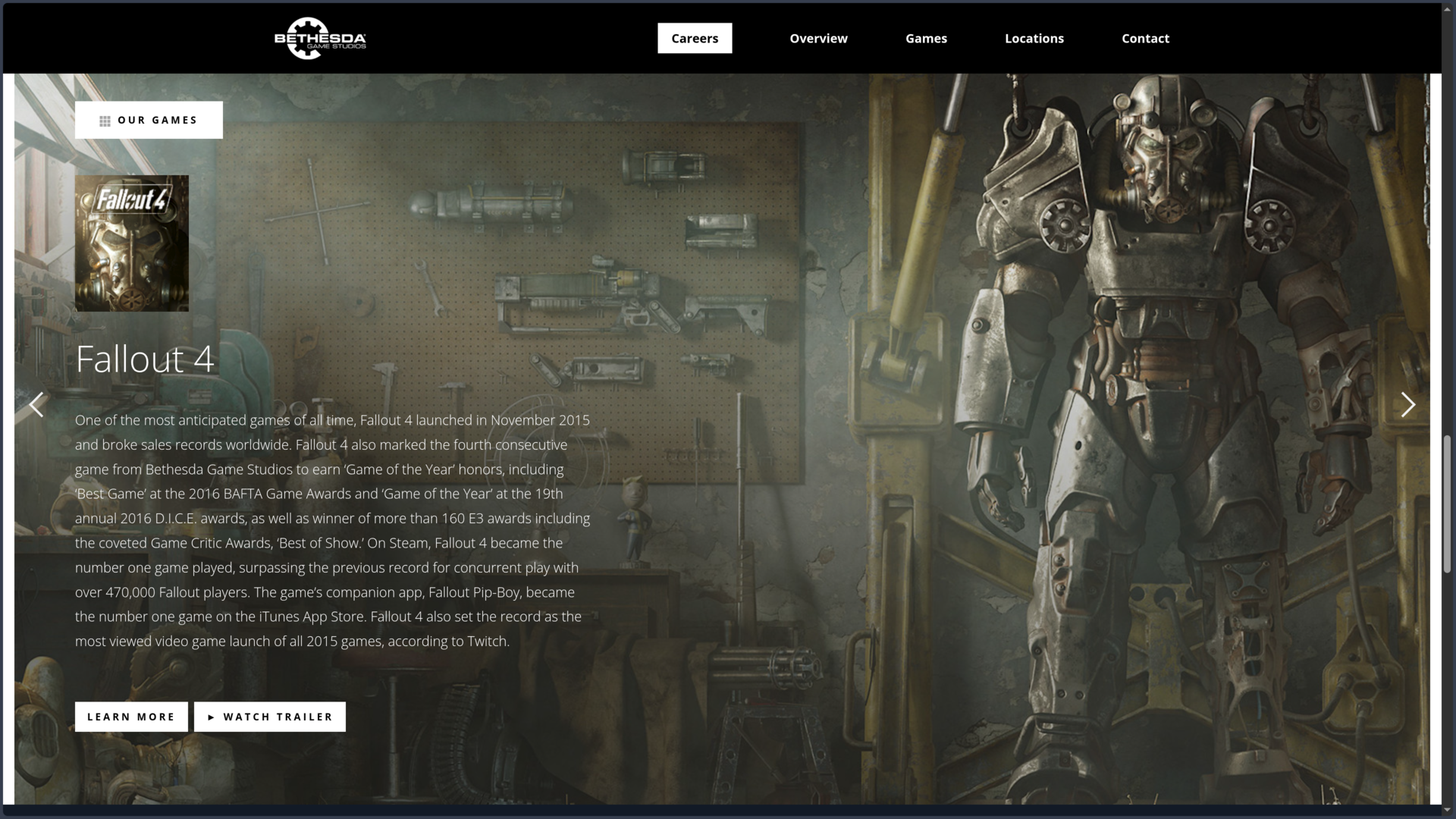
Fallout 4 was released in 2015.
The studio retains the major foundations of Fallout 3 while developing crafting, weapon modification, and especially settlement building much further.
That evolution gives almost literal form to an idea that had existed at Bethesda Game Studios for years.
The player no longer merely explores an environment.
They can begin transforming it.
Objects recovered from ruins become materials. An abandoned place can become a settlement. A weapon can change in form and function through modifications.
One Bethesda Game Studios artist explained that the idea of making weapons deeply modular forced the team to think simultaneously about how they looked and how they behaved, showing how crafting systems could directly change the way the game is played.
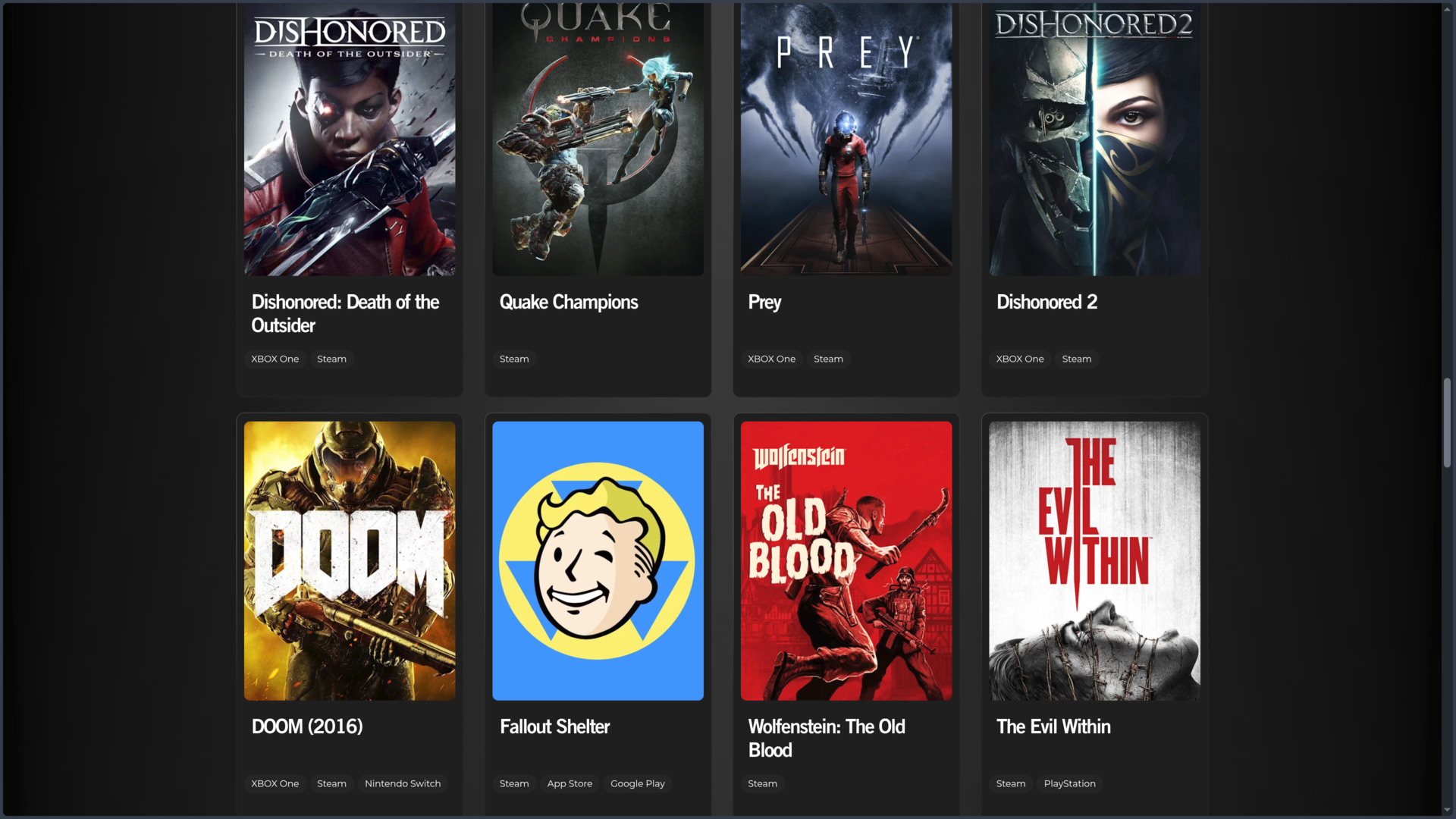
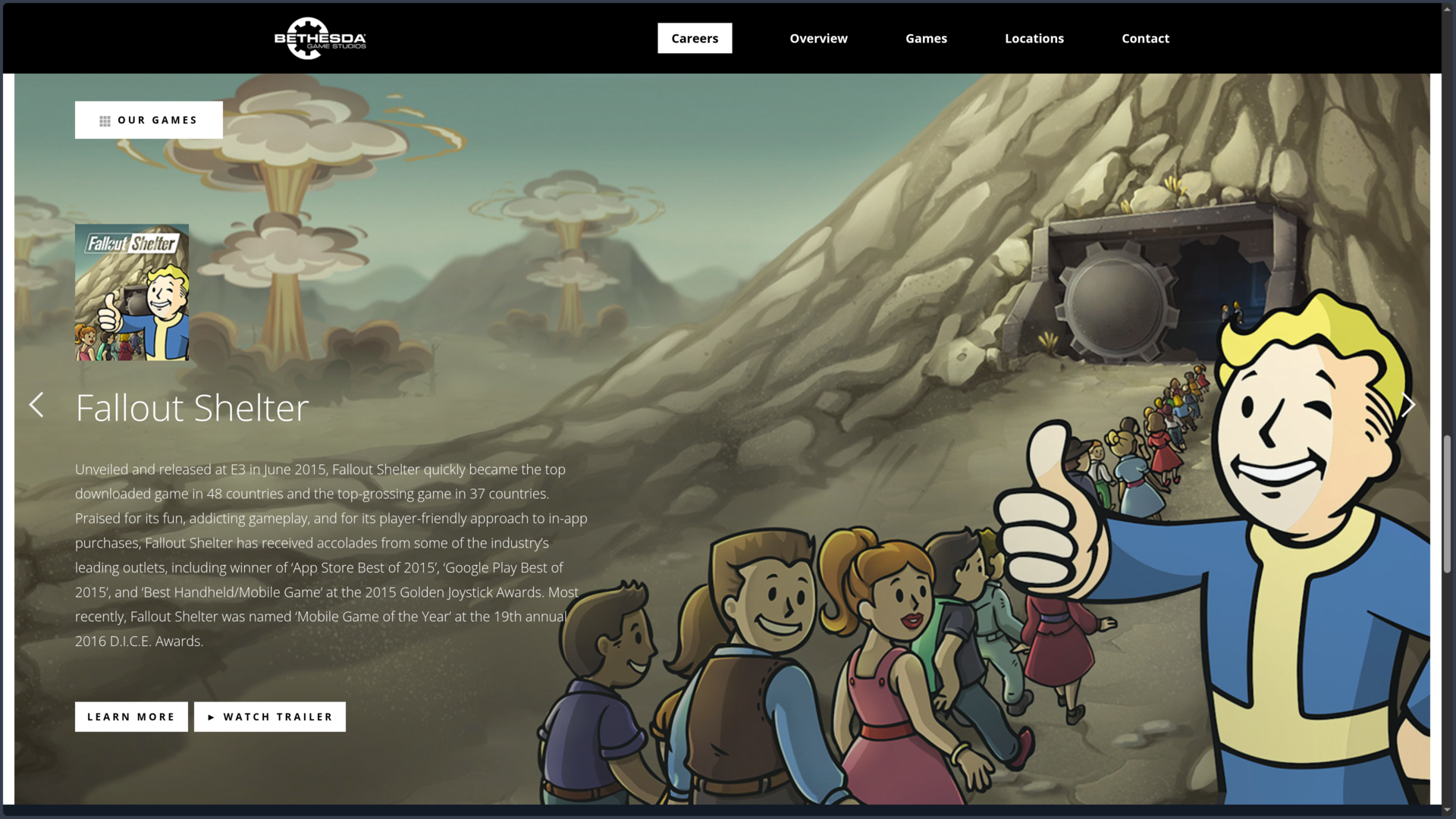
That same year, Fallout Shelter also shows that the studio can step outside its enormous traditional RPGs to experiment on mobile. The title remains part of Bethesda Game Studios’ official catalog today.
2015-2018: one team becomes a network of studios
For a long time, Bethesda Game Studios was primarily associated with its Maryland team.
That organization begins to change in 2015 with the opening of Bethesda Game Studios Montreal. The studio states that the expansion is intended to increase its development capacity across console, PC, and mobile.
In March 2018, Austin-based BattleCry Studios joins Bethesda Game Studios and becomes Bethesda Game Studios Austin. Bethesda explicitly explains that the integration is meant to support the increasing scale and ambition of its future games.
A few months later, the Escalation Studios team in Dallas is also integrated into Bethesda Game Studios. The group had already worked on several productions within the wider ZeniMax family and was contributing to Fallout 76 and Starfield at the time.
The studio therefore gradually changes in nature.
It is no longer simply one main team surrounded by occasional partners.
Bethesda Game Studios becomes a distributed organization capable of making several locations collaborate on the same worlds.
The official website still identifies Rockville, Montreal, Austin, and Dallas as its four main locations today.
Fallout 76: the world has to keep going when the player returns tomorrow
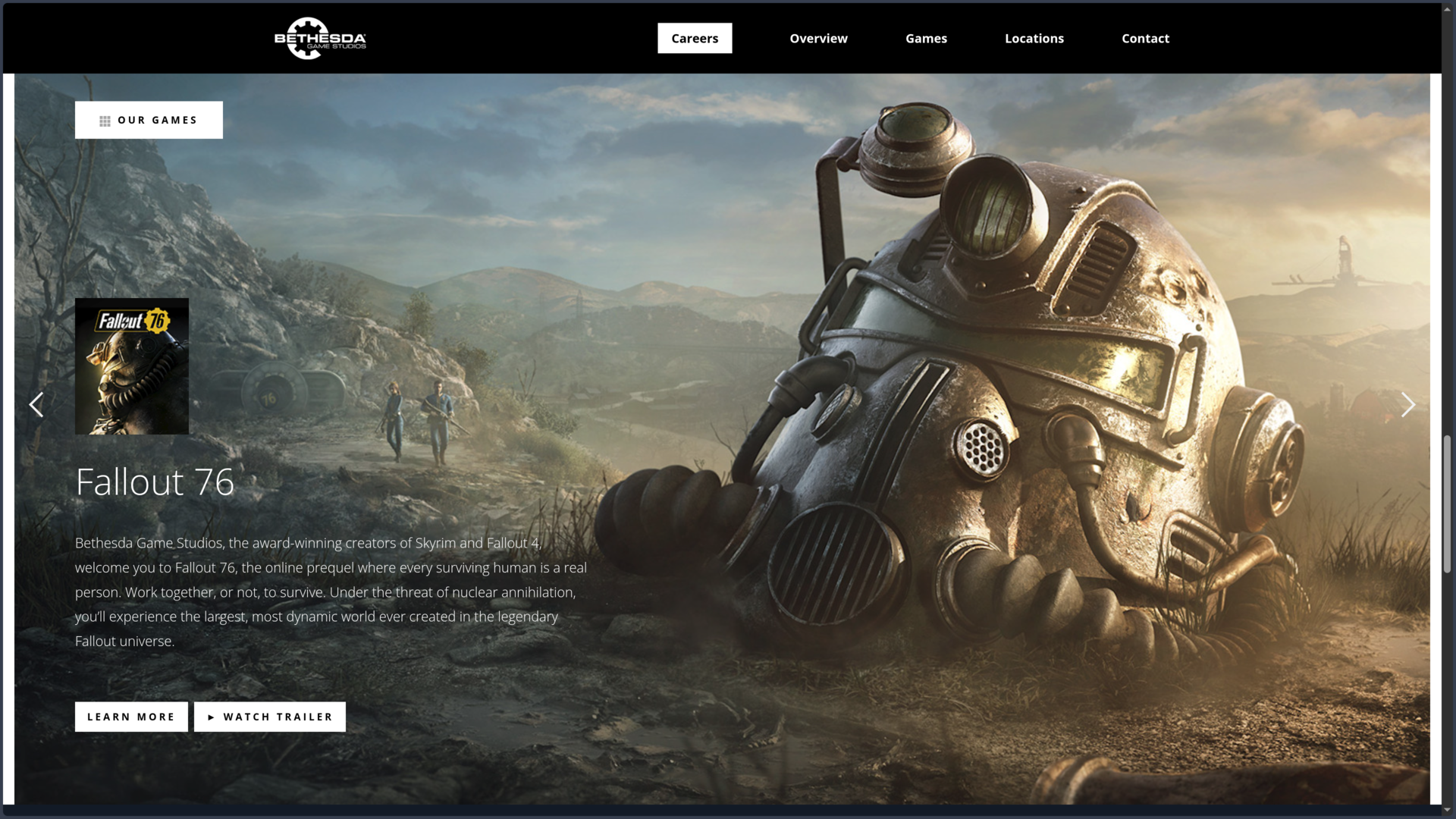
Fallout 76 was released in 2018 and forces Bethesda Game Studios to work with a logic very different from its traditional large-scale solo productions.
This time, the Wasteland becomes a shared world designed to evolve over time.
The change is significant.
In a classic single-player RPG, the player can reshape their experience deeply at their own pace. In an online game, the studio must also maintain shared systems, produce updates, evolve the content, and continue operating the world years after launch.
Bethesda Game Studios is still actively doing that work in 2026, with the official site and Bethesda.net regularly publishing new updates for Fallout 76.
The experience also changes the way the studio’s different teams collaborate.
Austin, in particular, plays an important role in the project’s history, and several developers from that location continued working on updates after release.
The studio therefore discovers a new kind of timeline.
Building a world is no longer only about spending years preparing it before launch.
It also means learning how to keep it alive after the players have entered it.
2021: joining Microsoft without becoming Xbox Game Studios
On March 9, 2021, Microsoft completed its acquisition of ZeniMax Media.
Bethesda Game Studios therefore joined the Xbox ecosystem alongside other studios in the group, including id Software, Arkane, MachineGames, and ZeniMax Online Studios.
The integration does not turn Bethesda Game Studios into just another interchangeable brand inside Microsoft.
The studio keeps its name, teams, and franchises.
More importantly, the acquisition extends a relationship with Microsoft that was already much older. Todd Howard noted in 2020 that Bethesda had worked closely with Xbox since the console’s early years, especially when Morrowind helped bring its RPGs into the console space.
The story therefore forms a fairly natural loop.
The technology partner from the early days of Morrowind becomes, almost twenty years later, the owner of the wider group.
Starfield: building a new world after twenty-five years
With Starfield, released in 2023, Bethesda Game Studios does something it had not done in more than twenty-five years: launch a major new universe.
The studio officially describes Starfield as its first new property of this scale in more than a quarter of a century.
Science fiction replaces the fantasy of Tamriel and Fallout’s nuclear retrofuturism.
But the Bethesda grammar is immediately recognizable.
The player creates a character, explores freely, meets different factions, accumulates objects and missions, and can spend an enormous amount of time on activities the main quest never requires.
The ship itself becomes a customizable space.
Outposts extend the construction systems.
Planets multiply the spaces available for exploration.
Starfield therefore demonstrates that Bethesda Game Studios can change its fictional universe without abandoning its fundamental idea of the RPG.
The studio is not simply trying to tell a story in space.
It is trying to build a space large enough for the player to begin telling their own story alongside it.
2026: three worlds now have to move forward together
Bethesda Game Studios’ current situation is particularly interesting because the studio is no longer working around one dominant franchise at a time.
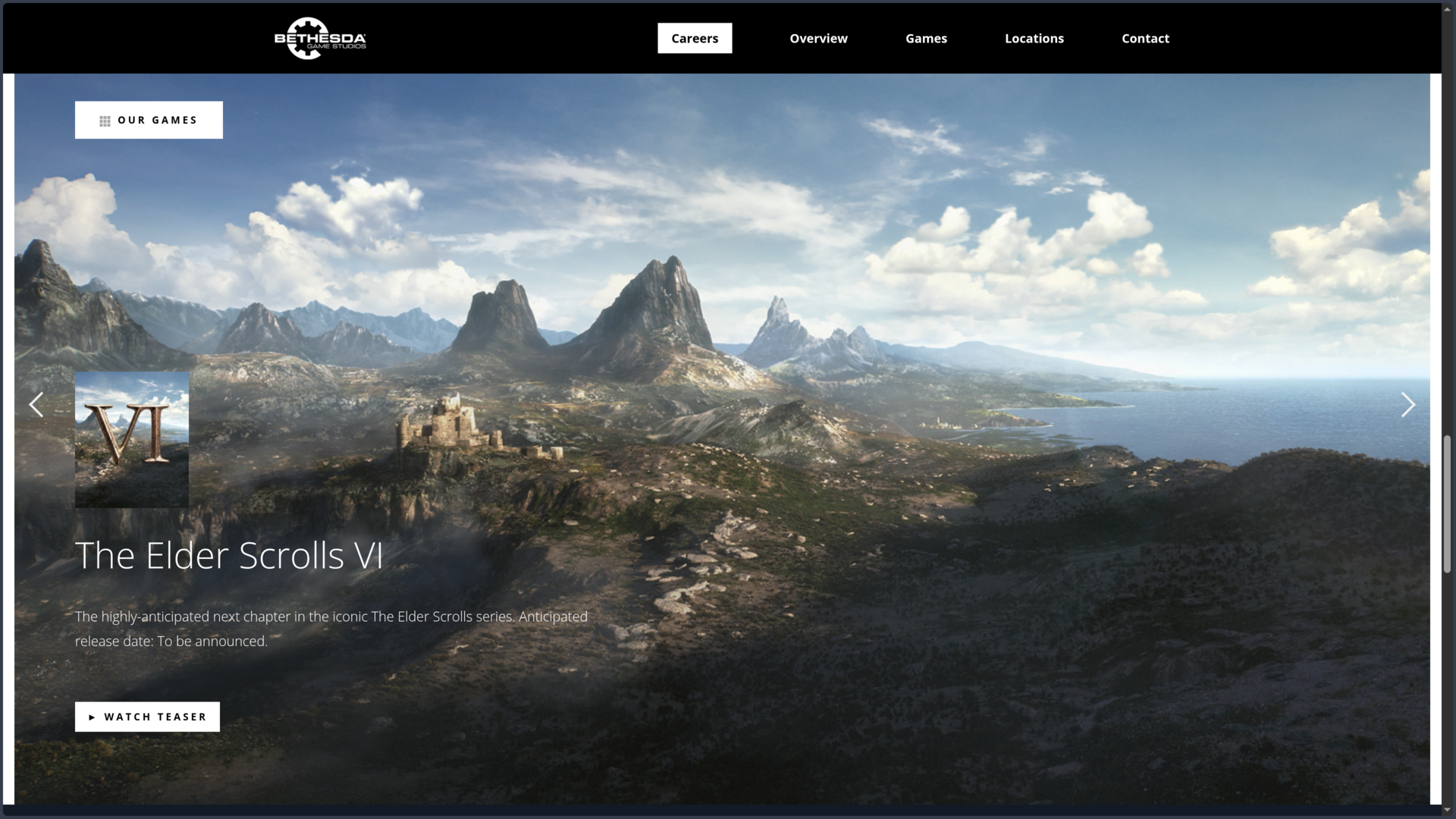
In an official communication published on July 17, 2026, Bethesda Game Studios outlined its main priorities. The Elder Scrolls VI is now its principal development project and occupies the majority of the team. Fallout 5 is in pre-production, while Starfield continues to receive new stories, improvements, and content.
The studio also states that it wants to bring its teams closer together and invest in new tools so it can support several projects simultaneously more effectively.
That is a major evolution for a team long known for spending many years on one enormous RPG before moving on to the next.
Bethesda Game Studios now has to maintain several timelines at once.
Skyrim is still being played fifteen years after release.
Fallout 76 continues to evolve.
Starfield remains in active development.
The Elder Scrolls VI becomes the main production effort.
And Fallout 5 already exists in the background.
The modern challenge for the studio is therefore no longer only to build one great world.
It is learning how to keep several worlds alive without each one having to wait for all the others to stop.
What sets it apart
The world before the itinerary
Many open games offer a large space.
Bethesda Game Studios is more interested in what happens when the player decides not to follow the intended route properly.
That philosophy runs through The Elder Scrolls, Fallout, and Starfield.
A city can contain several quests with no connection to the main story. An abandoned house can reveal a story of its own. An object sitting on a table can be picked up, moved, or sometimes become the first step in a story the developers never explicitly wrote.
The studio’s games obviously do not offer absolute freedom.
They contain rules, limits, scripts, and carefully designed narrative structures.
But Bethesda repeatedly tries to give the player enough latitude to decide in what order those elements are going to become important to them.
That freedom of attention contributes enormously to the personality of its games.
The main quest may announce the end of the world.
The player can still decide that it is time to pick mushrooms.
Building systems capable of meeting one another
That freedom works because Bethesda games do not rely only on their written quests.
They also combine numerous systems: inventory, factions, skills, physical objects, companions, economy, crafting, exploration, construction, and character reactions.
Not all of them are equally deep in every game.
But their coexistence regularly creates situations that do not need to have been scripted as a specific scene.
A fight attracts a creature.
An object falls.
A character intervenes.
The player uses an unexpected ability.
And an ordinary situation suddenly becomes memorable.
That is one of the fundamental differences between telling a story entirely through a script and building a world capable of generating small stories of its own all the time.
Bethesda Game Studios operates extensively in that second territory.
Changing universes without completely changing the grammar
The Elder Scrolls, Fallout, and Starfield do not tell the same kinds of stories.
Tamriel revolves around fantasy, cultures, and mythology.
Fallout turns the ruins of America into retrofuturist satire.
Starfield shifts exploration toward science fiction centered much more strongly on space discovery.
Yet the player repeatedly encounters familiar instincts.
Create a character.
Choose a direction.
Discover factions.
Accumulate objects that will probably be kept far too long.
Accept quests, then forget why you came there in the first place.
Explore a place simply because it exists.
Bethesda Game Studios therefore has less of a consistent visual style than a recognizable grammar of the open-ended role-playing game.
The setting changes.
The relationship with the world remains familiar.
Making the player an inhabitant rather than merely a visitor
Another distinctive aspect of the studio is the importance it gives to objects, homes, and personal spaces.
In Skyrim, the player can own houses.
Fallout 4 pushes the idea much further with settlements and construction.
Fallout 76 turns the C.A.M.P. into a personal space inside a shared world.
Starfield adds outposts and ship customization.
These systems do not exist only for progression.
They allow the player to begin leaving a mark on the world.
A generic location can become “my home.”
A prefabricated ship becomes “my ship.”
A settlement becomes a place the player has personally arranged.
That sense of ownership contributes enormously to the longevity of Bethesda RPGs.
The player is no longer simply crossing a map.
They begin leaving traces behind.
Modding extends the studio’s philosophy
That logic of ownership goes even further through modding.
Bethesda Game Studios has long maintained a strong relationship with the communities that modify its games, and the company continues to provide official tools such as the Creation Kit. In 2023, it reorganized part of that ecosystem under the name Bethesda Game Studios Creations, bringing existing mods, Creation Club content, and new creations together in one environment for Skyrim Special Edition.
That continuity is particularly revealing.
A Bethesda game already invites the player to bend its systems.
Modding simply takes the idea one level further.
The player no longer changes only their character.
They can change the game itself.
New quests, interfaces, environments, systems, characters, and visual transformations can extend the life of a production for years.
Bethesda obviously does not control all of that creativity.
And that is precisely why it matters.
Part of Skyrim’s cultural life now belongs as much to those who modify it as to those who originally built it.
One studio becoming several teams without losing a single public identity
Bethesda Game Studios currently operates across Rockville, Montreal, Austin, and Dallas. Montreal opened in 2015, Austin joined the organization in 2018 from BattleCry Studios, and Dallas became part of Bethesda Game Studios that same year through Escalation Studios.
This distributed organization responds directly to the increasing size and duration of modern projects.
A game like Starfield is no longer the work of a small team located in a single building.
Developers from several disciplines and several locations collaborate on the same systems.
Yet Bethesda Game Studios continues to be presented publicly as one creative studio.
That distinction from a collective such as PlayStation Studios is important.
Rockville, Montreal, Austin, and Dallas are not four brands each trying to develop a completely separate public identity.
They are different components of the same development organization.
Worlds designed to survive their launch
Bethesda Game Studios maintains its productions for unusually long periods.
Skyrim continues to be updated and expanded more than a decade after launch.
Fallout 76 remains an active live game.
Starfield enters its third year with new content announced.
This longevity is now explicitly part of the studio’s strategy: in July 2026, Bethesda stated that it wanted to support its worlds for longer and continue building them with their communities for decades.
That ambition changes the very meaning of release.
Launch is not necessarily the end of production.
It can become the moment when the world begins a second life with its audience.
Technology mainly serves to increase the space of possibilities
Bethesda Game Studios obviously develops its own technology to support its ambitions.
But what most distinguishes its games is not simply graphical spectacle.
The technology must support large quantities of objects, characters, systems, locations, and interactions that continue functioning while the player moves freely through the world.
That complexity can sometimes produce unpredictable situations.
It is almost inevitable when a game accepts so many variables at once.
But it also produces something difficult to recreate in a much more tightly controlled environment: the feeling that a world keeps existing even when the player does not follow the intended script exactly.
That is probably where Bethesda technology becomes most interesting.
Not when it simply displays an enormous landscape.
When it makes you want to touch it.
Player freedom remains a negotiation, not an absolute promise
The idea of freedom is central to Bethesda Game Studios’ identity, but it deserves some nuance.
None of its worlds is genuinely without limits.
Dialogue has predefined branches.
Quests have structures.
Characters operate according to defined systems.
Territories are designed by developers.
The studio therefore builds less a form of total freedom than a sufficiently rich illusion of possibilities.
That nuance does not weaken its work.
It explains it.
The craft lies precisely in preparing enough routes, systems, and reactions that the player regularly feels as though they invented their own way forward.
The best moment in a Bethesda RPG is therefore not always the one everyone else has seen.
Sometimes it is that strange little story the player later tells someone else, beginning with:
“I don’t even remember what I was supposed to be doing, but…”
Good to know
- Bethesda Game Studios was established as a distinct entity in 2001, when development activities were separated from Bethesda Softworks’ publishing role. Its creative lineage, however, goes back to the Bethesda teams that developed the first The Elder Scrolls titles during the 1990s.
- The studio is based in the United States and currently operates across four main locations: Rockville, Montreal, Austin, and Dallas.
- Bethesda Game Studios should not be confused with Bethesda Softworks. Bethesda Game Studios develops the games, while Bethesda Softworks primarily handles publishing within the Bethesda/ZeniMax organization.
- The Elder Scrolls: Arena was released in 1994 and Daggerfall in 1996, before Bethesda Game Studios officially existed as a separate entity, but both belong to the development lineage the studio claims today.
- The Elder Scrolls III: Morrowind was released in 2002 and represented a decisive moment for the studio’s future while also helping bring its large-scale RPGs to console through the Xbox version.
- Bethesda Game Studios later developed Oblivion, Fallout 3, Skyrim, and Fallout 4, four productions that its official website associates with major Game of the Year recognition.
- Fallout Shelter was released in 2015 and marked an important move into mobile gaming for the studio.
- Bethesda Game Studios Montreal opened in December 2015 to expand the studio’s development capabilities across console, PC, and mobile.
- BattleCry Studios joined Bethesda Game Studios in March 2018 and became Bethesda Game Studios Austin.
- Escalation Studios joined Bethesda Game Studios in August 2018 to form the Dallas team, after already contributing to several productions within the wider ZeniMax family.
- Fallout 76 was released in 2018 and remains Bethesda Game Studios’ principal experiment with a shared Fallout world operated over the long term. The game continues to receive updates in 2026.
- Microsoft completed its acquisition of ZeniMax Media on March 9, 2021, bringing Bethesda Game Studios into the Xbox family.
- Starfield was released in 2023 and represents Bethesda Game Studios’ first major new universe in more than twenty-five years.
- Bethesda Game Studios officially maintains an ecosystem for community creations, notably through the Creation Kit and Bethesda Game Studios Creations for titles such as Skyrim.
- In July 2026, Bethesda Game Studios stated that The Elder Scrolls VI had become its primary development project and was occupying the majority of the team.
- Fallout 5 is officially in pre-production in 2026, while the studio continues to develop and expand Starfield.
- The studio says it wants to improve collaboration between its different teams in order to support several projects in parallel and keep its major worlds evolving over longer periods.