Presentation
Fallout Shelter reverses the usual perspective of the series. Instead of playing as a resident leaving a Vault to discover the outside world, the player stays behind the door and must keep everything on the other side functioning.
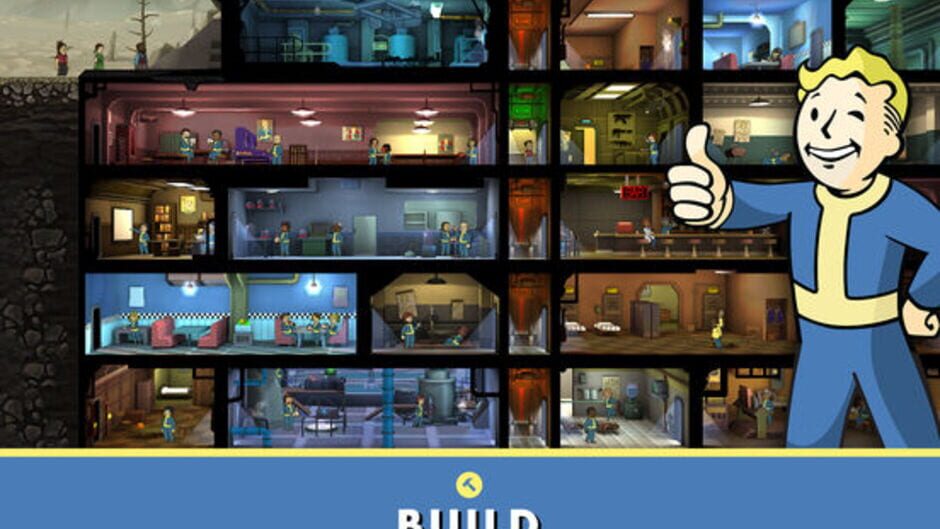
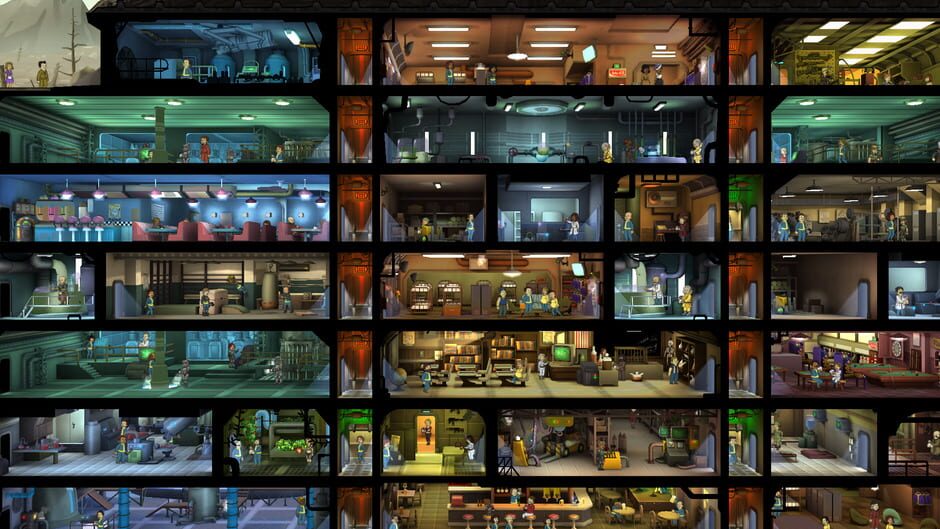
The Vault is built vertically into the rock. Each new room occupies a specific space and serves a purpose: producing electricity, purifying water, providing food, housing residents or developing other capabilities required by the community.
The three fundamental resources — power, water and food — structure the first decisions. Building more allows a larger population to be housed, but every expansion also increases the needs of the entire Vault. Growing too quickly can therefore turn an apparently prosperous facility into a shelter unable to sustain its own consumption.
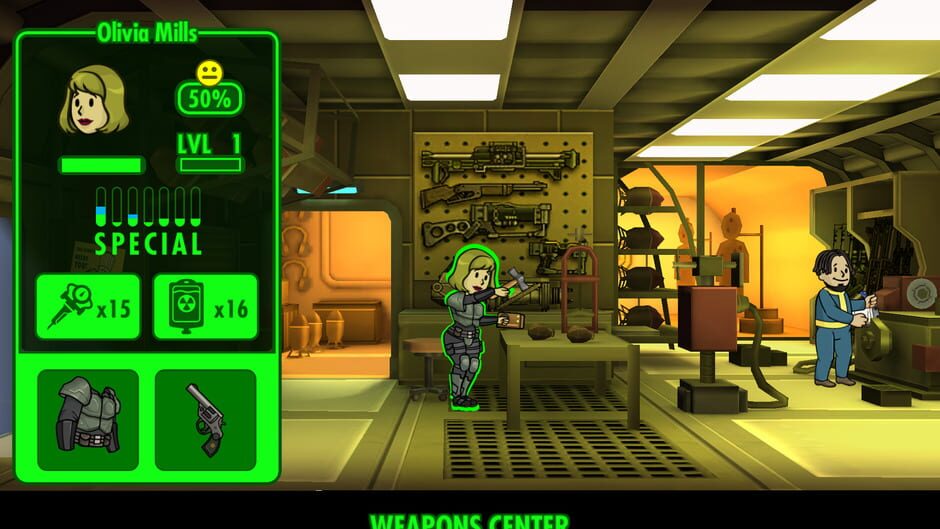
The residents are the real engine of this organization. Each has S.P.E.C.I.A.L. attributes that notably determine their effectiveness in different tasks. A particularly strong character will be better suited to certain facilities, while high Perception, Intelligence or Agility will be more useful elsewhere.
Assigning the right people to the right rooms therefore improves production without requiring extremely complex individual management. The system takes the RPG vocabulary of Fallout and turns it into a management mechanic.
Residents can gain experience, improve their statistics and receive weapons or outfits. The community therefore evolves both through the physical expansion of the Vault and through the development of the people living inside it.
The player must also decide when to speed things up. Certain rooms can be pushed to produce immediately through a “rush” attempt. Success quickly provides extra resources; failure can trigger an incident. This small risk-reward decision neatly summarizes part of the game’s design: saving time is possible, but rarely without consequences.
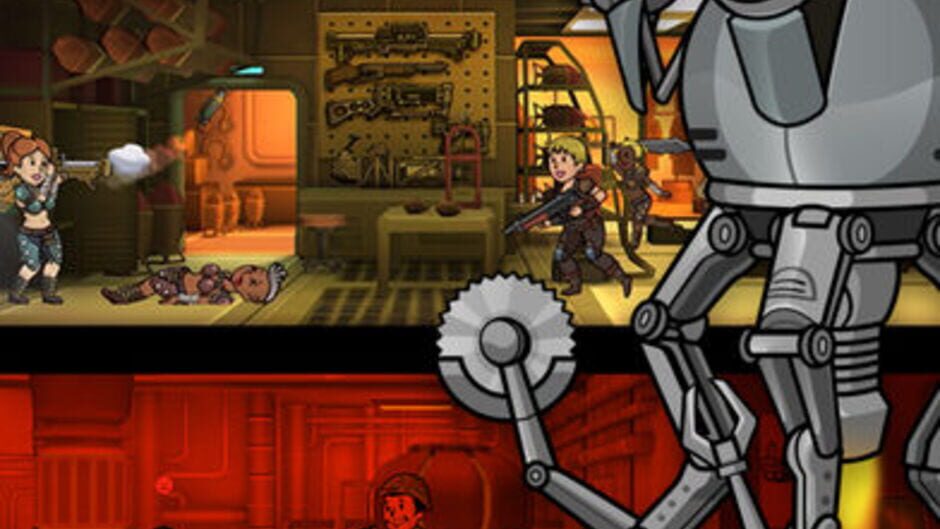
Incidents prevent the Vault from becoming a simple production line. Fires, infestations and attacks force the player to move residents and maintain enough equipment to respond when the routine breaks down.
The wasteland adds a second scale to this management. Residents can be sent to the surface to explore irradiated lands and recover weapons, outfits, caps and other resources. The longer they remain outside, the greater the potential rewards, but their survival also becomes more uncertain.
Quests later allow groups to be assembled and certain external locations to be visited directly. The player then encounters a simplified version of the series’ combat, with target selection, critical hits and character equipment, without Fallout Shelter ever ceasing to be primarily a management game.
The visual style plays a major role in the identity of the experience. Each room appears as a small animated cross-section in which residents work, talk or react to incidents. Vault-Tec’s cheerful advertising imagery therefore constantly coexists with the far less reassuring reality of the situation.
This contrast allows the game to recover the dark humor of Fallout with very little traditional storytelling. Everything looks clean, organized and cheerfully presented by Vault-Tec, while the player is literally managing a population sealed beneath several meters of rock after a nuclear catastrophe.
Fallout Shelter ultimately works through a very readable loop: produce, build, welcome, improve, explore, then repeat at a slightly larger scale. Its initial simplicity makes the system easy to enter, while the gradual increase in population multiplies the small decisions required to keep the shelter stable.
What to remember
- A management game in which the player becomes Overseer of a Vault-Tec Vault.
- Underground construction organized around rooms dedicated to production, housing and community development.
- Three fundamental resources to balance: power, water and food.
- Residents with their own S.P.E.C.I.A.L. attributes, to be assigned to tasks matching their abilities.
- Incidents and attacks capable of disrupting the daily operation of the Vault.
- The ability to send residents into the wasteland or assemble teams to complete quests.
- A lighter and more accessible adaptation of the Fallout universe, focused more on managing a community than exploring a vast RPG world.
Conclusion
Fallout Shelter starts from an almost obvious idea for the series: before anyone can leave a Vault, someone first has to keep it running.
That shift in perspective is enough to transform the vocabulary of Fallout. S.P.E.C.I.A.L. statistics become assignment criteria, weapons are used as much to defend a room as to explore the wasteland, and residents replace the lone hero at the center of the experience.
The formula deliberately remains simpler than a large-scale management game. Production chains are easy to understand, resident organization stays readable, and much of the enjoyment comes from gradually improving a shelter that becomes increasingly large.
That accessibility also creates a degree of repetition. Once the main systems are understood, the game relies heavily on optimization, waiting for new production, developing the population and searching for better equipment. Incidents and expeditions add movement without fundamentally changing that loop.
But this simplicity suits its format well. A few rooms become a network, a few residents become a community, and every new expansion forces the player to reconsider an equilibrium that seemed secure.
Beneath its cheerful little simulation appearance, Fallout Shelter therefore recalls a fairly basic rule of the post-apocalypse: surviving the bomb was only the first step. You still have to manage to live together afterward.
Good to know
- Fallout Shelter was developed by Bethesda Game Studios.
- The game was initially launched on iOS on June 14, 2015, before arriving on Android and later on several PC and console platforms.
- It uses a free-to-play model and was originally designed as a mobile adaptation of the Fallout universe.
- The player takes the role of Overseer of their own Vault-Tec Vault rather than a protagonist with a predetermined story.
- Residents’ S.P.E.C.I.A.L. attributes influence their effectiveness in the different facilities of the Vault.
- Residents can be sent into the wasteland to obtain experience, caps and equipment.
- The game continued to receive new content after launch while keeping Vault management and development as its central principle.