Synopsis
Skyrim is going through a particularly unstable period. The High King is dead, a civil war opposes the Empire and the Stormcloaks led by Ulfric Stormcloak, and political tensions divide cities as much as families.
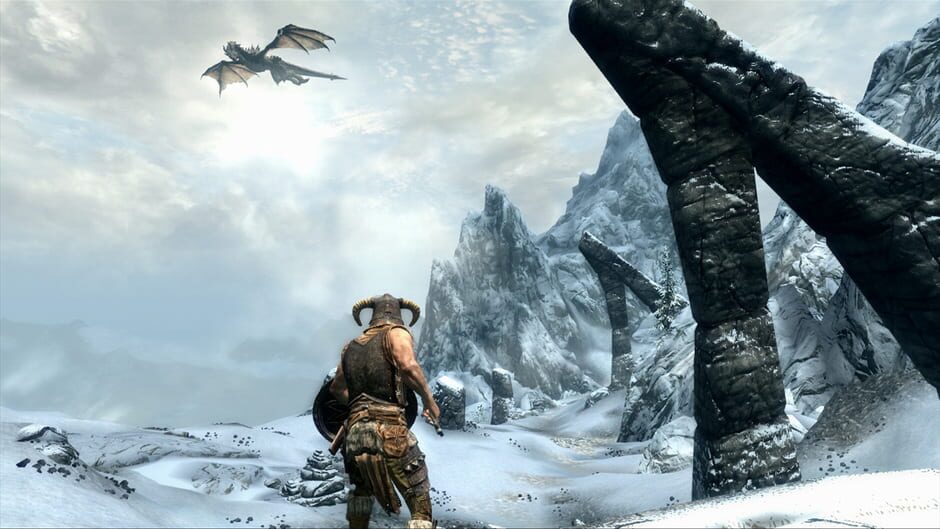
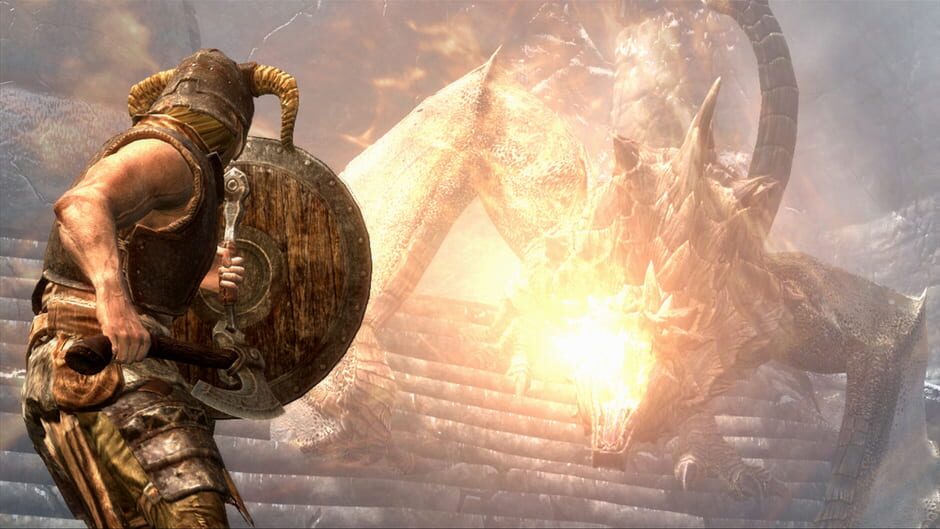
Then an even more worrying event is added to the crisis: dragons begin to return.
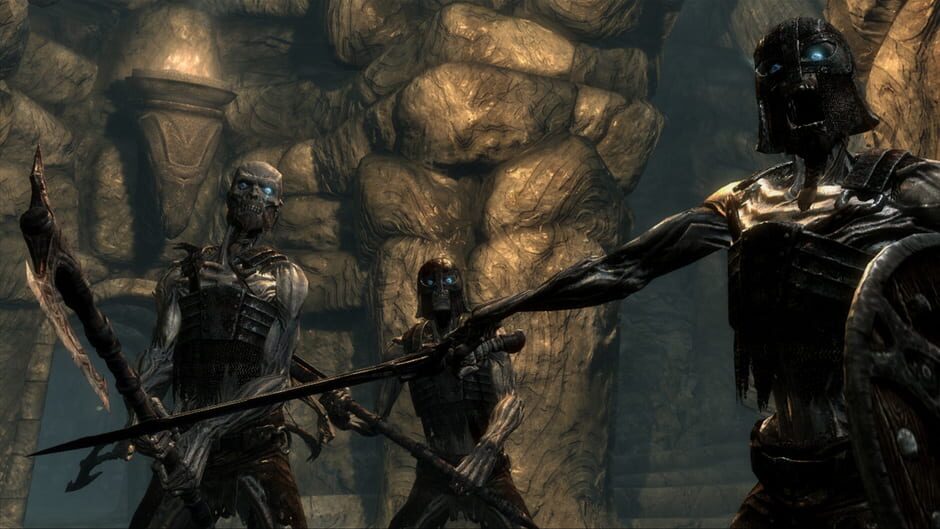
The player enters this situation under rather unglamorous circumstances. A prisoner being taken to an execution, they escape death when Alduin, a massive dragon tied to an ancient prophecy, attacks Helgen.
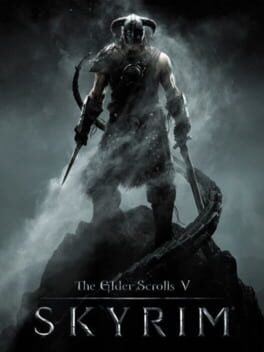
After surviving, the character discovers an exceptional ability: they can absorb the souls of dragons and use their language through Shouts, words of power capable of producing supernatural effects.
They are the Dragonborn, a figure foretold by ancient prophecies and directly connected to Alduin’s return. The Greybeards, living at the summit of High Hrothgar, soon summon the hero to teach them how to master the Voice and understand their role in the events threatening Skyrim.
That is the main story.
Skyrim, however, has a particular quality: the player can learn that the world is in danger, then decide that a cave spotted in the distance suddenly deserves much more attention.
And the game is perfectly happy with that change of plans.
Overview
A world built around curiosity
The Elder Scrolls V: Skyrim works first and foremost because of one very simple question: what is over there?
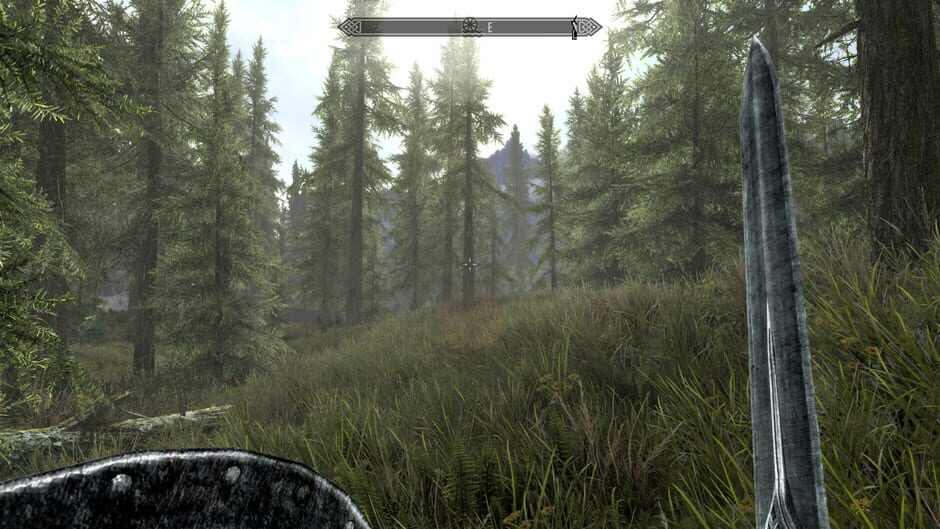
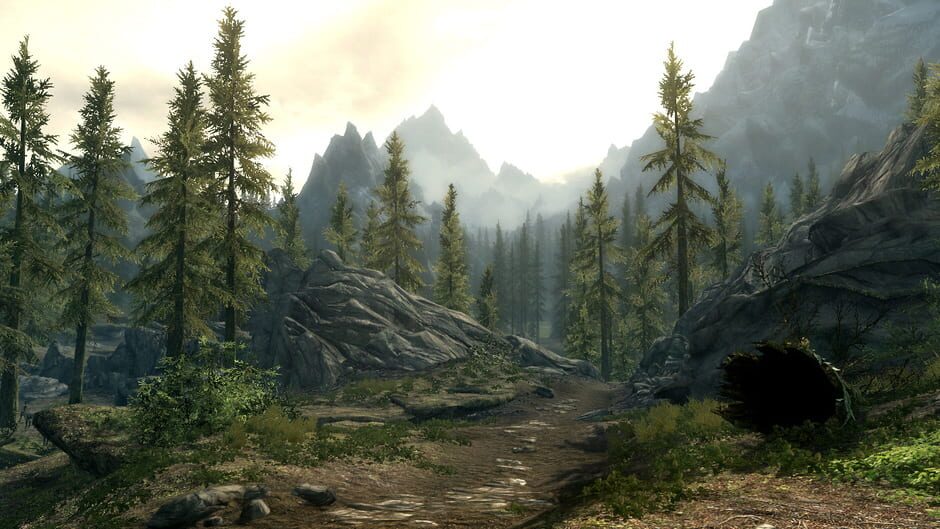
A road splits, a ruin appears behind a hill, a light can be seen in the distance or a silhouette draws the eye toward a mountain. The active quest can wait. The player goes to investigate.
Bethesda builds an entire province around that curiosity. Skyrim, in northern Tamriel, combines snowy mountains, tundra, forests, marshes, rivers, villages, fortresses, caves and ancient ruins.
Its main cities each have an instantly recognizable identity. Whiterun stretches across the plains, Solitude overlooks the coast, Riften hides among autumn colors, Markarth is built into Dwemer ruins, while Windhelm carries the political tensions of the civil war directly into its streets.
The world does not constantly try to create monumental spectacle. More often, it tries to give the player a reason to leave the road.
Becoming what you practice
Skyrim largely abandons traditional fixed classes. The character is not forced to remain a warrior, mage or thief because of a choice made at the beginning of the adventure.
Skills improve mainly through use. Fighting with a sword develops the corresponding abilities, casting spells improves schools of magic, while smithing, alchemy, enchanting, stealth, lockpicking, archery and speech all grow as the player practices them.
Perk trees then allow those skills to be specialized without completely locking the character into a single path.
You gradually become what you do.
That flexibility explains much of the RPG’s accessibility. A warrior can develop an interest in magic, a mage can learn heavy weapons, and a stealth-focused character can eventually abandon subtlety altogether.
It also explains one of Skyrim’s most famous phenomena: starting with a very clear character concept and ending dozens of hours later crouched behind a rock with a bow.
Several lives in the same playthrough
The main quest surrounding Alduin is only one part of the adventure. The player can participate in the civil war, join the Companions, the Thieves Guild, the Dark Brotherhood or the College of Winterhold, complete quests tied to the Daedric Princes or simply follow a story discovered by chance in an inn.
This structure creates the feeling of living several parallel lives within the same world.
Two players can spend the same amount of time in Skyrim and still remember completely different adventures. One may focus on politics, another on magic, another on guilds or dungeon exploration.
The game therefore does not rely only on the amount of content it contains. It relies on the freedom given to the player to decide what deserves their attention.
A world you can also stay in
That freedom extends beyond quests. Skyrim allows the player to buy a house, forge armor, brew potions, read books, gather plants or simply stop for a while inside an inn.
With Hearthfire, that domestic side expands further through house building and adoption.
These activities are not always especially deep systems, but they contribute to an important feeling: Skyrim is not only a territory to cross.
It is also a place where the player can develop habits.
Key takeaways
- Skyrim is the fifth main entry in The Elder Scrolls. Its story takes place roughly two centuries after The Elder Scrolls IV: Oblivion.
- The player is the Dragonborn, capable of absorbing dragon souls and using their language through Shouts.
- Alduin and the return of the dragons shape the main quest, but that storyline can be ignored for long stretches of time.
- Skyrim is a large open world made up of cities, villages, mountains, ruins, caves, forts and dungeons that can be explored freely.
- The character is not locked into a fixed class. Skills improve mainly when they are used.
- Many factions have their own storylines, including the Companions, Thieves Guild, Dark Brotherhood and College of Winterhold.
- The civil war pits the Empire against the Stormcloaks, and the player can join either side.
- Dawnguard, Hearthfire and Dragonborn are the three main official expansions.
- Modding plays a major role in the game’s longevity, particularly on PC.
- Skyrim has received many re-releases, including Special Edition, VR, Nintendo Switch and Anniversary Edition.
PANACHES review
The art of distracting the player
Skyrim remains remarkable for how easily it makes the player forget what they originally intended to do.
A quest points in one direction, but a cave appears. The cave leads to a book, the book mentions a ruin, and the road back introduces a dragon or a character with another problem.
That constant movement between exploration, encounters and new leads is one of the game’s greatest strengths. Skyrim obviously has a map and quest markers, but many of its best moments still come from the feeling of simply discovering something.
Exploration then feels less like a list of activities and more like a permanent distraction.
A world that is more livable than realistic
Skyrim has never been an especially convincing simulation. Some cities feel tiny, NPCs repeat their dialogue and the animations regularly reveal the age of the game.
And yet Skyrim works.
The reason probably has less to do with realism than with the possibility of developing a kind of everyday routine. A house, a familiar merchant, a companion, a favorite city or a route known by memory gradually gives the world a particular sense of familiarity.
You do not simply visit Skyrim; you often end up developing habits there.
That quality partly explains why returning to the game can still work after so many years and so many re-releases.
Systems that have aged, but still keep feeding one another
Time is much more visible in the combat. Melee lacks weight compared with many modern games, some schools of magic become less effective at high levels, and dragon encounters lose part of their impact once they become frequent.
Dungeons also reuse many familiar structures and enemies.
Skyrim compensates through the way its systems constantly pass the player from one activity to another. A dungeon can provide a weapon that encourages a new build; that build can lead toward a faction, which in turn sends the player into an unexplored region.
No single mechanic therefore has to carry the entire experience.
The classless progression system contributes especially well to this flexibility. The character can evolve alongside the player’s habits rather than according to a plan decided fifty hours earlier.
A game extended by its players
It is impossible to talk about Skyrim without discussing mods.
On PC, the community has spent more than a decade transforming the interface, graphics, lighting, animations, combat, quests and sometimes entire regions. The Creation Kit allowed the game to become less a completely finished product than a foundation that could continually be modified.
Bethesda gradually brought this culture closer to console audiences through the Special Edition, Creation Club and later the Creations system.
That history ultimately fits Skyrim’s wider philosophy rather well: Bethesda creates a territory open enough for players to make it their own, and the community simply pushes that freedom much further than originally intended.
Why Skyrim still works
The many re-releases have become an easy joke, but their existence also says something simple: a game does not keep returning if nobody wants to go back.
Skyrim has aged. Its combat shows it, some quests show it, and its world no longer carries the same technical impact it had in 2011.
But its essential quality remains surprisingly intact.
A mountain appears in the distance. A ruin stands along the road. The music begins.
And the same question returns.
What is over there?
As long as Skyrim still makes players want to go and find out, part of its magic remains fully functional.
Good to know
Release and setting
- The Elder Scrolls V: Skyrim was released worldwide on November 11, 2011. The original version launched on PC, Xbox 360 and PlayStation 3.
- The game was developed by Bethesda Game Studios and published by Bethesda Softworks.
- Skyrim uses the Creation Engine, developed by Bethesda Game Studios and introduced with this game.
- The adventure takes place in the province of Skyrim, in northern Tamriel, roughly two centuries after the events of The Elder Scrolls IV: Oblivion.
- Progression abandons traditional fixed classes in favor of skills that improve mainly through use.
- Shouts use the dragon language and notably require discovering Words of Power scattered throughout the world.
Expansions
- Three major official expansions extended the game: Dawnguard, Hearthfire and Dragonborn.
- Dawnguard mainly develops a conflict involving vampires and the Dawnguard.
- Hearthfire notably allows players to purchase land, build houses and adopt children.
- Dragonborn adds a major adventure on Solstheim, an island off the coast of Morrowind.
Re-releases
- Skyrim Special Edition was released on October 28, 2016 for PC, PlayStation 4 and Xbox One. It includes the base game and all three expansions with remastered graphics and effects.
- Special Edition also introduced integrated mod support on PlayStation 4 and Xbox One.
- Skyrim was released on Nintendo Switch on November 17, 2017. This version includes Dawnguard, Hearthfire and Dragonborn, along with motion controls and content inspired by The Legend of Zelda.
- Skyrim VR brings the full game world into virtual reality and also includes the three expansions.
- Skyrim Anniversary Edition was released on November 11, 2021, exactly ten years after the original launch.
- Anniversary Edition combines Skyrim Special Edition with the Creation Club content available at launch, totaling 74 creations representing more than 500 individual elements.
- Players on PlayStation 5 and Xbox Series X|S have access to an optimized version of Skyrim Special Edition.
- The Anniversary upgrade has also been available on Nintendo Switch since September 29, 2022.
- Skyrim Anniversary Edition was released on Nintendo Switch 2 on December 9, 2025. This version notably benefits from updated visuals and reduced loading times.
- Nintendo Switch 2 does not appear in the
plateformesfield because the current taxonomy does not yet contain anintendo-switch-2value.
Mods and continued support
- In December 2023, Bethesda expanded the ecosystem with Creations, bringing together mods, former Creation Club content and new community creations within Skyrim Special Edition.
- That update also added official Steam Deck support and ultrawide resolutions on PC.
- Bethesda presents Anniversary Edition as having received more than 200 Game of the Year awards across the game’s history.
- Despite continued community Creations and new editions, no new official narrative expansion for the main game has been announced as of the verification date. The entry therefore retains
statut_parution: completed.