
Overview
Activision is an American video game developer and publisher founded in 1979 in California. The company emerged at a time when the console market still operated largely according to a closed model: the manufacturer of the machine also developed most of the software sold for it. Activision took part very early in breaking that logic by becoming one of the first independent companies to produce games for hardware made by another company. Its own historical account describes its birth, in October 1979, as that of one of the industry’s first third-party development studios.
This origin explains why the editeur_jeu classification is the most appropriate one in PANACHES CULTURE. Activision today owns and coordinates a network of studios, publishes productions developed internally or with partners, and manages several major properties. It is therefore not a single studio comparable to BioWare or Naughty Dog. The current official site notably distinguishes Activision itself, Beenox, Demonware, Digital Legends, Elsewhere, High Moon Studios, Infinity Ward, Raven Software, Sledgehammer Games, Solid State and Treyarch.
The legal structure also requires clarification.
The historical company Activision, Inc. was reorganized in 2000 around a holding structure, while its main operating activity took the name Activision Publishing, Inc. In 2008, parent company Activision merged with Vivendi Games and became Activision Blizzard, Inc., but the Activision brand continued to exist as a distinct publishing branch. In October 2023, Microsoft acquired Activision Blizzard; Activision therefore now belongs to the Microsoft Gaming / Xbox ecosystem while retaining its own brand, website, management and organization.
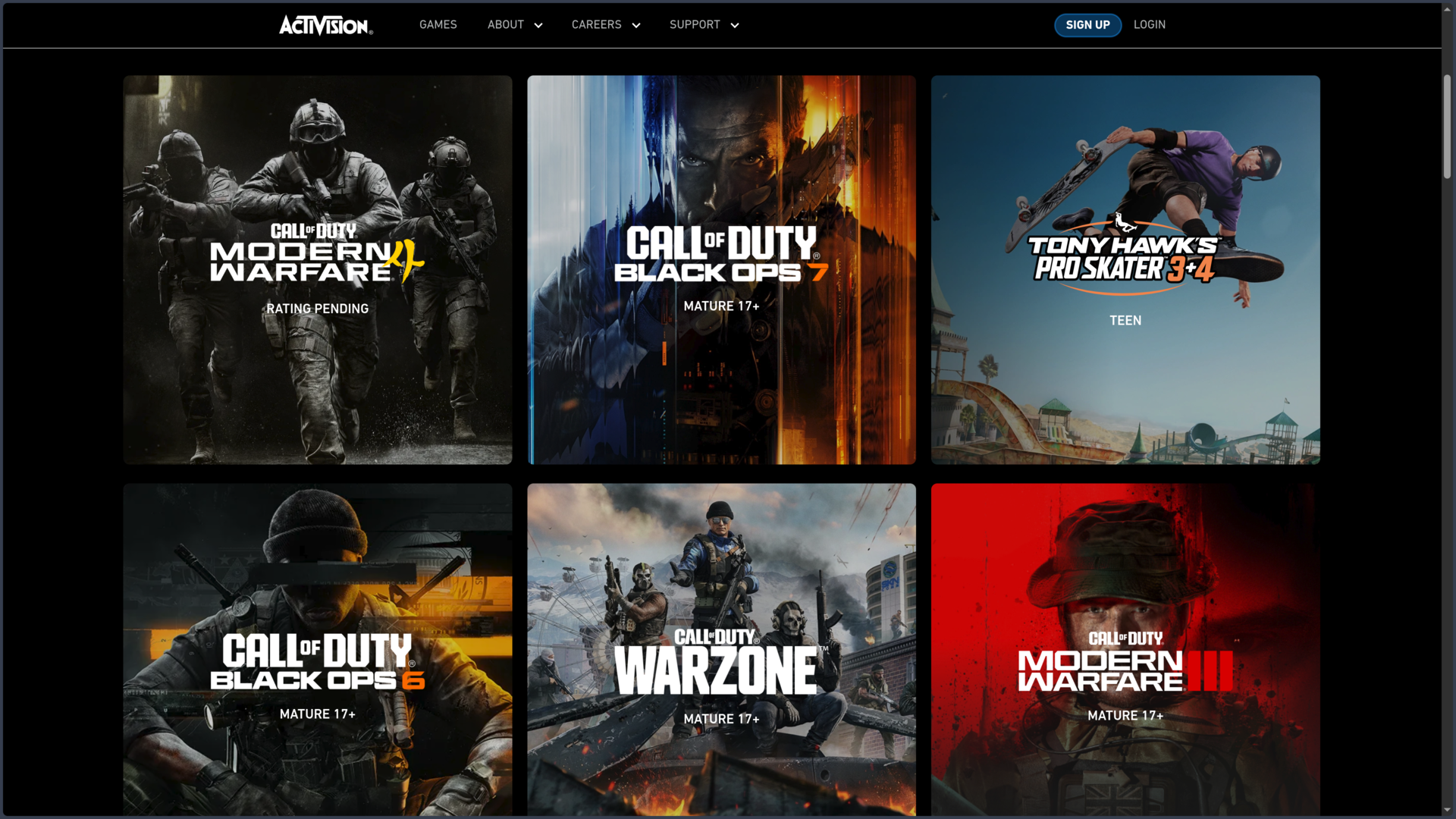
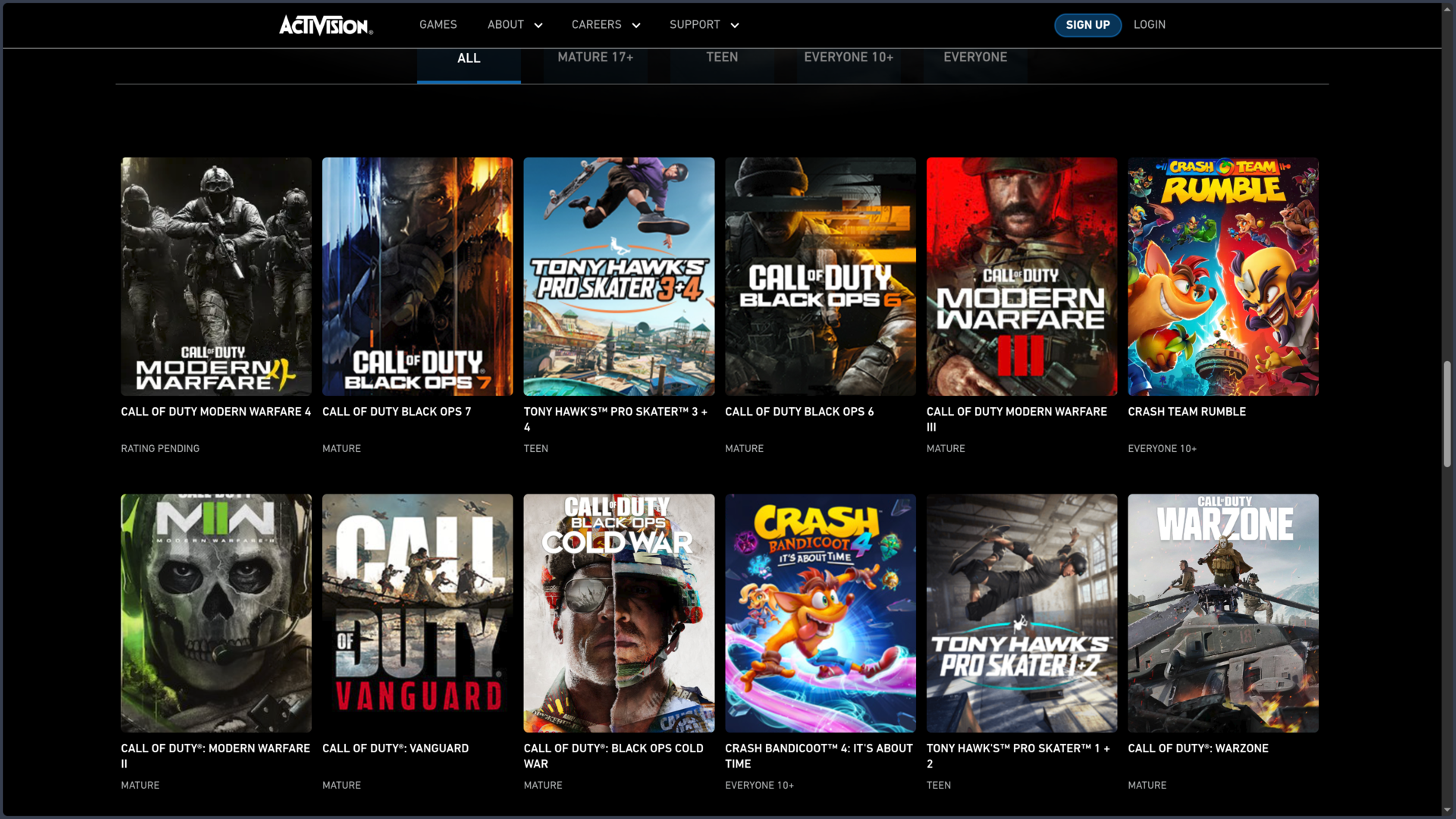
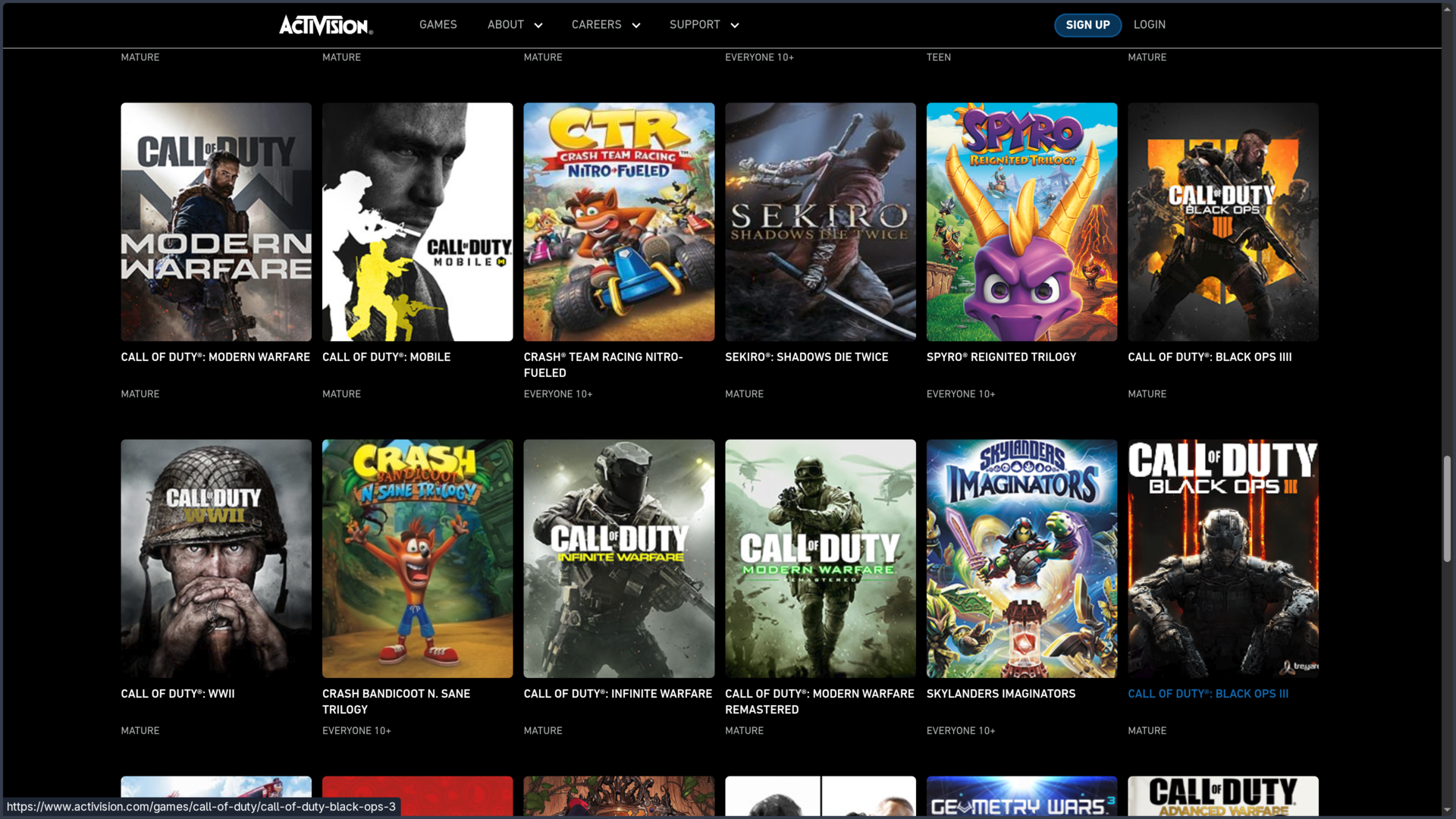
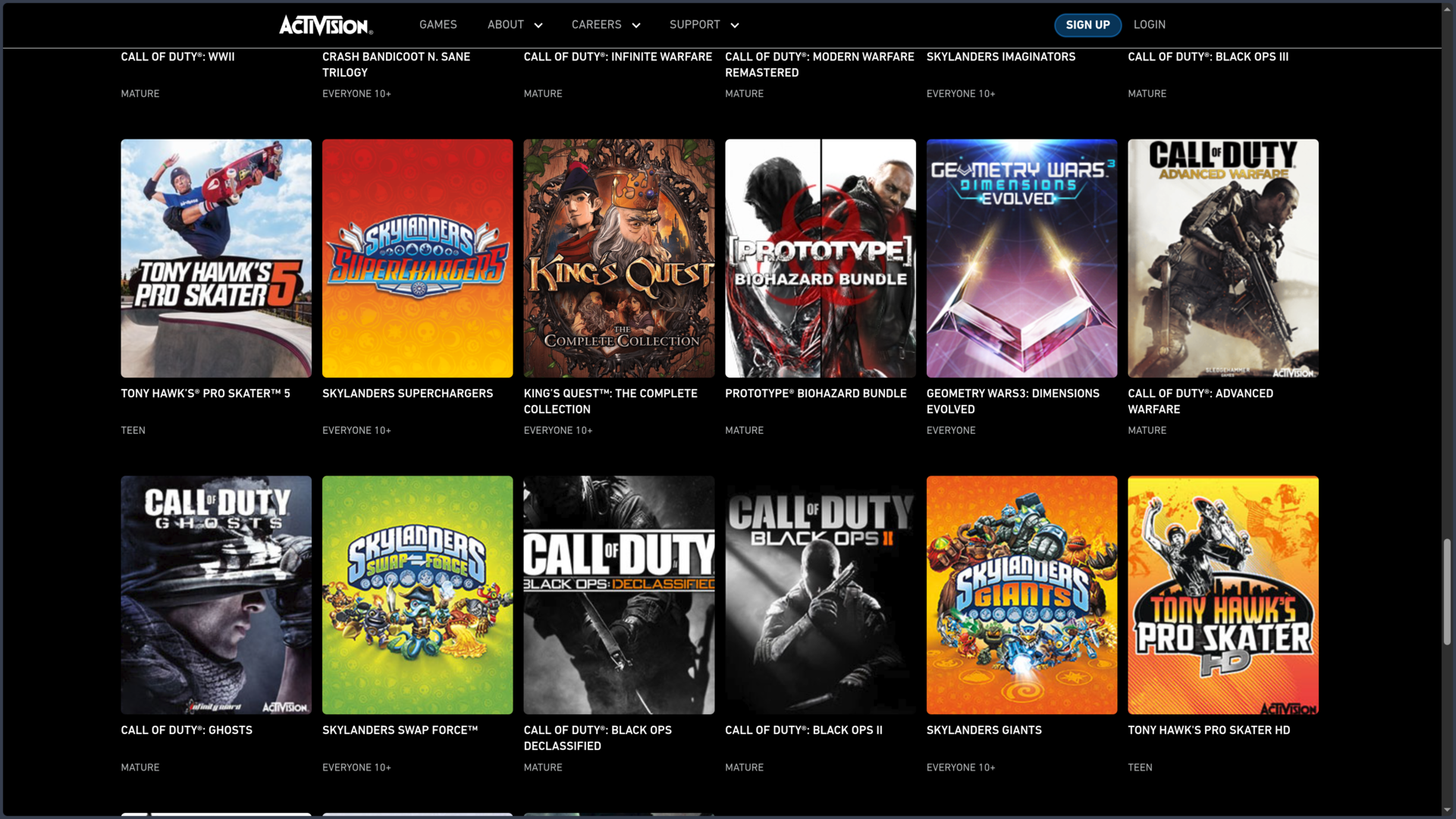
Activision’s current public catalog mainly highlights Call of Duty, Crash Bandicoot, Tony Hawk’s Pro Skater, Spyro and Sekiro: Shadows Die Twice. Yet this selection represents only part of a much broader history. Activision has successively been associated with the first Atari 2600 games, Pitfall!, licensed games, Tony Hawk, Guitar Hero, Skylanders, Destiny and, above all since the 2000s, Call of Duty.
This succession of periods is probably the best way to understand the company.
Activision has not preserved a single creative identity for nearly half a century.
What it has preserved is an ability to identify, acquire, finance, organize and industrialize properties capable of becoming very large.
In the 1980s, this logic involved recognition of individual developers and games such as Pitfall!.
In the 1990s, it involved rebuilding a publisher and progressively integrating studios.
In the 2000s, it ran through Tony Hawk, Spider-Man, Guitar Hero and above all Call of Duty.
In the 2010s, it expanded into online services, Skylanders, Destiny, mobile and free-to-play models.
In the 2020s, Call of Duty became a genuine ecosystem shared across several studios, several games, several platforms and a persistent service such as Warzone.
This evolution also explains why Call of Duty occupies a particular position today within the organization. Activision still owns other properties, but its website, studios and management clearly show that Call of Duty structures a considerable part of its modern activity. The current leadership team notably includes Matthew Cox as General Manager of Call of Duty and Patrick Kelly as Head of Creative for the franchise, while much of the studio network contributes directly or indirectly to that universe.
However, reducing Activision to Call of Duty would erase one of the most interesting dimensions of its history.
The company was born before the Nintendo Entertainment System.
Before PlayStation.
Before Xbox.
Before mainstream online gaming.
Before DLC.
Before battle passes.
And even before the idea of an independent publisher producing games for another manufacturer’s console had become normal.
This longevity makes Activision less a representative of one particular era than one of the few publishers to have had to reinvent itself through almost every major economic and technical transformation in home video gaming.
History
1979: Activision is born from a break with the platform-holder model
In October 1979, four developers create Activision and help establish one of the first third-party studios in the video game industry. The company takes its name from a combination of the words “Active” and “Television.” Historical regulatory documents confirm that the original company was incorporated in California in 1979.
The context is essential.
At the time, the Atari 2600 is one of the main home consoles. The machine’s manufacturer tightly controls its software ecosystem, and programmers receive little recognition. The arrival of an independent company developing cartridges for that hardware therefore helps establish an idea that seems obvious today: a console manufacturer does not need to create every game available on its platform itself.
The third-party developer and publisher model gradually becomes a structural component of the entire industry.
Activision is therefore not simply born with a new game.
It helps create a new economic role.
The creator also becomes part of the product
One of the distinctive traits of early Activision is the visibility given to the people who create the games.
The context of the time makes this approach important. At some platform holders, developers remain largely invisible behind the company name. Activision chooses instead to highlight the authors of its productions, almost as a music label might highlight its artists.
The strategy obviously has a marketing dimension.
But it also touches on a question that will run through the entire history of video games: who is the author of a game when one company owns the machine, another publishes the cartridge and a third person writes almost the entire program?
Activision in the 1980s helps make one answer more visible:
the developer matters.
1982: Pitfall! becomes the first major symbol
In 1982, David Crane’s Pitfall! becomes one of the most important games of Activision’s first period. The company describes it as one of the best-selling home games of 1982. On Atari 2600, its world fits into only a few kilobytes and uses a sequence of 256 screens, relatively sophisticated animation and an exploration structure that contributes to the history of platform games.
The technical performance is impressive.
But Pitfall! above all demonstrates that a property created by a third-party company can become just as identifiable as productions directly associated with the platform holder.
Activision no longer depends only on the existence of the Atari 2600.
It begins building its own heritage.
Pitfall Harry becomes a character.
River Raid, Kaboom! and other titles then strengthen this first library.
Activision patches already turn performance into community
The company also experiments very early with a form of player relationship that almost seems to anticipate modern achievements and trophies.
For several games, Activision distributes physical patches to players able to prove certain scores by sending in a photograph of their screen. In Pitfall!, reaching a specific objective can, for example, earn the player a badge accompanied by a congratulatory message.
The idea is simple but important.
The game no longer exists only inside the console.
It produces an external identity.
Proof.
An object.
A community of players sharing the same challenge.
Forty years later, Activision will obviously operate infinitely more complex systems of progression, profiles, seasons and online rewards.
But the principle is not entirely foreign to its beginnings.
The 1980s also reveal the fragility of the market
Initial success does not protect Activision from the industry’s turbulence. The North American console market goes through a major crash in the early 1980s, while the company expands its activities toward other machines, computer software and different categories of products.
Regulatory archives also show several changes of name and structure during this period: Activision temporarily becomes Mediagenic, before the Activision name returns in the early 1990s.
This phase matters because it destroys the idea of uninterrupted ascent.
The company that will later publish Call of Duty experienced a period in which even its identity had become uncertain.
Activision’s longevity is therefore not that of a success that was never interrupted.
It is that of a company that already had to rebuild itself.
1991: new leadership opens the modern period
Bobby Kotick takes control of the company in 1991 and will remain one of the central figures of Activision and later Activision Blizzard for more than three decades. Company communications from the mid-2000s explicitly recall the growth led since 1991 under this leadership.
The strategy that gradually develops is different from that of the first Activision.
It is no longer only about highlighting a few programmers producing cartridges.
The company now seeks to build a much broader portfolio, control more development capacity and work simultaneously with internal properties, licenses and partner studios.
This logic prepares the Activision of the 2000s.
1997: Raven Software becomes the first acquired studio
Raven Software joins Activision in 1997. Co-founder Brian Raffel himself recalls that Raven was then the first studio acquired by Activision. The studio will later work on numerous productions and eventually become one of the pillars of the Call of Duty network, notably around Warzone.
The acquisition reveals a new strategy.
Activision can work with an external studio.
But it can also decide that certain expertise deserves to be integrated permanently.
The game portfolio therefore begins to be accompanied by a portfolio of studios.
This distinction will become essential for understanding the company today.
1999: Tony Hawk turns skateboarding into a video game phenomenon
Beginning in 1999, the Tony Hawk’s Pro Skater series, historically developed by Neversoft, becomes one of the most important properties of the Activision era. The games combine skateboarding, levels designed as playgrounds, a combo system and soundtracks that directly contribute to their cultural identity. Activision still associates the series with its catalog today, notably through Tony Hawk’s Pro Skater 1 + 2 in 2020 and then Tony Hawk’s Pro Skater 3 + 4 in 2025.
Tony Hawk is interesting because the game is built around a real-world license.
The central figure exists outside the game.
Skateboard brands exist.
The songs exist.
The skaters exist.
Activision then demonstrates that a license can become more than a simple derivative product.
It can generate its own video game culture.
For a generation of players, certain songs, tricks and virtual skateparks remain almost as closely associated with Tony Hawk as the sport itself.
2000: Activision separates holding company and publishing activity more clearly
In June 2000, Activision reorganizes its corporate structure. The former Activision, Inc. essentially becomes the parent company, while its main operating activity is carried by Activision Publishing, Inc.
This detail may seem administrative.
It becomes essential later.
When the parent company changes its name in 2008 to become Activision Blizzard, Activision Publishing continues to exist.
That continuity explains why Activision and Activision Blizzard should not be treated as exactly the same entity in a cultural catalog.
Activision is the historical label.
Activision Blizzard becomes the parent company.
2003: Call of Duty appears
On April 8, 2003, Activision officially introduces Call of Duty as a new first-person action brand. The first title is developed by Infinity Ward, a young studio that notably includes several developers who previously worked on Medal of Honor: Allied Assault. Activision presents the series at the time as a cinematic war experience lived through several ordinary soldiers.
Nobody can yet measure what this name will become.
At that point, Call of Duty is a new World War II FPS in a market that already contains several.
But some components of its future identity are already there.
Intensity.
Staging.
Squad.
Spectacle.
Multiple perspectives.
A desire to transform the battlefield into a highly controlled and highly readable experience.
October 2003: Infinity Ward joins Activision
A few months after the launch of the brand, Activision acquires the remaining equity of Infinity Ward on October 30, 2003. The company explains that the operation, combined with the presence of Raven Software, strengthens its position in first-person action games.
The decision will prove crucial.
Activision does not merely own the right to publish Call of Duty.
It directly integrates the team behind the franchise.
The relationship between publisher, property and studio therefore becomes much tighter.
Over the years, other teams will progressively join Call of Duty production.
2005: Vicarious Visions strengthens the acquisition model
In January 2005, Activision acquires Vicarious Visions, a studio known for its multiplatform work and internal technologies. The operation is explicitly presented as a way to strengthen the publisher’s technical and development capabilities.
The studio will later work on numerous Activision properties, notably Crash Bandicoot and Tony Hawk, before being integrated years later into Blizzard under the name Blizzard Albany.
This trajectory shows that the network of a major publisher is never completely fixed.
A studio can change function.
Franchise.
Label.
And even organizational identity.
2006: Guitar Hero brings a second cultural phenomenon
In May 2006, Activision announces the acquisition of RedOctane, publisher of Guitar Hero. The company explicitly explains that it wants to position itself in the rapidly growing music-game market.
The franchise quickly becomes one of the major phenomena of the second half of the 2000s.
A plastic guitar is enough to summarize the idea.
But behind the accessory lies a deeper transformation.
Video games enter the living room as social performance.
Players no longer merely watch an avatar accomplish something.
They physically imitate the gesture.
Licensed music becomes the core of the content.
The peripheral becomes part of the product’s identity.
Activision therefore finds itself with two culturally very different franchises — Tony Hawk and Guitar Hero — that nevertheless share one thing: they turn an existing cultural practice into a video game ritual.
Call of Duty gradually leaves World War II behind
Call of Duty evolves rapidly throughout the 2000s.
The series does not remain confined to World War II. With Modern Warfare, part of its identity shifts toward contemporary conflict, military technology, spectacular action and online multiplayer whose progression systems become increasingly central.
This transition is essential for Activision.
A historical franchise becomes a platform flexible enough to absorb several sub-series, several periods and several teams.
Modern Warfare.
Black Ops.
Later Warzone.
Call of Duty progressively stops being a single story.
It becomes an architecture of internal brands.
2008: Activision and Vivendi Games create Activision Blizzard
In July 2008, the combination of Activision and Vivendi Games is completed. Vivendi Games notably contributes Blizzard Entertainment and its properties, while publicly traded Activision takes the name Activision Blizzard.
The operation creates confusion that still exists today.
Activision is not renamed Blizzard.
Blizzard is not creatively absorbed by Activision.
The two major brands continue to operate with their own teams and properties under a shared parent company.
The new Activision Blizzard therefore brings together two very different cultures.
On one side, Activision and its particularly strong console productions.
On the other, Blizzard and its PC and online universes such as Warcraft.
The parent company becomes larger.
The labels remain recognizable.
2009: Call of Duty Endowment extends the brand beyond the game
In November 2009, Activision Blizzard creates the Call of Duty Endowment, a nonprofit organization intended to support employment for military veterans.
The initiative shows how much the franchise has already become more than a series of software products.
Its name can support an organization outside the game.
The property becomes a cultural brand identifiable enough to exist in other contexts.
This type of extension will become increasingly common in the modern industry, where the largest franchises also serve as media, competitive or community platforms.
2010: Activision signs with Bungie
On April 29, 2010, Activision and Bungie announce a worldwide partnership initially planned for ten years around a new property. Bungie remains independent and retains ownership of the intellectual property, while Activision receives worldwide publishing and distribution rights for the games produced from this new universe.
The model is particularly interesting.
Activision does not acquire Bungie.
It does not own the new property.
It provides its publishing infrastructure, distribution, marketing and multiplatform experience.
The relationship shows that a major publisher does not need to own every studio it works with.
It can also build an alliance around complementary expertise.
2011: Skylanders connects physical toy and video game
In 2011, Activision launches Skylanders: Spyro’s Adventure. The concept relies on the “Portal of Power,” which allows physical figures to be placed on a peripheral so their characters appear inside the game.
The principle seems immediately understandable today.
At the time, however, it opens an extremely powerful commercial category: toys-to-life.
The child no longer buys only a game.
They also collect the characters.
Each figure simultaneously becomes a physical object, an access key and an extension of digital content.
Skylanders therefore demonstrates an ability that the Activision of Pitfall already possessed in another form: understanding that enjoyment can continue outside the screen.
The physical patches of the 1980s and the connected figures of the 2010s are technologically incomparable.
But both extend the game into an object.
Skylanders also shows that Spyro can become the starting point for something else
The first installment is titled Spyro’s Adventure, but Skylanders quickly builds its own cast of characters and its own identity.
The project becomes important enough to move beyond its origin.
By 2016, Activision stated that the franchise had generated several billion dollars and sold hundreds of millions of toys since its launch.
The lesson recalls that of the Rabbids at Ubisoft.
An existing property can open the door.
But the new universe can later learn to live without it.
2014: Destiny tests Activision’s publishing power
Destiny launches in September 2014, developed by Bungie and published by Activision. The publisher presents the project at the time as a new connected and persistent action universe combining solo, cooperative and competitive activities.
Destiny is an important case because it brings together two very strong reputations.
Bungie provides its expertise in FPS design and multiplayer.
Activision provides its international infrastructure and blockbuster-launch experience.
The publisher announces more than $500 million in sales to retailers and platforms on the first day of commercial availability, illustrating the industrial scale being pursued.
Destiny’s history nevertheless serves as a reminder of a fundamental distinction for an entity profile.
Publishing is not creating.
Destiny is a Bungie game published by Activision.
That difference must remain visible.
Activision in the 2010s becomes a specialist in blockbuster portfolios
During this period, Activision can simultaneously rely on Call of Duty, Skylanders and Destiny, while its historical catalog still includes Tony Hawk and other properties.
In 2014, the company itself highlights this combination: Call of Duty as a major console franchise, Skylanders as an important property for younger audiences and Destiny as a highly ambitious new property.
These games look almost nothing alike.
Their coherence is industrial.
Activision seeks less a shared aesthetic than a shared ability to produce brands capable of extending beyond a single launch.
Call of Duty gradually becomes a multi-studio production
As the franchise grows in scale, Call of Duty relies less and less on a single team.
Infinity Ward.
Treyarch.
Sledgehammer Games.
Raven Software.
Beenox.
Demonware.
High Moon.
And various technical or support teams contribute depending on the production.
Activision’s current website reflects this networked organization.
The model solves an obvious problem.
An extremely regular franchise requires enormous resources.
But it creates another one.
How do you preserve a recognizable identity when so many teams contribute to the same universe?
Activision then turns coordination itself into a production skill.
2019: Call of Duty truly arrives on mobile
On October 1, 2019, Call of Duty: Mobile launches on Android and iOS. The game is developed by Tencent’s TiMi Studios and published by Activision. It brings together maps, characters, weapons and modes notably from the Modern Warfare and Black Ops branches inside a free-to-play experience specifically designed for mobile devices.
The distinction between studio and publisher becomes particularly clear here.
Activision owns and publishes the franchise.
Tencent/TiMi develops the game.
The product culturally belongs to Call of Duty without having been made by Infinity Ward or Treyarch.
The brand becomes strong enough to travel across technologies, studios and business models.
2020: Warzone turns Call of Duty into a persistent space
On March 10, 2020, Activision launches Call of Duty: Warzone, a free experience initially built around Verdansk and capable of bringing together up to 150 players. The production exists within the Modern Warfare universe and notably uses Battle Royale and Plunder formats.
Warzone profoundly changes the temporality of Call of Duty.
The series was already annual.
It also becomes continuous.
A new production can arrive every year while a free-to-play space persists, receives new maps, new systems, new seasons and absorbs content from several installments.
The model therefore no longer consists only of replacing one game with the next.
Continuity has to be maintained between them.
Warzone forces several generations of Call of Duty to coexist
The project is progressively connected to the different branches of the franchise.
Modern Warfare.
Black Ops.
New equipment.
New operators.
New maps.
Shared progression depending on the period.
This organization turns Call of Duty into something closer to an ecosystem than a traditional series.
For Activision, the challenge then becomes twofold.
Sell new premium installments.
And maintain a free entry point capable of keeping a community active between those releases.
Activision’s heritage also returns through Crash, Spyro and Tony Hawk
The 2010s and 2020s are not devoted only to Call of Duty.
Activision also brings several historical or acquired properties back into circulation.
Crash Bandicoot N. Sane Trilogy.
Spyro Reignited Trilogy.
Tony Hawk’s Pro Skater 1 + 2.
Then Tony Hawk’s Pro Skater 3 + 4 in 2025.
The current official catalog continues to highlight Crash, Spyro and Tony Hawk directly alongside Call of Duty.
This policy shows that the value of an old publisher does not exist only in its new productions.
It also exists in its memory.
A catalog spanning several decades becomes a reservoir of characters, mechanics and names that new generations can rediscover.
2022-2023: Microsoft wants to acquire Activision Blizzard
In January 2022, Microsoft announces its plan to acquire Activision Blizzard.
The operation obviously goes far beyond Activision alone.
It also concerns Blizzard, King and all the structures owned by Activision Blizzard.
For Microsoft, the acquisition is intended to strengthen its gaming activity across console, PC, mobile and cloud while bringing properties as different as Call of Duty, Warcraft, Diablo, Overwatch and Candy Crush.
The size of the project leads to months of regulatory review and competition debates, notably around Call of Duty and cloud gaming.
The brand created in 1979 therefore becomes one of the main elements of a transaction extending far beyond its original market.
October 13, 2023: Activision joins Microsoft Gaming
On October 13, 2023, Microsoft officially completes the acquisition of Activision Blizzard. Phil Spencer announces the arrival of Activision Blizzard King teams within Xbox. Activision Blizzard becomes a Microsoft-owned subsidiary.
Activision therefore changes its level of ownership once again.
1979: independent company.
2008: branch of Activision Blizzard.
2023: component of a group owned by Microsoft.
But the Activision logo remains.
The Activision website remains.
Activision studios remain identifiable.
Corporate ownership changes more than the visible publishing identity.
Joining Xbox immediately changes distribution
Integration into Microsoft quickly begins to change the circulation of the catalog.
In July 2024, Call of Duty: Modern Warfare III joins Game Pass. Microsoft also confirms that Black Ops 6 will be available through Game Pass at launch in October of the same year.
The situation is culturally interesting.
For decades, Activision primarily sold its games through platforms belonging to other manufacturers.
It now belongs to one of those manufacturers itself.
However, its main franchises continue to exist on other machines as well.
Activision therefore moves from its historic status as a major third-party publisher to that of a publisher integrated into a platform holder, without immediately becoming exclusive to its hardware.
2024: Elsewhere Entertainment shows Activision still wants to create a new property
On May 16, 2024, Activision announces the formation of Elsewhere Entertainment, a new internal studio based primarily in Warsaw, with additional resources in the United States. Its stated mission is to create a new narrative AAA franchise.
The creation deserves attention because it contrasts with the modern image of an Activision almost entirely organized around Call of Duty.
The publisher is therefore not officially limiting itself to maintaining its existing properties.
It is also investing in the creation of a new universe.
Elsewhere thus becomes an interesting test.
Can Activision still create a major entirely new property unrelated to Call of Duty?
The current network no longer looks exactly like the one from the 2000s
Some historical studios have changed position.
Vicarious Visions is now part of Blizzard under the name Blizzard Albany. Activision’s current network instead highlights Beenox, Demonware, Digital Legends, Elsewhere, High Moon Studios, Infinity Ward, Raven Software, Sledgehammer Games, Solid State and Treyarch.
This evolution is a reminder that “Activision studios” does not describe an immutable list.
They form a network that changes according to properties, acquisitions, reorganizations and production needs.
2025: Tony Hawk reminds us Activision owns more than an FPS
Tony Hawk’s Pro Skater 3 + 4 launches on July 11, 2025, continuing the modern reintroduction of a series associated with Activision since the late 1990s.
Its presence in the current catalog matters.
Call of Duty dominates Activision’s contemporary identity so strongly that a visitor could forget the publisher also has a heritage deeply connected to skateboarding, platform games and characters such as Crash and Spyro.
Tony Hawk keeps another branch of that memory visible.
2026: Call of Duty remains at the center of the machine
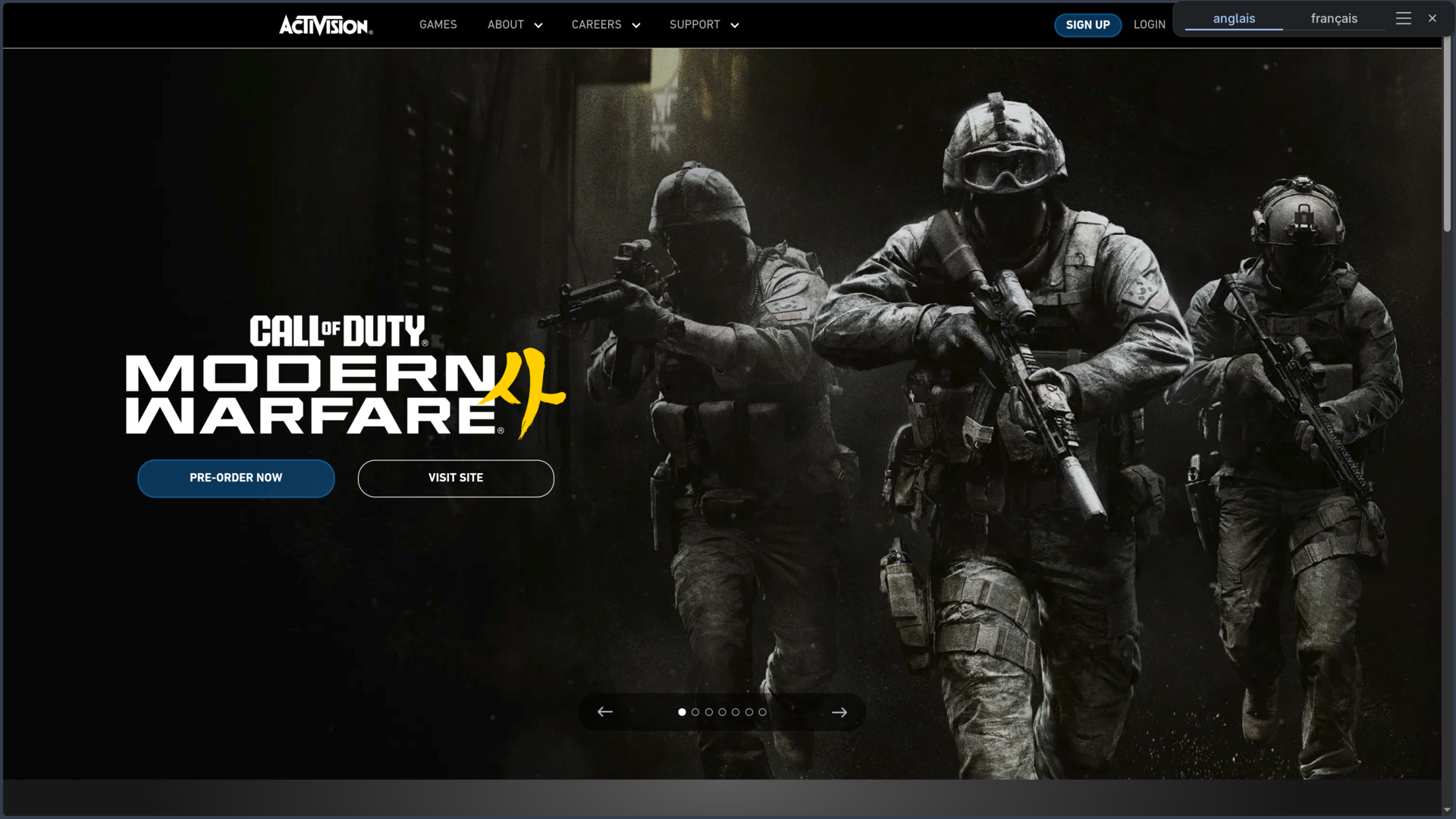
In 2026, Activision’s website continues to be dominated by Call of Duty news. Black Ops 7, Warzone and Modern Warfare 4 structure a large share of its publications, seasons, content and communications. The official site notably presents Modern Warfare 4 as one of its major upcoming games while continuing to actively document seasons for Black Ops 7 and Warzone.
The current production network reflects this priority.
Infinity Ward has several locations.
Sledgehammer Games does as well.
Raven, Treyarch, Beenox, Demonware and other teams form an infrastructure capable of maintaining several components of Call of Duty in parallel.
The game is therefore no longer simply made by “the Call of Duty studio.”
It is produced by an organization.
2026: Warzone also begins leaving the previous generation behind
The longevity of a service does not mean immobility.
Activision announces in 2026 the reduction and then the end of support for Warzone on PlayStation 4 and Xbox One, in connection with the franchise’s technological evolution and integration with Modern Warfare 4.
This transition illustrates a challenge specific to persistent services.
A traditional game can remain as it was.
A living service has to keep evolving.
At a certain point, maintaining an older platform can become incompatible with the technical direction chosen for the future.
Continuity therefore sometimes requires a break.
Today: Activision is both a very old brand and a modern infrastructure
The Activision of 2026 occupies an unusual position.
The brand is almost fifty years old.
Yet its main activity relies on some of the most contemporary models in the industry:
persistent services,
free-to-play,
seasons,
cross-play,
unified accounts,
multi-studio production,
mobile,
subscription distribution,
online security,
network infrastructure.
The contrast with the Atari 2600 cartridges of 1979 is considerable.
But continuity exists.
Activision continues to pursue the same thing in different forms:
a way to turn a game property into a lasting relationship with an audience large enough to cross several generations of technology.
What sets it apart
Activision has existed for almost as long as third-party publishing itself
The company did not simply adapt to the third-party publishing model.
It belongs to the companies that helped establish it.
Its 1979 history is directly connected to the idea that an independent developer can produce games for a console it does not manufacture itself. Activision still presents its creation as one of the foundational moments of third-party development.
That history gives its integration into Microsoft a particular perspective.
One of the great historical pioneers of third-party gaming now belongs to a platform holder.
The loop is almost ironic.
Activision’s history is a succession of dominant franchises
Activision was not built around one single work for forty-seven years.
Its centers of gravity changed.
Pitfall.
Tony Hawk.
Guitar Hero.
Skylanders.
Call of Duty.
Destiny as a major partnership for a period.
Some properties remain.
Others decline.
Some return.
Others leave the active portfolio.
That ability to change engines partly explains its longevity.
The company does not need its success of 1982 to remain its success of 2026.
Call of Duty nevertheless represents a different level of concentration
Today, no other Activision property structures its organization on the same scale as Call of Duty.
Several studios.
Network teams.
A mobile branch.
Warzone.
Premium installments.
Seasons.
Security systems.
Competitions.
Shared tools.
The corporate website even explicitly distinguishes leadership roles specific to the franchise.
Call of Duty is therefore no longer merely an important license.
It becomes an organizational structure.
The franchise functions like several series sharing one infrastructure
Modern Warfare and Black Ops have different identities.
Warzone has its own service logic.
Call of Duty: Mobile has another team and another technical environment.
Yet everything belongs to the same brand universe.
This architecture allows Activision to address several audiences without having to invent a new name for each one.
The coherence is not necessarily narrative.
It is primarily built from sensations, progression, technologies, iconography and account continuity.
Co-development has become essential to the model
Activision’s current network shows that modern production relies heavily on collaboration.
Infinity Ward can lead one branch.
Treyarch another.
Raven can manage or co-develop Warzone.
Beenox, Demonware, High Moon or technical teams can contribute elsewhere.
This organization allows production at a considerable scale.
But it also makes credits more important.
Simply saying that a game is “developed by Activision” erases an essential part of reality.
PANACHES CULTURE must therefore preserve the distinction between publisher and actual studio.
Activision knows how to own, acquire or simply publish
The company’s history shows several models.
Infinity Ward is acquired.
Raven is acquired.
Vicarious Visions is acquired.
RedOctane is acquired.
Bungie remains independent during its partnership.
Tencent/TiMi develops Call of Duty: Mobile while Activision publishes it.
These examples remind us that there is no single possible relationship between publisher and developer.
Control can be complete.
Partial.
Contractual.
Temporary.
The work profile must therefore always specify who actually developed it.
Activision’s catalog shows both the power and fragility of trends
Tony Hawk becomes gigantic.
Guitar Hero becomes gigantic.
Skylanders becomes gigantic.
Then their positions change.
That succession provides an interesting lesson about the industry.
A category can seem inexhaustible at its peak.
Music games.
Toys-to-life.
Skateboarding.
But no trend is guaranteed forever.
Activision survived precisely because it never depended on the same one forever.
Peripherals have repeatedly allowed Activision to escape the screen
Guitar Hero uses a guitar.
Skylanders uses a portal and figures.
Atari games already distributed physical patches as rewards for certain performances.
These experiences are technologically very different.
But they show a recurring fascination with making the game exist as a physical object.
Software produces something that can be held.
Worn.
Collected.
Shown.
This social and material dimension played an important role in several of the publisher’s major historical successes.
Activision knows how to exploit a license without necessarily creating its universe
Tony Hawk exists outside the game.
Activision has also published numerous adaptations and licensed properties throughout its history.
The company therefore developed expertise different from that of a studio focused entirely on its own universes.
The challenge is to transform an existing brand into an interactive experience strong enough for the game to develop its own identity.
Tony Hawk’s Pro Skater is probably one of the most successful examples of this logic.
A strong license guarantees nothing
A known brand can attract attention.
It does not guarantee a good game system or a long lifespan.
Activision’s history shows that licensed properties become truly important when design adds something to their culture.
Tony Hawk does not work only because Tony Hawk is famous.
The combo system works.
The levels work.
The music works.
The game creates its own language.
The license opens the door.
Game design still has to justify the journey.
The company thinks in terms of brands very early
One of Activision’s recurring themes is the transformation of games into brands.
When announcing Call of Duty in 2003, Activision already explicitly refers to a new “brand” intended to accommodate several experiences and platforms.
This way of thinking heavily influences later strategy.
A game can succeed.
A brand can produce a series.
A universe.
Services.
Merchandising.
Competitions.
A community.
Decades of content.
Activision repeatedly seeks the second possibility.
The annual game and the permanent service follow contradictory timelines
Call of Duty historically has an extremely regular cadence of premium releases.
Warzone, meanwhile, has to persist.
These two models create an interesting problem.
The new game wants to replace the old one.
The service wants to continue.
Activision therefore has to organize a franchise in which novelty and continuity exist simultaneously.
This tension influences progression systems, technology, weapons, operators, maps and the way different installments communicate with one another.
Call of Duty: Mobile shows that a property can survive a complete team change
The mobile game is developed with TiMi/Tencent, not with Infinity Ward’s historical team.
Yet it remains immediately identifiable as Call of Duty.
Maps.
Weapons.
Characters.
Modes.
Iconography.
Activision can therefore transport the franchise’s identity to another developer and another device.
That is one sign of a property that has reached maturity.
Its language becomes clear enough to be reproduced in a different context.
Warzone turned a series into a meeting place
Before Warzone, Call of Duty already has an extremely important multiplayer component.
Warzone adds another dimension.
The player can enter the universe for free.
They do not necessarily need to buy the newest installment.
The game therefore becomes a permanent meeting point capable of existing between several premium releases.
This function goes beyond Battle Royale.
Warzone serves as community infrastructure for the entire franchise.
Older heritage still has real value
Crash.
Spyro.
Tony Hawk.
Pitfall.
These names are a reminder that Activision does not own only contemporary services.
It also owns or operates several decades of video game memory.
Re-releasing is never neutral, however.
A remaster must decide what should remain identical.
What can change.
Which controls should be modernized.
Which aesthetic should be restored or reinterpreted.
Heritage therefore becomes a new form of editorial work.
Activision’s ownership changed several times without erasing the brand
Independent Activision.
Activision Blizzard.
Microsoft.
These changes could create the impression that they are three successive companies with no continuity.
The reality is more nuanced.
Corporate structures change.
But Activision Publishing keeps its name, properties and recognizable organization.
This distinction explains why Microsoft can own Activision without turning every Activision game into a “Microsoft Game Studios” production.
A parent company does not need to erase the brand it acquires.
Joining Microsoft transforms the old third-party problem
The story begins with a company that wants to produce games for another manufacturer’s hardware.
It reaches a point where that company now belongs to a platform holder itself.
Even so, Call of Duty continues to exist on multiple platforms.
The situation shows how much historical categories have become more complex.
First party.
Third party.
Publisher.
Platform holder.
Service.
Subscription.
Cloud.
A single property can now cross several of these categories at the same time.
The Microsoft deal underlines the strategic value of Call of Duty
Microsoft’s acquisition of Activision Blizzard obviously does not concern only Call of Duty.
Blizzard and King also bring gigantic properties.
But the military franchise occupies a central place in discussions surrounding the transaction and in distribution commitments across several platforms.
That reveals something simple.
A game can become important enough to stop being only a cultural or commercial product.
It can become a strategic platform asset.
Cloud adds another layer to the publisher’s role
The Microsoft transaction also leads to specific arrangements concerning cloud-streaming rights for Activision Blizzard games.
Access to a game therefore no longer depends only on who owns its copyright or who manufactures the console.
It also requires considering who controls certain remote-distribution rights, depending on territories and agreements.
The modern publisher therefore manages a map of rights far more complex than that of an Atari 2600 cartridge.
Elsewhere represents an important question for the future
The new Elsewhere studio is working on an entirely new AAA narrative property and has access to Activision’s resources and tools.
Its existence matters precisely because the modern company appears so concentrated around Call of Duty.
If Elsewhere succeeds in establishing a durable new franchise, Activision will demonstrate that it can still open a new cycle.
Otherwise, concentration around its historical properties will continue to deepen.
The project therefore represents more than one additional game.
It tests Activision’s ability to invent its next pillar rather than simply maintain the previous ones.
Activision’s true specialty may be less about creating than amplifying
Activision has created games.
Owned studios.
Developed technologies.
But one of its most consistent historical skills seems to lie elsewhere.
Take a promising property.
Give it resources.
Distribute it worldwide.
Build a brand.
Multiply the studios capable of supporting it.
Turn a success into a series.
Then turn a series into infrastructure.
Pitfall needed only a cartridge.
Call of Duty needs a global network.
Between the two lies almost the entire modern history of video game publishing.
Good to know
- Activision was founded in California in 1979. Regulatory archives confirm that year of creation.
- Activision dates its creation to October 1979 and presents itself as one of the industry’s first third-party studios.
- The name Activision comes from combining the words “Active” and “Television.”
- The entry uses
editeur_jeu, as Activision today is a developer and publisher coordinating several studios rather than a single studio. - Activision Publishing’s modern historic headquarters are located in Santa Monica, California.
- Pitfall! launched in 1982 and became one of the emblematic productions of Activision’s first period.
- David Crane, a former Atari programmer and Activision co-founder, notably created Pitfall!
- Activision was already using physical rewards in the 1980s, such as patches sent to players able to prove certain performances.
- The company operated under the name Mediagenic during part of its history before the Activision name returned in the early 1990s.
- Bobby Kotick took control of Activision in 1991 and remained a central figure of the company for several decades.
- Raven Software joined Activision in 1997 and is described by its co-founder as the first studio acquired by the publisher.
- Tony Hawk’s Pro Skater began in 1999 and became one of the major historical franchises published by Activision.
- In 2000, Activision reorganized its activities around a holding structure, while the main operating activity became Activision Publishing, Inc.
- Call of Duty was officially introduced by Activision on April 8, 2003 as a new first-person action brand.
- The first Call of Duty was developed by Infinity Ward.
- Activision acquired the remaining equity of Infinity Ward on October 30, 2003.
- Activision acquired Vicarious Visions in January 2005.
- Vicarious Visions is now part of Blizzard under the name Blizzard Albany.
- Activision announced the acquisition of RedOctane in May 2006, bringing the Guitar Hero franchise into its portfolio.
- Activision and Vivendi completed the transaction creating Activision Blizzard in July 2008.
- Activision Publishing continued to exist as a distinct branch after the creation of Activision Blizzard.
- The Call of Duty Endowment was created in November 2009 to notably support veterans’ access to employment.
- Activision and Bungie announced a global partnership around a new property in April 2010, with Bungie remaining independent and retaining ownership of its IP.
- Skylanders: Spyro’s Adventure began in 2011 with its system of figures connected to the game through the Portal of Power.
- Destiny was developed by Bungie and published by Activision, with a worldwide launch in September 2014.
- Call of Duty: Mobile launched on October 1, 2019 on Android and iOS.
- Call of Duty: Mobile was developed by Tencent’s TiMi Studios and published by Activision.
- Call of Duty: Warzone launched on March 10, 2020 as a free-to-play experience.
- Raven Software is now directly associated with Warzone on Activision’s official website.
- Microsoft announced its plan to acquire Activision Blizzard in January 2022.
- Microsoft completed the acquisition of Activision Blizzard on October 13, 2023.
- Activision Blizzard then became a Microsoft-owned subsidiary.
- Activision therefore now belongs to the Microsoft Gaming / Xbox ecosystem, while retaining its own brand.
- Activision created Elsewhere Entertainment in May 2024, an internal studio based primarily in Warsaw and dedicated to a new narrative AAA franchise.
- Modern Warfare III joined Xbox Game Pass in July 2024, after the Microsoft acquisition.
- Tony Hawk’s Pro Skater 3 + 4 launched on July 11, 2025.
- Activision’s current network notably includes Beenox, Demonware, Digital Legends, Elsewhere, High Moon Studios, Infinity Ward, Raven Software, Sledgehammer Games, Solid State and Treyarch.
- Infinity Ward currently has several locations, notably in California, Texas and Poland.
- Sledgehammer Games currently operates teams notably in California, Canada and Australia.
- Rob Kostich is currently President of Activision.
- Matthew Cox currently serves as General Manager of Call of Duty, while Patrick Kelly leads creative for the franchise.
- Activision’s current public catalog notably highlights Call of Duty, Crash Bandicoot, Tony Hawk’s Pro Skater, Spyro and Sekiro: Shadows Die Twice.
- In 2026, Call of Duty: Warzone remains an active service, but Activision is preparing to end support on PlayStation 4 and Xbox One.
- Activision continues to operate Call of Duty through several simultaneous experiences in 2026, notably Black Ops 7, Warzone, Call of Duty: Mobile and Modern Warfare 4.