


































Overview
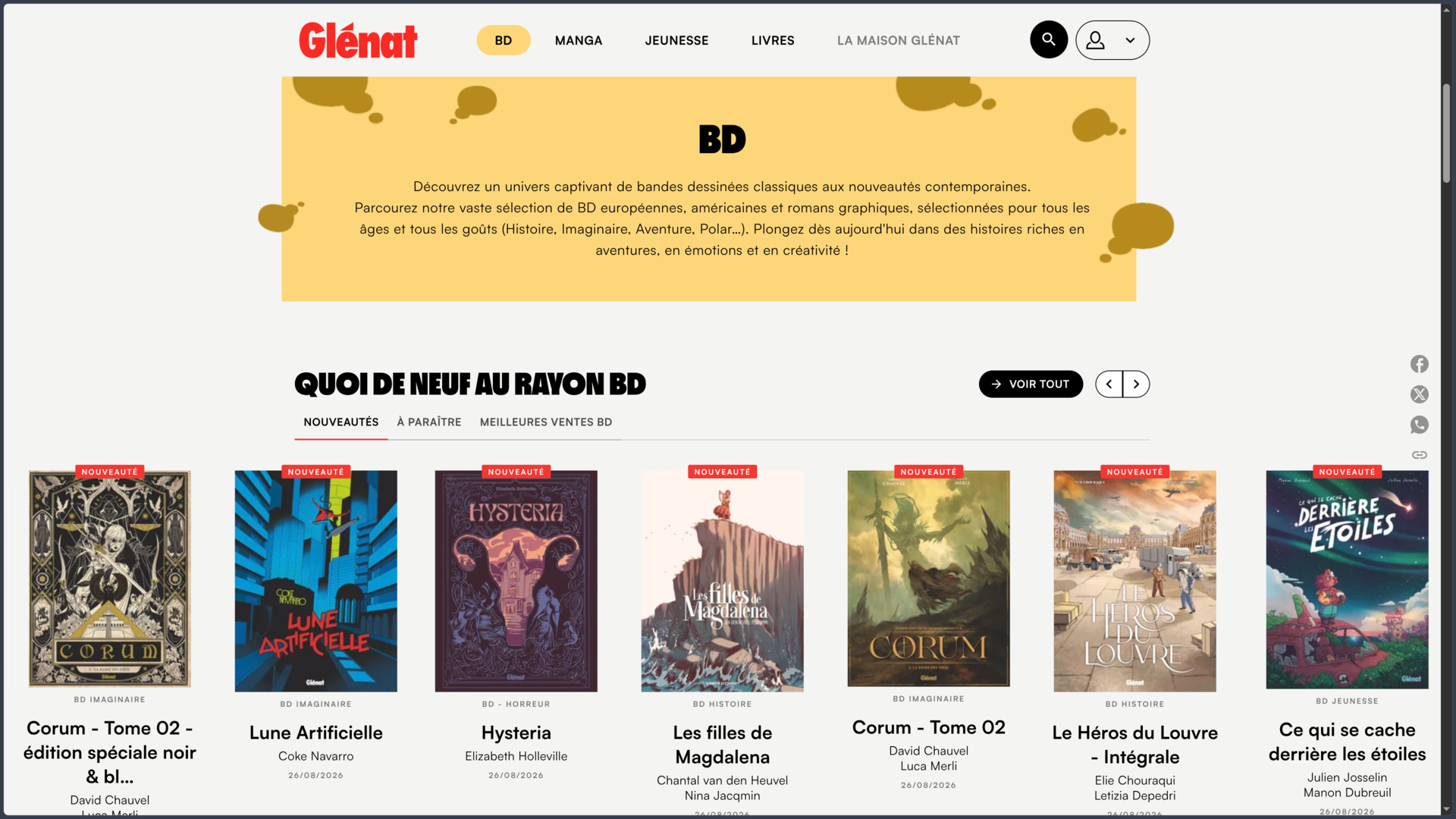
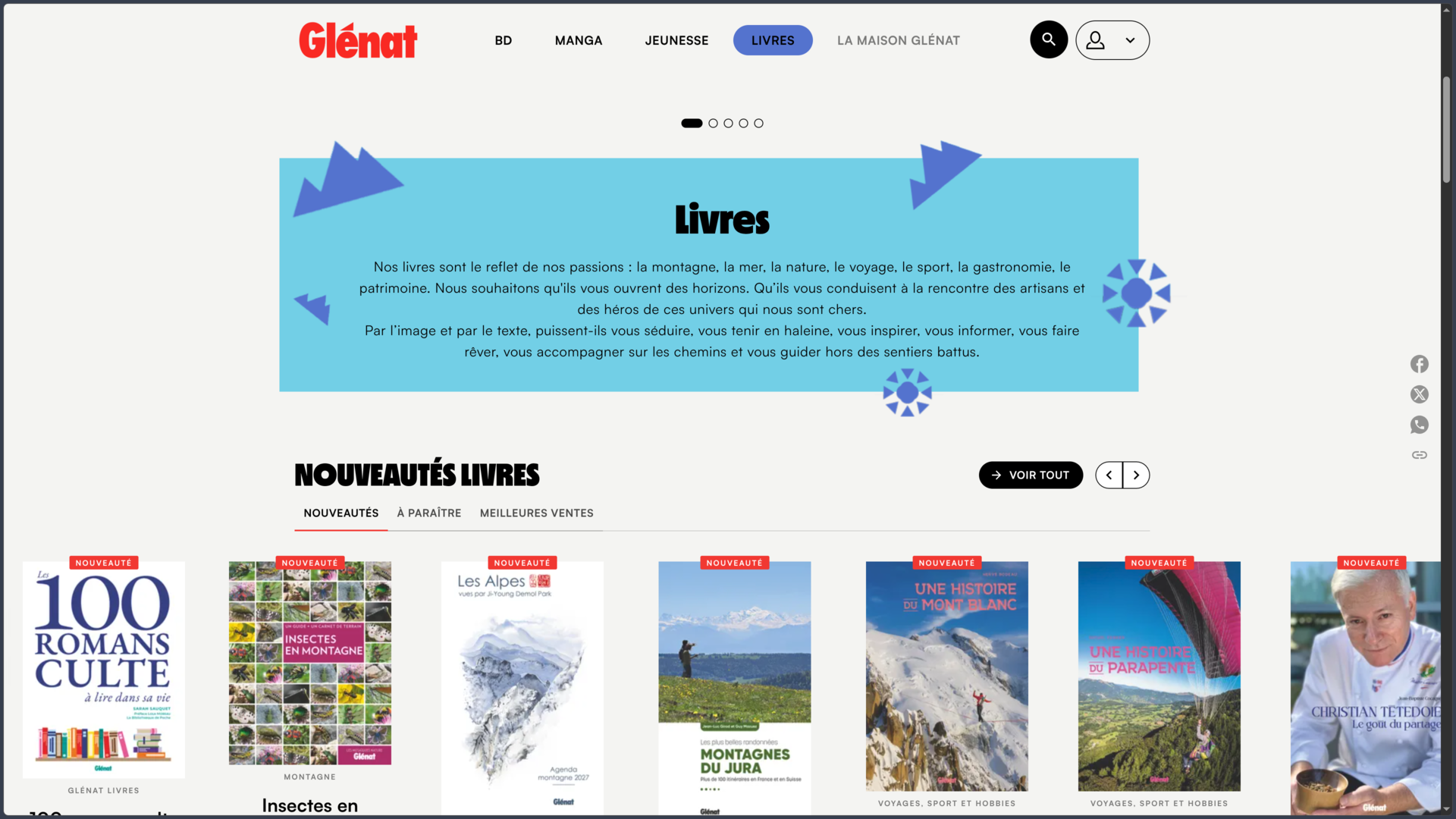
Éditions Glénat is a French publishing house founded in 1969 in Grenoble by Jacques Glénat. Historically built around comics, it now develops several major publishing fields: comics, manga, children’s publishing and illustrated books, with catalogues devoted notably to mountains, the sea, gastronomy, history, music, heritage and travel.
The legal company operating the publishing house is Glénat Editions, incorporated as a SAS and still headquartered in Grenoble.
Glénat’s trajectory is particularly connected to two transformations in popular publishing in France.
The first concerns the gradual recognition of comics as a genuine publishing field, at a time when they were still often regarded mainly as products intended for children.
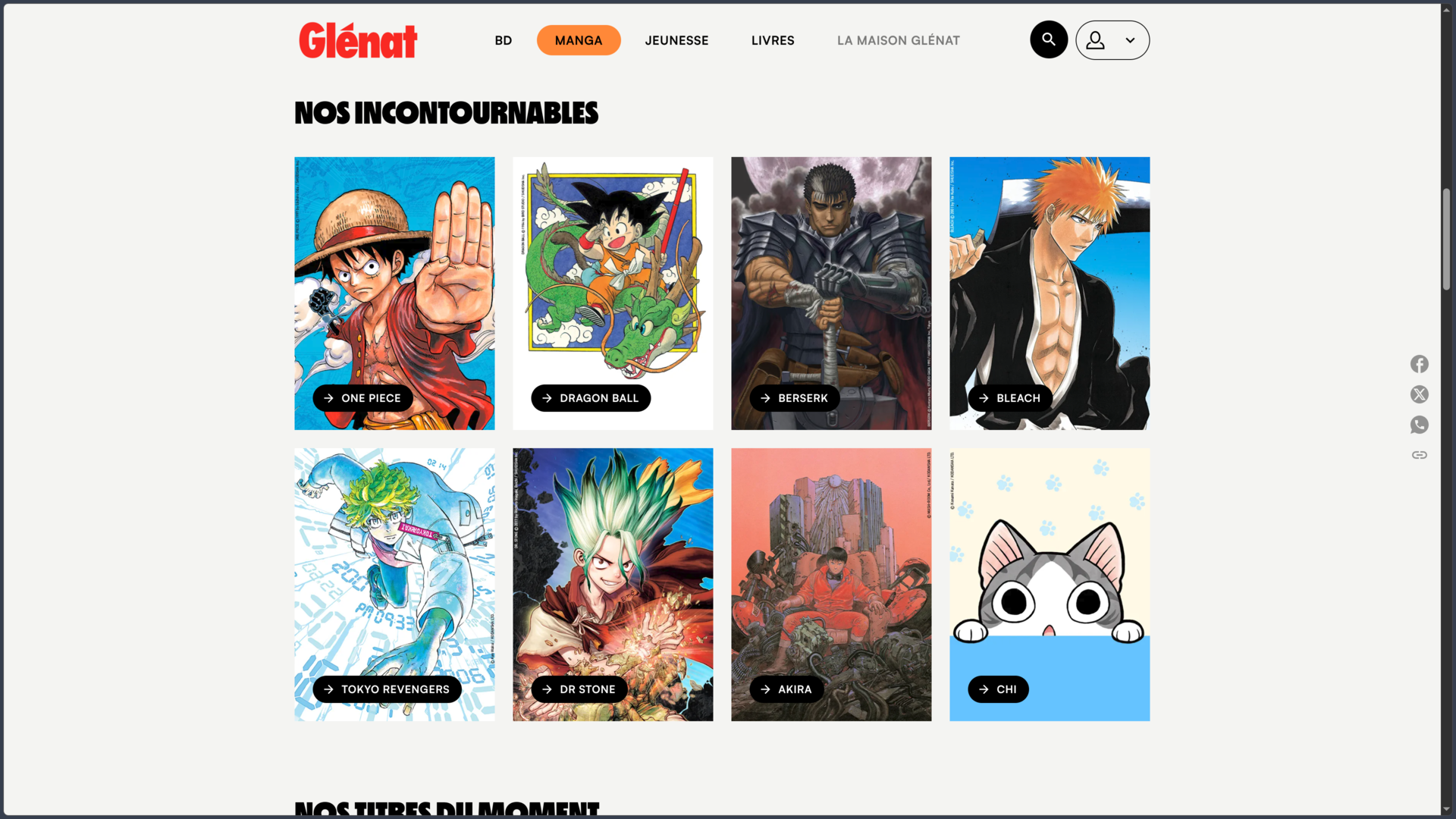
The second is the large-scale arrival of manga in French bookstores, a movement in which Glénat participated very early with Akira, then especially Dragon Ball, before building a catalogue including notably One Piece, Bleach and many other Japanese series.
This dual history explains the publishing house’s distinctive position.
Glénat is not simply a publisher that added manga to an existing comics catalogue. Its development has accompanied several generations of readers: Franco-Belgian and historical comics in the 1970s and 1980s, manga from the turn of the 1990s, children’s comics with Titeuf, followed by continuous diversification of formats and audiences.
The comics catalogue was built around very different authors and series.
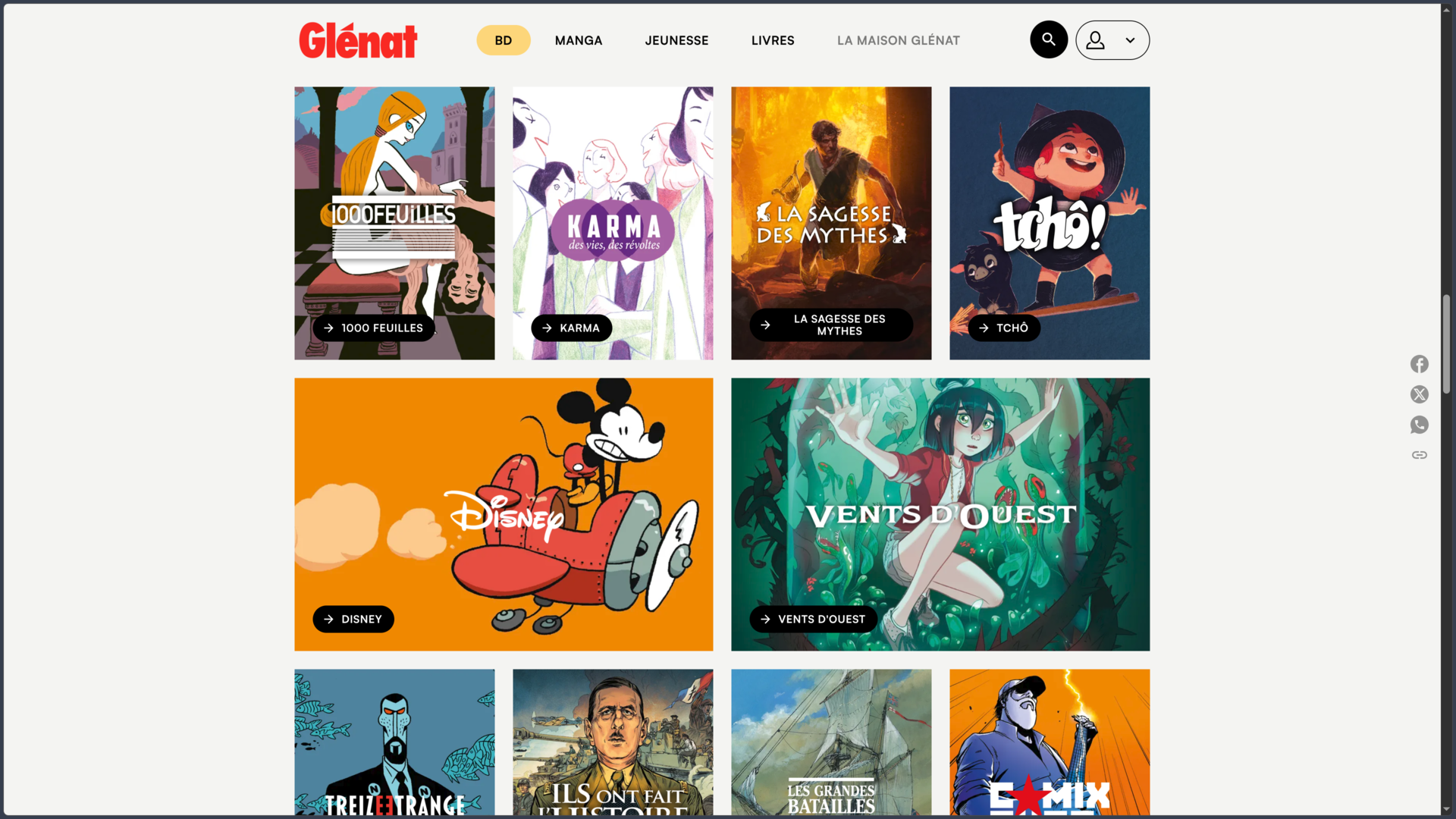
In historical comics, Les Passagers du vent by François Bourgeon played an important role from the late 1970s. Other series such as Les 7 Vies de l’Épervier, Balade au bout du Monde, Les Tours de Bois-Maury, Les Chemins de Malefosse and Les Pionniers du Nouveau Monde subsequently contributed to the identity of the publishing house.
With Titeuf, created by Zep and published by Glénat from 1993, the publisher found one of its greatest popular successes. The series expanded far beyond the album format alone and accompanied the creation of a broader children’s publishing environment around Tchô ! and new series.
Manga represents the other major historical pillar.
After Jacques Glénat travelled to Japan in the late 1980s, the publishing house began releasing manga around 1990-1991. Akira by Katsuhiro Otomo was among the first major works highlighted, before the arrival of Dragon Ball by Akira Toriyama.
The expansion was considerable.
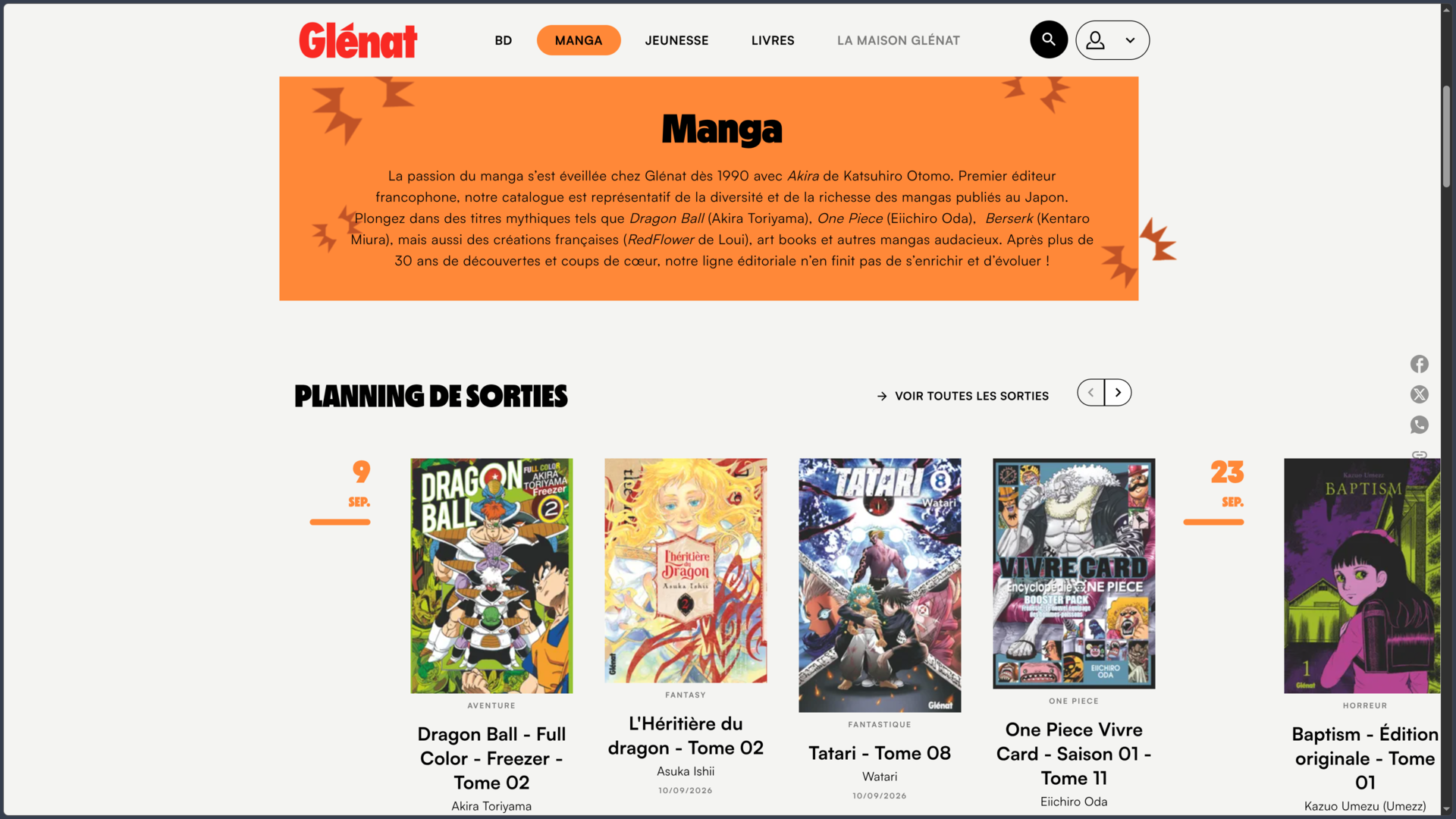
Glénat gradually built a catalogue featuring notably Dragon Ball, One Piece, Bleach, Berserk and many works belonging to the main categories of Japanese publishing.
The publishing house does not, however, create these manga itself. It acquires from Japanese publishers and rights holders the rights required for their French-language publication, and handles translation, editorial adaptation, manufacturing, marketing and distribution according to the relevant contracts.
This distinction is important within PANACHES CULTURE: Dragon Ball remains the work of Akira Toriyama and its Japanese publishing environment; Glénat is its French publisher.
The publishing house is not limited to comics and manga.
From the 1980s onward, it developed illustrated books around mountains, followed by the sea, gastronomy and other subjects. Children’s publishing also became an increasingly structured field, while various acquisitions and collections gradually broadened the Glénat organization.
This growth makes it necessary to distinguish Éditions Glénat from the broader Groupe Glénat.
Over time, the group has included or integrated other publishing houses, catalogues and structures. Vents d’Ouest, for example, joined the organization in 1991. Further acquisitions followed, while Hugo Publishing entered the group in 2022.
These publishing houses should not, however, be confused with Éditions Glénat itself. They have their own histories, editorial lines and sometimes their own brands.
In 2023, Glénat presented its group as the eighth-largest group in the French book market.
The company remains independent and continues adapting to new reading habits. In 2025, Glénat notably strengthened its digital offering and acquired a stake in ONO, a webtoon and manga platform created by Média-Participations.
More than fifty years after its creation, the publishing house therefore remains identifiable through a relatively rare characteristic: having built continuity between comics culture, illustrated publishing, children’s publishing and the French distribution of manga, without reducing its catalogue to any one of these activities.
History
1969: it all begins with a fanzine in Grenoble
Glénat’s history begins on September 1, 1969.
Jacques Glénat, still a high school student and passionate about comics, creates a fanzine in Grenoble called Schtroumpf.
The publication is devoted to comics and their creators.
It gradually evolves into Les Cahiers de la bande dessinée, a magazine that eventually reaches a total of 89 issues before ending in June 1990.
This origin is important for understanding the publishing house.
Glénat did not begin as a generalist company looking for a new sector to exploit.
Its starting point was the activity of an enthusiast focused on authors, works and the history of comics.
The transformation from fanzine into a genuine publishing activity took place gradually.
1972: the first albums truly launch the publishing house
In 1972, Jacques Glénat notably publishes Les Gnan-Gnan by Claire Bretécher, bringing together pages previously published in Spirou, as well as Humour noir et Hommes en blanc by Claude Serre.
The success of these first albums makes it possible to properly structure the business.
The publishing house gradually establishes a commercial network, develops its presence in Paris, looks for distributors in France and abroad, and expands its catalogue.
This period comes at a time when comics are still seeking recognition as a publishing sector on the same level as other forms of literature.
Glénat contributes to this evolution by publishing albums aimed at different audiences and by treating comics creators as the foundations of a genuine catalogue.
1979: historical comics become a major focus
The publication of Les Passagers du vent by François Bourgeon from the end of the 1970s opens an important period.
The series contributes to the development of historical comics aimed at a broader readership than the audience traditionally associated with children’s albums.
The Vécu magazine and collection subsequently emerge around this direction.
Glénat gradually develops a catalogue in which history can serve both as a setting for adventure and as documentary material.
Series such as Les 7 Vies de l’Épervier, Les Tours de Bois-Maury and Les Chemins de Malefosse contribute to this identity.
This work becomes one of the publishing house’s first lasting distinctive features.
The 1980s: moving beyond comics alone
From 1981, Glénat also begins developing a catalogue of illustrated books.
Its location in Grenoble plays a natural role here.
Mountains become one of the first major subjects explored, particularly through the meeting between Jacques Glénat and Samivel.
The catalogue is later strengthened by the integration of publishing houses and collections specializing in hiking and mountain activities.
The sea forms another important area, notably through works associated with Chasse-Marée.
Gastronomy also gradually joins the publishing house’s fields.
This diversification is significant: Glénat does not simply become a publisher accumulating unrelated sectors. A large part of these new catalogues maintains a strong connection with imagery, illustration, heritage and the transmission of a passion.
1989-1991: discovering Japanese manga
Glénat’s second major transformation begins at the end of the 1980s.
In 1989, Jacques Glénat travels to Tokyo and takes a direct interest in the Japanese comics market.
The publishing house’s official timeline presents 1991 as the beginning of Glénat’s publication of manga in France, first through newsstands and then bookstores.
The current catalogue nevertheless retains a slightly earlier trace: the first volume of the color edition of Akira is dated December 14, 1990.
This difference mainly reflects a transitional period during which manga began to be introduced gradually to French readers.
Akira by Katsuhiro Otomo is one of the first major works in this expansion.
Manga arrived in a cultural environment very different from that of the 2020s.
Japanese reading direction, formats, publication rhythms and even the general perception of manga were still unfamiliar to a large part of the French public.
Glénat therefore participated not only in translating the works but also in adapting them to a market that still had to be built.
Dragon Ball changes the scale of manga in France
The arrival of Dragon Ball forms the next decisive stage.
Akira Toriyama’s work already enjoys considerable visibility thanks to Japanese animation broadcast in France.
Its publication as manga allows a new generation of readers to directly discover the drawn work from which Son Goku’s adventures originate.
The first French editions adopt certain choices intended to make this discovery easier, including versions presented in a reading direction adapted to Western habits of the time.
Over time, this approach changes.
Glénat later publishes editions respecting the original Japanese reading direction, which has become familiar to French readers. In 2021, the publishing house even announces the discontinuation of its older French-reading-direction editions of Dragon Ball in order to retain only versions following the original work.
This evolution summarizes a broader transformation of the market.
What initially had to be adapted to make manga accessible gradually becomes a fully accepted publishing language in France.
1991: Vents d’Ouest joins Glénat
The same period also sees the group expand through acquisition.
In 1991, Éditions Vents d’Ouest joins the Glénat organization.
Its catalogue notably brings in series such as Joe Bar Team and Peter Pan by Régis Loisel, along with authors and heritage works.
This integration inaugurates a logic that will continue regularly: expanding the group by welcoming publishing houses or catalogues with their own identities rather than necessarily publishing every title directly under the Glénat brand.
This distinction becomes increasingly important as the group expands.
1993: Titeuf becomes a publishing phenomenon
In 1993, Glénat publishes Titeuf by Zep.
The character gradually becomes one of the greatest successes in French-language children’s comics.
The publishing house states that the series has exceeded 21 million albums sold.
Its importance extends beyond sales alone.
Titeuf helps renew the representation of childhood in comics, through its language, misunderstandings, school life, relationships and direct observation of the adult world.
Tchô ! subsequently develops around the character, functioning both as a magazine and as a publishing environment supporting the emergence or promotion of other children’s series.
Works such as Lou !, Captain Biceps and Mamette belong to this new generation.
Children’s publishing therefore becomes a genuine extension of the publishing house’s comics catalogue.
Manga gradually becomes a pillar of the catalogue
After Akira and Dragon Ball, Glénat continues expanding within Japanese publishing.
The publishing house gradually releases numerous series and develops an identifiable Glénat Manga branch within its catalogue.
One Piece by Eiichiro Oda becomes one of its major series.
Bleach by Tite Kubo also joins the catalogue.
Berserk by Kentaro Miura establishes itself in a very different register, that of dark fantasy aimed at an older audience.
This diversity becomes important.
Manga is no longer represented only by a few major shōnen aimed at teenagers. The catalogue extends across different genres, ages, tones and formats.
At the same time, Glénat continues reworking its major historical series through new translations, original editions, Perfect editions, oversized formats, box sets, art books and Prestige editions.
Manga thus becomes a heritage catalogue as well as a constant flow of new publications.
The 2000s: consolidating comics and expanding the catalogues
At the same time, Glénat continues developing European comics.
At the beginning of the 2000s, several major esoteric and historical series find their place in the catalogue, including Le Troisième Testament, Le Triangle secret and Le Décalogue.
In 2007, the group takes over the Albin Michel BD catalogue.
This operation brings authors such as Milo Manara, Georges Wolinski, René Pétillon, Philippe Vuillemin and Philippe Druillet into its environment, along with the magazine L’Écho des Savanes.
The group thereby simultaneously strengthens contemporary creation and comics heritage.
2009: Sainte-Cécile convent becomes Glénat’s Grenoble symbol
For the publishing house’s fortieth anniversary, in 2009, its Grenoble headquarters move into the former Sainte-Cécile convent.
The historic building is restored and becomes much more than a simple office complex.
Its chapel houses a library preserving a copy of titles published by the house, while the site also hosts cultural activities connected to the Fondation and Fonds Glénat.
This location embodies the publisher’s particular relationship with Grenoble.
Although its commercial activities also have a strong presence in the Paris region, the publishing house retains its historical roots in the city where Jacques Glénat created his fanzine forty years earlier.
Disney and heritage comics
In 2010, Glénat obtains authorization to publish various Mickey and Donald stories in album form.
The publishing house notably undertakes reissue work around major Disney creators such as Carl Barks, Floyd Gottfredson and Don Rosa.
It also develops creations in which contemporary authors offer their own interpretations of historic Disney characters.
This approach represents another aspect of the Glénat catalogue: combining heritage preservation with new interpretations of already established universes.
The 2010s: acquisitions and new collections
The group continues to develop.
In 2013, the catalogues of 12 bis, Mad Fabrik and Rando Éditions join the organization.
The integration of Mad Fabrik notably brings in the environment of Kid Paddle and Game Over.
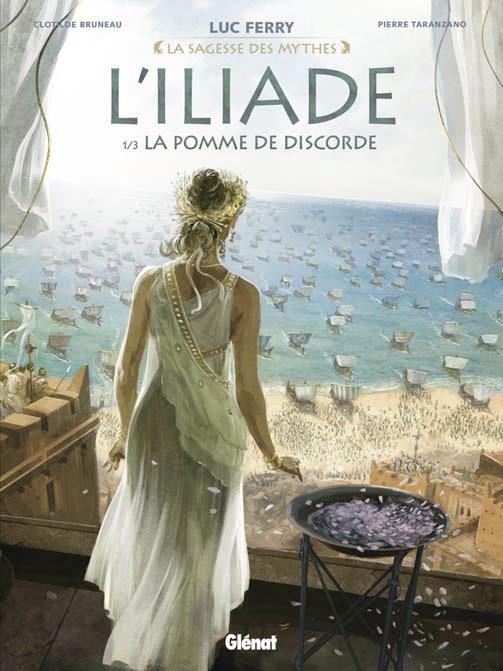
In 2014, Glénat develops several major thematic collections, sometimes in collaboration with other institutions or publishers: Ils ont fait l’Histoire, La Sagesse des mythes, Les Grands Peintres and Les Grandes Batailles navales.
Comix Buro joins Éditions Glénat in 2017.
Children’s publishing also continues to expand, notably with the integration of the Quatre Fleuves catalogue in 2018.
This period confirms that Glénat is no longer building its identity solely around a few emblematic series, but around several specialized editorial lines.
2022-2025: Groupe Glénat continues to expand
From January 1, 2022, Hugo Publishing joins Groupe Glénat.
The publishing house, notably active in new romance, practical books, sport and digital publishing, further broadens the group’s range.
This operation does not mean that Hugo books become Éditions Glénat publications: Hugo Publishing retains a distinct editorial identity within the organization.
In 2023, Glénat states that its group ranks eighth in the French book market.
In 2025, Maison Eliza also joins the organization in the form of a children’s collection retaining its editorial line.
That same year, Glénat strengthens its digital direction and acquires a stake in ONO, a legal webtoon and manga reading platform created by Média-Participations.
This movement shows that the evolution that began with printed manga around the turn of the 1990s is now continuing through new forms of digital reading.
What sets it apart
Building its identity from comics themselves
Glénat began as a fanzine devoted to comics before becoming a publishing house.
This origin has had a lasting influence on its identity.
The history of creators, the evolution of genres, the preservation of works and the construction of long-term catalogues all occupy an important place in the way the publishing house has developed.
The transition from the Schtroumpf fanzine to Les Cahiers de la bande dessinée, then to the first albums and major collections, creates continuity between criticism, publishing passion and publication.
Participating very early in the establishment of manga in France
Manga is probably one of Glénat’s most visible contributions to the evolution of the French market.
Around 1990-1991, the publishing house took the risk of publishing a type of comics still only weakly established in bookstores.
Akira and then especially Dragon Ball opened the way to a catalogue that would expand considerably.
Glénat also accompanied the evolution of reading habits.
The first adaptations intended to make reading easier for Western audiences gradually gave way to Japanese formats and reading direction.
Series such as One Piece, Bleach and Berserk later demonstrate that this activity was no longer an experiment but one of the permanent pillars of the publishing house.
Bringing together French creation, foreign licenses and heritage
The Glénat catalogue operates according to several different approaches.
The publishing house can support a French creation from its beginnings, as with Titeuf.
It can publish in France a Japanese work already established in its country of origin, such as Dragon Ball or One Piece.
It can take over and preserve historical catalogues.
It can also work with international properties such as Disney.
This diversity requires different publishing skills: original creation, translation, rights acquisition, heritage reissues, format adaptation and work with international rights holders.
Building catalogues capable of spanning several generations
Some properties published by Glénat have accompanied the publishing house for several decades.
Readers of Dragon Ball or Titeuf in the 1990s can now rediscover these works in new editions while also encountering new productions from the same catalogue.
This continuity encourages genuine heritage work.
Original editions, Perfect versions, Prestige editions, complete collections, illustrated books and reissues make it possible to keep works available beyond their initial commercial exploitation.
The phenomenon is particularly visible in manga, where major series can receive several successive presentations adapted to new generations of readers.
Maintaining cultural roots beyond commercial activity
Glénat’s relationship with comics is not limited to selling books.
The Sainte-Cécile convent in Grenoble houses a heritage library, cultural spaces and the activities of the Fondation and Fonds Glénat.
The publishing house also operates a gallery and participates in exhibitions devoted to drawing and illustration.
This dimension extends the company’s original philosophy: considering comics not only as a publishing product but also as a creative field with a history, creators and heritage worth preserving.
Remaining an identifiable publishing house within a much larger group
The development of Groupe Glénat could easily blur the boundaries between its different activities.
Vents d’Ouest, Hugo Publishing and other publishing houses or catalogues that joined the group do not automatically become works published under the Éditions Glénat brand.
This distinction is important.
Éditions Glénat has its own catalogue and its own editorial lines.
Groupe Glénat is the broader economic organization bringing together several publishing houses, collections and activities.
Within PANACHES CULTURE, linking a work to Glénat therefore requires verifying its actual publisher and not using the group name as a generic attribution.
Good to know
- Éditions Glénat was founded in 1969 in Grenoble by Jacques Glénat, who was still a high school student at the time.
- Its origin is the comics fanzine Schtroumpf, whose first issue appeared on September 1, 1969 and which later became Les Cahiers de la bande dessinée.
- The first albums published in 1972, notably Les Gnan-Gnan by Claire Bretécher and Humour noir et Hommes en blanc by Claude Serre, made it possible to properly structure the publishing house.
- Les Passagers du vent by François Bourgeon helped establish a major historical comics catalogue from 1979 onward.
- Glénat began taking a direct interest in manga after Jacques Glénat travelled to Japan in 1989; the publishing house dates the launch of its manga activity to 1991, while its catalogue dates the first color volume of Akira to December 14, 1990.
- Dragon Ball subsequently became one of the fundamental titles of Glénat Manga and strongly contributed to bringing manga to the French mainstream.
- The manga catalogue also includes major series such as One Piece, Bleach and Berserk, alongside many other Japanese works and creations.
- Titeuf, created by Zep and published by Glénat from 1993 onward, has exceeded 21 million albums sold according to the publishing house and contributed to the development of its children’s catalogue.
- Éditions Glénat currently publishes across four major areas visible on its website: comics, manga, children’s publishing and books.
- The legal company Glénat Editions SAS is headquartered in Grenoble; it should be distinguished from the broader economic organization represented by Groupe Glénat.
- The Sainte-Cécile convent in Grenoble has housed the publishing house’s historic headquarters since 2009, along with major heritage and cultural activities centered on drawing and comics.
- In 2023, Groupe Glénat presented itself as the eighth-largest group in the French book market and continues its digital development, notably through its acquisition of a stake in the manga and webtoon platform ONO in 2025.