Overview
Kazé is a historic French editorial brand connected to manga and Japanese animation, created in 1994. Its history spans several transformations of the French market: the rise of anime on VHS and DVD, the massive development of manga in bookstores, digital distribution, then the international consolidation of the sector.
Originally, Kazé was above all a publisher of Japanese animation. The brand helped distribute in France series and films that were still difficult to access legally at the time, with titles such as City Hunter, Cobra, GTO, Dr. Slump and Bleach. This activity allowed it to build an identity immediately associated with Japanese pop culture long before its direct entry into manga publishing.
The shift toward books took place gradually. In 2007, Kazé acquired Asuka, a manga publishing house founded a few years earlier by Raphaël Pennes and Renaud Dayen. Then, at the end of 2009, the group announced the creation of Kazé Manga, officially launched in 2010. A large part of the Asuka catalogue then moved under the new brand, while Asuka notably retained a specialization in Boys’ Love.
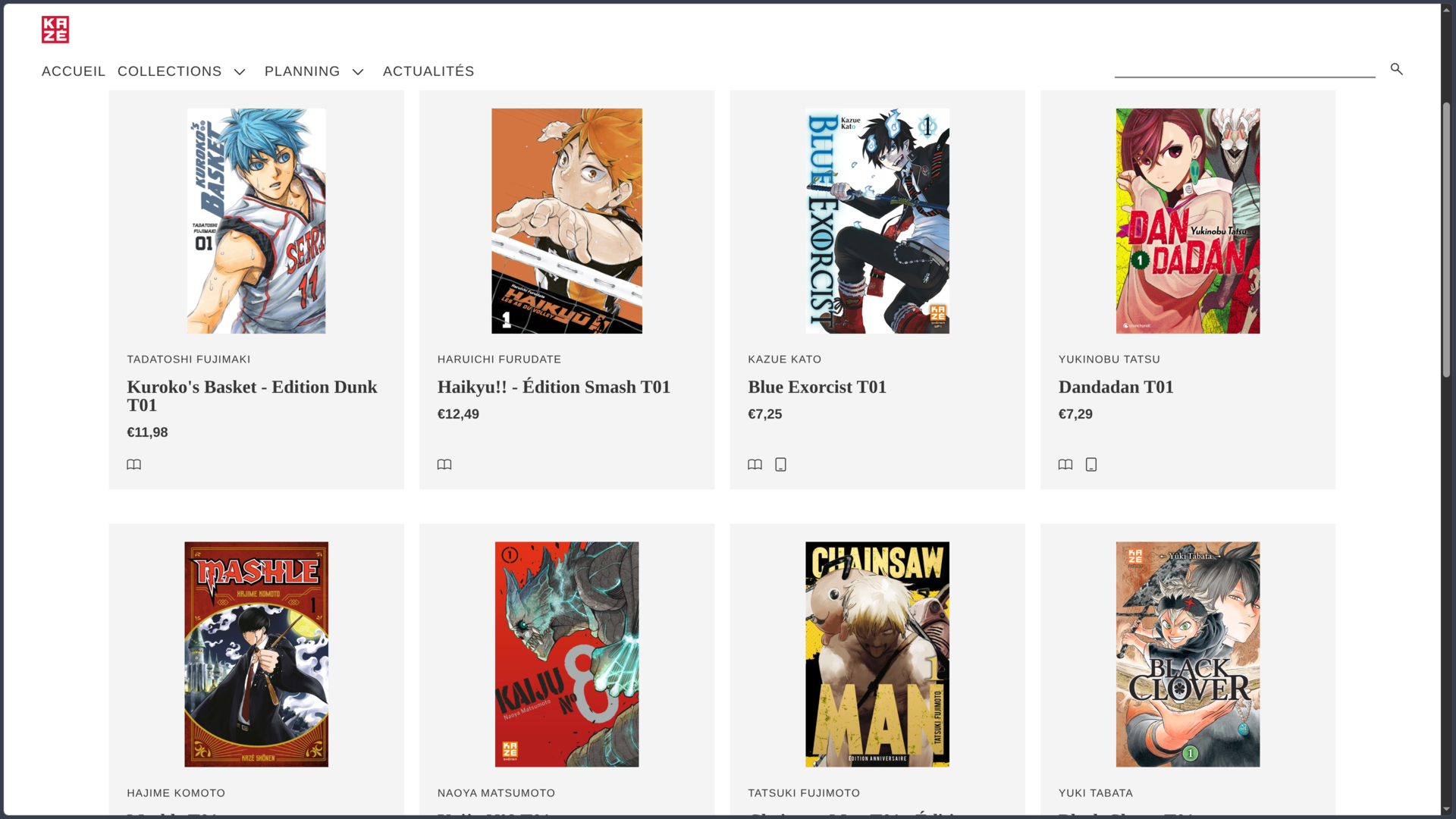
Kazé Manga then developed a very broad catalogue. Series such as Blue Exorcist, Kuroko’s Basket, Haikyu!!, Black Clover, The Promised Neverland, Chainsaw Man, Mashle and Kaiju No. 8 gradually became major titles for the publishing house. Alongside major shōnen licenses, Kazé also published works such as Ikigami, Rainbow, Initial D, Hokuto no Ken and L’Arcane de l’Aube, as well as heritage titles and works aimed at more specialized readerships.
This development is tied to another decisive stage: in 2009, Kazé was acquired together with Anime Virtual by VIZ Media Europe, controlled by the Japanese groups Shogakukan, Shueisha and Shogakukan-Shueisha Productions. The French publishing house thus became directly integrated into a major Japanese publishing environment, without limiting itself to Shueisha and Shogakukan catalogues.
From 2019 onward, the story changed again. Crunchyroll took a majority stake in VIZ Media Europe before gradually bringing its different European activities under its own brand. In 2022, the Kazé name therefore disappeared from new releases: manga and anime activities moved under the Crunchyroll identity.
This disappearance did not mean the end of the editorial team or the catalogue.
Series launched under Kazé continued under their existing identity, while new licenses appeared under the Crunchyroll Manga name. Dandadan, for example, was among the first major launches of this new period.
The situation changed again in 2025 when HarperCollins Publishers acquired Crunchyroll’s manga publishing activities in France and Germany. They were brought together within the Pegasus Manga structure.
The new owner then chose to restore a brand deeply identified by readers: Kazé.
From April 2026, new series once again appeared under the Kazé logo. Series already started under Crunchyroll Manga, however, retained that name in order to avoid changing their visual identity during publication.
The current Kazé is therefore both a revival and a continuation.
The historic brand returns, but within a different structure from that of 1994 or the VIZ Media Europe period. Its activity is now focused on manga publishing: streaming, animation, home video and merchandise activities remain with Crunchyroll.
In 2026, Kazé is operated by Pegasus Manga, a subsidiary of HarperCollins Publishers, with Mehdi Benrabah heading French editorial direction. The publishing house seeks to combine new licenses, rediscovery of its historical catalogue and continuity with the editorial team that passed through the Asuka, Kazé Manga and Crunchyroll Manga periods.
History
1994-2006 — A French pioneer of Japanese animation
Kazé was created in 1994, around figures including Cédric Littardi, at a time when legal access to Japanese animation remained far more limited than today.
The brand first developed through video. VHS and later DVD made it possible to offer Japanese works to French audiences beyond television broadcasts alone.
Over the years, Kazé notably released titles such as City Hunter, Cobra, GTO, Dr. Slump and Bleach. The brand gradually became one of the names most closely associated with anime in France.
This period above all built something that would remain essential later: a direct relationship with fans of Japanese culture.
Kazé was therefore not born as a manga publisher. Its print activity was a later diversification of a brand already recognized in animation.
2007-2010 — Asuka opens the way for Kazé Manga
In 2007, Kazé acquired Asuka.
Created in 2004, this publishing house already had a catalogue covering shōnen, seinen, shōjo, Boys’ Love and heritage works. The merger gave Kazé a genuine editorial base in books.
Two years later, a much more significant change occurred.
In 2009, Kazé was acquired by VIZ Media Europe, a structure connected to Shogakukan, Shueisha and ShoPro. The arrival of these Japanese groups accompanied a new ambition in European publishing.
Kazé then announced the creation of Kazé Manga, whose first publications arrived in 2010.
A large part of the Asuka catalogue was gradually integrated into this new identity, while the Asuka name continued mainly around certain specialized collections.
Kazé now had two strongly identified complementary activities: anime and manga.
2010s — Building a catalogue of major licenses without abandoning more targeted titles
The 2010s were the major period of establishment for Kazé Manga.
The publishing house released several series that became important on the French-speaking market: Blue Exorcist, Kuroko’s Basket, Haikyu!!, Black Clover and The Promised Neverland.
The latter became one of the catalogue’s greatest successes, surpassing several million copies sold in France.
Kazé simultaneously maintained very different works. Rainbow offered a much darker story, Ikigami developed a social dystopia, L’Arcane de l’Aube belonged to shōjo fantasy, while Hokuto no Ken and Initial D made it possible to work with titles already established in manga history.
This diversity gradually prevented Kazé from being reduced to a simple French relay for major Japanese shōnen series.
At the end of the decade and the beginning of the 2020s, a new generation of successes arrived with Chainsaw Man, Mashle and Kaiju No. 8.
The catalogue changed, but the logic remained the same: combining major licenses capable of reaching a very broad audience with more targeted series intended to build a lasting back catalogue.
2019-2022 — From VIZ Media Europe to Crunchyroll
In 2019, Crunchyroll acquired a majority stake in VIZ Media Europe.
This operation brought the international platform closer to a European group already active in manga, animation, video and distribution.
After several stages of integration, Crunchyroll decided in 2022 to unify these activities under a common brand.
Kazé then gradually disappeared from new releases.
In autumn 2022, new manga began appearing under the Crunchyroll Manga name. Dandadan was among the first major launches of this period.
The teams and ongoing series did not disappear, however. This was essentially a brand and structural change, not the end of editorial activity.
This distinction became particularly important a few years later.
2025-2026 — HarperCollins acquires the manga business and revives Kazé
In 2025, HarperCollins Publishers acquired Crunchyroll’s manga publishing activities in France and Germany.
The teams joined a new structure: Pegasus Manga.
Manga therefore became a publishing activity independent from Crunchyroll, whose streaming, animation and merchandise operations remained separate.
In December 2025, HarperCollins announced a symbolically significant decision: Crunchyroll Manga would return to the Kazé name.
The return became visible in bookstores from April 2026.
Continuity within existing collections was nevertheless preserved. A series begun under the Crunchyroll Manga logo was to retain that identity until completion, while new series would be published under Kazé.
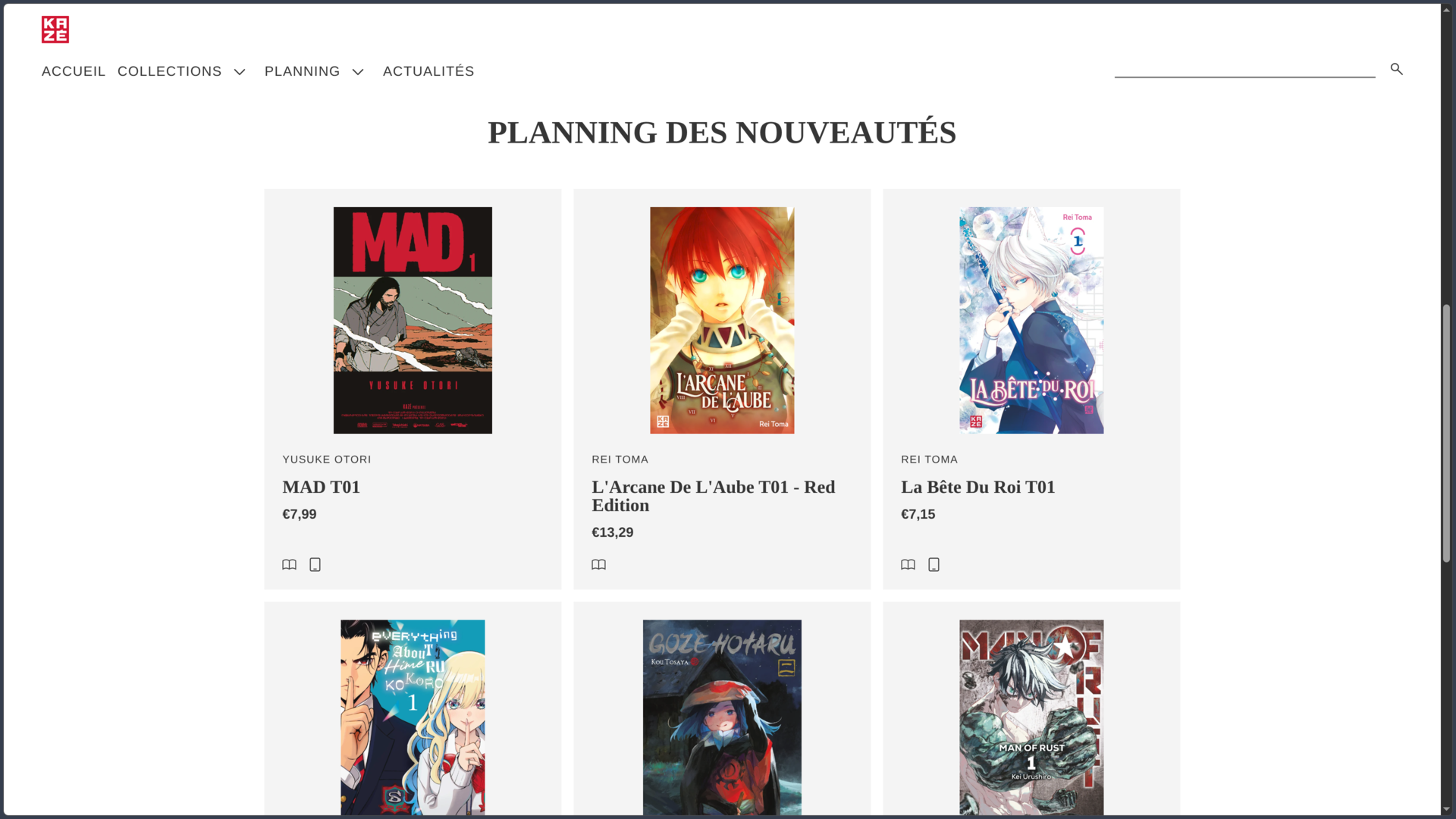
The comeback began with new licenses and rediscoveries from the back catalogue, notably a new edition of L’Arcane de l’Aube and its related series La Bête du Roi. Other titles then gradually expanded the new generation of the catalogue.
This revival therefore does not seek to erase the Crunchyroll years.
Instead, it uses Kazé as the identity for the next stage of an editorial team that has passed through several owners and several name changes.
What sets it apart
A history directly connecting anime and manga
Kazé has a different origin from many French manga publishing houses.
The brand has existed since 1994 through Japanese animation and only truly entered manga publishing through Asuka and later Kazé Manga.
This history explains why its identity long extended beyond books alone. Anime, manga, VOD, music and products connected to Japanese culture have at times coexisted within the same environment.
Even though the current Kazé is now focused on manga, this heritage remains central to its image.
A catalogue built between major licenses and more specialized choices
Kazé has published several major successes in contemporary manga, but its historical catalogue is not limited to them.
The Promised Neverland, Chainsaw Man, Black Clover, Haikyu!! and Kaiju No. 8 can coexist with Rainbow, Ikigami, Initial D, L’Arcane de l’Aube and heritage reissues.
This coexistence allows the brand to work both with highly visible current market titles and with series whose careers are built more gradually over time.
An identity capable of surviving several changes of ownership
Few French editorial brands have undergone as many transformations while maintaining continuity in their team and catalogue.
Kazé moved successively from an independent French structure to VIZ Media Europe, then into the Crunchyroll environment, before the manga business joined HarperCollins.
The name itself disappeared for three years before returning.
This trajectory makes the distinction between brand, editorial team and owner particularly important: the Kazé of 2026 no longer has the same ownership structure as the Kazé of 2010, but it clearly claims its heritage.
Bringing back the historic name without disrupting existing series
Kazé’s return in 2026 could have led to another visual change across hundreds of volumes.
Pegasus Manga instead chose to preserve ongoing collections: series begun under Crunchyroll Manga retain that brand, while Kazé applies to new series.
The catalogue can therefore carry both logos simultaneously for several years.
This solution places continuity in readers’ bookshelves ahead of immediate brand uniformity.
Good to know
- Kazé was founded in 1994 and initially developed as a French publisher of Japanese animation.
- Cédric Littardi is one of the founding and historical figures of the brand’s first period.
- In 2007, Kazé acquired Asuka, opening the way for the direct development of its manga publishing activity.
- Kazé Manga was launched in 2010, after Kazé was acquired by VIZ Media Europe in 2009.
- The historical catalogue notably includes Blue Exorcist, Haikyu!!, Black Clover, The Promised Neverland, Chainsaw Man, Mashle and Kaiju No. 8.
- In 2022, the Kazé brand was replaced on new releases by Crunchyroll Manga, without editorial activity stopping.
- In 2025, HarperCollins acquired Crunchyroll’s French and German manga publishing activities and integrated them into Pegasus Manga.
- Since April 2026, Kazé has once again been an active brand for new manga releases, while series begun under Crunchyroll Manga retain their previous logo.