


Presentation
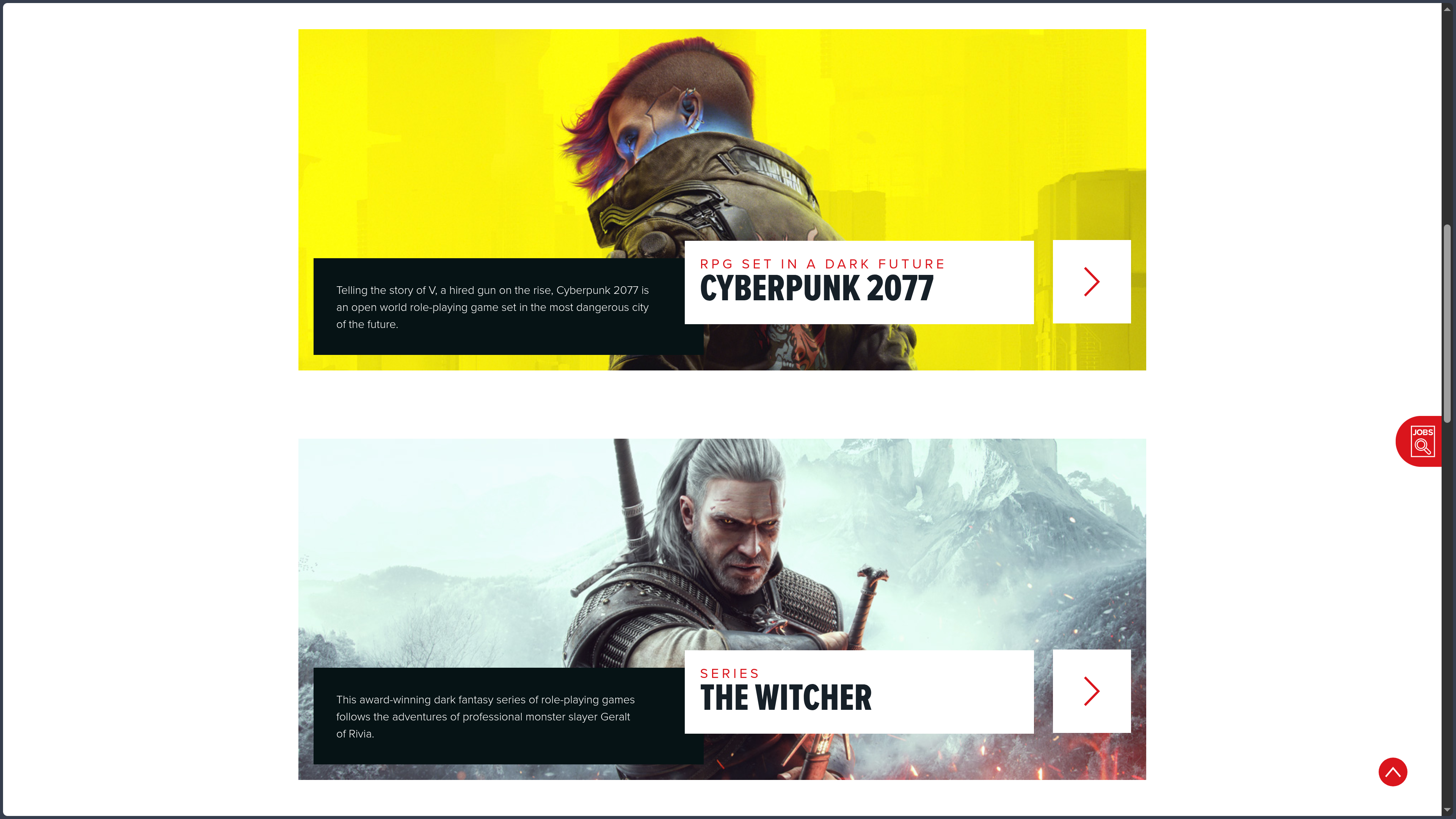
The Witcher and Cyberpunk 2077 seem to belong to two almost opposite worlds. The first crosses a fantasy of monsters, kingdoms at war, and rarely comfortable moral choices; the second dives into implants, megacorps, and the neon lights of Night City.
CD Projekt RED nonetheless approaches these universes with a common obsession: building worlds credible enough for the player's decisions to carry weight.
The studio was founded in 2002 within the CD Projekt group, a Polish company created eight years earlier around video game distribution. It had then neither major in-house franchise nor long development experience. Its first goal was already ambitious, however: transforming the literary universe of Andrzej Sapkowski into an RPG.
This first production became The Witcher. It allowed the studio to learn its craft, then each great following project widened what it thought it was capable of doing. The Witcher 2 developed a proprietary technology and pushed branching storytelling further. The Witcher 3 opened the world widely while trying to preserve the density of local stories. Cyberpunk 2077 added a complex metropolis, another perspective, other systems, and a new scale of production.
This progression is as much the strength as the fragility of CD Projekt RED. The studio has often chosen a project slightly more ambitious than what it already mastered. This method allowed it to quickly change scale; it also showed it, with the difficult launch of Cyberpunk 2077, what happens when ambition progresses faster than the organization able to support it.
Since then, CD Projekt RED has profoundly modified its way of working. The studio is gradually abandoning REDengine for Unreal Engine 5, expanding in North America, and preparing several projects in parallel, including a new The Witcher saga, the sequel to Cyberpunk, and an original property known as Hadar.
Its history can therefore be read as a permanent tension between two movements: pushing back the scale of its worlds, then learning to build the organization capable of sustaining that promise.
History
2002-2007: learning to become a developer
The history of CD Projekt RED begins with CD Projekt, founded in Poland in 1994 by Michał Kiciński and Marcin Iwiński. The company initially focused on importing, distributing, and localizing foreign games.
In 2002, a structure dedicated to development was created: CD Projekt Red Studio. The group already knew the market, the publishers, and how a game reached its audience, but it now had to learn how to make the product itself.
The first project drew on the universe of Andrzej Sapkowski. Development of The Witcher began in 2003 and lasted several years before a 2007 release.
The game bears the marks of a team still learning, but several principles already appear clearly. Decisions are rarely presented as simple choices between right and wrong. Consequences can arrive later and produce ambiguous results.
CD Projekt RED therefore did not just learn to build an RPG. It began to define the kind of RPG it wanted to tell: a world in which deciding often means accepting to live with an imperfect answer.
2011-2015: technology, divergence, and change of scale
The Witcher 2: Assassins of Kings, released in 2011, used REDengine, a studio-developed engine. This choice increased its technological autonomy but also gave it more internal responsibilities.
The game also pushed divergent storytelling further. A major decision can send the player toward different environments and events, which means producing content that part of the audience will never see during a first playthrough.
This logic becomes important: a choice cannot feel decisive if all paths immediately come back together.
In 2015, The Witcher 3: Wild Hunt definitively transformed the studio's place. The world became much more open, but CD Projekt RED sought to prevent this openness from reducing side quests to simple filler activities. Local stories, contracts, and old decisions can keep consequences independent of the main quest.
The game's success brought the studio considerably greater means, audience, and reputation.
It also created a new expectation: the next project would have to be even more ambitious.
Cyberpunk 2077: when growth meets its limits
CD Projekt RED announced Cyberpunk 2077 as early as 2012, based on the tabletop RPG universe created by Mike Pondsmith.
The change is radical: Night City replaces the kingdoms of The Witcher, firearms and implants replace the sword, and the studio seeks to build a dense and vertical metropolis very different from its previous spaces.
The game was released on December 10, 2020. Its launch became a major crisis, particularly on previous-generation consoles, where technical and performance issues were significant.
For CD Projekt RED, the difficulty went beyond bugs. Cyberpunk 2077 revealed the limits of an organization that had grown very fast while trying to produce its most complex project.
The studio then spent several years correcting and transforming the experience. Updates progressively improved the game, then the 2.0 update and the Phantom Liberty expansion in 2023 marked an important step in this reconstruction.
This period does not erase the launch mistakes. It rather becomes a second part of the story: that of a team forced to correct the consequences of its own ambition.
Turning the crisis into a new organization
After Cyberpunk 2077, CD Projekt RED gradually modified several foundations of its production.
In 2022, the studio announced a long-term partnership with Epic Games and confirmed that its future major projects would use Unreal Engine 5. The change ends exclusive dependence on REDengine.
It is not just a matter of changing engines. CD Projekt RED now wants to be able to advance several large productions in parallel without having to simultaneously rebuild all the technological infrastructure proper to each.
The studio is also expanding in North America, notably around its Boston and Vancouver teams. This international organization accompanies the preparation of several projects and profoundly changes the functioning of a company long centered on Poland.
The problem is therefore no longer just: how to build a great RPG?
It becomes: how to build several great productions without reproducing the fragilities revealed by Cyberpunk 2077?
A new period: extending the universes and finally creating one entirely from scratch
The next major chapter of The Witcher opens with The Witcher 4, which launches a new saga with Ciri as protagonist.
The franchise must continue without simply repeating the trilogy built around Geralt. The collaboration with Epic around Unreal Engine 5 also shows that CD Projekt RED continues to invest in technology, but now from a shared infrastructure.
The Cyberpunk universe is continuing in parallel. The project once known as Project Orion now bears the name Cyberpunk 2 and draws notably on the studio's North American teams.
Finally, Hadar represents a symbolic break: unlike The Witcher and Cyberpunk, this new intellectual property is created entirely in-house.
After more than twenty years spent adapting then extending pre-existing universes, CD Projekt RED will then have to answer a new question: what does a world designed from the start by the studio itself look like?
What Sets It Apart
Choice as narrative material
CD Projekt RED's RPGs do not simply stand out for having several dialogue options.
The studio mainly seeks to make their consequences less predictable. A decision may seem reasonable then later produce a much more ambiguous result. The player acts with imperfect information and does not always receive an immediately readable moral answer.
This way of designing choice gives more weight to the world. A decision is not just a button opening a different reward; it becomes a way of inhabiting the story.
At CD Projekt RED, choosing often consists less of finding the right answer than accepting the consequences of the one you gave.
Giving weight to stories encountered along the way
This philosophy goes beyond the main decisions.
The Witcher 3 particularly shows how a side quest can contribute to the general credibility of a world. A contract, a disappearance, or a local dispute can reveal a story worked through enough not to seem to exist only to occupy a portion of the map.
The distinction between main quest and side content then becomes less important than the quality of the context encountered.
This method directly serves immersion: the player has the impression of arriving in places where stories already existed before them.
Adapting without merely illustrating
The two great universes that built the studio's reputation existed before it.
The Witcher comes from the work of Andrzej Sapkowski. Cyberpunk builds on Mike Pondsmith's role-playing game.
CD Projekt RED does not, however, settle for turning these sources into interactive illustrations. The games develop their own continuity, shift the eras, create new characters, and produce their own conflicts.
The studio thus works in a delicate balance: staying close enough to the source for it to remain recognizable, while inventing enough for the game to have its own existence.
Hadar will be particularly interesting in this regard, since it will allow this sensibility to be observed without a prior universe.
Ambition as engine — and as risk
Each major CD Projekt RED production seems to have sought to solve a problem the previous one did not yet fully master.
The first The Witcher teaches the studio how to make an RPG. The Witcher 2 increases its technological control and pushes divergence. The Witcher 3 changes the scale of the world. Cyberpunk 2077 adds a metropolis, another structure, and much higher technical complexity.
This ambition explains much of the interest in the studio.
But the launch of Cyberpunk 2077 showed that this method has a limit: an organization cannot endlessly expand its projects without parallel increasing its ability to produce them correctly.
The move to Unreal Engine 5, the international expansion, and the parallel development of several projects can be read as an attempt to keep ambition while making production more sustainable.
Good to Know
- CD Projekt RED was founded in 2002, eight years after the creation of CD Projekt.
- Development of the first The Witcher began in 2003; the game was released on PC in 2007.
- The The Witcher universe comes from the literary works of Andrzej Sapkowski.
- The Witcher 2: Assassins of Kings was released in 2011 and uses REDengine.
- The Witcher 3: Wild Hunt was released in 2015 and profoundly transformed the studio's scale and reputation.
- Cyberpunk 2077 builds on the RPG universe created by Mike Pondsmith and was released in December 2020.
- The studio then spent several years improving the game, up to the 2.0 update and the Phantom Liberty expansion in 2023.
- CD Projekt RED announced in 2022 its gradual switch to Unreal Engine 5 as part of a partnership with Epic Games.
- The Witcher 4 opens a new saga with Ciri as protagonist, while Cyberpunk 2 mobilizes notably the North American teams.
- The studio is also working on Hadar, its first intellectual property entirely created in-house.