
Overview
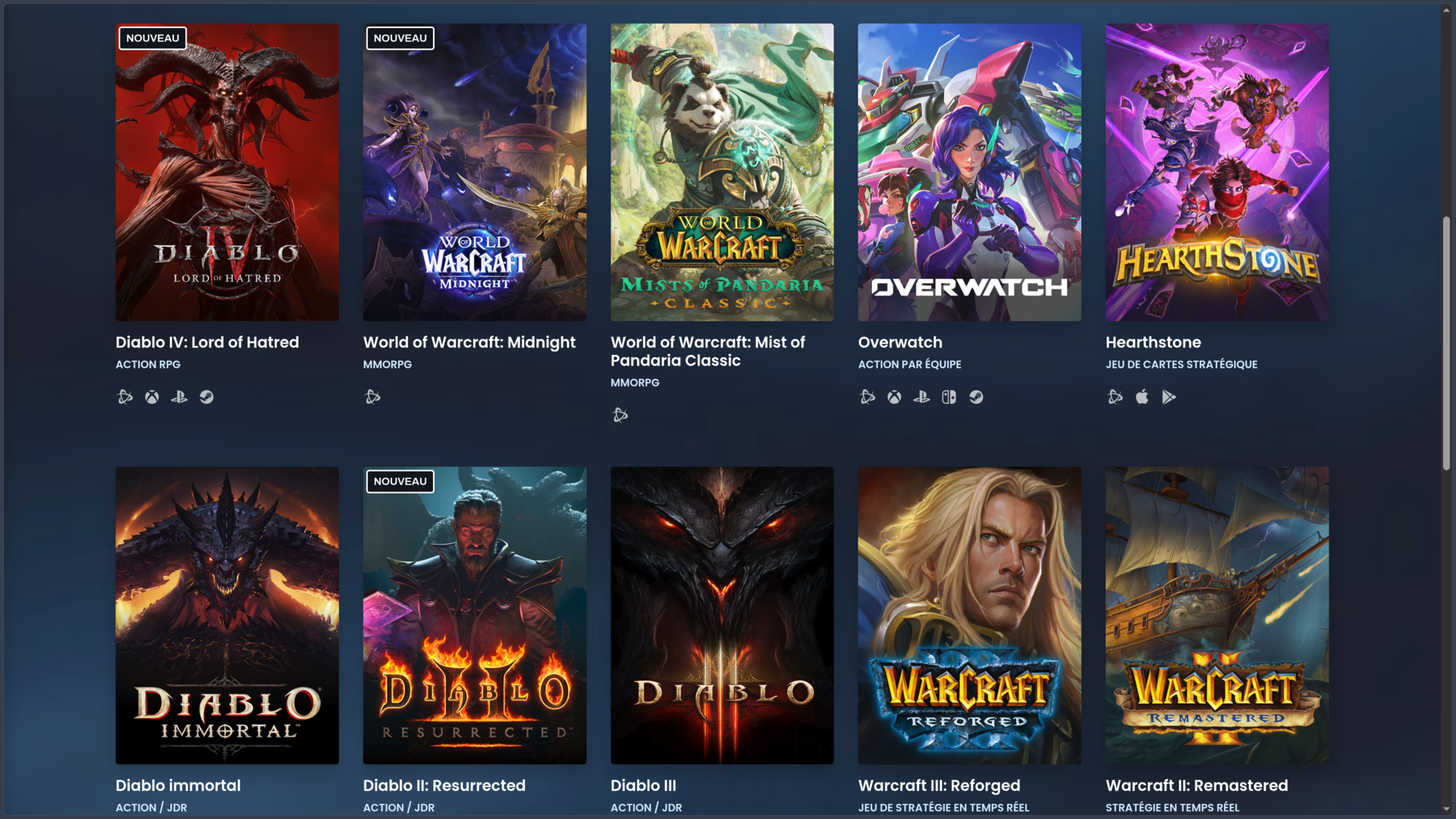
Founded in 1991 in California as Silicon & Synapse, Blizzard Entertainment became one of the studios most closely associated with the history of PC gaming. Its trajectory has been built around a relatively limited number of properties, but several of them have endured across decades: Warcraft, Diablo, StarCraft and later Overwatch. These universes are joined by Hearthstone and several productions that extend or recompose the same worlds through other genres.
This concentration is important for understanding Blizzard. The studio has never primarily built its identity around rapidly multiplying franchises. Its major properties are instead used as spaces capable of supporting several games, technological generations and forms of development. Warcraft, which began as a real-time strategy game, became the foundation of an MMORPG with World of Warcraft and later provided the setting for Hearthstone and Warcraft Rumble. Diablo expanded from action RPGs on PC to console and mobile productions, while StarCraft developed its own competitive culture over several decades.
Blizzard also built itself around connected play very early. Battle.net, launched in 1996, gradually became the shared infrastructure bringing its communities together. With Diablo, StarCraft and later Warcraft III, multiplayer features were no longer simply added independently to each game: they became part of a shared service. World of Warcraft pushed this relationship much further in 2004 by making a persistent world, continuous support and community the very foundations of the project.
At the same time, the studio went through numerous changes of ownership without losing its own legal and creative identity. Following several corporate transactions during the 1990s and 2000s, Blizzard became part of Vivendi Games. In 2008, the combination of Vivendi Games and Activision created Activision Blizzard, within which Blizzard remained a distinct organization. Microsoft then acquired Activision Blizzard in October 2023, bringing Blizzard into Microsoft Gaming.
These transformations changed its industrial environment but not its level within this history: Blizzard Entertainment remains the studio and publisher that develops and operates its own universes. Its current catalogue continues to revolve mainly around Warcraft, Diablo and Overwatch, while Battle.net remains the central point connecting its games.
History
From Silicon & Synapse to Blizzard Entertainment
The story begins in 1991, when Allen Adham, Mike Morhaime and Frank Pearce founded Silicon & Synapse after studying at UCLA. The small team initially worked on ports and productions for other publishers. This period allowed it to quickly gain experience across different platforms while developing its own projects.
Its early creations included The Lost Vikings and Rock N’ Roll Racing. These games did not yet have the scale of Blizzard’s future universes, but they already showed a desire to create systems that were immediately understandable without sacrificing depth. The team was still very small at the time, and several disciplines were handled by the same people.
The company briefly took the name Chaos Studios, then became Blizzard Entertainment in 1994 after being acquired by Davidson & Associates. The operation gave the team greater resources to develop and publish its own productions while preserving broad creative autonomy.
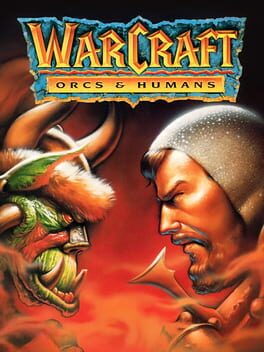
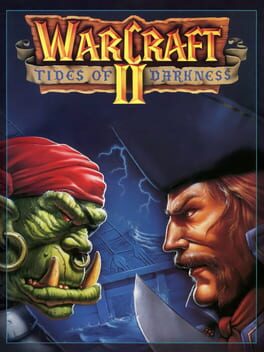
That same year saw the release of Warcraft: Orcs & Humans. The game marked the first step in a major transformation: Blizzard was no longer simply developing an isolated production, but beginning to build a universe capable of being extended. Warcraft II: Tides of Darkness, released in 1995, quickly expanded this foundation and helped establish Blizzard as an important force in PC real-time strategy.
Battle.net, Diablo and StarCraft: connected play becomes central
The second half of the 1990s gave Blizzard several of the elements that would define its identity over the long term.
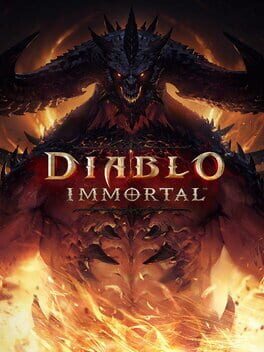
The first Diablo was initially developed by the independent studio Condor, which Blizzard acquired in 1996 and renamed Blizzard North. This distinction is important: the universe and foundations of Diablo largely came from this specific team, integrated into Blizzard before the game’s release. The project added a very different form of game to its catalogue compared with Warcraft, built around real-time action, character progression, item generation and strong replayability.
At the same time, Blizzard launched Battle.net. The service accompanied Diablo and allowed players to meet directly online without relying on a complex external infrastructure. Battle.net gradually became the common link between the studio’s productions and accompanied its transition from a developer of mainly self-contained games to a creator of connected experiences.
StarCraft, released in 1998, extended this evolution. Blizzard remained within real-time strategy but built a new science-fiction universe with three factions whose units, rhythms and possibilities were profoundly different. The game and its Brood War expansion also developed a lasting competitive dimension, particularly visible in South Korea.
The studio therefore did not simply repeat Warcraft in a different setting. It deepened an approach to asymmetric systems whose differences remained readable enough to understand while allowing a wide variety of situations.
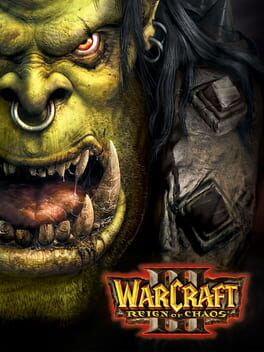
Diablo II in 2000 and Warcraft III: Reign of Chaos in 2002 then extended the two major branches in turn. Warcraft III placed greater emphasis on heroes, characters and staging, indirectly preparing a much more significant transformation of the Warcraft universe.
World of Warcraft: turning a franchise into a persistent world
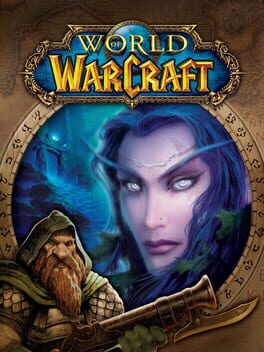
In 2004, Blizzard released World of Warcraft. This time, the studio used the universe built through its strategy games to create a persistent online world. The change did not concern genre alone: it profoundly transformed the relationship between Blizzard and its productions.
A game such as Warcraft III can receive fixes or an expansion, but its fundamental architecture remains that of a published work. World of Warcraft, by contrast, requires a team capable of continuously operating the service, adding content, maintaining servers, modifying systems and supporting a community that inhabits the same world every day.
The project therefore became a production infrastructure as much as a game. Expansions, updates and successive transformations evolved Azeroth over decades. Blizzard gained considerable experience in continuous development long before game-service models became common across the industry.
This success also changed the studio’s internal balance. For several years, World of Warcraft occupied a central place in its activity, while the other franchises experienced much longer development cycles. StarCraft II did not arrive until 2010 and Diablo III until 2012, but each revived a historic property with new online architectures and a much broader audience.
This period illustrates one of Blizzard’s characteristic contradictions: its games are often awaited for many years, yet once released they can continue evolving for an equally considerable length of time.
Hearthstone and Overwatch: moving beyond the three historic universes
At the beginning of the 2010s, Blizzard began to diversify its formats more extensively.
Hearthstone, released in 2014, reused the Warcraft universe but transformed it into a digital card game. The project differed from the studio’s large productions through a more compact and immediately accessible approach. It demonstrated that a historic universe could serve purposes beyond directly extending an existing genre.
The studio also explored the MOBA genre with Heroes of the Storm, bringing together characters from several of its universes. This production illustrates how Blizzard began to view its catalogue not only as a collection of separate series, but also as a shared heritage that could be recomposed.
The most important break, however, came with Overwatch in 2016. For the first time in many years, Blizzard introduced a major new universe with no direct connection to Warcraft, Diablo or StarCraft. The project emerged after the cancellation of the MMORPG known as Titan and transformed part of the team’s accumulated experience into a competitive action game built around heroes with highly differentiated abilities.
Overwatch rediscovered several principles already visible elsewhere at Blizzard: immediately identifiable characters, complementary roles, readable actions and the importance of team composition. The structure was different, but the desire to create systems that were accessible at first contact and complex enough to produce lasting interactions remained.
This period confirmed that Blizzard could still create an entirely new property while preserving certain design behaviors developed since the 1990s.
From Vivendi to Activision Blizzard, then Microsoft
Blizzard’s creative history unfolded alongside a succession of transformations involving its parent company. After the ownership changes that began with Davidson & Associates, the studio became integrated into the organization that would become Vivendi Games.
In 2008, Vivendi Games was combined with Activision. The transaction created Activision Blizzard. The name can be misleading: Blizzard Entertainment did not creatively merge with Activision Publishing to form a single studio. The two remained distinct operational organizations within the same group.
This structure allowed Blizzard to continue operating its own franchises, Battle.net and teams while belonging to a much larger organization. The following decades nevertheless saw changes in its leadership, production methods and the expectations associated with continuously developing several major properties at the same time.
A new break came on October 13, 2023, when Microsoft completed its acquisition of Activision Blizzard. Blizzard then joined Microsoft Gaming alongside Activision, King, Xbox Game Studios, Bethesda and other organizations. Once again, the change took place above the studio: Blizzard retained its name, universes and development organization.
This integration opened a new period whose long-term consequences are still being shaped. In 2026, however, Blizzard continues to operate and develop its main families of games. World of Warcraft, Diablo IV, Overwatch and Hearthstone remain active, while the classic catalogue also continues to be restored and made accessible on current platforms.
What sets it apart
Rules that are easy to understand, difficult to exhaust
One characteristic runs through much of Blizzard’s catalogue: its systems often aim to be readable before being simple.
In Warcraft or StarCraft, units have easily identifiable roles, but their interactions create significant tactical depth. Diablo relies on immediately accessible actions, while character builds, items and skill combinations produce much more complex progression. Overwatch presents heroes with clearly differentiated abilities, but combining them within a team multiplies the number of possible situations.
This approach allows Blizzard’s games to welcome very different audiences. A player can quickly understand the overall objective without immediately mastering every possibility. Depth gradually emerges through interaction, optimization and accumulated knowledge.
This relationship between accessibility and mastery also helps explain why several of its productions lend themselves to competitive play or long-term engagement. The fundamental rules remain relatively stable while the situations produced by their combination continue to vary.
Building universes capable of changing genre
Blizzard does not preserve its franchises by locking them into their original form. Warcraft provides the most striking example.
The property began as a strategy game, became an MMORPG with World of Warcraft, provided the setting for a card game with Hearthstone and later for a mobile strategy and action production with Warcraft Rumble. The universe provides continuity through characters, locations and references, but each project can completely rebuild the way players interact with it.
The same logic appears to a lesser extent with Diablo, whose productions expanded from PC to consoles and mobile while retaining action RPG gameplay as an identifiable core.
This ability allows Blizzard to treat its universes as long-term cultural resources rather than as a succession of numbered installments. A franchise can disappear for several years, return in a new form or continue simultaneously across several productions.
Battle.net and community as part of the infrastructure
Since 1996, Battle.net has been a structural part of Blizzard’s identity. The service is not used only to sell or launch games: it has gradually brought together accounts, multiplayer, communication and access to the studio’s different universes.
This continuity accompanies a deeper shift in the way productions are designed. Diablo and StarCraft use the network to connect players around games that are still largely autonomous. World of Warcraft then turns permanent connectivity into an essential condition of the experience. Hearthstone, Diablo and Overwatch extend this culture with games whose balance, seasons and content evolve after release.
The community therefore no longer enters the picture only when the product reaches the market. It lives with the game throughout its continuous development, requiring teams to observe real player behavior and regularly adapt their systems.
This practice also has a counterpart: maintaining several games for years requires permanent teams and forces Blizzard to balance renewal with preservation. Changing a system too deeply can weaken a community’s habits; leaving it unchanged can instead exhaust the experience.
A small number of universes sustained for decades
Finally, Blizzard stands out for the unusual longevity of its major properties. Warcraft has existed since 1994, Diablo since 1996, StarCraft since 1998 and Overwatch since 2016. The studio has launched other productions, but its public identity remains concentrated around a small number of universes.
This situation creates a shared memory across generations of players and developers. Characters, music, factions and locations can reappear several decades after their creation, sometimes in entirely different genres or contexts.
It also requires Blizzard to work constantly between heritage and transformation. Classic versions of World of Warcraft, remasters of StarCraft, Diablo II or the early Warcraft games show that part of the audience wants to rediscover precise historical forms, while current productions must continue modifying these universes so that they do not become purely heritage properties.
The studio therefore evolves within a permanent tension between two needs: preserving what makes its properties immediately recognizable and allowing them to continue changing. This tension explains a large part of its contemporary identity.
Good to know
- Blizzard Entertainment was founded in 1991 by Allen Adham, Mike Morhaime and Frank Pearce under the name Silicon & Synapse.
- After briefly operating as Chaos Studios, the company became Blizzard Entertainment in 1994.
- Warcraft: Orcs & Humans, released in 1994, launched the oldest of Blizzard’s major franchises still in operation.
- Condor, the studio behind Diablo, was acquired in 1996 and became Blizzard North.
- Battle.net has connected players across Blizzard productions since 1996 and remains the shared infrastructure of its catalogue.
- StarCraft was released in 1998 and became one of the studio’s main pillars of competitive strategy gaming.
- World of Warcraft, released in 2004, profoundly transformed Blizzard by placing the development and operation of a persistent world at the heart of its activity.
- Hearthstone was released in 2014 and brought the Warcraft universe into digital card games.
- Overwatch, launched in 2016, introduced a major new universe independent of Warcraft, Diablo and StarCraft.
- Blizzard became part of Activision Blizzard in 2008, then joined Microsoft Gaming in 2023 following Microsoft’s acquisition of the group.