Several years after the wars between Humans and Orcs, an uneasy peace has settled over Azeroth. The defeated Orcs languish in internment camps while the Human Alliance begins to fracture in the absence of a common enemy. But the Burning Legion, the demonic army that once corrupted the Orcs and caused their invasion of Azeroth, is preparing a new assault. Three destinies eventually intersect. Arthas Menethil, a young paladin and prince of Lordaeron, investigates a plague that transforms its victims into undead servants; his obsession with the source of the plague leads him toward a cursed blade and a terrible transformation. Warned by a mysterious prophet, Orc warchief Thrall leads his people across the sea to the forgotten continent of Kalimdor in search of a new home. Tyrande Whisperwind, leader of the ancient Night Elves, must defend her sacred lands first from the newcomers and then from the demonic invasion. As the Burning Legion marches toward a source of power capable of corrupting the entire world, old rivalries must give way or condemn those who refuse to overcome them.
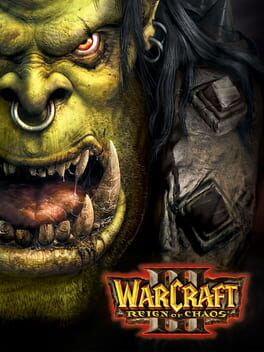
Warcraft III: Reign of Chaos
- Blizzard Entertainment Developer
- Blizzard Entertainment Publisher
- Capcom Publisher
- Sierra Entertainment Publisher
Four peoples, heroes at the heart of their armies, and a war that now threatens the entire world.
Details
- Type
- Video game
- Release
- 2002-07-03
- Genres
- Fantasy, Strategy, Real-time strategy
- Platforms
- PC, Mac
- Game modes
- Single player, Multiplayer
Synopsis
Warcraft III: Reign of Chaos
Trailer
Watch the trailer
Overview
Presentation
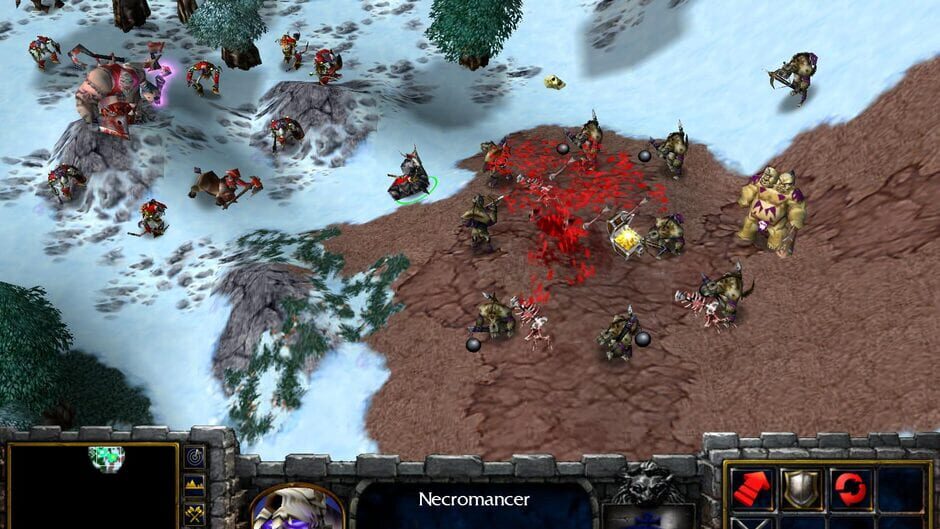
Warcraft III: Reign of Chaos deeply evolves the formula established by the first two Warcraft games. Base building, resource gathering and army command remain at the core of the experience, but Blizzard now combines them with mechanics inspired by role-playing games and a campaign driven much more directly by its characters.
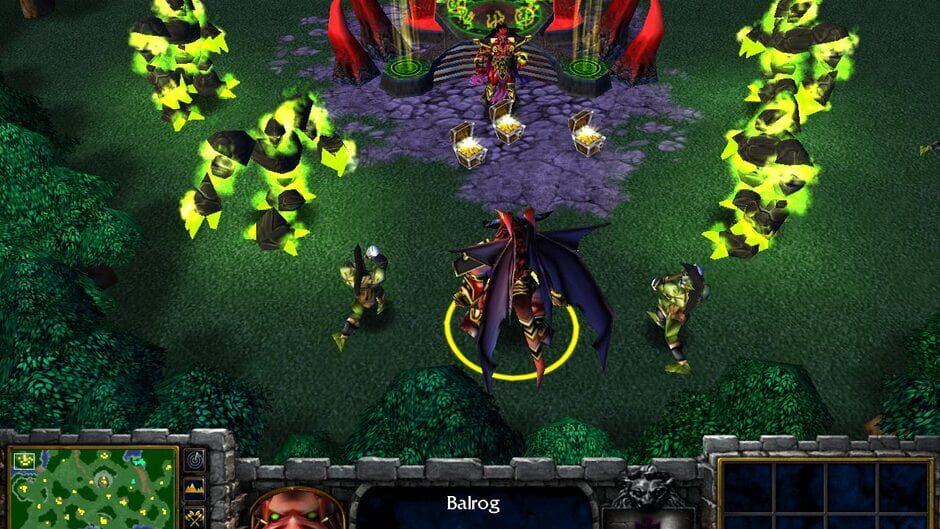
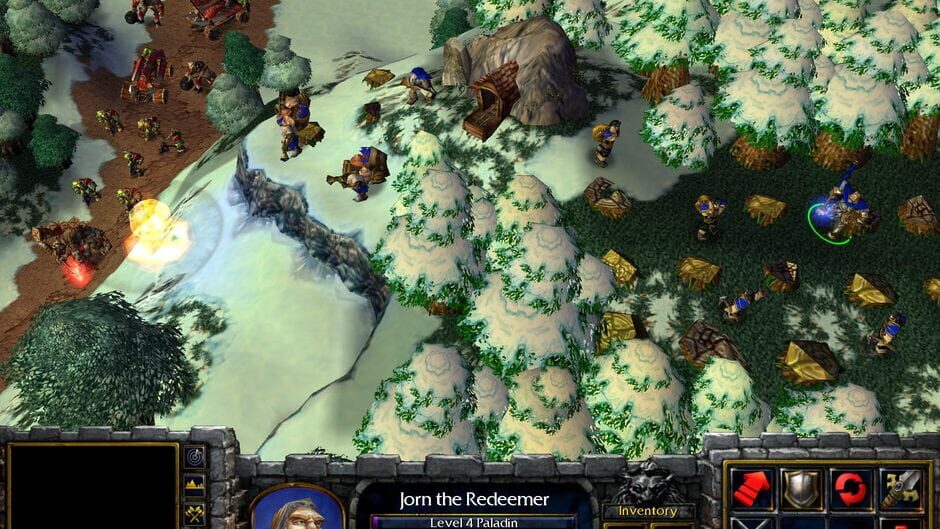
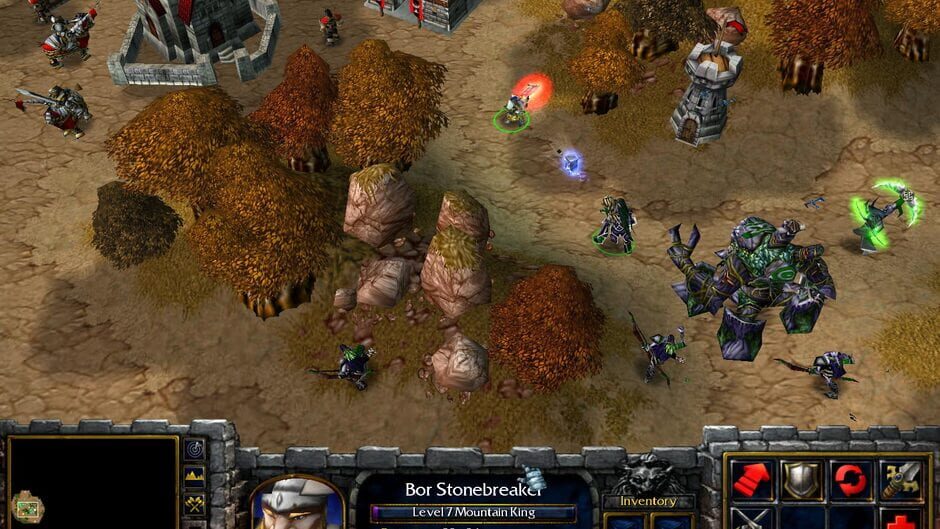
The most important change concerns the heroes. Each faction can rely on these special units, which are able to gain experience, level up and gradually develop new abilities. Heroes also have an inventory in which they can carry items found or acquired during a match. They are therefore no longer simply more powerful combat units: their progression develops alongside the army, and their use becomes a central part of the strategy.
The game features four playable factions. The Human Alliance and Orcish Horde return, while the Undead Scourge and Night Elves make their debut. Each has its own units, heroes, buildings, technologies and development methods. The differences therefore go far beyond a few faction-specific units: the way bases are built, forces are produced and certain mechanics are exploited genuinely varies from one side to another.
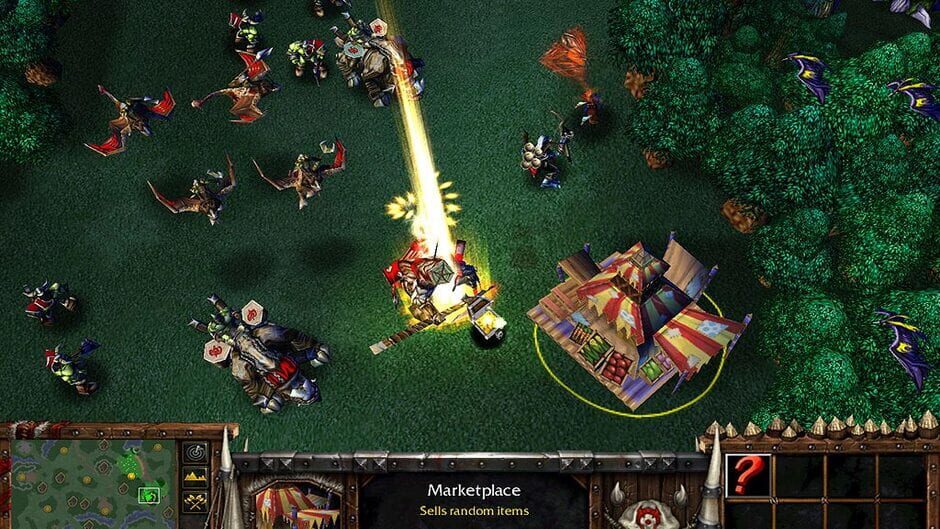
Maps also contain neutral creatures, often positioned around resources, special buildings or important routes. Defeating them can provide heroes with experience, gold or items. Neutral buildings can in turn offer various services. Exploration therefore becomes a strategic activity in its own right: moving beyond the safety of the base can strengthen heroes and secure useful locations before directly engaging the enemy.
Economic management continues to rely on gold and lumber, while food limits the size of the available forces. An upkeep system also reduces gold income once an army exceeds certain thresholds. This mechanic encourages players to think carefully about the growth of their forces rather than automatically building the largest possible army, increasing the importance of smaller groups organized around heroes.
The battlefield also changes with a fully 3D environment and a day/night cycle that affects certain mechanics. Visibility varies depending on the time of day, and several units or factions can take advantage of these changes. Fog of war remains essential: exploring the terrain reveals its geography, but enemy movements remain visible only when they are within the line of sight of allied forces.
The single-player campaign is organized around a prologue followed by several interconnected campaigns. The story moves through different factions and follows characters including Arthas, Thrall and Tyrande as their paths gradually converge around the threat posed by the Burning Legion. Some missions move away from traditional base building to place greater emphasis on exploration, secondary objectives or hero progression, with heroes able to retain their development from one scenario to the next.
Key points
- Four playable factions: Human Alliance, Orcish Horde, Undead Scourge and Night Elves.
- Heroes gain experience, level up, develop abilities and use items.
- Factions feature distinct mechanics, units, buildings and development methods.
- Neutral creatures and buildings give exploration a new strategic importance.
- The upkeep system limits the value of oversized armies by progressively reducing gold income.
- A day/night cycle affects visibility and certain abilities.
- The campaign places greater emphasis on characters, varied objectives and narrative continuity between the different factions.
- The game retains single-player and multiplayer modes and also includes tools for creating custom maps and scenarios.
Conclusion
Warcraft III: Reign of Chaos does more than expand the systems introduced in the previous games. The arrival of heroes and their progression, four strongly differentiated factions, neutral creatures and army management built around more controlled force sizes fundamentally change the way each match is approached.
This evolution is matched by a comparable change in storytelling. The conflict is no longer presented simply as the opposition between two sides: several peoples, characters and storylines intersect around a common threat. The game therefore brings strategy, individual hero progression and narrative closer together while preserving the resource and base management that has defined the series since its beginnings.
Good to know
Warcraft III: Reign of Chaos was developed by Blizzard Entertainment and released in 2002 on PC and Mac.
It is the first Warcraft game to feature four distinct playable factions, introducing the Undead Scourge and the Night Elves alongside the Human Alliance and Orcish Horde.
The game also includes the World Editor, a tool for creating and modifying custom maps and scenarios, with possibilities extending far beyond simply placing units and buildings.
It is also known under several names, including WC3, War3, Warcraft 3, Warcraft III and RoC.
This entry covers Warcraft III: Reign of Chaos itself, not its expansion Warcraft III: The Frozen Throne or later editions and adaptations.