Presentation
Developed by Blizzard North and published by Blizzard Entertainment, Diablo was released for Windows at the end of 1996. Game design is credited to Blizzard North, with David Brevik and Erich Schaefer serving as Senior Designers, Bill Roper as producer and Allen Adham as Executive Producer. The title established the foundations of a series that would become one of the major references in action role-playing games.
The adventure is concentrated almost entirely around Tristram and the cathedral built above an enormous underground complex. The village serves as a refuge between expeditions, with several inhabitants offering healing, trading, item identification or information about the events that have devastated the region.
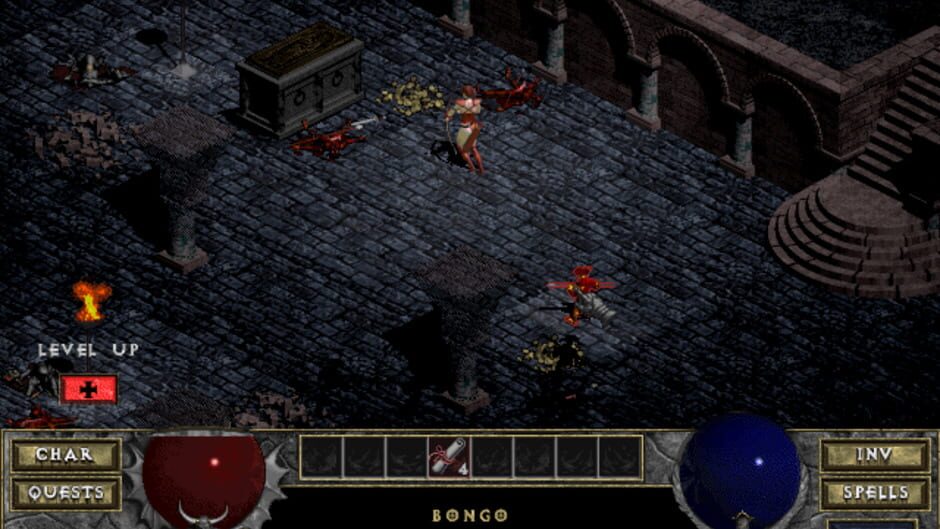
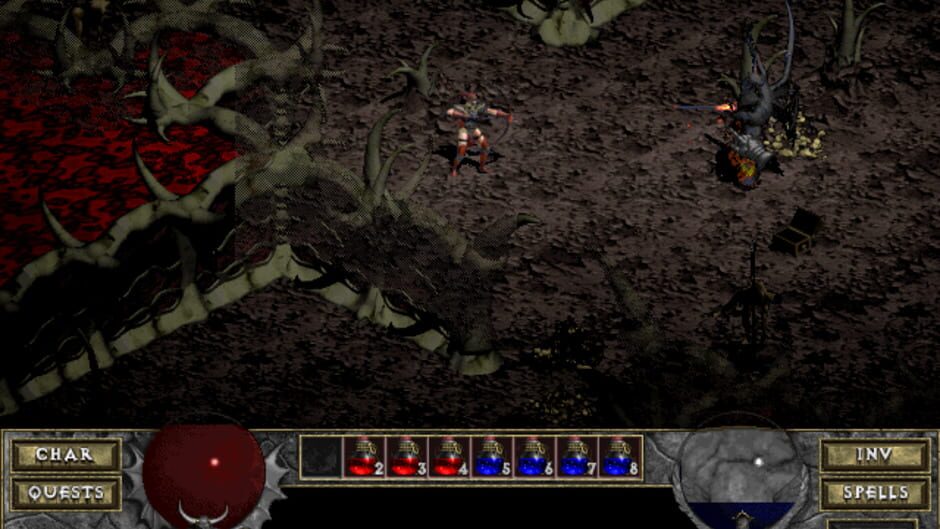
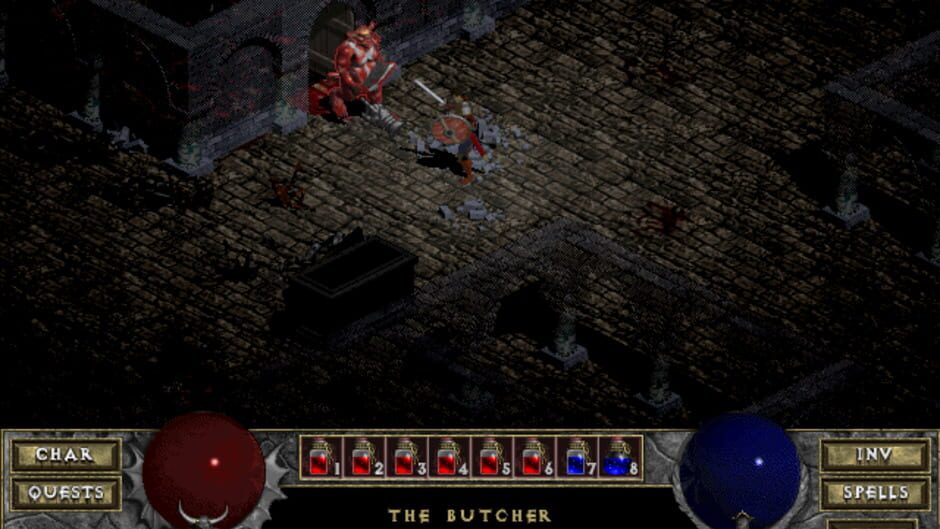
Beneath the cathedral are sixteen levels divided across several successive environments. Cathedral, catacombs, caves and eventually infernal regions accompany an increasing level of difficulty. Rather than using an entirely hand-built dungeon, much of their organization is generated again for each new game.
This random generation alters the arrangement of rooms, corridors, stairways, monsters, traps and many treasures. Players gradually learn the general rules associated with each environment without being able to memorize the exact route of a new adventure. This uncertainty becomes one of the main driving forces behind exploration.
Diablo offers three classes: the Warrior, Rogue and Sorcerer. The Warrior is better suited to close combat, the Rogue excels with ranged weapons and the Sorcerer has the strongest natural aptitude for magic. The classes nevertheless share much of the underlying system and can use many pieces of equipment or spells depending on their attributes.
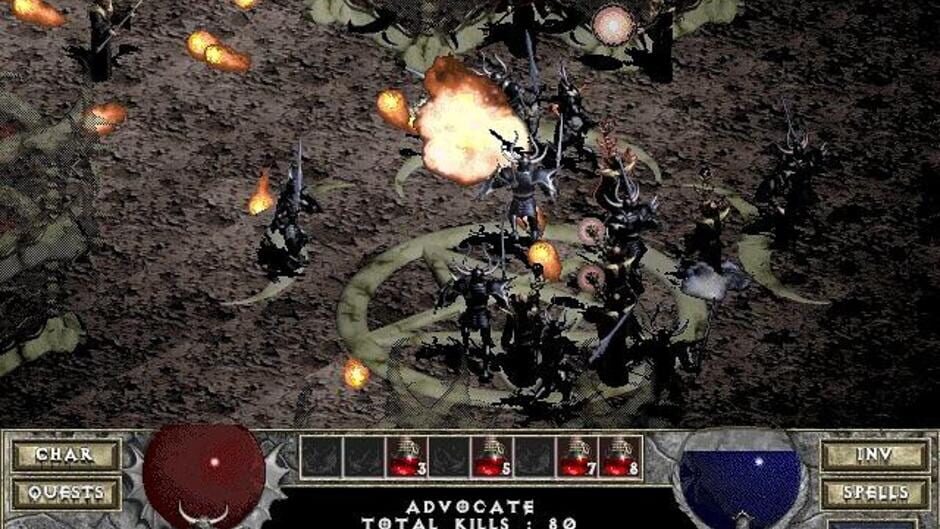
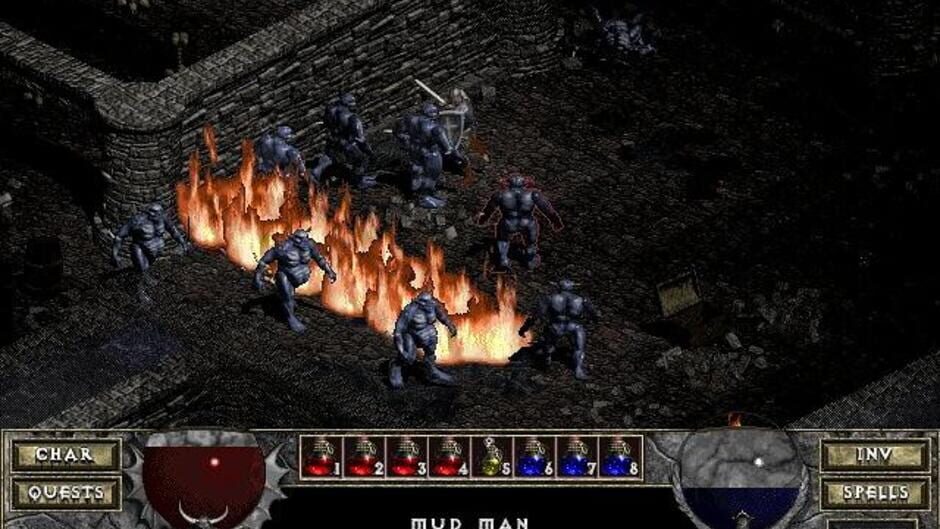
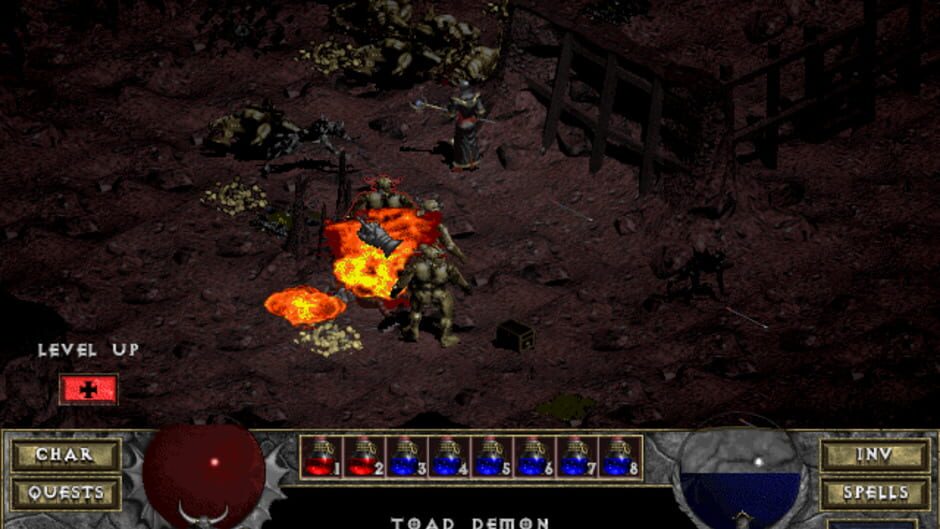
The game runs in real time with an interface controlled primarily through the mouse. A click can move the character, attack an enemy, collect an item or interact with the environment. This simplicity makes basic actions immediately accessible while character progression, equipment and positioning determine effectiveness during combat.
Characters possess several attributes, including strength, magic, dexterity and vitality. Gaining levels allows these values to be gradually improved, while the requirements of weapons, armor and spells influence development choices. A character is therefore shaped as much by statistics as by the equipment recovered along the way.
Randomized loot is one of the game's essential systems. Weapons, armor, jewelry and other objects can possess different properties, regularly changing the equipment available to the character. A powerful new weapon or piece of armor can alter combat priorities and encourage further exploration of the deeper levels.
Magic notably relies on spell books that can be found or purchased. Learning them requires sufficient magic, and certain spells can later be improved by discovering additional copies of the same book. Warriors and Rogues can therefore use magic as well, although the Sorcerer is naturally better suited to this approach.
Character management remains important outside combat. Items occupy space in the inventory, equipment has durability and potion supplies must be prepared before more dangerous descents. Returning to Tristram to sell, repair, identify or replace equipment consequently forms a regular part of the game's rhythm.
Atmosphere relies heavily on visual and audio direction. Environments become progressively darker and more organic as the player travels beneath Tristram, while Matt Uelmen's music gives both the village and the dungeons an immediately recognizable identity. Dialogue from the inhabitants simultaneously reinforces the impression of a community that has witnessed its own collapse.
Diablo also offers multiplayer for up to four participants, notably through Battle.net. Several players can explore the dungeons together and develop their characters in an adventure where combat, loot and cooperation create a different dynamic from the single-player game. This integration of online multiplayer directly contributed to the game's longevity and that of the future franchise.
What to remember
- An adventure concentrated around Tristram and the sixteen levels beneath its cathedral, gradually leading players into infernal depths.
- Three complementary classes, Warrior, Rogue and Sorcerer, with different strengths but shared access to much of the equipment and spell system.
- Randomly generated dungeons, changing the arrangement of rooms, monsters, treasures and routes between different games.
- A randomized loot system in which weapons, armor and items with variable properties become one of the main drivers of progression.
- Real-time gameplay controlled primarily through the mouse, combined with attributes, leveling, spells and inventory management.
- Multiplayer for up to four people, notably through Battle.net, turning the dungeon descent into a cooperative experience.
Conclusion
Diablo is built around a remarkably concentrated structure. Tristram is almost the only refuge, and the entire adventure consists of descending progressively deeper beneath its cathedral. This geographic simplicity allows the game to focus on a clear loop: explore, fight, collect equipment, return to town and descend again better prepared.
Random generation prevents this loop from becoming completely predictable. Environments maintain their general identity, but the exact arrangement of rooms and encounters changes between games. Players therefore improve their understanding of the systems without permanently learning one fixed route.
Loot reinforces this uncertainty. A large part of a character's power depends on discovered items, and every new piece of equipment can encourage different priorities. This relationship between combat, reward and improvement became one of the most enduring principles of the Diablo series.
Atmosphere simultaneously gives a distinctive identity to a formula that could otherwise feel purely mechanical. Tristram, survivor dialogue, music and the gradual transformation of the dungeons tell the story of the kingdom's corruption without relying on lengthy narrative sequences. The story accompanies the descent instead of repeatedly interrupting it.
By combining real-time combat, character development, variable dungeons, randomized loot and online cooperation, Diablo establishes an exceptionally durable formula in its first installment. Later games would greatly increase its scale and complexity, but the essential identity of the franchise is already present in this first descent beneath Tristram.
Good to know
- Diablo was designed by Blizzard North and published by Blizzard Entertainment, with David Brevik and Erich Schaefer serving as Senior Designers.
- Bill Roper is credited as Producer, Allen Adham as Executive Producer and Matt Uelmen composed the game's music.
- Blizzard places Diablo's original launch at the end of 1996 on Windows; Macintosh and PlayStation versions followed in 1998.
- The game features sixteen randomly generated dungeon levels and three main classes: Warrior, Rogue and Sorcerer.
- Multiplayer supports up to four players, notably through Battle.net.
- The expansion Diablo: Hellfire was released in 1997 and developed by Synergistic Software; it notably adds the Monk, new areas, quests and creatures, but was not developed by Blizzard North.
- Diablo received a digital re-release on GOG in 2019 and later also returned to the Battle.net store, making the original easier to run on modern systems.
```