
Presentation
Before Crash Bandicoot, Nathan Drake, Joel, or Ellie, there was simply JAM Software.
In 1984, Andy Gavin and Jason Rubin founded this small studio, which would become Naughty Dog five years later. Today, its name seems almost inseparable from PlayStation, but this relationship was built progressively, after several games, several publishers, and several machines.
The encounter with the original PlayStation changed everything.
With Crash Bandicoot, Naughty Dog found a huge audience and developed a way of working that would often come back in its history: observe what a new generation of hardware really allows, then accept reshaping the game around those possibilities.
This logic led successively to Jak and Daxter, Uncharted, and The Last of Us.
The universes barely resemble each other. Crash is a platforming mascot, Jak evolves in more continuous environments, Nathan Drake carries a spectacular adventure, and Joel or Ellie shift the center toward human relationships and intimacy.
Yet a continuity appears behind these breaks.
Naughty Dog uses technology less as a showcase than as a way to reduce the distance between the player, the character, and the staging. An animation becomes more natural. A transition becomes less visible. A dialogue can continue during exploration. A character seems to remain himself when the cutscene ends and the player regains control.
Sony acquired the studio in 2001, after several years of collaboration.
This integration further strengthens the proximity with each generation of PlayStation hardware, but it does not freeze Naughty Dog in a single franchise. The studio successively abandons Crash, Jak, and then Nathan Drake's main arc to rebuild something else.
This ability to start over is probably its most lasting trait.
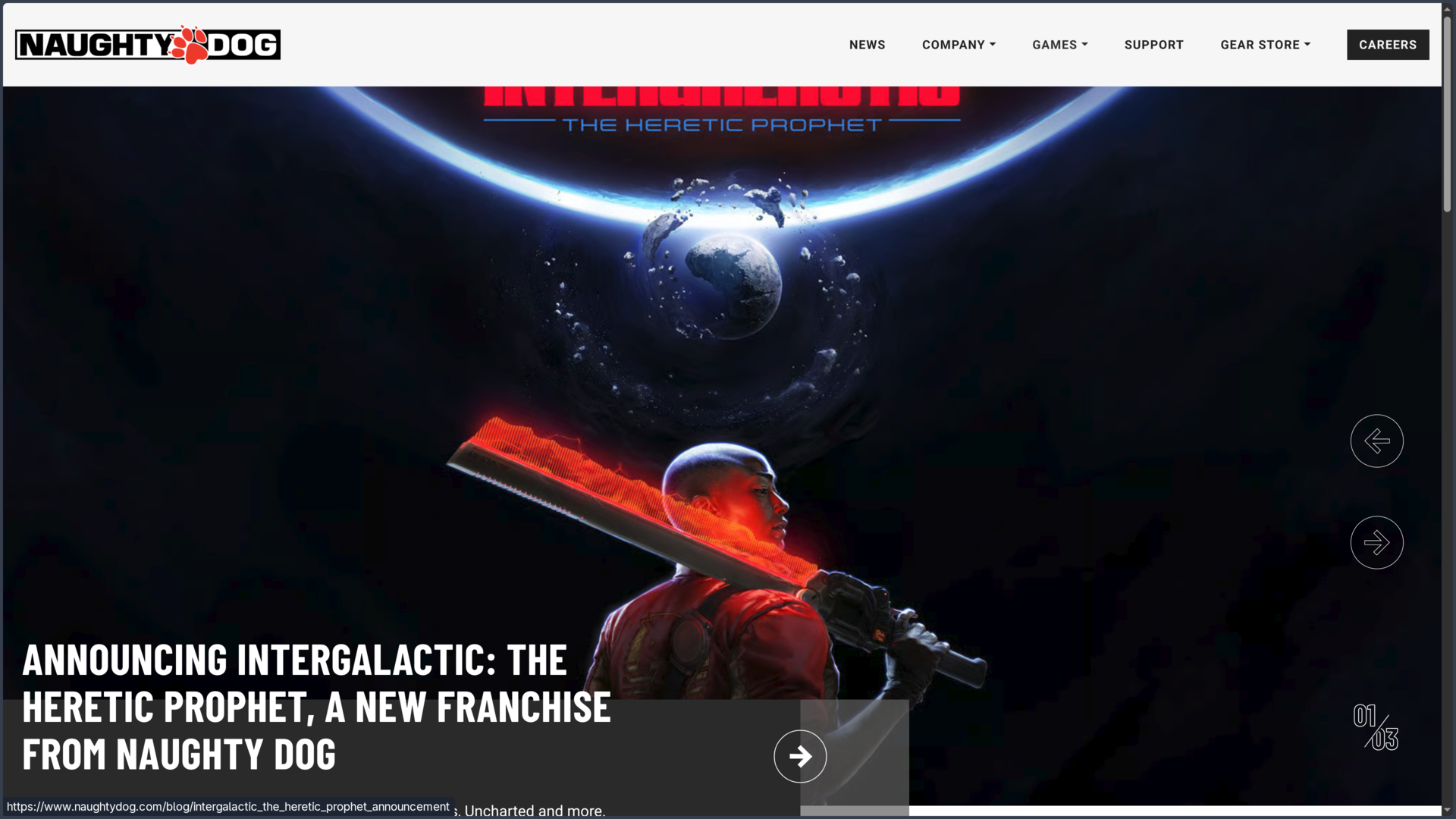
With Intergalactic: The Heretic Prophet, announced in 2024, Naughty Dog is preparing its first new property since The Last of Us.
Once again, the world changes.
The question remains the same:
what must the studio relearn so as not to simply reproduce what it already masters?
History
1984-1996: learning before PlayStation
Andy Gavin and Jason Rubin founded JAM Software in 1984.
The studio was still tiny and developed several projects before officially taking the name Naughty Dog in 1989.
This first period is above all one of learning: finding publishers, understanding machines, and turning ideas into marketable games.
The real change of scale came with the original PlayStation.
Crash Bandicoot was released in 1996.
The character quickly became one of the faces associated with the Sony console, but his importance for Naughty Dog went beyond that of a popular mascot.
The game forced the team to work directly with the machine's constraints: memory, loading, animation, camera, and geometry.
The hardware was not just the box in which to place an idea.
It shaped the very form of the game.
PlayStation 2: leaving Crash to build more continuity
With the PlayStation 2, Naughty Dog chose not to directly continue Crash.
The studio created Jak and Daxter.
The new generation allowed for larger environments and less visible transitions between zones. The world felt more continuous and exploration gained importance.
This break already reveals a lasting habit.
When a new technology sufficiently changes production possibilities, Naughty Dog sometimes prefers to question its formula rather than produce a simply more detailed version of it.
In January 2001, Sony Computer Entertainment America acquired the studio.
The operation formalized an already old relationship and placed Naughty Dog directly in the PlayStation ecosystem.
Uncharted: bringing spectacle and control closer together
With the PlayStation 3, the studio again deeply changed register.
Uncharted: Drake's Fortune abandoned the very stylized characters of Crash and Jak for a much more realistic adventure.
This evolution required new tools, new pipelines, and much more thorough work on animation and staging.
But the most important change was not just about image quality.
Naughty Dog sought to reduce the break between what the player controls and what the staging wants to tell.
Nathan Drake had to climb, fall, fight, or react with enough naturalness for the character not to seem to disappear when the cutscene stopped.
Over the installments, Uncharted pushed this continuity further and further.
The chases and big spectacular moments sought to keep a share of interaction.
Dialogues could start during exploration.
Animations naturally accompanied movement.
The studio gradually turned technique into narrative language.
The Last of Us: using the same mastery to get closer to the characters
The Last of Us once again changed the function of this technology.
The project did not constantly seek to produce bigger spectacle.
It accepted slowing down.
The heart of the game rests on the relationship between Joel and Ellie, and this relationship is not built only in the big scenes.
It exists during travel, in small conversations, and in how the characters react to the world.
An abandoned environment can tell what existed before.
An animation can reveal hesitation.
An exchange can appear without interrupting exploration.
Narration therefore tries to live in the continuity of gameplay, not just next to it.
With The Last of Us Part II, Naughty Dog deepened this search around animation, contextual reactions, and character performance.
Closeness sometimes becomes deliberately uncomfortable.
Technology no longer only serves to produce empathy.
It can also prevent the player from keeping their distance.
Franchises as stages rather than prisons
Looking at the studio's history, a mechanism becomes visible.
Naughty Dog develops a formula over several games.
Then accepts leaving it.
Crash gives way to Jak, then Jak to Uncharted. Uncharted then leaves the space needed for The Last of Us.
This attitude is risky.
A known franchise brings an audience, tools, habits, and part of the work already mastered.
Starting over elsewhere means becoming partially a beginner again.
But this loss of comfort is also a source of transformation.
Naughty Dog uses acquired skills as foundations without automatically considering them obligations.
Intergalactic: starting over once again
In December 2024, Naughty Dog revealed Intergalactic: The Heretic Prophet.
The studio says it has been working on the project since 2020 and is developing it for PlayStation 5.
After a long period dominated by The Last of Us, it thus returns to an entirely new property.
It is still too early, in the material provided, to judge the result.
But the project's historical position is already clear.
Intergalactic must show whether Naughty Dog can keep its attention to characters and continuity of experience while rebuilding a language around another universe.
What Sets It Apart
Technology as trigger of transformation
Each major period of Naughty Dog corresponds to an evolution of hardware.
The original PlayStation accompanies Crash.
PlayStation 2 lets Jak work more on environmental continuity.
PlayStation 3 forces the team to rebuild much of its methods for Uncharted.
Later generations let it push animation, performance, and density much further.
Technology is therefore not only used to display more details.
It becomes interesting when it allows a creative ambition that was not possible in the same form before.
Reducing the distance between gameplay and staging
Naughty Dog regularly seeks to make the passage between interaction and narration less visible.
Cutscenes remain important.
But dialogue, gestures, transitions, and events can also exist while the player keeps control.
This continuity produces a particular feeling: the character does not seem to alternately enter and leave a film and a game.
He must continue to exist in both.
This is particularly visible in Uncharted and then The Last of Us, where spectacle, exploration, and relationships between characters constantly seek to come together.
Making the character exist when there is no big scene
A character can be perfectly written in a cutscene and suddenly seem empty as soon as the player picks up the controller.
Naughty Dog works precisely against this break.
A posture, a contextual animation, a side conversation, or a reaction to an environment help maintain personality between two major moments.
The world then becomes less important for its mythology than for what it reveals about those crossing it.
This is one of the studio's major evolutions: gradually moving from a character defined mainly by his silhouette and abilities to protagonists whose presence must survive even in ordinary moments.
A culture of starting over
The studio finally seems to define itself by its ability to accept losing part of what it masters.
Changing franchise means rebuilding tools, learning new methods, and giving up some automatisms.
This attitude is costly.
It also prevents Naughty Dog from becoming entirely a prisoner of a single success.
Mastery acquired on one project becomes a foundation, not an obligation to redo the same game.
Good to Know
- Andy Gavin and Jason Rubin founded JAM Software in 1984; the studio took the Naughty Dog name in 1989.
- Crash Bandicoot was released in 1996 and became the first major franchise that established Naughty Dog with the international public.
- Sony Computer Entertainment America acquired Naughty Dog on January 22, 2001.
- Jak and Daxter accompanied the PlayStation 2 period and marked the move toward more continuous environments.
- Uncharted: Drake's Fortune inaugurated a new period around more realistic characters, animation, and interactive spectacle.
- The Last of Us shifts the center even more toward relationships between characters and continuity between narration and gameplay.
- Naughty Dog is now based in Santa Monica, California, within PlayStation Studios.
- Crash Bandicoot, Jak and Daxter, Uncharted, and The Last of Us correspond to four distinct major stages of its evolution.
- Intergalactic: The Heretic Prophet is Naughty Dog's next announced new franchise.
- The studio says it has been working on Intergalactic since 2020.