Presentation
Uncharted 3: Drake’s Deception takes the formula refined by Among Thieves and shifts more of the focus toward Nathan Drake himself. The historical mystery remains the driving force of the journey, but the adventure is just as interested in his need to pursue the next discovery as it is in the city he is searching for. His relationship with Sully therefore takes on far greater importance than in the previous two games.
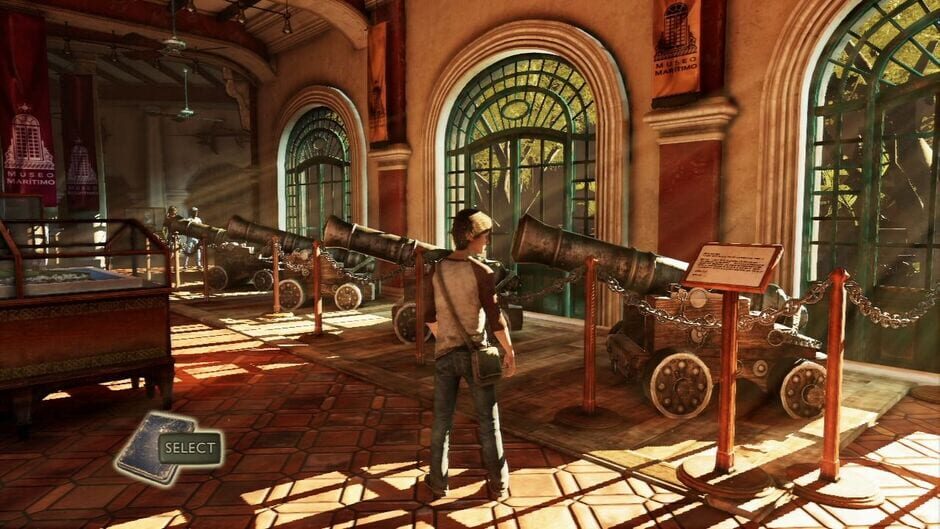
The return to Nathan’s adolescence gives that relationship a concrete origin. The player sees their first meeting in Cartagena and understands how Sully gradually becomes his mentor. These sequences also give Sir Francis Drake’s ring a different meaning: it is no longer simply an accessory associated with the hero, but an object around which part of Nathan’s identity has been built.
Katherine Marlowe exploits precisely this weakness. Unlike Lazarević, her threat does not rely only on military power. She knows Nathan’s past, questions his name and his supposed connection to Sir Francis Drake, and uses psychological manipulation alongside her agents. Talbot complements this approach with a more physical and unpredictable presence.
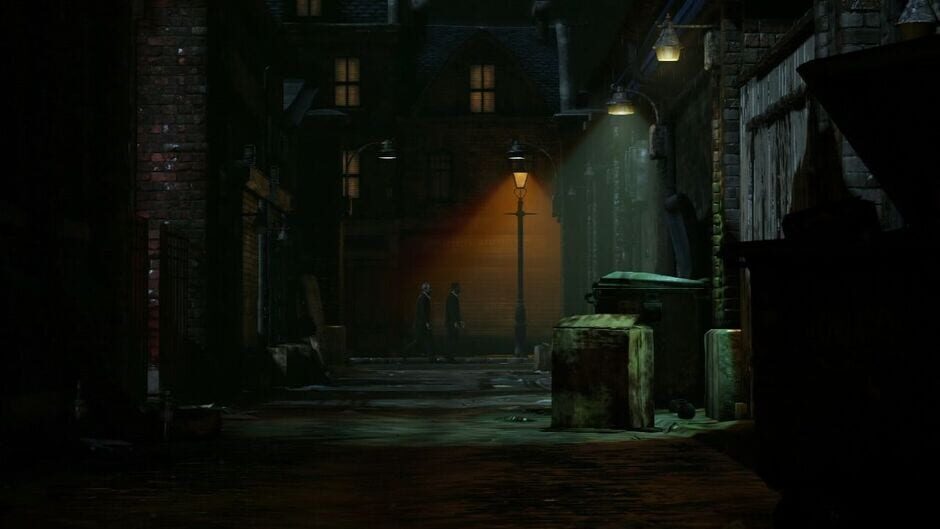
The journey nevertheless retains the geographical scale that has become characteristic of the series. London, Cartagena, France, Syria and Yemen precede the arrival in the Rub’ al Khali. This succession allows Naughty Dog to vary architecture, color and physical constraints considerably while maintaining an essentially linear progression.
Climbing remains central and makes greater use of moving environments. Nathan crosses burning buildings, ships thrown around by waves, vehicles and several structures whose geometry changes while he moves through them. The handholds are still largely determined by the level design, but the environments create a stronger sense of reacting to the action.
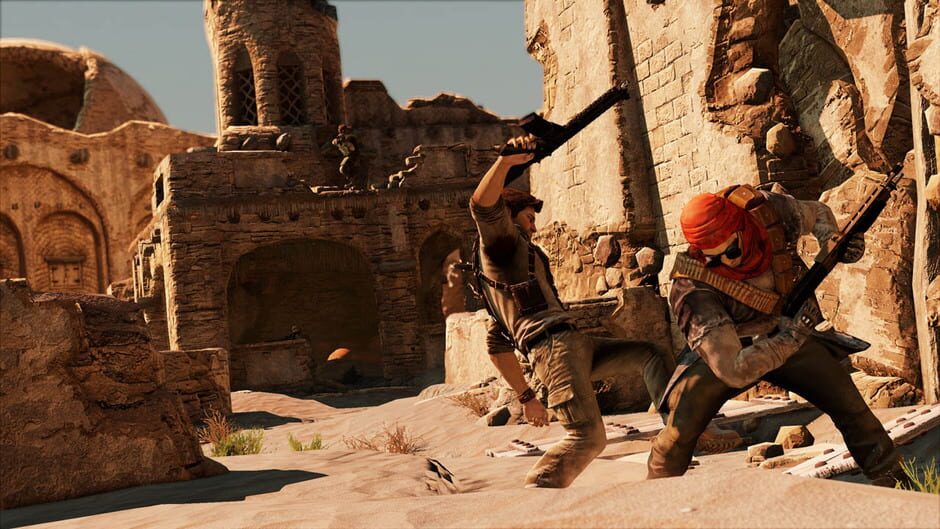
Melee combat is noticeably expanded. Nathan can fight several enemies in confined spaces, counter certain attacks and occasionally use elements of the environment. Bar fights, confrontations in narrow streets and some battles aboard the ship therefore give physical combat a more important role than in Among Thieves.
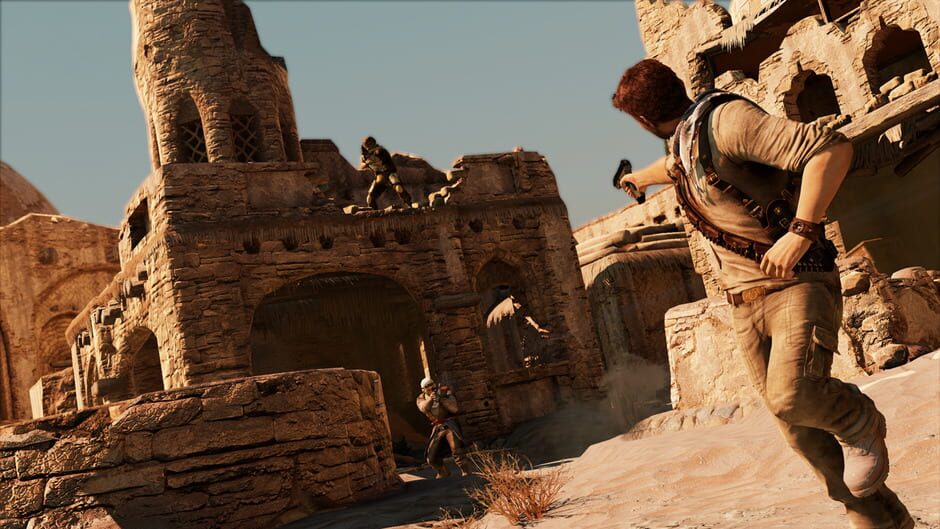
Gunfights retain the cover system, weapons collected from enemies and the alternation between movement and shooting. Combat spaces make greater use of verticality, and some still allow several opponents to be eliminated quietly before open combat begins. The game remains heavily action-oriented, but the situations change often enough to avoid constant repetition of the same type of encounter.
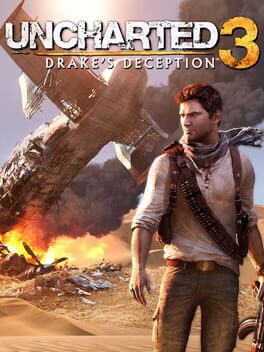
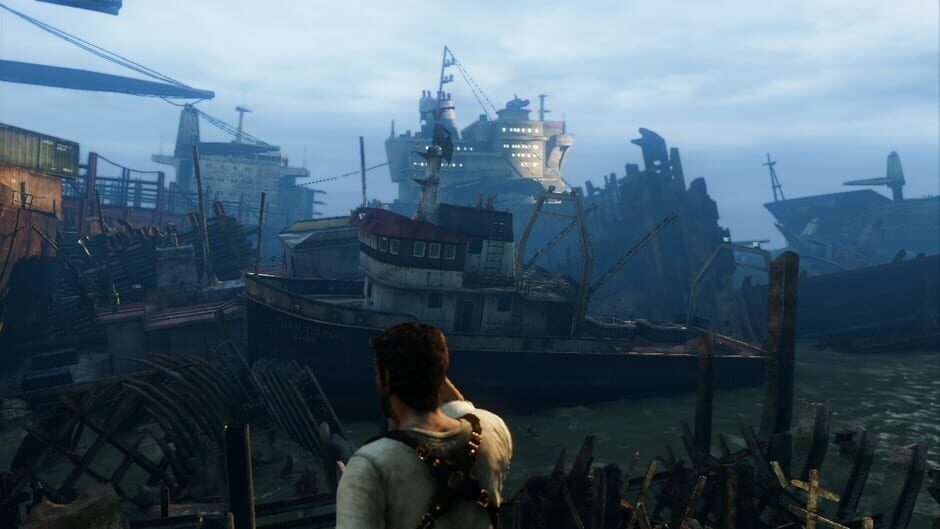
The large set pieces are nevertheless the most immediately recognizable element. Nathan crosses a château collapsing in flames, survives a cruise ship gradually rolling onto its side and clings to a cargo plane flying above the desert. The environments do not merely provide spectacle around the character: their transformation directly changes movement, cover and danger.
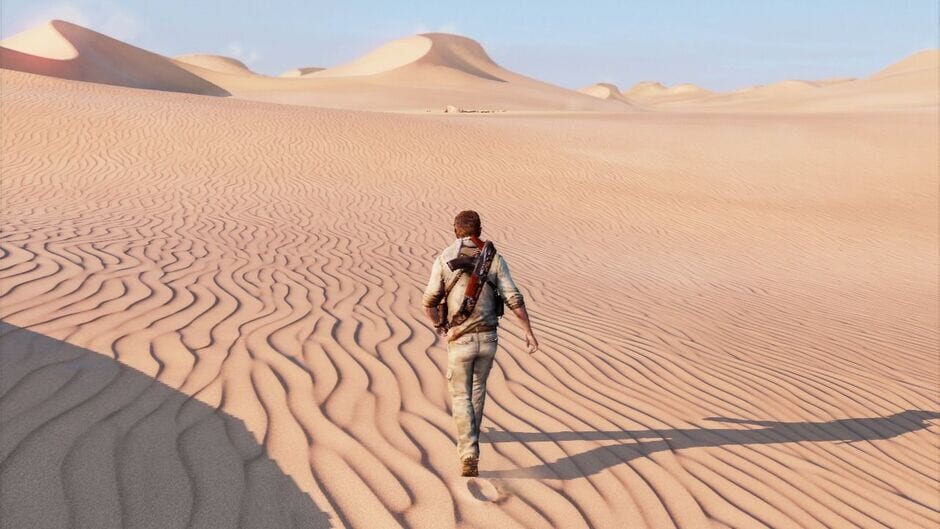
The Rub’ al Khali section works differently. After the plane explodes, Nathan walks alone through the desert for an extended period. The temporary absence of combat, lack of landmarks and gradual deterioration of his condition give this journey an unusual place within a series normally built around relentless pacing.
Puzzles retain their role as moments of respite and make use of Nathan’s notebook, symbols and the architecture of the locations being explored. They remain accessible, but some require more observation than in previous entries and reinforce the idea that Nathan is genuinely interpreting clues left by the explorers who came before him.
Ubar continues Uncharted’s familiar mixture of history and legend. Sir Francis Drake’s research, stories surrounding Lawrence of Arabia and the myth of the Atlantis of the Sands are brought together in a fiction where the city’s disappearance has a material explanation. The adventure therefore maintains a supernatural appearance without simply repeating the creatures of El Dorado or the guardians of Shambhala.
Multiplayer returns with greater ambition than in Among Thieves. The PlayStation 3 version includes competitive modes and co-op, customization, progression and maps that make greater use of the movement associated with the series. Some matches even begin with dynamic sequences involving vehicles before moving into more traditional arenas.
The overall experience is sometimes less tightly connected than Among Thieves. A few narrative transitions exist mainly to move Nathan toward the next major set piece, and some characters, particularly Chloe and Cutter, disappear relatively early from the story. In return, the game develops the relationship between Nathan and Sully more deeply and asks more clearly what treasure hunting costs the protagonist and the people who continue to follow him.
What to remember
- A search for Ubar, the legendary Atlantis of the Sands, connected to Sir Francis Drake’s research in the Arabian Desert.
- A story that strongly develops the relationship between Nathan Drake and Victor Sullivan, including their first meeting.
- Katherine Marlowe leads an ancient secret society and uses manipulation as much as violence to pursue her goals.
- An adventure passing through London, Colombia, France, Syria, Yemen and the Rub’ al Khali.
- A more developed melee system alongside the gunfights, climbing and stealth possibilities inherited from the previous game.
- Major sequences built around moving or collapsing environments, including the cruise ship, cargo plane and desert.
- A search that more directly questions Nathan’s obsession with Sir Francis Drake and his tendency to pursue a discovery regardless of the consequences.
- The return of competitive and cooperative multiplayer in the original PlayStation 3 version.
Conclusion
Uncharted 3: Drake’s Deception does not attempt to overturn the formula established by Among Thieves. Naughty Dog instead increases the scale of certain situations and uses the new adventure to look at Nathan Drake with more distance. The question is no longer only whether he will find the lost city, but why he is unable to abandon a lead when it touches the identity he has built for himself.
Sully gives that question its human dimension. Their first meeting shows where their bond began, while events in the present repeatedly remind Nathan of what he risks losing by pursuing Ubar. The mentor is no longer simply the experienced and amusing companion of the previous games; he becomes the person around whom Nathan’s decisions gain real weight.
The staging reaches a particularly spectacular level at the same time. The tilted cruise ship, cargo plane and desert crossing offer very different rhythms while remaining directly tied to character movement. Some transitions feel designed mainly to reach these moments rather than the other way around, but their execution remains closely connected to player control.
Marlowe also provides an interesting opposition because she attacks Nathan through his own story. His name, his connection to Sir Francis Drake and his need to prove the value of that legacy become weaknesses she can exploit. This gives the title Drake’s Deception several possible meanings without requiring the game to abandon its adventure tone.
This third entry therefore closes the PlayStation 3 era with a more personal than structural evolution. Drake’s Fortune established the foundations, Among Thieves found the balance of the formula, and Drake’s Deception uses it to begin questioning the character at its center. That reflection on the cost of adventure directly prepares the ground that A Thief’s End will develop several years later.
Good to know
- Uncharted 3: Drake’s Deception was developed by Naughty Dog and published by Sony Computer Entertainment.
- The original game was released for PlayStation 3 in November 2011, with a North American launch on November 1.
- The story focuses on the search for Ubar, known as the Atlantis of the Sands, in the Rub’ al Khali desert.
- Katherine Marlowe is the main antagonist and leads a secret society connected to the mystery pursued by Nathan for several centuries.
- The game revisits Nathan Drake’s youth and his first meeting with Victor Sullivan.
- The PlayStation 3 version includes competitive and cooperative multiplayer modes; their servers were shut down on September 3, 2019.
- The campaign was remastered in Uncharted: The Nathan Drake Collection, released for PlayStation 4 in 2015.
- As with Among Thieves, The Nathan Drake Collection includes only the single-player campaign and does not contain the original multiplayer.