Place a 1972 Magnavox Odyssey next to a PlayStation 5.
On one side, you have a machine incapable of producing a complex background on its own, relying on extremely simple shapes and, in some games, transparent overlays placed directly on the television screen to complete the image. On the other, billions of transistors, an SSD, ray tracing, 3D audio, games that can occupy tens or hundreds of gigabytes, and almost permanent access to global online services.
A little more than half a century separates them.
And yet their fundamental ambition remains remarkably similar: turn the television into a place where people can play.
Between those two machines, video game history is commonly divided into nine console generations. But before going any further, it helps to forget the neat image the word “generation” suggests.
A generation is not an official border. A new console does not arrive on Monday morning and magically replace every machine people were still using on Sunday night. Hardware cycles overlap, some systems remain active for many years, and several generations can coexist on the market.
The PlayStation 2, for example, continued its life long after the next generation had already established itself.
The “nine generations” are therefore best understood as a historical framework. They group together machines that share a period, certain technological developments, and a comparable commercial context.
It is not an exact science.
But if you want to explore more than fifty years of console history without running three kilometers of cables across the living room, it remains an extremely useful tool.
Before the first generation — someone first had to imagine the console
The idea of using a television as an interactive medium appeared before there was even a real market for home video games.
As early as the 1960s, engineer Ralph Baer worked on prototypes capable of displaying and controlling interactive shapes on a television set. That work eventually led to the commercial release of the Magnavox Odyssey in 1972.
By modern standards, the machine seems almost prehistoric. It has no microprocessor and no real software in the way we understand the word today. Its graphical capabilities are so limited that some games use transparent overlays placed directly on the screen to represent playing fields or scenery.
It looks like improvisation because, in a way, home video gaming is still being assembled like a laboratory prototype.
But one essential idea has just taken shape:
The television is no longer only something you watch. It can become something you interact with.
The game console has been born.
First generation — 1972 to the early 1980s: when a console mostly played what was already inside it
The first generation is an age of experimentation.
Magnavox Odyssey, Atari Home Pong, Coleco Telstar, and Nintendo Color TV-Game all belong to a period when manufacturers were still trying to understand what a home game console should actually be.
These machines work very differently from modern systems. Games are generally built directly into the hardware. A console may offer several variations of tennis, hockey, or shooting games, but there is no real software library waiting to be expanded with a new cartridge.
The period is therefore dominated by extremely simple visual forms: dots, lines, rectangles, and countless variations inspired by Pong.
The major innovation is not graphical
The importance of the first generation has little to do with rich fictional worlds or technical spectacle.
Its real achievement is much more fundamental: electronic gaming enters the home.
You no longer need access to a university computer or a trip to an arcade. The family television can now become a place where a game happens.
Nintendo itself participates in this period long before Mario, Zelda, or Pokémon, releasing its first Color TV-Game machines from 1977 onward.
There is no real winner yet
It is difficult to identify a winner comparable to those of later generations because the market is still trying to define itself.
Magnavox opens a path. Atari turns Pong into a commercial phenomenon. Numerous manufacturers follow with their own versions of the same basic idea.
The console is not yet an ecosystem. It is mainly an electronic device designed to provide a handful of games.
But this generation leaves behind one certainty that will never disappear:
the living room can become a game room.
The next generation will need to answer another question, one that will shape the entire business: how do you sell new games without making the player buy an entirely new machine every time?
Second generation — 1976–1992: the cartridge invents the game library
Today, buying a console and then choosing games separately seems completely normal.
In the mid-1970s, separating the machine from the software was a major breakthrough.
In 1976, the Fairchild Channel F became the first console to use programs stored on removable ROM cartridges. Hardware and game software were no longer the same product.
Players could buy the machine once, then gradually build a library.
That principle would define the console business for decades.
Atari immediately sees the potential
In 1977, the Atari Video Computer System arrived, later becoming known as the Atari 2600.
The console became one of the first major successes in home video gaming, eventually selling more than twenty million units over its lifetime.
Around it appeared systems such as the Fairchild Channel F, Intellivision, Odyssey², ColecoVision, Atari 5200, and the unusual Vectrex.
The market was beginning to resemble something we would recognize today.
More importantly, the software library became almost as important as the machine itself.
Space Invaders, Adventure, Pitfall!, and Pac-Man gave players another reason to choose a platform: the games available on it.
When an open software market becomes part of the problem
Separating hardware from software allows catalogs to grow rapidly, but that freedom also creates a problem of quality control.
By the early 1980s, the North American market was flooded with machines and games of wildly uneven quality. The famous 1983 crash therefore cannot be reduced to the story of the notoriously poor E.T. cartridge.
It was also a crisis of confidence.
Too many products reached the market, too little quality control existed, and expectations were regularly disappointed.
While the American industry struggled, a Japanese company was preparing a machine that would substantially rewrite the rules.
Nintendo.
Third generation — 1983 to the early 1990s: Nintendo rebuilds the ecosystem
In 1983, Nintendo released the Family Computer, or Famicom, in Japan.
Internationally, it would become the Nintendo Entertainment System, better known as the NES.
Nintendo did more than introduce another piece of hardware. The company organized a more tightly controlled ecosystem, both around its own games and around those produced by partner publishers.
That strategy directly addressed some of the problems that had weakened the market only a few years earlier.
Nintendo also possessed another advantage: games capable of becoming lasting fictional worlds.
Super Mario Bros., The Legend of Zelda, Metroid, and Punch-Out!! were no longer simply products sold for a machine. They began to become cultural references.
When the console becomes a cultural brand
Sega challenged Nintendo with the Master System, while Atari attempted a return with the Atari 7800.
But the balance of power had shifted.
The NES gradually became more than a piece of consumer electronics. Mario became an instantly recognizable mascot. Zelda became a world. Metroid developed an identity of its own.
Nintendo learned to sell something earlier generations had only begun to suggest: an imagination built around the hardware.
Buying a console was beginning to mean joining a catalog, a family of characters, and a particular brand identity.
The 8-bit era
This period is commonly called the “8-bit generation.” The phrase simplifies a much more complicated technical reality, but it remains a practical way to identify the era.
The visual change is obvious. Backgrounds become richer, scrolling improves, characters develop recognizable silhouettes, and composers create memorable music from remarkably limited resources.
Technical constraints are no longer simply obstacles. They begin to generate an aesthetic language of their own.
Who dominates the generation?
Nintendo clearly wins the global home console market during this period.
The NES / Famicom would reach 61.91 million units sold, according to Nintendo's historical sales figures.
Sega, however, is far from finished. It is already preparing the machine that will transform a commercial rivalry into a cultural battle.
Fourth generation — late 1980s to mid-1990s: Nintendo versus Sega
The fourth generation is often summarized by two words: 16 bits.
Its legacy, however, goes well beyond processor terminology.
PC Engine / TurboGrafx-16, Mega Drive / Genesis, Neo Geo, and Super Nintendo belong to an era when marketing and identity begin to matter almost as much as technical specifications.
This is one of the defining periods of the “console wars.”
Sega goes on the offensive
The Mega Drive launched in Japan in 1988 before arriving in North America under the Genesis name.
Sega built its image around speed, energy, and a strong connection to arcade culture. Then Sonic arrived.
On paper, a blue hedgehog wearing sneakers does not necessarily sound like the most obvious marketing plan ever created.
In practice, it worked remarkably well.
Sonic the Hedgehog became a global mascot and helped Sega establish itself as a credible alternative to Nintendo.
Nintendo responds with the Super Nintendo
The Super Famicom arrived in Japan in 1990 before becoming the Super Nintendo Entertainment System in other markets.
Its library included some of the most influential games of the era: Super Mario World, The Legend of Zelda: A Link to the Past, Super Metroid, Donkey Kong Country, Chrono Trigger, and Final Fantasy VI.
The rivalry became strong enough to move well beyond retail shelves.
For an entire generation of children, choosing between Sega and Nintendo sometimes felt less like selecting a consumer electronics product and more like declaring an identity.
A period of experimentation
Manufacturers also searched for ways to expand or transform existing hardware through add-ons and additional components.
Mega-CD, 32X, Satellaview, and the Super FX chip all reflect an era of experimentation with different ways to extend the capabilities of current systems.
Some ideas opened genuine technical possibilities. Others mostly suggest that someone looked at a console and wondered what would happen if another box were simply stacked on top of it.
But the next major transition is already approaching: CD-ROM is becoming viable, polygonal graphics are appearing, and 3D is moving from specialist experiments toward a new mainstream language.
Who wins?
Commercially, Nintendo retains the worldwide advantage with 49.10 million Super Famicom / SNES units sold.
That figure does not tell the whole story.
Sega became a credible global competitor. Sonic became an icon. More importantly, choosing a console was now as much a battle of culture, advertising, and identity as a comparison of processors.
Fifth generation — 1993–2006: the 3D revolution changes the grammar of games
For a long time, much of console gaming had been organized around movement on a relatively readable plane: left, right, up, down.
The fifth generation suddenly adds another dimension that forces both players and developers to relearn part of the language of games:
depth.
3DO, Atari Jaguar, Sega Saturn, Sony PlayStation, and Nintendo 64 all belong to the era in which polygonal 3D begins to become the dominant language of console gaming.
The transformation is not merely visual. It changes how characters are controlled, levels are built, cameras are managed, and space itself is understood.
Sony enters the market
The first PlayStation launched in Japan on December 3, 1994, followed by North America and Europe in 1995.
Sony entered a market already dominated by companies with deep gaming experience. Nintendo and Sega possessed established franchises, communities, and several generations of knowledge.
Sony came primarily from consumer electronics.
Yet PlayStation understood the transition remarkably well: CD-ROM, 3D graphics, marketing aimed at older audiences as well as children, strong support for third-party publishers, and an environment that many developers found attractive.
The console did not merely join the industry.
It changed its balance.
Nintendo chooses cartridges
The Nintendo 64 continued to use cartridges.
That choice brought benefits such as fast access times, but storage capacity was far more limited than CD-ROM.
Nintendo compensated by creating several games that became foundational references for 3D design.
Super Mario 64 helped define movement in a three-dimensional environment. The Legend of Zelda: Ocarina of Time explored camera control, targeting, and world navigation. GoldenEye 007 and Mario Kart 64 experimented with other ways of using the new dimension.
The Nintendo 64 eventually sold 32.93 million units.
Sega ends up in a difficult position
The Saturn had real strengths and an excellent Japanese software scene, but its complex architecture, difficult international strategy, and Sony's rapid advance weakened Sega's position.
Atari also failed to restore itself as a major console manufacturer with the Jaguar.
The real winner is also a new design language
Commercially, PlayStation dominates the generation.
But its importance extends beyond unit sales.
Analog sticks, 3D cameras, targeting systems, polygonal environments, more ambitious cinematic sequences, and worlds designed around depth gradually become familiar concepts.
Players do not merely learn how to use a new generation of hardware.
They learn how to inhabit digital space differently.
Sixth generation — 1998–2013: multimedia and the first major steps toward connected consoles
The sixth generation begins with a machine that sometimes feels as though it arrived several years too early.
The Dreamcast launched in Japan in November 1998 with a built-in modem and a serious ambition for online play.
It experimented heavily through games such as Shenmue, Phantasy Star Online, Jet Set Radio, and SoulCalibur.
But it entered an increasingly brutal market.
PlayStation 2 changes the scale again
Sony released the PlayStation 2 in 2000 with an unusually powerful proposition.
The system played new games, offered backward compatibility with much of the original PlayStation library, played DVDs, and gradually added network features.
In many homes, the PS2 could therefore replace several devices beneath the television.
The console became more than a gaming machine. It participated in a broader convergence between video games and home multimedia.
Nintendo fully embraces the GameCube
Nintendo took a different route with the GameCube.
Compact cube-shaped design, mini-discs, even a built-in handle: the system never seemed embarrassed about being unmistakably a game console.
Its library included Super Smash Bros. Melee, Metroid Prime, The Legend of Zelda: The Wind Waker, and Resident Evil 4.
Nintendo would sell 21.74 million units.
Microsoft enters the battle
On November 15, 2001, Microsoft launched the original Xbox.
The arrival mattered. One of the world's largest software companies was now entering a market long shaped by traditional console manufacturers.
The Xbox used an architecture strongly influenced by the PC world and brought with it a franchise that would become central to the brand:
Halo.
Then came Xbox Live.
Online console gaming began to take a much more structured form around accounts, persistent identities, and centralized services.
Who wins?
Commercially, the PlayStation 2 overwhelmingly dominates the generation and becomes one of the best-selling game systems in history.
Dreamcast, despite its considerable influence, cannot save Sega's hardware business. In 2001, Sega ended production and left the home console market.
A new trio was now established:
Nintendo, Sony, and Microsoft.
It would shape much of the console market for the following decades.
Seventh generation — 2005–2017: HD, motion, and permanent connectivity
With the seventh generation, the three major manufacturers appear to look at the same market and arrive at almost opposite answers.
Microsoft focuses heavily on networks and services. Sony builds around ambitious hardware and Blu-ray. Nintendo largely refuses to participate in the same race for graphical power.
Microsoft: structure the connected experience
The Xbox 360 launched in November 2005.
Microsoft expanded Xbox Live and placed profiles, achievements, downloads, and online multiplayer at the center of the experience.
The console increasingly looked less like an isolated box and more like an entry point into a service network.
Sony: power, Blu-ray, and PlayStation continuity
PlayStation 3 arrived with an ambitious architecture, a Blu-ray drive, and PlayStation Network.
Its launch was difficult. The price was high, the architecture complex, and the competition already established.
The system nevertheless evolved considerably throughout its lifetime and hosted games such as Uncharted, The Last of Us, LittleBigPlanet, and Metal Gear Solid 4.
Sony gradually strengthened the PlayStation ecosystem despite a difficult transition.
Nintendo: change the question entirely
Nintendo approaches the problem from almost the opposite direction.
The Wii does not try to directly match the graphical power of PlayStation 3 and Xbox 360. Instead, it relies on motion-sensitive controls and games designed to be understood almost immediately.
Wii Sports becomes the symbol of that strategy.
People who would never have described themselves as gamers suddenly find themselves swinging an imaginary tennis racket or bowling in front of the television.
The console greatly broadens the image of who a player can be.
The console becomes a truly connected device
Wi-Fi, digital storefronts, downloadable content, patches, profiles, trophies, achievements, and online multiplayer become standard elements of the experience.
The console no longer simply waits for a disc to be inserted.
It now has a life between games.
Services continue operating in the background, software evolves after release, and a player's digital identity begins to follow them across different experiences.
Who wins?
Commercially, the Wii exceeds 101 million units sold.
But each manufacturer leaves the generation with a different achievement.
Nintendo proves that graphical power is not the only path to massive commercial success. Microsoft firmly establishes Xbox and its connected-service model. Sony strengthens PlayStation and prepares a much more controlled next generation.
Above all, one change becomes difficult to reverse:
a console without an Internet connection begins to feel incomplete.
Eighth generation — from 2012 onward: the console gradually becomes a service
The eighth generation begins with the Wii U in 2012, followed by the PlayStation 4 and Xbox One in 2013.
A few years later, Nintendo introduces a machine that seriously complicates traditional generation charts:
the Switch.
Sony returns to a more direct proposition
With PS4, Sony builds a console that is relatively easy to understand: play, download, share, and connect.
The generation accelerates digital distribution, video streaming, massive patches, live-service games, and integration with social platforms.
The player's library becomes increasingly digital rather than purely physical.
Microsoft tries to extend Xbox beyond gaming
Xbox One is initially presented as a deeply integrated entertainment center built around television, Kinect, services, and multimedia.
The strategy meets strong resistance at launch, particularly around several originally planned policies concerning connectivity and physical games.
Microsoft gradually changes direction.
More importantly, Xbox begins rebuilding itself around an idea that will become increasingly central:
the ecosystem.
Backward compatibility, closer integration with PC, cloud services, and above all Xbox Game Pass gradually become more important than the hardware alone.
Nintendo stumbles with Wii U, then changes the physical form of the console
The Wii U achieves limited commercial success, selling 13.56 million units according to Nintendo.
Then the Nintendo Switch launches on March 3, 2017.
Its concept directly combines two uses that had historically been separated: home console and handheld console.
The player can remove the system from its dock and continue the same game in their hands.
Once the idea exists, it feels almost obvious.
That is often the mark of an especially effective concept.
By March 2026, Nintendo reports 155.92 million Switch systems sold worldwide, making the hybrid console one of the most successful game systems in history.
Games begin to outlive hardware generations
Another important shift becomes increasingly visible during this period.
Fortnite, Minecraft, GTA Online, Final Fantasy XIV, Rocket League, and Destiny can survive across multiple generations of hardware.
They change resolution, servers, versions, and sometimes business models, but they remain active.
This continuity fundamentally changes the historical logic of generations.
In the past, a new console often left much of the previous generation's software behind. Now some games outlive the machines on which they were born.
A hardware generation no longer automatically defines the lifespan of a game.
Ninth generation — since 2020: reducing waiting rather than simply increasing power
In November 2020, while the world was still living through the Covid-19 pandemic, Microsoft and Sony launched their new console families within days of each other.
Microsoft released the Xbox Series X|S on November 10.
Sony launched the PlayStation 5 from November 12, depending on the market.
The new machines naturally offer more power, but one of their most noticeable improvements is not necessarily the feature that looks best on a marketing poster.
A revolution measured in seconds
4K, ray tracing, higher frame rates, spatial audio, and haptic feedback all contribute to the generational change.
But the SSD transforms something particularly tangible:
waiting.
Loading times drop dramatically, data can be accessed far more quickly, and developers can rethink how certain worlds are structured and streamed.
PlayStation emphasizes the combination of CPU, GPU, and SSD as one of the PS5's technical foundations, while Microsoft promotes shorter loading times and frame rates of up to 120 frames per second in supported experiences.
Progress no longer means only displaying more detail.
It also means reducing interruptions between the player and the world.
Sony and Microsoft increasingly follow different philosophies
Sony continues to build the PlayStation identity strongly around its consoles, catalog, studios, and hardware-specific experiences such as the DualSense controller.
Microsoft increasingly develops Xbox as an ecosystem capable of extending beyond the console itself: Xbox Series, PC, Game Pass, cloud, and cross-play all participate in the same larger structure.
The question gradually begins to change.
Previously, people mostly asked:
“Which console do you have under your television?”
Increasingly, the question becomes:
“Which devices can you use to access your games?”
Nintendo follows its own calendar
Nintendo launches the Switch 2 on June 5, 2025, eight years after the original Switch.
By the end of March 2026, the company reports 19.86 million units sold.
Should it be classified as part of the ninth generation?
That question exposes the limitations of the framework itself.
Sony and Microsoft renewed their systems in 2020. Nintendo had launched its previous console in 2017 before introducing its successor in 2025.
The cycles are no longer synchronized.
More fundamentally, the companies no longer necessarily follow the same industrial strategy or timetable.
The concept of a generation is still useful for understanding history.
It is simply becoming less precise.
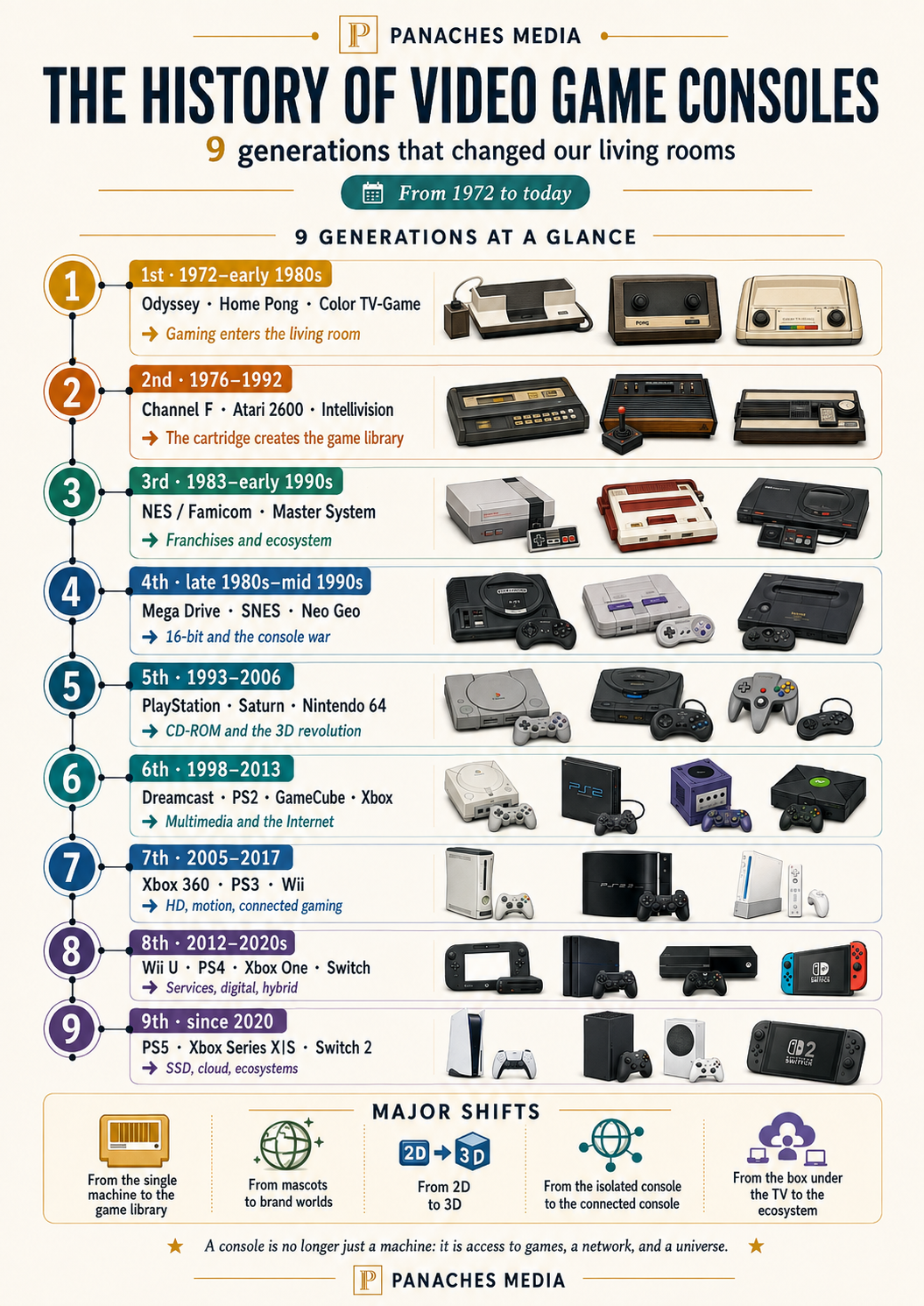
Nine generations at a glance
| Generation | Approximate period | Representative systems | Major shift |
|---|---|---|---|
| 1st | from 1972 | Magnavox Odyssey, Pong, Color TV-Game | Gaming enters the living room |
| 2nd | from 1976 | Channel F, Atari 2600, Intellivision, ColecoVision | Cartridges separate the game from the machine |
| 3rd | from 1983 | NES/Famicom, Master System, Atari 7800 | Franchises and controlled ecosystems become central |
| 4th | late 1980s | Mega Drive, SNES, PC Engine, Neo Geo | 16-bit era, brand identity, and console wars |
| 5th | from 1993 | PlayStation, Saturn, Nintendo 64, 3DO | CD-ROM and the 3D revolution |
| 6th | from 1998 | Dreamcast, PS2, GameCube, Xbox | Multimedia and major early online services |
| 7th | from 2005 | Xbox 360, PS3, Wii | HD, motion controls, and permanent connectivity |
| 8th | from 2012 | Wii U, PS4, Xbox One, Switch | Digital distribution, services, and hybrid hardware |
| 9th | from 2020 | PS5, Xbox Series X | S, later Switch 2 |
The dates intentionally overlap. A generation describes a technological and commercial period, not an official border drawn by manufacturers.
Console makers are no longer selling exactly the same thing
Look across all nine generations and another evolution becomes visible.
At first, manufacturers essentially sold a machine.
Then they sold a machine with interchangeable games.
After that came exclusive franchises, followed by networks, accounts, and services.
Today, the major companies increasingly sell complete ecosystems.
Nintendo owns Mario, Zelda, Pokémon, Animal Crossing, and a highly distinctive philosophy of hardware design.
Sony structures PlayStation around its systems, studios, franchises, network, and hardware-specific experiences.
Microsoft connects Xbox to Windows, Game Pass, cloud infrastructure, and multiple types of devices.
The physical console still matters.
It is simply no longer the only thing defining the platform.
Atari, Sega, Nintendo, Sony, Microsoft: nobody wins forever
Console history has one strangely reassuring constant:
no dominant position lasts forever.
Atari once appeared almost unavoidable before collapsing.
Nintendo dominated home consoles before Sony arrived.
Sega challenged Nintendo directly before leaving the hardware business altogether.
Sony achieved extraordinary success with the PlayStation 2 before Nintendo surprised the industry with the Wii.
The Wii U then seemed to expose the limits of Nintendo's strategy, until the Switch became one of the most successful consoles ever made.
Microsoft entered a market where the company was not expected to become a traditional hardware manufacturer, and twenty-five years later Xbox remains part of the landscape.
Every generation creates new certainties.
The next one usually finds a way to weaken them.
That instability is also part of what makes console history so interesting: technical, commercial, or cultural dominance in one era never guarantees the same position in the next.
What consoles actually changed
It would be possible to look at nine generations and see only technical progress.
More memory, more pixels, more polygons, more storage, more power.
That would be accurate.
It would also miss a far more important part of the story.
Because consoles mainly transformed the relationship between the player and the game.
The first generation brings interactivity to the television.
The second separates the machine from its library through cartridges.
The third builds characters, worlds, and franchises designed to endure.
The fourth turns console choice into cultural identity.
The fifth teaches players how to navigate three-dimensional spaces.
The sixth brings gaming closer to multimedia and major online ambitions.
The seventh makes permanent connectivity a normal part of the experience.
The eighth turns libraries, subscriptions, and live services into central components.
The ninth increasingly shifts importance away from the individual machine and toward access, continuity, and the wider ecosystem.
That produces a remarkable paradox:
the more technologically powerful the console becomes, the less the console alone is enough to define the experience.
Today, what follows the player extends far beyond the plastic box beneath the television: their account, friends, save files, library, subscriptions, and the digital worlds they may return to for years.
What comes after the ninth generation?
There will almost certainly be more consoles.
They will probably be more powerful, faster, perhaps more hybrid, and likely even more closely connected to cloud services, online ecosystems, and new forms of artificial intelligence.
But something already appears to be changing in how we think about them.
The boundaries are becoming less clear. A game can span several hardware generations. A library can follow its owner. A handheld system can run games once reserved for large home consoles. A relatively simple display can receive a game being calculated somewhere else.
Even manufacturers increasingly talk about ecosystems, accounts, libraries, and services rather than simply about boxes.
Perhaps one day, counting console generations will feel less natural than it does today.
We are not there yet. The console still has a few lives left.
But after more than fifty years and nine generations, one shift is already visible:
the next major battle may no longer be only about building the most powerful machine.
It may be about building the ecosystem that gives players the fewest reasons to think about the machine at all.