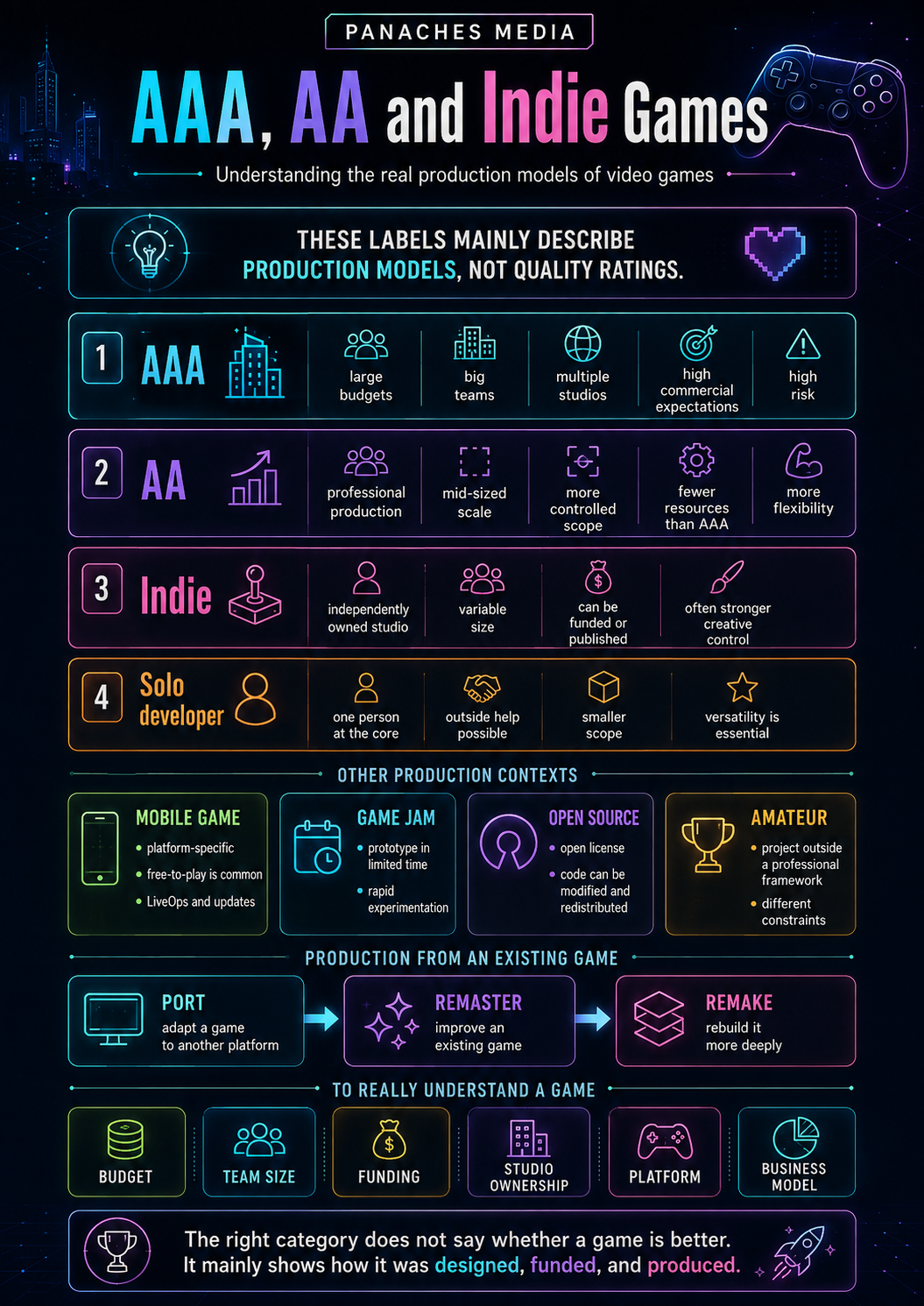
AAA, AA and indie are not quality ratings
A spectacular game created by several hundred people will easily be described as AAA. A more focused project with professional funding may be placed in the AA category. A game created by a small autonomous team will probably be presented as independent, or indie.
Reality quickly becomes more complicated.
An independent studio may employ dozens or even hundreds of people. A game developed by a small team may be financed by a publisher. A project with very ambitious production values may remain independently owned. Conversely, a game belonging to a major group may deliberately adopt a much smaller scope than a blockbuster production.
Even the term AAA has no universally accepted definition. It mainly serves as shorthand for productions involving large budgets, large teams, several years of work, and high commercial expectations.
AAA, AA and indie mainly describe how a game is produced and financed. They do not automatically tell us whether it is good, innovative, beautiful, or profitable.
To understand the different forms of production, several dimensions have to be examined at once.
| Question | What it reveals |
|---|---|
| What budget? | the economic scale of the project |
| What team? | the size and specialization of production |
| Who funds it? | the level of risk and the partners involved |
| Who owns the studio? | its corporate independence |
| Who owns the IP? | control over the universe and its exploitation |
| What ambition? | the amount of content and technical complexity |
| What market? | PC, console, mobile, niche, or mass market |
| What operating lifespan? | one-time release or service maintained over time |
Two games placed in the same category may therefore operate in very different ways.
AAA: producing like a blockbuster
The term AAA, or triple-A, generally refers to the largest productions in the traditional video game industry.
They often rely on several years of development, large teams, highly specialized roles, and funding provided by a major publisher, a platform holder, or a group that owns its own studios.
The comparison with a Hollywood blockbuster is useful as long as it is not taken too literally. The issue is not only how much the game costs, but the entire production machine built around it.
A AAA project may involve:
- one or more lead studios;
- several co-development teams;
- animation and art outsourcing partners;
- engine and rendering specialists;
- teams dedicated to cinematics;
- internal and external QA;
- several localization studios;
- network infrastructure;
- international marketing teams;
- producers and coordination managers.
The credits of a major contemporary game often give a better idea of its real scale than the studio name printed most prominently on the box.
Production built around specialization
In a small team, the same person may program a system, integrate assets, and later fix several bugs related to that feature.
In a AAA production, these tasks may be distributed across multiple disciplines and departments.
Creative direction
        ↓
Game design
        ↓
Gameplay programming
        ↓
Animation
        ↓
Technical animation
        ↓
VFX
        ↓
Audio
        ↓
QA
This is obviously not a truly linear pipeline. These departments work simultaneously and constantly exchange data.
The main difficulty then becomes just as organizational as technical. The larger the project becomes, the more teams have to be coordinated, systems documented, tools maintained, and different parts of the game prevented from evolving in incompatible directions.
A AAA budget also increases the level of risk
A very expensive project generally has to reach a large enough audience to justify its investment.
This constraint explains some of the characteristics often associated with AAA production: established franchises, major marketing campaigns, worldwide launches, multiple platforms, and a strong emphasis on production quality.
That does not mean a AAA game cannot experiment. The main issue is the relationship between investment and risk.
The more resources a project requires, the greater the consequences of poor commercial performance can become.
Large productions therefore often try to reduce certain uncertainties through known licenses, user testing, market research, sequels, or technologies the teams already understand.
AAA production must constantly resolve a paradox: offer enough novelty to attract players while protecting a considerable investment.
AA occupies the space between blockbuster production and the small team
The term AA, or double-A, is even less precisely defined than AAA.
It is generally used for professional projects with significant resources, but whose size, budget, or ambitions remain below the largest productions.
AA can be imagined as an intermediate zone:
Small production
        ↑
      indie
        ↑
       AA
        ↑
       AAA
        ↓
Large production
This diagram is deliberately approximate. There is no official threshold at which a budget or team suddenly moves from AA to AAA.
The term is mainly useful for describing projects that aim for high professional production quality while keeping their scope under control.
A AA game may, for example, concentrate its resources on:
- a shorter runtime;
- fewer characters;
- a smaller number of areas;
- less expensive technology;
- a highly focused art direction;
- fewer cinematics;
- a more limited marketing campaign.
The principle is therefore not necessarily to create an inferior version of a AAA game. It can mean reducing the scope intelligently so that more resources can be invested in what truly defines the game.
Why is AA so interesting to the industry?
The intermediate model can sometimes avoid some of the constraints of the largest productions.
A smaller team may make certain decisions faster. A more limited scope makes it easier to concentrate resources. A lower budget reduces the number of sales required to reach profitability.
This flexibility can make room for more specialized projects or experiences that do not need to target tens of millions of players from the outset.
There is also a downside. A AA production can end up in a difficult position if its costs become too high for a niche market while it still cannot visually compete with the largest blockbusters.
The real challenge of AA production is therefore often finding a coherent scale.
Being independent does not necessarily mean being small
The word independent, or indie, is probably the most ambiguous of all.
In its most direct sense, it describes a developer or studio that remains independently owned, meaning it is not controlled by a major publisher or another corporate group.
This definition is useful because it prevents independence from being reduced to a particular visual style.
An indie game is not necessarily:
- pixel art;
- developed by three people;
- self-funded;
- sold at a low price;
- experimental;
- without a publisher.
The IGDA defines an independent developer as an independently owned developer regardless of its size or the presence of investors.
This helps clarify an important distinction:
A studio can remain independent while receiving external funding or working with an independent publisher.
The real question is then what the contract gives to the financial partner: equity in the studio, intellectual property, creative control, distribution rights, or simply an economic share.
Indie development is often still an entrepreneurial form of production
Even when it is very small, an independent studio does not only deal with creation.
If it has neither a parent company nor a large publisher, it usually has to manage a large part of the responsibilities described in the previous article itself:
Create the game
+
Finance the project
+
Run the company
+
Find service providers
+
Communicate
+
Prepare storefronts
+
Negotiate
+
Launch the product
+
Provide support
This accumulation explains why independent production requires skills that go far beyond development itself.
An excellent programmer or artist does not automatically become a specialist in communication, contracts, accounting, or marketing.
This is precisely where another category of actors comes in: independent publishers.
An independent publisher is not the opposite of an indie game
The expression may sound contradictory.
An independent publisher is generally a publisher specializing in independent productions or operating at a smaller scale than traditional major groups.
It may provide:
- funding;
- marketing;
- press relations;
- localization;
- QA;
- production advice;
- platform relations;
- launch support.
The relationship varies greatly depending on the contract.
Some studios mainly need funding. Others already have a budget but need a marketing team. Some want to retain full ownership of their IP, while others accept a broader rights-sharing arrangement in exchange for greater investment.
Highly profitable independent studios now even finance other indie teams without necessarily handling their entire publishing operation.
The landscape can therefore no longer be reduced to a simple opposition between large publisher and small studio with no money.
Solo developer: can one person really make an entire game?
Yes, but the term also deserves clarification.
A solo developer carries most of the design and development of a project alone. They may program, design mechanics, create graphics, write, integrate sound, and prepare builds.
That does not necessarily mean no one else ever contributes.
A solo developer may buy assets, commission music, hire a translator, work with a porting specialist, or later partner with a publisher.
It is therefore useful to distinguish several situations:
| Situation | Description |
|---|---|
| Fully solo | one person creates almost every element |
| Solo + assets | one person develops the game using existing resources |
| Solo + freelancers | the core project remains individual but some tasks are outsourced |
| Solo + publisher | the main development remains individual but publishing receives outside support |
This form of production creates very specific constraints.
One person cannot produce at the same rate as a team of one hundred. The choice of project therefore becomes crucial: reusable systems, an art direction compatible with available skills, controlled content, and a technical architecture simple enough to remain maintainable.
In this context, reducing the scope of the game becomes a production skill.
Amateur and professional do not necessarily describe the quality of the game
Amateur production is another category that is often overlooked.
It generally describes a project created outside a primary professional activity, without a structured company or without a central commercial objective.
An amateur developer can still have a very high technical level. The real difference lies more in the production conditions.
A project made during evenings and weekends does not face the same constraints as a studio that has to pay ten employees every month.
This changes:
- the schedule;
- financial obligations;
- sales objectives;
- the ability to hire service providers;
- commercial pressure;
- production pace.
An amateur project can later become commercial. A personal prototype can also lead to the creation of a studio.
These categories therefore describe production situations more than permanent identities.
A game jam compresses development into a few hours or days
A game jam is a very particular case.
The Global Game Jam describes it as an event during which participants create a game within a limited amount of time, usually around a shared theme or common constraints.
The goal is less to immediately produce a complete commercial product than to prototype quickly.
Time deliberately becomes the main constraint.
Theme
  ↓
Idea
  ↓
Prototype
  ↓
Rapid production
  ↓
Testing
  ↓
Playable game
This format forces teams to abandon overly ambitious ideas quickly and concentrate their work on one central mechanic.
A jam can be used to:
- learn an engine;
- test an idea;
- meet other creators;
- experiment with a style;
- form a team;
- build a prototype.
Some games created during jams are later developed much further and become commercial products.
A jam is therefore less an economic category than an extremely constrained production context.
Mobile is not simply a smaller version of PC or console development
Talking about mobile games as one homogeneous production category would be misleading.
A smartphone game may be created by one person or by an international company employing hundreds of people.
The platform does, however, introduce specific constraints: highly varied devices, touch interfaces, power consumption, download size, frequent updates, free-to-play business models, and the potential importance of user acquisition.
For many mobile games operated as services, launch is only one stage.
Unity currently presents the mobile cycle as something extending from development to LiveOps, monetization, user acquisition, and publishing.
A common mobile cycle may look like this
Prototype
   ↓
Testing
   ↓
Limited launch
   ↓
Data analysis
   ↓
Game adjustment
   ↓
User acquisition
   ↓
Wider launch
   ↓
LiveOps
   ↓
Events and updates
This model can give a much larger role to analysts, virtual economy specialists, LiveOps teams, and acquisition experts.
Mobile is therefore a production platform with its own economic and operational constraints, not a lower level than PC or console.
Open source describes the license and access to the code
An open-source game follows yet another logic.
The Open Source Initiative emphasizes that open-source software is not defined simply by the fact that its code can be viewed. Its license must notably allow access to the source code, modification, and redistribution under the terms it establishes.
This leads to an important distinction:
Open source does not mean amateur, free of charge, or non-commercial.
An open-source project may be developed voluntarily by a community, supported by a foundation, or used in a commercial context.
Production can be distributed among contributors working on:
- code;
- tools;
- documentation;
- translations;
- testing;
- assets compatible with the project.
Governance then becomes just as important as technology. Someone has to decide who validates contributions, organizes releases, maintains quality, and defines the direction of the project.
Licenses also play a crucial role because they do not all impose the same obligations when software is redistributed or modified.
Open source and community development are not automatically the same thing
A studio can publish the source code of its game under an open license while retaining a highly structured central team.
Conversely, a community-driven project may accept contributions from a large number of people.
Opening the code mainly defines what users and developers are legally allowed to do with the software.
How production itself is organized is a separate question.
We encounter the same problem here as with the term indie: several dimensions are often mixed together even though they describe different realities.
Porting: making the same game work somewhere else
Porting means adapting an existing game so that it works on another platform.
The principle may appear simple when the same engine can export to multiple systems, but real multiplatform production can require a substantial amount of work.
Differences may involve:
- performance;
- available memory;
- controllers;
- interfaces;
- save systems;
- network services;
- resolutions;
- graphics formats;
- certification.
A port can be handled directly by the original studio or entrusted to a specialized porting studio.
Moving from a powerful PC to a handheld console, or from mouse and keyboard controls to a touchscreen, may require changes that affect both technology and design.
A port is therefore not necessarily just an “Export” button.
Remastering: improving what already exists
A remaster generally starts from the original game and attempts to improve it for newer hardware or standards.
The work may involve:
- resolution;
- textures;
- lighting;
- models;
- effects;
- audio;
- framerate;
- interface;
- quality-of-life improvements.
For Mass Effect Legendary Edition, Electronic Arts explained that remastering made it possible to work from the original assets and improve them, rather than rebuilding the games entirely.
That distinction provides a useful starting point.
Original game
   ↓
Existing assets and code
   ↓
Improvement / adaptation
   ↓
Remaster
The exact boundary nevertheless varies considerably from one project to another.
Remake: rebuilding much more deeply
A remake generally goes further.
It retains the identity or fundamental structure of an earlier game while rebuilding a significant part of it using contemporary technology and production methods.
Ubisoft, for example, describes its Splinter Cell remake as a reconstruction made with a new engine, alongside modernized graphics and certain design elements while attempting to preserve the spirit of the original.
The diagram therefore changes:
Original game
   ↓
Concepts · structure · identity
   ↓
New production
   ↓
New assets · new code · new technologies
   ↓
Remake
In production terms, a remake can therefore approach the scale of an entirely new game.
The intellectual property and part of the design already exist, but a large amount of content still has to be rebuilt.
Port, remaster and remake do not describe the size of a studio
This is where an essential distinction appears.
AAA, AA, indie, or solo mainly describe the scale and organization of production.
Porting, remastering, and remaking describe the relationship between the new production and an existing work.
Both dimensions can be combined.
| Production | Can be AAA? | Can be AA? | Can be indie? |
|---|---|---|---|
| New game | ✓ | ✓ | ✓ |
| Port | ✓ | ✓ | ✓ |
| Remaster | ✓ | ✓ | ✓ |
| Remake | ✓ | ✓ | ✓ |
| Mobile game | ✓ | ✓ | ✓ |
| Open source | possible | possible | possible |
It is therefore perfectly possible to have a AAA remake, an indie port, or a mobile project developed by a solo creator.
A more useful classification: look at several dimensions
Instead of trying to place every game into a single box, its production can be described along several axes.
| Axis | Possibilities |
|---|---|
| Scale | solo → small team → AA → AAA |
| Ownership | independent → subsidiary → internal studio |
| Funding | self-funding → investors → publisher → platform holder |
| Platform | PC → console → mobile → web |
| Origin | new game → port → remaster → remake |
| Code | proprietary → source-available → open source |
| Context | amateur → game jam → professional |
| Operation | one-time sale → updates → live service |
This grid tells us much more about reality.
A game could, for example, be described as:
An independent AA-scale production, funded by a publisher, developed for PC and consoles from a new proprietary IP.
Another might be:
An amateur open-source project developed by a small community and distributed free of charge on PC.
The category then stops being a marketing label and becomes a description of the production system.
What really changes when production scales up
Moving from solo development to AAA production does not simply mean adding more people.
The entire organization changes.
| Small production | Large production |
|---|---|
| direct communication | complex processes and documentation |
| few specializations | highly specialized roles |
| simple tools may be enough | significant internal pipelines and tools |
| fast decisions | validation across several managers |
| few service providers | frequent co-development and outsourcing |
| lower budget | high financial risk |
| limited content | massive asset production |
| grassroots marketing possible | international campaigns |
A five-person team can talk around one table. A production involving several studios spread across multiple countries has to build tools, procedures, and responsibilities that allow everyone to work on the same version of the game.
Scaling therefore creates a new problem: producing the production itself.
The team must build not only the game, but also the organization capable of making it.
Small projects have fewer resources, but different freedoms
A small team generally cannot produce the same amount of content as a major studio.
It can, however, benefit from much shorter decision-making chains.
An idea can be tested in the morning and integrated into the prototype that evening. The lead creator may change gameplay directly without coordinating several departments. A stylized art direction can replace the pursuit of extremely expensive realism.
This flexibility explains part of the creativity often associated with independent productions.
It does not make development easier.
A small team has fewer people available to absorb mistakes, delays, or missing skills. Every production decision matters more.
Large teams have considerable resources, but pay for complexity
A AAA production can mobilize technologies, artists, and specialists completely beyond the reach of a small studio.
It can build extremely detailed worlds, capture complex performances, develop proprietary tools, and produce enormous amounts of content.
But every increase in capability also increases coordination.
Changing one character may affect their model, skeleton, animations, effects, sounds, scripts, cinematics, and several localized versions.
At this scale, production begins to resemble a problem of industrial engineering.
Size brings power.
It also brings inertia.
The production model has to match the game
There is no natural hierarchy in which solo developer is level one, indie is level two, AA is level three, and AAA is the final objective.
These are different ways of organizing creation.
A highly focused puzzle game may be perfectly suited to a tiny team. A photorealistic open world will require completely different resources. A mobile free-to-play game will need an organization oriented toward data and LiveOps. An open-source project may depend more heavily on its community and governance.
The right scale is not the largest one possible. It is the one the project, its funding, and its team can realistically sustain.
This idea also explains why scope is one of the most important decisions in any production.
The game the team imagines has to remain compatible with the game it can actually build.
Behind the labels are primarily organizational models
The terms AAA, AA, indie, or solo are useful because they quickly communicate part of the context.
They become misleading when we expect them to explain the entire production.
AAA describes a blockbuster model characterized by large amounts of capital and labor. AA generally aims for an intermediate scale. Independence mainly concerns studio ownership and control. Solo development concentrates production around one person. Mobile introduces a specific set of platform and operational constraints. A game jam imposes an extremely short timeframe. Open source changes the relationship to code and licensing.
Ports, remakes, and remasters answer yet another question: what are we making from a game that already exists?
These modes can overlap almost freely.
That is why the most useful question is ultimately not “is this game AAA or indie?”
To truly understand its production, we should instead ask: how many people are working on it, with what budget, for how long, under whose control, with what funding, and for what kind of market?
From there, the labels stop being marketing vocabulary.
They become a way of understanding how a game can actually come into existence.