Between the studio and the player lies an entire ecosystem
When a game appears on a digital storefront or a store shelf, it is easy to imagine a fairly simple journey: a studio creates the game, a publisher sells it, and the player buys it. That representation contains some truth, but it hides an industry in which responsibilities are far more intertwined.
A studio may develop a game it owns itself, work on an intellectual property belonging to a publisher, or contribute only to one part of a project produced elsewhere. A publisher may finance production without owning the intellectual property, handle only marketing, or instead control almost the entire project. A company such as Nintendo, Sony, or Microsoft can simultaneously own studios, publish games, operate a platform, and manufacture hardware. On PC, an independent studio can now publish its game directly on Steam without going through a traditional publisher.
The video game industry therefore looks less like a perfectly linear chain than a network of companies, contracts, and services.
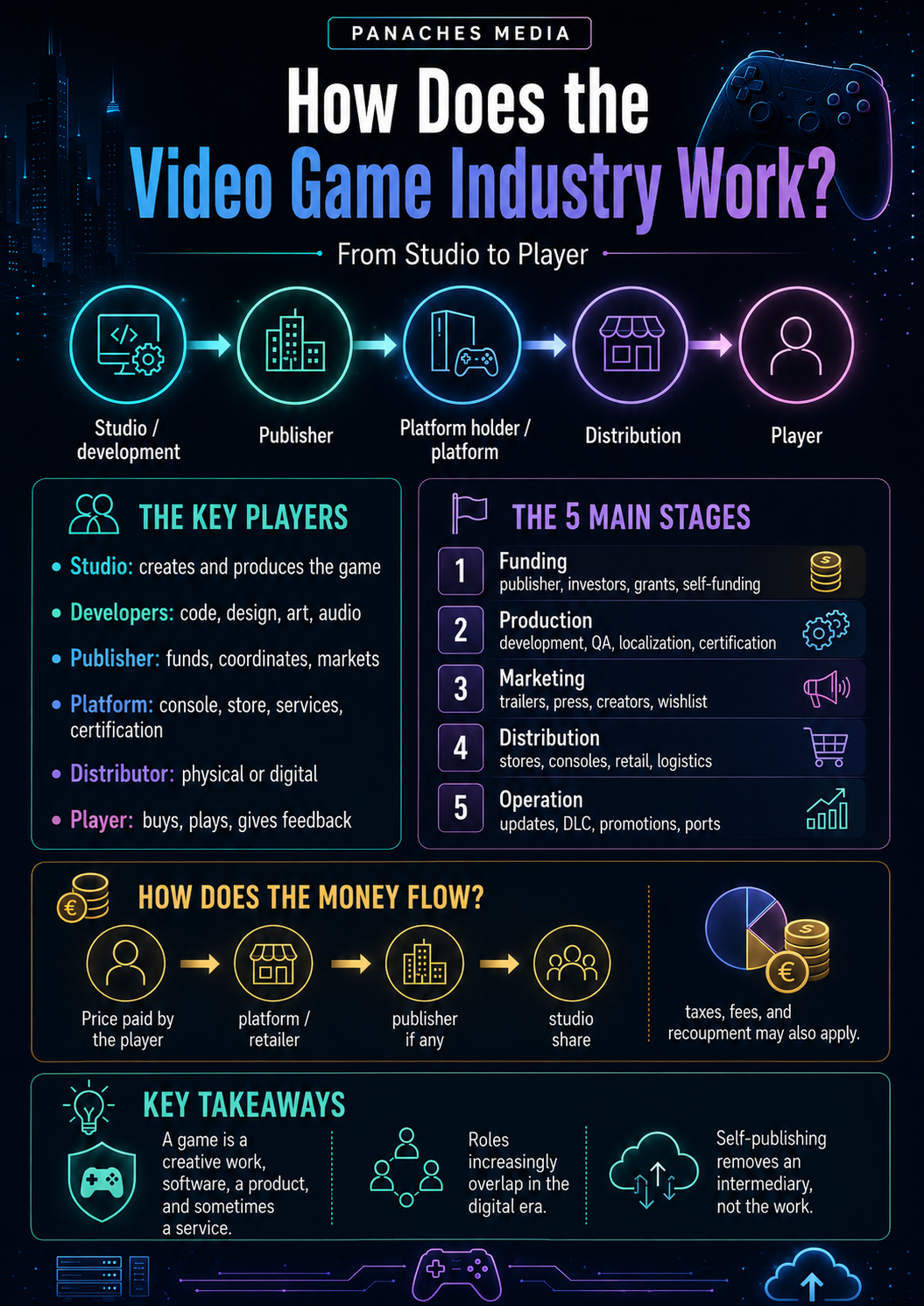
We can nevertheless begin with a simplified representation:
Studio / development team
            ↓
        Developer
            ↓
         Publisher
            ↓
Platform holder / platform
            ↓
        Distributor
            ↓
          Player
This model becomes much more useful once we add what actually circulates between these actors: money, rights, content, data, services, and responsibilities.
A video game is simultaneously a creative work, a piece of software, a commercial product, and sometimes a service operated for several years. The industry exists precisely to organize these four dimensions.
Studio and developer: two similar words that do not mean exactly the same thing
In everyday discussion, studio and developer are often used as though they were interchangeable. The distinction remains useful.
A studio generally refers to the organization producing the game: a company, subsidiary, independent team, or sometimes a structure created around a particular project. Developer is broader and refers to whoever participates in development. It can mean the studio as a whole, another specialized company, or an individual working in programming, design, art, or production.
A large game may therefore involve several developers. The lead studio retains overall direction while external teams contribute to animation, cinematics, environment production, multiplayer, porting, or quality assurance.
| Term | What it generally refers to |
|---|---|
| Studio | the organization or team coordinating the game’s creation |
| Lead developer | the team responsible for the core production |
| Co-developer | a studio directly contributing to a significant part of the game |
| Service provider / outsourcing partner | a company performing a specialized task |
| Porting studio | a team responsible for adapting the game to another platform |
This organization has expanded considerably as productions have grown. A studio does not necessarily benefit from keeping every skill permanently in-house when some expertise may only be required for a few months.
Modern production can therefore involve specialists in motion capture, voice recording, visual effects, localization, QA, cinematics, or compatibility with a specific platform.
The name printed most prominently on the box does not always tell the whole story of who actually made the game.
The studio turns financing into production
A studio’s central role is to transform an idea, a budget, and time into a functioning game.
That may sound obvious, but this transformation is precisely where much of the economic risk of development lies. For months or years, salaries, software, offices, equipment, and external services have to be funded while the product is generally not yet on sale.
The studio therefore manages two realities at once. The first is creative: designing gameplay, producing levels, creating characters, programming systems, and building the experience. The second is industrial: recruiting, scheduling, paying teams, controlling the budget, managing external partners, and reaching planned milestones.
In a small independent team, these two realities may rest on only a few people. In a large production, they are spread across many departments.
What a development budget actually pays for
A development budget does not simply pay programmers and artists. It may notably cover:
- salaries and employment costs;
- external studios and other service providers;
- software, engines, and technical licenses;
- music, actors, and motion capture;
- network infrastructure and servers;
- testing and certification;
- localization;
- development hardware;
- part of the project’s administrative and legal costs.
A separate marketing budget may then be added, sometimes reaching very large amounts on major productions.
The cost of a game therefore depends less on the number of lines of code than on the length of production multiplied by the number of people and services involved.
Who finances development?
Not every studio has enough cash to fund several years of production before the first sale. This is one of the historical reasons publishers became so important.
Ukie, the UK games industry trade body, notes that publisher funding has long been a major source of financing for studios and remains important within the ecosystem, even as self-publishing and alternative sources of funding have expanded the available options. A publisher may finance all or part of development in exchange for contractual rights related to the game, its commercialization, or its revenues.
But a publisher is no longer the only solution.
| Funding source | Principle |
|---|---|
| Self-funding | the studio uses its own cash or revenue from previous games |
| Publisher | a publisher advances part or all of the budget |
| Investors | investors take equity or finance the company |
| Crowdfunding | a community funds part of the project in advance |
| Public support | grants, tax credits, or dedicated funds support certain productions |
| Work-for-hire contracts | the studio finances its own projects through work performed for other companies |
| Platform agreements | some platforms provide funding or guaranteed revenue in exchange for specific terms |
| Early Access | a commercial version released before completion helps finance continued development |
These models can be combined. A studio might fund a prototype itself, then obtain public support, sign with a publisher, and later release the game in Early Access.
Funding influences far more than the amount of money available. It can affect intellectual property ownership, target platforms, schedules, commercial objectives, and the future distribution of revenue.
The publisher: much more than a company whose name appears on the box
The publisher occupies a particular position because it often connects game creation with commercial exploitation.
Valve summarizes this diversity fairly well when explaining to Steam developers why they might choose to work with a publisher: financing, marketing, testing, and other publishing-related services. A publishing agreement can indeed take very different forms depending on the project.
A large publisher may finance nearly the entire production, supervise certain decisions, handle worldwide marketing, organize localization, manage relationships with platforms, and oversee commercialization.
A smaller independent publisher may intervene much more lightly, allowing the studio to retain ownership of the game and substantial creative freedom while providing an advance, marketing expertise, or a distribution network.
Possible functions of a publisher
| Area | Possible involvement |
|---|---|
| Financing | advances and funding for development stages |
| Production | monitoring schedules, budgets, and milestones |
| Marketing | strategy, advertising, trailers, influencers, events |
| Press relations | communication with media and content creators |
| QA | internal or outsourced testing |
| Localization | translation, adaptation, and dubbing |
| Business development | negotiations with platforms and partners |
| Distribution | organization of digital and physical releases |
| Sales | pricing, promotions, pre-orders, and sales strategy |
| Analytics | monitoring sales and performance |
| Exploitation | DLC, ports, editions, licensing, and other extensions |
Not every publisher performs all of these functions. Some specialize in financing and marketing independent games; others own their own studios and keep almost the entire process inside the same group.
Advances, milestones, and recoupment: how does a publishing agreement work?
When a publisher finances a game, it does not necessarily pay the entire budget on the first day.
Development is often divided into milestones, contractual stages tied to specific deliverables or states of the project. One payment may finance a prototype, another an alpha version, while later payments accompany the project as production progresses.
This system allows the publisher to monitor development and gives the studio access to the funds it needs during production.
Once the game is released, the agreement may include recoupment. Part of the revenue may first be used to repay certain advances or expenses defined in the contract before the normal revenue split begins.
Ukie emphasizes that terms can vary enormously. In some deals, the publisher fully finances the game and may ask for significant intellectual property rights. In others, the studio retains its IP and grants only a limited license covering certain platforms, territories, or periods.
Financing, ownership of the game, and revenue sharing are three different questions. A studio can create a game without owning the IP, or retain the IP while temporarily licensing certain exploitation rights.
This is why publishing contracts occupy such an important place in the economics of the industry.
Intellectual property determines who can exploit the game
A video game brings together several kinds of rights: code, artwork, music, characters, story, trademarks, and sometimes licenses originating from other universes.
Intellectual property, commonly shortened to IP in the industry, notably determines who controls the game’s universe and who can authorize new forms of exploitation.
The studio may retain the entire IP and grant the publisher commercialization rights. The publisher may own the IP from the outset and hire a studio to produce a game based on that property. Both companies may also share certain rights depending on the agreement.
This becomes especially important when a game succeeds. An IP can later generate sequels, remasters, adaptations, merchandise, books, films, or other licensing opportunities.
The economic value therefore does not always end with sales of the first game.
The platform holder and the platform control access to a market
Once developed, a game still has to reach players.
On consoles, platform holders have historically occupied a central position. Sony, Microsoft, and Nintendo control their own hardware and software ecosystems. A game released on their systems must comply with technical, administrative, and commercial procedures specific to each platform.
On PC, the platform role is more often performed by digital storefronts and distribution services such as Steam, Epic Games Store, and others. On mobile, Apple and Google play a similarly important role through their operating systems and stores.
The term platform can therefore encompass several functions:
Hardware
+
Operating system
+
Storefront
+
User account
+
Payment
+
Network services
+
Developer tools
+
Publishing rules
A company does not need to manufacture a console to exercise part of this power. The storefront itself may become the main gateway to a market.
What the platform provides to the game
Platforms do more than host a file for download. They provide commercial and technical infrastructure.
Steamworks, for example, allows developers to manage builds, store pages, prices, DLC, payments, certain community features, and various operations related to running the game commercially. Steam Direct also allows developers to publish their own products after completing the corresponding onboarding process.
This change is fundamental: digital distribution has made direct market access possible for studios that would once have needed both a publisher and a physical distribution network.
On consoles, the platform also performs technical control. The game must comply with the requirements necessary for publication and pass through the validation stages defined by the platform holder.
The platform therefore acts at once as infrastructure, storefront, commercial intermediary, and a set of rules the product must follow.
The distributor has not disappeared: its role has changed
When the industry relied mainly on cartridges, floppy disks, and later discs, physical distribution was a major operation.
Copies had to be manufactured, boxes printed, stock stored, products transported across territories, wholesalers supplied, and stores stocked. Each intermediary had to anticipate demand in order to avoid both shortages and unsold inventory.
The physical model can be simplified like this:
Studio
  ↓
Publisher
  ↓
Manufacturing
  ↓
Distributor / wholesaler
  ↓
Retailer
  ↓
Player
Digital distribution greatly shortens this chain.
Studio / publisher
        ↓
Digital storefront
        ↓
      Player
Distribution has not disappeared, however. It has become software infrastructure: servers, storage, payments, downloads, account management, updates, refunds, security, and storefront discovery.
The cost of manufacturing a box disappears, but the role of the commercial intermediary remains.
The player is the final link in the chain, but also the starting point of revenue
The player does not enter the process only at the moment of purchase.
Before release, they may add the game to a wishlist, participate in a beta, follow the studio on social media, or try a demo. After launch, their purchases, playtime, reviews, and behavior can help determine the product’s commercial trajectory.
For games receiving regular updates, the relationship becomes even longer. Usage data can help teams understand which features are used, where players stop playing, which content performs well, and how the active population changes.
This does not mean every game redesigns itself around statistics. But digital operation now makes possible a level of observation that barely existed when a cartridge was sold and then remained disconnected from the studio.
The product can continue evolving after purchase.
How does money flow when a game is sold?
The price paid by the player does not go directly to the studio.
The exact flow depends on the contract, territory, distribution model, taxation, and many other variables. The general principle can nevertheless be represented like this:
Price paid by the player
          ↓
Taxes / refunds / commercial costs
          ↓
Platform or retailer
          ↓
Publisher, if applicable
          ↓
Possible recoupment
          ↓
Studio revenue share
Every line can change depending on the model.
A studio self-publishing on PC does not necessarily have a publisher between itself and the platform. A game fully produced by a company that owns its studio and publishes through its own platform may instead combine several of these roles within the same corporate group.
This variety explains why knowing that a game generated a certain amount of revenue does not immediately tell us its profit.
Development, marketing, operational costs, contractual shares, and any expenses required to maintain the game still have to be deducted.
A game that sells well is not necessarily profitable
Profitability depends on the relationship between what the project cost and what it actually earns.
A game selling 500,000 copies can be an enormous success for a small team working with a limited budget. The same result could be insufficient for a production involving hundreds of people, global marketing, and several years of development.
Success must therefore always be understood within its economic context.
Simplified model
Revenue generated
      −
Development costs
      −
Marketing
      −
Distribution and commissions
      −
Operations / support
      =
Economic result
Additional revenue can later change the equation substantially: discounted sales, ports to new platforms, DLC, subscription deals, licensing, or long-tail catalog sales.
A game does not necessarily stop generating money the month after launch.
Marketing starts long before release
An excellent game can fail commercially if nobody knows it exists.
Marketing is therefore not decoration added a few weeks before launch. For many projects, it begins much earlier with positioning, target audience, the way the game is presented, and the gradual construction of an audience.
A campaign can combine trailers, social media, events, press relations, influencers, demos, showcases, advertising, promotions, or content produced directly by the studio.
The storefront itself also becomes a marketing space. A page on Steam, PlayStation Store, Xbox Store, or Nintendo eShop has to communicate the game’s identity quickly through its title, visuals, video, description, and tags.
Before and after launch
| Before release | After release |
|---|---|
| announce the game | maintain visibility |
| build a community | organize promotions |
| gain wishlists | communicate updates |
| release trailers and demos | support DLC and new content |
| reach press and creators | relaunch attention around new events |
| prepare positioning | develop the catalog over time |
Marketing therefore plays a directly economic role: it tries to turn the existence of the game into attention, then convert that attention into sales or users.
Release is no longer necessarily the end of the product
Digital distribution has deeply changed how games are operated after launch.
A production can receive patches, free content, paid expansions, new seasons, or events for several years. Studios can also adapt the game to new platforms or prepare enhanced editions.
Long-term exploitation can take very different forms:
| Form of exploitation | Example logic |
|---|---|
| Initial sale | purchase of the complete game |
| DLC / expansions | additional paid content |
| Microtransactions | in-game purchases |
| Battle pass / seasons | renewed progression and content |
| Subscription | inclusion in a catalog or service |
| Porting | release on a new platform |
| Remaster / remake | new exploitation of an existing title |
| Licensing | third-party use of the intellectual property |
| Merchandising | physical products and merchandise |
| Adaptation | film, series, book, or another medium |
The importance of these revenue streams obviously depends on the game. A narrative single-player title may remain centered on the initial sale, while a live-service game may build its entire business model around a long-term relationship with its community.
We will return specifically to these models in the article about how video games make money.
When the game becomes a service
The live-service model pushes continuous operation even further.
The studio no longer produces only a finished piece of software. It maintains an environment that must remain functional, renewed, and sufficiently interesting to retain players.
This often requires a specific organization: content teams, data analysis, moderation, customer support, server infrastructure, security, commercial operations, and event scheduling.
The nature of the budget also changes. A substantial portion of costs can occur after launch, whereas in a traditional game most production spending is committed before commercial release.
This model illustrates why the boundary between development and operation has become less clear.
A game can be publicly released while remaining continuously in production.
Roles increasingly overlap
The traditional representation of the industry gives each actor one precise function. Contemporary reality is much less tidy.
Sony Interactive Entertainment can own studios, develop games, publish them, and operate the PlayStation platform. Microsoft similarly combines development, publishing, and operation of the Xbox ecosystem. Nintendo integrates game creation, publishing, hardware, and platform operation even more directly.
Valve develops games while operating Steam. Epic Games develops Fortnite, supplies Unreal Engine, and also runs a digital storefront. Many publishers own development studios, while some independent studios publish their own games.
The structure may therefore look more like this:
One company can simultaneously be:

Studio
+ Developer
+ IP owner
+ Publisher
+ Platform
+ Digital distributor
+ Service operator
This integration gives the company greater control, but it also requires substantially greater resources.
Self-publishing changed the publisher’s position
Digital distribution did not eliminate publishers. It removed the idea that a publisher is required to access the market.
Steam Direct illustrates this clearly: a developer can join Steamworks, prepare a store page, upload builds, set a price, and distribute the game without first signing with a traditional publisher.
This changes the choice available to studios.
Traditional model
Studio
  ↓
Publisher
  ↓
Platforms / distribution
  ↓
Players
Self-publishing
Studio
  ↓
Platforms / storefronts
  ↓
Players
The second model looks more direct, but the tasks previously performed by the publisher do not disappear. The studio must then finance the project itself, organize marketing, manage business relationships, prepare localization, provide support, and run the launch.
Self-publishing removes an intermediary.
It does not remove the intermediary’s work.
Producing a game also relies on an industry of services
Between the major visible categories lies a multitude of specialized companies whose names players rarely know.
A studio may outsource part of its 3D artwork to a company in another country, entrust QA to a specialist testing lab, work with a public-relations agency, hire a dubbing studio, and then use several providers to localize the game into different languages.
The ecosystem therefore includes:
- co-development companies;
- art and animation studios;
- QA providers;
- localization specialists;
- marketing and public-relations agencies;
- engine and middleware providers;
- network and cloud services;
- specialized legal firms;
- payment platforms;
- consultants and analytics companies.
Ukie was still describing London in 2026 as a cluster containing almost the entire production chain: development, tools, outsourcing, creative services, publishing, marketing, and public relations. This shows clearly that the industry extends far beyond the names printed on game boxes.
A major production can depend on dozens of different companies.
Games move through a chain, but risk moves through it too
Every actor accepts a different kind of risk.
The studio risks its time, its team, and sometimes its financial survival if production fails. The publisher commits money to projects without knowing their future sales. The platform invests in infrastructure and tries to maintain an attractive catalog. The physical distributor manages inventory. Even the player accepts a much smaller but real risk when buying a game they have not yet experienced.
Contracts exist partly to distribute these risks.
More financing may come with greater control. A financial guarantee may require temporary exclusivity. An intellectual-property license imposes specific rules. Revenue sharing reflects the way several partners contributed to the project.
The industry’s economic structure is therefore inseparable from its creative structure: the party financing part of the risk often receives part of the control or revenue in return.
The complete journey of a game
If we bring the different layers together, a typical game journey can be represented like this:
IDEA / IP
   ↓
FINANCING
   ↓
STUDIO
   ↓
DEVELOPMENT
   ↓
QA · LOCALIZATION · CERTIFICATION
   ↓
PUBLISHER / SELF-PUBLISHING
   ↓
MARKETING
   ↓
PLATFORMS AND DISTRIBUTION
   ↓
LAUNCH
   ↓
PLAYERS
   ↓
SALES · DATA · FEEDBACK
   ↓
UPDATES · DLC · PORTS · PROMOTIONS
   ↓
LONG-TERM OPERATION
Reality can naturally change this order. Marketing often begins during development, players may participate in tests before release, and financing may evolve throughout production.
The diagram mainly helps identify the major functions.
Who does what? The overall map
| Actor | Central function | What they provide |
|---|---|---|
| Studio | organize creation | team, direction, production |
| Developers | build the game | code, design, art, audio, content |
| Service providers | supplement production | specialized expertise |
| Investors / funders | provide capital | cash flow and development financing |
| Publisher | organize commercial exploitation | financing, production, marketing, distribution |
| Platform holder | provide a hardware ecosystem | console, SDK, services, certification |
| Platform / store | bring the game to market | storefront, payment, download, services |
| Distributor | deliver the product | physical logistics or digital infrastructure |
| Marketing / press / influencers | create visibility | audience and discovery |
| Player | use and finance the product | sales, activity, community, feedback |
No production is required to use exactly this configuration.
That is precisely what makes the industry difficult to summarize with one simple arrow.
From idea to player, the industry mainly organizes responsibilities
Behind a game are artists, programmers, designers, and writers, but also producers, lawyers, financiers, marketing specialists, platform managers, QA teams, translators, analysts, and technical service providers.
The video game industry connects all of these skills so that a project can be financed, built, completed, discovered, purchased, and potentially operated for several years.
The studio remains the place where the experience takes shape, but it does not exist in isolation. The publisher can provide resources and market access. The platform provides commercial and technical infrastructure. Distributors organize access to the product. Players ultimately transform that production into economic activity.
The historical chain therefore remains useful:
Studio → Publisher → Platform → Distribution → Player
But today it should be read as shorthand.
In the contemporary industry, an independent team may control almost the entire chain, while a large group may combine several links within the same company. Between those two extremes lies a huge variety of possible agreements.
Understanding the video game industry therefore means less memorizing a fixed list of actors than following four questions: who finances the risk, who builds the game, who controls access to the market, and who owns the right to exploit it?
Those four answers already explain a large part of what happens between a studio’s first idea and the moment a player clicks “Buy.”