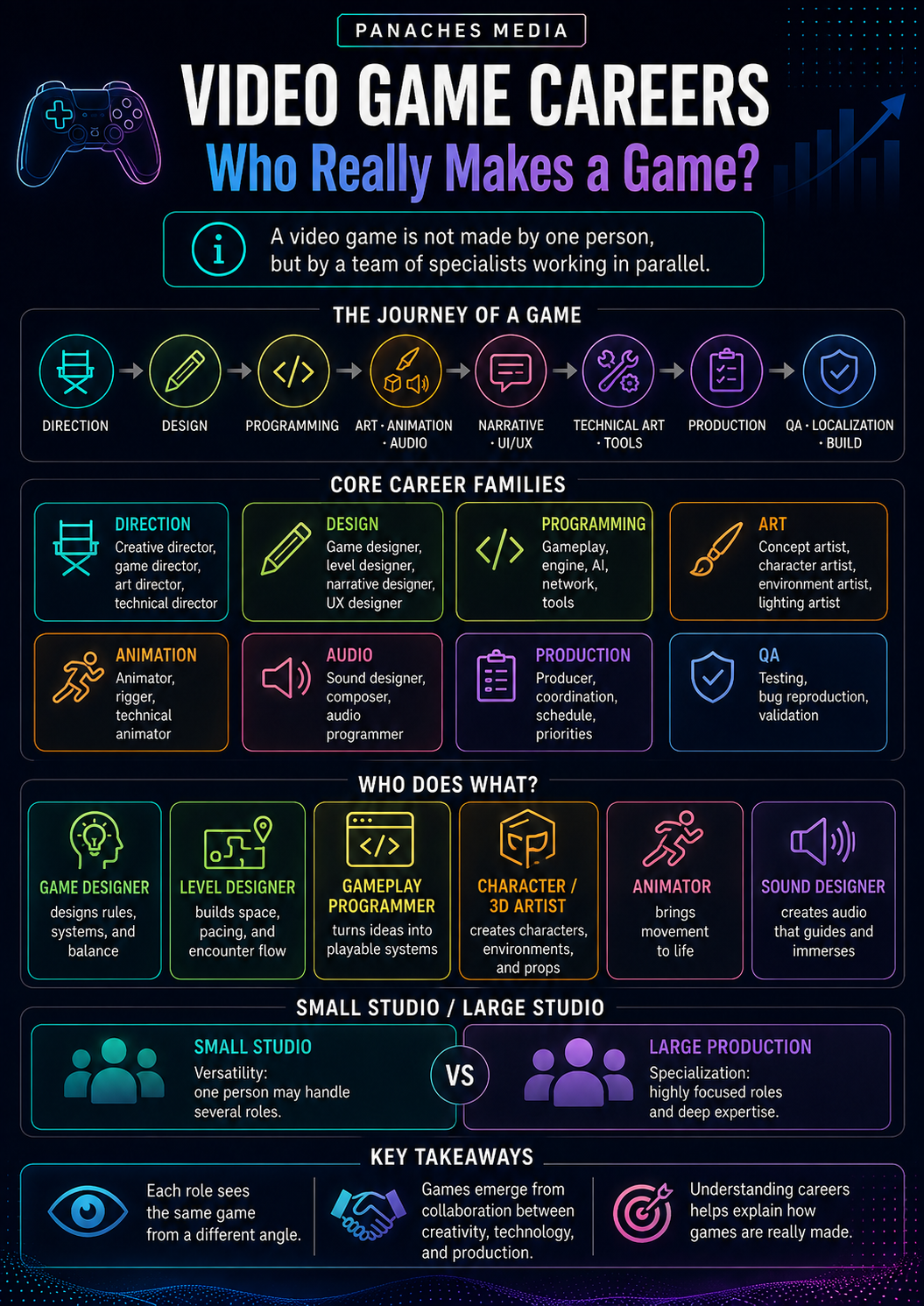
Behind a game, there are not just “developers” but dozens of professions
When you look at the credits of a major video game, they can run for several dozen minutes. Hundreds, sometimes thousands, of names appear under job titles whose functions players may not always understand: gameplay programmer, level designer, technical artist, lighting artist, producer, QA tester, build engineer, cinematic designer, or audio programmer.
Yet in everyday language, all these people are often summed up with a single word: developers.
The term is not wrong, but it is extremely broad. It can refer to the company developing the game, the entire production team, or, in a more specific sense, the people who write the code.
A modern game is actually the result of collaboration between several major disciplines.
DIRECTION
   ↓
DESIGN
   ↓
PROGRAMMING
   ↓
ART · ANIMATION · AUDIO
   ↓
NARRATIVE · UI / UX
   ↓
TECHNICAL ART · TOOLS
   ↓
PRODUCTION
   ↓
QA · LOCALIZATION · BUILD
This diagram should not be read as a chain in which each profession waits for the previous one to finish. All these disciplines work largely in parallel, constantly exchange information, and return to the same elements several times.
Making a game is less about adding professions together than about getting specialists who all look at the same project from different angles to work together.
This is also what makes video game careers difficult to understand from the outside: two people can work on the same character, one on their appearance, another on their skeleton, a third on their animations, and a fourth on their behavior.
A first map of the main career families
The ScreenSkills career map currently groups video game careers into major families very close to those found in studios: production, art, animation, audio, design, technical art, programming, and quality assurance.
| Field | Some professions |
|---|---|
| Direction | creative director, game director, art director, technical director |
| Design | game designer, gameplay designer, level designer, UX designer, narrative designer |
| Programming | gameplay programmer, engine programmer, AI programmer, network programmer, tools engineer |
| Art | concept artist, character artist, environment artist, 3D artist, lighting artist |
| Animation | animator, rigger, technical animator |
| Technical Art | technical artist, VFX artist, shader artist |
| Audio | sound designer, composer, audio programmer, voice designer |
| Narrative | writer, narrative designer, cinematic designer |
| Production | producer, associate producer, project manager |
| QA | QA tester, QA analyst, build engineer |
| UI / UX | UI designer, UX designer, user researcher |
| Production support | localization, marketing, community, data, certification |
This list is deliberately broad. Job titles vary between companies, and the boundaries between professions are never perfectly identical.
A small team may combine several responsibilities within a single role. A AAA production may instead divide one specialty into several very specific professions.
Creative direction gives the project a common direction
Before looking at the production roles themselves, we first need to understand the people who carry the overall vision.
The creative director or game director ensures the project remains coherent as a whole. They obviously do not create every asset, mechanic, or level themselves. Their role is more about ensuring that the many decisions made by the teams converge toward the same experience.
Depending on the studio structure, several specialized leadership roles may coexist:
- Game Director: overall vision of the game and its experience;
- Creative Director: overall creative direction;
- Art Director: visual identity;
- Technical Director: technical architecture and direction;
- Audio Director: sound direction;
- Narrative Director: narrative direction.
In a small production, one person may take on several of these responsibilities.
In a large project, they become genuine coordination roles between entire departments.
Direction therefore does not create the content in place of the teams. It defines the framework within which the teams make their decisions.
The game designer designs the rules of the game
The game designer is probably one of the best-known and most misunderstood professions.
They do not simply spend their days “coming up with game ideas.”
Their role is to transform an intention into playable rules, systems, and interactions.
Ubisoft describes game design as the discipline responsible for imagining and developing the rules and mechanics that structure the experience.
A game designer may work on:
- character movement;
- combat;
- economy;
- items;
- abilities;
- progression;
- rewards;
- multiplayer rules;
- statistics;
- balancing.
Take a combat system.
The game designer may define damage values, delays between attacks, resources used, defensive options, and the way these elements interact.
They do not necessarily program the final system themselves.
INTENTION
“Combat should encourage risk-taking”
        ↓
GAME DESIGN
rules · costs · rewards · timings
        ↓
PROGRAMMING
system implementation
        ↓
ANIMATION · VFX · AUDIO
combat feedback
        ↓
QA / PLAYTEST
observe the result
        ↓
ADJUSTMENTS
Game design therefore continues long after the initial idea.
A large part of the profession consists of testing, measuring, and adjusting.
The level designer turns rules into playable space
While the game designer focuses on rules, the level designer mainly works on how the player encounters those rules within the game space.
Ubisoft describes its level designers as architects of worlds responsible for working on pacing, flow, obstacles, and the activities offered to players.
The level designer may decide:
- where the player starts;
- which paths are possible;
- where obstacles are placed;
- when an enemy appears;
- how a mechanic is introduced;
- where rest areas are located;
- how difficulty progresses;
- which visual information guides the player.
They should not be confused with the level artist.
| Level designer | Level artist |
|---|---|
| builds the gameplay experience | builds the visual presentation |
| thinks about circulation and pacing | thinks about composition and aesthetics |
| places gameplay elements | produces and places assets |
| tests playability | works on materials, lighting, and atmosphere |
| prioritizes function | prioritizes visual quality |
In practice, the two disciplines collaborate constantly.
A level needs to be both playable and visually believable.
The technical designer sits between design and programming
As games become more complex, more professions appear between two disciplines.
The technical designer or technical level designer is a good example.
They understand the goals of game design but also have enough technical knowledge to build prototypes, use scripting, create tools, or solve integration problems.
Ubisoft currently describes the Technical Level Designer as an interface between gameplay intentions and their technical translation, working in particular on the tools, workflows, and pipelines used by level designers.
This intermediary position is extremely important in modern productions.
A design idea always has to become something the engine can actually execute.
The programmer builds the systems that make the game work
In everyday language, a programmer is often simply called a developer.
But programming itself is divided into many specialties.
| Specialty | Main work |
|---|---|
| Gameplay programmer | mechanics and interactions |
| Engine programmer | engine architecture |
| Graphics programmer | rendering, shaders, graphics performance |
| AI programmer | behaviors, navigation, AI systems |
| Physics programmer | simulations and physics systems |
| Network programmer | multiplayer and network communication |
| Tools engineer | tools used by the teams |
| Build engineer | compilation and production of game builds |
| UI programmer | interfaces and related systems |
| Audio programmer | technical audio systems |
ScreenSkills currently distinguishes several of these branches in its career map, including gameplay, engine, physics, artificial intelligence, networking, tools, graphics, and build.
This specialization depends enormously on the size of the studio.
A generalist programmer working in a five-person team might work on gameplay in the morning, fix an interface issue in the afternoon, and prepare a build in the evening.
On a AAA production, a programmer may spend several years working on a much more specific area.
The gameplay programmer turns rules into behaviors
The gameplay programmer works closely with game designers.
When a designer describes how a weapon, vehicle, or ability should work, the gameplay programmer builds the logic required to make it function in the engine.
Take a jump.
The system may need to manage:
- ground detection;
- vertical speed;
- gravity;
- collisions;
- animations;
- sounds;
- effects;
- the character’s different states.
What appears to be an extremely simple action from the player’s perspective may therefore depend on several systems.
The job consists of turning a gameplay intention into robust, performant, and maintainable behavior.
The concept artist explores before production builds
Before modeling a character for several days or weeks, it is better to know what that character should look like.
That is one of the roles of the concept artist.
They visually explore ideas before they are produced in their final form.
Their work may concern:
- characters;
- creatures;
- environments;
- vehicles;
- objects;
- architecture;
- costumes;
- atmosphere;
- color palettes.
Concept art is therefore not simply about producing “beautiful illustrations.”
A production image often needs to communicate information that other professions can actually use.
Brief
  ↓
Visual research
  ↓
Variations
  ↓
Approved concept
  ↓
3D modeling / production
The concept artist works at the beginning of many elements, but may also continue producing research throughout production.
The character designer builds the character’s visual identity
The character designer focuses more specifically on designing characters.
They work on silhouette, body shape, clothing, accessories, colors, and how all these elements communicate a personality or function.
A good design often has to satisfy several constraints at once:
- be recognizable;
- fit the universe;
- work in motion;
- remain readable on camera;
- be possible to model and animate;
- respect technical constraints.
The work may include front, side, and back views, expression studies, different poses, costume details, or material studies.
In a small production, the concept artist and character designer may be the same person.
In a larger team, specialization becomes more common.
The 3D artist turns concepts into objects the engine can use
Once the visual directions have been defined, the elements of the game need to be built.
The term 3D artist can itself cover several specialties.
Character artist
The character artist builds character models: volumes, details, clothing, textures, and materials.
Environment artist
The environment artist creates the elements that make up environments: buildings, rocks, furniture, vegetation, or structures.
Prop artist
The prop artist specializes in the objects that populate the world.
Texture / Material artist
This specialty focuses more specifically on surfaces and materials.
The final result must respect the art direction while remaining compatible with the required performance targets.
A beautiful model containing an impossible amount of geometry or textures that are too heavy may be unusable in the game.
The artist therefore already works within a technical framework.
The lighting artist sculpts the scene with light
Lighting plays an essential role in readability and atmosphere.
The lighting artist works in particular on:
- light intensity;
- colors;
- shadows;
- contrast;
- atmosphere;
- visibility of important areas;
- transitions between environments.
Their work directly overlaps with that of the level artist, art director, and technical teams.
The lighting needs to look good, but it also needs to guide the player and respect the performance budget.
It is a good example of a profession where aesthetics and technology constantly meet.
The animator gives movement to characters and objects
A motionless 3D model is not yet a playable character.
The animator creates the movements required to bring the game to life: walking, running, combat, reactions, interactions, expressions, or cinematics.
Video game animation has a particular constraint: many animations will not be played in a fixed order.
They need to combine according to the player’s actions.
Run
  ↘
   Transition → Jump → Landing
  ↗
Walk
The animator therefore works with state systems, transitions, and blending.
They regularly collaborate with gameplay programmers, designers, and technical animators.
Rigging and technical animation prepare the character to move
Before an animator can manipulate a character, that character needs a controllable structure.
The rigger or technical animator notably creates:
- the skeleton;
- controllers;
- constraints;
- facial systems;
- deformations;
- certain tools for animators.
ScreenSkills also distinguishes the animator from the technical animator in its career map.
This work is barely visible to the player but essential.
A good rig allows animators to work quickly while avoiding incorrect deformations.
The technical artist connects art and technology
The technical artist is one of the professions most characteristic of modern digital production.
Their role sits between artists and programmers.
They may work on:
- shaders;
- materials;
- optimization;
- tools;
- asset import;
- performance;
- procedural systems;
- graphics pipelines.
An artist may want to display an extremely dense forest.
The programmer knows that the machine has limited resources.
The technical artist looks for a way to achieve the visual intention without exceeding the technical constraints.
The technical artist does not choose between art and technology: their job is precisely to make them work together.
This role becomes particularly important when productions use complex tools and need to create very large amounts of content.
The VFX artist creates effects that make the action readable
Explosions, magic, smoke, impacts, sparks, rain, dust, or interface effects may depend on the VFX artist.
Their work is not only about spectacle.
An effect can communicate gameplay information:
- an attack is dangerous;
- an ability is ready;
- an area deals damage;
- a projectile has hit its target;
- a character has just used an ability.
VFX therefore sits at the intersection of art direction, gameplay, and readability.
A spectacular effect can still be bad if it prevents the player from understanding what is happening.
The sound designer builds the world through sound
A game does not come alive through visuals alone.
The sound designer creates and integrates part of the soundscape: environments, weapons, interfaces, vehicles, footsteps, impacts, creatures, and countless other elements.
Ubisoft describes its sound designers, for example, as responsible for creating and integrating ambience, effects, and foley alongside more technical specialists and voice designers.
Every sound can serve several functions.
A reload needs to sound believable, but it also tells the player that their weapon is temporarily unavailable.
The sound of an enemy positioned behind the camera can communicate a threat before it is even visible.
Sound therefore contributes directly to gameplay.
The composer writes the music, but it sometimes needs to react
The composer creates the music for the game.
In a linear work, music can be written to accompany a sequence with exact timing.
In a game, the player often controls the duration and pacing of the action.
The music may therefore need to adapt:
Exploration
      ↓
Tension
      ↓
Combat
      ↓
Victory
      ↓
Return to calm
Some systems use several musical layers that can appear or disappear depending on the state of the game.
The composer then works with sound designers, audio programmers, and designers so that the music can react without losing its coherence.
The writer is not the only person building the narrative
The writer, or games writer, writes narrative elements: dialogue, scenes, characters, descriptions, or other text.
But interactive storytelling also involves other professions.
The narrative designer focuses more on the way the story and game systems interact.
The difference can be summarized like this:
| Writer | Narrative designer |
|---|---|
| writes dialogue and scenes | organizes narrative within the game system |
| works on characters and tone | works on choices, triggers, and progression |
| produces narrative content | connects story and interaction |
The boundaries remain variable depending on the studio.
Ubisoft currently explicitly identifies narrative design as a discipline responsible for building the narrative ecosystem of the game within its design teams.
A game’s narrative is therefore not simply a screenplay with buttons added to it.
It has to work with space, actions, and the freedom given to the player.
UI and UX determine how the player understands the game
Menus, maps, inventory, HUD, quest indicators, settings, and many interface elements notably fall within UI and UX.
The UI designer mainly works on the visible interface.
The UX designer looks more broadly at how the player understands and uses the system.
A button can look beautiful while still being difficult to find.
An inventory can contain all the necessary information and still remain incomprehensible.
User experience design therefore aims to make interaction:
- readable;
- coherent;
- accessible;
- predictable;
- efficient.
Large productions may also employ user researchers, who organize studies and tests to observe how real players use the game.
The producer moves the production forward rather than the character
The word producer can create confusion with film production.
In game development, the producer is heavily involved in organizing the project.
They notably work on:
- schedules;
- priorities;
- resources;
- coordination;
- risks;
- milestones;
- communication between teams.
Their goal is not to define the creative vision alone.
They try to ensure that the teams can actually produce what has been decided, within the available time and resources.
The distinction can be summarized like this:
Creative direction → Where do we want to go?
Design             → How should the game work?
Production         → How are we going to actually build it?
ScreenSkills also places producer and assistant producer within the production branch of its career map.
QA is not simply about “playing games all day”
Quality Assurance, or QA, is often reduced to the role of tester.
Professional game testing, however, is not the same as playing like an ordinary user.
QA aims to identify, reproduce, and document problems.
A report may need to specify:
Game version
     ↓
Platform
     ↓
Steps to reproduce the bug
     ↓
Observed result
     ↓
Expected result
     ↓
Frequency
     ↓
Severity
A tester may deliberately repeat the same action many times, check different parameters, or try to trigger an error.
QA also participates in validating fixes.
The discipline therefore sits at the heart of communication between teams.
A graphical bug may come from an asset, shader, script, animation, or the engine. QA needs to provide enough information to help the relevant specialists locate the problem.
Build engineers create the versions everyone uses
During production, the game exists in many different versions.
Code changes, assets change, fixes are integrated, and teams regularly need access to an executable version.
The build engineer automates and monitors part of this process.
Their work may include:
- compilation;
- continuous integration;
- build creation;
- deployment;
- error detection;
- management of different platforms.
This profession becomes particularly important when several hundred people modify the same project every day.
A broken build can prevent a large part of the studio from working.
Production infrastructure then becomes almost as important as the product itself.
Localization adapts the game to several languages and cultures
Translating a game is not simply a matter of replacing French text with an English or Japanese equivalent.
Localization teams need to consider:
- interfaces;
- text length;
- dialogue;
- dubbing;
- subtitles;
- terminology;
- cultural references;
- legal constraints;
- date and number formats.
A perfectly translated sentence can become unusable if it no longer fits inside its button.
A joke may require adaptation.
Dubbed dialogue has to work within the constraints of the scene.
Localization therefore combines translation, technology, and QA.
For a worldwide release, it becomes a genuine parallel production.
Marketing and community teams do not directly build levels, but they contribute to the game’s success
Not every profession in the industry works directly inside the engine.
Marketing teams shape how the game is presented to the public.
Community managers work with communities.
Press, influencer, acquisition, and business development teams also operate between production and the market.
In a service game, this boundary becomes even less clear.
Community feedback, usage data, and event schedules can directly influence future content.
Work after launch therefore increasingly reconnects with production itself.
Studio size completely changes what job titles mean
The actual profession depends enormously on the scale of the project.
Small team
One person may combine:
Concept art
+
3D
+
Animation
+
UI
A programmer may be responsible for gameplay, AI, and tools.
The game designer may also be the producer.
Large production
Roles become far more specialized:
Character Concept Artist
Character Artist
Technical Character Artist
Rigger
Gameplay Animator
Technical Animator
Cinematic Animator
The two models therefore do not require exactly the same profiles.
A small studio often values versatility.
A large production may look for very deep expertise in one specific area.
No profession truly works alone
Perhaps the most useful way to understand these professions is to follow a single element of the game.
Take an enemy.
| Discipline | Contribution |
|---|---|
| Concept artist | explores its appearance |
| Character designer | defines its visual identity |
| Character artist | builds its model |
| Technical artist | ensures its graphical integration |
| Rigger | creates its skeleton |
| Animator | produces its movements |
| Game designer | defines its rules |
| AI programmer | builds its behaviors |
| Sound designer | creates its sounds |
| VFX artist | produces its effects |
| Level designer | decides how the player encounters it |
| Writer / narrative designer | may give it a narrative function |
| QA | tests its behavior |
| Producer | coordinates the required production |
The character the player perceives as a single entity is therefore often the result of work by many different people.
That is what video game production really is.
Professions are organized into teams, but the boundaries need to remain open
A production that is too compartmentalized works poorly.
The level designer needs to understand art and programming constraints. The concept artist needs to know what can actually be modeled. The gameplay programmer needs to understand the designer’s intention. The technical artist communicates with both art and programming.
Ubisoft’s current job listings also illustrate this logic: its level design leads collaborate directly with game direction, programming, technical art, QA, and production.
Studios therefore organize people into specialties in order to develop expertise, but the game can only emerge when those specialties communicate with one another.
Which profession should you choose if you want to work in video games?
There is no single profile for a “video game creator.”
Someone drawn to drawing will not follow the same path as someone passionate about algorithms or writing.
A first direction can be built around what you actually enjoy doing.
| If you mainly enjoy… | Careers to explore |
|---|---|
| inventing rules | game design, systems design |
| building spaces | level design, level art |
| programming | gameplay, engine, AI, tools, networking |
| drawing and exploring ideas | concept art, character design |
| creating in 3D | character art, environment art, prop art |
| making characters move | animation, rigging, technical animation |
| combining art and technology | technical art, VFX, shaders |
| writing | games writing, narrative design |
| working with sound | sound design, composition, audio programming |
| organizing projects | production |
| finding problems | QA |
| designing interfaces | UI / UX |
| observing users | user research |
This table is not a definitive career guide.
Many professionals change specialties during their careers or discover professions they did not even know existed before entering the industry.
The portfolio matters a great deal in creative professions
In artistic and design disciplines, being able to explain what you can actually produce is essential.
A concept art portfolio should show research, not just finished illustrations.
A level designer can present playable levels accompanied by explanations of their intentions.
A programmer can show prototypes, tools, or personal projects.
A sound designer can create a sound redesign demo from a sequence.
A technical artist can present shaders, tools, or optimization systems.
The portfolio should therefore answer one simple question:
What are you capable of producing in the discipline you are applying for?
Ubisoft recruiters also indicate that their recruitment processes may include exercises directly related to the position, such as a writing exercise for a writer or a technical test for a programmer.
A degree can open doors.
The ability to demonstrate concrete skills nevertheless remains central in many professions.
Working in video games means choosing a discipline before choosing “video games”
One of the most common mistakes is wanting to “work in video games” without knowing what you actually want to do there.
The industry brings together extremely different professions.
Programming a graphics engine and writing dialogue belong to the same industry, but require almost opposite skills.
Creating a 3D character and organizing a production schedule both contribute to the same project without sharing the same tools or career paths.
The first useful question is therefore not:
How do I get into video games?
It is:
Which part of making a game actually interests me?
From there, the industry becomes much easier to understand.
A game is a meeting point between professions
When we studied the production pipeline, we followed the stages required to move from an idea to the finished game.
Professions now allow us to look at the same process from another angle: who is responsible for each of those stages?
The game designer builds the rules. The level designer organizes the space. The programmer turns intentions into systems. Artists build the visible world. Animators give it movement. Audio specialists create its sonic identity. Writers and narrative designers organize the story. Technical artists connect creativity and technology. Producers coordinate the work. QA looks for what is not working.
And this list is still incomplete.
That is precisely what makes video games distinctive: few productions bring together computer science, drawing, animation, writing, music, design, psychology, management, and engineering to such an extent around a single object.
The player generally does not see this organization.
They see a character running through a world, hear its music, understand its interface, and press a button.
Behind that apparently simple action lies the coordinated work of dozens of disciplines.
It is less a single person who “makes a game” than a team that manages, over several months or several years, to make all these professions converge toward the same playable experience.