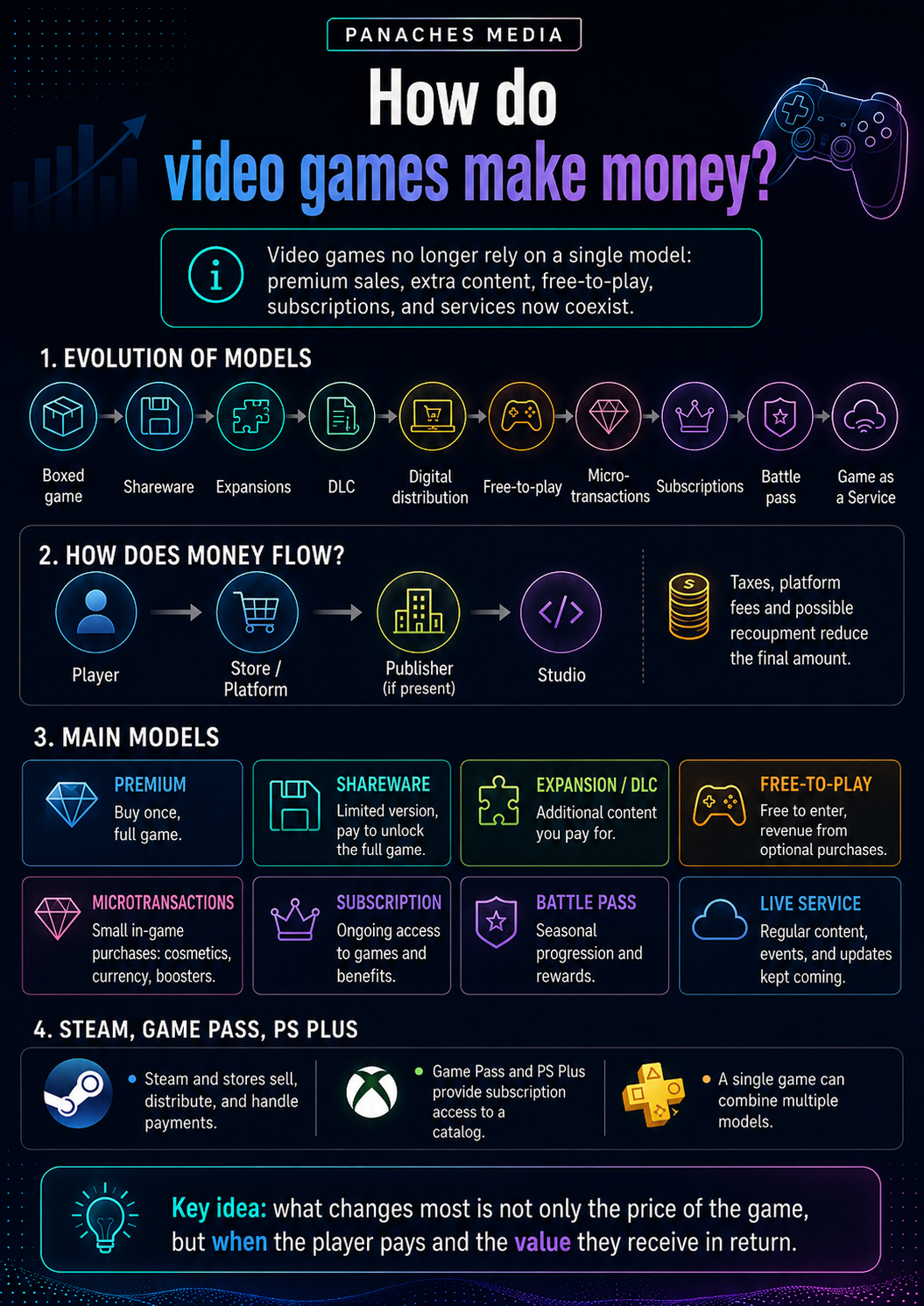
Buying a game has never been the only way to finance it
For a long time, the model seems obvious: a company makes a game, the player buys it, and the transaction ends there.
This image fits part of the history of physical video games fairly well. A cartridge or boxed copy is manufactured, distributed, sold in a store, and then used by the player. Economic success depends mainly on the number of copies sold and the price at which they are sold.
But even that era was more complex than it appears. Arcades were already charging for access to a play session rather than ownership of the game. Expansions later made it possible to sell additional content. Shareware distributed part of a game for free in order to convince players to buy the rest.
With the Internet, digital distribution, and connected games, this diversification accelerated.
Today, the same game can be:
- sold at a fixed price;
- offered for free;
- financed through expansions;
- monetized through cosmetic items;
- included in a subscription;
- accompanied by a battle pass;
- operated for several years with new content.
The price of a game no longer necessarily describes its business model. A free game can generate considerable revenue, while a game sold only once can continue producing income for years.
To understand how the industry makes money, we therefore need to distinguish the product being sold, when the player pays, and what they receive in return.
The classic model: selling a copy of the game
The premium model remains the easiest to understand.
The player pays a set price and gains access to the game.
Development
     ↓
Launch
     ↓
Game purchase
     ↓
Revenue
In traditional physical distribution, that price had to cover far more than development.
It also had to account for:
- manufacturing cartridges or discs;
- printing boxes and manuals;
- logistics;
- distributors;
- retailers;
- returns and unsold stock;
- marketing;
- taxes.
The price displayed in stores therefore never went entirely to the studio.
Digital distribution would later remove much of this physical logistics, but not the existence of intermediaries.
Revenue depends as much on sales volume as on price
Let us take a deliberately simplified example.
A game sold for €30 does not necessarily earn its developer €30.
Price paid
   ↓
Possible taxes
   ↓
Platform commission / share
   ↓
Possible publisher share
   ↓
Possible recoupment
   ↓
Revenue received by the studio
The actual result depends on the contract, territory, and distribution channel.
That revenue then has to be compared with the cost of the project.
A game that cost €500,000 does not need the same number of sales as a production costing 100 million.
Profitability is therefore less about asking “how many copies were sold?” than:
How much did the project actually cost, and how much does each sale actually generate?
Shareware: giving away part of the game to sell the rest
Before modern digital stores made downloadable demos commonplace, shareware was a particularly effective form of PC distribution.
The principle was to distribute a sufficiently substantial portion of the software freely so that users could discover it, copy it, and share it.
They could then purchase the full version.
Free portion
      ↓
Discover the game
      ↓
Sharing between users
      ↓
Purchase of the full version
This model greatly reduces the barrier to entry: the player can try the product before paying.
DOOM became one of the most famous historical examples of this strategy. Its 1993 shareware distribution contributed to its massive spread, while DOOM II would later be sold directly through traditional retail channels.
Shareware already contains an idea that would later reappear in many digital models: free access can serve as an acquisition tool rather than meaning the absence of a business model.
Expansions extend the commercial life of a game
Once a game has been sold, why stop generating revenue from an audience that wants to keep playing?
Expansions answered this question very early.
An expansion generally adds a significant amount of content: new areas, campaigns, characters, missions, units, or systems.
The model becomes:
Base game
    +
Expansion
    +
Next expansion
The developer can therefore extend the commercial life of the game without rebuilding an entirely new production.
This logic works particularly well once a community is already established. Part of the cost of acquiring the player has already been paid by the original game: the expansion is sold directly to an audience that already knows the product.
It can also be less expensive to develop than a full sequel, since the engine, some assets, and the fundamental systems already exist.
DLC turns the expansion into modular digital content
As Internet connections became widespread on consoles and PC, additional content could increasingly be distributed directly.
Downloadable Content, or DLC, takes part of the expansion model and makes it far more flexible.
Steam currently defines DLC as additional free or paid content associated with the base game. This can include expansions, new maps, levels, or characters.
The model can then be broken into modules:
Base game
   ├── story DLC
   ├── new characters
   ├── new maps
   ├── cosmetic content
   └── major expansion
This modularity offers an obvious advantage: each player can decide how much they want to invest in the product.
But it also changes how the price is perceived.
A game listed at €50 can ultimately represent a much larger investment if several pieces of additional content are sold.
That is why the boundary between a complete game and content sold separately also becomes a matter of trust between the studio and its audience.
Digital distribution changes less about the product than the economy around it
Digital distribution is one of the most important transformations in the industry.
The player no longer necessarily buys a physical object. They buy a right of access to software distributed through online infrastructure.
On Steam, PlayStation Store, Xbox Store, Nintendo eShop, or Epic Games Store, the process can be reduced to:
Studio / publisher
        ↓
Digital platform
        ↓
Payment
        ↓
Download
        ↓
Player
Physical manufacturing and transportation disappear.
In return, the platform handles a large number of functions: payment, hosting, distribution, user accounts, updates, refunds, security, and commercial tools.
Steamworks now supports dozens of currencies and payment methods, allows publishers to set regional pricing, and provides a complete infrastructure for distributing and operating games.
A digital store is therefore not simply a virtual shelf.
It becomes part of the business model.
Digital distribution also makes it possible to sell for much longer
A physical box gradually disappears from a shelf when a store needs to make space.
A digital game can remain available for years.
This transformation creates what is sometimes called a long tail.
A game can continue generating sales through:
- discounts;
- seasonal events;
- recommendations;
- updates;
- releases on new platforms;
- visibility generated by a sequel;
- a film or television adaptation;
- a community that continues talking about it.
Launch remains important, but it no longer necessarily represents the only commercial window.
An older catalog can itself become an economic asset.
Discounts change the relationship between price and volume
Digital distribution also makes price changes easier.
A game can launch at full price, receive its first discount a few months later, and then regularly take part in sales.
The objective is simple: different audiences accept different price points.
A highly interested player may buy the game on day one. Another may wait for a 20% discount. A third may only be convinced at 75% off.
Price therefore becomes a tool for addressing different levels of demand throughout the life of the product.
Steam directly provides partners with tools for managing prices and discounts across its different markets.
A discount therefore does not necessarily mean the game has lost all its value.
It can be built into the commercial strategy from the beginning.
Free-to-play separates access to the game from its financing
Free-to-play changes the model much more profoundly.
The player can start playing without buying the game.
The economic question then becomes:
What can be sold inside a game whose entry point is free?
The general model looks like this:
Free access
     ↓
Large potential population
     ↓
Some players spend money
     ↓
Possible recurring revenue
The idea is not that every user pays.
A game can function with a large majority of free players if a sufficiently significant portion of the community makes purchases.
The economic challenge is therefore to balance three elements:
- attract players;
- retain them;
- convert some of them into paying customers.
This is what brings the free-to-play model so close to marketing, data analysis, and LiveOps.
Free does not mean free to produce
A free-to-play game still has to finance its development.
And when it operates as an online service, its costs can continue long after release.
It must notably pay for:
- development teams;
- servers;
- support;
- moderation;
- security;
- new content;
- events;
- marketing;
- user acquisition.
The model therefore depends on its ability to produce revenue regularly enough to maintain this infrastructure.
A free game that attracts millions of people but converts almost none of them can become economically fragile.
Microtransactions fragment the purchase
A microtransaction is a purchase made inside the game or its commercial environment.
It can involve:
- an appearance;
- a character;
- virtual currency;
- an item;
- a progression boost;
- an additional slot;
- a feature;
- consumable content.
Steam also clearly distinguishes major DLC — maps, modes, or expansions — from content such as cosmetics, consumable items, or virtual currencies, for which microtransaction systems are more appropriate.
The economic change is considerable.
Instead of asking for a single large transaction:
€60
the game can offer a series of smaller transactions:
€5 + €10 + €2 + €20 + ...
Revenue per player then becomes highly variable.
Some players will never pay.
Others may spend more than the price of a traditional premium game.
Not all microtransactions sell the same thing
It is useful to distinguish several major categories.
| Type | What is sold |
|---|---|
| Cosmetic | appearance without a direct functional advantage |
| Content | character, level, mission, or feature |
| Convenience | storage, acceleration, practical options |
| Progression | saving time or resources |
| Virtual currency | credits used for other purchases |
| Randomized | reward whose exact contents are unknown before purchase |
These differences matter because they can directly influence game design.
A purely cosmetic store can remain relatively separate from the rules of the game.
A system selling progression, however, has to be connected to the normal speed of that progression.
The business model can then begin to influence how the game itself is designed.
The real challenge of free-to-play is retention
When a premium game is sold, the main transaction has already taken place.
In a free-to-play game, a user who leaves after ten minutes has very little chance of becoming profitable.
The team therefore tries to improve several metrics:
Acquisition
    ↓
Installation
    ↓
Activation
    ↓
Retention
    ↓
Engagement
    ↓
Conversion
    ↓
Spending
This logic explains the importance of regular events, daily rewards, new seasons, and frequent updates in many free games.
The player needs a reason to return.
Production then gradually turns into continuous operation.
The battle pass sells progression limited in time
The battle pass organizes another form of monetization.
The player buys access to a reward track associated with a specific season or period. By playing and earning experience, they gradually unlock the content offered.
Fortnite is one of the most visible examples of this model. Epic currently indicates that its different passes cover a season and progress through XP earned by playing.
The principle combines several levers:
Payment
   +
Progression
   +
Limited time
   +
Rewards
   =
Battle pass
The player is therefore not simply buying a collection of items.
They are also buying a progression path.
This structure aims to reinforce retention: the more the player plays during the season, the more rewards associated with their purchase they recover.
The battle pass turns playtime into commercial value
This mechanism creates a particular relationship between money and engagement.
Traditional DLC is available after purchase.
A battle pass often requires the player to continue playing in order to obtain its full value.
It therefore directly combines:
- monetization;
- retention;
- progression;
- seasonal renewal.
From the company’s perspective, the appeal is obvious: the model can generate recurring revenue while giving players a reason to return regularly.
For game design, however, it requires balance. Progress that is too fast reduces the expected engagement; progress that is too slow can make players feel that their purchase requires too much additional work to actually benefit from it.
Subscriptions shift the value of the game toward the catalog
With a subscription such as Xbox Game Pass or PlayStation Plus, the player no longer necessarily pays to own access to a particular game.
They pay for access to a range of services and a catalog.
The model is closer to Netflix or Spotify:
Monthly payment
      ↓
Access to a catalog
      ↓
Discover multiple games
      ↓
Subscription renewal
In 2026, Xbox Game Pass offers several subscription tiers providing access to different catalogs, cloud gaming, and, depending on the plan, certain new games from launch.
PlayStation Plus also operates through tiers — Essential, Extra, and Premium — including monthly games, online multiplayer, and game catalogs depending on the plan.
Here, the player is buying less of a product than a temporary right of access to a library.
So how does a studio make money through a subscription?
This is where the model becomes less visible to the player.
The monthly price is not directly tied to one particular game.
The platform therefore has to make agreements with publishers and developers in order to include their titles in the catalog.
These agreements do not necessarily take one single form. They can depend on the game, how new it is, how long it remains in the service, its commercial value, or the negotiated contract.
For a studio, joining a catalog can bring:
- a negotiated payment;
- additional reach;
- new players;
- more DLC sales;
- greater visibility for a franchise;
- renewed activity for an older title.
But it can also change traditional purchasing behavior: a player who already has access to a game through a subscription has less reason to buy it immediately.
The subscription therefore does not automatically replace sales.
It becomes an additional economic channel.
Steam and stores are not merely distributors
A digital store takes part in the transaction itself.
It notably provides:
- payment processing;
- currency management;
- distribution servers;
- customer accounts;
- downloads;
- updates;
- refunds;
- certain social features;
- commercial visibility.
Steam, for example, states that net revenue is calculated after various adjustments such as returns, chargebacks, and taxes, after which a contractual revenue share determines the amount paid to the partner.
The store therefore plays a central economic role.
The question is no longer simply:
“How much does the game cost?”
but also:
“Through which channel is it sold, and what share of each transaction goes to each party?”
Not all stores play exactly the same role
A console platform can combine far more functions than a simple storefront.
PlayStation, Xbox, or Nintendo control hardware ecosystems, accounts, network services, stores, and different subscription models at the same time.
On PC, the situation is more fragmented.
Steam mainly acts as a distribution and services platform, while Microsoft can simultaneously publish games, operate Windows, manage the Xbox Store, and offer Game Pass.
This vertical integration influences how money flows.
A game developed, published, distributed, and operated by the same company does not follow exactly the same economic path as an independent game published on a platform owned by a third party.
Game as a Service aims to generate revenue over time
Game as a Service pushes this transformation even further by making continuous operation a fundamental part of the product.
The game is no longer simply made and then sold.
It is continuously:
- updated;
- balanced;
- expanded;
- animated through events;
- monetized;
- analyzed;
- technically maintained.
The financial model can combine several mechanisms:
Free or premium game
        +
Microtransactions
        +
Battle pass
        +
DLC
        +
Possible subscription
        +
Events
        =
Revenue over time
Launch then becomes the beginning of commercial operation rather than the end of production.
Live service also transforms the organization of the studio
A game sold once can gradually require fewer people after release.
A service game often needs to retain a significant team.
Seasons have to be produced, problems fixed, servers maintained, the economy balanced, player behavior analyzed, the community moderated, and upcoming content prepared.
The business model therefore directly influences production structure.
| Traditional game | Service game |
|---|---|
| costs mainly before release | significant costs before and after release |
| launch campaign is central | continuous marketing and live operation |
| content largely fixed | content regularly renewed |
| revenue heavily tied to sales | revenue spread over time |
| team may shrink after release | long-term operations team |
The game thus becomes almost a small permanent economic activity.
The business model can directly influence game design
This is probably the most important question.
A business model is not always added after the game has been created.
It can influence its structure from the very beginning.
A game sold once mainly needs to convince the player to buy it.
A free-to-play game also needs to convince them to stay.
A battle pass needs a progression path long enough to sustain engagement.
A service needs to create reasons to return.
A cosmetic store needs to regularly produce new desirable items.
Economic decisions can therefore affect:
- progression;
- rarity;
- reward pacing;
- difficulty;
- events;
- interface;
- social structure;
- update frequency.
That is why monetization itself becomes a game design issue.
Making money and respecting the player are not incompatible goals
Monetization is sometimes presented as something that necessarily degrades the game.
That is not automatic.
A studio needs to generate revenue in order to pay its teams and continue producing.
The real question is how value is exchanged.
A substantial DLC can extend a well-loved game. A cosmetic store can finance years of free updates. A subscription can allow a player to discover dozens of titles they would never have purchased separately.
But the same mechanisms can become problematic when the business model excessively exploits frustration, urgency, artificially slowed progression, or difficulty in understanding the real cost.
The quality of the model therefore depends greatly on how it is integrated into the game and how transparent the offer is.
The same game can combine several models
The boundaries between categories are now especially porous.
A game can be sold for €70 and then offer:
- a Deluxe Edition;
- DLC;
- cosmetic items;
- a battle pass;
- an optional subscription;
- expansions;
- virtual currency.
A free-to-play game can itself combine a battle pass, an item store, a monthly subscription, and commercial partnerships.
The question is therefore no longer necessarily:
What is this game’s business model?
But rather:
Which business models does it combine?
The map of the main models
| Model | The player pays for… | Revenue |
|---|---|---|
| Premium | the complete game | mainly at the time of purchase |
| Shareware | the full version after trying it | conversion of free users |
| Expansion | a large amount of additional content | occasional after release |
| DLC | additional digital content | occasional or recurring |
| Microtransactions | small in-game purchases | potentially recurring |
| Free-to-play | free access, optional purchases | depends on paying players |
| Battle pass | seasonal progression and rewards | cyclical |
| Game subscription | recurring access or benefits | monthly or yearly |
| Subscription catalog | access to a library of games | contractual / platform revenue |
| Live service | combination of content and services | continuous |
None of these models is inherently superior to the others.
They represent different ways of organizing the relationship between price, content, time, and access.
From the box to the service, what mainly changed is when we pay
If we look at the evolution as a whole, one idea emerges.
Video games did not simply move from one business model to another.
They multiplied the moments when a transaction can take place.
INITIAL PURCHASE
     ↓
EXPANSION
     ↓
DLC
     ↓
MICROTRANSACTIONS
     ↓
SUBSCRIPTION
     ↓
BATTLE PASS
     ↓
CONTINUOUS SERVICE
The player can pay before playing, while playing, to extend the experience, or simply to retain access to a catalog.
Revenue can be concentrated around launch or spread across several years.
This transformation explains why modern teams talk as much about retention, conversion, engagement, revenue per user, and LiveOps as they do about copies sold.
Behind every model lies the same question: who pays for what value?
A premium game directly asks the player: “Is this experience worth this price?”
Shareware asks: “Does this first portion make you want to buy the rest?”
Free-to-play asks: “What will make you want to spend money after starting for free?”
A subscription asks: “Is this library worth coming back to every month?”
A battle pass asks: “Are this progression path and these rewards worth your money and your time?”
A service game adds another question: “How can we continue creating enough value for the community to remain present for years?”
This is probably the best way to understand the economic evolution of the industry.
Steam, Game Pass, PlayStation Plus, DLC, microtransactions, and battle passes are not isolated phenomena.
They are all different ways of answering a single question:
How can time, content, and access to a game be turned into a sustainable economic relationship between creators and players?
The business model therefore does not only explain how a game makes money.
It also explains what kind of relationship the company wants to build with its player.