Origins
Classical music today refers to a vast range of art music traditions, mainly originating in European history. It belongs neither to a single period nor to an unchanging style: it encompasses works composed over several centuries, transmitted notably through musical notation and continually reinterpreted.
It is important to distinguish classical music in its broad sense from the Classical period itself, situated approximately between the middle of the 18th century and the beginning of the 19th century. The term therefore encompasses medieval, Baroque, Romantic, modern and contemporary repertoires.
Other civilizations possess their own classical music traditions, notably in India, China and the Arab world. The history presented here primarily concerns the Western classical tradition, to which the composers in the PANACHES catalogue belong.
The Middle Ages — Musical Notation Transforms Transmission
The origins of this tradition reach back to European musical practices during the Middle Ages. In monasteries and cathedrals, liturgical chants occupied an essential place. Gregorian chant, generally monophonic, constitutes one of the major repertoires transmitted by religious institutions.
Between the 9th and 11th centuries, systems of musical notation underwent decisive developments. They gradually made it possible to preserve and transmit melodies with greater precision.
This evolution encouraged the development of increasingly complex compositions. From the 12th century onward, musicians associated with the Notre-Dame school in Paris developed forms of polyphony that superimposed several vocal lines. Pérotin is among the composers associated with this history.
Hildegarde de Bingen represents another remarkable figure of the 12th century. Her vocal compositions demonstrate particularly expressive melodic writing.
During the 14th century, Guillaume de Machaut contributed to transformations in polyphony and rhythmic notation, particularly within the context of the Ars nova.
These developments do not mean that all medieval music was religious. Troubadours, trouvères and other musicians also developed secular repertoires. However, religious institutions played a decisive role in preserving the scores that have survived.
The Renaissance — The Art of Bringing Voices Together
During the 15th and 16th centuries, polyphony reached a remarkable degree of sophistication.
Composers developed works in which several melodic lines responded to and intertwined with one another. Masses, motets and madrigals constituted important forms of this period.
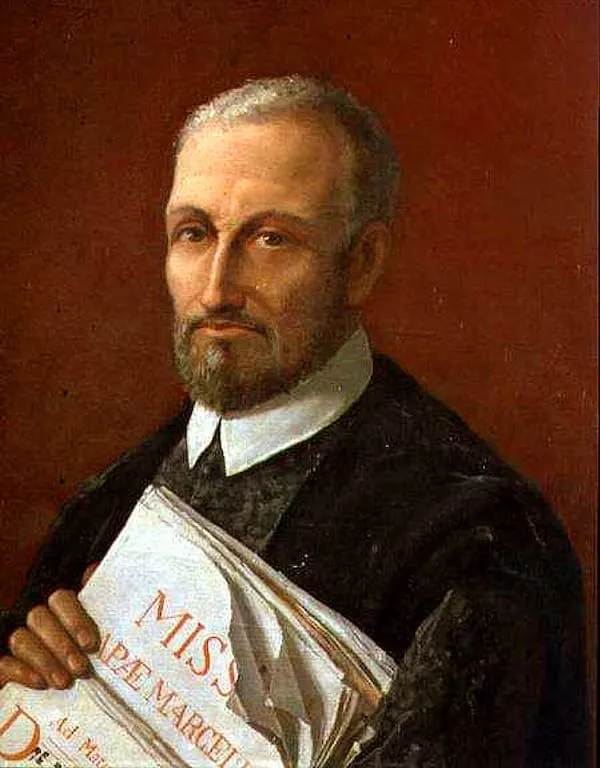
Josquin des Prez contributed to the prominence of Franco-Flemish traditions, while Giovanni Pierluigi da Palestrina became one of the great references of Italian sacred polyphony.
His compositions, notably those collected in recordings such as Miserere / Missa Papae Marcelli, illustrate a style of writing in which different voices retain their independence while forming a particularly balanced whole.
Music printing gradually contributed to the circulation of works. Compositions could thus reach an increasing number of chapels, courts and musicians.
The Renaissance also prepared new relationships between music and theater. At the end of the 16th century, several Italian artists sought to develop a form of musical expression capable of directly serving dramatic emotion and text.
These experiments anticipated the birth of opera.
Emergence and Early Musical Scenes
Around 1600 — Opera Opens the Baroque Era
At the turn of the 17th century, musical practices underwent a major transformation.
Composers searched for new ways to express emotions. Accompanied monody, the development of basso continuo and contrasts between voices and instruments helped renew musical language.
In Italy, Claudio Monteverdi became one of the essential figures of this evolution.
His opera L'Orfeo, first performed in Mantua in 1607, represents a fundamental milestone in musical theater. It was not the very first opera, but it demonstrated the dramatic possibilities of a work combining singing, instruments, choruses and theatrical action.
The genre gradually spread to several European cities.
In France, Jean-Baptiste Lully contributed to the development of tragédie lyrique during the reign of Louis XIV. In England, Henry Purcell participated in the evolution of musical theater.
However, Baroque music was not limited to opera. This period also witnessed the development of numerous instrumental and religious forms.
The Baroque — Concertos, Suites and Great Sacred Works
During the 17th and 18th centuries, instruments acquired an increasingly important place.
The concerto made it possible to highlight one or more soloists against an ensemble. The suite brought together different instrumental dances, while the fugue explored the possibilities of counterpoint.
Antonio Vivaldi contributed significantly to the development of the concerto. His cycle Le quattro stagioni, published in 1725 as part of a collection of concertos, constitutes one of the emblematic works of the Baroque repertoire.
Johann Sebastian Bach brought several instrumental and vocal traditions to a remarkable level of sophistication. Works now collected in recordings such as Brandenburg Concertos 1-6, The Goldberg Variations and The Six Cello Suites demonstrate the diversity of his writing.
Meanwhile, George Frideric Handel developed a particularly important career across Germany, Italy and England. His oratorio Messiah, first performed in Dublin in 1742, became a major reference in vocal music.
In France, François Couperin and Jean-Philippe Rameau contributed to the evolution of keyboard, orchestral and lyric theater traditions.
Élisabeth Jacquet de La Guerre also participated in this history, notably through her harpsichord compositions and vocal works.
The Baroque era thus established several fundamental forms of the classical repertoire while preparing the transformations of the 18th century.
Places of Creation — Churches, Courts and Theaters
For several centuries, European art music depended primarily on religious institutions, aristocratic patrons and princely courts.
Composers could be employed as organists, chapel masters or court musicians. Their works often responded to the needs of an employer or a particular ceremony.
The multiplication of opera theaters and public concerts gradually changed this situation.
Musicians gained new spaces for creation and new sources of income.
Instrumental practices also developed in domestic settings. Keyboard instruments, chamber ensembles and printed scores helped broaden audiences.
This transformation prepared the emergence of a musical life increasingly organized around concerts and the publication of works.
The Golden Age
The 18th Century — Haydn and Mozart Establish the Classical Style
During the second half of the 18th century, a new aesthetic became particularly prominent in Central Europe.
The Classical style generally favored clear structures, balance between musical phrases and easily recognizable harmonic organization.
The symphony, string quartet and sonata underwent considerable development.
Joseph Haydn played an essential role in this evolution. His symphonies and quartets helped establish lasting models, notably through the works collected under the title 6 String Quartets, op. 76.
Wolfgang Amadeus Mozart developed these forms with great expressive diversity.
His concertos, symphonies and chamber compositions demonstrate a style capable of combining clarity with dramatic intensity.
In opera, Le nozze di Figaro, first performed in 1786, reveals the richness of his characters and his remarkable sense of musical theater.
Vienna became one of the great centers of this period, although musical creation remained active in numerous other European cities.
The Classical style did not completely break with the Baroque. Instead, it gradually transformed forms and practices that already existed.
Beethoven — The Symphony Expands Its Horizons
Ludwig van Beethoven occupies a particular position between Classicism and Romanticism.
Inheriting forms developed by Haydn and Mozart, he gradually expanded their possibilities.
His symphonies gave new importance to contrasts, thematic development and dramatic intensity.
The Fifth Symphony became one of the most famous examples of this construction based on a particularly recognizable musical motif.
His Ninth Symphony, first performed in Vienna in 1824, introduced solo voices and a chorus in its final movement.
His piano sonatas and late string quartets also explored new forms of expression.
Recordings now collected in The Complete Piano Sonatas and The Late String Quartets reveal the breadth of this evolution.
Beethoven thus helped transform the image of the composer, increasingly regarded as a creator with a personal artistic vision.
The 19th Century — Romanticism Expands Emotional Expression
During the 19th century, Romanticism placed increasing importance on personal expression, literature, nature and the imagination.
Piano music became an essential field of creation.
Franz Schubert notably developed the lied, a form of art song combining poetry and instrumental accompaniment. His cycle Winterreise constitutes one of the great references of this repertoire.
Robert Schumann and Fryderyk Chopin explored different expressive possibilities of the piano.
Franz Liszt helped transform piano virtuosity and the public recital.
Clara Schumann also played a major role as a pianist, composer and performer. Her works for piano and chamber ensembles demonstrate a distinctive creative personality.
Meanwhile, Hector Berlioz renewed orchestral writing. His Symphonie fantastique, first performed in 1830, combined inventive orchestration with a narrative program.
Felix Mendelssohn and Johannes Brahms followed other paths, notably in symphonic and instrumental music.
Romanticism therefore did not possess a single aesthetic. It encompassed sometimes very different approaches, connected by the search for expressiveness and a renewed interest in the possibilities of musical language.
Romantic Opera — From Verdi to Wagner
During the 19th century, opera became one of Europe's great cultural spectacles.
In Italy, Gioachino Rossini helped renew musical theater, notably with Il barbiere di Siviglia.
Giuseppe Verdi subsequently developed a particularly powerful dramatic language. La traviata, first performed in 1853, combined vocal expressiveness with characters confronting social conventions.
Richard Wagner pursued a different approach, based on the continuity of musical drama and the orchestra's structural role.
His cycle Der Ring des Nibelungen represents one of his most ambitious achievements.
In France, Georges Bizet composed Carmen, first performed in 1875, whose subsequent influence would be considerable.
Toward the end of the century, Giacomo Puccini developed musical theater characterized by melodic and dramatic intensity, notably through La bohème and Tosca.
Romantic opera thus helped transform relationships between music, literature and theatrical performance.
National Musical Traditions — From Russia to Northern Europe
The 19th century also witnessed the growing prominence of several national traditions.
Composers drew inspiration from their countries' popular repertoires, landscapes and stories while using international musical forms.
Piotr Ilitch Tchaïkovski notably contributed to the prominence of Russian music in symphonic, instrumental and choreographic fields. The ballet Swan Lake became one of his best-known works.
Antonín Dvořák developed music combining Central European traditions and symphonic writing.
Jean Sibelius became an essential figure in Finnish musical creation.
Camille Saint-Saëns and other French composers meanwhile participated in diversifying the instrumental repertoire.
These developments demonstrate that Classicism and Romanticism were not exclusively Austro-German histories.
They took many forms across different European regions and, gradually, beyond Europe.
Late Romanticism — Orchestras and Monumental Forms
At the end of the 19th century and the beginning of the 20th, several composers developed large-scale orchestral works.
Gustav Mahler expanded the dimensions of the symphony, sometimes incorporating voices, choruses and references to popular song.
Richard Strauss explored the expressive possibilities of a particularly rich orchestra.
Anton Bruckner developed another conception of the symphony, based notably on vast musical architectures.
Sergueï Rachmaninov continued a strongly melodic tradition, particularly through his piano concertos and symphonies.
These composers extended certain Romantic legacies while other artists were already seeking to transform musical language radically.
Movements and Subgenres
Medieval and Renaissance Music
These repertoires notably encompass liturgical chants, early polyphony, masses, motets and madrigals.
Musical notation underwent several fundamental transformations during these periods.
Guillaume de Machaut and Giovanni Pierluigi da Palestrina represent two distant stages of this long history.
Today, these musical traditions are being rediscovered through the work of ensembles specializing in historical performance practices.
Baroque Music
Baroque music corresponds approximately to the period from 1600 to 1750.
It is characterized by a great diversity of forms: opera, cantata, oratorio, concerto, suite and fugue.
Claudio Monteverdi, Antonio Vivaldi, Johann Sebastian Bach and George Frideric Handel are among its major references.
The development of instruments and musical theater played an essential role in its evolution.
Classical Style
The Classical style became particularly prominent during the second half of the 18th century.
It often favored clarity of form, balanced phrasing and the development of musical themes.
Joseph Haydn, Wolfgang Amadeus Mozart and the early works of Ludwig van Beethoven are particularly associated with this period.
The symphony, sonata and string quartet acquired considerable importance.
Romantic Music
Musical Romanticism developed primarily during the 19th century.
It encompasses particularly diverse works, characterized notably by individual expression and the importance of emotion.
Franz Schubert, Robert Schumann, Fryderyk Chopin, Clara Schumann and Hector Berlioz represent different directions.
Piano music, the lied and the symphony occupied important places during this period.
Symphonic and Concerto Music
A symphony is an orchestral composition generally organized into several movements.
A concerto brings one or more soloists into a musical relationship with an instrumental ensemble.
These forms appeared and evolved across different periods.
They therefore do not correspond to a single historical style.
From Joseph Haydn to Gustav Mahler, and from Wolfgang Amadeus Mozart to Sergueï Prokofiev, they gave rise to particularly different approaches.
Chamber Music
Chamber music describes works written for small instrumental ensembles.
The string quartet constitutes one of its most representative forms.
Joseph Haydn, Ludwig van Beethoven, Johannes Brahms and Bartók Béla made particularly important contributions to its development.
This repertoire frequently emphasizes interactions between instruments, often without a conductor.
Opera and Vocal Music
Opera combines music, singing and theater.
It developed from the end of the 16th century onward and underwent numerous transformations.
Claudio Monteverdi, Wolfgang Amadeus Mozart, Giuseppe Verdi and Richard Wagner represent different stages of its evolution.
Classical vocal music also includes lieder, art songs, cantatas, oratorios and choral works.
Ballet and Incidental Music
Ballet music maintains a particular relationship with dance and theatrical performance.
Piotr Ilitch Tchaïkovski contributed significantly to the development of the grand Romantic ballet.
Igor Stravinsky subsequently transformed the rhythmic and orchestral possibilities of the genre.
Incidental music more broadly encompasses compositions intended for theater or other forms of performance.
Impressionism and New Orchestral Colors
At the end of the 19th century and the beginning of the 20th, several French composers renewed harmonic and orchestral possibilities.
Claude Debussy developed a style particularly attentive to timbre and sonic color.
The works collected in La Mer / L'après-midi d'un faune / Jeux illustrate several aspects of this approach.
Maurice Ravel also explored new relationships between harmony, orchestration and older musical forms.
The term Impressionism, frequently used to describe this music, nevertheless remains imperfect and does not fully summarize their respective approaches.
Modernism and New Musical Languages
The beginning of the 20th century witnessed several radical transformations of musical language.
Igor Stravinsky developed particularly innovative rhythmic and orchestral writing.
His ballet The Rite of Spring, first performed in Paris in 1913, became a major milestone of musical modernity.
Arnold Schönberg explored new systems of pitch organization, notably through atonality and later the twelve-tone method.
Alban Berg and Anton Webern participated in this evolution.
Meanwhile, Bartók Béla developed an approach combining rhythmic experimentation, folk traditions and art music composition.
These innovations did not constitute a single movement, but rather several responses to the transformations of European music.
20th-Century Music
The 20th century cannot be reduced to the avant-garde.
Dmitri Chostakovitch notably composed symphonies and quartets marked by the historical tensions of his time.
Sergueï Prokofiev developed a style combining rhythmic energy, lyricism and modernity.
Lili Boulanger and Florence Price also represent important voices in early 20th-century composition.
Olivier Messiaen explored new rhythmic and harmonic languages.
Composers therefore pursued very different directions, from the continuation of traditional forms to the boldest experiments.
Contemporary Classical Music
From the middle of the 20th century onward, several composers questioned inherited musical structures.
Pierre Boulez and Karlheinz Stockhausen participated in developing new research into musical language and sound technologies.
John Cage notably explored indeterminacy and the possibilities of renewed listening.
Steve Reich and Philip Glass developed different forms of repetitive and minimalist music.
Arvo Pärt created an aesthetic based on great economy of means.
Kaija Saariaho pursued an approach particularly attentive to timbre and sonic transformation.
Caroline Shaw represents one of the voices of more recent generations.
Contemporary creation therefore encompasses highly diverse approaches that may employ traditional instruments, electronics or new forms of performance.
Legacy and Influence Today
Classical music possesses a fundamental characteristic: its works can continue to live for several centuries after their composition.
A symphony by Ludwig van Beethoven, a concerto by Johann Sebastian Bach or an opera by Giuseppe Verdi can be performed by musicians far removed from their original historical context.
This continuity does not mean that the works are frozen in time.
Each performance relies on choices of tempo, phrasing, tone and balance between instruments.
Conductors, instrumentalists and singers therefore participate in continually renewing the repertoire.
Performers — One Work, Many Interpretations
Unlike much of recorded popular music, classical music generally does not rely on a single sound recording considered definitive.
The score provides an essential foundation, but it does not entirely determine the musical result.
Two orchestras can offer noticeably different interpretations of the same symphony.
Conductors Herbert von Karajan and Leonard Bernstein notably represent two major figures in the discographic and orchestral history of the 20th century.
The development of historical research also renewed interpretations of early repertoires.
William Christie and John Eliot Gardiner are among the artists who helped introduce different approaches to historically informed performance.
These approaches notably explore instruments, ensemble sizes and playing practices associated with the periods in which works were composed.
The diversity of interpretations thus constitutes an essential dimension of the life of classical works.
Records — A New Chapter in Classical Music History
The emergence of recording profoundly transformed the distribution of the classical repertoire.
At the beginning of the 20th century, technical limitations still restricted the duration and sonic possibilities of records.
Advances in electrical recording, followed by the long-playing record, gradually made it possible to distribute longer works.
Great symphonies, operas and instrumental cycles became accessible to audiences who did not necessarily attend concert halls.
Record companies developed extensive catalogues bringing together works from several centuries.
This evolution explains a fundamental difference from rock or pop discographies.
Johann Sebastian Bach, Wolfgang Amadeus Mozart and Fryderyk Chopin obviously never recorded their own albums.
Today's albums are performances, complete editions or compilations made by musicians and orchestras long after the works were composed.
The same concerto may therefore exist in dozens of recorded versions, made at different times.
Works and Recordings — Two Complementary Heritages
In classical music, it is essential to distinguish a work from its recorded interpretation.
A composition generally possesses a title, a composer and sometimes an opus number or catalogue reference.
A recording, meanwhile, has performers, potentially a conductor, an ensemble, a recording location and dates, as well as a particular discographic edition.
The album The Complete Piano Sonatas, for example, allows listeners to discover Ludwig van Beethoven's sonatas, but it is not an original album published by the composer.
Similarly, The Rite of Spring may designate a recording of the work composed by Igor Stravinsky, whose interpretations vary according to orchestras and conductors.
This distinction is fundamental to understanding classical discographies.
It also allows works to be correctly connected to their composers and to the musicians who perform them.
Women Composers — A History Gradually Rediscovered
The history of classical music has long emphasized a relatively small number of male composers.
Yet women contributed to musical creation throughout different periods.
Hildegarde de Bingen was composing as early as the Middle Ages.
Élisabeth Jacquet de La Guerre participated in French musical life during the Baroque era.
During the 19th century, Clara Schumann and Fanny Mendelssohn developed instrumental and vocal works despite social restrictions that often limited women's composing careers.
Louise Farrenc also contributed to the history of symphonic and chamber music.
During the 20th century, Lili Boulanger and Florence Price participated in new developments in composition.
Today, musical institutions and performers are helping rediscover some of these repertoires.
This approach does not involve artificially rewriting history, but rather representing more accurately the real diversity of those who contributed to musical creation.
Classical Music in Film and Media
The classical repertoire has long maintained relationships with cinema.
Filmmakers can use older compositions to accompany images, create an atmosphere or establish dramatic contrasts.
Orchestration techniques inherited from symphonic traditions have also influenced the composition of numerous film scores.
This influence continues in television series and video games.
Orchestras therefore participate in contemporary creations that do not necessarily belong to the traditional classical repertoire.
Meanwhile, historical works continue circulating through recordings, radio, digital platforms and filmed concerts.
These new formats allow very different audiences to access several centuries of music.
A Living Tradition
Classical music is not limited to preserving the past.
Orchestras, chamber ensembles and opera institutions continue performing historical works while also commissioning and presenting new compositions.
Festivals and concert halls regularly bring early music and contemporary creations into dialogue.
Artists explore new relationships between acoustic instruments, electronic technologies and other artistic forms.
This diversity sometimes makes the boundaries of classical music difficult to define.
However, it reminds us that the repertoire has never stopped transforming.
From medieval polyphony to contemporary sonic experimentation, each period has developed new ways of organizing sounds and expressing emotions.
A History That Spans the Centuries
Western classical music was built through several major transformations.
The Middle Ages developed written traditions and forms of polyphony.
The Renaissance deepened vocal composition and counterpoint.
The Baroque era witnessed the establishment of opera, the concerto and numerous instrumental forms.
Classicism helped establish a language based on clarity and structural balance.
Romanticism expanded expressive and orchestral possibilities.
The 20th and 21st centuries subsequently opened numerous new directions.
From Giovanni Pierluigi da Palestrina to Claudio Monteverdi, from Johann Sebastian Bach to Wolfgang Amadeus Mozart, from Ludwig van Beethoven to Clara Schumann, and from Claude Debussy to Igor Stravinsky, this history demonstrates an extraordinary continuity of creation.
Its heritage resides not only in preserved scores.
It also lives through performances, recordings, concerts and new works.
Classical music therefore remains a continuous dialogue between composers of the past, artists of today and the generations that will continue bringing their works to life.