Johannes Brahms (1833–1897) was a German composer, pianist and conductor, and a leading figure of Romantic music. His compositions combine the discipline of Classical forms with melodic and harmonic richness, creating a musical language characterized by emotional depth and sophisticated thematic development. Drawing on the legacy of Beethoven and Schumann, he distinguished himself in symphonic music, concertos, chamber music and choral compositions. His four symphonies, A German Requiem, Violin Concerto and Hungarian Dances remain among his most celebrated works.
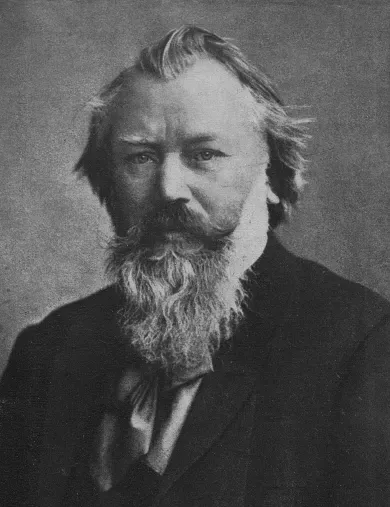
Johannes Brahms
Romantic depth meets the mastery of great Classical musical forms.
Details
- Type
- Music
- Countries
- 🇩🇪 Germany
- Genres
- Classical, Romantic music
- Albums
- 3
Synopsis
Johannes Brahms
Glossary terms: Chamber music, Classical music, Composer, Composition, Counterpoint, Development, Finale, Fundamental, Harmonic (overtone), Opera, Piano, Theme
Trailer
Watch the trailer
Overview
Presentation
Johannes Brahms (1833–1897) was a German composer, pianist and conductor, recognized as one of the major figures of European Romanticism. Born in Hamburg into a musical family, he received extensive piano training and developed an early interest in composition. His encounter with Robert and Clara Schumann in 1853 marked a decisive moment: Robert publicly praised his talent, while Clara became a lifelong artistic friend and confidante.
After establishing himself in Vienna during the 1860s, Brahms gradually achieved international recognition. Deeply influenced by the traditions of Bach, Beethoven and Schubert, he developed a distinctive musical language combining formal discipline, harmonic richness and Romantic lyricism. His extensive catalogue encompasses nearly every major instrumental and vocal form, with the notable exception of opera.
Key Points
Brahms's music is distinguished by intricate motivic development, counterpoint and mastery of Classical structures. His compositions frequently transform relatively simple musical ideas into elaborate expressive forms. His four symphonies demonstrate this approach, particularly Symphony No. 1, completed in 1876, and Symphony No. 4, whose finale is constructed as a passacaglia.
A German Requiem holds a central position in his choral output, emphasizing consolation for the living through biblical texts. His two piano concertos, Violin Concerto and extensive chamber music demonstrate his command of instrumental writing. His Hungarian Dances, inspired by popular musical traditions, also reveal a more energetic and rhythmically vibrant aspect of his compositions.
Conclusion
Johannes Brahms holds a fundamental position in the history of Romantic music. By renewing Classical forms while preserving their structural foundations, he developed a musical language that profoundly influenced later generations of composers, particularly in symphonic and instrumental music.
Did You Know?
- Birth: May 7, 1833, in Hamburg; died April 3, 1897, in Vienna.
- Symphonies: he composed four symphonies, completed between 1876 and 1885.
- Requiem: A German Requiem was performed in its complete version in 1869, following a major earlier performance in 1868.
- Clara Schumann: their friendship and musical exchanges continued for more than forty years.
- Hungarian Dances: this collection of 21 dances, primarily conceived for piano four hands, became one of his most popular publications.
Link graph
Open in the full graphLoading the graph…
Only the strongest links are shown.
View the list ({count})
Discography
Discography (3)


