
Overview

A raccoon jumps onto a ledge.

A courier climbs the side of a building with electricity in his hands.

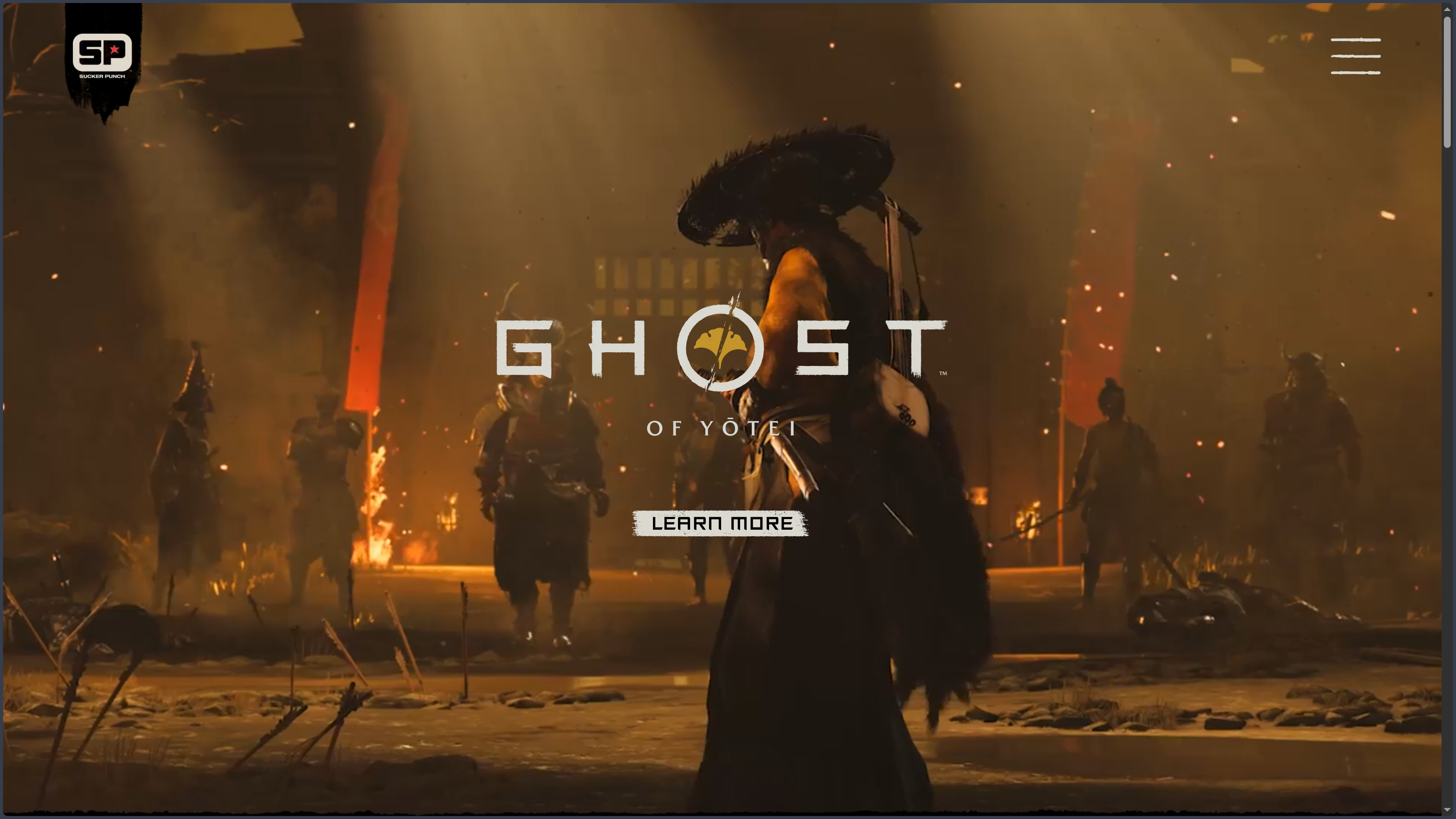
A samurai crosses a field of tall grass while the wind shows him the way.

A warrior walks toward Mount Yōtei beneath an immense sky.

At first glance, these images could belong to four different studios.

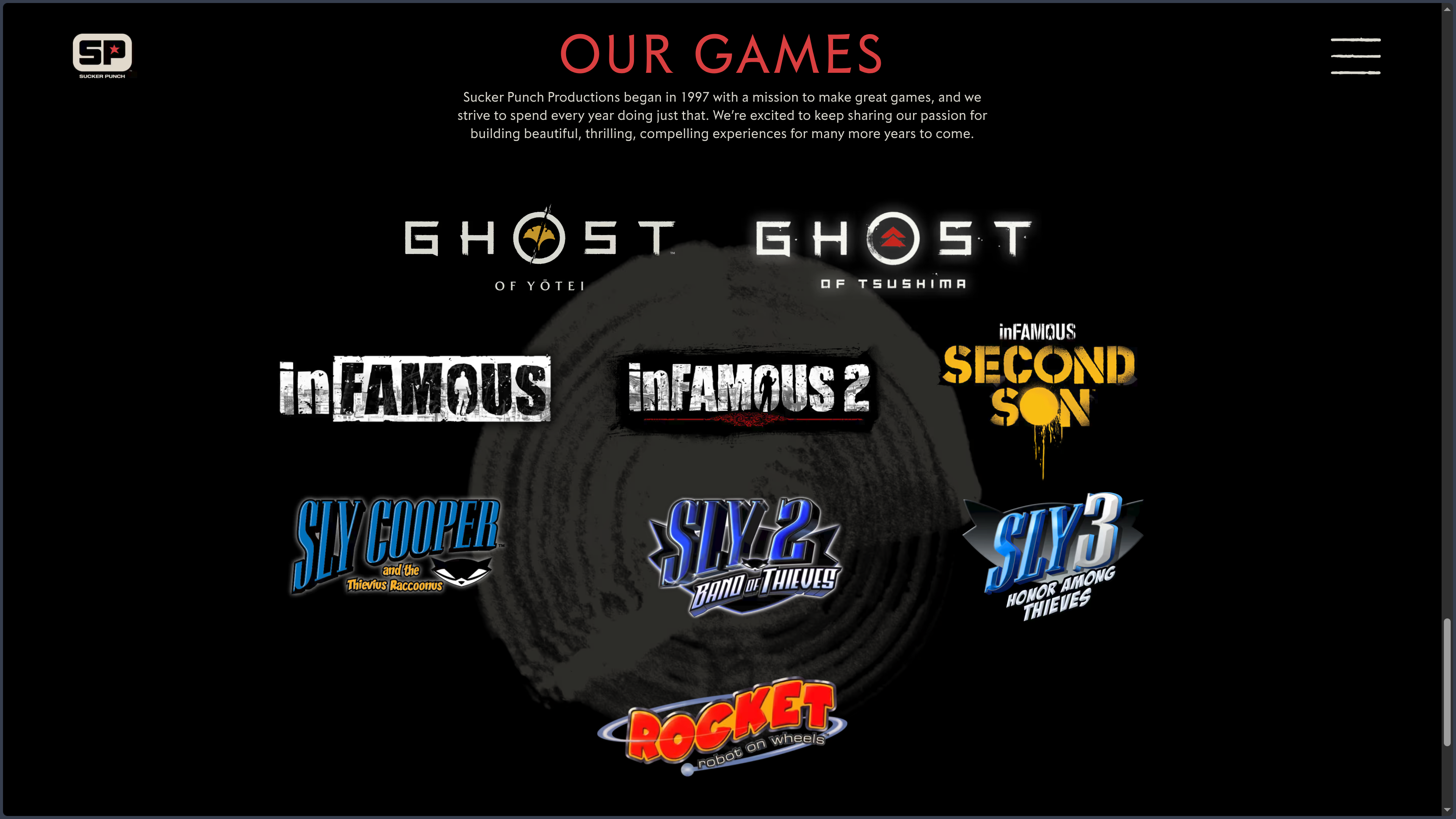
Sly Cooper.

inFAMOUS.

Ghost of Tsushima.

Ghost of Yōtei.

And yet the same team stands behind them:

Sucker Punch Productions.

Founded in 1997 in Washington State, the American studio has followed a rather unusual path.

It has not spent thirty years developing the same universe.

It has done almost the opposite.

A robot.

A thieving raccoon.

Urban superheroes.

Feudal Japan.

At every major period in its history, Sucker Punch accepts leaving behind part of what once made it recognizable.

Sly’s cel-shading disappears.

inFAMOUS’s electrical powers disappear.

Cole MacGrath disappears.

Delsin Rowe disappears.

Then even Jin Sakai stops being the center of the Ghost series when the time comes to create Ghost of Yōtei.

The studio changes.

But certain instincts remain.

The character has to feel good to control.

Movement should not merely serve as a way to reach the objective.

It has to be part of the pleasure.

Environments need to remain readable without necessarily looking like dashboards covered in icons.

And the world regularly needs to provoke one very simple reaction:

“I want to go see what’s over there.”

That may be the best common thread running through Sucker Punch.

Not a genre.

Not a franchise.

Not even a technology.

But a way of thinking about the space between two objectives.

A rooftop.

A ledge.

A cable.

A street.

A forest.

A mountain on the horizon.

The journey matters almost as much as the place it leads to.

Sucker Punch regularly changes heroes, but its games often return to the same question: how do you make the simple act of moving forward enjoyable enough that the player forgets they are traveling from point A to point B?

History

1997: six friends leave Microsoft

The story begins in October 1997.

Six friends leave their jobs at Microsoft.

Among them are Brian Fleming and Chris Zimmerman, two figures who will remain deeply associated with the studio’s history.

They rent a small workspace and begin creating their first game.

No empire.

No major intellectual property.

No historic partnership with Sony yet.

Just a small team that wants to make games.

Sucker Punch nevertheless already possesses a characteristic it will retain for a long time:

a structure relatively concentrated around one main project.

Even today, the studio explains that it prefers working on one title at a time, so that the entire team can collaborate on the same experience.

That concentration will accompany several radical transformations.

Because at Sucker Punch, finishing a series often means accepting the idea of almost starting from zero again.

Rocket: Robot on Wheels: before PlayStation

The studio’s first game is not a PlayStation game.

It is a Nintendo 64 game.

Rocket: Robot on Wheels.

The main character is a small robot tasked with saving an amusement park.

The game notably emphasizes physics and object manipulation at a time when this kind of interaction is still relatively unusual in 3D platformers.

Commercially, Rocket does not turn Sucker Punch into a phenomenon.

But it introduces something more important for what comes next.

The game’s world contains an antagonist:

a criminal raccoon.

A few years later, Sucker Punch will mainly remember one part of that idea.

The raccoon.

Not exactly that one.

But enough for another thief to begin taking shape.

Moving from Nintendo to PlayStation

After Rocket, Sucker Punch enters into a relationship that will shape practically the rest of its history.

Sony.

The studio begins working on a new game for the PlayStation 2.

This time, the hero is no longer a robot.

He is a thief.

A thief elegant enough to turn burglary into choreography.

Sly Cooper.

The series marks the true beginning of the long-lasting relationship between Sucker Punch and PlayStation.

The first installment is released in 2002.

And with it, the studio finds one of its first major identities.

Sly Cooper: stealing should be fun before it is discreet

A game about a thief could naturally be built around extremely slow stealth.

Watch.

Wait.

Never be seen.

Sucker Punch chooses a much more mobile approach.

Sly climbs.

Jumps.

Balances on points.

Walks along ropes.

Sneaks behind guards.

Uses his cane as much as a tool as a weapon.

The character is a thief.

But he is also a platforming hero.

The pleasure therefore does not come only from avoiding detection.

It comes from the precise movement required to cross the space.

That distinction matters.

It will become almost a studio signature.

At Sucker Punch, mobility does not merely serve the main mechanic.

It becomes a reward in itself.

An aesthetic that turns constraint into identity

Sly Cooper and the Thievius Raccoonus also adopts a highly stylized visual direction.

Anthropomorphic characters.

Exaggerated architecture.

Highly readable silhouettes.

Cel-shading.

An aesthetic evoking animation and comics.

This direction gives the game an immediately recognizable identity.

But above all, it reveals something Sucker Punch will preserve even after leaving Sly behind:

the studio does not necessarily seek the most realistic representation.

It seeks an image that serves the intended feeling.

Sly has to remain readable.

Routes have to be understandable.

Places have to make the player want to climb them.

Art direction is therefore not merely decorative.

It tells the player how to inhabit the space.

Sly 2: becoming a team of thieves

With Sly 2: Band of Thieves, the series grows in scope.

Sly is no longer alone at the center of everything.

Bentley.

Murray.

The Cooper Gang becomes a genuinely playable team.

Each character has their own abilities.

Sly remains agile and stealthy.

Bentley focuses more heavily on gadgets.

Murray brings strength.

This evolution transforms the structure.

Missions can require different approaches.

Environments become more open.

Heists are built through several stages.

The fantasy is no longer only:

being a thief.

It becomes:

planning a heist.

Scout.

Sabotage.

Organize.

Then execute.

The player no longer simply crosses levels.

They take part in operations.

Sly 3 and the end of a first cycle

Sly 3: Honor Among Thieves continues this logic by expanding the team and the situations even further.

But after several years dedicated to the series, Sucker Punch feels the need to change.

And the change will be radical.

The studio leaves behind:

anthropomorphic animals;

cel-shading;

traditional platforming;

cartoon heists.

It wants a new challenge.

This time:

an open world.

A large city.

Superpowers.

And a player forced to decide what they want to do with them.

inFAMOUS: what would you do with powers?

The project that becomes inFAMOUS does not immediately begin in its final form.

Sucker Punch experiments.

At one point in development, the concept even resembles a kind of Animal Crossing with superheroes.

The character fights crime.

But their alter ego can also participate in urban development.

Pet shops.

Bars.

City planning.

The idea is abandoned.

Fortunately for the virtual residents who would probably have ended up with far too many tiki bars.

The studio refocuses the project around the superhero fantasy.

And gradually, two essential elements emerge.

Parkour.

And morality.

Movement becomes a superpower

With inFAMOUS, Sucker Punch’s long-standing relationship with movement changes scale.

Sly jumped between platforms.

Cole MacGrath needs to be able to cross an entire city.

He climbs.

Grabs onto surfaces.

Moves along cables.

Uses electricity to accelerate his movement.

Buildings are no longer simply scenery.

They become surfaces.

A façade is a vertical route.

An electrical cable is a fast lane.

A rooftop is a platform.

The city therefore has to function on two levels.

As a narrative place.

And as a gigantic movement structure.

An important influence appears during development with the French film District 13, whose parkour scenes push the team to develop this dimension even further.

The character possesses electrical powers.

But one of his true superpowers may simply be:

the ability to see the entire city as a route.

Being a hero or becoming something else

The other pillar becomes the karma system.

Cole receives powers.

What will he do with them?

Use them to help?

Or impose his strength?

The idea seems obvious for a superhero game.

Yet it was not necessarily part of the project from the beginning.

Sucker Punch gradually realizes that this moral decision can provide a strong structure for the entire experience.

Powers.

Missions.

Relationships.

Character development.

Consequences.

The player therefore does not merely select abilities.

They gradually choose which version of the hero they want to become.

The first inFAMOUS is released in 2009 on PlayStation 3.

And suddenly, Sucker Punch has a second major identity.

Completely different from Sly.

2011: inFAMOUS 2 and Sony formalizes a long relationship

inFAMOUS 2 is released in June 2011.

The game deepens the powers, moral choices and worldbuilding while moving the action to New Marais.

But a few weeks after release, something even more important happens in the studio’s history.

On August 2, 2011, Sony announces that Sucker Punch Productions is officially joining Sony Computer Entertainment Worldwide Studios.

The acquisition actually formalizes a relationship that is already extremely old.

Sony explains at the time that it has been working with Sucker Punch for more than twelve years.

Sly Cooper.

inFAMOUS.

The studio had been legally independent.

Creatively, its history was already deeply tied to PlayStation.

The acquisition therefore changes its identity less than it gives official form to a relationship built over several generations of consoles.

Brian Fleming emphasizes one important point at the time:

Sony gave them enough flexibility and trust to take creative risks and invent new properties.

That freedom will become crucial.

Because Sucker Punch will once again walk away from a successful franchise.

Second Son: a new generation, a new hero

With the arrival of PlayStation 4, Sucker Punch develops inFAMOUS Second Son.

The game is released in March 2014.

Cole gives way to Delsin Rowe.

The city becomes Seattle, a particularly logical setting for a studio based in the same region.

The powers evolve too.

Smoke.

Neon.

Then other abilities.

Sucker Punch takes advantage of the new technical possibilities of the PS4 to build a much denser-looking city and give each power its own identity.

Movement remains central.

With Delsin’s abilities, the city can be crossed at a speed that turns architecture even more strongly into a system.

Buildings are not there merely to look good.

They have to respond to the powers.

First Light and the end of inFAMOUS at Sucker Punch

inFAMOUS First Light expands the universe around Fetch.

Then Sucker Punch reaches another boundary.

The studio has spent around nine years with inFAMOUS.

It has a recognized franchise.

A strong system.

A spectacular identity.

It could continue.

It chooses to leave again.

That decision is essential to understanding Sucker Punch.

Many studios gradually become synonymous with a single series because success turns creation into obligation.

Sucker Punch regularly seems to try to avoid that situation.

After Sly:

inFAMOUS.

After inFAMOUS:

the void.

Not Ghost yet.

First:

a question.

What do we want to make now?

Pirates, musketeers… then samurai

After Second Son and First Light, the team begins exploring several directions.

It knows it wants to build:

a vast open world;

close-combat gameplay.

But everything else remains open.

Pirates.

Rob Roy.

The Three Musketeers.

Several possibilities are explored.

Then one idea keeps returning.

Feudal Japan.

Samurai films.

The wandering warrior.

An island.

An invasion.

And gradually, the team formulates a vision clear enough to support several years of development:

a samurai surviving the Mongol invasion of Tsushima must abandon certain traditions to save his home.

That vision becomes:

Ghost of Tsushima.

Six years to change scale

The creation of Ghost of Tsushima takes around six years.

The change in scale is immense.

The studio already knows how to make open worlds.

But Tsushima introduces new problems.

Size.

Vegetation.

Dialogue.

Missions.

Characters.

Tools.

Certain elements increase five, ten, twenty or even forty times compared with previous productions.

Much of the technology developed for inFAMOUS is no longer sufficient.

The studio has to rebuild.

The history of Sucker Punch therefore becomes as much a story of technology and pipelines as of game design.

Moving from an urban Seattle built around superpowers to a natural island filled with dynamic vegetation requires a profound transformation.

Japan as inspiration, not exact reproduction

Sucker Punch is an American studio.

It does not pretend to naturally possess all the cultural knowledge required to represent medieval Japan without help.

The team therefore carries out research trips.

Tsushima.

Historical references.

Photography.

Samurai films.

Architecture.

Costumes.

Landscapes.

And collaboration with Japanese partners and specialists.

The final world is not, however, an exact reproduction of the real island.

Sucker Punch describes it more as a love letter.

Nature is amplified.

Colors are pushed.

Fields become almost graphic compositions.

Leaves, particles, grass and fabrics constantly react to the wind.

The goal is not only:

to be accurate.

It is also:

to create the feeling of the samurai film the team had in mind.

The wind replaces part of the interface

This may be one of the ideas that best summarizes the studio’s evolution.

In a traditional open world, reaching an objective often means looking at:

the map;

the mini-map;

a compass;

a marker.

Sucker Punch wants the player to look more at the world itself.

The team already has an advanced wind system used to move:

grass;

trees;

fabric;

particles;

smoke.

Then comes an idea.

What if that wind could also show the direction?

The Guiding Wind is born from the meeting between art direction and navigation.

The player calls the wind.

The landscape responds.

Leaves fly.

Grass bends.

And the path appears without requiring a huge glowing arrow.

It is exactly the kind of solution that best characterizes Sucker Punch.

Turn an interface function into a behavior of the world.

2020: Ghost of Tsushima

Ghost of Tsushima is released on July 17, 2020 on PlayStation 4.

The change in tone is spectacular.

No more electrical powers.

No more superheroes.

No cel-shading.

Instead:

steel.

Mud.

Blood.

Wind.

Forests.

Tall grass.

Japanese architecture.

And combat designed to give weight to every katana strike.

And yet the old Sucker Punch is still there.

The world remains built around movement.

Distant silhouettes draw the eye.

Animals sometimes guide the player.

Nature becomes interface.

And the main objective is not simply to display a large space.

That space has to make the player want to cross it.

Jin Sakai: change to survive

Jin’s story also contains something that strangely echoes the studio itself.

Jin is trained as a samurai.

The Mongol invasion makes his traditional methods insufficient.

He has to evolve.

Use new tools.

Adopt new tactics.

Become the Ghost.

Sucker Punch has spent its history making similar transformations.

It could have remained the Sly studio.

Then the inFAMOUS studio.

Then the Jin Sakai studio.

Instead, it regularly chooses to leave part of its previous identity behind so it can continue moving forward.

The parallel is obviously not intentionally autobiographical.

But it works remarkably well.

Legends: the ghost becomes collective

A few months after release, Ghost of Tsushima receives Legends, a cooperative multiplayer mode that moves into a more mythological and supernatural direction.

The contrast with the campaign is clear.

Jin’s world seeks a degree of historical and cinematic grounding.

Legends embraces:

demons;

mythology;

classes;

cooperation.

Samurai.

Hunter.

Rōnin.

Assassin.

Sucker Punch demonstrates that the same combat foundation can support two very different tones.

The mode becomes popular enough with players that the idea returns several years later.

Iki: returning to Jin’s world

With the Iki Island expansion, Sucker Punch continues Jin’s story and develops more of his past.

The project also allows certain systems to evolve without rebuilding the entire game.

But after this period, the studio once again has to make a decision.

Continue with Jin?

Or continue with something else?

The answer will be revealing.

Sucker Punch decides that Ghost can become bigger than Jin Sakai.

Ghost is no longer just a character

When development begins on a new Ghost game, the team wants to preserve certain pillars of Ghost of Tsushima.

A wandering warrior.

Historical Japan.

The freedom to explore at your own pace.

A world whose beauty is part of the experience.

But it does not simply want to tell another Jin adventure.

So it shifts the concept.

More than three centuries later.

A new region.

A new heroine.

A new legend.

Atsu.

The fundamental principle then becomes:

the Ghost can be an idea.

Not just a man.

That is an important decision for the potential future of the series.

A franchise can continue without being permanently attached to the same protagonist.

Ghost of Yōtei: new place, same question

Ghost of Yōtei takes place in 1603 around Mount Yōtei, in the region of Ezo corresponding largely to present-day Hokkaidō.

Atsu pursues the Yōtei Six after the massacre of her family.

Revenge provides the starting point.

But, as often with Sucker Punch, much of the game exists between the main objectives.

Travel.

Explore.

Meet people.

Observe.

Take another direction simply because something in the landscape catches your attention.

The studio wants to preserve Tsushima’s freedom of exploration while giving Yōtei an identity of its own.

Plains.

Snow-covered tundra.

Forests.

Auroras.

Mountains.

A wilder frontier.

The geography changes.

The principle remains:

make the world itself a call to adventure.

Understanding a territory before stylizing it

For Ghost of Yōtei, Sucker Punch returns to Japan to gather new references.

But the move to Hokkaidō introduces an important cultural question.

The presence and history of the Ainu people.

Sucker Punch explicitly acknowledges that it is an American studio and does not naturally possess all the knowledge needed to portray that culture.

The team therefore expands the number of advisers and collaborators involved.

That approach obviously does not erase every question surrounding cultural representation.

But it demonstrates an evolution in method.

Research.

Travel.

Advice.

Feedback.

Then artistic interpretation.

The studio does not try to pretend that its fictional world is a historical documentary.

It tries to build its fiction with a better understanding of what it rests upon.

First project built entirely for PS5

Ghost of Yōtei also has particular technical significance.

It is the first Sucker Punch game developed from the ground up for PlayStation 5.

The studio can therefore build its world without having to maintain compatibility with the PS4 generation.

Much broader sightlines.

More detailed skies.

Lighting.

Vegetation.

Density.

Wind movement.

Loading times.

More flexible combat systems.

The world can be designed more directly around the capabilities of a single hardware generation.

That may sound almost trivial.

For a studio that has adapted its tools through every major transition since Nintendo 64, it represents another important step.

October 2, 2025: Atsu takes over

Ghost of Yōtei is released on October 2, 2025 on PlayStation 5.

Five years after Tsushima, Sucker Punch therefore returns to historical Japan.

But not the same place.

Not the same era.

And not the same hero.

That is precisely what makes the project interesting in the studio’s history.

Sucker Punch does not treat Tsushima’s success as an obligation to reproduce Tsushima exactly.

It keeps the pillars it considers important.

Then changes the rest.

A principle the studio has applied almost since its beginnings.

Legends returns in 2026

On March 10, 2026, Sucker Punch releases Ghost of Yōtei Legends.

As with Tsushima, the cooperative mode transforms the historical setting into a much more fantastical space.

Monstrous versions of the Yōtei Six.

Classes.

Survival.

Missions.

Progression.

Cooperation for up to four players depending on the mode.

The return of Legends shows that certain elements of Ghost can now become traditions of the series themselves.

But even here, Sucker Punch does not settle for simple copy-and-paste.

The mode incorporates the new weapons and mechanics developed for Yōtei.

It also introduces a playable lobby with training and small activities between players.

The multiplayer mode therefore becomes more of a place than a simple menu.

Once again:

even when the player is waiting, Sucker Punch prefers giving them something to do.

One game at a time

Sucker Punch’s current website summarizes part of its production philosophy rather well.

The studio explains that it focuses on one title at a time so the entire team can collaborate and bring its best to each game.

That obviously does not mean only one task exists within the studio.

A modern large-scale production involves:

technology;

art;

animation;

writing;

audio;

game design;

production;

QA;

external partners;

localization;

support.

But the central idea remains notable.

Sucker Punch does not seek to become a factory where several enormous main franchises advance simultaneously in different wings of the building.

Its history looks more like a succession of major creative periods.

Sly.

inFAMOUS.

Ghost.

Each new period absorbs some of the lessons from the previous one.

Then changes enough to force the team to learn something new.

What sets it apart

Movement should be enjoyable before it is necessary

This is probably the clearest continuity throughout Sucker Punch’s entire history.

Sly jumps between ledges.

Cole turns Empire City and New Marais into vertical routes.

Delsin crosses Seattle through his powers.

Jin follows the wind between the hills.

Atsu travels through the vast spaces of Ezo.

The systems have almost nothing in common.

But the question is similar:

how do you make the journey more than just dead time between two interesting moments?

At Sucker Punch, movement regularly tries to become interesting in itself.

Through precision.

Speed.

Beauty.

Readability.

Or simply through the curiosity created by the landscape.

A good open world should not merely contain many destinations.

It should make you want to cross the space between them.

The world can replace part of the HUD

The Guiding Wind in Ghost of Tsushima is probably the most elegant expression of this philosophy.

The player needs a direction.

Traditionally:

an arrow.

A marker.

A mini-map.

Sucker Punch asks:

can the world itself answer?

The wind rises.

Vegetation moves.

Particles follow.

The landscape shows the direction.

The interface has not disappeared.

It has been partially absorbed into the staging.

That kind of decision is particularly interesting because it solves two problems at once.

Navigation.

Immersion.

The player receives the information they need without having to visually leave the world to find it.

Every major series needs its own silhouette

Sucker Punch does not have a single aesthetic.

That is precisely part of its identity.

Sly uses cel-shading.

inFAMOUS develops a contemporary city saturated with powers and effects.

Ghost of Tsushima turns nature into an almost painterly composition.

Ghost of Yōtei develops wilder spaces around the Ezo frontier.

The studio therefore does not seem to ask:

“What should a Sucker Punch game look like?”

It asks instead:

“Which image best serves the fantasy of this project?”

That allows the studio to remain recognizable through its design principles without needing to endlessly repeat the same visual direction.

The system must reinforce the fantasy

With Sly:

being a thief means moving precisely and preparing heists.

In inFAMOUS:

being a superhero means crossing the city like someone no longer constrained by ordinary rules of mobility.

In Ghost:

being a wandering warrior means observing the land, following nature and choosing your path.

The main mechanics therefore generally try to respond to the fantasy of the character.

That coherence is fundamental.

A good power is not only spectacular.

It needs to change the way the player thinks about space.

A good open world is not merely large.

It needs to produce the kind of journey that fits the character being played.

Leaving a success before it becomes a prison

Perhaps Sucker Punch’s most unusual decision is not a gameplay system.

It is its historical ability to stop.

Sly works.

The studio moves to inFAMOUS.

inFAMOUS works.

The studio moves to Ghost.

Ghost of Tsushima works.

The studio does not simply reproduce Jin’s adventure.

It turns Ghost into a broader idea with Atsu.

That ability is risky.

An existing franchise provides:

an audience;

tools;

characters;

systems;

commercial recognition.

Starting over means sacrificing part of that security.

But it is also what prevents the studio from becoming only the caretaker of a formula discovered twenty years earlier.

Sucker Punch seems less concerned with protecting a formula than with protecting its ability to invent a new one.

Ideas sometimes emerge from detours

The studio’s history is also filled with concepts that did not exist on day one.

The raccoon in Rocket indirectly contributes to the emergence of Sly.

inFAMOUS passes through a strange urban-simulation phase before becoming a superhero game.

Parkour gains greater importance after the influence of District 13.

The karma system becomes central after other people recognize the strength of the idea during the concept’s presentation.

The Guiding Wind emerges from a visual system originally devoted to environmental movement before becoming a navigation tool.

These examples matter.

Development is not always:

good idea → production → finished game.

It often looks more like:

idea;

prototype;

mistake;

detour;

another idea;

unexpected solution.

Sucker Punch’s identity also comes from this ability to recognize a good idea when it appears somewhere nobody originally thought to look.

A relatively focused team in an industry that keeps spreading out

Sucker Punch also has an interesting organization within PlayStation Studios.

The studio is part of a huge group.

It can benefit from:

technology;

expertise;

support;

collaboration;

PlayStation resources.

But it retains a highly visible studio identity.

Sucker Punch is not simply a hidden line behind the Sony logo.

Its name remains directly associated with its productions.

And its stated choice to focus on one main title at a time reinforces that impression further.

In an industry where large companies often try to multiply simultaneously:

projects;

franchises;

services;

teams;

content;

Sucker Punch retains a creative structure that is easier to read.

The project changes.

The entire studio changes direction with it.

PlayStation as a relationship before ownership

Sony acquires Sucker Punch in 2011.

But the relationship between them begins much earlier.

The studio’s first PlayStation game arrives with Sly Cooper in 2002.

When the acquisition is announced, Sony already explains that it has been working closely with the team for more than twelve years.

That detail matters.

Sucker Punch does not join PlayStation as a studio suddenly discovered after a major outside success.

It is more the formalization of a long-standing relationship.

That history probably explains part of the studio’s creative continuity after acquisition.

It does not need to discover an entirely new organization.

It had already been working with it for years.

Technology should disappear behind the experience

Sucker Punch obviously develops complex technical systems.

Physics.

Streaming.

Particles.

Vegetation.

Animation.

Lighting.

Visual effects.

Open-world tools.

But its most interesting solutions often become the ones players stop perceiving as technology.

The wind moves the grass.

Then shows the way.

Particles add depth to the landscape.

Then contribute to navigation.

The city becomes parkour geometry.

Powers become locomotion.

Technology is everywhere.

But its best result is often:

making the world feel as though it simply behaves the way it should.

The landscape is not only a graphical reward

With Ghost, this philosophy becomes particularly strong.

A beautiful landscape is not only there to produce a screenshot.

It can guide the player.

A mountain can become a destination.

Smoke can become an invitation.

An unusual color can signal a place.

The wind can indicate direction.

Animals can attract attention.

Sucker Punch therefore uses beauty as a game-design tool.

That is an important distinction.

The landscape is no longer only the reward after exploration.

It sometimes becomes the very reason exploration begins.

Changing heroes without necessarily abandoning the universe

With Ghost of Yōtei, Sucker Punch finally experiments with a different form of continuity.

Sly Cooper revolved around Sly.

inFAMOUS had already shown that a universe could move from Cole to Delsin.

Ghost pushes the idea further.

Jin Sakai has a story strongly tied to Tsushima and the year 1274.

Rather than forcing that character to endure new disasters forever, Sucker Punch moves forward more than three centuries and introduces Atsu.

The studio can preserve:

the wandering-warrior fantasy;

historical Japan;

combat;

exploration;

certain design philosophies;

while changing:

the character;

the region;

the era;

the story.

The franchise therefore becomes more flexible.

Ghost can describe a legend rather than a single person.

That is potentially one of the most important decisions Sucker Punch has made since leaving inFAMOUS behind.

Good to know

  • Sucker Punch Productions was founded in 1997 in Washington State, United States.
  • The studio began when a group of six friends left Microsoft in October 1997 to create their own development team.
  • Brian Fleming and Chris Zimmerman are among the historical co-founders most directly associated with the studio’s history.
  • Sucker Punch’s first game was Rocket: Robot on Wheels, a platforming and physics game developed for Nintendo 64.
  • Sly Cooper and the Thievius Raccoonus was released in 2002 on PlayStation 2 and became the studio’s first PlayStation game.
  • Sucker Punch developed the first three major Sly Cooper games, before leaving the series to work on a new intellectual property.
  • The first inFAMOUS was released in 2009 on PlayStation 3. Its open world combines electrical powers, urban traversal and a karma system.
  • The parkour in inFAMOUS was notably influenced during development by the French film District 13.
  • inFAMOUS 2 was released on June 7, 2011.
  • Sony announced the acquisition of Sucker Punch Productions on August 2, 2011, with the studio joining Sony Computer Entertainment Worldwide Studios as the organization’s sixteenth studio.
  • At the time of the acquisition, Sony stated that it had worked closely with Sucker Punch for more than twelve years, showing that the integration formalized an already long-standing relationship.
  • inFAMOUS Second Son was released on March 21, 2014 on PlayStation 4 with a new protagonist, Delsin Rowe, and a fictionalized representation of Seattle.
  • After Second Son and First Light, Sucker Punch decided to leave the inFAMOUS universe behind after roughly nine years devoted to the series.
  • Ghost of Tsushima was developed over approximately six years and represented a major transformation of the studio’s tools and production scale.
  • Ghost of Tsushima was released on July 17, 2020 on PlayStation 4.
  • Ghost of Tsushima’s Guiding Wind uses wind, vegetation and world particles as a navigation system, reducing dependence on a traditional directional interface.
  • Sucker Punch has made several research trips to Japan for its Ghost games and works with different partners and advisers to inform its fictional representations.
  • Ghost of Tsushima was not designed as a 1:1 reproduction of the real island, but as a stylized interpretation inspired by the location, historical research and samurai cinema.
  • Sucker Punch officially became part of PlayStation Studios under its current name when the Worldwide Studios organization was renamed, while retaining its own studio identity within Sony Interactive Entertainment.
  • Ghost of Yōtei was released on October 2, 2025 on PlayStation 5.
  • Ghost of Yōtei takes place in 1603 in the region of Ezo, around Mount Yōtei, more than three centuries after the events of Ghost of Tsushima.
  • Atsu replaces Jin Sakai as the protagonist, with Sucker Punch choosing to expand the concept of the “Ghost” beyond a single hero.
  • Ghost of Yōtei is the first Sucker Punch game designed from the ground up entirely for PlayStation 5.
  • For Ghost of Yōtei, the team expanded its research and consultation around Ainu culture, encountered through the game’s setting in present-day Hokkaidō.
  • Ghost of Yōtei Legends was released on March 10, 2026 as a free update for owners of the game, once again developing a supernatural cooperative experience.
  • Sucker Punch remains part of PlayStation Studios as of August 2026.
  • The studio states that it focuses on one title at a time, allowing the entire team to collaborate on the same production.
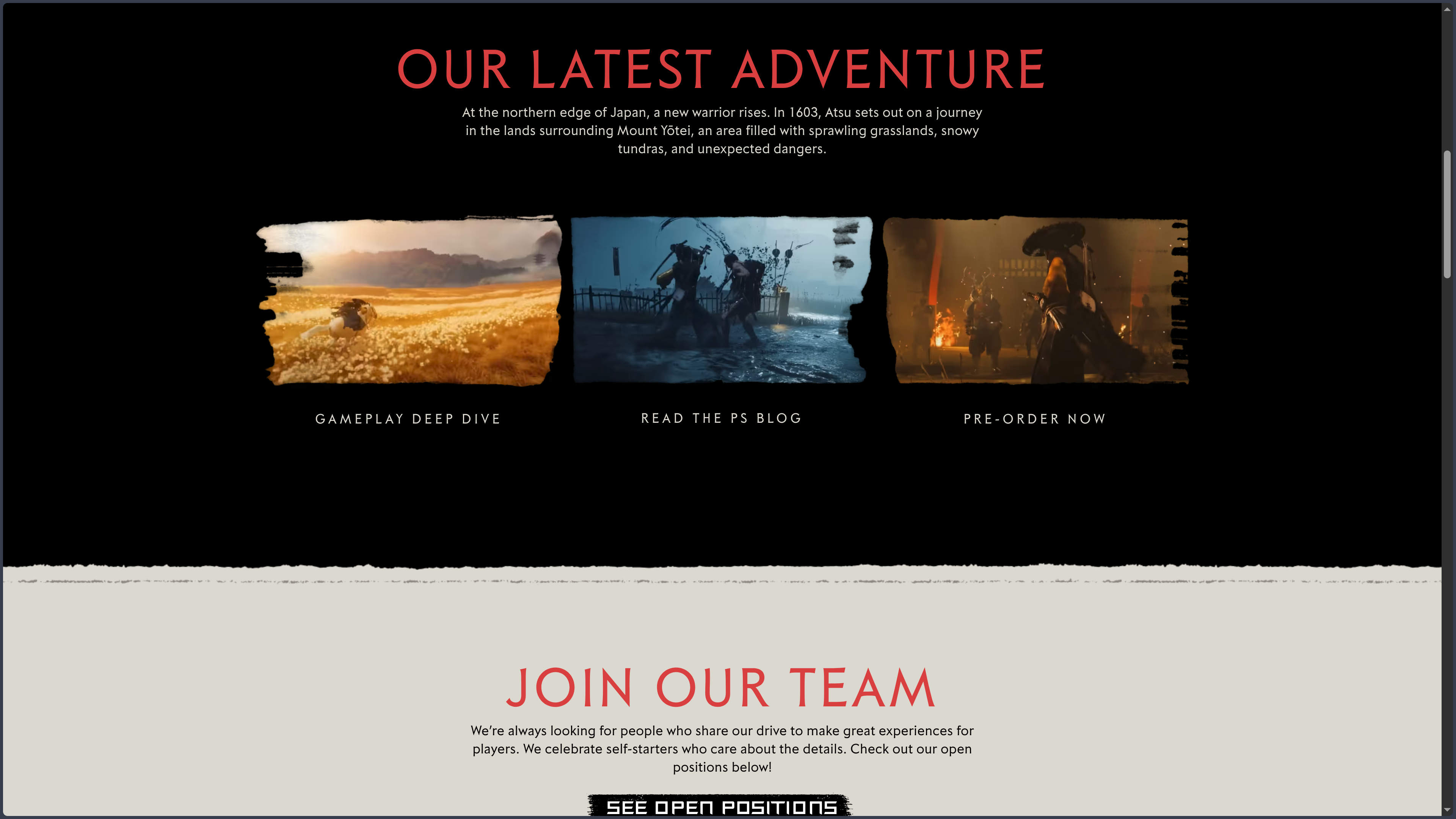
  • Its official website currently presents Ghost of Yōtei as its latest major adventure and continues to list recruitment opportunities.