
Overview
Kana is a French-language publishing house specializing in manga and Asian comics, created in 1996 in Brussels by Yves Schlirf. Legally, Kana is currently an editorial brand of Dargaud-Lombard, a Belgian company belonging to the Média-Participations group.
Its history began in a rather unusual way. Before becoming one of the major names in French-language manga, Kana first published two Korean comics by Hyun Se Lee, Angel Dick and Armagedon. From 1997 onward, however, the publishing house refocused on Japanese manga with Saint Seiya, Yû Yû Hakusho and above all Détective Conan, whose first French volume was released in April 1997.
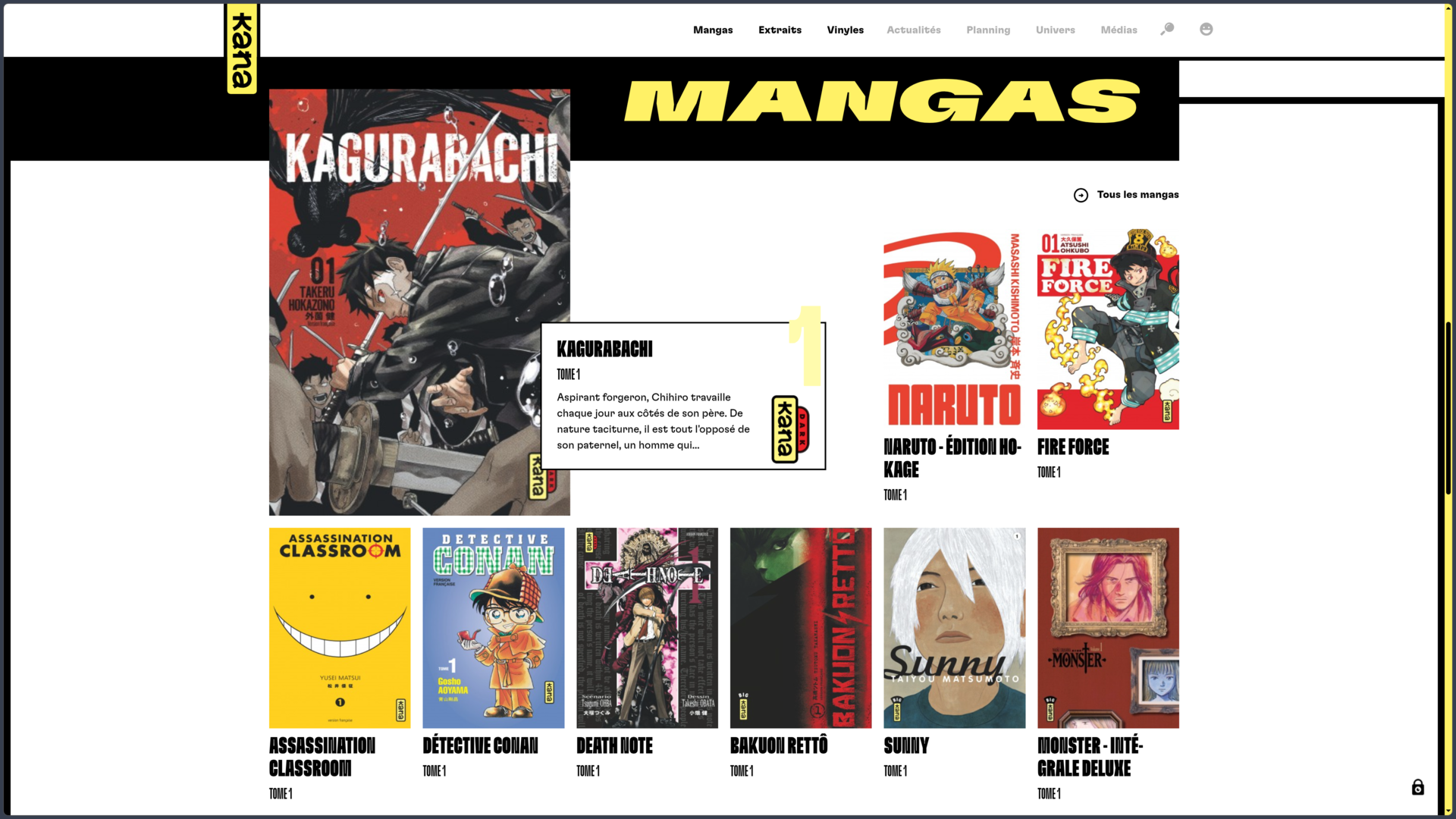
This first generation gradually laid the foundations of the catalogue. Kana then welcomed Hunter x Hunter, Slam Dunk, Monster, Yu-Gi-Oh!, before undergoing a major change of scale with Naruto, published in France from March 2002. Masashi Kishimoto’s series became one of the publishing house’s emblematic titles and accompanied an entire generation of readers.
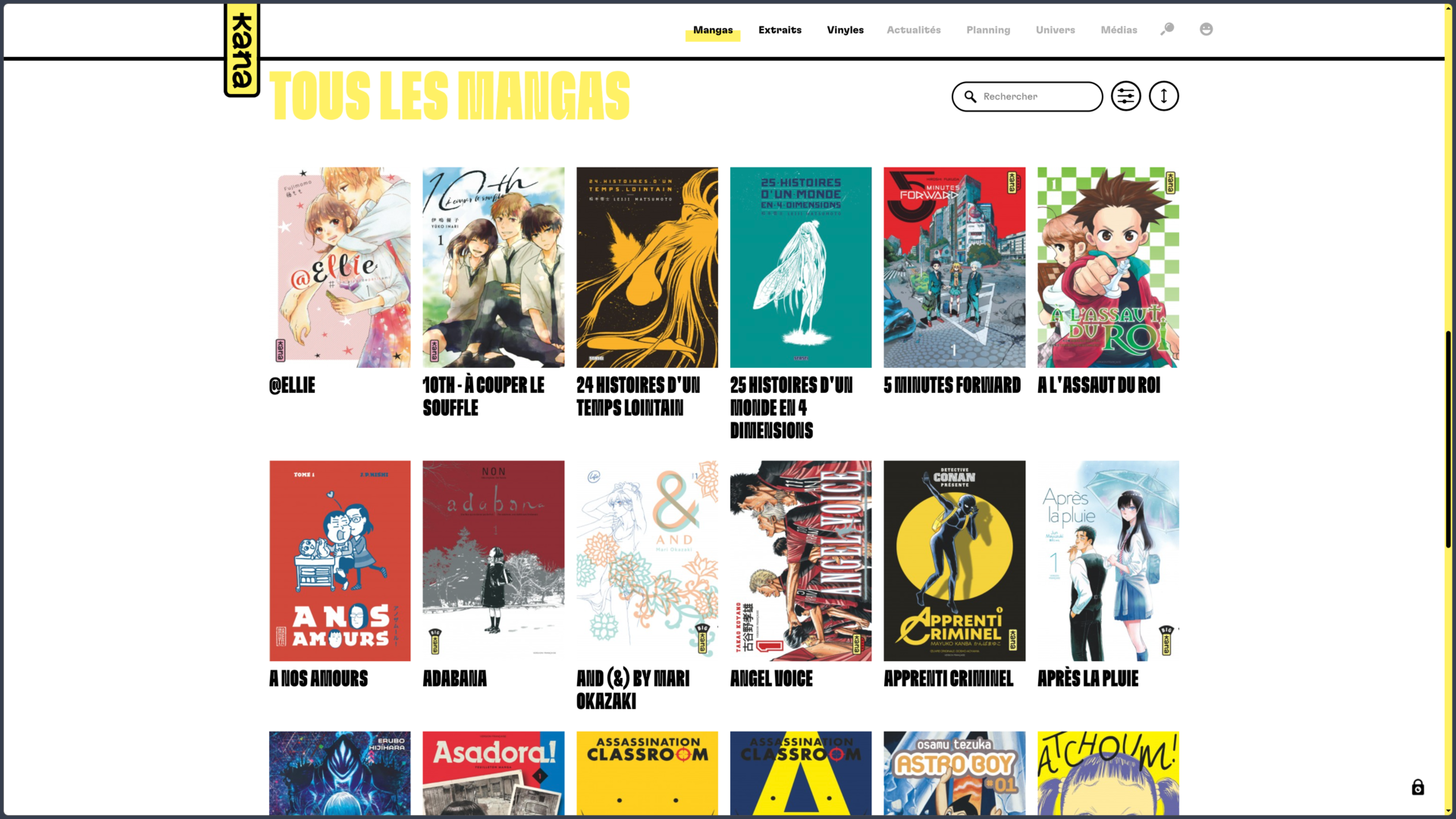
The catalogue did not remain confined to adventure shōnen, however. Monster and the works of Naoki Urasawa, the manga of Jirô Taniguchi, Death Note, Black Butler, Bonne nuit Punpun, Blue Spring Ride and Assassination Classroom gradually introduced very different sensibilities. Kana therefore structured its offer around collections such as Shonen Kana, Shojo Kana, Dark Kana, Big Kana, Made In, Life and Sensei, with the aim of covering several generations and several ways of reading manga.
This diversity is now one of the publishing house’s main strengths. Kana can keep a long-running popular series such as Détective Conan, a shōnen landmark such as Naruto, a thriller such as Death Note, a creator-driven work such as Bonne nuit Punpun or Tokyo, ces jours-ci, and newer series such as Kagurabachi within the same catalogue. Reissues also play an important role: Deluxe editions, Star Editions, Final Editions and new translations regularly bring major historical series back into circulation.
In 2026, the year of its 30th anniversary, Kana remains based in Brussels and publishes for France, Belgium, Switzerland and Luxembourg. The catalogue continues to rely on major Japanese licenses while also developing new initiatives, notably Manga Issho, a European serialization magazine launched with Altraverse, Planeta Cómic and Star Comics to host original European creations.
History
1996-1997 — From Korean beginnings to Japanese manga
Kana was founded in 1996 at the initiative of Yves Schlirf, a Brussels bookseller who was very early convinced of the potential of Asian comics.
Its first publications were nevertheless Korean: Angel Dick and Armagedon by Hyun Se Lee. The experiment remained brief, but it already showed a desire to look beyond the traditional Franco-Belgian market.
From 1997 onward, Kana turned clearly toward Japan. Saint Seiya, Yû Yû Hakusho and Détective Conan were among the first important manga in the catalogue. The latter proved particularly enduring: nearly thirty years later, Gosho Aoyama’s series is still published in French by Kana.
Late 1990s-2002 — Building a catalogue beyond a single genre
Kana quickly developed several pillars.
Hunter x Hunter by Yoshihiro Togashi, Slam Dunk by Takehiko Inoue and Yu-Gi-Oh! strengthened the shōnen side of the catalogue, while Monster by Naoki Urasawa helped establish an adult readership.
The publishing house also opened its catalogue to other sensibilities, notably shōjo and works closer to the graphic novel.
In 2002, however, the arrival of Naruto profoundly changed Kana’s scale. The first volume was released on March 9. The series became one of the major entry points into manga for French-language readers of the 2000s and would remain durably associated with the publisher’s identity.
2007-2013 — Death Note and a more visible diversification
In January 2007, Kana published the first volume of Death Note by Tsugumi Ohba and Takeshi Obata.
The success of the thriller showed that a dark, psychological title based more on an intellectual duel than on combat could reach a very broad audience. It became one of the major titles of Dark Kana and would later receive several new editions.
This period also saw Kana welcome very different series such as Black Butler, published from 2009 onward, as well as numerous seinen, shōjo and creator-driven manga.
The Made In collection in particular played a distinctive role by offering works that moved away from the most obvious commercial categories: stories by Jirô Taniguchi, Korean or Chinese comics, autobiographies and graphic novels could all find a place there.
In 2013, Assassination Classroom joined the catalogue and in turn became one of the publishing house’s major shōnen successes.
2010s-2020s — Keeping classics alive while renewing the catalogue
Kana gradually entered a period in which several generations of readers coexisted.
Historical series remained available or returned in new forms: Death Note Black Edition, Slam Dunk Star Edition, new editions of Saint Seiya, collected editions of Monster and renewed editions of Naruto.
This policy allows the catalogue not to depend only on new releases. A work first published twenty years earlier can return to a central position through a new translation, more ambitious production or a different format.
At the same time, new successes took over: Black Butler, Assassination Classroom, Fire Force, Blue Spring Ride, Bonne nuit Punpun and other series further broadened the readership.
Kana therefore gradually developed an identity less centered on a particular demographic category and more on the coexistence of several manga cultures.
2025-2026 — European creation and thirty years of catalogue
In 2025, Kana took part in the launch of Manga Issho, presented as a European manga magazine.
The project brings together four publishers: Kana for France and Belgium, Altraverse in Germany, Planeta Cómic in Spain and Star Comics in Italy. Each issue brings together stories created specifically for the magazine by European creators.
This initiative marks an interesting evolution.
Kana remains above all the French-language publisher of Japanese manga, but can now also participate directly in the emergence of European creations inspired by manga codes.
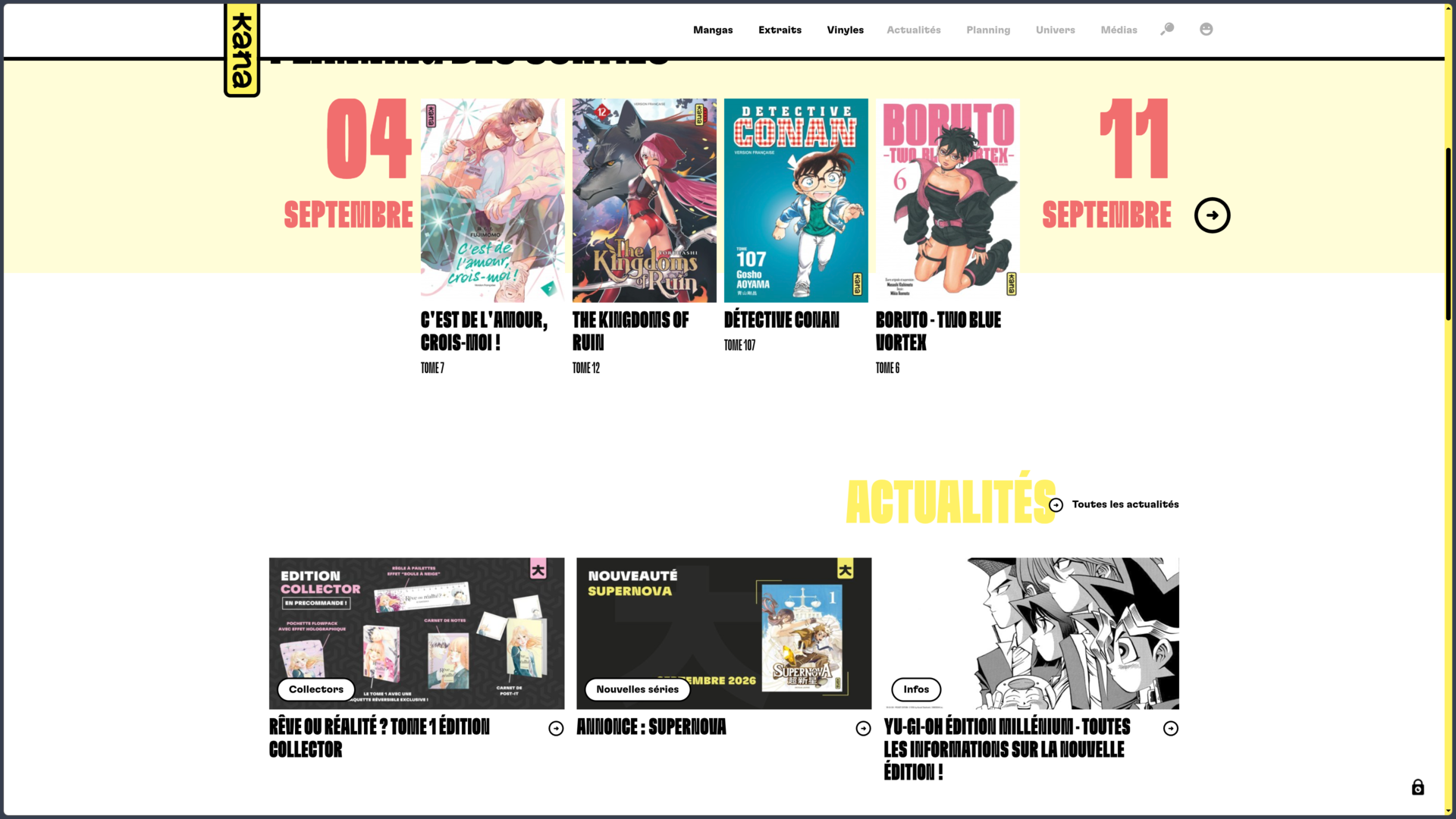
In 2026, the publishing house officially celebrates its 30th anniversary. The event draws both on its historical series — Naruto, Détective Conan, Hunter x Hunter, Monster — and on its contemporary catalogue. An exhibition, MANGATOPIA – 30 ans de manga signé Kana, is notably scheduled at the Belgian Comic Strip Center in Brussels.
Three decades after its first titles, Kana therefore operates through two complementary movements: preserving a heritage that has become important in the history of French-language manga and continuing to search for the series that will speak to the next generation.
What sets it apart
A historic French-language manga publisher born in Brussels
Kana belongs to the first generation of publishing houses that durably structured manga publishing in French.
Its history is deeply connected to Brussels, where its offices and the Dargaud-Lombard structure operating the brand are still located. Its market, however, extends far beyond Belgium and covers the entire European French-speaking world.
This dual identity explains why Kana can be perceived as a major publisher in France while remaining legally and historically rooted in Belgium.
Having accompanied several generations rather than a single phenomenon
Kana’s catalogue does not rely on one period of success.
Détective Conan belongs to the publishing house’s beginnings. Naruto defined the 2000s. Death Note and Black Butler accompanied the next generation. Assassination Classroom, Fire Force and more recent titles then took over.
This continuity allows the publishing house to retain long-standing readers while regularly renewing its audience.
Making popular manga coexist with a creator-driven catalogue
Kana can publish series aimed at a very broad audience while maintaining space for works that are less immediately commercial.
The Big Kana, Dark Kana and Made In collections have notably allowed creators such as Naoki Urasawa, Jirô Taniguchi, Inio Asano and Taiyô Matsumoto to coexist with major shōnen licenses.
The catalogue therefore does not seek only the next sales phenomenon: it also gradually builds a heritage and creator-driven backlist.
Reissuing major series instead of letting them disappear
An important part of Kana’s current work consists of bringing the works that built its history back into circulation.
Star Editions, Deluxe editions, Final Editions, collected editions and renewed editions make it possible to give renewed visibility to manga whose original French edition may be several decades old.
This policy creates continuity between long-standing readers and new audiences: classics remain available without being locked into their first edition.
Good to know
- Kana was created in 1996 by Yves Schlirf, a Brussels bookseller passionate about Asian comics.
- The brand’s first publications were the Korean manhwa Angel Dick and Armagedon by Hyun Se Lee.
- From 1997, Kana turned strongly toward Japanese manga with notably Saint Seiya, Yû Yû Hakusho and Détective Conan.
- Naruto has been published in French by Kana since March 9, 2002 and became one of the publishing house’s most emblematic titles.
- Death Note arrived in January 2007, Black Butler in November 2009 and Assassination Classroom in October 2013.
- Kana is legally an editorial brand of Dargaud-Lombard, a Belgian company belonging to the Média-Participations group.
- In 2025, Kana took part in the creation of Manga Issho, a European magazine bringing together original creations from several countries.
- In 2026, Kana celebrates its 30th anniversary, with an active catalogue still combining major historical series, new licenses, creator-driven works and heritage reissues.