
Overview
BioWare is a Canadian video game development studio founded on February 1, 1995 in Edmonton, in the province of Alberta, by Ray Muzyka, Greg Zeschuk and Augustine Yip. The three founders met while studying medicine at the University of Alberta and initially worked on medical software before bringing programmers and artists together around a project dedicated to video games.
This origin is unusual, but it already contains something very BioWare.
Complex systems.
Information to organize.
Decisions to make.
Consequences to understand.
The subject will change completely.
The logic will remain surprisingly familiar.
BioWare gradually specializes in narrative role-playing games, with particular attention paid to characters, dialogue, relationships between companions, player choices and worlds capable of reacting to those decisions. Today, the studio defines its mission around creating worlds of adventure, conflict and camaraderie in which the player becomes the hero of their own story.
This direction runs through works that are nevertheless very different.
Baldur’s Gate uses the rules and world of Dungeons & Dragons.
Star Wars: Knights of the Old Republic places moral decisions at the heart of a Star Wars story.
Jade Empire builds an original world inspired by several Asian traditions.
Mass Effect turns space opera into an interactive saga.
Dragon Age develops political fantasy in which alliances, beliefs and characters can change the direction of the story.
BioWare itself still cites Baldur’s Gate, Neverwinter Nights, Knights of the Old Republic, Jade Empire, Mass Effect and Dragon Age among the productions that defined its journey.
The studio_jeu classification is unambiguous here. BioWare is a development team now owned by Electronic Arts, not a publisher sitting above several independent studios. EA still presents it as the studio behind Mass Effect, Dragon Age and Knights of the Old Republic, specializing in the creation of complex RPGs for console, PC and online play.
Its ownership by Electronic Arts officially begins in January 2008, when EA completes the acquisition of VG Holding Corp., the company that then owned BioWare and Pandemic Studios. The deal had been announced in October 2007. BioWare keeps its name and studio culture while joining the EA Games organization.
Today’s BioWare is nevertheless much more streamlined than the one that once managed several major productions and several teams simultaneously.
In 2023, development of Star Wars: The Old Republic is transferred to Broadsword, while EA remains its publisher. BioWare then explains that it wants to refocus its activity on immersive and emotional single-player experiences, primarily around Dragon Age and Mass Effect.
After the release of Dragon Age: The Veilguard in October 2024, the studio announces another reorganization in January 2025. A core team works on the next Mass Effect, while some employees are repositioned toward other Electronic Arts teams. BioWare explicitly describes its new goal as becoming a more agile and focused studio, dedicated to memorable RPGs.
The most recent official communication sharpens this direction further. During N7 Day 2025, BioWare confirms that the next Mass Effect is still in development and states that the team is now exclusively focused on Mass Effect.
This situation gives the studio an almost symmetrical shape compared with its beginnings.
BioWare grew into an organization capable of producing several worlds, several games and several services in parallel.
Then the organization contracted.
But its challenge remains almost the same as it was in 1995:
build a world, place characters in it that the player can care about, then ask them what they want to become inside it.
History
1994-1995: before RPGs, medical simulators
Before BioWare, Ray Muzyka and Greg Zeschuk work on software intended for medical education at the University of Alberta. Augustine Yip later joins their collaboration with a stronger interest in art and animation. BioWare notably mentions an acid-base simulator and then a gastroenterology patient simulator among their earliest projects.
The idea may seem far removed from role-playing games.
It is not entirely.
A simulator relies on variables.
States.
Decisions.
Consequences.
A system has to be represented clearly enough for a user to act upon it.
A few years later, BioWare will apply this logic not to a virtual patient, but to combat, relationships, dialogue and entire worlds.
February 1, 1995: BioWare becomes real
BioWare officially dates its birth to February 1, 1995.
The studio takes shape in a small room in Greg Zeschuk’s basement in Edmonton. Ray Muzyka, Greg Zeschuk and Augustine Yip gradually gather a team of programmers and artists around their shared passion for games, animation and comics.
The name BioWare directly reflects this origin.
Medicine on one side.
Software on the other.
But the studio quickly abandons medical tools to focus its energy on games.
1996: Shattered Steel opens the first door
BioWare’s first major commercial game is Shattered Steel, released in October 1996.
The project is developed with Calgary subcontractor Pyrotek Game Studios and attracts the attention of Interplay Productions, which later signs BioWare for several projects.
Shattered Steel is not yet the narrative role-playing game that will define BioWare.
It is a mech combat game.
That distance from what comes later is interesting.
The studio’s first significant success therefore does not yet prove that it has a formula.
It mainly gives BioWare the opportunity to search for one.
1998: Baldur’s Gate changes the trajectory
On November 30, 1998, Baldur’s Gate launches on PC.
BioWare adapts the Forgotten Realms setting and the rules of Advanced Dungeons & Dragons into an RPG combining exploration, tactical combat, a party of characters and large-scale storytelling. The studio also develops its own Infinity Engine, which will serve as the foundation for several RPGs of the period.
The game’s importance to BioWare is considerable.
The studio is no longer simply building a combat system.
It has to build an adventure.
Cities.
Companions.
Quests.
Dialogue.
Consequences.
And above all, a way to transform a role-playing campaign into a computer experience without entirely removing what gives RPGs their freedom.
That question will never really leave BioWare.
Baldur’s Gate understands that the party matters as much as the hero
An important part of BioWare’s future identity is already visible in the logic of the party.
The player controls a protagonist.
But travels with other characters.
These companions have their own characteristics, strengths and weaknesses.
Later, BioWare will push this relationship much further by giving companions more dialogue, opinions, conflicts, friendships and romances.
The fundamental principle is already present:
an adventure becomes more memorable when the player does not travel through it alone.
2000: Baldur’s Gate II turns the formula into a tradition
Baldur’s Gate II launches on September 20, 2000 and directly continues this approach. BioWare’s official catalog identifies the studio as developer and the Infinity Engine as its technology.
The second game allows the studio to deepen what it has learned.
More relationships.
More companion-related quests.
More situations in which a narrative decision and an RPG system intersect.
BioWare then begins to be identified not only with a type of game, but with a certain promise.
A BioWare RPG should make the player feel that the characters in the party possess an existence beyond their statistics.
The Infinity Engine becomes bigger than BioWare alone
The Infinity Engine does not remain confined to BioWare’s direct productions.
The technology contributes to an entire period of computer RPGs and circulates through several projects connected to the Interplay and Black Isle ecosystem.
This diffusion already reveals a characteristic of the studio’s history.
BioWare does not only produce stories.
It also produces tools capable of structuring interactive stories.
That idea will return with Neverwinter Nights and its creation tools.
2002: Neverwinter Nights turns the RPG into a toolbox
With Neverwinter Nights, BioWare pushes its relationship with tabletop role-playing practices further.
The appeal is not limited to the campaign.
The project also allows users to create adventures, environments and scenarios through tools designed for them.
This philosophy of community creation will remain important enough that BioWare later continues the tradition with the Dragon Age: Origins toolset. In 2008, EA still described access to developer-level tools as a historic BioWare tradition.
The player can therefore become something other than a character.
They can become the game master.
Builder.
Author.
BioWare is no longer only reproducing a role-playing session.
It is trying to reproduce its creative ecosystem.
2003: Knights of the Old Republic meets Star Wars
In 2003, BioWare develops Star Wars: Knights of the Old Republic.
EA still cites the game today among the studio’s major works, while its historical communications present it as one of BioWare’s major successes before the acquisition.
The project gives BioWare an almost ideal playground.
Star Wars already has a mythology.
Institutions.
A morality structured around the light side and the dark side.
BioWare can then build choices that do not merely alter a statistic.
They alter the identity of the character.
The RPG becomes a way of asking the player not only what they want to do, but who they want to be.
That question will become central to Mass Effect.
Licenses allow BioWare to test its own voice
Baldur’s Gate belongs to Dungeons & Dragons.
Knights of the Old Republic belongs to Star Wars.
BioWare therefore spends an important part of its early years working within existing worlds.
That constraint does not prevent the studio from developing its own way of writing.
Companions.
Multiple dialogue options.
Moral choices.
Relationships.
A central party.
A major threat.
A customizable protagonist.
The studio gradually learns to build a narrative grammar it will later apply to its own worlds.
2005: Jade Empire shows that BioWare can build its own world
Jade Empire launches in 2005 and is an original property developed by BioWare. EA was already citing it among the studio’s important original creations before the acquisition.
The project represents a crucial step.
BioWare no longer has a pre-existing universe to rely on.
It has to invent its mythology.
Its cultures.
Its characters.
Its rules.
Its tone.
This experience directly prepares what follows.
Mass Effect and Dragon Age will no longer simply be stories written inside worlds owned by others.
They will become BioWare worlds.
2005: BioWare and Pandemic move closer together
At the end of 2005, BioWare and Pandemic Studios become part of the same corporate structure. BioWare now summarizes this period as a moment when the two studios “join forces,” before their joint acquisition by Electronic Arts two years later.
The arrangement does not merge their creative identities.
BioWare remains BioWare.
Pandemic remains Pandemic.
But both companies end up under VG Holding Corp., the structure that will later become the target of Electronic Arts’ acquisition.
This period therefore marks the gradual end of a fully independent BioWare.
2007: Mass Effect turns BioWare into a creator of space opera
The first Mass Effect launches in 2007.
Even before release, Electronic Arts presents the title as one of the main original properties in development at BioWare. When announcing the acquisition of the studio in October 2007, EA states that the game is due to be published by Microsoft in November.
Mass Effect allows BioWare to bring together almost all of its obsessions.
A customizable hero.
A team.
Dialogue.
Decisions.
A major threat.
Romances.
Moral choices.
A world built to continue.
But one new element profoundly changes the feel.
The staging becomes much more cinematic.
Conversations use camera work, facial animation, voice acting and dramatic pacing to turn dialogue into actual scenes.
The player no longer only reads a response.
They perform it.
The dialogue wheel changes the rhythm of conversation
Mass Effect particularly associates BioWare with an interface that becomes iconic: the dialogue wheel.
Its importance goes beyond ergonomics.
It aims to reduce the time needed to understand the intention behind a response.
Rather than reading several paragraphs before choosing, the player quickly identifies an attitude.
Conversation gains pace.
It can be staged as a continuous sequence.
This evolution brings BioWare closer to an ideal that runs through much of its history: making RPG complexity fluid enough that the story does not feel interrupted by the systems.
2007-2008: Electronic Arts acquires BioWare
On October 11, 2007, Electronic Arts announces its intention to acquire VG Holding Corp., owner of BioWare and Pandemic Studios. The operation is intended to bring BioWare into the EA Games label.
The transaction is completed on January 7, 2008.
EA officially welcomes BioWare into its organization and appoints Ray Muzyka and Greg Zeschuk as Electronic Arts vice presidents and co-general managers of BioWare. EA emphasizes at the time its intention to preserve the studio’s creative integrity and culture.
BioWare therefore ceases to be independent.
But its name does not disappear.
Its identity has become strong enough to be preserved inside a much larger group.
The acquisition changes the scale without immediately changing the promise
At the time of the acquisition, BioWare has teams in Edmonton and Austin and is already working on several projects.
Electronic Arts therefore does not simply buy a catalog.
It acquires a production method.
A reputation.
Technologies.
Writers.
Designers.
An already strong relationship with the RPG audience.
The challenge then begins: how can BioWare be given more resources without changing what made the studio recognizable?
That question will run through the entire EA period.
2009: Dragon Age: Origins returns to fantasy without going backward
Dragon Age: Origins launches in 2009 and inaugurates BioWare’s other major modern property.
The project retains several roots of classic PC RPG design while building a new world entirely controlled within the BioWare ecosystem. EA presents it at the time as the spiritual successor to Baldur’s Gate.
The origin system is one of its most revealing ideas.
The player does not only choose a class or appearance.
They also choose a narrative origin.
A Dalish elf does not begin in the same place as a human noble.
A mage does not begin like a dwarf.
BioWare therefore uses character creation to directly modify the opening of the story.
Identity becomes content.
Dragon Age turns the world into political and cultural debate
Thedas is not just a fantasy map.
The world is structured by tensions.
Religion.
Magic.
Social classes.
Species.
Institutions.
History.
The player moves through these structures with companions who may themselves interpret them differently.
This organization allows BioWare to do something it particularly enjoys:
turn the party into a miniature version of the world.
Political conflicts can reappear around the campfire.
A major historical question can become an argument between two characters.
Lore then stops existing only in a codex.
It gets a voice.
2010: Mass Effect 2 puts companions at the center
With Mass Effect 2, BioWare pushes the team-centered structure particularly far.
The game asks the player to recruit several characters, learn who they are and resolve some of their conflicts before a final mission whose outcome depends in part on how well the team was prepared.
The logic is deeply BioWare.
The stated objective is galactic.
But a large part of the game simply consists of listening to people.
Understanding their problems.
Earning their trust.
The final mission works because the studio has devoted enormous amounts of time to what might otherwise have looked like side content.
The companions are no longer decoration around the plot.
They become the plot.
2011: BioWare also tries the MMORPG with The Old Republic
Star Wars: The Old Republic is developed as a narrative MMORPG by BioWare, notably through its Austin operation.
The project tries to apply the studio’s narrative tradition to a genre based on online persistence and the massive presence of players.
BioWare will then have to keep the game alive for more than a decade. In 2023, the studio describes it as the longest-running Star Wars game in continuous service at that point.
The project demonstrates the ambition BioWare takes on at the beginning of the 2010s.
The studio is no longer simply producing one RPG after another.
It tries to manage several franchises, several teams and several game models at once.
That expansion will eventually reveal its organizational limits as well.
2012: Mass Effect 3 concludes a rare experiment in continuity
Mass Effect 3 directly continues Commander Shepard’s story and closes the original trilogy.
One of the project’s major characteristics goes beyond the content of a single episode: BioWare had built a saga in which the player could carry their character and some decisions from one game to the next.
The RPG therefore gains memory across several works.
A decision made years earlier can return.
A character who was saved may be present.
Another may be missing.
The idea strengthens the feeling that the player is not simply consuming three scenarios.
They are building a particular version of the saga.
2012: Ray Muzyka and Greg Zeschuk leave BioWare
On September 18, 2012, BioWare announces the departure of its two major historical co-founders still at the company, Ray Muzyka and Greg Zeschuk. Both leave video game development.
The transition is symbolic.
BioWare will continue.
Mass Effect will continue.
Dragon Age will continue.
But the company is no longer led by the people who built it from the Edmonton basement.
The studio enters a new period in which its culture has to survive its founders.
A studio culture must be able to exist without its founders
Aaryn Flynn, then general manager of BioWare Edmonton and Montréal, explains at the time of the departure that the teams had been able to prepare for this transition and that the studio needed to enter a new era.
The situation raises an interesting question.
What is BioWare when Ray Muzyka and Greg Zeschuk are no longer there?
A logo?
Franchises?
A method?
Teams?
A culture?
The following years will show that continuity exists, but that it is never automatic.
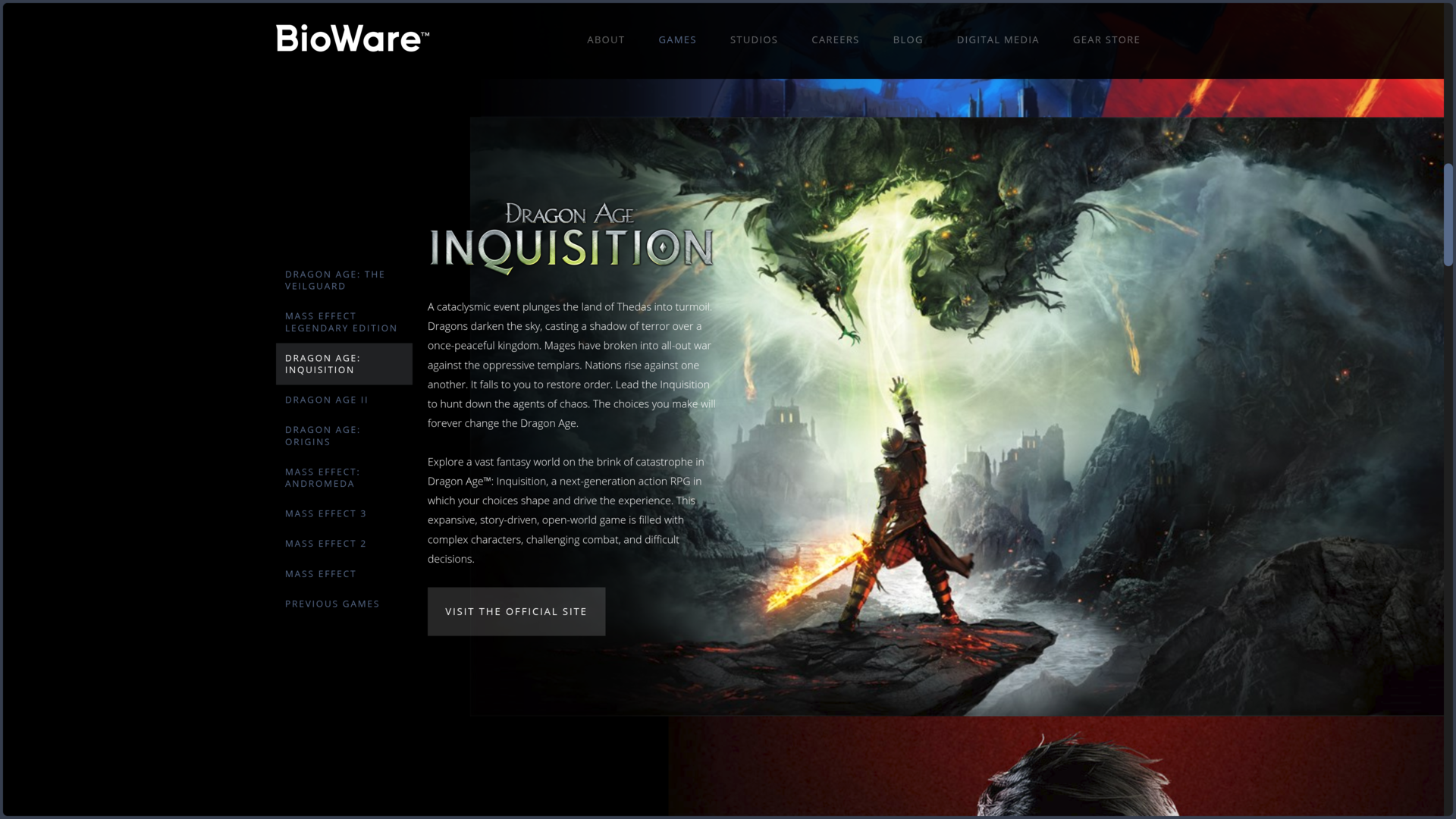
2014: Dragon Age: Inquisition greatly expands Thedas
Dragon Age: Inquisition launches in 2014 and develops a much broader structure than the previous installments.
BioWare had prepared certain narrative elements as early as Dragon Age: Origins, according to its own lead writer David Gaider, showing that the studio was already thinking about part of Thedas across multiple games.
This continuity allows a world to become bigger than its protagonist.
The hero changes.
The world remains.
Institutions evolve.
Past events become history.
That is an important difference from Mass Effect, which remained centered on Shepard for a long time.
Dragon Age is designed as a world capable of producing several heroes.
The BioWare hero is not always the same person, but always remains central
The Warden.
Hawke.
The Inquisitor.
Rook.
Dragon Age regularly replaces its main protagonist.
This structure forces BioWare to preserve coherence without depending forever on the same character.
The world becomes the true permanent element.
Choices from older games can leave traces.
But every new installment also has to allow a new player to enter.
BioWare therefore constantly works between two requirements:
reward memory.
And avoid making that memory mandatory.
2017: Mass Effect: Andromeda tries to leave Shepard and the Milky Way behind
Mass Effect: Andromeda moves the action to another galaxy and adopts a new protagonist, the Pathfinder.
BioWare’s current catalog still presents the game as an adventure centered on finding a new home for humanity in an unknown region of Andromeda.
The idea is logical.
If Mass Effect is going to survive Shepard, it has to prove its universe can work elsewhere.
New galaxy.
New characters.
New conflict.
New exploration structure.
The project therefore attempts a transition similar to the one Dragon Age had integrated more fully from its beginnings: making the universe, rather than a single protagonist, the true heart of the property.
2019: Anthem looks for a very different BioWare
Anthem launches on February 22, 2019.
Electronic Arts and BioWare present it as a new property centered on a connected and cooperative action-RPG experience, in which up to four players use Javelin exosuits.
The project represents a major break with BioWare’s traditional image.
Real-time combat becomes central.
Flight transforms exploration.
The game is designed as a connected experience.
The service is supposed to continue after launch.
EA even described it at announcement as something unlike any previous BioWare game.
This desire to experiment is consistent with the studio’s history.
But it also shows that not every extension of identity works with the same ease.
Anthem brings BioWare into the logic of continuous service
At launch, BioWare explains that Anthem marks the beginning of a Live service intended to evolve after release through community feedback.
This structure profoundly changes the studio’s traditional work.
A story can be finished.
A service never really is.
Servers have to be maintained.
Content created.
Behavior analyzed.
Problems fixed.
Balance adjusted.
The future prepared.
The model requires a very different discipline from a single-player RPG whose core value largely exists on the day it launches.
2021: Mass Effect Legendary Edition turns a recent trilogy into heritage
In 2021, BioWare releases Mass Effect Legendary Edition, bringing together and remastering the original trilogy.
The studio describes the project at the time as more than a simple remaster: a celebration of the community that had accompanied Mass Effect since 2007.
The gesture has particular importance.
BioWare has then existed for more than twenty-five years.
Its games are no longer merely new releases or relatively recent memories.
They are becoming heritage that has to remain accessible.
Remastering means deciding what should change.
And what absolutely should not.
An interactive work ages with its technology
An old film can still be projected.
An old book can still be printed.
A game depends on operating systems, hardware, interfaces and technologies that can disappear.
BioWare therefore gradually has to learn a new craft.
Preserve.
Adapt.
Restore.
Mass Effect Legendary Edition shows that the studio’s relationship with its own works is changing.
It no longer has only to create the future.
It also has to maintain the past.
2023: The Old Republic leaves BioWare
On June 27, 2023, BioWare announces that development of Star Wars: The Old Republic will be transferred to Broadsword.
Electronic Arts remains publisher, but a large portion of the team joins Broadsword in order to continue developing and maintaining the MMORPG.
The decision closes an important period.
BioWare had spent more than a decade trying to make single-player RPG development coexist with the management of a massive persistent service.
The studio now announces that it wants to refocus on immersive and emotional single-player experiences.
Dragon Age.
Mass Effect.
The historical core returns to the center.
2023: BioWare explicitly chooses to become more focused again
In the same message about SWTOR, Gary McKay explains that BioWare wants to return to being a leader in immersive, emotionally charged single-player games and refocus its efforts on its two major properties: Dragon Age and Mass Effect.
The wording matters.
The studio is no longer trying to become everything a major developer could be.
Instead, it begins to select.
The question is no longer:
“how far can BioWare expand?”
It becomes:
“what does BioWare actually do better than others?”
2024: Dragon Age: The Veilguard returns to a single-player adventure
Dragon Age: The Veilguard launches on October 31, 2024.
BioWare explains that it experimented with several concepts during development, including a multiplayer idea, before refocusing the project on a single-player experience built around the choices, characters and worldbuilding expected from Dragon Age.
The change is revealing.
The company does not deny its earlier experiments.
It uses them to return to a form more directly connected with its identity.
The player creates Rook.
Recruits seven companions.
Develops relationships.
Makes decisions.
BioWare therefore returns to a familiar question:
who are the people traveling with you?
Companions explicitly become the heart of the project again
The title change from Dragon Age: Dreadwolf to Dragon Age: The Veilguard is not purely marketing.
BioWare explains that the former name focused too strongly on the enemy, while the heart of the experience should be the protagonist and their companions.
That decision almost summarizes thirty years of BioWare design.
The great threats matter.
The gods.
The Reapers.
The darkspawn.
The Sith.
But the player often remembers most clearly the people who stood beside them while facing those threats.
January 2025: BioWare becomes smaller and more focused
On January 29, 2025, Gary McKay publishes an important studio update.
A core team is now working on the next Mass Effect, under the leadership of veterans of the original trilogy, notably Mike Gamble, Preston Watamaniuk, Derek Watts and Parrish Ley.
Because the project is not yet at a stage requiring the resources of the entire studio, BioWare states that several employees have been connected with other EA teams that have roles matching their expertise.
BioWare then clearly states the objective:
become a more agile and focused studio producing unforgettable RPGs.
That sentence probably marks one of the most important organizational changes since the EA acquisition.
2025: Mass Effect becomes the only announced priority
During N7 Day on November 7, 2025, BioWare officially confirms that the next Mass Effect remains in development.
The studio adds that its team is then exclusively focused on Mass Effect.
The situation contrasts sharply with some earlier periods.
BioWare had once been able to work on Mass Effect, Dragon Age, SWTOR and other projects simultaneously.
It is now concentrated around a single announced major production.
The scale changes.
But that reduction may also allow a form of creative refocusing.
January 2026: Anthem shuts down permanently
Electronic Arts announces in 2025 that Anthem servers will shut down on January 12, 2026, making the game unplayable afterward.
The shutdown gives a particular ending to one of the experiments furthest removed from BioWare’s historical model.
Anthem had been designed as a persistent world.
Its dependence on servers means it cannot simply become an old game available in a catalog.
When the infrastructure disappears, the work also disappears in playable form.
That difference makes its history especially revealing of the risks of Live service design.
Today: BioWare prepares its next chapter with Mass Effect
In 2026, the last project officially confirmed as being in development at BioWare is the next Mass Effect.
The studio states that the project remains active, that Electronic Arts and BioWare remain committed to the universe, and that the team is working on new features, new stories and, true to studio tradition, new romances.
No release date has been announced.
No final title has been presented.
That caution matters.
BioWare is not yet asking the public to judge a product.
It is asking for time to rebuild.
After thirty years shaped by growth, acquisitions, major successes, multiplayer experiments, leadership changes and restructurings, the studio therefore returns to a surprisingly simple situation.
One team.
One RPG.
One universe.
And a great deal to prove.
What sets it apart
BioWare treats the companion as a game system
In many games, a companion is a functional presence.
They shoot.
Heal.
Carry objects.
Follow the player.
At BioWare, the companion is often a complete narrative system.
They have a history.
Values.
Opinions.
Conflicts.
A relationship with the protagonist.
Sometimes a romance.
Sometimes conditional loyalty.
Sometimes the possibility of leaving or dying.
This approach appears in different forms from Baldur’s Gate onward and runs through Mass Effect, Dragon Age and Knights of the Old Republic. BioWare still defines its games today around rich stories and memorable characters.
The result is simple:
talking to a companion is not necessarily a pause between two important sequences.
It can be the important sequence.
Dialogue is a mechanic, not just text
BioWare has built a large part of its identity around interactive conversations.
Choosing a response can change a relationship.
Unlock information.
Close a path.
Trigger a conflict.
Start a romance.
Change a future decision.
Dialogue therefore stops being simply the way a story transmits information.
It becomes a form of gameplay.
This approach explains why characters occupy such an important place in the studio’s official presentations. BioWare itself emphasizes rich stories, memorable characters and worlds to discover as foundations of its RPGs.
Choice should make the player feel the story belongs to them
BioWare obviously did not invent narrative choice.
But the studio made it a central component of its modern identity.
Origin.
Class.
Response.
Romance.
Alliance.
Sacrifice.
Moral decision.
The system’s power does not come only from the number of branches actually available.
It comes from the feeling that the player has a personal version of the story.
Two people may have finished Mass Effect.
But they can talk about “their Shepard.”
Two people may have finished Dragon Age.
But they are not necessarily talking about the same hero.
BioWare therefore seeks less to enable an infinite number of stories than to create a story flexible enough to be personally appropriated.
A customizable protagonist creates a different relationship with the story
Commander Shepard has a clear narrative role.
But the player chooses part of their identity.
Rook too.
The Warden too.
The Inquisitor too.
BioWare regularly places the player between two positions.
They embody a written character.
And they write part of that character.
This tension is extremely productive.
A completely empty protagonist can sometimes lack dramatic presence.
A fully fixed protagonist limits appropriation.
BioWare often tries to occupy the space between the two.
Romances turn relationships into narrative progression
BioWare romances have become famous enough that the studio still mentions them directly when talking about the next Mass Effect.
But their importance goes beyond seduction.
A romance often uses several systems already present in the game.
Dialogue.
Trust.
Time.
Decisions.
Personal quests.
Values.
The relationship therefore becomes a form of progression.
The player does not only unlock an ability.
They unlock intimacy.
That is one reason BioWare characters can remain in memory for so long.
Emotional progression runs alongside mechanical progression.
The party turns world exposition into conversation
An RPG world can contain enormous amounts of information.
History.
Politics.
Religion.
Species.
Technology.
Conflicts.
One solution is to write everything into internal encyclopedias.
BioWare also makes heavy use of its companions.
One character can explain their culture.
Another can criticize it.
A third may have suffered because of it.
The player therefore does not only learn what the world is.
They learn how different people perceive it.
This method makes exposition less neutral.
It turns lore into opinion.
And opinion can create conflict.
Characters give political systems a face
Dragon Age works particularly well this way.
A question about mages is not just a paragraph in a codex.
It can directly concern a companion.
A religious institution can have a face.
A war can divide two characters the player cares about.
Mass Effect uses a comparable logic with its species, institutions and historical conflicts.
The world becomes easier to understand when it walks into the room with you.
BioWare often thinks about its worlds across several games
Mass Effect is built as a trilogy.
Dragon Age develops Thedas through several protagonists.
BioWare had already explained with Dragon Age: Inquisition that some narrative directions went back to the design of Origins.
This long-term construction allows a detail to change status.
A small reference can become important.
A secondary character can return.
A decision can gain weight several years later.
The world gains memory.
That memory is one of the particular pleasures of BioWare’s major series.
Continuity turns the player into the historian of their own playthrough
When a choice travels across several games, the player gains something a linear scenario cannot produce as easily.
An interactive past.
They remember having made the decision.
Not merely having watched it.
That psychological difference matters.
A consequence may be relatively small objectively.
But it carries a special value because the player knows they are responsible for it.
The world does not simply have a history.
It has your history.
BioWare can work inside existing universes without disappearing behind them
Dungeons & Dragons.
Star Wars.
Sonic.
BioWare worked on several major external licenses throughout its history. Greg Zeschuk recalled when leaving the company how unlikely it had seemed, at the studio’s beginnings, that a small Canadian team might one day work with Star Wars, Dungeons & Dragons or other major properties.
And yet Knights of the Old Republic feels deeply like BioWare.
Baldur’s Gate does too.
The studio therefore does not merely apply a license.
It tries to pass that license through its own way of building RPGs.
That is often where adaptation becomes interesting.
Original properties then reverse the relationship
With Jade Empire, Mass Effect and Dragon Age, BioWare is no longer adapting a universe.
It becomes the author of the universe itself.
That changes the possibilities considerably.
The studio can write a political history because it directly serves a future choice system.
It can create a species because it produces an interesting relationship with a companion.
It can develop an ancient war because it prepares a future conflict.
Narrative and game design can be conceived together from the beginning.
That freedom contributes strongly to the richness of Mass Effect and Dragon Age.
The BioWare RPG seeks a balance between system and spectacle
The studio’s roots lie in highly systemic RPGs.
Baldur’s Gate.
Neverwinter Nights.
Dragon Age: Origins.
But Mass Effect gradually introduces much more cinematic staging.
Camera.
Voices.
Animation.
Action.
The studio therefore spends part of its history moving the slider between two traditions.
The RPG as system.
The RPG as spectacle.
The difficulty lies in improving one without sacrificing the other.
Every generation of BioWare redefines what “RPG” means
Baldur’s Gate is deeply connected to the classic computer RPG.
Knights of the Old Republic simplifies certain systems to integrate them into a more direct console adventure.
Mass Effect mixes RPG and shooter.
Dragon Age evolves considerably between Origins, Inquisition and The Veilguard.
Anthem pushes action even further.
BioWare therefore does not possess one immutable mechanical definition of the RPG.
Continuity lies more in the relationship between character, decision, progression and world.
The studio likes to give the player a team before giving them an army
BioWare scenarios can be enormous.
A threatened galaxy.
A kingdom at war.
Released gods.
Sith.
Reapers.
Yet the point of entry often remains surprisingly small.
A few people on a ship.
A camp.
A base.
A group.
This structure makes an abstract threat emotionally readable.
Saving a galaxy is difficult to feel.
Saving someone you have known for forty hours is much more concrete.
BioWare therefore uses the party to give a human scale to gigantic stakes.
The base often becomes a home
The Normandy.
The Dragon Age camp.
Skyhold.
The Lighthouse.
These places are not just three-dimensional menus.
They let the player find characters again.
Listen.
Observe their relationships.
Trigger new conversations.
The player leaves on a mission and then returns to a familiar place.
That alternation creates a particular rhythm.
Danger outside.
Relationships inside.
Gradually, the base stops being only an operational center.
It becomes a narrative home.
BioWare often turns side quests into portraits
A companion mission usually has two functions.
It provides playable content.
But it also explains who the character is.
Their past.
Their fear.
Their family.
Their mistake.
Their culture.
Their loyalty.
The player then directly participates in a piece of characterization.
The story does not simply say:
“this character has a problem.”
It says:
“come with them and discover that problem.”
That difference is fundamental in an interactive medium.
Consequences work better when they affect people the player knows
A text announcing the destruction of a planet can seem spectacular.
The disappearance of a character the player has spent thirty hours with can be much stronger.
BioWare understood early that emotional choice depends on attachment.
The studio therefore invests heavily in the time spent with companions before asking the player to make certain decisions.
The choice is no longer only moral.
It becomes personal.
The studio accepts that player memory is a mechanic
Mass Effect Legendary Edition shows how strongly that memory still exists years after the original trilogy. BioWare explicitly presents the re-release as a celebration of its community.
The player remembers characters.
Choices.
Lines.
Romances.
Regretted decisions.
This memory outside the software then becomes a resource for future games.
A return can create emotion simply because a shared past exists.
BioWare therefore sometimes builds with something no engine can store:
the player’s real memory.
The toolset reveals another idea of authorship
Neverwinter Nights and Dragon Age also revealed a less discussed side of BioWare: the desire to place creation tools in the hands of players.
EA described Dragon Age’s tools in 2008 as the continuation of a long BioWare tradition of giving powerful creative tools to its community.
This approach blurs the boundary between author and audience.
BioWare builds the system.
The player can then build their own story.
The RPG partially returns to its tabletop role-playing roots.
Growth enabled larger worlds, but also a harder organization to manage
The BioWare of the 1990s is a small Canadian team.
The BioWare of the 2010s manages Edmonton, Austin, Montréal and different projects tied to several franchises.
That growth provides resources.
But it also increases the number of decisions, teams and dependencies to coordinate.
The studio’s recent history shows that size is not automatically synonymous with stability.
In 2023 and then 2025, BioWare explicitly chooses to reduce and concentrate its organization around single-player RPGs and then the next Mass Effect.
The question is therefore no longer only how many people can contribute to a game.
It is what size actually allows the studio to produce its best work.
Anthem matters precisely because it moves away from the historical model
Anthem is interesting in BioWare’s history even apart from its commercial fate.
The project forces the studio to work with another structure.
Permanent cooperation.
Action.
Flight.
Loot.
Live service.
Continuous updates.
BioWare itself presented it as something radically different from its earlier productions.
That experience helps explain the next phase.
When BioWare announces in 2023 that it wants to refocus on immersive and emotional single-player games, the studio does not formulate that strategy in a vacuum.
It formulates it after having tried something else.
Anthem’s shutdown also raises a heritage question
Anthem’s servers shut down on January 12, 2026, making the game unplayable.
That situation radically distinguishes Anthem from Baldur’s Gate or Mass Effect.
An old single-player RPG may become difficult to run.
A game fully dependent on servers can become impossible to run.
For a studio with thirty years of history, that difference becomes culturally important.
Not every work ages the same way.
Some can be remastered.
Others can disappear with their infrastructure.
The Old Republic shows that a world can continue without BioWare
When SWTOR moves to Broadsword in 2023, BioWare stops directly participating in the continuation of its story, while EA remains publisher.
The transition shows that a work can survive its original studio.
That is particularly interesting for a company so strongly associated with authorship.
BioWare creates.
But BioWare does not necessarily have to maintain every creation forever.
A living property can continue elsewhere.
Today’s BioWare embraces a much narrower definition of itself
In January 2025, Gary McKay does not promise more projects.
He promises a more agile and focused studio producing memorable RPGs.
In November of the same year, BioWare states that the team is working exclusively on Mass Effect.
Those statements outline a different identity.
Fewer fronts.
Less dispersion.
One priority.
The success of that strategy cannot yet be judged.
But its logic is clear.
BioWare is now trying to rebuild its future by reducing how many things it has to be at the same time.
The next Mass Effect carries more than a simple sequel
The next Mass Effect is not only supposed to extend a franchise.
It arrives after several major changes.
The historic departure of the founders.
Andromeda.
Anthem.
The transfer of SWTOR.
The Veilguard.
The 2025 restructuring.
The reduction in teams.
It therefore also becomes a test of the new organization.
BioWare confirms that several veterans of the original trilogy hold important roles on the project and that the studio remains committed to telling new stories in this universe.
The question then goes beyond:
“is it a good Mass Effect?”
It almost becomes:
“what does a BioWare game still mean in 2026?”
BioWare remains recognizable because its identity is built more on relationships than technology
Engines change.
Consoles change.
Combat systems change.
Teams change.
Owners change.
But one line remains surprisingly stable.
The player.
A group.
Dialogue.
Choices.
A world.
Consequences.
That continuity probably explains why Baldur’s Gate and Mass Effect can feel like part of the same history despite their enormous technical differences.
The signature is not only visual.
It is relational.
BioWare’s real specialty may be making the gigantic feel personal
BioWare worlds like major threats.
Wars.
Empires.
Invasions.
Gods.
Galaxies.
But the strongest memories are often much smaller.
A conversation.
An argument.
Someone waiting in a room.
A response the player hesitates to choose.
A romance.
A betrayal.
A companion who returns.
That is probably where the studio’s strongest continuity lies.
BioWare builds large worlds.
But it tries to make sure the player remembers them through a few people.
Good to know
- BioWare was founded on February 1, 1995 in Edmonton, in the Canadian province of Alberta.
- The founders are Ray Muzyka, Greg Zeschuk and Augustine Yip, three doctors who met while studying at the University of Alberta.
- Before BioWare, the founders worked on medical simulation software, notably at the University of Alberta.
- The entry uses
studio_jeu, as BioWare is a development team now owned by Electronic Arts. - BioWare’s first major commercial game was Shattered Steel, released in October 1996.
- Baldur’s Gate launched on November 30, 1998 and used the BioWare Infinity Engine.
- Baldur’s Gate II launched on September 20, 2000 and was developed by BioWare.
- BioWare also developed Neverwinter Nights, whose tools continued the studio’s historical interest in community creation.
- Star Wars: Knights of the Old Republic was developed by BioWare and became one of the major works in its history.
- Jade Empire is an original BioWare property released in 2005.
- BioWare and Pandemic Studios moved closer together at the end of 2005 before their joint acquisition by EA.
- The first Mass Effect launched in 2007 and is an original property created by BioWare.
- Electronic Arts announced the acquisition of BioWare and Pandemic on October 11, 2007.
- Electronic Arts completed the acquisition on January 7, 2008.
- BioWare retained its name after joining Electronic Arts.
- Dragon Age: Origins launched the Dragon Age franchise in 2009 and was presented at the time as a spiritual successor to Baldur’s Gate.
- Ray Muzyka and Greg Zeschuk left BioWare in September 2012.
- Dragon Age: Inquisition launched in 2014, with part of its narrative direction prepared as early as Dragon Age: Origins.
- Mass Effect: Andromeda moved the series to the Andromeda galaxy with a new protagonist, the Pathfinder.
- Anthem launched on February 22, 2019 on PC, PlayStation 4 and Xbox One.
- Anthem was designed as a connected and cooperative action-RPG, very different from BioWare’s traditional productions.
- Mass Effect Legendary Edition launched in 2021 and brought together the original trilogy in a remastered edition.
- In June 2023, BioWare announced the transfer of Star Wars: The Old Republic development to Broadsword.
- Electronic Arts remained the publisher of Star Wars: The Old Republic after the transfer.
- BioWare then announced that it wanted to refocus on immersive and emotional single-player RPGs, primarily Dragon Age and Mass Effect.
- Dragon Age: The Veilguard launched on October 31, 2024.
- The Veilguard was refocused on a single-player experience after several development experiments, including a multiplayer concept.
- In January 2025, BioWare announced another restructuring and became a smaller studio.
- The next Mass Effect is led by a team that includes several veterans of the original trilogy, including Mike Gamble, Preston Watamaniuk, Derek Watts and Parrish Ley.
- During N7 Day 2025, BioWare confirmed that the next Mass Effect was still in development.
- BioWare then stated that its team was exclusively focused on Mass Effect.
- Anthem’s servers were shut down on January 12, 2026, making the game unplayable.
- BioWare continues to be presented by EA as the studio behind Mass Effect, Dragon Age and Knights of the Old Republic.
- BioWare’s official mission remains centered on worlds of adventure, conflict and camaraderie where the player becomes the hero of their own story.