Take a game where you explore a vast world, fight creatures in real time, improve your character, craft items, complete quests, and occasionally join other players. What category does it belong to?
Action? RPG? Adventure? Survival? Open world? Multiplayer?
All of those answers can be correct at the same time, and that is exactly where things become interesting.
For a long time, a handful of broad families were enough to describe much of the video game landscape: action, adventure, role-playing, strategy, simulation, sports, or puzzle games. Those categories have not disappeared, but they have increasingly crossed paths. Action met RPG systems, platforming merged with exploration, strategy gave birth to new multiplayer forms, and mechanics inherited from roguelikes found their way into games that sometimes have very little left in common with Rogue.
Today, a store description might read like this:
Open-world Action RPG with Soulslike elements, crafting, roguelite progression, and online co-op.
The wording may sound excessive, but each term is actually describing something different. To understand video game genres, we therefore need to stop thinking of them as perfectly sealed boxes. A genre works more like a family of mechanics, rules, and expectations that can overlap with others.
A genre mostly describes what the player does
In literature or cinema, genre is often closely tied to tone, setting, or narrative tradition: science fiction, fantasy, horror, crime, romance.
In video games, those labels remain useful, but they are not enough to describe the experience.
A science-fiction game might be an FPS, an RPG, a strategy game, a simulation, a puzzle game, or a visual novel. Two games filled with spaceships, distant planets, and artificial intelligence may belong to completely different gameplay traditions.
The reverse is also true. Two games with radically different visual worlds may belong to the same genre because they ask the player to perform similar kinds of actions.
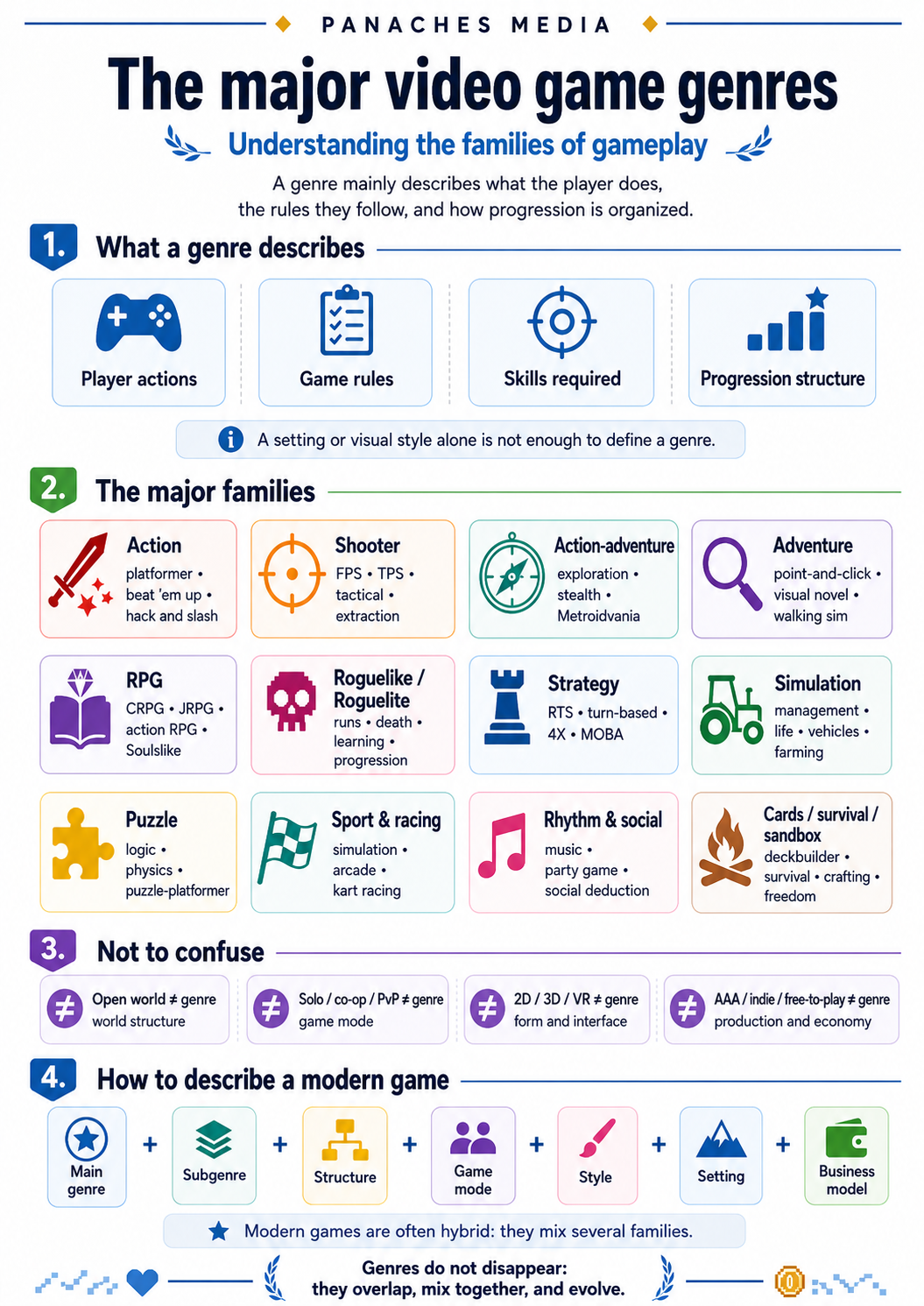
A video game genre therefore mainly tells us what the player does, what rules structure those actions, what skills the game asks them to use, and how progression is organized. Setting, art direction, or multiplayer features then add further layers of description.
That distinction sounds simple, but it clears up a surprising amount of confusion.
There is no official classification
Genre classifications vary between stores, developers, critics, and player communities. A game might be labeled “action” on one platform, “action-adventure” on another, described as an “RPG” by its studio, and extensively discussed as an immersive sim by its players.
There is no universal chart where every game has one final, unquestionable place. Classification is primarily a tool for understanding and communication.
For this article, we will work with the following broad families:
| Broad family | Central question |
|---|---|
| Action | Can I perform the right action quickly enough? |
| Action-adventure | How do combat, exploration, and progression interact? |
| Adventure | How do I understand, explore, and move the situation forward? |
| RPG | How does my character or party evolve? |
| Strategy | Which decision will give me an advantage over time? |
| Simulation | How does the system placed in my hands behave? |
| Puzzle | How do I solve the problem in front of me? |
| Sports | How do I master the rules and actions of a discipline? |
| Racing | How do I control speed, trajectory, and competition? |
| Rhythm / music | How do I synchronize my actions with time? |
| Party / social | What emerges from interaction between players? |
| Cards / board games | How do I use rules, chance, information, and combinations? |
Around those major families sit dozens of subgenres, some decades old, others born when one influential game inspired an entire wave of developers to explore the same idea.
Action — when execution becomes central
Action games usually place execution at the heart of the experience. The player has to move, aim, jump, dodge, strike, block, or time their movements precisely enough to respond to what happens on screen.
That does not mean thinking disappears. A good action game may demand anticipation, system knowledge, or careful reading of the opponent. The difference is that decisions often have to be translated into movement very quickly.
Platformers
Platform games organize the experience around movement through space: running, jumping, avoiding obstacles, reaching new areas, or using the character’s abilities to navigate the level.
Super Mario Bros., Sonic the Hedgehog, Crash Bandicoot, and Celeste all belong to this broad tradition, while also showing how flexible it can be. Platformers may be 2D or 3D, focus on precision, include combat and exploration, or turn movement itself into a puzzle.
Fighting Games
Fighting games build their core system around direct confrontation between characters. Street Fighter, Tekken, Mortal Kombat, and Super Smash Bros. follow very different philosophies, but all place heavy emphasis on positioning, timing, distance, opponent reading, and mastery of available moves.
Behind the visual spectacle there is often an extremely precise discipline.
Beat ’em up / Brawler
Beat ’em ups keep close-range combat but change the scale of the confrontation. Instead of fighting a single opponent, the player usually moves through areas filled with groups of enemies.
Final Fight, Streets of Rage, and various Teenage Mutant Ninja Turtles games helped define that tradition.
Hack and Slash
The term hack and slash can refer to different traditions depending on context, but it is often used for action games built around fast, expressive close-range combat and elaborate attack chains.
Games such as Devil May Cry and Bayonetta illustrate this highly expressive approach to fighting. The boundary becomes less clear when statistics and equipment systems begin pulling the game toward Action RPG territory.
Shoot ’em up
Shoot ’em ups place the player against large numbers of enemies and projectiles, often within tightly structured spaces. Space Invaders, Gradius, R-Type, and Ikaruga represent very different stages of that history.
When projectile density becomes one of the defining challenges, we enter the territory of the bullet hell, where reading space and moving precisely can matter almost as much as firing.
Run and Gun
Run-and-gun games combine rapid movement with constant shooting. The name is refreshingly honest about the concept.
Contra and Metal Slug are two of the genre’s major references: move forward, dodge, shoot, and survive levels that rarely give you much time to admire the scenery.
Shooter — when gunplay organizes the experience
Shooters are broad enough to feel almost like a family of their own. The general idea is simple: aiming and firing are central, but camera perspective, pacing, lethality, level design, and objectives can create radically different experiences.
FPS — First-Person Shooter
In an FPS, the world is primarily seen from the character’s point of view. Doom, Quake, Half-Life, Counter-Strike, and Call of Duty all belong to this family despite very different design philosophies.
The perspective gives particular importance to direct spatial perception, movement, and precision.
TPS — Third-Person Shooter
Third-person shooters usually position the camera behind or around the player character. That distance makes it easier to read the character’s body, cover, and nearby environment.
Gears of War, Max Payne, The Division, and Splatoon all use this perspective in very different ways, reminding us once again that camera position alone never explains an entire game.
Tactical Shooter
Tactical shooters shift attention toward coordination, positioning, information, preparation, and generally higher lethality. Equipment, terrain knowledge, and teamwork can matter as much as pure aiming speed.
Rainbow Six and ARMA explore this philosophy in very different ways.
Arena Shooter
Arena shooters emphasize speed, mobility, and map knowledge. Weapons and resources are often placed directly in the environment, forcing players to control space as much as they control their aim.
Quake III Arena and Unreal Tournament remain two of the clearest examples of this approach.
Hero Shooter
Hero shooters combine gunplay with characters who have unique abilities, roles, and sometimes strong team synergies. Character choice therefore directly shapes both playstyle and team composition.
Overwatch played a major role in bringing this terminology into mainstream contemporary gaming language.
Extraction Shooter
Extraction shooters build much of their tension around a distinctive loop: enter an area, collect resources or complete objectives, then successfully leave.
The danger is therefore not just dying. Failure may also mean losing part of what you were carrying. Escape from Tarkov helped popularize this structure on a large scale.
A single game can therefore be an FPS, tactical shooter, multiplayer game, and extraction shooter at the same time. Genre is already starting to behave less like a box and more like a stack of layers.
Action-adventure — exploring as much as fighting
Action-adventure is one of gaming’s largest hybrid territories. The player directly controls the action and often fights enemies, but must also explore environments, understand spaces, find paths, solve situations, and progress through a broader structure.
The Legend of Zelda, Tomb Raider, and Uncharted come from different traditions, but all illustrate the meeting point between action and exploration.
In these games, the environment is no longer just the backdrop for action. It becomes part of the problem to understand.
Stealth
Stealth turns information management into a mechanic. The player has to observe movement patterns, understand routes, exploit blind spots, manipulate attention, and decide whether to bypass or neutralize threats.
Metal Gear Solid, Splinter Cell, and Hitman offer three very different interpretations of this idea.
Sometimes the best fight is the one you never have.
Survival Horror
Survival horror does more than use horror as an aesthetic. It turns fear into systems through vulnerability, limited resources, scarce ammunition, dangerous enemies, and exploration under pressure.
Resident Evil and Silent Hill are among the genre’s clearest historical landmarks, even though they approach horror very differently.
“Horror” mostly describes a mood or emotional intention. Survival horror also describes a way of playing.
Metroidvania
The term Metroidvania grew from the combined influence of Metroid and Castlevania. It generally describes games built around interconnected worlds where new abilities gradually unlock previously inaccessible areas.
The player may discover a door, height, or obstacle early on and only gain the ability to overcome it much later. The world becomes a form of spatial memory: progress depends not only on discovering new places, but also on remembering old barriers.
Hollow Knight and the Ori games show how alive this structure still is.
Adventure — understanding, observing, and progressing
Adventure games generally give more importance to exploration, storytelling, dialogue, puzzles, and understanding the world than to rapid execution.
The genre has evolved enormously since the earliest computer adventures and now includes several very different traditions.
Text Adventure / Interactive Fiction
In text adventures, the world primarily exists through writing. The player reads descriptions of situations and then selects or formulates actions.
This format belongs to the historical roots of computer adventure games and proves that interactive experiences do not need complex visual representation to create spaces worth exploring.
Point-and-Click
Point-and-click adventures turn curiosity into the main interaction loop: inspect a scene, talk to characters, collect objects, and understand how to use them to solve problems.
Monkey Island, Broken Sword, and Day of the Tentacle all belong to a tradition where the cursor becomes almost a tool for mentally taking the environment apart.
Modern Graphic Adventure
Some more recent forms shifted attention toward dialogue, choices, and consequences. Telltale’s games contributed greatly to this evolution, emphasizing interactive storytelling where the main interest lies less in traditional puzzles and more in decisions made throughout the narrative.
Walking Simulator
The term “walking simulator” was initially often used dismissively before gradually becoming accepted as a label for experiences centered on movement, observation, environmental storytelling, and indirect narrative.
Dear Esther, Gone Home, and Firewatch show different ways of using physical space as a storytelling medium. The actions required of the player may be simple, but what they discover through those actions does not have to be.
Visual Novel
Visual novels combine text, illustrations, dialogue, and sometimes choices or branching narratives. Particularly prominent in Japan but by no means exclusive to it, the format sits between video games, interactive novels, and digital fiction.
Whether every visual novel should be considered a game is still debated from time to time, which is ultimately a rather good reminder of both the usefulness and the limitations of genre labels.
RPG — evolving a character and their possibilities
RPG stands for Role-Playing Game. Its video game history is deeply connected to tabletop role-playing, from which it inherited character attributes, skills, equipment, progression, and different forms of decision-making.
The genre has become so broad that two modern RPGs may share a handful of basic ideas while still feeling as though they belong to completely different worlds.
Western RPG / CRPG
The term CRPG historically refers to computer role-playing games and to traditions strongly influenced by tabletop systems.
Games and series such as Ultima, Baldur’s Gate, Fallout, and Divinity: Original Sin often place strong emphasis on statistics, dialogue, character building, decisions, and interaction with complex systems.
Freedom here does not only come from how much physical space can be explored. It also comes from how many different ways a situation can be approached.
JRPG
JRPG, or “Japanese Role-Playing Game,” developed historically as a way to describe several traditions within Japanese role-playing games.
Dragon Quest, Final Fantasy, Persona, and Chrono Trigger are frequently associated with the category. JRPGs have often been described through predefined protagonists, strongly structured stories, or specific combat systems, but decades of experimentation have made any rigid definition increasingly fragile.
The label is still useful. It simply should not become a box in which every RPG made in Japan is assumed to work the same way.
Action RPG
Action RPGs combine character progression with combat directly controlled by the player. Statistics, equipment, and skills remain important, but execution also plays a major role.
Diablo, Dark Souls, The Witcher 3, and Elden Ring all occupy this broad territory without offering remotely identical experiences.
Action RPG is a perfect example of genre permeability: depending on the game, the balance may lean much more heavily toward action or toward systems inherited from traditional RPG design.
Tactical RPG / Strategy RPG
Tactical RPGs move part of the role-playing experience onto a tactical battlefield. Character development remains important, but positioning, range, terrain, and party composition also become critical.
Final Fantasy Tactics and Fire Emblem are two major examples of this meeting point between RPG and strategy.
MMORPG
The Massively Multiplayer Online Role-Playing Game brings RPG systems into persistent online worlds where very large numbers of players can share the same universe.
Ultima Online, EverQuest, World of Warcraft, and Final Fantasy XIV represent different stages of that history.
The character still progresses, but that growth now takes place inside an economy, a community, and a world designed to continue existing long after any individual player logs off.
Soulslike
The influence of Dark Souls and FromSoftware’s broader design lineage became strong enough to create its own vocabulary.
The term Soulslike is commonly associated with deliberate combat, stamina management, dangerous enemies, rest points structuring exploration, meaningful consequences for death, and demanding boss encounters. Many games also borrow a form of indirect storytelling or worldbuilding associated with this tradition.
These characteristics should not be treated like a mechanical checklist. Adding a dodge roll to a game does not instantly turn it into a Soulslike — which mercifully saves us from having to classify Tetris that way.
Roguelike and Roguelite — restarting is part of the design
The terms roguelike and roguelite are now everywhere, sometimes at the cost of clarity.
Both trace their lineage back to Rogue. Historically, roguelikes were associated with a much more specific collection of traits than simply repeating runs: procedural generation, systemic interaction, traditionally grid-based movement, and permanent death were all central to the classic definition.
Modern usage has expanded considerably.
Roguelite
Roguelite is commonly used for games built around repeated runs while preserving some form of permanent progression between attempts.
Hades, Dead Cells, and Rogue Legacy all explore different versions of this structure.
Part of the appeal comes from two parallel forms of progression. The character may become stronger between runs, but the player also improves by learning enemy behavior, level structures, item interactions, and the consequences of their decisions.
Roguelite mechanics now appear in shooters, platformers, deckbuilders, Action RPGs, and strategy games. In many cases, they therefore describe less of a setting or aesthetic than a structure of repetition and progression.
Strategy — winning through decisions
Strategy games shift the focus toward decisions that matter over the medium and long term. Execution may still be important, especially in real-time games, but success depends heavily on managing resources, positions, information, production, economies, units, or technologies.
The challenge is not simply acting quickly. It is understanding which action will create an advantage later.
RTS — Real-Time Strategy
In an RTS, the game continues to evolve while the player thinks. You have to build, produce, move units, attack, and react without time stopping.
Dune II, Command & Conquer, StarCraft, and Age of Empires all played major roles in defining this tradition.
The tension comes precisely from the meeting point between planning and execution: even the best strategy in the world becomes less useful if it arrives thirty seconds too late.
TBS — Turn-Based Strategy
Turn-based strategy divides time into discrete turns, giving players more room to think between decisions.
Civilization is one of the best-known examples. Each choice may be made calmly, while its consequences can unfold dozens or even hundreds of turns later.
Turn-Based Tactics
Tactical games usually reduce the scale. Instead of managing an empire or huge army, the player controls a small group of units across a battlefield where positioning, cover, range, and synergy become essential.
XCOM is one of the most recognizable examples.
The difference between strategy and tactics is therefore less about whether thinking is involved than about scale. Deciding whether to start a war is not exactly the same problem as deciding how to cross a room without losing half your squad.
4X
The term 4X traditionally refers to four verbs: Explore, Expand, Exploit, Exterminate.
Civilization, Endless Space, and Stellaris offer different interpretations of this structure, often centered on civilizations, empires, or societies developing over extremely long games.
Some campaigns last long enough to make actual human history feel oddly impatient.
Grand Strategy
Grand strategy pushes scale and systemic complexity even further. Diplomacy, economy, politics, armies, dynasties, and historical events may all interact within the same campaign.
Series such as Crusader Kings and Europa Universalis show how this approach can turn a map into a network of relationships rather than a simple battlefield.
Tower Defense
Tower defense games usually send waves of enemies along paths or toward an objective while the player constructs and organizes defenses.
The concept is easy to understand. Optimizing it is much harder, because each placement changes how resources, attack ranges, and enemy routes can be exploited.
MOBA
The Multiplayer Online Battle Arena generally places two teams on a map organized around lanes, objectives, and a base to defend or destroy. Each player controls a character with a specific role and develops temporarily during the match.
Dota 2 and League of Legends remain the two clearest modern references.
The MOBA emerged historically from custom maps and modifications rooted in real-time strategy, but its identity has become strong enough to function as a genre in its own right.
Auto Battler
Auto battlers shift strategy once again. Players select, combine, and position units, then allow much of the combat itself to resolve automatically.
The real game therefore lies in composition, synergy, economy, and placement. Combat becomes the visible consequence of decisions made beforehand.
Simulation — understanding a system by manipulating it
“Simulation” covers an enormous territory. It can describe an extremely demanding flight simulator or a game about managing a virtual family that appears to have developed a philosophical objection to cleaning dishes.
What connects these experiences is not necessarily realism, but the desire to model a system that the player can observe and influence.
Vehicle Simulation
Cars, aircraft, trains, trucks, and ships can all become the center of a simulation. Realism varies dramatically, from accessible interpretations to highly detailed models of real-world behavior.
Microsoft Flight Simulator clearly belongs toward the ambitious end of that spectrum.
Construction and Management
Construction and management games ask the player to develop and administer systems such as cities, parks, networks, companies, or other interconnected structures.
SimCity, Cities: Skylines, RollerCoaster Tycoon, and Planet Zoo each explore that idea differently.
Roads, money, population, services, and satisfaction quickly become a small machine for generating chaos. And yes, that interchange you built at three in the morning eventually sends the bill.
Life Simulation
The Sims remains the most immediately recognizable example of this family. The player influences characters, their needs, relationships, homes, jobs, and social lives.
There may be no conventional victory condition. Much of the appeal comes from observation, experimentation, and the stories produced by the system.
Farming / Cozy Simulation
Games such as Stardew Valley and Story of Seasons mix farming, relationships, construction, and daily progression.
These experiences often place less emphasis on competition and more on routine, gradual improvement, and the creation of a personal space. The term “cozy” therefore describes an intended experience as much as any specific mechanical system.
God Game
God games generally place the player at a scale above individual characters. The player influences populations, civilizations, belief systems, or ecosystems.
Populous and Black & White belong to this tradition, where you do not necessarily control every individual directly, but instead influence the conditions under which the entire system develops.
The special case of the Immersive Sim
The name “immersive sim” can be misleading. It does not simply mean a simulation that happens to be immersive.
Deus Ex, System Shock, Dishonored, and Prey are commonly associated with a design tradition built around coherent systems that can interact and offer multiple solutions to the same problem.
A locked door might be opened with a key, hacked electronically, bypassed through a window, reached through a special ability, or suddenly become irrelevant after the player creatively explodes something the developers may not have expected anyone to explode.
The point is not to create one scripted solution for every situation, but to build systems capable of producing several possibilities.
Immersive sims therefore show how some genre labels describe less a specific type of action than a philosophy of game design.
Puzzle — when the problem becomes the opponent
In puzzle games, difficulty primarily comes from understanding the problem itself. The player may have to reason about logic, space, sequence, patterns, physics, or time.
Classic Puzzle
Tetris remains perhaps the most universal example. Its basic principle can be understood in seconds, while mastery may take a lifetime.
That gap between simple rules and emergent depth is one of the great strengths of puzzle design.
Physics Puzzle
Physics puzzles turn the behavior of simulated physical systems into a central part of problem-solving.
Portal became one of the best-known examples by taking a relatively simple spatial idea and gradually developing it into increasingly sophisticated problems.
Puzzle-Platformer
Puzzle-platformers combine movement and reasoning. Reaching a platform is no longer just a question of execution; understanding how space or time behaves becomes part of the puzzle itself.
Braid and Inside offer two very different interpretations of that meeting point.
Narrative / Exploration Puzzle
Puzzles can also be integrated into much larger worlds where exploration and environmental understanding become part of the solution.
The Witness and The Talos Principle show how puzzle systems can support experiences that go far beyond a simple sequence of isolated challenges.
Sports — between simulation and reinterpretation
Sports games use the rules, gestures, or imagery of existing disciplines: football, basketball, tennis, golf, skateboarding, boxing, wrestling, and many others.
But representing a sport does not necessarily mean reproducing it faithfully.
Sports Simulation
Sports simulations generally aim to reproduce more of the real discipline’s rules, tactics, teams, and behavior.
Realism here is not only about graphics. It also depends on how accurately the game models decisions, constraints, and performance.
Arcade Sports
Arcade sports games are much more willing to bend reality. Movement can be exaggerated, rules simplified, and impossible abilities introduced.
The real sport becomes raw material rather than a regulation book.
Sports Management
Sports management changes the player’s role entirely. In Football Manager, “playing football” mostly means recruiting players, analyzing performances, organizing a squad, managing contracts, and preparing tactics.
The theme remains football, but the gameplay belongs largely to management simulation.
Once again, the subject represented on screen does not define the genre by itself.
Racing — mastering speed and trajectory
Racing games also contain several distinct traditions.
Racing Simulation
Racing simulations seek to reproduce vehicle behavior and the factors that influence it: grip, tires, setup, weather, wear, and other physical considerations.
Assetto Corsa and iRacing push this philosophy particularly far.
Arcade Racing
Arcade racing prioritizes sensation, accessibility, and spectacle over exact reproduction.
Burnout and certain Need for Speed entries turn speed, drifting, and collisions into an experience with very little interest in whether your insurance company would approve.
Kart Racing
Kart racing often adds items, shortcuts, attacks, and defensive mechanics to the basic structure of racing.
Mario Kart is the obvious reference. Racing lines and driving skill still matter, but they coexist with carefully organized chaos — and with the blue shell, whose contribution to the philosophy of justice remains controversial.
Rhythm and music — when time becomes the mechanic
In rhythm games, timing is not simply a constraint. It becomes the central form of interaction.
The player may press buttons, dance, sing, strike objects, or use specialized hardware in synchronization with music.
Dance Dance Revolution, Guitar Hero, Rhythm Heaven, and Beat Saber show how much the interface can change while the underlying principle stays recognizable.
Gamepad, dance mat, plastic guitar, body movement, or virtual reality all change how the player acts. The central idea remains the same: do the right thing at the right time.
Party Games and social games — when the players become part of the system
Some games are designed less around individual mechanical performance and more around what happens between the people playing them.
Mario Party and the Jackbox collections use mini-games, randomness, communication, and competition to create situations whose appeal extends far beyond the screen.
The software provides the rules. The players provide the rest — including family betrayals that may continue to be mentioned fifteen years later.
Social Deduction
Mafia, Werewolf, and Among Us build their gameplay around hidden information.
Some players know things that others do not. Lying, observing, convincing, accusing, and deducing become the real actions at the center of play.
The main system no longer exists entirely in the software. Part of it lives in the psychology of the group.
Card games, deckbuilding, and digital board games
Video games have naturally absorbed a huge amount of vocabulary and design from physical games.
Collectible Card Game / Digital Card Game
Digital card games often revolve around deck construction, synergies, probabilities, and resource or information management.
Hearthstone and Magic: The Gathering Arena are two major examples.
Deckbuilder
In deckbuilders, the deck is usually constructed during the run or campaign rather than entirely beforehand.
Slay the Spire helped popularize the particularly effective combination of deckbuilding and roguelite structure, demonstrating how two compatible systems can generate an entire new family of games.
Digital Board Games
Video games can directly adapt chess, traditional card games, and tabletop games, or create entirely new experiences inspired by physical game mechanics.
At that point, the difference between a board game and a video game can become less a matter of rules than of medium and interface.
What about Battle Royale?
Battle royale is a strong example of a modern genre defined primarily by match structure.
A large number of players enter an area that gradually becomes smaller, elimination plays a central role, and one player or team is eventually left standing.
PUBG, Fortnite, and Apex Legends all played major roles in popularizing the format.
But a battle royale can be an FPS, TPS, or use an entirely different combat model. What defines it is therefore not necessarily what the player does every second, but the overall structure of the match: many participants, elimination, increasing spatial pressure, and survival until the end.
Survival — when staying alive becomes progression
Survival games make needs such as hunger, thirst, temperature, resource gathering, crafting, or construction central to the experience.
The Forest, Subnautica, Rust, and certain modes of Minecraft all explore that idea in very different ways.
Survival combines especially well with crafting, sandbox design, multiplayer, horror, and open worlds. Its ability to absorb several systems at once is one reason it has become such an important part of modern game design.
Sandbox — playing with possibilities
The term sandbox generally describes a structure that gives players considerable freedom to experiment with the systems available to them.
Minecraft and Garry’s Mod are two particularly clear examples.
A predefined objective may become secondary compared with the possibility of building, modifying, experimenting, or creating entirely new situations.
Sandbox therefore often works more as a structure of freedom than as a closed genre. An RPG, survival game, or simulation can all adopt a sandbox philosophy.
Open world is not really a genre
This distinction matters.
Open world mainly describes how space is organized and how freely the player can move through it.
Grand Theft Auto V, The Witcher 3, Forza Horizon, and Elden Ring all use open worlds, yet their core experiences are radically different.
“Open world” therefore answers a question closer to:
What kind of space will I move through, and how freely can I explore it?
rather than:
What will I actually be doing in this game?
An open world can host an RPG, racing game, shooter, survival game, or almost any other genre.
Single-player, multiplayer, and co-op are not genres either
Single-player, co-op, PvP, PvE, MMO, and split-screen mainly describe how the player relates to other participants and opponents.
An FPS can be single-player or multiplayer. An RPG can be fully solo or take the form of an MMO. A survival game may be cooperative, competitive, or both.
These terms are therefore better understood as play modes layered on top of genre.
Cross-play belongs to yet another category: it describes a technical feature allowing users on different platforms to play together.
2D, 3D, VR, and pixel art are not genres
The same logic applies to several other labels that are frequently mixed together.
2D and 3D mainly describe spatial representation. Pixel art is an aesthetic approach. VR describes a technology and interface. “Anime,” “realistic,” or “low-poly” refer to visual styles.
Fantasy, cyberpunk, western, and science fiction mostly describe settings. Horror often describes mood and emotional intention.
All of these can be combined with many different genres. A game can therefore be a 3D cyberpunk RPG, a 2D pixel-art puzzle game, a horror VR FPS, a fantasy strategy game, or a science-fiction visual novel without contradiction.
The important thing is simply to remember that these terms are not all describing the same layer.
AAA, indie, and free-to-play are still not genres
AAA, indie, and free-to-play belong to yet another set of categories.
AAA mostly refers to production scale and investment. Indie describes a production or publishing situation, though the reality behind the term can vary enormously. Free-to-play describes an access model and generally part of the business model.
An indie game can be an RPG. A AAA release can be a racing game. A free-to-play game can be a MOBA.
These labels matter when discussing the industry, but they do not tell us directly what happens when the player starts playing.
So how should we describe a game?
One label is rarely enough for a modern video game.
Imagine, for example:
An open-world Action RPG playable in co-op, with Soulslike progression and survival elements.
Each label is describing a different layer:
| Label | What it describes |
|---|---|
| Action RPG | The core gameplay |
| Open world | The structure of the space |
| Co-op | The social mode |
| Soulslike | A combat and progression tradition |
| Survival | Certain systems and constraints |
We could still add a fantasy setting, 3D presentation, premium business model, or particular visual style without changing the main genre.
Modern games therefore look less like a branching tree where every title eventually falls into one single category and more like a combination of overlapping characteristics.
Broadly speaking, we can distinguish several layers:
- main genre, describing the central interaction;
- subgenre, refining a tradition or variation;
- structure, such as open world, sandbox, or roguelite;
- play mode, such as single-player, co-op, or PvP;
- representation and technology, such as 2D, 3D, or VR;
- visual style and setting, such as pixel art, fantasy, or cyberpunk;
- production or access model, such as indie, AAA, or free-to-play.
Not every game needs every layer. The framework simply explains why multiple labels can coexist without contradicting one another.
The major families at a glance
| Family | Common subgenres or forms |
|---|---|
| Action | platformer, fighting, beat ’em up, hack and slash, shoot ’em up, run and gun |
| Shooter | FPS, TPS, tactical shooter, arena shooter, hero shooter, extraction shooter |
| Action-adventure | stealth, survival horror, Metroidvania |
| Adventure | interactive fiction, point-and-click, graphic adventure, walking simulator, visual novel |
| RPG | CRPG, JRPG, Action RPG, Tactical RPG, MMORPG, Soulslike |
| Roguelike | traditional roguelike, roguelite, hybrid forms |
| Strategy | RTS, TBS, tactics, 4X, grand strategy, tower defense, MOBA, auto battler |
| Simulation | vehicles, management, life simulation, farming, god games |
| Puzzle | logic, physics, puzzle-platformer, integrated puzzle systems |
| Sports | simulation, arcade, management |
| Racing | simulation, arcade, kart racing |
| Rhythm / music | rhythm, dance, instruments, VR music games |
| Party / social | mini-games, social deduction, group games |
| Cards / board games | CCG, deckbuilder, digital adaptations of physical games |
| Survival / Sandbox | survival, crafting, construction, experimentation |
| Battle Royale | large arena, elimination, survival until the final player or team |
Even this map is not definitive.
That is probably a good thing.
Genres evolve mostly by meeting each other
The history of video game genres is not a clean succession in which one category replaces another. Forms overlap, transform, and constantly borrow ideas from each other.
RPGs did not replace action games. Their meeting helped create the Action RPG. RTS design indirectly contributed to the birth of the MOBA. Roguelike ideas escaped their historical framework and entered shooters, deckbuilders, platformers, and action games. Metroidvania combines spatial exploration with ability-based progression. Battle royale often combines shooting, survival, and competitive multiplayer.
Even when a new genre name appears, it rarely describes something created entirely from scratch.
Game design works more like an enormous construction set. A developer takes an old mechanic, combines it with another, changes the scale, moves the camera, or redesigns the progression structure. If the combination produces something distinctive enough — and other developers begin exploring it too — a new term may eventually appear.
Classification follows creation far more often than creation follows classification.
A genre is also a promise to the player
If genre labels are imperfect, why do we keep using them?
Because they are incredibly useful.
Writing “FPS” obviously does not explain an entire game, but it immediately creates certain expectations: first-person perspective, movement through space, and gunplay.
“RPG” usually suggests character progression, skills, statistics, equipment, or some form of character building.
“Strategy” suggests planning and decision-making. “Puzzle” suggests that understanding a problem will be part of the challenge.
Genre therefore acts as a minimal promise. It gives the player enough information to imagine what kind of attention, reasoning, or dexterity the game is likely to demand.
Only then can the game begin to bend that promise, combine it with others, or surprise us with what it does differently.
Will tags eventually replace genres?
The more hybrid games become, the less useful rigid classification becomes. Digital stores already show this clearly: one game may simultaneously carry tags such as action, RPG, co-op, difficult, open world, fantasy, crafting, exploration, narrative, or Soulslike.
Those labels do not all describe the same dimension. That is precisely why the combination works.
A broad family such as “RPG” remains extremely useful for orientation, but tags can then refine the description far more precisely.
Genres are therefore unlikely to disappear completely. We will probably continue talking about FPS, RPGs, strategy games, and adventures because those families remain effective shortcuts.
Around them, however, subgenres, structures, play modes, settings, and tags will continue to gain importance.
Video games have always had a complicated relationship with boxes. The moment one category becomes comfortable, some designer inevitably borrows a mechanic from the box next to it, shifts a rule, or breaks a boundary simply to see what happens.
And that is often how a new genre begins.