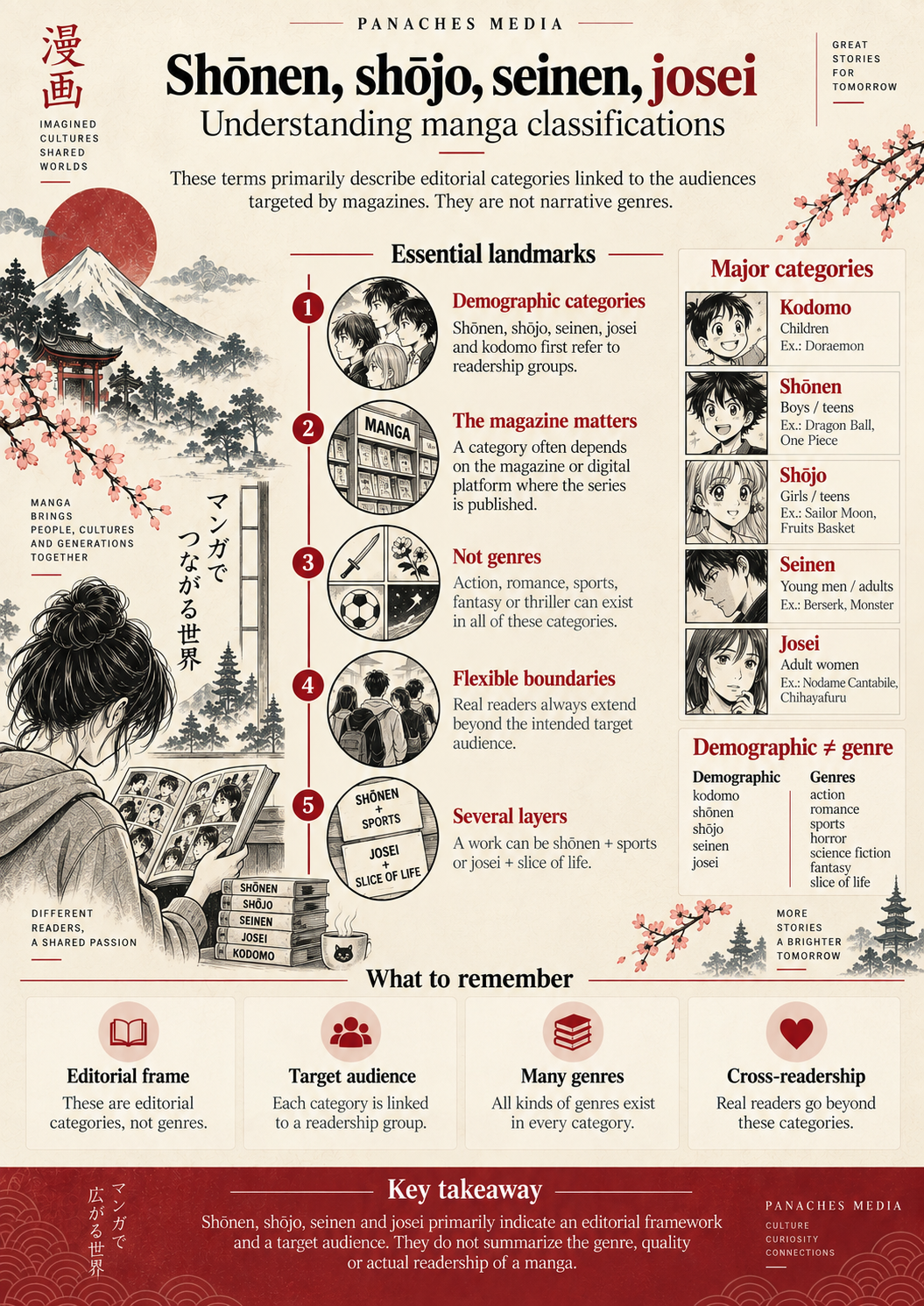
Editorial categories, not genres
One Piece is a shōnen. Sailor Moon is a shōjo. Berserk is a seinen. Nodame Cantabile is a josei.
At first glance, these words seem to work like genres. It would be easy to assume that shōnen means action, shōjo romance, seinen adult storytelling and josei sentimental stories aimed at women.
That reading is convenient.
It is also largely wrong.
The terms shōnen, shōjo, seinen and josei primarily come from the way the Japanese manga industry organized its magazines and audiences. They do not directly describe what a work is about, but rather which readership a publication was historically intended for.
The word shōnen refers to boys and teenage boys. Shōjo refers to girls and teenage girls. Seinen refers to young men and adults. Josei refers to adult women.
This distinction is fundamental because it explains why two manga placed in the same category can tell stories that have almost nothing in common.
A demographic category primarily indicates who a publisher expects to address. It defines neither the genre of the story, nor the real age of all its readers, nor the quality of a work.
Understanding manga therefore requires separating two things that are very often confused: editorial demographics and narrative genre.
It all starts with magazines
The origin of this classification is closely linked to the historical structure of Japanese manga publishing.
For much of the twentieth century, manga series did not begin their lives directly as collected volumes. They were first published chapter by chapter in specialized magazines.
These magazines had very strong identities.
Weekly Shōnen Jump, Weekly Shōnen Magazine and Weekly Shōnen Sunday already make their positioning clear in their names: historically, they belong to the shōnen press.
Other publications target teenage girls, young adults, adult men or adult women.
For a long time, manga publishing was therefore organized around a simple principle: a magazine identifies a readership, then builds an editorial line designed to keep that audience coming back.
That does not mean every title in the same magazine looks alike.
Quite the opposite.
A magazine can simultaneously publish a sports series, a comedy, an action story, a thriller and a fantasy adventure. Their common point is not necessarily genre, but the editorial environment in which they appear.
This logic also explains why the classification of a work often depends more on where it was published than on its apparent content.
A violent manga is not automatically seinen.
A romance is not automatically shōjo.
A manga in which teenagers fight monsters is not automatically shōnen.
To understand the category properly, you have to look at where the work was published and which audience it was primarily intended for.
Five major demographic landmarks
Japanese publishing segmentation is more complex than a simple table, but a few major categories provide useful reference points.
| Category | Historical target audience | Some examples |
|---|---|---|
| Kodomo | Children | Doraemon, Pokémon Adventures |
| Shōnen | Boys and teenagers | Dragon Ball, One Piece, Naruto, Haikyū!! |
| Shōjo | Girls and teenage girls | Sailor Moon, Cardcaptor Sakura, Fruits Basket |
| Seinen | Young men and adults | Berserk, Monster, Vagabond, Vinland Saga |
| Josei | Adult women | Nodame Cantabile, Chihayafuru, Princess Jellyfish |
These categories are useful for understanding the history of Japanese publishing.
They become much less reliable when treated as rigid boundaries.
An adult man can read Sailor Moon. A teenage girl can love Berserk. A sixty-year-old reader can follow a shōnen manga every week.
The real readership never perfectly matches the intended readership.
It works much like a film marketed as “family entertainment”: the label suggests an orientation, not the identity of every person sitting in the audience.
Shōnen: fighting is only part of the picture
Shōnen is now the most internationally visible category.
The enormous success of Dragon Ball, Naruto, One Piece, Bleach and My Hero Academia has helped create a very specific image in the collective imagination: a teenage hero, progression, training, rivals, battles, new techniques and a final confrontation.
That formula genuinely exists.
It has produced some of the most popular series in manga history.
But it does not define shōnen.
Haikyū!! is about volleyball.
Death Note is built primarily around an intellectual duel.
The Promised Neverland begins as a thriller set in an orphanage.
Dr. Stone uses science as the driving force behind an adventure of reconstruction.
Frieren develops a melancholic reflection on time, memory and loss.
All of these works nevertheless belong to the shōnen publishing world.
Their common ground lies less in subject matter than in certain publishing traditions: accessible storytelling, characters capable of significant growth, regular pacing, the desire to retain a teenage readership and the ability to sustain a story over time.
Even these tendencies are not obligations.
Shōnen remains above all an editorial space broad enough to contain extremely different stories.
Shōjo: far more than a love story
Shōjo suffers from another particularly persistent shortcut.
In many Western classifications, it is almost automatically associated with romance.
That association has a historical basis: romantic relationships, emotions and human bonds occupy an important place in many shōjo works.
But shōjo is no more limited to romance than shōnen is limited to fighting.
Sailor Moon combines romance, action, fantasy and fighting heroines.
Cardcaptor Sakura develops a world of magic and adventure.
Other works explore family drama, science fiction, history, comedy, the supernatural or psychology.
One of shōjo manga’s major contributions also lies in graphic experimentation.
Some creators moved far beyond the traditional grid of regular panels: portraits can spread across the page, symbolic backgrounds appear, floral motifs emerge, images overlap and panel borders partially disappear in order to represent emotions and thoughts directly.
During the 1970s, creators such as Moto Hagio, Keiko Takemiya and Riyoko Ikeda played an especially important role in this renewal.
Shōjo is therefore not only important because of the stories it tells.
It also profoundly expanded the ways a manga page itself can tell a story.
Seinen: adult does not necessarily mean dark
The word seinen is often used as a synonym for “mature manga”.
That definition works up to a point.
Seinen magazines can indeed offer stories that are more violent, complex or explicitly aimed at adult readers. Berserk, Monster, Vagabond and Ghost in the Shell fit reasonably well with the image many readers associate with the category.
But once again, the diversity is enormous.
Seinen can also tell a comedy, a romance, a sports story or an entirely peaceful slice of everyday life.
The category does not automatically promise blood, sex, philosophy or a complicated plot.
It primarily indicates an editorial orientation toward an older male readership than shōnen.
That difference in audience can obviously influence certain subjects, pacing choices or approaches to characters. But it does not create a mandatory aesthetic.
A seinen manga can be spectacular.
It can also be contemplative, absurd or deeply ordinary.
Josei: a category that is often less visible
Josei is generally less familiar to mainstream Western audiences.
Historically, it developed as part of publishing aimed at adult women, often featuring older characters than those usually found in shōjo.
Romantic relationships may play an important role, but work, friendship, family, life choices and everyday difficulties can also become central.
Nodame Cantabile, for example, combines classical music, comedy and human relationships.
Princess Jellyfish blends identity, fashion, marginality and comedy.
Chihayafuru builds much of its story around competitive karuta, while also developing the ambitions and relationships of its characters.
Josei is therefore not simply “the adult version of shōjo romance”.
It is a broader editorial space in which adult experiences and concerns can take many different forms.
Kodomo: manga also begins with children
The kodomo category is sometimes forgotten when presenting manga’s major demographic families.
It refers to works primarily aimed at children.
The artwork often favors clarity, easily identifiable characters and stories accessible to younger readers. That does not mean these works lack depth or cannot appeal to adults.
Doraemon is the emblematic example.
The adventures of Nobita and the robot from the future rely on a structure simple enough for children, while regularly addressing responsibility, friendship, laziness, jealousy or the consequences of our choices.
This category reminds us of something important: manga can accompany readers from childhood onward, while the publishing industry historically offers different editorial spaces as they grow older.
Demographics and genre: two different pieces of information
To avoid mixing up the terminology, one distinction is usually enough.
Demographics answer:
“Which audience is this publication primarily aimed at?”
Shōnen, shōjo, seinen, josei and kodomo belong to this logic.
Genre answers:
“What kind of story is being told?”
Action, adventure, romance, horror, science fiction, fantasy, sport, thriller, comedy and slice of life belong more closely to this second logic.
The two can then be combined.
A manga can therefore be:
- shōnen + sport;
- shōjo + fantasy + romance;
- seinen + thriller + science fiction;
- josei + slice of life + romance.
A single work can of course combine even more genres and themes.
This layering is precisely why classifications become confusing when we try to force every manga into a single box.
Isekai, mecha, yuri, boys’ love: something else again
Manga vocabulary contains many other terms that can give the impression of belonging to the same system.
That is not always the case.
Isekai generally describes stories in which a character is transported or reincarnated into another world.
Mecha refers to stories where giant robots or piloted machines play an important role.
Slice of life describes an approach more focused on everyday experience.
Boys’ love and yuri, meanwhile, refer to storytelling traditions centered on relationships between characters of the same sex, with their own publishing histories and readerships.
These terms can overlap with demographic categories.
An isekai is not automatically shōnen.
A mecha manga can be aimed at teenagers or adults.
A romance does not become shōjo simply because it tells a love story.
The system therefore resembles less a row of drawers than several descriptive layers placed on top of one another.
A single work can blur the boundaries
The categories become even more interesting when they stop working perfectly.
Some series change magazines.
Others move from print publication to a digital platform.
Some are published within a strongly defined editorial environment but immediately attract a much wider audience than expected.
Digital publishing intensifies this phenomenon.
Apps and reading platforms can now place side by side works historically associated with different demographics. Readers no longer necessarily discover a manga because they buy a magazine designed specifically for their age and gender every week.
They may simply notice a cover, receive a recommendation or follow a link.
The old categories do not disappear.
They remain deeply connected to the history of Japanese manga, editorial teams and publishing brands. But their role evolves.
What was once a very visible segmentation on the newsstand gradually becomes one reference point among many in a much more open digital environment.
Do these categories really influence the works?
Even though these terms do not define genres, it would be wrong to claim that they have no influence on content.
Creators do not work in a vacuum.
Publishing in a magazine means working with an editorial team, a historical readership, a rhythm and a particular identity.
Certain conventions can therefore appear more frequently in some categories.
Shōnen manga have historically developed many stories centered on growth, friendship and self-improvement.
Shōjo played an essential role in developing page compositions focused on emotion and interiority.
Seinen often allows more room for certain adult themes or slower narratives.
But these are historical tendencies, not rules.
Some of the most interesting works are precisely those that use a familiar editorial framework to move somewhere unexpected.
Why these categories are still useful
If they are imperfect and increasingly flexible, why continue using them?
Because they tell an essential part of manga history.
They help explain why certain magazines exist, how publishers organize their catalogues, how graphic traditions developed and why certain works were created within a specific environment.
They can also serve as useful reference points for readers.
Someone who enjoys several series published in seinen magazines may naturally explore other works from the same editorial world.
But these words should remain doors of entry, not barriers.
Reading beyond the labels
Understanding the terms shōnen, shōjo, seinen and josei ultimately means learning to use them more accurately.
A shōnen is not necessarily a battle manga.
A shōjo is not automatically a romance.
A seinen is not automatically smarter or more mature than a shōnen.
A josei is not simply a shōjo whose characters have grown older.
These categories mainly tell us about the editorial history of a work and the audience it was originally intended to reach.
Genre, tone, themes and style come afterward.
Once this distinction is understood, the diversity of manga becomes much easier to read. Dragon Ball, Sailor Moon, Monster and Nodame Cantabile come from different editorial worlds, but none of these labels is enough to explain what they actually tell.
Most importantly, none of them tells us who should read them.
Readers have long moved across these boundaries.
Works do too.
After looking at how manga tells stories and then how the industry classifies its publications, the next step becomes clear: understanding how a series is actually created.
From the first concept to the storyboard, from working with an editor to collaborating with assistants, then from the published chapter to the collected volume, manga production relies on a process that is far more collaborative than it is often imagined to be.
That is the process we will follow next.
Main sources
To explore these classifications further: British Museum for the major demographic categories and their history; Kyoto International Manga Museum for the historical organization of its collections; as well as editorial resources from Shueisha, Kodansha and Shogakukan dedicated to their magazines and different readerships.