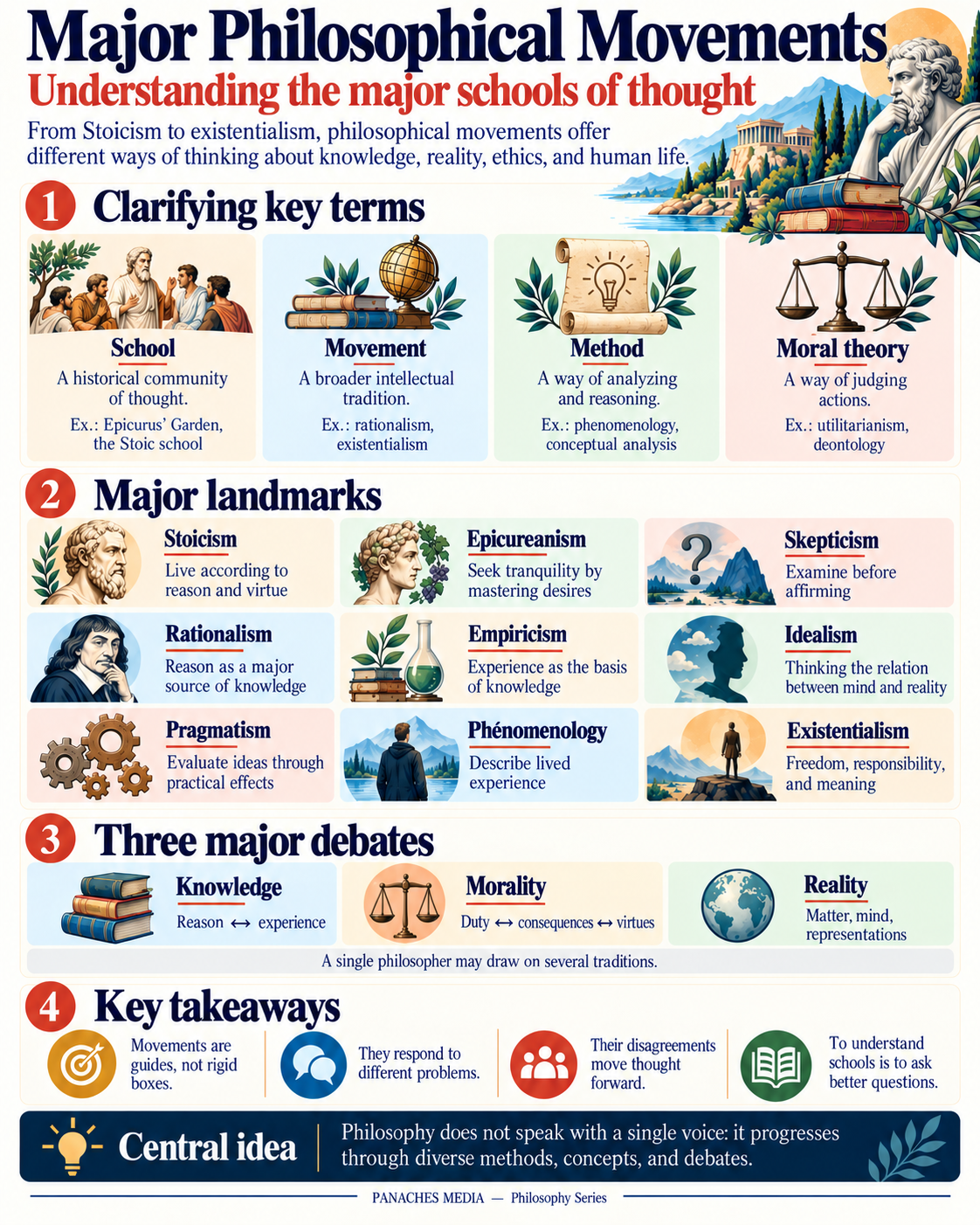
Should we follow reason or trust experience? Does happiness consist in mastering our desires, cultivating virtues, or embracing our freedom? Does the world exist independently of our minds? Since antiquity, philosophers have done more than offer different answers to these questions: they have developed distinct ways of thinking. Stoicism, skepticism, rationalism, empiricism, idealism, existentialism, and pragmatism refer to intellectual traditions that have profoundly shaped the history of ideas. Understanding their differences helps us grasp the great philosophical debates and discover why no school has definitively settled humanity's fundamental questions.
Why Are There So Many Philosophical Movements?
Imagine two people discussing freedom.
For the first, being free means primarily being able to choose without external constraints.
For the second, freedom requires, above all, understanding the causes that shape our desires and decisions.
A third person might argue that genuine freedom is impossible when social conditions prevent certain individuals from developing their possibilities of existence.
All three use the same word, yet they interpret it differently.
Their disagreements do not simply reflect personal preferences. They reveal different conceptions of human beings, responsibility, and the world.
This is precisely what gives rise to major philosophical traditions.
Over the centuries, thinkers have developed sets of concepts, arguments, and methods for addressing fundamental problems. Their ideas have been discussed, transmitted, criticized, and sometimes transformed by successive generations.
Some traditions were organized around actual schools, with teachers, students, and places of instruction.
Others gradually emerged through writings and controversies, sometimes without their representatives considering themselves members of a common movement.
A philosophical movement is therefore not simply an opinion shared by several authors. It is a relatively identifiable way of asking questions, constructing arguments, and understanding certain aspects of reality.
This definition nevertheless remains flexible.
A philosopher may belong to several traditions, move away from them over the course of their life, or develop a philosophy that resists conventional classification.
Movements are tools for understanding the history of ideas, not impassable intellectual boundaries.
Movement, School, Method, or Theory: What Is the Difference?
These expressions are often used interchangeably. Yet they do not mean exactly the same thing.
| Term | What it primarily describes | Example |
|---|---|---|
| Philosophical school | A historically identifiable intellectual community, sometimes organized around a teacher or founder. | Epicurus's Garden, the Stoic school. |
| Philosophical movement | A tradition of thought bringing together several authors around shared problems, ideas, or orientations. | Rationalism, existentialism. |
| Philosophical method | A way of conducting inquiry, analyzing problems, and constructing arguments. | Phenomenology, certain forms of conceptual analysis. |
| Philosophical doctrine | A relatively definite set of claims about a question or field. | Cartesian mind–body dualism. |
| Moral theory | A conception of what makes an action right or a way of living good. | Utilitarianism, deontology, virtue ethics. |
These categories can overlap.
Phenomenology is both a method and a philosophical tradition. Stoicism has an institutional history, but also encompasses theories of logic, nature, and ethics.
Existentialism, by contrast, brings together authors whose doctrines differ considerably, despite certain shared concerns.
We must also distinguish philosophical movements from branches of philosophy.
Metaphysics, epistemology, ethics, and political philosophy designate fields of study. Rationalism, empiricism, and Stoicism represent particular ways of approaching some of their problems.
The same field can therefore accommodate several opposing movements.
An essential distinction: branches of philosophy primarily indicate what we study. Philosophical movements help us understand how different traditions approach problems and what answers they propose.
The Schools of Antiquity: Understanding the World and Learning How to Live
In the ancient Greek world, philosophy gradually developed through intellectual traditions that placed particular importance on discussion, education, and the search for a fulfilled life.
Some of these schools profoundly influenced Western history. Others, less familiar for centuries, have regained importance in contemporary debates.
They do not, however, form a uniform whole.
Their conceptions of knowledge, nature, and happiness can be radically different.
Platonism: Searching for Intelligible Realities
Platonism originated in Plato's writings and the intellectual tradition of the Academy he founded in Athens during the fourth century BCE.
One of its fundamental concerns is the relationship between the things we perceive and the principles that allow us to understand them.
Our everyday experiences confront us with changing realities.
An object deteriorates, a person grows older, and a society transforms its laws and customs.
Yet we use concepts that seem to possess a certain stability: equality, justice, beauty, and number.
How can we explain this contrast?
In several dialogues, Plato develops a reflection on Forms or Ideas, intelligible realities that help account for the properties of sensible things.
The objective is not simply to oppose an imaginary world to the real world.
It is to understand how stable, rational knowledge can be possible when our perceptions concern changing realities.
Platonism also places major importance on education, political organization, and the transformation of philosophical understanding.
But the Platonic tradition did not remain unchanged.
The Academy underwent different intellectual phases, including a period characterized by skepticism. Platonism would subsequently be profoundly transformed by thinkers of Late Antiquity.
Its central legacy: questioning what makes knowledge of things possible beyond their immediate appearances.
Aristotelianism: Explaining Beings Through Their Causes
Aristotelianism draws upon the works of Aristotle, a student of Plato who established his own teaching institution at the Lyceum in Athens.
His approach places fundamental importance on analyzing concrete beings, their properties, and the causes that explain their transformations.
Aristotle does not reject the search for general principles.
He nevertheless considers the study of particular realities, observation, and rigorous conceptual distinctions essential to knowledge.
His philosophy includes an analysis of different kinds of causation.
To understand a statue, for example, we may ask what material it is made from, what form it has, what activity produced it, and what purpose its production serves.
These different levels of explanation allow us to move beyond an overly simple conception of causes.
Aristotelianism also includes inquiries into logic, biology, metaphysics, and ethics.
It would exert considerable influence on Greek, Arabic, Jewish, and Latin intellectual traditions.
However, it would be misleading to describe Aristotelianism as an unchanged doctrine. Medieval and modern philosophers proposed frequently divergent interpretations of Aristotle, sometimes transforming his concepts profoundly.
Cynicism: Challenging Social Conventions
Ancient Cynicism, associated particularly with Antisthenes and Diogenes of Sinope, developed an especially provocative approach to philosophical life.
The Cynics questioned the value of conventions, wealth, and social recognition.
Why do we devote so much energy to acquiring possessions or honors that we do not necessarily need?
In this tradition, the pursuit of a free life requires cultivating personal independence and reducing artificial dependencies.
Philosophy should therefore not remain confined to discourse.
It should concretely transform the way we live.
The anecdotes associated with Diogenes illustrate this critical dimension, although their historical reliability varies.
Ancient Cynicism does not correspond exactly to the contemporary meaning of "cynical," often used to describe a disillusioned or unscrupulous attitude.
It is instead a tradition that challenges dominant social values in order to question what makes a genuinely independent existence possible.
Stoicism: Living According to Reason and Nature
Stoicism was founded by Zeno of Citium around 300 BCE.
It became one of the major philosophical schools of the Hellenistic period and subsequently underwent significant development in the Roman world.
Its representatives include Chrysippus, Seneca, Epictetus, and Marcus Aurelius.
Today, Stoicism is often presented as a method for remaining calm and coping with difficulties.
This dimension exists, but it represents only part of the ancient doctrine.
Stoicism is a philosophical system organized around three major fields:
- Logic, which examines reasoning, knowledge, and the conditions of argumentation.
- Physics, which develops a conception of nature as an organized and intelligible whole.
- Ethics, which seeks to understand how to live according to reason and cultivate virtue.
For the Stoics, the moral quality of our existence does not depend exclusively on external circumstances.
Wealth, reputation, and even health may play a role in our lives, but they do not, by themselves, constitute the foundation of moral happiness.
What matters most is how we judge situations and guide our conduct.
This perspective explains the importance placed on distinguishing what falls within our responsibility from what lies beyond our control.
But it does not mean that the Stoics necessarily encouraged passivity.
Acting justly, participating in collective life, and fulfilling our responsibilities can all belong to a virtuous existence.
The heart of Stoicism is therefore not the absence of emotions: it is the transformation of our judgments and conduct according to a rational conception of life.
Epicureanism: Seeking Pleasure Without Becoming Dependent on Desire
Epicureanism also emerged around the fourth century BCE, within the school founded by Epicurus in Athens.
It makes pleasure a fundamental element of a happy life.
This claim might appear to encourage the constant pursuit of pleasant sensations.
But Epicurus proposes a much more nuanced conception.
He distinguishes different desires and examines their consequences for our peace of mind.
Some needs are relatively easy to satisfy. Others, such as the limitless pursuit of prestige or wealth, risk producing permanent dissatisfaction.
Philosophy should therefore help us recognize which desires genuinely contribute to a happy existence.
Friendship, security, the reduction of suffering, and tranquility of mind occupy essential places in this approach.
Epicureanism also includes a materialist conception of nature, inherited in part from ancient atomism.
Understanding natural phenomena should, among other things, help reduce fears associated with the gods and death.
It would therefore be misleading to summarize this school as a doctrine of immediate pleasure.
Epicureanism seeks to make happiness more accessible by freeing us from desires and fears that unnecessarily perpetuate suffering.
Skepticism: Should We Suspend Judgment?
Skepticism encompasses critical traditions that question human claims to possess certain knowledge.
In antiquity, several skeptical orientations developed, particularly within Plato's Academy and the Pyrrhonian tradition.
Their positions were not perfectly identical.
Skeptics were particularly interested in disagreements between doctrines and the difficulties encountered when attempting to justify a claim.
Imagine two philosophers presenting apparently compelling arguments for opposing conclusions.
How can we determine which one is right?
When arguments do not allow the disagreement to be resolved, certain skeptical traditions propose suspending judgment, an attitude called epochē.
Such suspension does not necessarily mean refusing to act.
It remains possible to live according to ordinary experience and everyday practices without claiming to have established definitive truths about the ultimate nature of things.
Skepticism would exert lasting influence on Montaigne, Descartes, Hume, and numerous debates concerning the foundations of knowledge.
It remains important today, particularly when we must distinguish legitimate intellectual caution from generalized doubt that would prevent all inquiry.
Three Schools, Three Conceptions of a Happy Life
| Question | Stoicism | Epicureanism | Pyrrhonian skepticism |
|---|---|---|---|
| Central concern | Live according to reason and cultivate virtue. | Understand desires and pursue a life free from unnecessary disturbances. | Examine dogmatic claims to truth. |
| Relationship with events | Work on our judgments and actions. | Reduce unnecessary fears and dependencies. | Avoid prematurely accepting uncertain claims. |
| Relationship with happiness | Virtue constitutes the true good. | Pleasure properly understood and tranquility are essential. | Suspension of judgment can encourage tranquility. |
| Common caricature | "Never feel anything." | "Pursue every pleasure." | "Believe nothing and never act." |
All three schools attach great importance to how we live, but they rest on different doctrines.
They are not three interchangeable variations of the same ancient wisdom.
Major Philosophical Traditions Beyond the Greek World
Philosophical schools did not develop exclusively within Greek city-states.
In India, China, and other regions, intellectual traditions developed their own methods, concepts, and controversies.
It would be misleading to classify them systematically through European categories.
Certain similarities exist, particularly concerning logic, morality, and knowledge. Yet the questions, doctrinal frameworks, and contexts of their development can be very different.
Nyāya and Vedānta: Two Distinct Paths in Indian Philosophy
The Indian Nyāya tradition developed an especially rigorous study of reasoning and the means of knowledge.
It examined perception, inference, analogies, and certain forms of testimony.
Its thinkers sought to determine what makes an argument valid and how a proposition can be properly justified.
This tradition was not limited to logical techniques: it also participated in broader metaphysical and religious debates.
Vedānta, meanwhile, designates a collection of philosophical traditions that interpret, among other things, the Upanishads and examine the relationship between the self, the world, and ultimate reality.
It is not a single doctrine.
Advaita Vedānta, associated with Śaṅkara, develops a nondualistic conception of reality.
Rāmānuja's philosophy offers a different interpretation, generally described as qualified nondualism.
These disagreements concern essential problems: what is the self? Does the world possess independent reality? What relationship exists between particular beings and the ultimate foundation of existence?
The diversity of Indian schools demonstrates that the same textual tradition can give rise to profoundly different philosophical constructions.
Madhyamaka and Yogācāra: Two Major Buddhist Traditions
Buddhist philosophy also encompasses numerous schools.
Madhyamaka, associated particularly with Nāgārjuna, develops a critique of the idea that things possess an inherent and independent essence.
The concept of śūnyatā, or emptiness, occupies a central place.
It encourages examination of the dependent relationships that make phenomena possible, without necessarily denying their conventional existence.
Yogācāra, another major tradition of Indian Buddhism, develops particularly complex analyses of consciousness, cognition, and the relationship between experience and reality.
It would be simplistic to portray Madhyamaka as a philosophy claiming that nothing exists and Yogācāra as a doctrine according to which everything is merely imaginary.
Interpretations of these schools are multiple, and their disagreements concern precise philosophical problems.
Their influence would extend to Central Asia, Tibet, China, Korea, and Japan.
Confucianism, Daoism, and Mohism: Chinese Diversity
Ancient Chinese philosophy was also shaped by major controversies.
Confucianism places fundamental importance on education, moral cultivation, social relationships, and the conditions of just government.
Confucius's successors debated human nature and the role of collective practices in cultivating virtue.
Philosophical Daoism, associated particularly with the Dao De Jing and Zhuangzi, examines the limits of conventions, language, and the desire for control.
It develops different conceptions of the Dao, or Way, and of action that avoids excessive coercion.
Mohism, associated with Mozi and his successors, examines the criteria of just government, impartial concern, and the consequences of human decisions.
These movements can defend profoundly opposing positions.
Should individuals be educated through rituals and traditions? Should we distrust social conventions? Should institutions be evaluated according to their consequences for collective life?
Chinese debates demonstrate that philosophy can be organized around moral and political questions without abandoning argumentative rigor.
An Essential Precaution: Do Not Turn Cultures into Schools
Not every philosophical tradition takes the form of an identifiable school.
African philosophies, for example, encompass extremely diverse thinkers, methods, and debates.
The concept of ubuntu, important in different traditions of southern Africa, should not be regarded as a universal doctrine shared by the entire continent.
Indigenous thought from the Americas does not constitute a single school of "philosophy of nature" either.
Its conceptions of existence, knowledge, community, and territory differ according to particular societies and traditions.
Contemporary research into African philosophy, Indigenous thought, and philosophies of liberation has helped challenge intellectual classifications inherited from colonial history.
Recognizing the plurality of philosophical schools also means accepting that not all human thought can be placed within one system of categories.
From the Middle Ages to the Renaissance: Preserving, Debating, and Transforming Intellectual Legacies
Ancient schools did not suddenly disappear with the political transformations of the Roman Empire.
Their works continued to circulate, receive commentary, and encounter new intellectual traditions.
Medieval philosophy was not simply a period during which thinkers repeated ancient doctrines.
It produced major innovations in logic, metaphysics, philosophy of language, and reflections on the relationship between reason and religion.
Neoplatonism: A New Metaphysics of Unity
Neoplatonism, associated particularly with Plotinus in the third century CE, develops a profound renewal of Platonism.
It seeks to understand the organization of reality and the relationships between its different levels.
In Plotinus's philosophy, all reality ultimately finds its principle in the One.
This conception is not limited to the search for abstract truths.
It also involves reflections on intellect, the soul, and the possibilities for transforming human existence.
Neoplatonism would exert considerable influence on Christian, Islamic, and Jewish philosophical traditions.
But its different receptions produced interpretations that were sometimes far removed from Plotinus's doctrines.
Falsafa and Traditions of Islamic Philosophy
In the Arabic- and Persian-speaking worlds, several intellectual traditions developed through the study and transformation of Greek philosophical works.
The term falsafa generally refers to philosophical traditions that engage extensively with Greek intellectual legacies, particularly Aristotelian and Neoplatonic thought.
Al-Kindi, Al-Farabi, Avicenna, and Averroes are among its major figures.
However, these thinkers did not all share the same doctrine.
They debated causation, existence, knowledge, the soul, and the relationship between rational demonstration and revelation.
Other approaches, including certain traditions of kalām, also developed complex metaphysical and theological arguments.
Philosophies of illumination, associated particularly with Suhrawardī, and later metaphysical systems such as that of Mullā Ṣadrā continued and transformed these investigations.
We should therefore not imagine a homogeneous Islamic philosophy or a simple opposition between "religion" and "reason."
The controversies concerned precisely how these concepts and their relationships should be understood.
Scholasticism: A Rigorous Method of Discussion
In medieval Europe, scholasticism designates an intellectual tradition linked particularly to the development of schools and universities.
It is sometimes presented as a doctrine grounded in obedience to ancient authorities.
This image does not do justice to the diversity of medieval debates.
The scholastic approach is characterized particularly by the close study of texts, the use of logic, and the organization of discussions around precise questions.
A philosophical difficulty might be examined through arguments for and against a proposed position before an answer was constructed and defended.
Thomas Aquinas, John Duns Scotus, and William of Ockham illustrate the richness of these controversies.
Yet they did not defend the same conceptions of being, universals, or knowledge.
Scholasticism represents an intellectual and argumentative culture more than a single philosophical doctrine.
Humanism: Putting Texts and Human Experience Back at the Center
Renaissance humanism developed particularly through the study of ancient languages, the rediscovery of texts, and renewed reflections on education.
Thinkers such as Erasmus, Pico della Mirandola, and Montaigne illustrate different dimensions of this movement.
Humanism does not necessarily imply a complete break with religion or medieval philosophy.
It involves, among other things, a renewal of reading methods, greater attention to historical contexts, and reflection on human capacities.
In Montaigne's work, critical self-examination, lived experience, and doubt occupy particularly important places.
Humanism thus encourages us to understand education and judgment as activities that help shape human beings.
Nor does it constitute a perfectly uniform doctrine.
Its history is that of a collection of intellectual practices, discussions, and cultural transformations.
Modern Philosophy: Reason, Experience, and the Foundations of Knowledge
Beginning in the sixteenth and seventeenth centuries, scientific and intellectual transformations led to a profound reconsideration of the conditions of knowledge.
Debates concerning astronomy, mathematics, physics, and the organization of the natural world changed how philosophers understood the search for truth.
One question became particularly important: where does our knowledge come from, and how can we justify it?
It is within this context that the opposition between rationalism and empiricism is traditionally presented.
Rationalism: What Reason Can Know
Modern rationalism is generally associated with Descartes, Spinoza, and Leibniz.
It gives fundamental importance to certain capacities of reason in the formation of knowledge.
Depending on the doctrine, some truths may be known independently of sensory experience or cannot be adequately established through experience alone.
Mathematics provides a particularly suggestive example.
To establish certain geometrical propositions, we do not merely observe a large number of drawn figures.
We also use conceptual relationships and demonstrations.
The philosophical question then becomes how far this type of knowledge can extend.
Can we reach certain truths about reality through the exercise of reason?
Are there principles or concepts that do not derive entirely from sensory experience?
These questions are central to different forms of rationalism.
But it would be wrong to assume that every rationalist rejects observation or experimental science.
Descartes, for example, also gives experience an important place in certain scientific investigations.
Rationalism therefore does not necessarily mean that we could know the entire world while remaining enclosed within our thoughts.
Empiricism: Beginning with Experience
Modern empiricism, often associated with Locke, Berkeley, and Hume, emphasizes the role of experience in forming our ideas and knowledge.
John Locke examines the origins of the contents of our minds.
Hume develops a critical analysis of the relationships between impressions, ideas, and beliefs.
Empiricism particularly encourages us to identify the experiences that justify our claims.
Consider the concept of causation.
When we say that one event produces another, do we directly observe a necessary connection between them?
Or do we construct this belief from the repetition of certain experiences?
Hume shows that moving from observed regularities to the assertion of a necessary connection raises a major philosophical difficulty.
Empiricism does not, however, simply reject abstract reasoning.
Empiricist philosophers can recognize the role of mathematics, logic, and reflection on our own mental operations.
The disagreement primarily concerns the sources and scope of certain forms of knowledge.
A Useful but Imperfect Opposition
| Question | Rationalist tendency | Empiricist tendency |
|---|---|---|
| Source of knowledge | Some knowledge or concepts may depend on reason independently of sensory experience. | Experience plays a fundamental role in the origin of our ideas and knowledge. |
| Important intellectual model | Demonstration, deduction, rational principles. | Observation, experience, analysis of how beliefs are formed. |
| Major difficulty | How can we justify what reason claims to know beyond experience? | How can general principles be justified from particular experiences? |
| Figures traditionally associated | Descartes, Spinoza, Leibniz. | Locke, Berkeley, Hume. |
This table helps clarify an important debate.
But it should not be interpreted as a description of two perfectly homogeneous camps.
Retrospective classifications can obscure differences between authors and minimize other important figures in modern philosophy.
Descartes, Spinoza, and Leibniz do not defend the same metaphysics. Nor do Locke, Berkeley, and Hume agree on every aspect of reality and knowledge.
A philosopher may adopt rationalist positions in certain fields and empiricist positions in others.
The distinction remains useful for understanding certain disagreements, provided it is not turned into a universal opposition.
Kantian Criticism: Examining the Conditions of Knowledge
With Kant, the discussion underwent a major transformation.
Rather than simply choosing between rationalism and empiricism, Kant sought to determine how knowledge is possible and what its limits are.
In the Critique of Pure Reason (1781), he examined the conditions that give our experience its familiar structure.
According to his analysis, knowledge depends neither exclusively on sensory information received passively nor on a reason capable of knowing all reality independently of experience.
It requires forms and concepts that organize our experience.
This approach, generally called critical philosophy or Kantian criticism, leads us to reconsider what we can legitimately claim.
Philosophy must also acknowledge the limits of its own capacities.
Kantian criticism therefore does not simply mean "being critical" in the ordinary sense.
It constitutes a systematic investigation into the conditions, scope, and limits of human knowledge.
Idealism, Materialism, and Realism: What Constitutes Reality?
Philosophical debates do not concern only how we know the world.
They also concern its nature.
Does reality exist independently of our minds? Can mental phenomena be explained through physical processes? Are the fundamental structures of the world material, spiritual, or something else?
These questions span several centuries and have generated particularly diverse traditions.
Idealism: Several Conceptions of Reality
The term idealism encompasses different doctrines that assign a fundamental role to mind, ideas, or the conditions of representation.
But not every form of idealism claims that the external world is an illusion.
Berkeley, for example, develops an idealist conception in which the existence of sensible objects is closely connected to their being perceived.
Kant proposes a very different transcendental idealism: he examines how the forms of our sensibility and the categories of our understanding condition our experience of objects.
Hegel, meanwhile, develops an idealist philosophy in which history, reason, and forms of collective life play essential roles.
These philosophies are not interchangeable.
It would therefore be misleading to define idealism through a single formula such as "everything happens inside our heads."
The term designates a family of positions that examine, each in their own way, the relationship between thought and reality.
Materialism: Is Matter Sufficient to Explain the World?
Materialism has an ancient history.
In antiquity, certain atomist traditions developed conceptions according to which natural phenomena could be explained through material constituents and their movements.
In the modern era, materialism took new forms through scientific transformations.
Contemporary materialist approaches often seek to understand how mental, biological, and social phenomena fit within physical reality.
But they do not necessarily propose identical explanations.
Some defend reductionist conceptions, according to which complex phenomena can, in principle, be explained in terms of more fundamental processes.
Others recognize different levels of organization and investigate the new properties that emerge within complex systems.
Materialism therefore cannot be reduced to the simplistic claim that thought does not exist.
Rather, it seeks to determine what status mental phenomena possess and how their relationships with physical reality should be understood.
Realism: Does the World Depend on Our Representations?
Philosophical realism refers to a family of positions maintaining, in certain domains, the existence of realities or truths independent of our beliefs and representations.
A philosopher may be realist about physical objects, mathematical truths, or certain moral properties without necessarily adopting the same realist position in every field.
Realism is therefore not simply the opposite of idealism or materialism.
A philosopher may defend a materialist conception of the world while also being realist about its existence independently of our representations.
The boundaries between these positions depend on the precise questions being examined.
Idealism, materialism, and realism do not designate three universally opposing camps. They help formulate metaphysical disagreements that must be specified according to the doctrines and fields concerned.
The Nineteenth Century: Science, History, and the Transformation of Society
With political revolutions, industrialization, and the development of science, new questions became central.
How do societies evolve? Can history be understood according to rational principles? Should scientific knowledge become the model for all inquiry? What importance should be given to economic and social conflicts?
Several philosophical movements developed within this context.
Positivism: Taking the Sciences as a Reference
Positivism is associated particularly with Auguste Comte in the nineteenth century.
It places scientific knowledge at the center of inquiry and seeks to understand the conditions of its development.
Comte proposes a conception of intellectual history in which theological and metaphysical forms of thought are gradually replaced by a positive orientation attentive to the laws governing phenomena.
His project also includes reflections on the classification of sciences and the scientific study of society.
The appeal of this approach lies particularly in its insistence on distinguishing explanations grounded in observation from insufficiently justified speculation.
But it also raises difficulties.
Can the sciences answer every human question?
Can moral judgments, political problems, or questions about the meaning of existence be entirely resolved through scientific methods?
Positivism would undergo various transformations, particularly in the twentieth century with logical positivism.
These two movements should not, however, be confused.
Marxism: Understanding Social Contradictions
Marxism originated in the works of Karl Marx and Friedrich Engels.
It subsequently developed through numerous philosophical, economic, and political traditions.
One of its major orientations is to study societies through their material conditions, relations of production, and social conflicts.
Institutions, values, and ideas cannot always be understood independently of the economic and historical relationships within which they emerge.
This perspective profoundly transforms social analysis.
Inequalities are no longer interpreted solely as the consequences of unjust individual behavior.
They can also be examined as effects of social and economic structures.
But Marxism does not constitute a perfectly uniform doctrine.
Marxist traditions have developed major disagreements concerning history, culture, politics, the role of institutions, and the conditions of emancipation.
Some emphasize economic analysis. Others place greater importance on ideology, culture, or mechanisms of domination.
Marxism thus represents a family of critical philosophies seeking to understand the relationships between material conditions, social life, and historical transformations.
Major Moral Theories: Duties, Consequences, and Virtues
Some philosophical classifications do not correspond directly to historical schools.
Instead, they distinguish different ways of determining what makes an action morally right.
Three approaches occupy particularly important places in contemporary normative ethics: consequentialism, deontology, and virtue ethics.
Consequentialism and Utilitarianism: Looking at Results
Consequentialism designates a family of theories according to which the moral character of an action depends on its consequences.
Utilitarianism is one of its most influential expressions.
Associated particularly with Jeremy Bentham and John Stuart Mill, it places fundamental importance on the well-being of those affected by decisions.
An action should therefore be evaluated according to its effects on the people who experience its consequences.
Consider a public health decision.
A utilitarian approach may compare different measures according to their expected effects on well-being, suffering, and the population's living conditions.
This approach draws attention to the concrete consequences of decisions.
It nevertheless raises important difficulties.
How can different forms of well-being be measured? How should minority interests be taken into account? Is an improvement in collective well-being sufficient to justify a decision that seriously violates someone's rights?
Contemporary consequentialist theories propose different answers to these objections.
We must also distinguish consequentialism from utilitarianism: not every consequence-based theory necessarily defines the good in terms of utility or pleasure.
Deontology: Some Obligations Do Not Depend on Outcomes
Deontological approaches attach fundamental importance to duties, rights, and moral constraints.
They maintain, among other things, that certain actions may be prohibited even when they appear to produce beneficial consequences.
Kant's moral philosophy constitutes a major reference in this field.
It emphasizes the requirement that our actions be justifiable through rational principles and that people be respected as ends in themselves.
A deontological approach may therefore reject deliberately using a person merely as a means to achieve a collective benefit.
But these theories also encounter problems.
How can conflicts between different obligations be resolved? Are there rules to which no exception should ever be permitted? How can we determine which rights should take priority?
Deontology therefore encompasses several approaches and is not exactly equivalent to Kantian morality alone.
Virtue Ethics: What Kind of Person Do We Want to Become?
Virtue ethics adopts a different starting point.
Rather than asking exclusively which rule to follow or which consequences to produce, it examines the qualities of character necessary for a good life.
Courage, justice, generosity, honesty, and discernment occupy essential places.
This approach has ancient roots, particularly in Aristotle's philosophy, but it can also be found, in other forms, within various Confucian traditions.
It has undergone an important revival in contemporary philosophy.
The question is not simply whether an action conforms to an obligation.
We must also examine the dispositions that lead someone to act and how these dispositions develop through experience.
But virtue ethics also encounters difficulties.
How can we determine which qualities deserve to be considered virtues? How should we act when different virtues appear to conflict?
Three Ways to Evaluate the Same Action
Imagine someone discovering a serious mistake made by a colleague.
They hesitate between immediately reporting the problem, trying to resolve it discreetly, or waiting until they understand all the circumstances.
| Moral approach | Central question |
|---|---|
| Consequentialism | Which decision will produce the best consequences for everyone concerned? |
| Deontology | Which duties and rights must be respected, even when certain consequences appear beneficial? |
| Virtue ethics | How would a just, honest, courageous, and discerning person act in this situation? |
These three approaches do not necessarily produce incompatible conclusions.
They may sometimes recommend the same decision while offering different justifications.
Their distinction concerns above all what grounds the moral value of an action.
Philosophies of Experience and Existence
Beginning in the nineteenth century, and especially during the twentieth century, several movements sought to renew philosophy by starting from experience, concrete existence, and human practices.
They challenged, among other things, representations of a subject supposedly capable of observing the world from a completely external and neutral position.
Pragmatism: Understanding Ideas Through Their Practical Consequences
Pragmatism emerged in the United States during the nineteenth century, particularly through the work of Charles Sanders Peirce, William James, and John Dewey.
It attaches fundamental importance to relationships between thought, inquiry, experience, and action.
One of its most important ideas is to examine the practical consequences associated with our concepts.
Imagine a discussion in which two people appear to defend opposing conceptions but cannot explain what concrete differences their proposals would imply.
A pragmatist approach might ask them to specify what each conception would change in experience, inquiry, or action.
This does not simply mean that "whatever is useful is true."
Pragmatists develop different theories of truth, knowledge, and the conditions of inquiry.
For Peirce, scientific investigation and the community of inquirers occupy important places.
For James, human experience and the plurality of situations are particularly significant.
For Dewey, philosophy is concerned especially with education, democracy, and the resolution of collective problems.
Pragmatism thus proposes understanding thought as an activity engaged with the world rather than as a mere representation detached from experience.
Phenomenology: Describing What Appears in Experience
Phenomenology, developed particularly by Edmund Husserl at the beginning of the twentieth century, seeks to examine rigorously the structures of our experience.
It does not simply consist of describing our personal feelings.
It seeks to understand how things appear to our consciousness and acquire meaning for us.
Consider an everyday object: a cup placed on a table.
We generally perceive only part of its surface.
Yet we understand it as an object possessing sides that we cannot directly see.
Our experience therefore extends beyond what is immediately present to our gaze.
Phenomenology examines the structures that make this kind of perception possible.
The concept of intentionality, according to which consciousness is always consciousness of something, plays an essential role in this tradition.
Husserl's successors, however, profoundly transformed his approach.
Heidegger developed an analysis of human existence and its relationship to the world.
Merleau-Ponty placed fundamental importance on the lived body and perception.
Phenomenology thus became a diverse tradition examining experience, consciousness, time, embodiment, and our relationships with others.
Existentialism: Existing Before Defining Ourselves
Existentialism brings together thinkers who attach particular importance to concrete existence, freedom, responsibility, and the search for meaning.
Kierkegaard and Nietzsche are often regarded as precursors, although their philosophies differ greatly.
In the twentieth century, Sartre and Simone de Beauvoir helped give existentialism substantial intellectual and cultural visibility.
One of its major questions concerns the relationship between what we are and what we make of our existence.
Are we entirely defined by a predetermined nature? Do our choices help construct our identity? To what extent are we responsible for how we live?
In Sartre's philosophy, freedom occupies a fundamental place.
But this freedom should not be understood as a magical ability to escape every historical or material condition.
Beauvoir examines in particular the relationships between freedom and concrete situations.
Social obstacles, relationships of domination, and the possibilities available to individuals must be taken into account to understand the conditions of their existence.
Existentialism does not, however, form a single doctrine.
Some philosophies of existence are religious, while others are atheistic. Several thinkers associated with the movement even rejected the label.
Its major legacy: placing the individual who exists, chooses, acts, and must confront the uncertainties of the human condition at the center of philosophy.
Hermeneutics: Understanding Always Involves Interpretation
Hermeneutics has a long history connected to the interpretation of texts.
It gradually developed into a broader philosophical reflection on the conditions of understanding.
Thinkers such as Wilhelm Dilthey, Hans-Georg Gadamer, and Paul Ricœur contributed to its modern and contemporary development.
The fundamental idea is that we never understand a text, an event, or a tradition from a position entirely free of assumptions.
Our language, history, and situation influence how we interpret.
This does not mean that all interpretations are equivalent.
An interpretation can be debated, compared with the texts, and corrected through new arguments.
Hermeneutics examines precisely the conditions that make more rigorous understanding possible.
It gives particular importance to dialogue between the interpreter and what they seek to understand.
This approach is especially influential in the humanities, philosophy of history, and the study of cultural works.
Language, Structures, and Social Criticism: The Great Renewals of Twentieth-Century Philosophy
The twentieth century did not produce a single dominant philosophical school capable of unifying the entire discipline.
Methods multiplied, sciences became increasingly specialized, and political transformations forced thinkers to reconsider institutions and human relationships.
Several movements acquired particular importance.
Analytic Philosophy: Examining Arguments and Concepts
Analytic philosophy developed particularly through the work of Frege, Russell, Moore, and Wittgenstein.
It attaches special importance to the precision of arguments, logic, and the clarification of problems.
A philosophical question can sometimes seem insoluble because the terms being used are ambiguous or several distinct problems have been confused.
Analysis then seeks to formulate the relevant propositions more rigorously.
But it would be misleading to assume that analytic philosophy is limited to the study of language.
Today, it encompasses extensive research in metaphysics, ethics, epistemology, political philosophy, and philosophy of mind.
It constitutes less a common doctrine than an intellectual tradition committed to certain standards of clarification and argumentation.
Logical Positivism: What Makes a Proposition Meaningful?
At the beginning of the twentieth century, logical positivism, associated particularly with the Vienna Circle, sought to renew the relationship between philosophy, logic, and the sciences.
Its representatives developed different analyses of the meaning of propositions and the role of empirical verification.
Their objective included distinguishing claims capable of contributing to knowledge from formulations regarded as insufficiently determinate.
This project quickly encountered difficulties.
Can every scientific proposition genuinely be verified once and for all? Do the principles of logical positivism themselves satisfy the requirements they propose?
Internal and external criticism led to major transformations within the movement.
Its history illustrates an important feature of philosophy: a school can exert considerable influence even when several of its central doctrines are subsequently abandoned.
Structuralism: Searching for Relationships That Organize Phenomena
Structuralism developed particularly during the twentieth century across several fields of the humanities.
An important source lies in Ferdinand de Saussure's linguistic work, with subsequent transformations particularly through the research of Claude Lévi-Strauss.
Its approach consists of examining the relationships and systems through which individual elements acquire meaning.
A word, for example, does not necessarily possess its meaning independently of other words and the distinctions that organize a language.
Similarly, certain social practices can be studied through the relationships that structure them rather than through their elements considered in isolation.
Structuralism exerted considerable influence on philosophy, anthropology, linguistics, and literary theory.
But it does not constitute a single system shared by every author to whom the label has been applied.
Poststructuralism: Challenging Overly Stable Systems
The expression poststructuralism retrospectively designates several critical approaches associated particularly with Foucault, Derrida, and Deleuze.
These thinkers do not form a homogeneous school.
Their works investigate, in different ways, conceptual oppositions, historical processes, and the conditions under which knowledge is formed.
Some analyses show how apparently natural categories depend on institutional histories and relationships of power.
Others examine internal tensions within texts and conceptual systems.
It would be misleading to summarize these philosophies as claiming that all truth is impossible or every interpretation arbitrary.
Their approaches seek, among other things, to understand the limitations of certain models of thought and the transformations affecting the categories we use.
Critical Theory: Understanding Domination to Envision Emancipation
Critical theory, particularly associated with the Frankfurt School, develops investigations into society, culture, rationality, and mechanisms of domination.
Max Horkheimer, Theodor W. Adorno, Herbert Marcuse, and later Jürgen Habermas are among the major figures of this tradition.
Its thinkers examine, among other things, the contradictions of modern societies.
How can societies that value freedom and reason produce new forms of domination?
How do culture, institutions, and economic structures influence the possibilities of emancipation?
Critical theory frequently connects philosophical reflection with historical and social research.
It does not simply seek to describe the world.
It also attempts to understand the conditions under which certain forms of domination might be transformed.
But its orientations are diverse.
Adorno and Horkheimer's work is not identical to the philosophy of communication developed by Habermas.
Critical theory therefore constitutes a tradition of debates rather than a perfectly uniform intellectual program.
Contemporary Movements: Expanding Philosophical Questions
Contemporary philosophy cannot be reduced to the legacies of ancient schools or the major movements of the twentieth century.
Numerous approaches now seek to renew moral, political, and metaphysical questions by drawing on experiences that were long insufficiently studied.
These traditions do not necessarily possess a single founder or a common doctrine.
Feminist Philosophies: Rethinking Categories and Institutions
Feminist philosophies constitute a particularly diverse collection of reflections on gender, freedom, knowledge, justice, and relationships of power.
They examine, among other things, the conditions under which certain human experiences were excluded from philosophical theories.
The question is not simply why women were less present in scholarly institutions.
It also involves examining categories that philosophy sometimes presented as universal even though they were grounded in historically particular experiences.
Contemporary feminist theories therefore address epistemology, morality, political philosophy, metaphysics, and philosophy of science.
They sometimes develop incompatible positions.
Some attach particular importance to individual autonomy, others to social relationships, institutions, or mechanisms of domination.
They do not therefore constitute a single philosophy, but a field of controversies that profoundly transforms several areas of inquiry.
Ethics of Care: Taking Relationships of Dependence Seriously
The ethics of care, developed particularly through the work of Carol Gilligan, Nel Noddings, Virginia Held, and Joan Tronto, gives fundamental importance to human relationships, vulnerability, and responsibilities of care.
It questions certain moral theories that focus exclusively on abstract rules or the image of perfectly autonomous individuals.
In real life, human beings experience situations of dependence.
Children need support. People experiencing illness may depend on others. Aging, disability, or economic insecurity change what individuals are able to do.
Moral reflection must therefore take these concrete relationships into account.
This does not mean that care is a naturally feminine quality.
Contemporary philosophers debate precisely its relationships with gender, collective responsibility, and political institutions.
The ethics of care encourages us to understand that justice does not concern only the distribution of rights.
It also depends on how a society recognizes needs, organizes responsibilities, and cares for vulnerable people.
Postcolonial and Decolonial Philosophies: Who Defines Universal Concepts?
Postcolonial and decolonial philosophies encompass different critical approaches to the relationships between domination, history, and the production of knowledge.
They examine, among other things, the intellectual, political, and cultural consequences of colonization.
Thinkers such as Frantz Fanon, Edward Said, Enrique Dussel, and various figures of decolonial thought contributed to renewing these debates, though from distinct perspectives.
An important question concerns intellectual authority.
Why have certain traditions been presented as embodying universal rationality, while others were reduced to local or cultural expressions?
How do historical and political categories inherited from colonization continue to influence contemporary representations?
These approaches do not necessarily imply rejecting every European tradition.
They seek, among other things, to examine the conditions under which ideas circulate, acquire authority, and can be transformed by new historical experiences.
Environmental Philosophies: Rethinking Our Place Among Living Beings
Contemporary ecological transformations are also inspiring new philosophical movements.
Environmental ethics examines, among other things, human obligations toward animals, ecosystems, and future generations.
Some approaches attribute particular moral value to sentient beings.
Others seek to recognize value in natural realities independently of their immediate usefulness to human beings.
Debates also concern collective responsibilities, models of economic development, and institutions capable of responding to ecological crises.
Once again, there is no single environmental philosophy.
Different doctrines may disagree profoundly about how to define value, prioritize obligations, and reconcile human interests with those of other living beings.
Contemporary movements demonstrate that philosophy continues to transform when it encounters new experiences, new knowledge, and problems insufficiently addressed by earlier traditions.
One Question, Several Movements: How Should We Make a Just Decision?
To understand the differences between philosophical traditions in concrete terms, imagine a contemporary situation.
A city wants to use an automated system to help allocate social housing.
The system promises to process applications quickly and improve administrative efficiency.
But some residents are concerned about the transparency of decisions, their consequences for vulnerable people, and the risk of inequality.
How might different philosophical movements approach this problem?
A Consequentialist Approach: What Are the Results for the Population?
It would seek to evaluate the system's consequences.
Does it actually reduce waiting times? Does it improve living conditions? Do its errors cause disproportionate harm?
This approach places the effects of decisions on those concerned at the center of the analysis.
A Deontological Approach: Which Boundaries Must Not Be Crossed?
It would examine the rights and obligations involved.
Are people treated with dignity? Can they challenge a decision? Are fundamental principles of justice and respect guaranteed?
Even an efficient system might be considered problematic if it violated essential rights.
A Pragmatist Approach: What Does Experience Reveal?
It would seek to clarify the problems the system is intended to solve, examine observable results, and modify practices when difficulties emerge.
The question would not simply be whether the system conforms to an abstract theory of efficiency.
It would be necessary to understand what it actually changes in people's lived situations.
A Critical Approach: Which Relationships of Power Are Reproduced?
It would examine the institutions that determine the decision-making criteria.
Who chooses the categories being used? Which data are regarded as relevant? Are certain social situations at risk of being systematically disadvantaged?
The analysis would address decision-making structures as well as individual outcomes.
An Approach Inspired by Care Ethics: What Happens to Vulnerable People?
It would draw attention to situations that general administrative categories may fail to represent adequately.
Are particular needs taken into account? Are there human representatives capable of understanding individual circumstances? Do those affected receive appropriate support?
This perspective would emphasize the importance of relationships and concrete responsibilities.
These approaches do not necessarily lead to five opposing decisions.
On the contrary, they may contribute to a more comprehensive analysis.
Their value lies in the fact that they do not ask exactly the same questions.
One highlights consequences, another rights, a third experience, a fourth structures of power, and a fifth relationships of vulnerability.
This example demonstrates why philosophical diversity can enrich the analysis of a problem rather than make such analysis impossible.
Major Philosophical Movements at a Glance
The traditions presented in this article possess very different histories and degrees of diversity.
The following table is an introductory guide, not an exhaustive definition.
| Movement or tradition | Central question or orientation | Key references |
|---|---|---|
| Platonism | What realities and principles make knowledge possible? | Plato and his successors. |
| Aristotelianism | How can we understand beings, their properties, and their causes? | Aristotle and traditions of commentary. |
| Stoicism | How can we live according to reason and cultivate virtue? | Zeno, Chrysippus, Epictetus, Marcus Aurelius. |
| Epicureanism | Which desires genuinely contribute to a happy life? | Epicurus, Lucretius. |
| Skepticism | What can we affirm with sufficient justification? | Pyrrho, Sextus Empiricus. |
| Nyāya | How can valid knowledge and reasoning be established? | Classical traditions and Navya-Nyāya. |
| Vedānta | What relationships exist between the self and ultimate reality? | Śaṅkara, Rāmānuja, and other schools. |
| Madhyamaka | Do things possess an independent nature? | Nāgārjuna and his successors. |
| Confucianism | How can we cultivate virtuous people and govern justly? | Confucius, Mencius, Xunzi. |
| Philosophical Daoism | What are the limits of conventions and the desire for control? | Dao De Jing, Zhuangzi. |
| Scholasticism | How can questions be rigorously examined through logic and discussion? | Thomas Aquinas, Duns Scotus, Ockham. |
| Rationalism | What can we know through reason? | Descartes, Spinoza, Leibniz. |
| Empiricism | What role does experience play in our knowledge? | Locke, Berkeley, Hume. |
| Idealism | What relationships exist between mind, representation, and reality? | Berkeley, Kant, Hegel. |
| Materialism | How can phenomena be understood through material reality? | Atomist traditions and modern materialisms. |
| Positivism | What role should scientific methods play in knowledge? | Comte and his successors. |
| Marxism | How do material conditions and social relationships structure society? | Marx, Engels, and various critical traditions. |
| Utilitarianism | Which consequences contribute to the well-being of those concerned? | Bentham, Mill, Sidgwick. |
| Pragmatism | How do ideas acquire meaning through inquiry and action? | Peirce, James, Dewey. |
| Phenomenology | How does the world appear to us in lived experience? | Husserl, Heidegger, Merleau-Ponty. |
| Existentialism | How can we understand freedom, responsibility, and the meaning of existence? | Sartre, Beauvoir, and various philosophies of existence. |
| Analytic philosophy | How can concepts be clarified and arguments rigorously evaluated? | Frege, Russell, Wittgenstein, and numerous successors. |
| Critical theory | How can mechanisms of domination be understood and transformed? | Horkheimer, Adorno, Habermas. |
| Ethics of care | What responsibilities arise from our relationships and vulnerability? | Gilligan, Noddings, Held, Tronto. |
Some terms designate historically established schools, others families of doctrines, methods, or research orientations. They do not therefore all belong to the same level of classification.
How Can We Recognize a Philosophical Movement Without Reducing It to a Label?
Faced with the diversity of schools of thought, it is tempting to memorize one definition for each movement.
Stoicism would mean self-mastery.
Rationalism would mean the primacy of reason.
Empiricism would mean trusting experience.
Existentialism would mean individual freedom.
These formulas can serve as initial reference points.
But they quickly become misleading when treated as complete descriptions.
To understand a movement, we need to examine several dimensions.
1. The Problem It Seeks to Address
A philosophical tradition generally emerges within a particular intellectual context.
Certain ancient schools respond to questions concerning a happy life. Modern philosophies of knowledge develop amid the renewal of the sciences.
Critical theory emerges particularly in response to the contradictions of modern societies.
Understanding these contexts helps prevent doctrines from being separated from the problems that gave rise to them.
2. The Concepts It Transforms
Every movement develops or reinterprets particular concepts.
Virtue, experience, consciousness, matter, freedom, and truth do not necessarily have the same meanings from one tradition to another.
It is therefore essential to understand how concepts are defined and connected.
A philosophical disagreement may sometimes arise from different conceptions of the problem rather than from two directly opposing answers.
3. The Arguments It Employs
A philosophical doctrine cannot be reduced to its central claim.
We must also examine the reasons used to defend it.
Why do Stoics regard virtue as a fundamental good?
What arguments does Hume offer concerning causation?
How does Kant justify certain moral obligations?
It is through the study of arguments that philosophy reveals its true richness.
4. The Objections It Encounters
A school cannot be understood solely through its defenders.
Its opponents may reveal difficulties in its doctrines and contribute to their transformation.
Rationalism and empiricism have criticized one another.
Major moral theories continue to debate their criteria of judgment.
Feminist, critical, and decolonial traditions highlight problems insufficiently examined by certain earlier philosophies.
Objections are not merely obstacles to understanding a movement.
They form part of its history.
5. The Transformations It Undergoes
Movements are not fixed systems.
Ancient Stoicism differs from some contemporary appropriations of Stoicism.
Modern interpretations of Aristotle do not correspond exactly to his original doctrines.
Peirce's pragmatism is not identical to that of James or Dewey.
And existentialism cannot be understood as a theory accepted without reservation by all the authors associated with the term.
Understanding a philosophical school therefore means recognizing both what ensures its continuity and what drives its transformations.
Which Philosophical School Should We Follow?
This question may seem natural after discovering so many doctrines.
If several movements defend incompatible positions, should we not choose the one with the strongest arguments and abandon the others?
Philosophy does not always function as a system of loyalty to a particular school.
We can find a Stoic analysis of our judgments convincing without adopting the entirety of ancient Stoic physics.
We can recognize the value of empiricist critiques of knowledge while still considering certain rational demonstrations indispensable.
We can also attach considerable importance to the consequences of a moral decision while judging that certain rights should never be sacrificed.
This does not mean arbitrarily constructing a personal philosophy by selecting whichever ideas happen to suit us.
Such an approach would risk concealing contradictions between doctrines.
Rather, it means understanding arguments, recognizing their limits, and reflecting on the conditions under which different approaches may complement or oppose one another.
Some disagreements remain fundamental.
Others concern different problems and can be examined simultaneously.
Philosophizing does not necessarily mean belonging to a school. It can mean learning to engage with several traditions without abandoning the demand for coherence.
A History of Disagreements That Advances Thought
Major philosophical movements do not form a harmonious whole in which every doctrine ultimately leads to the same conclusion.
Stoicism and Epicureanism do not define happiness in the same way.
Rationalists and empiricists debate the sources of knowledge.
Different forms of idealism, materialism, and realism examine the relationships between thought and reality.
Consequentialism, deontology, and virtue ethics propose distinct criteria for evaluating actions.
Phenomenology, pragmatism, and analytic traditions develop different ways of examining experience and philosophical problems.
Critical, feminist, and decolonial theories help question the institutions, categories, and relationships of power that organize intellectual and social life.
These disagreements can make philosophy seem particularly difficult.
Why have so many centuries of reflection not produced a definitive doctrine of truth, freedom, or justice?
Because these questions do not all present themselves as technical problems for which a single method could deliver a universally accepted solution.
They involve different conceptions of reality, knowledge, human life, and values.
Philosophical history is also shaped by transformations in science, society, and historical experience.
New questions emerge. Ancient concepts change their meanings. Long-marginalized traditions receive closer study. Some doctrines are abandoned, while others undergo unexpected renewals.
Philosophical movements are therefore less definitive answers than traditions of inquiry that allow us to investigate human problems more deeply.
Their diversity does not make the pursuit of truth impossible.
It reminds us that this pursuit requires confronting arguments, acknowledging difficulties, and remaining willing to question our own categories.
Key takeaway: major philosophical movements are not simply labels to memorize. They are ways of thinking with their own concepts, methods, arguments, and controversies. Understanding them reveals multiple paths for questioning the world, without confusing the diversity of perspectives with the idea that every claim is equally valid.
Philosophy does not advance only when one school replaces another.
It also advances when different traditions encounter one another, criticize each other, and compel us to formulate our questions with greater precision.
And perhaps that is their greatest value: teaching us that before choosing an answer, we must understand the different ways of asking the question.
Sources and References
Ancient Schools and Historical Traditions
- Stanford Encyclopedia of Philosophy — Stoicism — Introduction to Stoicism as a philosophical system combining logic, physics, and ethics.
- Stanford Encyclopedia of Philosophy — Epicurus — Study of Epicurean philosophy, its physics, and its conception of happiness.
- Stanford Encyclopedia of Philosophy — Ancient Skepticism — Overview of ancient skeptical traditions and their principal controversies.
- Stanford Encyclopedia of Philosophy — Neoplatonism — Analysis of the Neoplatonic tradition and its influence.
Indian and Chinese Philosophical Traditions
- Stanford Encyclopedia of Philosophy — Epistemology in Classical Indian Philosophy — Introduction to Indian schools of knowledge and reasoning.
- Stanford Encyclopedia of Philosophy — Nāgārjuna — Study of the foundations of Madhyamaka and the concept of emptiness.
- Stanford Encyclopedia of Philosophy — Confucius — Overview of the foundations of the Confucian tradition.
- Stanford Encyclopedia of Philosophy — Mohism — Analysis of Mohist ethical and political doctrines.
Modern Philosophy and Major Controversies
- Stanford Encyclopedia of Philosophy — Rationalism vs. Empiricism — Critical examination of the opposition between rationalism and empiricism and its historical limitations.
- Stanford Encyclopedia of Philosophy — Idealism — History of the different forms of idealism.
- Stanford Encyclopedia of Philosophy — Consequentialism — Introduction to consequentialist theories and their debates.
- Stanford Encyclopedia of Philosophy — Virtue Ethics — Study of the foundations and contemporary developments of virtue ethics.
Modern and Contemporary Philosophies
- Stanford Encyclopedia of Philosophy — Pragmatism — History of pragmatism and its different conceptions of knowledge and action.
- Stanford Encyclopedia of Philosophy — Phenomenology — Introduction to the phenomenological method and its major transformations.
- Stanford Encyclopedia of Philosophy — Existentialism — Study of philosophies of existence and the diversity of the existentialist movement.
- Stanford Encyclopedia of Philosophy — Critical Theory (Frankfurt School) — Introduction to critical theory and its different generations.
- Stanford Encyclopedia of Philosophy — Feminist Ethics — Study of feminist moral philosophies and developments in the ethics of care.
- Stanford Encyclopedia of Philosophy — Analysis — History of philosophical methods of analysis across different intellectual traditions.