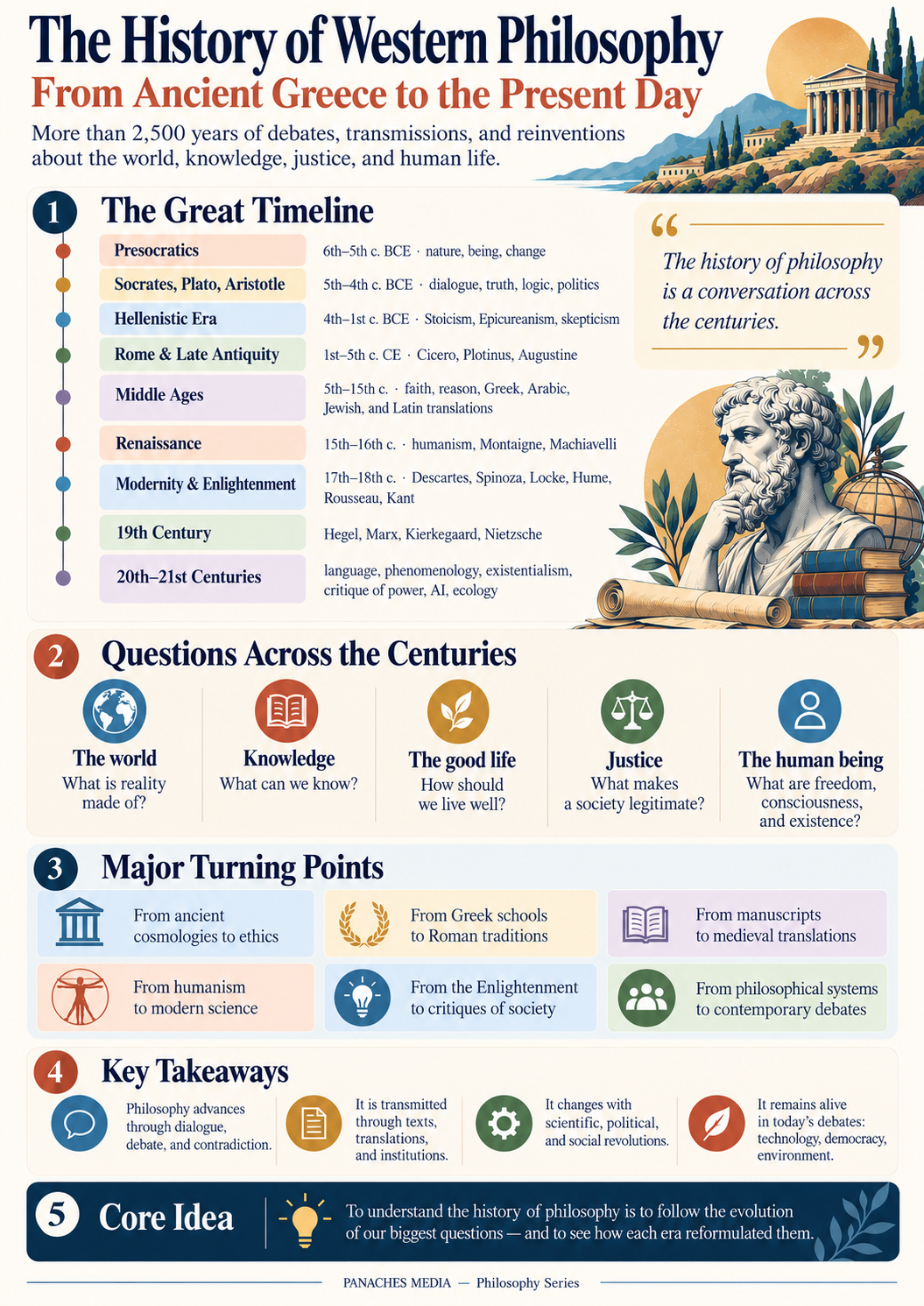
How did Western thought move from the earliest questions about nature to the study of consciousness, freedom, society, and technology? For more than two thousand years, philosophers have debated, contradicted one another, rediscovered forgotten works, and transformed the questions inherited from their predecessors. From Socrates to Hannah Arendt, from ancient Greece to contemporary debates about artificial intelligence, this is the story of an intellectual pursuit that has never stopped evolving.
A History of Questions, Revolutions, and Intellectual Heritage
The history of Western philosophy is often told through a handful of major figures: Socrates, Plato, Aristotle, Descartes, Kant, or Nietzsche. Their works undoubtedly marked decisive turning points. Yet reducing more than two millennia of reflection to a succession of famous thinkers would overlook what makes this history so fascinating.
Philosophy rarely progresses in a straight line.
An idea formulated in antiquity may be debated for centuries, disappear from certain intellectual circles, and then regain considerable importance in an entirely different context. A doctrine originally developed to address a religious question may later contribute to a discussion about scientific knowledge. A criticism intended to overthrow a philosophical system may eventually become the foundation of a new school of thought.
Philosophers inherit questions they do not always choose. They also live in societies shaped by political, scientific, religious, and cultural transformations that influence their concerns.
The emergence of Greek city-states, the expansion of the Roman world, the rise of the major monotheistic religions, the establishment of universities, the Scientific Revolution, modern political upheavals, and industrialization all profoundly changed the conditions under which philosophical reflection developed.
We should also be cautious of an overly simplistic idea: that Western thought evolved independently, following an uninterrupted path from Athens to contemporary European universities.
During the Middle Ages in particular, Arabic-speaking philosophers, Jewish scholars, Byzantine intellectuals, and translators played decisive roles in transmitting, interpreting, and renewing the intellectual heritage of antiquity.
The expression Western philosophy therefore refers here to a historical tradition of thought shaped by exchanges and influences, rather than an entirely isolated intellectual culture.
The Major Periods at a Glance
| Period | Approximate dates | Major transformations |
|---|---|---|
| Presocratic philosophy | 6th–5th centuries BCE | Investigation of the principles of nature, being, and change. |
| Classical Greek philosophy | 5th–4th centuries BCE | Development of dialogue, ethics, logic, and political philosophy. |
| Hellenistic and Roman periods | Late 4th century BCE–Late Antiquity | Major philosophical schools and reflection on the art of living. |
| Late Antiquity and the Middle Ages | 3rd–15th centuries | New syntheses of ancient intellectual traditions, religious thought, and rational inquiry. |
| Renaissance and humanism | 15th–16th centuries | Return to ancient texts, renewal of knowledge, and reflection on human nature. |
| Modern philosophy | 17th–18th centuries | Scientific Revolution, rationalism, empiricism, Enlightenment, and critical philosophy. |
| 19th century | 1800–1900 | Philosophy of history, social criticism, existence, and challenges to established values. |
| 20th century | 1900–2000 | Analytic philosophy, phenomenology, existentialism, critical theories, and new debates. |
| 21st century | Since 2000 | Ethics of technology, environmental questions, justice, identity, and contemporary transformations. |
These periods overlap. They provide useful historical reference points rather than rigid intellectual boundaries.
The Greek Origins: Searching for the Principles of the World
Before Socrates: Understanding Nature
In the Greek cities of Ionia, along the coast of Asia Minor, several thinkers of the sixth and fifth centuries BCE began investigating the principles governing the world.
They inherited a culture already rich in mythological narratives, poetry, and observations of nature. The works of Homer and Hesiod, in particular, offered representations of the cosmos, the gods, and the origins of the world.
The earliest Greek philosophers did not simply eliminate these traditions. However, they introduced other ways of explaining phenomena by searching for principles that might account for the organization of reality.
Thales of Miletus, traditionally regarded as one of the earliest figures in Greek philosophy, is said to have identified water as a fundamental principle of nature. His successor Anaximander proposed the concept of the apeiron, an indefinite principle from which things emerge and undergo transformation.
These hypotheses may seem strange when compared with modern scientific knowledge. Their significance, however, does not lie in their physical accuracy.
They reveal an emerging ambition within Greek intellectual traditions: to understand the diversity of the world through explanatory principles.
It would nevertheless be an exaggeration to describe this development as an instantaneous transition from a civilization dominated by myth to one governed entirely by rational thought. Religious traditions, cosmological speculation, and philosophical reasoning continued to coexist and influence one another for a long time.
Heraclitus and Parmenides: Does the World Really Change?
Two figures particularly illustrate the tensions running through early Greek thought.
Heraclitus of Ephesus attached fundamental importance to becoming, the tensions between opposites, and the order governing their relationships. Change was not necessarily a form of disorder for him: it belonged to the very structure of the world.
Parmenides of Elea, by contrast, developed a radical reflection on being. His reasoning challenged the very possibility of something coming into being from non-being and raised questions about the reality of change as we perceive it.
Behind these positions lies an enormous philosophical problem: how can things change while remaining, in some sense, what they are?
This debate would leave a lasting mark on Western metaphysics.
Other thinkers attempted to resolve the difficulty. Empedocles proposed a cosmology based on several fundamental elements, while Democritus, within the atomist tradition developed alongside Leucippus, conceived reality in terms of atoms and the void.
Their proposals do not directly correspond to modern scientific theories. Nevertheless, they opened different paths toward understanding matter, movement, and natural transformations.
A foundational question: how can we explain the world's diversity and transformations without abandoning the search for something stable beneath appearances?
The writings of these early thinkers have generally survived only in fragments or through later testimonies. Their ideas must therefore be reconstructed with caution.
The term Presocratic is itself a convenient but imperfect historical classification: some philosophers included in this category were contemporaries of Socrates.
Socrates, Plato, and Aristotle: Three Foundational Legacies
From the fifth century BCE onward, Athens became one of the major centers of Greek philosophical reflection.
The political life of the city, public debates, law courts, and the education of citizens encouraged new questions about justice, virtue, language, and the relationship between knowledge and power.
The Sophists, including Protagoras and Gorgias, played an important role in this context. They taught techniques of speech and argumentation while developing their own reflections on knowledge, human conventions, and collective life.
It was within this environment that Socrates carried out his philosophical activity.
Socrates: The Art of Questioning Certainty
Socrates (c. 469–399 BCE) left no known philosophical writings of his own.
We know him primarily through Plato's dialogues, Xenophon's works, and several other testimonies that do not always present the same portrait.
In many Platonic dialogues, Socrates questions people about concepts they believe they understand perfectly.
What is courage? What is justice? Can virtue be taught? Is it possible to do wrong knowingly?
Rather than accepting their first answers, he examines their contradictions, confronts definitions with concrete situations, and encourages his interlocutors to clarify their ideas.
Philosophy thus appears as a practice of dialogue and critical self-examination.
This attitude takes on a political dimension when Socrates is sentenced to death by an Athenian court in 399 BCE. The circumstances of his conviction, particularly the accusations of impiety and corrupting the young, continue to inspire reflections on the relationship between critical thinking, education, and political authority.
His death became a major event in the history and memory of Western philosophy, especially through Plato's Apology and Phaedo.
Plato: Looking Beyond Appearances
Plato (c. 427–347 BCE), a student of Socrates, gave philosophy a new intellectual breadth.
He developed his work through dialogues addressing a remarkable range of problems: truth, knowledge, justice, love, the soul, education, and political organization.
In The Republic, the allegory of the cave illustrates one of the most famous questions in the philosophical tradition.
Prisoners know nothing of the world beyond the shadows projected onto a wall. To discover what produces those appearances, they would have to turn around, leave their familiar situation, and undertake a difficult transformation of their perspective.
This image can be understood as a reflection on education, knowledge, and the difficulty of freeing ourselves from inherited opinions.
Platonic thought also gives central importance to Forms or Ideas, intelligible realities in which sensible things participate according to relationships explored and debated throughout his dialogues.
But Plato was not concerned solely with metaphysics. He also reflected on how a society might be governed according to rational principles, making his work an essential reference in political philosophy.
Aristotle: Observing, Distinguishing, and Organizing Knowledge
Aristotle (384–322 BCE), a student of Plato, developed an extraordinarily diverse body of work.
He investigated logic, metaphysics, physics, biology, ethics, politics, rhetoric, and poetry.
Where Plato gave central importance to intelligible realities, Aristotle developed a philosophy particularly attentive to concrete beings, their properties, and the causes that explain their existence and transformation.
His investigations into reasoning, particularly those collected in the Organon, helped shape the study of logic for centuries.
In the Nicomachean Ethics, he examined the question of a fulfilled human life, associating it particularly with the exercise of reason and the cultivation of virtues.
In Politics, he studied constitutions, the city-state, and the conditions of collective life, drawing upon the political ideas and institutions of his time.
Aristotle's historical importance is immense: his works would be studied, debated, translated, and transformed for centuries within Greek, Arabic, Jewish, and Latin intellectual traditions.
Three Ways of Approaching Philosophy
| Thinker | Characteristic approach | Major legacy |
|---|---|---|
| Socrates | Questioning opinions and examining contradictions through dialogue. | Philosophy as critical inquiry and self-examination. |
| Plato | Exploring the conditions of truth, knowledge, and justice through dialogues. | Metaphysics of Forms, political thought, and philosophical education. |
| Aristotle | Analyzing beings, their causes, and the structures of reasoning. | Logic, systematic investigation of knowledge, and virtue ethics. |
These distinctions obviously do not encompass their entire philosophies. They nevertheless help explain why their works became three fundamental reference points for later generations.
Hellenistic Philosophy: Learning to Live in an Uncertain World
Following the death of Alexander the Great in 323 BCE, the Greek world underwent profound political and cultural transformations.
The Hellenistic kingdoms succeeded Alexander's empire, while intellectual exchanges expanded across new territories. Athens remained an important philosophical center, but other cities, particularly Alexandria, contributed to the development of knowledge.
The questions inherited from Plato and Aristotle remained influential. However, several schools placed particular emphasis on how individuals might lead happy, reasonable lives without being entirely dependent on external circumstances.
For these traditions, philosophy became both a theoretical investigation and a discipline of living.
Epicurus: Understanding Desire to Live Better
Epicurus (341–270 BCE) founded a philosophical community in Athens known as the Garden.
His teaching combined a materialist conception of nature with an ethical philosophy that gave pleasure a central role.
Epicurean pleasure, however, should not be confused with the constant pursuit of excess.
Epicurus distinguished desires according to their nature and necessity. He placed fundamental importance on freedom from unnecessary suffering, peace of mind, and friendship.
His philosophy sought, among other things, to free human beings from certain fears, particularly the fear of the gods and death.
Stoicism: Reason in the Face of Events
Stoicism, founded by Zeno of Citium around 300 BCE, developed a philosophical system organized around logic, physics, and ethics.
The Stoics believed that human beings should learn to exercise their reason in accordance with nature and cultivate virtue.
This tradition extended across several centuries and found important representatives in the Roman world.
Seneca, Epictetus, and Marcus Aurelius illustrate different approaches to reflecting on the conduct of life, moral responsibility, and events beyond our control.
Stoicism does not simply consist of suppressing emotions. It seeks, among other things, to transform the judgments underlying certain passions and to guide action according to rational principles.
Skepticism: Examining the Limits of Certainty
Skeptical traditions, particularly those associated with Pyrrho and later Sextus Empiricus, questioned the human claim to possess certain truths.
Confronted with the diversity of opinions and the difficulties encountered by dogmatic reasoning, some skeptics advocated suspending judgment on questions that could not be settled.
This did not necessarily mean rejecting all experience or refusing to act. Rather, it encouraged caution toward claims whose justification remained insufficient.
Skepticism would have a lasting influence on modern philosophy, particularly during the Renaissance and the seventeenth century.
The major transformation of this period: philosophy was no longer concerned only with understanding what the world is. It also examined how we might live in it with discernment.
These traditions were not independent of the societies in which they developed. Greek philosophy continued to circulate throughout the Roman world, where it interacted with the political, legal, and moral concerns of new readers.
From Rome to Late Antiquity: Transforming the Greek Legacy
Ancient philosophy did not end with Aristotle or with the disappearance of the Hellenistic kingdoms.
In the Roman world, Cicero played a major role in transmitting and discussing Greek philosophy in Latin. His writings became important references in the history of moral and political thought.
From the third century CE onward, Neoplatonism became one of the major intellectual movements of Late Antiquity.
Plotinus and the Renewal of Platonism
Plotinus (c. 204–270) developed an ambitious philosophy of reality, intellect, and the soul.
In his Enneads, organized after his death by his student Porphyry, he elaborated a conception in which all reality ultimately derives from the One.
His philosophy profoundly transformed Plato's legacy and would exert considerable influence on later intellectual traditions, particularly Christian, Islamic, and Jewish thought.
Late Antiquity was also marked by the coexistence of, and tensions between, different religious and philosophical traditions.
In Alexandria, Hypatia, a mathematician and philosopher active around the turn of the fourth and fifth centuries, taught in an intellectual environment attached to Greek philosophical traditions. Her murder in 415, amid political and religious conflicts, illustrates how closely the production of knowledge could be connected to the tensions of its time.
Augustine: Inner Experience, Truth, and Christian Thought
Augustine of Hippo (354–430) was another major figure of this transitional period.
Trained in rhetoric and influenced by several philosophical traditions, particularly Platonism, he developed reflections on memory, time, will, truth, and the relationship between human beings and God.
In his Confessions, he explored inner experience with a depth that would leave a lasting mark on the history of philosophy.
His analysis of time, in particular, reveals a difficulty that remains relevant today: we constantly speak about the past, present, and future, yet defining precisely what time is remains surprisingly difficult.
Augustine's thought would profoundly influence medieval Latin philosophy.
The transition from Antiquity to the Middle Ages did not therefore represent an abrupt interruption of philosophical inquiry. Rather, it involved a transformation of institutions, languages, studied texts, and dominant questions.
The Middle Ages: Philosophy Between Faith, Reason, and the Transmission of Knowledge
The familiar image of an intellectually stagnant Middle Ages, during which philosophy simply waited for the Renaissance to be reborn, does not withstand historical examination.
Between the fifth and fifteenth centuries, philosophical thought continued to develop in remarkably diverse contexts.
Monasteries, religious schools, scholarly courts, translation centers, and later universities all provided settings in which ancient works were preserved, interpreted, and debated.
Christian, Jewish, and Muslim intellectual traditions produced original philosophical reflections on existence, knowledge, language, and the relationship between reason and revelation.
Philosophy in the Arabic-Speaking World
From the eighth century onward, particularly under the Abbasids, a major movement of translation and study of Greek works developed in several intellectual centers of the Islamic world.
Texts by Aristotle and Galen, along with Platonic and Neoplatonic traditions, were translated into Arabic, often through the work of scholars familiar with several languages, particularly Greek and Syriac.
This effort was far more than the passive preservation of ancient texts.
The thinkers who engaged with these works interpreted them, criticized them, and developed new philosophical systems.
Al-Kindi, in the ninth century, contributed to the development of philosophy in Arabic while engaging with Greek intellectual traditions.
Al-Farabi, in the ninth and tenth centuries, developed important reflections on logic, the classification of sciences, and political philosophy.
Avicenna (Ibn Sina, c. 980–1037) constructed a major philosophical system in which metaphysics, logic, psychology, and medicine played significant roles. His distinction between essence and existence would leave a profound mark on later debates.
Averroes (Ibn Rushd, 1126–1198), a philosopher from Al-Andalus, became particularly famous for his commentaries on Aristotle. He also developed original reflections on the relationship between philosophical demonstration and religious interpretation.
These thinkers did not all share the same convictions. Their debates demonstrate the vitality of an intellectual world in which ancient traditions encountered new philosophical problems.
Jewish Philosophies and Intellectual Exchanges
Jewish thinkers also participated in this history.
Solomon Ibn Gabirol, in the eleventh century, developed a metaphysical philosophy influenced by Neoplatonism.
Maimonides (1138–1204), particularly in The Guide for the Perplexed, examined the relationship between Jewish religious tradition, Aristotelian philosophy, and the limits of human knowledge.
His works circulated in several languages and generated significant debates in different scholarly communities.
Medieval philosophical traditions were thus connected through a complex network of translations, commentaries, and controversies.
The Rediscovery of Aristotle in the Latin West
From the twelfth and thirteenth centuries onward, translations produced particularly in the Iberian Peninsula, Sicily, and Italy made numerous philosophical texts accessible.
Some Greek works were translated directly into Latin. Others circulated through Arabic versions and the commentaries of Muslim or Jewish philosophers.
These transmissions played a considerable role in transforming European university philosophy.
It would be misleading to reduce this movement to a single chain in which texts simply passed from Greek to Arabic and then into Latin. The routes taken by manuscripts and translations were multiple and changed according to place and period.
The Middle Ages were therefore also a history of the international circulation of knowledge.
Scholasticism: Examining Faith with the Tools of Reason
In the Latin West, the development of schools and then universities contributed to the formation of an intellectual culture commonly associated with scholasticism.
This tradition placed central importance on textual analysis, logic, and the systematic discussion of arguments.
A question would be formulated, different objections examined, and answers constructed through organized reasoning.
Anselm of Canterbury, in the eleventh and twelfth centuries, developed reflections on faith, reason, and the existence of God.
Peter Abelard, in the twelfth century, helped renew methods of discussion and debates concerning language and universals.
Thomas Aquinas (1225–1274) sought to bring together different intellectual traditions, particularly Aristotelian and Christian thought, within an extensive body of work. His analyses of being, causation, knowledge, and morality would exert a lasting influence on Western philosophy.
Toward the end of the Middle Ages, John Duns Scotus and William of Ockham developed important positions on metaphysics, concepts, knowledge, and the limits of reasoning.
These authors did not form a perfectly homogeneous school. Their disagreements instead reveal the intensity of medieval intellectual debates.
An Intellectual History Beyond the Universities
The great medieval philosophical syntheses did not, however, represent the entirety of intellectual life during this period.
Hildegard of Bingen, in the twelfth century, developed an original religious, cosmological, and intellectual body of work, several aspects of which are now relevant to the history of philosophy.
Christine de Pizan, at the turn of the fourteenth and fifteenth centuries, defended the dignity and intellectual capacities of women. In The Book of the City of Ladies, she responded to the misogynistic discourses of her time by constructing arguments informed by history and literature.
These examples remind us that the exclusion of women from many scholarly institutions did not mean they were absent from all philosophical activity.
The medieval legacy cannot therefore be reduced to theology or the preservation of ancient works. It includes philosophical innovations, argumentative methods, and exchanges between traditions that helped prepare the transformations of the modern era.
The Renaissance: Rediscovering the Ancients to Rethink Humanity
Between the fourteenth and sixteenth centuries, European societies underwent significant cultural and intellectual changes.
The development of humanism, new methods of distributing books, maritime exploration, religious transformations, and the rediscovery of numerous ancient texts helped reshape the frameworks of intellectual inquiry.
The Renaissance did not abolish medieval philosophy overnight. Scholastic traditions remained influential while new approaches developed alongside them.
Humanism and the Return to Ancient Texts
Humanists sought, among other things, to recover ancient works in their original languages and historical contexts.
The study of Greek, Latin, and manuscripts acquired new importance. Printing gradually facilitated the circulation of texts, although access to books remained socially unequal.
Erasmus (c. 1466–1536) defended an intellectual culture grounded in textual study, education, and critical reflection on human behavior.
In Italy, Marsilio Ficino contributed to the renewal of Platonic thought through his translations and commentaries.
Giovanni Pico della Mirandola developed reflections on human dignity and possibilities while seeking to bring different intellectual traditions into dialogue.
Within these movements, individual education and the exercise of judgment became increasingly important.
Machiavelli: Examining Power as It Actually Works
With Niccolò Machiavelli (1469–1527), political reflection underwent an important transformation.
In The Prince and his other political writings, Machiavelli examined the practical conditions of exercising power, the stability of states, and the relationship between human decisions, circumstances, and fortune.
His philosophy cannot be reduced to the idea that any means are justified in order to govern.
Above all, it opened an enduring debate about whether politics could be analyzed through its own mechanisms without being entirely identified with the demands of individual morality.
Montaigne: Making Human Experience a Philosophical Subject
Michel de Montaigne (1533–1592) followed a different path.
In his Essays, first published in 1580, he drew upon his reading, observations, and personal experience to examine human behavior.
His approach was deeply influenced by ancient skepticism. It encouraged reflection on the limits of judgment, differences between customs, and the fragility of certain convictions.
Montaigne questioned, among other things, cultural prejudices and our tendency to regard our own habits as naturally superior to those of others.
His work illustrates an essential transformation: philosophy can become an open-ended exploration of human experience, rather than only the construction of a theoretical system.
The Renaissance thus prepared several central questions of modern philosophy: how should we exercise our judgment? What can human beings know? What makes political authority legitimate? How can we understand a world whose intellectual and geographical boundaries are changing?
The Seventeenth Century: Philosophy Confronts the Scientific Revolution
The seventeenth century occupies a particularly important place in the history of Western philosophy.
Scientific discoveries challenged representations inherited from Antiquity and the Middle Ages. The work of Copernicus, Kepler, Galileo, and later Newton profoundly transformed astronomy and physics.
Earth's place in the cosmos, the laws of motion, and the methods used to understand nature became subjects of major debate.
Philosophy had to reconsider its relationship with mathematics, observation, and the emerging sciences.
Descartes: Searching for Indubitable Certainty
René Descartes (1596–1650) sought to reconstruct knowledge on foundations he considered secure.
In Discourse on the Method (1637), followed by Meditations on First Philosophy (1641), he placed methodological doubt at the center of his inquiry.
The objective was not to remain in permanent doubt, but to examine what knowledge could withstand radical questioning.
Descartes discovered a fundamental starting point in the very act of thinking: while he doubts, he cannot deny that he thinks and exists as a thinking being.
His famous formulation, "I think, therefore I am," symbolizes this turning point.
Modern philosophy increasingly focused on the knowing subject and the conditions under which knowledge of the truth might be possible.
Descartes also developed a distinction between mind and body that would generate major controversies.
Rationalism and Empiricism: Where Does Knowledge Come From?
Modern philosophy is often presented through an opposition between rationalism and empiricism.
This distinction is useful, provided that individual philosophers are not treated as representatives of two perfectly uniform doctrines.
Rationalism gives fundamental importance to reason and certain intellectual principles in the formation of knowledge.
Empiricism places greater emphasis on experience and perception.
| Tradition | Representative thinkers | Central question |
|---|---|---|
| Modern rationalism | Descartes, Spinoza, Leibniz | To what extent can reason produce necessary and universal knowledge? |
| Modern empiricism | Locke, Berkeley, Hume | How does our knowledge develop from experience? |
Baruch Spinoza (1632–1677) developed, particularly in his Ethics, a philosophy in which God and Nature are not separate realities. His work profoundly reconsidered necessity, freedom, and human emotions.
Gottfried Wilhelm Leibniz (1646–1716) constructed an original metaphysics of substances, harmony, and the principles of reason.
Within empiricist traditions, John Locke (1632–1704) examined the origins of ideas and the limits of human understanding. He also contributed to political debates about government and rights.
George Berkeley (1685–1753) challenged the idea of matter existing independently of perception, while David Hume (1711–1776) subjected the concepts of causation, self, and knowledge to an especially influential critical analysis.
These debates were not confined to universities. They accompanied the evolution of science, political institutions, and conceptions of the individual.
Voices Long Marginalized in the Traditional Narrative
The history of modern philosophy was not written solely by its most famous male authors.
Elisabeth of Bohemia (1618–1680) corresponded with Descartes about the relationship between soul and body, raising objections that challenged his doctrine.
Margaret Cavendish (1623–1673) developed original reflections on nature, matter, and the scientific knowledge of her time.
Anne Conway (1631–1679) proposed a metaphysical philosophy that contested several dominant conceptions of substance and living beings.
Their contributions demonstrate that the major controversies of modern philosophy extended far beyond the oppositions usually presented in traditional textbooks.
The seventeenth century thus transformed the conditions of knowledge: claims had to be justified, methods examined, and the foundations of certainty reconsidered in light of a renewed conception of nature.
The Enlightenment: Reason, Freedom, and the Critique of Authority
During the eighteenth century, philosophical debates acquired a particularly significant public dimension.
Books, periodicals, salons, and learned societies encouraged the circulation of ideas. Philosophers participated in discussions about religion, education, political institutions, and individual freedoms.
The Enlightenment was not a perfectly homogeneous movement. It brought together thinkers who sometimes disagreed profoundly, but who shared an interest in examining inherited authorities and the possibilities of human reason.
The Encyclopédie: Spreading and Organizing Knowledge
In France, Denis Diderot and Jean le Rond d'Alembert directed an ambitious editorial project: the Encyclopédie, whose principal volumes began appearing in 1751.
The undertaking aimed to gather and organize contemporary knowledge, ranging from science and the arts to technology and practical trades.
Its significance extended far beyond documentary compilation.
By giving considerable attention to practical skills, crafts, and the critical examination of knowledge, it contributed to a transformation in how European societies understood the circulation of learning.
Rousseau: Freedom, Society, and Sovereignty
Jean-Jacques Rousseau (1712–1778) developed an original reflection on the relationship between individuals and society.
In Discourse on the Origin and Basis of Inequality Among Men (1755), he sought to understand how social inequalities emerge.
With The Social Contract (1762), he examined the conditions under which a political community could be legitimate and compatible with the freedom of its members.
His reflections on sovereignty and the general will would leave a lasting mark on political philosophy.
They also raised difficult questions: how can individual freedom be reconciled with collective decisions? What does it mean to obey laws that one is supposed to help establish?
The Limits of Universal Ideals
The Enlightenment witnessed powerful demands for freedom, tolerance, and equality.
Yet these ideals coexisted with societies marked by slavery, colonialism, social privilege, and the political exclusion of women.
This contradiction inspired important challenges.
Mary Wollstonecraft (1759–1797) defended women's education and rights, particularly in A Vindication of the Rights of Woman (1792).
Émilie du Châtelet (1706–1749) contributed to the dissemination and discussion of scientific and philosophical knowledge while developing original reflections on knowledge and metaphysics.
Olympe de Gouges (1748–1793), writing in an explicitly political context, denounced the exclusion of women from the principles proclaimed by the French Revolution.
These voices remind us that the universality of rights and reason was never an unquestioned achievement: it was also something to be fought for and redefined.
Kant: A Decisive Transformation of Modern Philosophy
Immanuel Kant (1724–1804) occupies a central place in the history of philosophy.
His works sought, among other things, to overcome difficulties encountered by rationalist and empiricist traditions.
In the Critique of Pure Reason (1781, with a second edition in 1787), he posed a fundamental question: how is knowledge possible?
Rather than asking only what we can know, Kant examined the conditions that make our experience of objects possible.
According to his analysis, knowledge does not simply depend on information passively received from the external world. It also involves forms and structures belonging to our own cognitive faculties.
This perspective is often described as a transcendental turn or a Copernican revolution in philosophy.
Kant was not, however, concerned solely with the theory of knowledge.
In his moral philosophy, he defended a conception of obligation grounded in practical reason and the capacity of rational beings to establish principles that can be universalized.
He also examined freedom, aesthetic judgment, the relationship between nature and purposiveness, and the conditions of political life.
With Kant, several great philosophical questions were profoundly reformulated:
- Knowledge: what are the conditions and limits of our experience of the world?
- Morality: how can we establish obligations that do not depend solely on our desires or interests?
- Freedom: how can human autonomy be understood in a world governed by natural laws?
- Aesthetics: how can we understand judgments of beauty and their claim to be shared?
His work would exert considerable influence on nineteenth-century philosophy and many contemporary debates.
The Nineteenth Century: History, Society, and Existence Take Center Stage
During the nineteenth century, Europe experienced major transformations: industrialization, the development of capitalism, new political movements, social upheavals, and the growth of historical and natural sciences.
Philosophers questioned how societies change, which forces shape history, and which contradictions run through human existence.
Kant's legacy remained important, but it was subjected to radical reinterpretations and criticisms.
Hegel: Understanding Reason Through History
Georg Wilhelm Friedrich Hegel (1770–1831) developed a philosophy in which human and historical reality occupied a central place.
In the Phenomenology of Spirit (1807), he examined different movements of consciousness and human experience, showing how forms of understanding can transform through their own tensions.
His philosophy was particularly concerned with the relationship between individuals, institutions, freedom, and collective life.
Hegel is often associated with dialectics, although reducing his entire philosophy to the simplified formula "thesis, antithesis, synthesis" would be historically misleading.
His work influenced both thinkers who developed some of his insights and authors determined to overturn them.
Marx: The Critique of Social Relations
Karl Marx (1818–1883) emerged from the critical development of German philosophy, particularly the works of Hegel and Feuerbach.
Together with Friedrich Engels, he developed a historical and social analysis attentive to the material conditions of existence, relations of production, and conflicts between social classes.
In Capital, whose first volume appeared in 1867, Marx undertook a systematic critique of political economy and the functioning of capitalism.
His approach transformed a fundamental philosophical question: to understand the ideas and institutions of an era, should we first examine the intellectual principles it defends, or the social and material relationships within which it develops?
Marxist theories would exert major influence on philosophy, economics, sociology, and modern political movements.
Kierkegaard: Existence Cannot Be Reduced to a System
Søren Kierkegaard (1813–1855) developed a very different approach.
He focused on individual existence, choice, anxiety, and personal responsibility.
His philosophy challenged the claim of great philosophical systems to fully capture human experience.
For Kierkegaard, understanding a truth in abstract terms is not necessarily sufficient to know how to live.
This attention to personal commitment would profoundly influence several philosophies of existence in the twentieth century.
Schopenhauer and Nietzsche: Desire, Suffering, and the Critique of Values
Arthur Schopenhauer (1788–1860) developed a metaphysics in which the will occupied a central place.
In The World as Will and Representation (1818–1819), he presented a vision of existence shaped by desire, dissatisfaction, and suffering.
His philosophy also engaged with certain Indian intellectual traditions, which he interpreted through the knowledge and translations available during his lifetime.
Friedrich Nietzsche (1844–1900), meanwhile, undertook a radical critique of morality, religion, and Western values.
Through works such as The Gay Science, Thus Spoke Zarathustra, and On the Genealogy of Morality, he questioned the origins of values, their functions, and their effects on existence.
The expression "death of God" does not simply represent an atheistic declaration. It also expresses a historical crisis in the religious and metaphysical foundations that had supported many European values.
Nietzsche thus raised a disturbing question: what happens to the way we judge and live when the values we considered eternal come to appear as historical constructions?
Other Intellectual Transformations
Nineteenth-century philosophy cannot be reduced to these figures.
John Stuart Mill made important contributions to moral philosophy, reflections on individual liberty, and the defense of equality between women and men.
The positivism of Auguste Comte proposed a conception of the development of knowledge in which the sciences occupied a central place.
In the United States, the emergence of pragmatism, associated with thinkers such as Charles Sanders Peirce and William James, opened new investigations into the relationships between thought, experience, meaning, and practical consequences.
At the same time, new scientific knowledge, particularly concerning the evolution of living organisms, compelled philosophers to reconsider certain conceptions of human nature.
The nineteenth century thus left an intellectual legacy marked by tensions between the individual and society, history and freedom, science and values, reason and existence.
The Twentieth Century: The Multiplication of Philosophical Approaches
The twentieth century was marked by two world wars, totalitarian regimes, decolonization, scientific transformations, and the emergence of new technologies.
Philosophy developed in a profoundly disrupted world.
Academic disciplines became increasingly specialized. New logical tools appeared. The human sciences acquired considerable importance.
It became increasingly difficult to describe philosophical thought as a single intellectual tradition.
Several major approaches emerged, intersected, and sometimes opposed one another.
Analytic Philosophy: Logic, Language, and Precise Argumentation
At the turn of the nineteenth and twentieth centuries, Gottlob Frege contributed to the renewal of modern logic.
His work exerted a major influence on Bertrand Russell and the development of analytic philosophy.
This tradition placed particular importance on conceptual clarity, the structure of reasoning, and the analysis of language.
Ludwig Wittgenstein occupies a distinctive place in this history.
In his Tractatus Logico-Philosophicus (1921), he developed reflections on the relationships between language, logic, and the world.
His later investigations, published particularly in Philosophical Investigations after his death, led to a different conception of language, more attentive to human practices and uses.
The Vienna Circle, active during the interwar period, also sought to renew philosophy through logic and the sciences.
These approaches helped transform debates on scientific knowledge, the meaning of propositions, and the nature of philosophical problems.
Analytic philosophy subsequently evolved considerably, particularly through the criticisms of W. V. O. Quine and the development of new research in metaphysics, ethics, philosophy of mind, and philosophy of language.
Phenomenology: Returning to Lived Experience
Beginning with the work of Edmund Husserl (1859–1938), phenomenology proposed another approach.
It sought to describe rigorously how things appear to consciousness and acquire meaning within our experience.
This approach paid particular attention to intentionality, the idea that consciousness is always consciousness of something.
Martin Heidegger, in Being and Time (1927), transformed this approach by developing an analysis of human existence and its understanding of being.
Maurice Merleau-Ponty, particularly in Phenomenology of Perception (1945), emphasized the role of the lived body in our relationship with the world.
These investigations contributed to renewed conceptions of consciousness, time, perception, and existence.
Existentialism: Freedom and Responsibility
In the middle of the twentieth century, existentialism acquired considerable intellectual and cultural visibility, particularly in France.
This philosophy developed in a context marked by war, occupation, political violence, and questions about human responsibility.
Jean-Paul Sartre, in Being and Nothingness (1943), offered an analysis of consciousness, freedom, and relationships with others.
He emphasized, among other things, that human beings cannot entirely escape responsibility for their choices.
Simone de Beauvoir (1908–1986) developed a major philosophical body of work on freedom, moral ambiguity, and the condition of women.
In The Second Sex (1949), she examined the historical and social construction of women's situation, opening a fundamental field of reflection for contemporary feminist philosophies.
Albert Camus, whose thought cannot simply be equated with Sartre's, explored the absurd, rebellion, and the moral limits of action.
With these authors, philosophical questions became closely connected to concrete choices, human relationships, and historical responsibilities.
Hannah Arendt: Understanding Power and Responsibility
Hannah Arendt (1906–1975) occupies a major place in twentieth-century political philosophy.
Shaped by her experience of Nazism, exile, and European political upheavals, she studied the origins and mechanisms of totalitarian regimes.
In The Origins of Totalitarianism (1951), she offered an analysis of the forms of political domination that had marked her era.
She subsequently developed reflections on action, human plurality, freedom, and public life.
Her work on the trial of Adolf Eichmann, published in 1963, also inspired an enduring debate about moral judgment and individual responsibility.
Arendt reminds us that political catastrophes cannot be understood solely through abstract theories: they require us to examine institutions, human behavior, and the concrete conditions in which individuals act.
Critical Theories and the Questioning of Power
Critical theory, particularly associated with the Frankfurt School, developed reflections on the relationships between society, domination, culture, and rationality.
Max Horkheimer and Theodor W. Adorno examined the contradictions of modernity and the conditions under which reason itself can become an instrument of domination.
Jürgen Habermas would develop some of these debates further by placing communication, rational discussion, and democratic institutions at the center of his philosophy.
In France, other transformations emerged around structuralism and the criticisms it inspired.
Michel Foucault studied the relationships between knowledge, power, institutions, and the formation of subjects.
Jacques Derrida developed deconstruction, questioning certain conceptual oppositions and assumptions inherited from the metaphysical tradition.
Gilles Deleuze produced a body of work concerned particularly with difference, becoming, conceptual creation, and the transformation of thought.
These approaches did not constitute a homogeneous movement. Nevertheless, they profoundly renewed questions concerning language, subjectivity, history, and the mechanisms of power.
Intellectual Boundaries Less Rigid Than They Appear
The history of twentieth-century philosophy is often presented through an opposition between analytic and continental philosophy.
This distinction reflects certain historical, institutional, and methodological differences. It nevertheless remains imperfect.
Analytic philosophy is not limited to the study of language. Phenomenological traditions do not necessarily reject rigorous conceptual analysis. And several philosophers draw upon different approaches.
The twentieth century did not therefore produce two entirely separate philosophies, but rather a diversity of inquiries whose interactions are more complex than their labels suggest.
The Twenty-First Century: New Questions, Living Traditions
In the twenty-first century, philosophy continues to draw upon ancient works while incorporating problems linked to contemporary transformations.
Cognitive science, digital technologies, environmental crises, debates about identity, and new forms of power generate numerous philosophical reflections.
The discipline is also characterized by increasing efforts to reconsider its own intellectual heritage.
Philosophy and Technology
The development of artificial intelligence has brought old philosophical problems back to the forefront.
What does it mean to think? Does consciousness necessarily require biological experience? How should responsibility be assigned when a decision results from the involvement of automated systems?
These questions extend debates already present in the works of Descartes, Kant, and numerous philosophers of mind.
But they have now acquired a practical dimension.
Digital technologies can transform the circulation of information, working conditions, artistic practices, and social relationships.
Philosophy therefore examines not only what these systems can accomplish, but also which uses should be permitted, encouraged, or restricted.
Environmental Ethics and Future Generations
Environmental crises also encourage us to reconsider humanity's place in nature.
Western philosophical traditions have proposed different conceptions of the relationship between human beings and the rest of the living world.
Contemporary debates examine, among other things, the moral value of animals, our obligations toward future generations, and collective responsibilities in the face of environmental transformations.
These reflections engage with the natural sciences, but they cannot be reduced to them: knowing the consequences of an action is not always sufficient to determine what we ought to do.
Rethinking Justice and the History of Philosophy
Since the second half of the twentieth century, several intellectual movements have profoundly renewed reflections on justice.
The work of John Rawls, particularly A Theory of Justice (1971), contributed to renewed debates about fair institutions and the principles governing the distribution of rights and resources.
The research of Martha Nussbaum examines, among other things, human capabilities, dignity, and the conditions under which a genuinely fulfilling life becomes accessible to everyone.
Feminist philosophies continue to investigate the relationships between gender, freedom, power, and recognition.
Other traditions, particularly those connected with postcolonial and decolonial thought, question the relationships between knowledge production, domination, and historical legacies.
These debates accompany a reassessment of how the history of philosophy has been written.
For a long time, some historical narratives emphasized a relatively small number of male European philosophers, minimizing the contributions of other thinkers and the exchanges between cultures.
Contemporary scholarship allows forgotten works to be rediscovered, their contexts to be better understood, and the criteria that determined their transmission to be questioned.
This does not mean denying the importance of Plato, Aristotle, Descartes, or Kant.
It means understanding why certain thinkers became central to the history traditionally taught, while others remained in the shadows for so long.
A History Also Shaped by Books and Their Transmission
The history of ideas depends on their content, but also on the means through which they are preserved and circulated.
A large proportion of ancient philosophical works has disappeared. Other texts have survived through copies, commentaries, translations, or quotations.
Over the centuries, several material transformations have changed how philosophical ideas circulate:
- Ancient philosophical schools enabled the teaching, discussion, and transmission of philosophical doctrines.
- Medieval manuscripts and translations preserved, transformed, and circulated numerous intellectual traditions across different languages and cultures.
- Printing, beginning in the fifteenth century in Europe, encouraged the wider dissemination of books and intellectual controversies.
- Periodicals and modern public spaces created new places for debate beyond traditional educational institutions.
- Universities and specialized journals progressively helped structure contemporary philosophical research.
- Digital libraries and online publications now offer new possibilities for accessing texts, although linguistic, economic, and cultural obstacles remain.
These transformations are far from secondary.
A philosophical idea can exert considerable influence centuries after its original formulation because a manuscript was preserved, a translation was produced, or a later thinker decided to engage with it.
The history of philosophy is therefore also the history of the material conditions that allow ideas to travel through time.
What More Than Two Thousand Years of Philosophy Teach Us
Looking back over this history, one thing becomes clear: philosophers have constantly returned to their predecessors' questions, giving them new meanings.
The earliest Greek thinkers searched for the principles governing nature. Socrates transformed dialogue into an instrument of critical inquiry. Plato and Aristotle developed works whose influence would cross centuries.
Hellenistic schools examined how to live. Thinkers of Late Antiquity and the Middle Ages renewed the relationship between reason, metaphysics, and religious traditions.
The Renaissance reexamined texts, values, and human experience. Modern philosophy questioned the foundations of knowledge, while the Enlightenment placed freedom, criticism, and institutions at the center of debate.
During the nineteenth century, history, society, and existence became major philosophical concerns. The twentieth century multiplied methods and perspectives, before our own era confronted these intellectual traditions with technological, political, and environmental transformations.
These developments can be summarized through a few major questions.
| Major transformation | Central philosophical question |
|---|---|
| Understanding nature | What principles can explain the world? |
| Examining human life | How should we live and act? |
| Connecting intellectual traditions | What relationships should exist between reason, faith, and knowledge? |
| Establishing modern knowledge | How can we achieve reliable knowledge? |
| Criticizing institutions | How can we build a free and just society? |
| Understanding history and existence | How are human beings shaped by their choices and social conditions? |
| Thinking about contemporary transformations | What responsibilities do we have toward the powers and technologies we develop? |
We should not imagine, however, that each era abandoned previous concerns to adopt entirely new ones.
Questions about truth, justice, happiness, and freedom run through every period, but their formulations and implications change.
That is precisely what makes this history so rich.
A Conversation Across the Centuries
Reading the history of philosophy means discovering an intellectual conversation whose participants do not live in the same era.
Aristotle debates Plato's positions. Medieval thinkers interpret Aristotle while proposing their own theories. Descartes challenges several scholastic traditions. Kant attempts to respond to difficulties raised by Hume. Hegel transforms the Kantian legacy, while Marx develops a critique of Hegelian philosophy.
Nietzsche reexamines the foundations of Western morality. Twentieth-century philosophers once again investigate consciousness, language, freedom, and power.
And contemporary debates about artificial intelligence, justice, and the environment extend ancient questions in unprecedented forms.
This continuity does not imply a simple and regular progression toward definitive truth. Some ideas have been abandoned, others profoundly transformed. Works have been forgotten and later rediscovered. New historical experiences have revealed problems previously neglected.
Western philosophy is therefore neither a completed system nor a succession of obsolete doctrines. It is a living collection of questions, arguments, and controversies that continue to transform our understanding of the world.
Studying its history does not simply mean learning what philosophers of the past believed.
It also means discovering why certain questions seem natural to us today, how our concepts were constructed, and which alternatives have been proposed throughout history.
An idea we regard as self-evident may have been fiercely debated for centuries. An opposition that seems impossible to overcome may have been understood very differently by thinkers far removed from our own time.
This history therefore teaches us to gain a certain distance from our convictions.
Key takeaway: the history of philosophy is less the story of a truth gradually discovered than that of a collective inquiry marked by disagreements, transmissions, ruptures, and new beginnings. Each generation inherits ancient questions, but also retains the possibility of asking them differently.
And perhaps that is its most valuable lesson: humanity's great questions are not merely remnants of the past. They remain open to anyone willing to continue thinking.
Sources and References
General History of Philosophy
- Wikipedia — History of Philosophy — General chronological overview of major philosophical traditions.
- Stanford Encyclopedia of Philosophy — Presocratic Philosophy — Study of early Greek thinkers, surviving sources, and their principal questions.
- Stanford Encyclopedia of Philosophy — Stoicism — History and doctrines of Greek and Roman Stoic traditions.
- Stanford Encyclopedia of Philosophy — Neoplatonism — Introduction to Neoplatonism and its influence in Late Antiquity.
Medieval and Modern Philosophy
- Stanford Encyclopedia of Philosophy — Medieval Philosophy — Study of medieval philosophical traditions in Latin, Greek, Arabic, and Jewish intellectual contexts.
- Stanford Encyclopedia of Philosophy — Influence of Arabic and Islamic Philosophy on the Latin West — Analysis of philosophical transmissions and influences between Arabic-speaking and Latin intellectual worlds.
- Stanford Encyclopedia of Philosophy — Michel de Montaigne — Study of Montaigne's humanism, skepticism, and philosophical work.
- Stanford Encyclopedia of Philosophy — Enlightenment — Introduction to the intellectual transformations of the Enlightenment and major debates in modern philosophy.
Nineteenth-, Twentieth-, and Twenty-First-Century Philosophies
- Stanford Encyclopedia of Philosophy — Idealism — History of the major forms of idealism and their influence.
- Stanford Encyclopedia of Philosophy — Phenomenology — Introduction to phenomenology and its principal developments.
- Stanford Encyclopedia of Philosophy — Existentialism — History of existential philosophies and their development in the twentieth century.
- Stanford Encyclopedia of Philosophy — Vienna Circle — Study of logical positivism and its relationship with analytic philosophy.
- Stanford Encyclopedia of Philosophy — Feminist History of Philosophy — Research on the contributions of women philosophers and contemporary transformations in the history of the discipline.