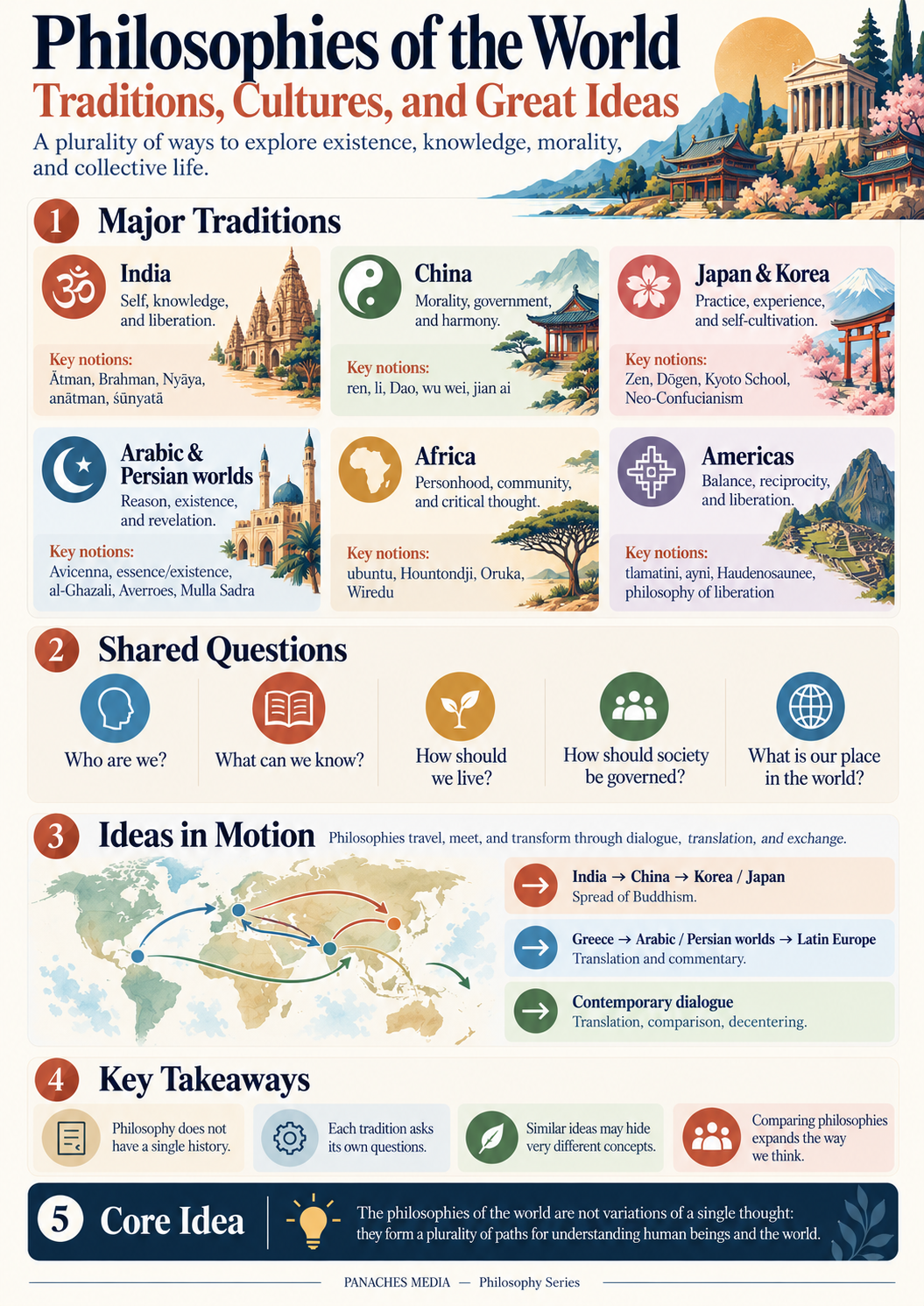
What makes a life just? How can we recognize the truth? Is there a permanent self? What place do human beings occupy within nature and their communities? Across the centuries, these questions have inspired intellectual traditions on several continents. From ancient India to imperial China, from the scholarly cities of the Islamic world to African and Indigenous American societies, philosophers have developed answers that are sometimes closely related and sometimes profoundly contradictory. Exploring these traditions means recognizing that philosophy has many histories, many languages, and countless ways of questioning existence.
Philosophy Does Not Have a Single History
When we think about the history of philosophy, a few names usually come to mind: Socrates, Plato, Aristotle, Descartes, Kant, or Nietzsche.
Their importance is undeniable. Their works helped shape European philosophical traditions and continue to influence contemporary thought.
Yet this history, however rich, represents only one part of a much broader intellectual landscape.
Long before philosophy was organized into academic disciplines, different societies had developed elaborate conceptions of knowledge, morality, existence, and the natural world.
Some of these traditions emerged independently. Others encountered one another, entered into debate, and changed through trade, migration, translation, and political upheaval.
Indian thinkers developed sophisticated theories of perception and reasoning. Chinese philosophers spent centuries debating human nature, education, and government. In the Arabic- and Persian-speaking worlds, discussions about existence, causation, and the relationship between reason and revelation produced original philosophical systems.
Across the African continent, different traditions examined personhood, community, knowledge, and moral responsibility. In the Americas, intellectual traditions developed by Indigenous societies also established distinctive ways of understanding existence, balance, and relationships between beings.
These histories raise an initial difficulty: what exactly do we choose to call "philosophy"?
A European Discipline or a Broader Human Activity?
The word philosophy comes from the ancient Greek philosophía, generally translated as "love of wisdom."
This linguistic origin does not mean that philosophical questions appeared exclusively in Greece.
Part of the difficulty comes from our tendency to recognize philosophy through familiar forms: written treatises, explicit arguments, intellectual schools, or academic disciplines.
Yet traditions of thought can take other forms.
Reflection on values and existence can develop through dialogues, textual commentaries, narratives, oral teachings, or practices of living. These forms do not automatically become philosophical, but they can contain questions and arguments that philosophical inquiry must take seriously.
It would nevertheless be misleading to consider every belief, narrative, or cultural practice a philosophy in itself.
The challenge is rather to examine the questions being asked, the arguments being developed, the concepts being used, and the discussions they generate, without imposing a single intellectual model everywhere.
Traditions That Do Not All Think in the Same Way
The world's major philosophical traditions share certain concerns, but they do not necessarily organize them in identical ways.
| Fundamental question | Some philosophical approaches |
|---|---|
| What is a human being? | The self and consciousness in Indian philosophies; personhood and social relationships in several African traditions. |
| How should we live? | Confucian moral cultivation; Buddhist practices aimed at liberation from suffering; different communal conceptions of well-being. |
| What can we know? | Indian theories of the means of knowledge; logic and demonstration in Arabic-language philosophical traditions. |
| How should society be organized? | Chinese debates about good government; African traditions of deliberation; philosophies of liberation. |
| What is our place in the world? | Relationships between humans, other living beings, and territories in certain Indigenous American philosophies. |
These examples indicate areas of reflection without attempting to reduce each tradition to a single question or doctrine.
Philosophical diversity cannot therefore be understood simply by opposing a rational Western tradition to non-Western traditions supposedly concerned primarily with spirituality.
Such a division does not withstand scrutiny.
Indian and Chinese traditions possess rich forms of logical argumentation. European philosophies have long reflected on spiritual life and practices of wisdom. Arabic-language philosophers developed metaphysical inquiries of great precision while also examining the place of religion.
There is no civilization of reason standing opposite civilizations of wisdom. There are diverse philosophical traditions, each with its own methods, disagreements, and histories.
Indian Philosophies: The Self, Knowledge, and Liberation
The Indian subcontinent possesses one of the oldest and most complex philosophical histories.
Its traditions developed through numerous languages, including Sanskrit, Pali, and Prakrit, and within different religious, political, and intellectual contexts.
It would be impossible to reduce them to a single worldview.
Indian thinkers investigated, among other things, the existence of the self, the nature of reality, the means of acquiring valid knowledge, the consequences of actions, and the possibility of liberation from suffering.
These questions gave rise to doctrines that were sometimes profoundly incompatible.
The Upanishads: What Is the Self?
Among the important texts of ancient Indian thought are the Upanishads, a collection of works composed over several centuries, some dating back to the first millennium BCE.
These texts belong to Vedic traditions but develop particularly profound questions about existence and knowledge.
Two concepts occupy an essential place in several teachings:
- Ātman: a concept whose meanings vary between texts, often associated with the deeper self or a principle of personal identity.
- Brahman: a fundamental principle of reality, understood in different ways within later philosophical traditions.
Some Upanishads explore the relationship between these two concepts, going so far as to propose a profound identity between the self and the ultimate foundation of reality.
This conception should not, however, be attributed indiscriminately to all Indian philosophy.
Other traditions would challenge the existence of a permanent self, defend a plurality of realities, or develop entirely different conceptions of human beings.
The Upanishads are also notable for their dialogical form. Several passages present exchanges between teachers and students, as well as philosophical discussions involving women, including Gārgī Vācaknavī and Maitreyī.
These dialogues show that major questions about knowledge and existence already occupied an important place in different intellectual circles of ancient India.
The Major Indian Philosophical Schools
Over the centuries, several traditions developed structured doctrines, often designated by the term darśana, which can suggest a perspective or a way of apprehending reality.
Six major schools are traditionally grouped among the systems recognizing the authority of the Vedas, although their philosophical positions differ considerably.
| School | Philosophical orientation |
|---|---|
| Nyāya | Study of reasoning, argumentation, and the means of establishing valid knowledge. |
| Vaiśeṣika | Analysis of the categories of reality, substances, properties, and relationships between things. |
| Sāṃkhya | A conception distinguishing, among other things, consciousness (puruṣa) and material nature (prakṛti). |
| Yoga | Reflection on the mind, its transformations, and the disciplines leading to liberation. |
| Mīmāṃsā | Analysis of Vedic texts, their interpretation, language, and ritual action. |
| Vedānta | A collection of traditions developing different interpretations of the Upanishads and the relationships between the self, the world, and ultimate reality. |
This classification, however, represents only part of the Indian philosophical landscape.
Buddhism, Jainism, and materialist traditions also developed major intellectual systems, often in disagreement with the Vedic schools.
Nyāya: How Can We Recognize Valid Knowledge?
The Nyāya tradition particularly illustrates the sophistication of Indian philosophical debates.
Its thinkers sought to determine how a claim can be justified and how correct reasoning can be distinguished from a misleading conclusion.
They developed analyses of the means of knowledge, called pramāṇa, including perception, inference, comparison, and reliable testimony.
Consider a classic example: someone sees smoke in the distance and infers the presence of fire.
This inference may be correct, but it raises several questions.
How do we know that smoke actually indicates the presence of fire? Under what conditions is the reasoning valid? What observations might contradict it?
Nyāya philosophers devoted substantial attention to such difficulties.
Their work demonstrates that logic and epistemology have an exceptionally rich history beyond Greek and European philosophical traditions.
Buddhism: Understanding Suffering and Impermanence
Buddhism emerged in ancient northern India around the teachings attributed to Siddhārtha Gautama, the historical Buddha, whose exact dates remain debated.
Its philosophical traditions developed reflections on suffering, impermanence, causation, and the nature of personal identity.
One of its most important concepts is anātman, commonly translated as "non-self."
This doctrine challenges the idea that a permanent, independent, and unchanging personal substance exists behind our experiences.
Our existence may instead be understood through bodily and mental processes subject to change.
This perspective opens profound questions.
If our thoughts, sensations, and bodies are constantly changing, what constitutes our identity? Why do we become attached to realities we know are fragile and impermanent?
Buddhism does not, however, offer a single answer to all these questions.
Over the centuries, different schools developed their own analyses of consciousness, knowledge, and liberation.
Nāgārjuna, an Indian philosopher generally placed between the second and third centuries CE, plays a major role in this history.
Associated with the Madhyamaka school, he developed the concept of śūnyatā, commonly translated as "emptiness."
This concept does not simply mean that nothing exists.
Rather, it challenges the idea that things possess an inherent nature entirely independent of the conditions and relationships that make their existence possible.
Nāgārjuna's thought would profoundly influence Buddhist traditions in India, Tibet, China, Korea, and Japan.
Jainism: Nonviolence and the Plurality of Perspectives
Jainism constitutes another major Indian intellectual tradition.
It develops a demanding conception of moral conduct in which ahiṃsā, or nonviolence, occupies a fundamental place.
This requirement particularly concerns relationships with living beings and belongs to a broader reflection on actions, their consequences, and liberation.
Jain philosophy also developed important conceptions of knowledge and the plurality of viewpoints.
Anekāntavāda, often presented as a doctrine of non-one-sidedness, emphasizes that reality cannot always be adequately understood through a single partial description.
This does not mean that every opinion must necessarily be true.
Rather, the challenge is to recognize the complexity of the objects being studied and to understand that different judgments may capture certain aspects of them without fully exhausting their meaning.
From Materialists to Different Conceptions of Vedānta
Indian diversity is also evident in the Cārvāka, or Lokāyata, traditions, generally associated with materialist positions and criticism of certain religious or metaphysical claims.
Most of their texts have been lost. Part of what we know about their doctrines comes from accounts written by opponents, sometimes hostile ones. This situation requires particular caution when interpreting them.
In contrast to certain materialist conceptions, the traditions of Vedānta developed elaborate metaphysical theories about ultimate reality.
Śaṅkara, generally placed in the eighth century, is associated with Advaita Vedānta, which defends a nondualistic conception of reality.
Rāmānuja, in the eleventh and twelfth centuries, proposed a different interpretation, generally described as qualified nondualism.
These positions are not merely variations of a single doctrine. They involve major disagreements about the nature of the self, the world, and the relationship to ultimate reality.
What Indian philosophy reveals: far from being an exclusively spiritual or meditative tradition, it encompasses rigorous debates about logic, causation, knowledge, identity, and reality. Its schools have sometimes opposed one another as vigorously as the major European philosophical traditions.
Chinese Philosophies: Morality, Government, and Harmony with the World
Ancient China experienced intense philosophical activity, particularly during the Spring and Autumn and Warring States periods.
Amid political conflicts, social transformations, and the search for a stable order, different thinkers proposed answers to the problems of their time.
How should a society be governed justly? How can a virtuous person be cultivated? Is human nature good? Do social rules encourage harmony, or do they distance us from an authentic life?
These questions gave rise to several major traditions.
Confucius: Learning to Become Human
Confucius (traditionally 551–479 BCE), known in Chinese as Kongzi, occupies a fundamental place in the intellectual history of East Asia.
The Analects (Lúnyǔ), a compilation of sayings and dialogues transmitted through tradition, constitute one of the main sources for studying his thought.
Confucius placed essential importance on education, moral cultivation, and human relationships.
One of his central concepts is ren, often translated as "humaneness," "benevolence," or "humanity."
It does not simply mean feeling sympathy for others. Ren involves a way of conducting oneself, developing moral judgment, and taking into consideration the relationships that connect us with other people.
Li, generally associated with rituals and rules of conduct, also plays an important role.
For Confucius, social practices can help shape behavior and cultivate certain moral dispositions. Yet their value does not lie solely in external observance of rules: sincerity and inner attitude also matter.
This reflection has a political dimension.
A ruler should not rely exclusively on punishment and coercion. They should also cultivate virtue and provide a moral example.
Confucian philosophy thus establishes a profound connection between self-cultivation, human relationships, and the quality of government.
Mencius and Xunzi: Is Human Nature Good?
The Confucian tradition has never constituted a perfectly uniform body of thought.
Two philosophers particularly illustrate its internal debates.
Mencius (Mengzi) defended the idea that human beings possess dispositions capable of developing toward goodness.
Compassion, for example, can be understood as one of the starting points of moral life.
But this capacity must be cultivated. It does not guarantee that individuals will spontaneously act virtuously.
Xunzi, another major Confucian thinker, proposed a different conception of human nature.
He emphasized that our spontaneous impulses and desires do not necessarily lead to just conduct. Education, rules, and collective practices therefore become essential for transforming behavior.
Their disagreement cannot be reduced to a simplistic opposition between optimism and pessimism.
Both philosophers attached essential importance to moral formation, but they understood human dispositions and the role of education differently.
Behind this ancient controversy lies a question that remains relevant today:
Do we become better people by developing capacities already present within us, or primarily through learning and transforming our behavior?
Daoism: Thinking About the Way Rather Than Controlling Everything
Another major Chinese tradition is associated with the Dao, often translated as "Way" or "Path."
Its major texts include the Dao De Jing, traditionally attributed to Laozi, and the Zhuangzi.
Their composition and transmission histories are complex. It would be misleading to regard them as perfectly homogeneous works by two authors whose biographies are precisely known.
The Dao De Jing develops reflections on the limits of the desire to dominate and on the relationships between beings, transformations, and the natural order.
The concept of wu wei, often translated as "non-action," is particularly important.
It does not necessarily mean remaining motionless or renouncing all initiative.
Rather, depending on the interpretation, it refers to a way of acting that avoids excessive coercion, artificial intervention, or unnecessary opposition to the course of things.
In the Zhuangzi, philosophical reflection frequently takes the form of narratives, imaginary dialogues, and paradoxical situations.
The famous butterfly dream, for example, questions our ability to distinguish waking experience from dreaming with certainty and challenges our supposedly stable identity.
These texts examine the intellectual habits that lead us to establish rigid distinctions between true and false, natural and artificial, or self and others.
Daoist thought should not, however, be reduced to a doctrine of passive harmony. It contains substantial debates about language, values, and the conditions of action.
Mozi: Impartial Concern and the Consequences of Actions
Mozi, active in ancient China around the fifth century BCE, developed a philosophical tradition known as Mohism.
Mohist thinkers investigated the criteria by which something could be judged right or wrong.
They defended a form of impartial concern, often associated with the concept of jian ai, translated in different ways as "universal concern," "impartial care," or "inclusive love."
The aim was to challenge a moral conception in which obligations toward others depended exclusively on family ties or social belonging.
Mohists also developed arguments against wars of aggression and sought to evaluate policies according to their consequences for collective well-being.
Their approach is particularly interesting because it includes structured reflections on moral norms, argumentation, and the criteria of good government.
It demonstrates that ancient Chinese philosophy contained exceptionally elaborate rational controversies.
The Legalists and the Question of Power
The traditions commonly grouped under the name Legalism, associated particularly with Han Feizi, proposed another way of thinking about political order.
They attached particular importance to institutions, rules, administrative techniques, and mechanisms enabling effective government.
This approach differs from the Confucian emphasis on the ruler's virtue.
It raises a classic political difficulty: should a society rely primarily on the moral qualities of those who govern, or on institutions capable of regulating behavior independently of individual intentions?
This tension between virtue and political organization would continue to shape Chinese debates.
A Tradition That Never Stopped Changing
Over the centuries, Chinese philosophies underwent numerous transformations.
The development of Buddhism in China contributed to changing debates about consciousness, reality, and liberation.
Beginning under the Song dynasty and continuing afterward, Neo-Confucianism renewed reflections on human nature, the organizing principles of reality, and moral education.
Zhu Xi (1130–1200) developed a particularly influential synthesis, while Wang Yangming (1472–1529) emphasized moral knowledge and the unity of knowledge and action.
These traditions also spread to Korea, Japan, and other regions of East Asia, where they underwent original reinterpretations.
An important distinction: Confucianism, Daoism, Mohism, and Legalist traditions are not four expressions of a single Chinese wisdom. They are intellectual movements that sometimes develop opposing conceptions of human beings, morality, and collective life.
Japanese and Korean Philosophies: Reinventing Inherited Traditions
Philosophy in East Asia cannot be understood as a simple extension of Chinese thought.
Japan and Korea received, discussed, and transformed different intellectual traditions, particularly Buddhist and Confucian ones, while developing their own approaches.
Japan: Buddhist Practices and Philosophical Reflection
In Japan, Buddhism helped shape intellectual, religious, and cultural life over many centuries.
Different schools developed their own conceptions of knowledge, experience, and liberation.
Zen Buddhism, originating from Chinese Chan traditions, places particular importance on meditation, attention, and the transformation of how we perceive existence.
Yet it would be reductive to present this tradition as simply rejecting rational thought.
Its texts contain numerous analyses of mind, language, time, and the relationship between practice and understanding.
Dōgen (1200–1253), a major figure of Japanese Zen Buddhism, developed particularly profound reflections on experience, practice, and temporality.
In the Shōbōgenzō, he explored questions concerning both everyday existence and the nature of time and our understanding of reality.
The Kyoto School: Bringing Traditions into Dialogue
In the modern era, Japanese philosophers encountered European intellectual traditions amid major political and institutional transformations.
Nishida Kitarō (1870–1945) occupies a fundamental place in this renewal.
Associated with the emergence of the Kyoto School, he developed an original philosophy engaging with Buddhist traditions and modern Western thought.
His reflections on pure experience, the self, and absolute nothingness sought to move beyond certain classical oppositions between subject and object.
Other thinkers, including Tanabe Hajime and Nishitani Keiji, contributed to the development of this tradition.
These philosophies were not, however, independent of their historical context. Certain relationships between Japanese intellectuals, nationalism, and imperial ideologies have generated important critical debates.
Dialogue between traditions therefore does not erase political tensions or philosophical disagreements.
Korea: Metaphysics, Education, and Human Nature
Korea also possesses a particularly rich philosophical history.
Buddhist and Confucian traditions underwent major developments there, particularly under the Goryeo and Joseon dynasties.
Korean Neo-Confucianism gave rise to profound debates concerning the organizing principles of reality, material force, mind, and human emotions.
Two major figures are Yi Hwang (1501–1570), known as Toegye, and Yi I (1536–1584), called Yulgok.
Their works examined, among other things, the relationships between the structure of the world, human dispositions, and the conditions of moral cultivation.
These questions were not merely abstract.
They also concerned education, personal conduct, and the organization of society.
Japanese and Korean philosophies thus illustrate a fundamental feature of intellectual history: receiving an intellectual tradition does not mean reproducing it unchanged. It can become the starting point for new questions and new philosophical systems.
Arabic, Persian, and Islamic Philosophies: Reason, Existence, and Revelation
Between the eighth century and subsequent periods, the Arabic- and Persian-speaking worlds became major centers of philosophical inquiry.
The history of these traditions is particularly complex because languages, religious affiliations, and political territories do not always coincide.
A philosopher writing in Arabic was not necessarily Arab by origin. Not all Arabic-language thinkers were Muslims. And philosophical traditions developed within Islamic societies were not limited to religious debates.
Research into logic, metaphysics, medicine, mathematics, and theories of knowledge occupied an essential place in this intellectual world.
Translation as the Starting Point for Philosophical Creation
Beginning in the Abbasid period, particularly during the eighth and ninth centuries, numerous Greek texts were translated and studied in Arabic.
Aristotle's works, certain Platonic and Neoplatonic traditions, and ancient scientific and medical research became accessible to new scholarly communities.
These translations involved intellectuals from different backgrounds and religious traditions, including Christian scholars familiar with Greek and Syriac.
Far from simply transmitting ancient knowledge passively, thinkers in these circles debated and transformed it.
Al-Kindi, in the ninth century, contributed to the development of a philosophical vocabulary in Arabic and sought to bring different intellectual traditions into conversation.
Al-Farabi, in the ninth and tenth centuries, developed research into logic, the classification of sciences, and political philosophy.
His work gave particular importance to the conditions under which a human community could be organized according to rational principles.
Avicenna: What Makes Something Exist?
Avicenna (Ibn Sīnā, c. 980–1037) is one of the major figures of medieval philosophy.
A philosopher and physician, he developed an extensive intellectual system encompassing logic, metaphysics, the study of the soul, and the natural sciences.
One of his most influential contributions concerns the relationship between essence and existence.
We can understand what something is without knowing whether it actually exists.
For example, we can define the properties of an imaginary object without that definition implying its existence.
Avicenna developed this distinction to construct a theory of contingent beings and the necessity of a fundamental principle of existence.
He also proposed a famous thought experiment, generally known as the Flying Man.
He invites us to imagine a human being created suddenly, suspended in empty space, and deprived of all perception of their own body.
Could this person nevertheless be aware of their own existence?
The experiment serves to examine self-knowledge and the nature of the soul.
It reveals how closely Avicenna's investigations connect with questions that would remain central to the philosophy of mind.
Al-Ghazālī and Averroes: Can Reason Demonstrate Everything?
The relationship between philosophy and religion generated particularly important debates.
Al-Ghazālī (c. 1056–1111) developed a critique of certain metaphysical doctrines defended by philosophers in the Aristotelian tradition.
In The Incoherence of the Philosophers, he examined their arguments concerning causation, the eternity of the world, and the limits of rational demonstration.
It would be misleading to portray him as a thinker who simply rejected all philosophy.
His approach itself employed rigorous philosophical arguments and helped transform debates about knowledge and metaphysics.
Averroes (Ibn Rushd, 1126–1198), a philosopher from Al-Andalus, defended the value of rational demonstration and developed an extensive interpretation of Aristotle.
In The Incoherence of the Incoherence, he responded to several criticisms formulated by Al-Ghazālī.
Their disagreement illustrates a fundamental question: how far can philosophical reasoning take us when it encounters problems also addressed by religious traditions?
Persian Philosophy Did Not End with Avicenna
The philosophical history of the Islamic world did not end with Averroes or with the transmission of Arabic works to Latin Europe.
In Persia and other regions, new schools continued metaphysical inquiry.
Suhrawardī (1154–1191) developed a philosophy of illumination offering original reflections on light, being, and knowledge.
Mullā Ṣadrā (c. 1571–1640) constructed a particularly influential metaphysics, notably through his conception of the primacy of existence and substantial motion.
These traditions belong to a long intellectual history in which philosophy, religious scholarship, and certain forms of mystical thought maintained complex relationships.
Key point: Arabic- and Persian-language philosophies were not merely intermediaries between ancient Greece and modern Europe. They produced their own systems, controversies, and innovations, whose influence extended far beyond the Middle Ages.
African Philosophies: Personhood, Community, and Critical Thought
Speaking of "African philosophy" in the singular can give the impression that an entire continent shares one unified worldview.
Yet Africa possesses an exceptional diversity of languages, societies, histories, and intellectual traditions.
Conceptions of personhood, social institutions, practices of transmission, and moral systems differ profoundly across regions and historical periods.
African philosophy also includes contemporary movements whose thinkers explicitly debate the very conditions under which a distinctively African philosophy can be said to exist.
Ancient and Diverse Intellectual Traditions
In ancient Egypt, various wisdom and instructional texts, particularly those associated with Ptahhotep, developed reflections on justice, moral conduct, speech, and social relationships.
Their study nevertheless requires attention to their literary forms and cultural contexts.
It would be excessive to assimilate them directly to philosophical treatises produced in other civilizations.
In many African societies, oral traditions also played an essential role in transmitting knowledge, values, and conceptions of existence.
Narratives, proverbs, and dialogues can contain important reflections on responsibility, truth, wisdom, and human relationships.
But their existence does not mean that every proverb automatically constitutes a complete philosophical doctrine.
Analysis must distinguish collective representations, particular interpretations, and the critical approaches of individuals who examine them.
Ubuntu: Becoming a Person Through Relationships with Others
Among the concepts widely discussed in contemporary African philosophies is ubuntu, associated with several linguistic and intellectual traditions of southern Africa.
It is often presented through the idea that human existence and the formation of personhood are deeply connected to relationships with others.
This perspective places particular importance on recognition, solidarity, and reciprocal responsibilities.
Yet it should not be reduced to the simplistic idea that the community must always matter more than the individual.
Philosophical interpretations of ubuntu are diverse and sometimes controversial.
How can communal obligations be reconciled with personal freedom? Can a community become unjust toward some of its members? Is respect for social relationships sufficient to define moral conduct?
These questions demonstrate that ubuntu is not a universal formula that automatically solves every ethical problem.
Rather, it represents a field of reflection on personhood, human connections, and the conditions of communal life.
Can There Be a Collective Philosophy?
During the twentieth century, several African philosophers criticized the tendency to portray African societies as though each possessed a collective, perfectly coherent system of thought shared by all its members.
This approach has been discussed particularly under the term ethnophilosophy.
Paulin Hountondji (1942–2024) developed an important critique of certain conceptions that attributed an anonymous and unchanging philosophy to entire peoples.
His work emphasized the need to take individual thinkers, debates, disagreements, and argumentative practices seriously.
The question is essential.
When studying Greek philosophy, we distinguish the positions of Plato, Aristotle, and Epicurus. Why should we assume that African traditions are necessarily free of disagreements or individual thinkers?
African philosophy cannot be understood solely as the timeless expression of collective customs.
It also possesses a history of critical discussions about its own concepts and methods.
Sage Philosophy and the Search for Argumentation
The Kenyan philosopher Henry Odera Oruka (1944–1995) developed research associated with Sage Philosophy.
One of his aims was to document the individual reflections of thinkers recognized for their wisdom within different African communities.
This approach sought to distinguish the simple transmission of beliefs from the personal development of critical arguments.
It also raised an important methodological question: must philosophical reflection necessarily be written down to be recognized as philosophy?
The interviews and dialogues collected through this research contributed to renewed discussions about the sources and possible forms of philosophy.
Contemporary African Philosophers
Contemporary African thought encompasses a diversity of figures and movements.
Kwasi Wiredu (1931–2022), a Ghanaian philosopher, examined the relationships between language, knowledge, truth, and conceptual traditions.
His work demonstrated how certain philosophical problems can be reformulated when the categories of African languages are taken seriously rather than assuming the immediate universality of European concepts.
Souleymane Bachir Diagne, a Senegalese philosopher, develops reflections on translation, Islamic philosophy, African traditions, and the conditions of intellectual dialogue between cultures.
These investigations belong to broader debates about the decolonization of knowledge, the organization of universities, the transmission of texts, and the ways in which certain traditions have long been marginalized.
Africa and Its Diasporas: Thinking About Freedom and Domination
African philosophies also maintain profound connections with thought developed within African diasporas.
Authors such as W. E. B. Du Bois, Frantz Fanon, and Aimé Césaire helped renew questions about freedom, identity, colonialism, and mechanisms of domination.
Their works do not necessarily share a single doctrine.
They nevertheless raise questions directly relevant to political and moral philosophy: how does a society construct categories of belonging? What consequences do relationships of domination have for self-consciousness? What does becoming free mean in a world marked by historical inequalities?
African philosophies are therefore neither simply traditions of oral wisdom nor a single communal doctrine. They encompass ancient and contemporary investigations into knowledge, morality, freedom, personhood, and the very conditions of philosophical thought.
Philosophies of the Americas: Existence, Balance, and Relationships with the World
Long before European colonization, the Americas were home to an enormous diversity of societies possessing their own languages, institutions, and intellectual traditions.
Mesoamerican civilizations, Andean societies, and the numerous Indigenous nations of North America developed conceptions of the world that cannot be reduced to a single philosophy.
A major historical difficulty concerns the preservation of sources.
Many traditions suffered destruction, disruption, and profound transformations during colonization. Some are known through texts transcribed or interpreted after conquest, sometimes by writers who did not belong to the societies concerned.
Others remain living traditions that continue to evolve within contemporary communities.
Studying them therefore requires particular attention to languages, historical contexts, and the people who transmit this knowledge.
Nahua Thought: How Should We Live on Uncertain Ground?
In precolonial central Mexico, Nahuatl-speaking societies developed reflections on life, knowledge, education, and the organization of the cosmos.
Nahua intellectual traditions placed particular importance on personal formation, moral conduct, and the fragility of human existence.
The term tlamatini, whose plural is tlamatinime, is often used to designate sages or people possessing profound knowledge.
Some contemporary interpretations of these traditions emphasize a particularly suggestive question: how can we maintain our balance in an uncertain and changing world?
Human life can be understood as a path on which we constantly risk losing our footing.
Wisdom, in this perspective, is not merely abstract knowledge. It concerns how we conduct ourselves, learn to judge, and maintain balanced relationships with our surroundings.
Nahua traditions also give particular importance to the relationships between knowledge, poetry, and artistic expression.
These dimensions do not correspond exactly to modern academic divisions between metaphysics, ethics, and aesthetics.
Caution remains necessary, however: the available sources are uneven, and philosophical interpretations of Nahua texts are themselves subjects of debate.
Andean Traditions: Reciprocity and Collective Life
In the Andes, different societies developed distinctive conceptions of relationships between human beings, their communities, and their environment.
Quechua and Aymara traditions, in their diversity, place particular importance on certain forms of reciprocity and mutual obligations.
The concept of ayni, often associated with reciprocity, can help us understand relationships of mutual assistance and responsibility within certain Andean communities.
Its meaning, however, must be understood within the social and historical contexts in which it is used.
It would be misleading to turn it into an identical philosophical principle shared by all Andean peoples.
Contemporary debates surrounding sumak kawsay, often translated as "good living" or "living well," also show how concepts originating in Indigenous traditions can be reinterpreted in modern political and environmental discussions.
This concept is particularly mobilized to question approaches to development focused exclusively on economic growth.
Its interpretations, however, vary considerably according to authors, communities, and political contexts.
It should therefore not be presented as an ancient, uniform doctrine immediately applicable to every society.
Indigenous Philosophies of North America
The numerous Indigenous nations of North America also possess diverse intellectual traditions.
Some reflections concern relationships between generations, obligations toward territories, collective institutions, and responsibilities toward other living beings.
The political traditions of the Haudenosaunee Confederacy, for example, provide opportunities to study conceptions of deliberation, authority, and relationships between communities.
Other traditions offer different interpretations of the connections between people, places, knowledge, and collective practices.
Yet it would be misleading to assume that all Indigenous nations share a single philosophy of nature.
Their conceptions may differ on many points and continue to evolve within contemporary historical contexts.
After Colonization: Philosophy and Emancipation
The philosophical history of the Americas obviously did not end with European conquest.
During colonial and postcolonial periods, new intellectual traditions developed in societies shaped by cultural encounters, social hierarchies, and struggles for independence.
Sor Juana Inés de la Cruz (1648–1695), a major intellectual figure of New Spain, defended, among other things, women's opportunities for education and knowledge.
During the twentieth century, different Latin American thinkers examined the relationships between philosophy, history, economic dependence, and political domination.
Philosophy of liberation, developed particularly from the 1970s onward, placed central importance on the experiences of populations confronted with structures of inequality.
Enrique Dussel (1934–2023) helped bring this movement to wider attention. Its thinkers developed critiques of the power relations that shaped modern history.
These philosophies were not limited to reinterpreting European systems.
They also sought to transform philosophical questions by starting from historical realities long treated as secondary in dominant intellectual narratives.
An essential idea: philosophies of the Americas are not exclusively precolonial legacies. They also encompass living traditions, debates about colonization, and contemporary reflections on institutions, territories, identities, and justice.
Ideas That Travel: Exchanges Between Civilizations
Presenting philosophical traditions by major geographical regions makes them easier to discover, but it carries a risk: creating the impression that each civilization developed its ideas within perfectly sealed intellectual boundaries.
The actual history is far more complex.
Trade, migration, conquest, scholarly travel, and translation have constantly transformed philosophical landscapes.
From Indian Buddhism to East Asian Philosophies
The spread of Buddhism constitutes one of the most important examples of philosophical circulation.
Originating in the Indian subcontinent, it gradually spread across different regions of Asia, particularly toward Central Asia, China, the Korean Peninsula, and Japan.
This transmission was not simply a matter of transporting unchanged doctrines from one territory to another.
Texts were translated. Concepts encountered new intellectual categories. Schools transformed through contact with local traditions.
In China, Buddhist debates interacted particularly with Confucian and Daoist philosophies.
The development of Chan, followed by its Japanese extensions in Zen, illustrates the capacity of a tradition to undergo profound renewal in different cultural contexts.
From Greek Texts to Arabic-Language Philosophers
Another major movement of transmission involved the works of Greek antiquity.
Between Late Antiquity and the Middle Ages, philosophical texts circulated in several languages, particularly Greek, Syriac, Arabic, and Latin.
Thinkers from different religious traditions participated in translations and commentaries.
Arabic-language philosophers developed original interpretations of Aristotle and Neoplatonism while constructing their own theories.
These works subsequently influenced debates in the medieval Latin world.
Exchanges also continued in other directions, particularly within Persian, Jewish, and Byzantine traditions.
Modernity and the Mutual Discovery of Ideas
During the modern period, translations and encounters between Asian and European traditions contributed to renewing different debates.
However, these contacts sometimes took place within profoundly unequal political relationships, particularly in colonial contexts.
Texts could be interpreted through categories foreign to their original traditions.
Certain philosophies were presented as purely religious doctrines or cultural curiosities, while European traditions continued to occupy a dominant place in many educational institutions.
For several decades, comparative philosophy and historical scholarship have sought to reconsider these relationships.
The goal is no longer merely to identify what non-European traditions may have contributed to Europe, but to study them as traditions capable of producing their own problems, concepts, and innovations.
Translating Concepts Without Erasing Their Differences
Studying the world's philosophies raises a particularly important difficulty: concepts do not always translate perfectly from one language into another.
The same word may carry several meanings depending on the period, school, or text.
Conversely, two terms translated in the same way may refer to profoundly different conceptions.
| Term | Tradition | Translation challenge |
|---|---|---|
| Dharma | Indian traditions | Depending on the context, may refer to a teaching, order, law, duty, or certain characteristics of reality. |
| Ātman | Indian philosophies | Often translated as "self," but its meanings and philosophical status vary between doctrines. |
| Śūnyatā | Buddhism | "Emptiness" does not simply mean that nothing exists. |
| Dao | Chinese philosophies | The "Way" may concern different aspects of the world's order, human conduct, and natural or social processes. |
| Ren | Confucianism | "Humaneness" or "benevolence" captures only part of its ethical and relational dimensions. |
| Ubuntu | Southern African traditions | Translations such as "humanity" or "solidarity" do not fully convey its different philosophical interpretations. |
These difficulties are not insurmountable obstacles to dialogue.
They simply remind us that it is sometimes necessary to retain an original term, clarify its context, and compare several interpretations.
Consider the concept of the "self."
It occupies an important place in certain Indian traditions, Buddhist analyses of identity, and numerous Western philosophies.
But these reflections do not necessarily concern an object conceived in the same way.
Comparing doctrines can be extremely fruitful, provided that their divergences are not erased simply because they employ similar words.
Likewise, recognizing that several traditions reflect on harmony or community does not mean that they defend identical moral and political principles.
Understanding a philosophy that challenges our intellectual habits does not simply mean finding similarities. It also requires taking its differences seriously.
What the World's Philosophies Can Teach Us Today
At first glance, the traditions examined here may seem to belong to times and contexts far removed from our daily lives.
Yet the questions they address continue to inform contemporary debates.
Indian philosophies of knowledge can enrich research into the justification of beliefs and the mechanisms of reasoning.
Chinese controversies about human nature and moral formation raise questions about the relationship between education, personal dispositions, and institutions.
Japanese and Korean philosophical traditions open new perspectives on experience, consciousness, the body, and human relationships.
Arabic and Persian metaphysics contribute to the history of reflections on existence, causation, and the limits of knowledge.
Contemporary African philosophies question conceptions of personhood, forms of recognition, and the conditions under which knowledge is produced.
Indigenous thought from the Americas, in its diversity, contributes to discussions about territories, collective responsibilities, and relationships between human beings and their environment.
Yet it would be misleading to assume that each of these traditions possesses a privileged answer to a particular contemporary problem.
Philosophies are not cultural toolboxes from which we can simply extract an idea to solve a difficulty.
They contain tensions, debates, and transformations.
Their value lies precisely in their capacity to challenge our habitual questions and propose different ways of examining problems.
One Question, Several Philosophical Paths
Imagine that we want to understand what it means to "live well."
An approach inspired by certain Confucian traditions might lead us to examine how we cultivate virtues and fulfill our responsibilities toward others.
Buddhist traditions might draw our attention to desire, attachment, suffering, and impermanence.
Certain African philosophies might invite us to examine more deeply the role of social relationships in the formation of personhood.
Nahua traditions might emphasize the importance of maintaining balance within a changing and uncertain existence.
These perspectives do not all answer exactly the same question in equivalent ways. Nor are they necessarily compatible.
But confronting them can make our own reflection more precise.
It compels us, among other things, to ask whether a fulfilled life depends primarily on our personal qualities, our understanding of reality, our relationships, or the collective conditions in which we live.
Philosophical diversity does not eliminate disagreements.
It helps us understand their foundations more clearly.
A Plural History of Human Thought
Exploring the world's philosophies means abandoning the idea that humanity followed a single intellectual path toward understanding existence.
Indian traditions produced sophisticated theories of knowledge, identity, and liberation. Chinese philosophies developed major controversies concerning morality, language, and government. Japanese and Korean thinkers transformed inherited traditions by developing their own conceptions of experience and reality.
Arabic and Persian philosophies constructed major metaphysical and logical systems. African traditions and the thought of their diasporas renewed questions about personhood, knowledge, and freedom. Philosophies of the Americas opened diverse perspectives on existence, collective relationships, territories, and emancipation.
These traditions do not form a harmonious whole in which every idea ultimately leads to the same conclusion.
They sometimes contradict one another profoundly.
Some defend the existence of a fundamental self, while others challenge that conception. Some give central importance to the moral organization of society, while others question the constraints imposed by conventions. Some privilege logical demonstration, while others also develop narrative and practical forms of reflection.
These differences are not flaws that need to be erased.
They are among the greatest sources of richness in philosophical history.
Human thought developed through multiple languages, institutions, and historical experiences. No single civilization possesses every possible way of asking fundamental questions.
This diversity also invites a certain intellectual humility.
Concepts that seem natural to us are not always universal. Oppositions we consider self-evident may lose their relevance in other traditions. And some questions we imagine to be new have already been examined through remarkably elaborate debates in contexts we know little about.
Studying the world's philosophies therefore does not simply mean adding new names to an already established history.
It means broadening our understanding of what philosophy itself can be.
Key takeaway: there is no single universal philosophy of which every tradition is merely a variation. There is a plurality of intellectual inquiries that examine the world, knowledge, morality, and existence from different contexts. Dialogue between them does not require erasing their disagreements, but understanding them.
Philosophy can then reveal itself as something else as well: a collective human adventure whose greatest questions cross borders while never ceasing to evolve.
Sources and References
Indian and Buddhist Philosophies
- Stanford Encyclopedia of Philosophy — Epistemology in Classical Indian Philosophy — Overview of major Indian traditions concerning knowledge, inference, and methods of justification.
- Stanford Encyclopedia of Philosophy — Nāgārjuna — Analysis of Madhyamaka philosophy, emptiness, and critiques of substantialist conceptions.
- Stanford Encyclopedia of Philosophy — Jaina Philosophy — Study of Jain conceptions of knowledge, morality, and liberation.
Chinese, Japanese, and Korean Philosophies
- Stanford Encyclopedia of Philosophy — Confucius — Introduction to Confucian thought, moral education, and relationships between individuals and society.
- Stanford Encyclopedia of Philosophy — Xunzi — Study of Confucian debates on human nature and moral formation.
- Stanford Encyclopedia of Philosophy — Zhuangzi — Analysis of Daoist philosophy, language, and perspectives on reality.
- Stanford Encyclopedia of Philosophy — Mohism — Overview of Mohist moral, political, and argumentative doctrines.
- Stanford Encyclopedia of Philosophy — Japanese Philosophy — Historical overview of Japanese philosophical traditions and their transformations.
- Stanford Encyclopedia of Philosophy — Korean Confucianism — Study of Korean Neo-Confucianism and its major metaphysical and moral debates.
Arabic, Persian, and Islamic Philosophies
- Stanford Encyclopedia of Philosophy — Ibn Sina (Avicenna) — Analysis of Avicenna's metaphysics, logic, and theory of knowledge.
- Stanford Encyclopedia of Philosophy — al-Ghazali — Study of critiques of falsafa and debates about demonstration and causation.
- Stanford Encyclopedia of Philosophy — Mulla Sadra — Overview of Persian philosophy of existence and its metaphysical developments.
African and Indigenous American Philosophies
- Stanford Encyclopedia of Philosophy — Contemporary Africana Philosophy — Overview of contemporary African and diasporic philosophical debates.
- Stanford Encyclopedia of Philosophy — African Sage Philosophy — Study of research on sages, argumentation, and oral forms of philosophy.
- Internet Encyclopedia of Philosophy — Aztec Philosophy — Introduction to Nahua traditions, their sources, and their conceptions of knowledge and human conduct.
- Stanford Encyclopedia of Philosophy — Latin American Philosophy — History of Latin American philosophical traditions and the philosophy of liberation.