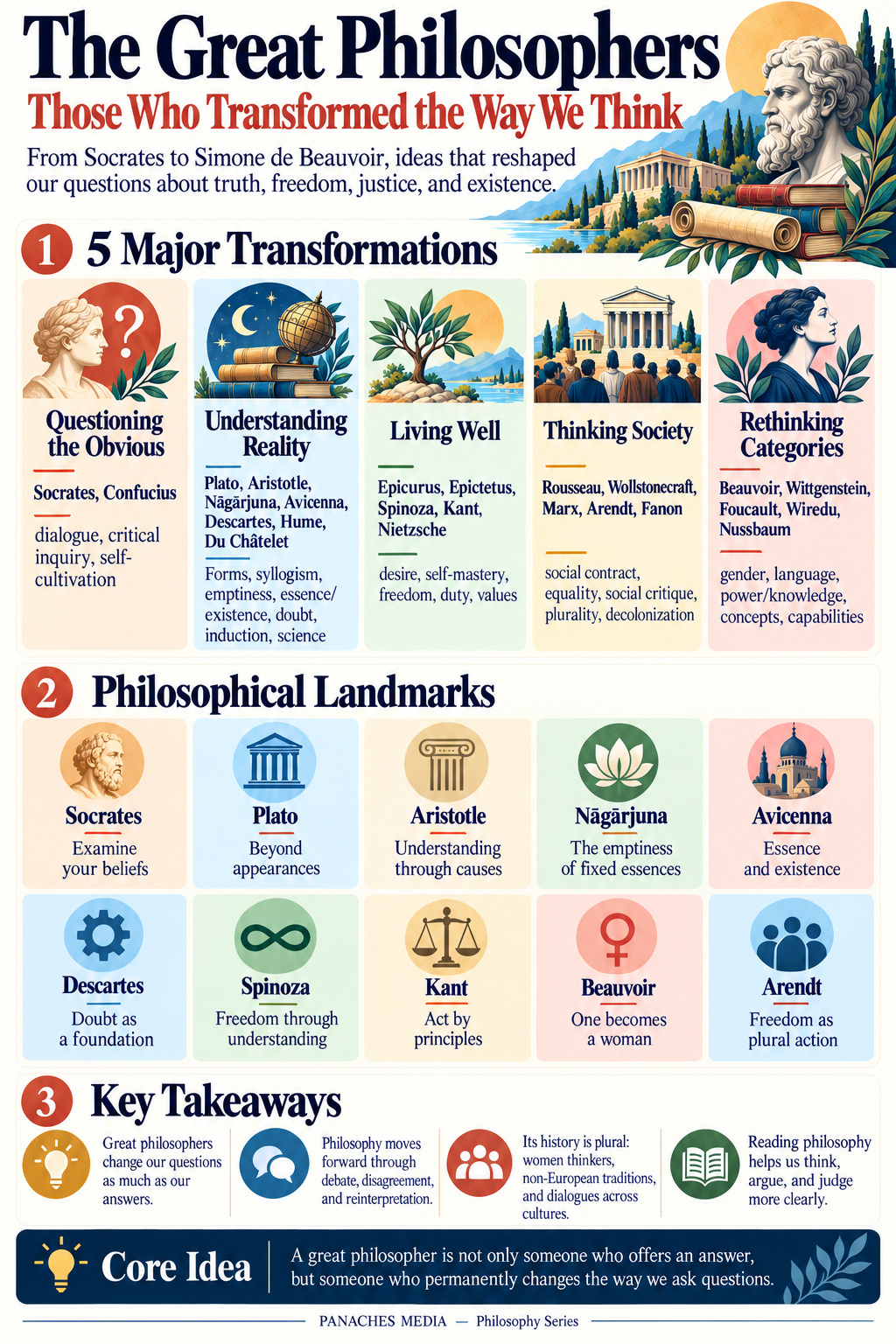
Why do some ideas survive for centuries while others disappear? How can a question raised in the streets of Athens, a reflection developed in ancient China, or a book published in the twentieth century permanently transform our understanding of the world? Socrates, Confucius, Avicenna, Descartes, Spinoza, Nietzsche, Simone de Beauvoir, and Hannah Arendt did not live in the same societies, nor did they defend the same conceptions of existence. Yet each contributed, in their own way, to shifting the boundaries of what we thought we knew. Behind these famous names lie ideas, disagreements, and questions that continue to concern us.
What Makes a Great Philosopher?
The history of philosophy is filled with figures who have become almost mythical.
We readily imagine Socrates debating in the public squares of Athens, Descartes immersed in his meditations, Nietzsche challenging the values of his time, or Simone de Beauvoir examining the contradictions of the society in which she lived.
These images have helped make certain philosophers famous. But they can also obscure what truly makes their thought interesting.
A philosopher does not become important simply by writing extensively, founding a school, or producing a memorable quotation.
Philosophical influence can take several forms.
Some thinkers introduced new ways of seeking truth. Others transformed our understanding of morality, freedom, or political life. A few challenged ideas so deeply rooted in society that they seemed part of the natural order of things.
Their importance does not mean that their conclusions must necessarily be correct.
Plato, Aristotle, Kant, and Nietzsche developed profoundly different, sometimes incompatible doctrines. Yet their works continue to be studied because they formulated problems, constructed arguments, and opened debates whose influence extends far beyond their own time.
A philosophical idea can also become influential through the objections it provokes. Sometimes, a philosopher has an enormous impact on later thinkers precisely because they attempt to contradict their predecessor.
A Selection, Not a Ranking
It would be impossible to bring together every major figure in the history of philosophy within a single article.
The very notion of a "great philosopher" partly depends on intellectual traditions, institutions, and historical choices that determined which works would be taught, translated, and preserved.
For a long time, certain historical narratives focused almost exclusively on male European philosophers, leaving numerous women thinkers and non-European traditions in the shadows.
This selection is therefore neither a ranking nor a definitive list.
Instead, it offers an opportunity to encounter philosophers through five major transformations in human thought:
- Learning to question what seems obvious and develop critical reflection.
- Reexamining truth, knowledge, and the nature of reality.
- Rethinking happiness, morality, and freedom.
- Investigating justice, power, and human relationships.
- Challenging the categories and certainties inherited from our cultures.
These perspectives naturally overlap. No important philosopher can be reduced to a single idea, and several could easily appear in more than one part of this journey.
Those Who Taught Us to Question the World
Socrates: Recognizing What We Do Not Know
Socrates (c. 469–399 BCE) — Ancient Greece
What is courage? What is justice? Can someone be virtuous without knowing what virtue means?
These questions seem simple. They become much more difficult when we attempt to provide precise answers.
Socrates profoundly influenced the history of philosophy by making this kind of questioning a fundamental intellectual activity.
He left no known philosophical writings of his own. His thought has mainly reached us through Plato's dialogues, Xenophon's works, and other testimonies that do not always present the same portrait.
We must therefore distinguish the historical Socrates from the different representations developed by his contemporaries and successors.
In several of Plato's dialogues, Socrates does not immediately attempt to teach a doctrine. He questions his interlocutors, asks them to define their ideas, and examines the contradictions that emerge from their answers.
Imagine someone claiming that courage means never being afraid.
Socrates might then ask whether someone incapable of recognizing danger is necessarily courageous. Does courage not require, on the contrary, some understanding of risk?
A definition that initially seemed obvious begins to reveal its weaknesses.
This method, often associated with the elenchus, or critical examination through refutation, transforms discussion into an instrument of inquiry.
Socrates' contribution lies not only in the answers he may have proposed, but in the demand that we submit our convictions to rational examination.
His trial and death sentence in 399 BCE would also give his figure a political and moral dimension.
Plato's Apology presents a man for whom examining his own existence and pursuing truth were demands important enough not to abandon, even under the threat of death.
What Socrates changed: philosophy became a practice of critical dialogue. It was no longer enough to state what one believed to know: one had to explain why and accept the possibility of contradictions.
Confucius: Thinking as a Process of Self-Cultivation
Confucius (traditionally 551–479 BCE) — Ancient China
Thousands of kilometers from the Greek world, Confucius developed a different approach to philosophical inquiry.
His teachings, transmitted particularly through the Analects, place essential importance on moral formation, education, and human relationships.
One of his central questions might be expressed as follows: how does someone become a person capable of acting justly toward others?
For Confucius, moral qualities are not merely abstract principles that one needs to understand.
They must be cultivated through behavior, social relationships, and learning.
The concept of ren, often translated as "humaneness" or "benevolence," refers in particular to a moral disposition that shapes how we regard others.
Li, associated with rituals and rules of conduct, refers to practices capable of shaping our behavior and judgment.
This conception may seem distant from modern habits of thought, which sometimes oppose personal authenticity to social conventions.
For Confucius, certain collective practices can instead help cultivate an attentive, respectful person capable of discernment.
His philosophy also has a political dimension.
A just government should not rely exclusively on fear of punishment. The moral character of leaders and their ability to set an example play an essential role.
Confucius therefore did not regard education, morality, and politics as three independent fields.
The way a society educates its members directly influences the quality of collective life.
His legacy profoundly shaped Chinese, Korean, Japanese, and Vietnamese intellectual traditions, although his ideas have continually been debated and reinterpreted.
It would nevertheless be misleading to contrast an exclusively rational Socrates with an entirely moral Confucius. Both were concerned with the quality of human life, but their methods, contexts, and conceptions of education differed profoundly.
Plato: Can We Move Beyond Appearances?
Plato (c. 427–347 BCE) — Ancient Greece
Plato, a student of Socrates, profoundly transformed the ambitions of philosophy.
He did not merely question individual opinions. He examined the conditions that make knowledge, justice, and an understanding of reality possible.
In The Republic, his famous allegory of the cave depicts prisoners who know nothing of the world beyond the shadows projected onto a wall.
These shadows constitute their entire experience. They have no immediate reason to imagine that reality could be different from what they perceive.
Yet one of them might be freed, discover the source of the shadows, and gradually arrive at a deeper understanding of the surrounding world.
This image raises a fundamental question: is what we perceive sufficient to know what truly exists?
Plato developed a philosophy of Forms or Ideas, intelligible realities that, according to different interpretations of his doctrine, help explain the properties and structures of sensible things.
Philosophy thus becomes a search for what lies beyond immediate appearances.
But Plato did not limit this inquiry to metaphysics.
He also sought to understand justice, political organization, education, and the conditions under which individuals could develop their reason.
His conception of the ideal city, presented particularly in The Republic, has generated important criticism, especially concerning the power granted to philosophers and the limits imposed on individual freedom.
A philosopher's influence therefore does not mean that their proposals should be accepted without question.
Plato helped establish philosophy as a systematic investigation into truth, knowledge, and the principles of existence.
Aristotle: Learning to Distinguish in Order to Understand
Aristotle (384–322 BCE) — Ancient Greece
Aristotle, a student of Plato, developed an extraordinarily wide-ranging body of work.
He studied logic, nature, living beings, knowledge, morality, politics, and artistic creation.
His work is particularly distinguished by the desire to identify the properties of things, understand their causes, and organize different fields of knowledge.
One of his major contributions concerns the logic of reasoning.
Consider a simple example:
- All human beings are mortal.
- Socrates is a human being.
- Therefore, Socrates is mortal.
This reasoning illustrates a classical form of syllogism.
The philosophical interest does not lie in the conclusion itself, but in the structure that explains why it follows from the premises.
Aristotle thus helped formalize the study of valid arguments.
Yet his philosophy extended far beyond logic.
In the Nicomachean Ethics, he examined the conditions of a fulfilled human life, associated with eudaimonia, often translated as "happiness" or "flourishing."
He particularly emphasized the importance of virtues acquired and cultivated through practice.
Courage, for example, consists neither of systematically avoiding danger nor of recklessly seeking risks. It involves the ability to judge and act appropriately.
His work exerted considerable influence on Greek, Arabic, Jewish, and Latin philosophical traditions.
It also contains conceptions that are deeply contested today, particularly concerning slavery and certain social hierarchies.
Aristotle's historical greatness should therefore not lead us to overlook the limitations of his thought.
Two complementary legacies: Plato invites us to question what lies behind appearances; Aristotle teaches us to examine beings, their properties, and the reasoning that allows us to understand them. Their often conflicting dialogue would shape philosophy for centuries.
Those Who Transformed Our Understanding of Reality and Knowledge
Nāgārjuna: Do Things Exist Independently of Their Relationships?
Nāgārjuna (c. 2nd–3rd centuries CE) — India
Nāgārjuna is one of the most influential figures in Buddhist philosophy.
Associated with the Madhyamaka school, or "Middle Way," he developed a particularly elaborate critique of certain conceptions of existence.
His major work, the Fundamental Verses on the Middle Way (Mūlamadhyamakakārikā), examines causation, movement, time, identity, and the conditions under which phenomena exist.
One of his central concepts is emptiness, or śūnyatā.
This concept is sometimes misunderstood as the claim that nothing exists.
The philosophical issue, however, is different.
Nāgārjuna challenges the idea that things possess an inherent, permanent nature independent of the relationships that make them possible.
Consider an ordinary situation.
A tree depends on numerous conditions: soil, water, sunlight, its biological history, and the processes supporting its growth.
We can identify it as a tree, but its existence and properties cannot be completely separated from these conditions.
This example does not, of course, summarize Nāgārjuna's entire philosophy. It does, however, introduce a fundamental question: can we truly understand something by isolating it from all the relationships that make its existence possible?
Nāgārjuna's philosophy does not merely attempt to replace one metaphysical doctrine with another.
It examines the difficulties that arise when we attribute entirely independent existence to things.
His influence extended across many Buddhist traditions in India, Tibet, China, Korea, and Japan.
His work also continues to inform contemporary discussions about metaphysics, knowledge, and the limits of language.
Avicenna: Distinguishing What Something Is from the Fact That It Exists
Avicenna (Ibn Sīnā, c. 980–1037) — Medieval Islamic World
A philosopher, physician, and scholar, Avicenna developed a particularly ambitious body of intellectual work.
He inherited Greek philosophical traditions, especially Aristotelian and Neoplatonic thought, which he profoundly transformed.
One of his major contributions concerns the relationship between essence and existence.
We can understand what something is without knowing whether it actually exists.
For example, we can define certain properties of an imaginary object. But knowing its definition is not enough to establish its existence.
This seemingly simple distinction opens up considerable metaphysical questions.
Why do certain things exist rather than not exist? Does their existence depend on other realities? Can we conceive of a being whose existence is necessary?
Avicenna developed a sophisticated reflection on contingent beings and necessary existence.
He also proposed a famous thought experiment, often called the Flying Man.
Imagine a human being suddenly created, suspended in space, and deprived of all perception of their own body.
Would this person nevertheless be conscious of existing?
The question allows us to examine the relationship between the soul, the body, and self-awareness.
Avicenna's influence extended far beyond his original intellectual environment. His works generated numerous debates within Islamic, Jewish, and Christian philosophical traditions.
His importance lies particularly in constructing a philosophical system in which logic, metaphysics, and the study of the mind are closely connected.
Descartes: Can Knowledge Be Rebuilt from Doubt?
René Descartes (1596–1650) — France
With Descartes, modern philosophy placed renewed importance on the search for certain foundations of knowledge.
In his Meditations on First Philosophy, published in 1641, he undertook to question beliefs that might be deceptive.
Our senses can sometimes mislead us. We may dream while believing ourselves awake. Even certain forms of reasoning that we consider obvious might be misunderstood.
Descartes pushed doubt to the point of examining what could resist it.
But doubt was not an end in itself.
It was a method for discovering a sufficiently secure starting point.
The famous statement "I think, therefore I am," appearing in the Discourse on the Method (1637), expresses one of the central discoveries of this approach: the very act of doubting presupposes the existence of a thinking subject.
It remains possible to question what this certainty actually establishes. Philosophers have never stopped examining Cartesian arguments.
Descartes also developed a distinction between thinking substance and extended substance that would permanently transform debates about the relationship between mind and body.
His influence was not limited to metaphysics. He also participated in the scientific transformations of his era and defended a conception of inquiry grounded in the methodical exercise of reason.
Descartes changed the direction of an essential philosophical question: before claiming to know the world, we must examine the conditions and limits of our own knowledge.
David Hume: Do Our Certainties Rest on Habit?
David Hume (1711–1776) — Scotland
Hume developed a particularly powerful critique of certain claims made by human reason.
In A Treatise of Human Nature and later An Enquiry Concerning Human Understanding, he examined the mechanisms through which we form beliefs.
Consider a familiar situation.
Every morning, we expect the sun to rise. This expectation rests on the regularity of past experience.
But how can we demonstrate with absolute certainty that the future will resemble the past?
Hume showed that our confidence in cause-and-effect relationships involves habits of thought that cannot simply be reduced to logical demonstration.
We regularly observe certain events following one another, but this repetition does not allow us to perceive a necessary causal connection directly.
His reasoning opens up the famous problem of induction.
How can we justify moving from what we have observed to what we predict?
This question remains important in contemporary discussions about science, probability, and knowledge.
Hume also developed critical analyses of the self, morality, and human passions.
His work would play a major role in the formation of Kant's critical philosophy.
Émilie du Châtelet: Understanding Science Without Separating Physics from Philosophy
Émilie du Châtelet (1706–1749) — France
Émilie du Châtelet occupies a fundamental place in eighteenth-century natural philosophy.
For a long time, she was presented primarily through her relationship with Voltaire. Yet she was an original thinker and scientist actively engaged in the major intellectual debates of her era.
In her Institutions de physique (Foundations of Physics, 1740), she sought to clarify the principles underlying our understanding of natural phenomena.
Her work brought Newton's discoveries into dialogue with metaphysical traditions associated particularly with Leibniz and Christian Wolff.
She was especially interested in the relationship between physical laws, forces, and the principles used to explain nature.
Her work demonstrates that accepting a scientific theory does not eliminate the need to examine its conceptual foundations.
The question is not simply which equations correctly describe a phenomenon, but also what those equations allow us to claim about reality.
Her annotated French translation of Newton's Principia, completed shortly before her death and published in full in 1759, was also a major contribution to the dissemination of Newtonian physics in French.
But her intellectual contribution cannot be reduced to translation.
Émilie du Châtelet illustrates a philosophy directly involved in the construction of scientific knowledge, through the examination of its concepts, methods, and foundations.
Her career also reminds us how deeply the history of science and philosophy was shaped by the institutional obstacles women faced.
Those Who Rethought Happiness, Morality, and Freedom
Since antiquity, much of philosophy has attempted to answer a very concrete question: how should we live?
The answers are far from forming a common doctrine.
For some thinkers, happiness depends on how we understand our desires. For others, it requires developing virtues, obeying rational principles, or radically transforming our values.
Epicurus: Does Happiness Require Always Wanting More?
Epicurus (341–270 BCE) — Ancient Greece
In everyday language, Epicureanism is often associated with the pursuit of pleasure.
This interpretation becomes misleading when it turns Epicurus into a defender of excess and endless consumption.
His philosophy is instead grounded in an examination of desires and their consequences.
Some desires respond to fundamental needs. Others are difficult to satisfy permanently and may perpetuate anxiety.
A happy life does not therefore necessarily require accumulating ever more possessions, achievements, or sensations.
It may require learning to distinguish what genuinely contributes to our well-being from what fuels dissatisfaction.
Epicurus placed particular importance on friendship, freedom from bodily suffering, and peace of mind.
His reflections on death also sought to reduce certain fears that can poison existence.
His contribution lies in demonstrating that happiness may require transforming our relationship with desire rather than satisfying every desire without limit.
Epictetus: Does Freedom Begin with Our Judgment?
Epictetus (c. 50–135 CE) — Greco-Roman World
Formerly enslaved and later a Stoic teacher, Epictetus developed a philosophy attentive to individual responsibility and the exercise of judgment.
His teachings are known primarily through notes recorded by his student Arrian, collected particularly in the Discourses and the Enchiridion.
One of his most famous distinctions concerns what depends on us and what does not depend entirely on us.
We cannot control every external event, the behavior of others, illnesses, or political transformations.
We can, however, work on how we judge situations and on the decisions we make.
This distinction does not mean that we should remain passive in the face of injustice or abandon attempts to change the world.
Rather, it invites us not to confuse our responsibility for action with complete control over its results.
Consider the example of an examination.
Someone can prepare carefully, develop their knowledge, and try to answer as well as possible. But they do not have absolute control over the final result.
For Epictetus, the quality of our conduct should therefore not depend exclusively on events that lie partly beyond our will.
This conception of inner freedom would leave a lasting mark on Stoic traditions and certain contemporary approaches to practical life.
Spinoza: Does Freedom Mean Understanding What Determines Us?
Baruch Spinoza (1632–1677) — Dutch Republic
Spinoza's philosophy challenges several common ideas about human freedom.
We tend to believe ourselves free because we are conscious of our desires and decisions.
But do we truly know all the causes that produce them?
Our behavior is influenced by our history, our bodies, our relationships, and circumstances whose effects we do not always understand.
In his Ethics, Spinoza developed a philosophy in which human beings belong entirely to the order of nature.
His conception of God or Nature departs profoundly from many traditional religious representations.
It also leads to a reconsideration of passions, emotions, and freedom.
For Spinoza, freedom cannot simply be understood as absolute independence from causes.
It involves, among other things, a better understanding of the determinations shaping our existence and the development of our power to act.
Imagine someone reacting angrily to criticism.
As long as they remain entirely dominated by this emotion, they may believe they are acting freely while actually undergoing an affect whose causes they do not understand.
Understanding what triggered the reaction may allow them to respond differently.
The example is simplified, but it illuminates an essential aspect of Spinoza's philosophy.
Freedom is not necessarily the opposite of all necessity: it may be connected to understanding our place within the natural order.
Kant: Can We Act Morally Without Pursuing Our Own Interests?
Immanuel Kant (1724–1804) — Prussia
Kant developed a moral philosophy that profoundly transformed how human obligations are understood.
We may perform a good action for many different reasons.
Sometimes we help someone out of affection, to obtain a reward, or because we fear punishment.
But can an action be considered morally right solely according to its consequences or the benefits it brings us?
Kant placed fundamental importance on the will to act according to principles that reason can recognize as universalizable.
This requirement is formulated particularly through the categorical imperative.
One way of approaching its meaning is to ask whether the principle guiding our action could be willed as a rule valid for everyone.
Consider lying to obtain a personal advantage.
If everyone allowed themselves to make promises without intending to keep them, the trust required for the very practice of promising would be seriously undermined.
Kant also developed a particularly influential conception of human dignity.
People should never be treated merely as instruments for satisfying someone else's objectives.
This reflection profoundly shaped modern ethics and discussions about autonomy and respect for persons.
It nevertheless raises important objections, particularly when different moral obligations seem to come into conflict.
Nietzsche: Where Do Our Values Come From?
Friedrich Nietzsche (1844–1900) — Germany
Nietzsche adopted a radically different critical approach.
Rather than immediately searching for the principles of a universal morality, he investigated the origins of values we take for granted.
Why do we admire certain qualities and condemn certain behaviors?
Do our moral judgments express eternal truths, or are they also the result of historical and cultural transformations?
In On the Genealogy of Morality (1887), Nietzsche examined the conditions under which certain moral evaluations developed.
His approach sought, among other things, to reveal the relationships between values, human experiences, and forms of power.
He criticized certain moralities that he regarded as hostile to the affirmation of life and the flourishing of forms of human excellence.
But Nietzsche cannot be reduced to a simple defense of selfishness or the idea that everyone should act according to their whims.
His philosophy contains complex and sometimes deeply contested positions, particularly regarding equality and hierarchies between individuals.
His influence largely rests on a transformation of the moral question.
Instead of asking only "What is good?", Nietzsche compels us to examine "Why have we learned to call this good?"
Conflicting Conceptions of Happiness and Freedom
| Philosopher | Central question | Major approach |
|---|---|---|
| Epicurus | What do we genuinely need to be happy? | Examine desires and pursue a life free from unnecessary disturbances. |
| Epictetus | How can we preserve freedom in the face of events? | Work on the judgments and choices for which we are responsible. |
| Spinoza | Can we become freer by understanding what determines us? | Develop knowledge of causes and our power to act. |
| Kant | What can ground our moral obligations? | Act according to rational principles and respect the dignity of persons. |
| Nietzsche | How did our values come into existence? | Examine their history, functions, and consequences for life. |
These philosophers do not merely offer five different pieces of advice for living happily.
They investigate distinct aspects of the human condition and sometimes defend incompatible positions.
Their confrontation reveals that happiness, freedom, and morality are far from self-evident concepts.
Those Who Transformed Our Understanding of Society and Power
Philosophy is not limited to individual knowledge or the pursuit of happiness.
It also examines institutions, laws, inequalities, and the mechanisms that organize human relationships.
Some works have profoundly changed how we understand political legitimacy, emancipation, and collective responsibility.
Rousseau: How Can We Remain Free While Living with Others?
Jean-Jacques Rousseau (1712–1778) — Geneva and France
Rousseau examined a fundamental difficulty of political life: how can a society impose common rules without destroying the freedom of its members?
In The Social Contract (1762), he investigated the conditions under which political authority could be legitimate.
Freedom does not simply mean doing whatever we wish independently of others.
Living together requires rules, institutions, and collective decisions.
But these rules can become oppressive when individuals are subjected to an authority they cannot recognize as legitimate.
Rousseau therefore developed a conception of sovereignty in which citizens collectively participate in forming the general will.
This reflection should not be confused with simply adding together individual preferences.
On the contrary, it raises difficult problems concerning the relationship between the common interest, freedom, and political decision-making.
Rousseau's work would exert considerable influence on modern democratic thought, while generating criticism concerning the tensions between political unity and the plurality of opinions.
Mary Wollstonecraft: Does Equality Require a Different Education?
Mary Wollstonecraft (1759–1797) — Great Britain
At the end of the eighteenth century, ideals of freedom and reason occupied a central place in European debates.
But these principles were far from being applied equally to everyone.
Women remained largely excluded from many educational and political institutions.
In A Vindication of the Rights of Woman (1792), Mary Wollstonecraft challenged arguments presenting this situation as the natural consequence of intellectual differences between the sexes.
She particularly emphasized the effects of education and social expectations on individual development.
If women have fewer opportunities to learn, develop their judgment, and exercise autonomy, how can the consequences of this exclusion then be used to supposedly demonstrate their inferiority?
The problem reveals a fundamental contradiction.
We cannot invoke the consequences of an organized inequality as proof that this inequality is natural or legitimate.
Wollstonecraft thus defended a conception of education and reason that helped renew philosophical reflection on rights and equality.
Her work also contains the limitations and assumptions of its time. Nevertheless, it remains a major reference in the history of feminist thought.
Marx: Are Ideas Enough to Understand Society?
Karl Marx (1818–1883) — Germany and Industrial Europe
Marx's philosophy developed in a context shaped by industrialization, the expansion of capitalism, and transformations in social relationships.
He sought to understand the connections between the material conditions of existence, institutions, and forms of thought.
Why do certain inequalities reproduce themselves even when societies proclaim principles of freedom and equality?
For Marx, examining the ideas a society officially defends is not enough.
We must also study its economic organization, property relations, labor, and relationships between social groups.
In Capital, whose first volume appeared in 1867, he developed a critique of capitalism and the social relationships structuring production.
His conception of exploitation was not limited to denouncing unjust individual behavior.
It sought to reveal economic and social mechanisms that can persist independently of the personal intentions of those participating in them.
Marx thus profoundly transformed political and social philosophy.
He raised a question that remains relevant today: can the institutions and ideas of a society be understood independently of the material conditions in which its members live?
His analyses would exert major influence on the social sciences, political movements, and numerous critical philosophical traditions.
Hannah Arendt: What Makes Political Life Possible?
Hannah Arendt (1906–1975) — Germany and United States
Hannah Arendt's thought developed in response to the major upheavals of the twentieth century.
A German Jewish intellectual forced into exile by Nazism, she devoted a significant part of her work to analyzing modern forms of political domination.
In The Origins of Totalitarianism (1951), she studied the historical and political conditions that made totalitarian regimes possible.
But her work was not limited to understanding violence and domination.
Arendt also developed an original reflection on action, human plurality, and political freedom.
In The Human Condition (1958), she distinguished several dimensions of human activity and gave essential importance to action undertaken with others in a public space.
For Arendt, politics cannot be reduced to administering material needs or exercising power imposed from above.
Political life emerges when different individuals can appear before one another, discuss, and act collectively.
This plurality constitutes a fundamental condition of political freedom.
Her reflections on the trial of Adolf Eichmann, published in 1963, also generated major debates concerning responsibility, judgment, and the ability of individuals to examine their own actions.
Arendt invites us to understand power not only as domination, but also as the collective capacity to act and open new possibilities.
Frantz Fanon: Can We Be Free in a World That Defines Us Against Our Will?
Frantz Fanon (1925–1961) — Martinique, France, and Algeria
A psychiatrist, writer, and anticolonial thinker, Frantz Fanon developed a philosophical reflection shaped by experiences of racism and colonial domination.
In Black Skin, White Masks (1952), he examined the psychological, social, and existential consequences of racial categories imposed on individuals.
How can we construct our identity when the gaze of others confines us within representations we did not choose?
How can we exercise freedom in a society that materially and symbolically organizes relationships of domination?
Fanon drew particularly on concepts from phenomenology and existentialism, but transformed them by confronting them with colonial experience.
In The Wretched of the Earth (1961), he developed a critique of colonial structures and the political conditions required to overcome them.
His analysis of violence, which remains particularly controversial, must be understood within the history of decolonization struggles and the debates it generated.
Fanon's philosophical importance lies in his ability to show that freedom cannot be understood solely as an abstract capacity to choose.
Historical, social, and political conditions profoundly influence the concrete possibilities available to individuals for existing and acting.
This perspective continues to inform political philosophy, postcolonial studies, and research into recognition and identity.
Those Who Challenged Our Familiar Categories
Some major philosophical transformations do not consist of proposing a new answer to an old question.
They involve demonstrating that the question itself may rest on questionable assumptions.
Why do we regard certain differences as natural? How does language influence our understanding of the world? What relationships exist between knowledge and power?
Simone de Beauvoir: Becoming Rather Than Being Born
Simone de Beauvoir (1908–1986) — France
In The Second Sex (1949), Simone de Beauvoir profoundly transformed debates about the condition of women.
Her famous statement expresses one of the central ideas of her work:
"One is not born, but rather becomes, a woman."
— Simone de Beauvoir, The Second Sex (1949)
This statement does not mean that bodily realities do not exist or are unimportant.
Rather, it leads us to examine how social expectations, institutions, education, and cultural representations contribute to constructing what it means to be a woman within a particular society.
Beauvoir drew on several intellectual traditions, particularly phenomenology, existentialism, and certain historical and social analyses.
She examined how women had been constituted as the "Other" in relation to a male subject presented as the human norm.
Her work profoundly shifted philosophical reflection.
It was no longer enough to ask abstractly whether human beings are free.
We must also understand the concrete situations in which freedom can be exercised and the obstacles that prevent certain individuals from developing their possibilities of existence.
Nor did Beauvoir reduce philosophy to the analysis of inequalities between women and men.
In The Ethics of Ambiguity (1947), she developed reflections on responsibility and the relationship between our own freedom and that of others.
Her thought profoundly influenced feminist philosophy, ethics, and contemporary research into identity and social relationships.
Wittgenstein: Does Language Shape Our Philosophical Problems?
Ludwig Wittgenstein (1889–1951) — Austria and United Kingdom
Wittgenstein occupies a distinctive position in twentieth-century philosophy.
His early investigations, particularly in the Tractatus Logico-Philosophicus (1921), examined the relationships between logic, language, and the world.
He sought, among other things, to understand what allows a proposition to represent a state of affairs.
But his later work led to a significantly different conception of language.
In Philosophical Investigations, published after his death in 1953, Wittgenstein emphasized how words are used in human practices.
A word does not necessarily possess a fixed meaning that we simply need to discover behind all its different uses.
Its meaning may depend on the situations and activities in which it is employed.
Consider the word "game."
It can describe a chess match, a sporting activity, a children's pastime, or a solitary activity.
These activities do not all seem to share one unique, perfectly defined characteristic.
Wittgenstein used examples of this kind to question our tendency to search for common essences where we may instead encounter networks of similarities.
His philosophy suggests that some intellectual problems arise because we use words outside their ordinary contexts or attribute functions to them that they do not possess.
Wittgenstein's contribution lies particularly in making the examination of our linguistic practices a way of clarifying, and sometimes dissolving, philosophical problems.
Michel Foucault: How Are Knowledge and Power Constructed Together?
Michel Foucault (1926–1984) — France
Foucault developed a historical and philosophical approach that profoundly transformed the study of institutions and forms of knowledge.
His research focused particularly on madness, medicine, prisons, sexuality, and the processes through which individuals become objects of knowledge.
In Discipline and Punish (1975), he examined transformations in penal practices and forms of discipline.
He was not interested solely in laws or the explicit decisions of political leaders.
He also studied everyday techniques that organize behavior: surveillance, examination, classification, and normalization.
These practices do not necessarily operate through direct violence.
They can help shape individuals, define behaviors considered normal, and produce knowledge about those who depart from these norms.
Foucault did not simply defend the idea that all knowledge is false because it maintains relationships with power.
He examined how certain forms of knowledge and institutional practices are historically constituted within relationships of power.
This approach exerted considerable influence on the humanities, political philosophy, and research into contemporary institutions.
It invites us to ask an unsettling question: when we regard a category as natural or obvious, have we sufficiently examined the history of the practices that made it possible?
Kwasi Wiredu: Thinking with Our Own Concepts
Kwasi Wiredu (1931–2022) — Ghana
The Ghanaian philosopher Kwasi Wiredu devoted an important part of his work to the relationships between language, knowledge, and philosophical traditions.
One of his most influential projects concerned conceptual decolonization.
The aim was to question the automatic adoption of intellectual categories inherited from foreign traditions, particularly European ones, when they do not necessarily correspond to distinctions found in other languages and cultures.
This approach does not involve rejecting every idea originating elsewhere.
Rather, it invites us to examine the assumptions we sometimes carry unconsciously when using philosophical concepts.
Wiredu drew particularly on the linguistic and intellectual resources of Akan traditions to renew questions concerning knowledge, personhood, and morality.
His work demonstrates that a philosophical question may be formulated differently depending on the languages and conceptual systems employed.
This does not mean that every attempt to reach a common understanding is impossible.
On the contrary, comparing traditions can help distinguish genuine philosophical problems from those that depend on the specific categories of a language or culture.
Wiredu reminds us that thinking freely also requires the ability to examine the words and concepts through which we learned to think.
Martha Nussbaum: Does Justice Require Real Opportunities?
Martha Nussbaum (born 1947) — United States
Martha Nussbaum contributes to contemporary debates about ethics, emotions, dignity, and social justice.
An important part of her work concerns the capabilities approach, also developed in the research of economist and philosopher Amartya Sen.
This approach invites us not to evaluate a society solely by its wealth, resources, or the rights formally recognized for its members.
It also seeks to determine what individuals are genuinely able to do and become.
Consider two people who formally possess the same right to education.
If one has access to suitable schools, favorable material conditions, and the support needed to study, while the other encounters major obstacles, legal equality does not necessarily guarantee equality of real opportunities.
The question of justice therefore concerns more than the abstract distribution of rights and goods.
It also requires examining the concrete conditions that allow everyone to develop their capabilities and lead a dignified life.
The capabilities approach itself generates debates about the criteria used to define these opportunities and the role institutions should play in securing them.
Its philosophical significance is nevertheless considerable: it shifts attention from the resources people possess toward the genuine freedoms available to them.
Great Women Thinkers Long Marginalized: A History Worth Reexamining
Discussing the great philosophers also requires examining how their importance came to be recognized.
For centuries, women were excluded from many educational institutions, universities, and publishing spaces.
This situation profoundly influenced the transmission of works and the construction of historical narratives.
Traditional bibliographies often privileged authors whose writings circulated within recognized scholarly institutions.
But this selection does not necessarily represent the full extent of philosophical activity in any given period.
The example of Émilie du Châtelet demonstrates how an original intellectual contribution can long be reduced to translation or association with a famous man.
Simone de Beauvoir's work, meanwhile, reminds us that a woman philosopher can permanently transform a discipline while still being presented too often through her intellectual and personal relationships.
Other figures reveal the extent of this problem.
Hypatia: A Philosopher Whose Work Has Almost Entirely Disappeared
Hypatia of Alexandria (c. 350/370–415) — Roman Egypt
Hypatia taught mathematics and philosophy in Alexandria, one of the major intellectual centers of Late Antiquity.
She belonged to a scholarly environment shaped particularly by Neoplatonic traditions.
Her intellectual activity is attested by several sources, including correspondence from her student Synesius of Cyrene and later historical testimonies.
She is believed to have participated in editing and commenting on mathematical and astronomical texts.
However, the surviving sources do not allow us to reconstruct a detailed philosophical system of her own.
Much of her work has disappeared, and her murder in 415, amid political and religious tensions, helped turn her into a symbol that has frequently been reinterpreted over the centuries.
It would be misleading to attribute detailed doctrines to her when the surviving evidence does not support them.
Her importance also lies in the testimony of her teaching activity and the position she occupied within Alexandria's intellectual life.
Hypatia reminds us that the absence of surviving works does not necessarily mean the absence of an important philosophical contribution.
Christine de Pizan: Challenging the Authority of Prejudice
Christine de Pizan (c. 1365–c. 1430) — Medieval France
A writer and political thinker, Christine de Pizan developed an extensive body of work on education, morality, and society.
In The Book of the City of Ladies (1405), she responded to representations that devalued women and were widespread in the scholarly and moral literature of her era.
The work takes the form of an allegorical construction featuring, among others, Reason, Rectitude, and Justice.
Christine examined arguments claiming to demonstrate women's intellectual and moral inferiority.
She drew on historical, literary, and religious examples to challenge the generalizations underlying these claims.
Her approach raises an essential question: does an opinion become more truthful simply because it is repeated by authors regarded as authorities?
Christine de Pizan's response was to subject these authorities to critical examination and counter their claims with other arguments and examples.
Her work does not correspond in every respect to contemporary conceptions of equality.
Nevertheless, it represents an important contribution to the history of reflections on education, dignity, and women's place in society.
Rediscovery Does Not Mean Idealization
Reevaluating the history of women philosophers does not mean replacing a list of great men with a list of great women.
It requires the same critical work for every figure studied: examining their writings, understanding their contexts, identifying their arguments, and recognizing the limitations of their doctrines.
Philosophers of the past did not necessarily defend all the values we associate with them today.
And their intellectual importance does not erase their contradictions or mistakes.
Broadening the history of philosophy does not mean abandoning historical rigor. On the contrary, it allows us to better understand how intellectual traditions were actually constructed.
Thinkers Who Respond to One Another Across the Centuries
The philosophers presented in this article did not necessarily belong to the same traditions.
They did not all pursue the same objectives or develop comparable doctrines.
Yet some of their problems can be brought into dialogue.
Such comparisons should not erase historical and conceptual differences. Rather, they help us understand how a question can be transformed when it encounters a different way of thinking.
Freedom: From Spinoza to Beauvoir
Spinoza invites us to examine the causes that determine our desires and behaviors.
Several centuries later, Beauvoir places particular importance on the concrete conditions under which individuals can exercise their freedom.
The two philosophers do not defend the same conception of subjectivity or autonomy.
Their comparison nevertheless reveals a shared difficulty: can freedom be understood independently of the conditions that shape our existence?
This question acquires a new dimension when it concerns social inequalities, institutions, or technologies capable of influencing our behavior.
Justice: From Rousseau to Nussbaum
Rousseau examined the legitimacy of laws and the conditions of political freedom.
Nussbaum investigates, among other things, the concrete opportunities individuals must possess to lead dignified lives.
Their philosophies belong to different contexts.
But comparing them reveals that a society cannot be evaluated solely by the intentions publicly expressed by its institutions.
We must also examine the conditions of political participation and the reality of the freedoms available to individuals.
Knowledge: From Descartes to Wiredu
Descartes examined the foundations that allow us to justify knowledge.
Wiredu draws attention to the conceptual and linguistic categories through which philosophical problems are formulated.
These approaches do not pursue the same objective.
They nevertheless remind us that knowledge requires reflection on its own conditions.
We never think from nothing: we rely on concepts, methods, and traditions that themselves deserve examination.
Judgment: From Socrates to Hannah Arendt
In Plato's dialogues, Socrates subjects opinions to critical examination.
In a radically different historical context, Arendt explored thought, judgment, and political responsibility.
Bringing them together does not mean that they defended the same doctrine.
It helps explain why the ability to examine our own convictions remains important in societies where individuals encounter multiple discourses, institutions, and authorities.
Major Ideas That Changed Our Perspective
| Idea or transformation | Associated thinkers | What it invites us to reconsider |
|---|---|---|
| Critical examination of opinions | Socrates | A conviction must be open to discussion and justification. |
| Moral formation through education | Confucius | Character and social relationships develop through practices. |
| The search for causes and structures of reasoning | Aristotle | Understanding requires distinguishing concepts and examining arguments. |
| Critique of independent essences | Nāgārjuna | Things cannot always be understood separately from their conditions of existence. |
| Distinction between essence and existence | Avicenna | Understanding what something is does not explain why it exists. |
| Methodological doubt | Descartes | The foundations of our knowledge must be examined. |
| Critique of induction | Hume | The regularity of past experiences does not logically guarantee the future. |
| Freedom as understanding | Spinoza | Our choices are connected to causes we do not always recognize. |
| Moral autonomy | Kant | Our actions must be justifiable through rational principles. |
| Genealogy of values | Nietzsche | Our moral judgments also have a history. |
| Analysis of lived situations | Beauvoir and Fanon | Freedom cannot be understood without examining the concrete conditions of existence. |
| Political action as plurality | Arendt | Political freedom requires a world shared with others. |
| Conceptual decolonization | Wiredu | Our intellectual categories should not automatically be regarded as universal. |
This table does not attempt to summarize the entire works of these authors. It highlights several particularly influential intellectual transformations.
How Can We Discover Their Works?
Great philosophical texts can seem difficult to approach.
Their vocabulary is sometimes technical, their arguments require historical knowledge, and certain books respond to controversies that are no longer familiar to us.
Yet there is no single path toward discovering these philosophers.
A useful approach is to begin with a question that genuinely interests us, then explore the works that attempt to answer it.
A Few Books to Get Started
| Work | Author | Why read it? |
|---|---|---|
| Apology | Plato | To discover the moral and critical dimensions of Socratic questioning. |
| Analects | Confucius | To explore the connections between education, moral conduct, and human relationships. |
| Letter to Menoeceus | Epicurus | To encounter a concise reflection on desire, happiness, and death. |
| Discourse on the Method | Descartes | To understand the ambitions of the modern search for knowledge. |
| Theological-Political Treatise (selected passages) | Spinoza | To approach the relationships between freedom of thought, religion, and political power. |
| A Vindication of the Rights of Woman | Mary Wollstonecraft | To explore a philosophical critique of inequality grounded in education and reason. |
| The Gay Science (selected aphorisms) | Nietzsche | To encounter critical, experimental, and often provocative philosophical writing. |
| The Second Sex (introduction and selected passages) | Simone de Beauvoir | To understand the philosophical analysis of social situations and the construction of otherness. |
| The Human Condition | Hannah Arendt | To reflect on action, freedom, and political plurality. |
| Black Skin, White Masks | Frantz Fanon | To examine the relationships between lived experience, identity, and domination. |
These works vary in difficulty. Some are best approached with a historical introduction or an annotated edition.
Reading a philosopher does not necessarily mean agreeing with their doctrine.
It is entirely possible to admire the rigor of an argument while rejecting its conclusion.
Indeed, this is one of the most fruitful experiences of philosophical reading.
Why Do These Philosophers Still Matter to Us?
At first glance, the questions raised by Socrates, Confucius, or Avicenna may seem far removed from the twenty-first century.
Yet scientific, political, and technological transformations frequently give renewed relevance to ancient problems.
Contemporary debates about artificial intelligence examine the nature of knowledge, consciousness, and reasoning.
Discussions about digital freedom and surveillance mechanisms intersect with certain questions raised by Foucault or Arendt.
Controversies concerning social inequality extend questions found, in different forms, in the works of Rousseau, Wollstonecraft, Marx, Beauvoir, and Nussbaum.
Research into emotions, desires, and happiness can enter into dialogue with the philosophies of Epicurus, Epictetus, or Spinoza.
But it would be artificial to assume that thinkers of the past already possess all the answers to contemporary challenges.
They did not know our technologies, institutions, or the scientific transformations of our time.
Their concepts must therefore be examined, debated, and sometimes profoundly adapted.
The value of great philosophers does not lie in their ability to spare us the effort of thinking, but in their capacity to make our own reflections more demanding.
They teach us that the most familiar questions can become surprisingly complex.
What is freedom? What is a person? What makes justice possible? How can we distinguish knowledge from belief? How should we live with others?
None of these questions belongs exclusively to the past.
A History of Philosophy That Is Still Being Written
The figures presented in this article helped transform our understanding of the world.
Some constructed philosophical systems of extraordinary scope. Others developed critiques that challenged the dominant doctrines of their era.
Several introduced new methods of analysis. Others demonstrated that questions considered universal could depend on particular historical, social, or linguistic contexts.
Their works do not form a perfectly coherent whole.
Socrates, Confucius, Nāgārjuna, Descartes, Spinoza, Kant, Nietzsche, Beauvoir, and Wiredu do not defend the same conceptions of truth, freedom, or existence.
Their disagreements are precisely part of their legacy.
Philosophy does not progress only when a thinker discovers a convincing answer.
It also progresses when someone else reveals a difficulty, questions an assumption, or proposes a different way of understanding the problem.
The history of great philosophers is also the history of voices that did not always have equal opportunities to be heard.
Non-European intellectual traditions, women philosophers, and thinkers long marginalized now contribute to broadening our understanding of this history.
This does not make ancient works less important.
It allows us to situate them more accurately, confront them with other perspectives, and understand that philosophy has more than one way of developing.
A great philosopher, therefore, is not necessarily someone who was right about everything.
It is also someone whose thought compels us to examine differently a question we believed we already understood.
Key takeaway: the philosophers who shaped history did not pass down a collection of definitive truths. They transformed the questions we ask, the arguments we use, and the possibilities we recognize for understanding the world and our existence.
Their legacy remains alive whenever an idea is discussed, a certainty is questioned, or a new generation decides to revisit an old problem.
Philosophy does not end with the great names filling our libraries.
It continues with those who read them, challenge them, and seek, in their turn, to think differently.
Sources and References
Foundational Figures and Ancient Philosophies
- Stanford Encyclopedia of Philosophy — Socrates — Study of the historical Socrates, his different representations, and the questioning practices associated with him.
- Stanford Encyclopedia of Philosophy — Plato — Overview of Platonic thought, its dialogues, and major philosophical problems.
- Stanford Encyclopedia of Philosophy — Aristotle — Introduction to logic, metaphysics, and the principal fields of Aristotelian philosophy.
- Stanford Encyclopedia of Philosophy — Confucius — Analysis of Confucian ethics, education, and political philosophy.
- Stanford Encyclopedia of Philosophy — Nāgārjuna — Study of Madhyamaka philosophy and the concept of emptiness.
Knowledge, Metaphysics, and Morality
- Stanford Encyclopedia of Philosophy — Ibn Sina (Avicenna) — Overview of Avicenna's metaphysics, logic, and theory of knowledge.
- Stanford Encyclopedia of Philosophy — Descartes' Epistemology — Study of methodological doubt and the Cartesian search for certainty.
- Stanford Encyclopedia of Philosophy — Émilie du Châtelet — Analysis of her original contributions to natural philosophy.
- Stanford Encyclopedia of Philosophy — Spinoza — Overview of his metaphysics, theory of emotions, and conception of freedom.
- Stanford Encyclopedia of Philosophy — Kant's Moral Philosophy — Study of the categorical imperative, autonomy, and moral obligation.
- Stanford Encyclopedia of Philosophy — Nietzsche's Moral and Political Philosophy — Analysis of Nietzsche's critique of morality and values.
Political Philosophy, Freedom, and Society
- Stanford Encyclopedia of Philosophy — Mary Wollstonecraft — Overview of her political, moral, and educational philosophy.
- Stanford Encyclopedia of Philosophy — Hannah Arendt — Study of her political philosophy, totalitarianism, action, and plurality.
- Stanford Encyclopedia of Philosophy — Simone de Beauvoir — Analysis of her existentialism, ethics, and philosophy of women's condition.
- Internet Encyclopedia of Philosophy — Frantz Fanon — Study of his anticolonial thought and analyses of identity and freedom.
Critical History and Contemporary Philosophy
- Stanford Encyclopedia of Philosophy — Feminist History of Philosophy — Research on women philosophers and their place within intellectual traditions.
- Stanford Encyclopedia of Philosophy — Medieval Political Philosophy — Overview of medieval political thought, including Christine de Pizan's philosophical and political work.
- Internet Encyclopedia of Philosophy — Kwasi Wiredu — Study of conceptual decolonization and the relationships between language and philosophy.
- Stanford Encyclopedia of Philosophy — The Capability Approach — Introduction to the capabilities approach and its developments in contemporary political philosophy.