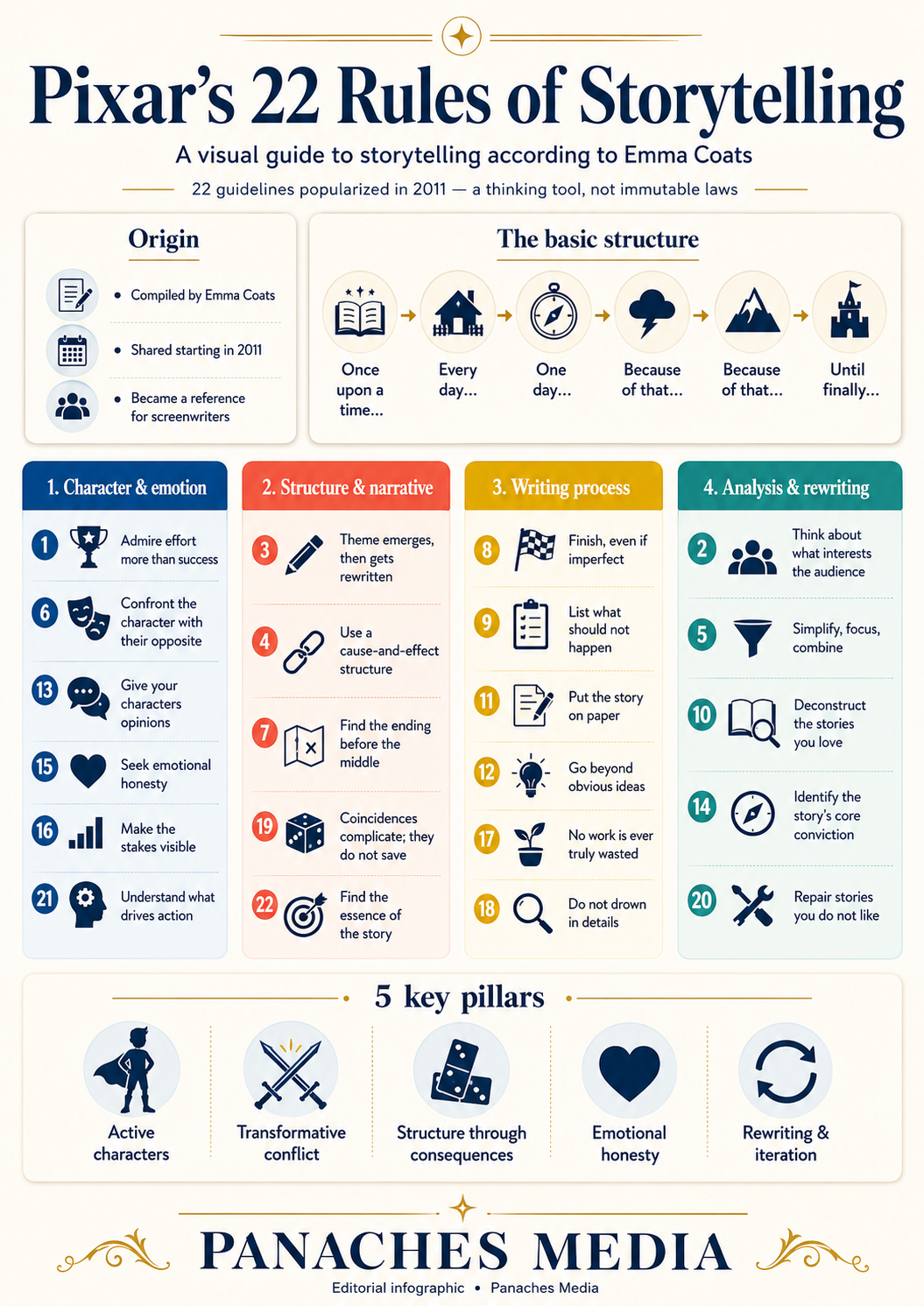
Pixar's 22 Rules of Storytelling
Creating a memorable story is not simply a matter of imagining an original world, a compelling character, or a succession of spectacular scenes. A story works when its characters pursue something, face obstacles, make decisions, and give us a reason to care about what happens to them.
This is precisely what the famous “Pixar's 22 Rules of Storytelling” remind us.
These tips were shared beginning in 2011 by Emma Coats, who was then a story artist at Pixar. They brought together various lessons she had learned while working on stories, both at Pixar and elsewhere. The list later spread across the Internet under the name “Pixar's 22 Rules of Storytelling.”
However, an important distinction must be made: these are not official rules mechanically followed by every screenwriter at the studio. Emma Coats herself later explained that she should have called them “guidelines” rather than rules.
These principles nevertheless remain an excellent creative toolkit. They can help writers question a story, strengthen its characters, clarify its stakes, and find a way out of a creative dead end.
Here are the 22 rules, each accompanied by an explanation and a practical way to apply it.
1. We Admire a Character for Trying, Not Only for Succeeding
A character does not need to win constantly to hold the audience's attention. What matters most is that they try, endure, learn, and continue despite the difficulties they face.
An invincible hero quickly becomes predictable. By contrast, a character who fails but refuses to give up reveals their determination, values, and limitations.
The audience therefore does not become attached only to the final victory. It becomes attached to the price the character had to pay to achieve it.
How to Apply It
Ask yourself:
- What is your character truly trying to accomplish?
- What do they risk by continuing?
- What does the way they fail reveal about them?
- Why do they decide to try again despite everything?
Effort makes a character human. Victory only becomes satisfying after it has seemed difficult, or even impossible.
2. Think About What Interests the Audience
What entertains the author while writing is not always what will interest the reader or viewer.
A long description may be fascinating to create because it expands the world. A secondary scene may be enjoyable to write because its dialogue is funny. However, if these elements do not move the story forward, they may slow the narrative down.
This rule does not suggest blindly following audience expectations. It simply reminds us that a work is an experience intended to be received by someone else.
How to Apply It
For each scene, ask three questions:
- What does the audience learn?
- What does the audience feel?
- What question makes the audience want to continue?
A scene can be slow, contemplative, or mysterious. It must nevertheless create an intentional effect.
3. The True Theme Often Appears at the End
A writer may begin with a clear idea of their story's theme: grief, freedom, family, ambition, loneliness, or the fear of failure.
But the writing process often transforms that initial intention.
The characters' decisions, improvised scenes, and conflicts discovered along the way may reveal that the story is actually about something else.
The theme is not only what the writer intended to say. It is also what the story ultimately demonstrates.
How to Apply It
Finish a first draft, then ask yourself:
- What transformation truly dominates the story?
- What final choice summarizes the character's journey?
- What idea naturally returns across several scenes?
- What does the story seem to say, even if you did not plan it?
Once you have found the answer, rewriting allows you to strengthen that theme from the very beginning.
4. Use a Simple Narrative Structure
Emma Coats proposed a formula that has since become famous:
Once upon a time… Every day… One day… Because of that… Because of that… Until finally…
This structure may seem elementary, but it forces the writer to identify the essential turning points of the narrative.
- Once upon a time introduces the character and their world.
- Every day establishes the routine.
- One day introduces the inciting incident.
- Because of that builds the consequences.
- Finally leads to the resolution.
The value of this formula does not come from its rigidity, but from the chain of cause and effect it imposes.
A good story is not merely a succession of events. Each event should cause the next one.
Example
Once upon a time, there was a cartographer who was unable to leave her village.
Every day, she drew countries she had never visited.
One day, an unknown island appeared on one of her maps.
Because of that, she was accused of falsifying the royal archives.
Because of that, she had to set out in search of the island to prove her innocence.
Until finally, she discovered that the island only existed for those who were afraid to search for it.
In just a few sentences, the story already has a character, a desire, a conflict, and a direction.
5. Simplify, Focus, and Combine
When a story is not working, the natural reaction is often to add another plot, character, explanation, or twist.
Yet the solution is frequently found through subtraction.
Two supporting characters can sometimes be combined. Several stages of the story can be condensed. A subplot can be removed if it distracts from the central conflict.
Simplifying does not mean impoverishing the story. It means making every remaining element more important.
How to Apply It
Look for:
- characters who perform the same function;
- scenes that communicate the same information;
- detours that produce no consequences;
- explanations that could be replaced by action;
- interesting ideas that may belong in another story.
A focused story leaves more room for emotion.
6. Confront the Character With Their Opposite
Identify what your character is good at, comfortable with, or protected by. Then place them in a situation where that strength is no longer enough.
A solitary character may be forced to lead a group. A skilled negotiator may meet someone who refuses all discussion. A rational person may have to act without evidence. A warrior may face a problem that violence cannot solve.
Conflict becomes interesting when it attacks the character's usual way of dealing with the world.
How to Apply It
Complete this sentence:
My character usually solves problems by using __, but this time that method fails because ____.
You now have a challenge capable of producing genuine character development.
7. Find the Ending Before Building the Middle
Beginnings are seductive. They contain promises, a world that is still open, and almost infinite possibilities.
Endings are more difficult. They must resolve the conflict, fulfill or subvert expectations, and give meaning to the journey.
Knowing the destination allows the writer to prepare the clues, transformations, and choices that will make the conclusion believable.
The ending may naturally evolve during the writing process. What matters is having a direction.
How to Apply It
Before developing every plot complication, determine:
- the character's final choice;
- what they gain;
- what they lose;
- what they understand;
- the image or feeling on which the story ends.
The middle then becomes the necessary path that makes this conclusion feel inevitable without making it predictable.
8. Finish the Story, Even if It Is Not Perfect
An unfinished story cannot truly be evaluated.
As long as a writer remains focused on the opening scenes, they can preserve the illusion that the story will eventually become perfect. Finishing it forces them to see the complete work: its inconsistencies, slow sections, missed opportunities, and unexpected strengths.
The first draft does not need to be brilliant. It needs to exist.
How to Apply It
Clearly separate two stages:
- Finish the story without correcting every detail.
- Improve the story once its complete structure is visible.
Premature perfectionism is often an elegant form of procrastination.
9. List What Should Not Happen
When a writer is stuck, they generally search for the right idea. This direct search can increase the pressure and make every possibility seem inadequate.
Emma Coats suggests approaching the problem from the opposite direction: write down everything that should not happen next.
This list eliminates obvious, absurd, or inconsistent solutions. But it may also reveal an unexpected possibility.
How to Apply It
Quickly write down ten bad possibilities for what happens next:
- the hero gives up;
- a stranger solves everything;
- the problem disappears;
- the character suddenly discovers a new power;
- the antagonist changes their mind for no reason.
Then examine why these solutions do not work. The answer often contains what the story truly needs.
10. Deconstruct the Stories You Love
Our tastes are not arbitrary. They reveal the emotions, structures, characters, and themes to which we are most sensitive.
Analyzing a story you love does not mean copying it. It means understanding the mechanisms that create its effect.
Perhaps you enjoy stories about reconciliation, dysfunctional groups, ordinary worlds disrupted by an anomaly, or heroes who must abandon their original goal.
Recognizing these patterns allows you to transform them consciously.
How to Apply It
Choose three works you love and write down the following for each:
- the type of protagonist;
- the central conflict;
- the dominant emotion;
- the nature of the ending;
- the scene you remember most;
- the reason that scene works.
The similarities between your answers form part of your creative identity.
11. Put the Story on Paper
An idea kept inside your head remains flexible, perfect, and protected from contradictions.
As soon as it is written down, its weaknesses become visible. That is precisely what makes it possible to work on them.
Writing is not only a way to record a story that has already been designed. It is a way to think, test, discover, and correct.
How to Apply It
Turn the idea into something concrete, even in an imperfect form:
- a one-page synopsis;
- a timeline;
- a list of scenes;
- a dialogue;
- a mind map;
- an awkward first chapter.
A bad page can be revised. A nonexistent page cannot.
12. Eliminate the First Obvious Ideas
The first idea is often logical. It is also frequently the same idea that much of the audience would have found.
It does not necessarily need to be rejected because it is bad, but because it deserves to compete with other possibilities.
By moving beyond the first answers, the writer explores less immediate associations and discovers more personal solutions.
How to Apply It
For a character, location, conflict, or revelation, produce at least five possibilities.
Do not choose immediately. Compare them using three criteria:
- Which one creates the most consequences?
- Which one reveals the character most effectively?
- Which one feels as though it belongs only to this story?
Originality does not always come from an idea that has never been seen before. It often comes from a less obvious combination.
13. Give Your Characters Opinions
A character without opinions waits for the plot to make decisions on their behalf.
They may be pleasant, polite, or sympathetic, but they lack dramatic force. Memorable characters interpret the world. They judge, desire, refuse, make mistakes, and defend their beliefs.
An opinion naturally creates decisions and conflict.
How to Apply It
Determine what your character thinks about:
- love;
- success;
- authority;
- family;
- truth;
- fear;
- their own worth.
These opinions do not need to be correct. They need to influence the character's actions.
An active character does not merely endure the story: they help cause it.
14. Identify the Belief That Fuels the Story
Why must this story be told by you?
The answer does not need to be grand. It may come from anger, fear, fascination, a memory, or a question you do not yet know how to answer.
This inner conviction gives the story its energy.
A premise can be spectacular while remaining empty. Conversely, a simple situation can become powerful when it carries a personal necessity.
How to Apply It
Complete this sentence without searching for the perfect wording:
I want to tell this story because…
Then go deeper:
What I refuse to accept is… What I would like to understand is… What I want the audience to feel is…
The heart of the story is often found in these answers.
15. Seek Emotional Honesty
A story may contain robots, monsters, imaginary worlds, or impossible phenomena. Its emotions must still remain believable.
Ask yourself how you would genuinely react in the character's situation.
You might not immediately become courageous. You might deny the problem, search for an excuse, behave awkwardly, or initially focus on an insignificant detail.
These imperfect reactions bring truth to fiction.
How to Apply It
For each important moment, distinguish between:
- what the character shows;
- what they feel;
- what they refuse to admit;
- what they would like to do;
- what they actually do.
The gap between these elements creates depth.
16. Make the Stakes Visible
Why should the audience want the character to succeed?
The stakes answer this question. They show what will be lost if the character fails.
An abstract threat is not always enough. “Saving the world” can feel less emotionally powerful than preserving a relationship, keeping a promise, or avoiding becoming the person one fears.
The strongest stakes often combine several dimensions:
- external stakes, connected to the situation;
- personal stakes, connected to the character's desire;
- emotional stakes, connected to the character's identity.
How to Apply It
Complete these sentences:
If the character fails, they will lose __. More importantly, that failure will prove to them that ____.
The second answer often reveals the true stakes.
17. No Work Is Ever Entirely Wasted
Some scenes, ideas, or versions must be abandoned. That does not mean the work was useless.
A deleted subplot may become a new story. A secondary character may return in another form. A failed scene may have helped reveal the protagonist's tone or motivations.
Creating involves producing a large amount of invisible material.
How to Apply It
Keep a separate document for:
- deleted scenes;
- abandoned characters;
- unused dialogue;
- visual concepts;
- undeveloped premises.
However, do not keep an element in the story simply because it required a great deal of work. Its past value does not guarantee its present usefulness.
18. Learn to Recognize Excessive Detail
Doing your best does not mean perfecting every element with the same level of intensity.
A writer may spend days developing the history of a building, a secondary timeline, or the precise operation of a technology that will appear for only a few seconds.
This work may enrich the fictional world. It may also become a way of avoiding difficult decisions concerning the character and plot.
A story is an experience, not an encyclopedia.
How to Apply It
For every detail, ask:
- Does it influence a decision?
- Does it change an emotion?
- Does it prepare an event?
- Does it help the audience understand the scene?
- Will it actually be perceived?
The world should support the story, not bury it.
19. Use Coincidences Carefully
A coincidence can trigger a disaster. It can place the character in the wrong location, reveal dangerous information, or cause an unexpected encounter.
But when a coincidence solves the problem, the audience may feel that the story is cheating.
The difference lies in the character's responsibility.
An accidental complication forces the hero to act. An accidental solution prevents them from having to act.
How to Apply It
Coincidences are effective when they:
- make the situation worse;
- trigger the story;
- force a decision;
- reveal a weakness.
They become fragile when they replace preparation, intelligence, sacrifice, or character development.
20. Repair a Story You Dislike
Analyzing a successful work teaches you how certain solutions function. Rearranging a work you dislike teaches you to identify precisely what is missing.
Instead of simply declaring that a film or novel is bad, try rebuilding it.
This approach transforms a subjective reaction into a writing exercise.
How to Apply It
Choose a disappointing work and ask yourself:
- Which character should be at the center?
- Which conflict deserves greater importance?
- Which scene could be removed?
- Which decision would make the hero more active?
- Which ending would logically extend the theme?
The goal is not to prove that you could have done better, but to train your ability to diagnose a narrative structure.
21. Understand What Drives the Character to Act
A character should not perform an action simply because it looks impressive or because the plot requires it.
You need to understand what in their experience, beliefs, or emotional wounds leads them to act that way.
Identification does not mean that the audience must approve of the character. It means that the audience should be able to follow the emotional logic behind their decisions.
How to Apply It
Before an important decision, ask:
- What does the character believe to be true?
- What are they trying to protect?
- Which fear influences their judgment?
- Which other possibility do they refuse?
- Why does this decision seem reasonable to them at that moment?
Even a bad decision becomes believable when it is properly motivated.
22. Find the Essence of the Story
What is the simplest and most direct version of your story?
This question does not ask you to eliminate all complexity. It seeks the core around which everything else should be organized.
A complex story should still be summarizable through a fundamental relationship, transformation, or conflict.
How to Apply It
Try presenting your story in one sentence:
This is the story of __, who must _, but ___.
Then look for an emotional version:
This is the story of someone who believes __ and discovers ____.
The first sentence usually describes the plot. The second reveals its essence.
When both are clear, the supporting characters, locations, scenes, and twists can be built around a solid foundation.
The Core Principles Behind the 22 Rules
Although the list covers many aspects of writing, it is primarily built around five ideas.
Action Reveals Character
A character becomes interesting through their decisions, attempts, mistakes, and reactions under pressure.
Their biography may explain who they are, but action allows the audience to witness it.
Conflict Must Create Transformation
An obstacle is not merely a way to delay the hero's success. It should challenge their beliefs and make their old methods insufficient.
External conflict becomes powerful when it creates internal conflict.
Structure Is Built on Consequences
Events should not merely follow one another. They should cause one another.
The character acts, the action produces a consequence, the consequence creates a new problem, and the new problem requires a more difficult decision.
Emotion Must Remain Honest
Spectacle attracts attention, but emotion gives meaning to what happens.
Even in an impossible world, the audience must recognize fear, hope, shame, desire, jealousy, or the need to be accepted.
Writing Is a Process of Discovery
Several of these rules concern not the final structure, but the way writers work: finishing, rewriting, removing material, preserving abandoned ideas, and accepting imperfection.
Writers do not always discover their story before writing it. They often discover it by writing it.
How to Use These Rules Without Formulaically Shaping Your Story
These 22 principles should not become a checklist mechanically applied to every narrative.
Not every story needs an admirable hero, a conventional structure, or a conclusion prepared in minute detail. Some stories rely on ambiguity, contemplation, fragmentation, or a deliberate absence of resolution.
A narrative rule becomes useful when it helps solve a specific problem.
If your character seems passive, examine rules 6, 13, and 21.
If the story lacks tension, use rules 4, 16, and 19.
If the narrative seems too complex, return to rules 5, 18, and 22.
If you are stuck, try rules 9, 10, 12, and 20.
If you never manage to finish, focus on rules 7, 8, 11, and 17.
The goal is therefore not to obey all 22 rules simultaneously. It is to have 22 questions capable of revealing a story's weaknesses.
A Simple Method for Testing Your Story
You can summarize all of this advice through ten questions:
- What does the character want?
- Why does that desire truly matter to them?
- What do they risk losing?
- Which weakness prevents them from moving forward?
- Which event destroys their routine?
- How do their decisions make the situation worse?
- Why should the audience want them to succeed?
- Which difficult choice will they ultimately have to make?
- How does that choice transform them?
- What essential idea is left with the audience?
When the answers remain vague, the story probably needs further development.
When the answers are clear but the narrative still feels weak, the problem may lie less in the structure than in the execution: overly explanatory scenes, artificial dialogue, uneven pacing, or insufficiently developed emotions.
Conclusion
The 22 storytelling rules popularized by Emma Coats are neither a secret Pixar formula nor a guarantee of success.
They offer something more useful: a set of creative instincts for questioning a story while it is being developed.
They remind us that audiences connect with a character's efforts, that obstacles should provoke decisions, that stakes give conflict its weight, and that the first draft is only the beginning of the work.
A story does not become memorable because it perfectly follows a list of principles. It becomes memorable when it transforms structure into a human experience.
Rules can help build the path. But characters, emotions, and the writer's conviction are what give it a soul.