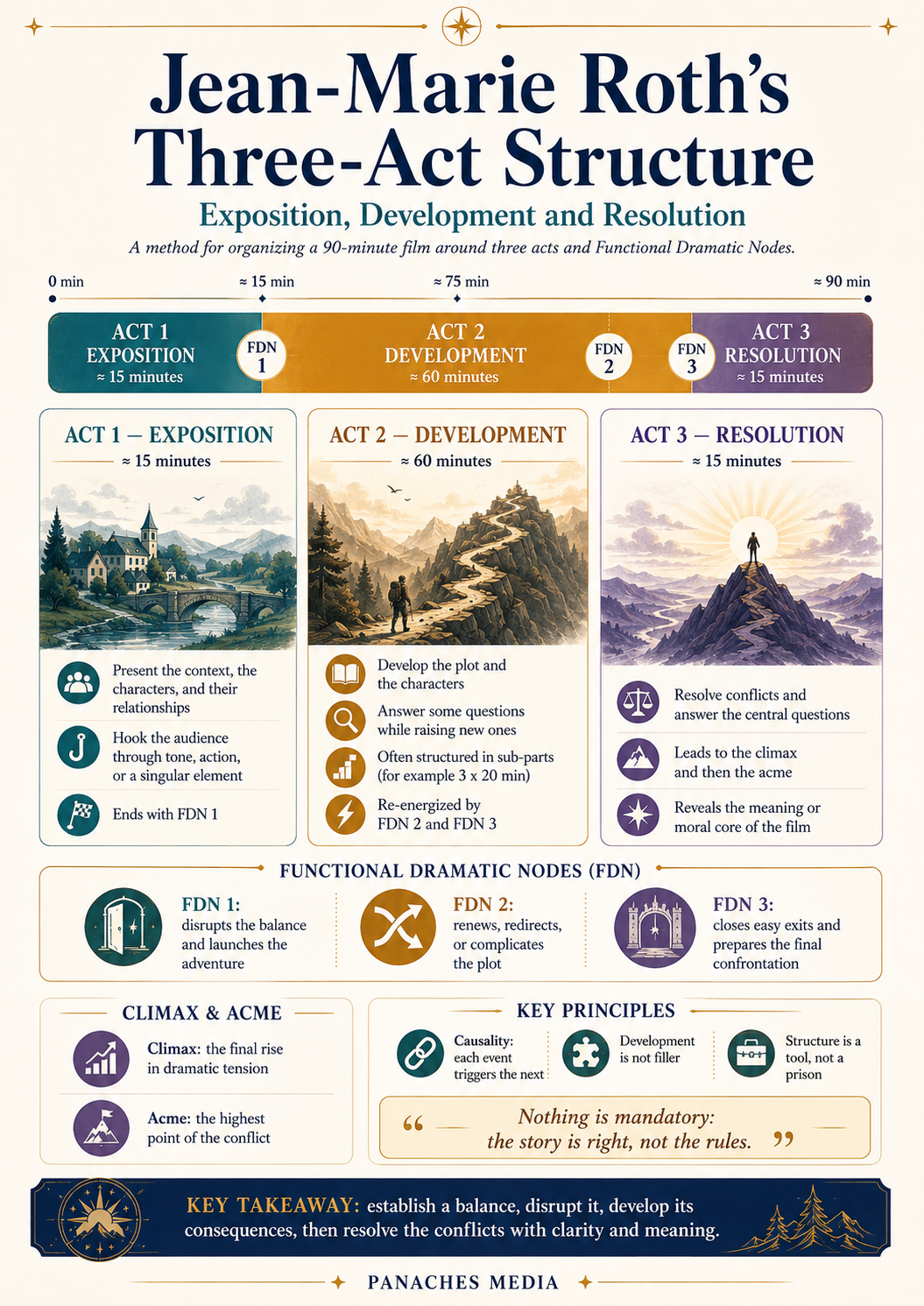
Jean-Marie Roth’s Three-Act Structure
Exposition, Development, and Resolution
A story has a beginning, a middle, and an end.
This observation may seem almost too simple to become a writing method. Yet between an appealing idea and a screenplay capable of holding an audience’s attention for ninety minutes, an essential difficulty emerges: how should narrative time be organized?
When should the characters be introduced?
When should their balance be disrupted?
How can the heart of the film be prevented from becoming a repetitive succession of obstacles?
When should the resolution begin?
Above all, how can each section be made to prepare the next?
The three-act structure proposed by Jean-Marie Roth offers a deliberately clear answer to these questions. It divides a standard ninety-minute feature film into three major sections:
- Exposition, lasting approximately fifteen minutes;
- Development, lasting approximately sixty minutes;
- Resolution, lasting approximately fifteen minutes.
These three acts are not isolated blocks.
They are connected by Functional Dramatic Nodes, events that alter the situation, close off certain possibilities, and force the character to continue evolving.
The method is therefore not concerned only with distributing scenes across a running time.
It organizes a movement:
establish a balance, disrupt it, develop the consequences of that disruption, and then resolve the conflicts it has created.
The three-act structure is sometimes criticized for being too classical. Nevertheless, it remains an effective foundation for sorting ideas, observing dramatic progression, and constructing a coherent first version before potentially changing its order or form.
The supplied document specifically presents it as a basis for organizing ideas between the beginning, middle, and end of a film.
Jean-Marie Roth and L’Écriture de scénarios
Jean-Marie Roth is a screenwriter, novelist, script doctor, trainer, and theorist of cinematic dramaturgy. His book L’Écriture de scénarios guides the development of a project from the initial idea through its presentation and the search for a producer. A revised and expanded new edition was published by Dixit in 2018. (dixit.fr)
His approach is distinguished by its practical orientation.
Dramaturgy is not presented as a collection of abstract laws, but as a toolbox that notably includes:
- finding the idea;
- the screenwriting point of view;
- the dramatic point of view;
- exposition;
- development;
- resolution;
- dramatic nodes;
- conflict;
- the information given to the audience;
- characters;
- dialogue;
- division into sequences.
The training programs he teaches retain this organization: premises or exposition, development—either as a single act or three sub-acts—resolution, climax, and the management of several categories of dramatic nodes. (21 Interactive)
The three-act structure is therefore only one part of his method.
It nevertheless constitutes its most immediately visible temporal framework.
The General Principle: 15 Minutes, 60 Minutes, 15 Minutes
For a feature film lasting approximately ninety minutes, the proposed distribution can be represented as follows:
| Section | Indicative duration | Main function |
|---|---|---|
| Act I — Exposition | 15 minutes | Present the world and characters, then provoke the story’s true beginning |
| Act II — Development | 60 minutes | Develop the plot, intensify the difficulties, and transform the characters |
| Act III — Resolution | 15 minutes | Resolve the conflicts, answer the questions, and reveal the meaning of the story |
This distribution is not perfectly symmetrical.
Act II occupies approximately two-thirds of the film.
This is logical: a story spends less time presenting and resolving the problem than exploring its consequences.
An article discussing Roth’s theory presents this organization as a structure observable in a large part of classical narrative cinema and reports an estimate of approximately 70% of films. This percentage should be understood as a pedagogical order of magnitude rather than a universal statistical measurement. (devenir-realisateur.com)
The durations primarily serve as landmarks.
They help identify several possible imbalances:
- exposition that delays the action for too long;
- development that is too short to give the trials sufficient weight;
- a middle section that repeats the same obstacles;
- a rushed resolution;
- a finale that does not answer the questions previously established.
Act I: Exposition
Indicative duration: approximately fifteen minutes.
The Exposition establishes the world of the film.
It allows the audience to understand where they are, whom they should follow, and what kind of story is beginning.
The supplied document assigns two main objectives to this act:
- presenting the context, the characters, their relationships, and their environment;
- engaging the audience through the tone, the action, or the singularity of the narration.
These two functions complement one another.
An exposition that is highly informative but unable to create anticipation becomes academic.
Conversely, a spectacular opening that does not allow the audience to understand the characters risks producing agitation without stakes.
Act I must therefore simultaneously inform and intrigue.
Presenting the Context
The context refers to the conditions in which the story begins.
It may include:
- a historical period;
- a location;
- a political situation;
- a family environment;
- a professional activity;
- the rules of an imaginary world;
- an already conflictual relationship;
- a latent danger.
The screenplay does not necessarily need to explain everything immediately.
It must provide the information required to understand what is normal in this universe before that balance is disturbed.
Example
A technician works alone in a weather station located high in the mountains.
The opening scenes may show:
- her isolation;
- the precision of her habits;
- her poor relationship with the team in the valley;
- a malfunctioning radio;
- a former avalanche mentioned but not explained;
- her refusal to leave the station despite the approaching storm.
The context already contains several dramatic possibilities.
Defining the Characters and Their Relationships
Exposition does not merely introduce identities.
It must show relationships.
Who depends on whom?
Who admires the protagonist?
Who resents them?
Who possesses information?
Who wants them to leave?
Who will be affected by their decisions?
A character becomes dramatic when connected to other people’s desires.
The screenplay may therefore establish:
- a personal objective;
- a weakness;
- a contradiction;
- an already active conflict;
- a debt;
- a promise;
- an unfinished relationship.
Showing Relationships Through Action
Instead of explaining that a mother and son no longer speak, a scene can show the son allowing his phone to ring, listening to the message, and then deleting it without replying.
Behavior immediately gives the relationship a visible form.
Engaging the Audience
The hook does not necessarily have to be an explosion, a chase, or a murder.
It may come from:
- an unusual situation;
- a mystery;
- a contradiction;
- surprising dialogue;
- a powerful image;
- an announced danger;
- an incomprehensible decision;
- a distinctive atmosphere.
The objective is to create anticipation.
The audience should sense that a question exists, even if they cannot yet formulate it precisely.
Different Forms of Hooks
In a thriller:
Every morning, a woman receives a photograph of herself taken the previous day.
In a comedy:
A man hired to announce staff layoffs discovers that his own name appears on the list.
In an intimate drama:
A teenage girl prepares two plates every evening even though she lives alone with her father.
In a fantasy film:
Everyone in a town suddenly stops dreaming, except for one child.
The hook promises a story.
FDN 1 will truly set it in motion.
Functional Dramatic Node 1
Act I ends with a Functional Dramatic Node, or FDN 1.
The document describes it as the event that disrupts the character, launches their adventure, and marks the beginning of their transformation.
This node has a precise function:
- breaking the initial balance;
- defining or altering the objective;
- making inaction more difficult;
- committing the character to the Development;
- closing off certain overly simple solutions.
The FDN is therefore not merely a spectacular twist.
An event can surprise the audience without changing the story.
To become functional, it must have consequences.
Inciting Event and Functional Node
The inciting event and the FDN may sometimes be the same event, but their functions can also be distinguished.
The Inciting Event Creates the Problem
The weather station receives a distress signal from an area that is officially uninhabited.
The FDN Commits the Protagonist
The technician deliberately destroys her only means of returning to the valley in order to prevent her superior from shutting down the transmission.
The first event attracts her attention.
The second makes her commitment difficult to reverse.
This distinction preserves the character’s agency.
The story does not depend only on what happens to the protagonist, but also on what they decide to do.
The Qualities of an Effective FDN 1
A first dramatic node should ideally:
- arise from elements presented during the Exposition;
- directly concern the main character;
- produce a decision or constraint;
- create an identifiable objective;
- alter the relationships;
- open several dramatic questions;
- prevent an immediate return to the status quo.
Questions to Ask
- What event destroys the initial balance?
- Why does it affect this particular character?
- What does the protagonist decide?
- What objective becomes visible?
- What former life becomes impossible?
- What question will guide Act II?
Act II: Development
Indicative duration: approximately sixty minutes.
Development is the longest and most complex part of the film.
It allows the writer to deepen:
- the main plot;
- the secondary characters;
- the relationships;
- the conflicts;
- the false leads;
- the information;
- the consequences of the decisions made in Act I.
The supplied document explains that this section answers some of the film’s questions while potentially creating new ones. It is also renewed by FDN 2 or FDN 3, which may introduce false clues or increase the difficulty of the hero’s journey.
This alternation is essential.
If the writer provides no answers, the audience may feel that the story is stagnating.
If everything is revealed too quickly, the mystery or conflict loses its power.
Act II must therefore manage a constant exchange:
one answer opens a new question; one victory creates a new difficulty; one piece of information changes the meaning of an earlier one.
Why Is the Second Act So Difficult?
The beginning naturally benefits from discovery.
The ending naturally benefits from the expectation of resolution.
The middle has neither of these advantages.
It must maintain interest without constantly relying on the novelty of the world or the proximity of the conclusion.
A poorly constructed Act II can produce several symptoms:
- repetition of similar obstacles;
- accumulation of scenes without causality;
- decorative secondary characters;
- false leads without consequences;
- an overly passive protagonist;
- an absent opponent;
- stakes that remain unchanged;
- information delayed artificially.
In older dramaturgy, the middle was sometimes considered a zone of filler.
Roth’s approach instead treats it as an internal construction that can be organized into several sub-acts. His training program explicitly refers to Development constructed either as a single act or as three sub-acts. (21 Interactive)
For a sixty-minute Act II, dividing it into three movements of approximately twenty minutes provides a practical model:
- discovery and initial strategies;
- complication and modification of the plot;
- tightening of the conflict and preparation of the resolution.
Act IIA: Discovering and Trying
In the first movement of Development, the protagonist fully enters the situation created by FDN 1.
They begin to act.
But they still act with:
- their old beliefs;
- their habits;
- their flaws;
- an incomplete understanding of the problem;
- a provisional plan.
This section allows the story to deliver the promise of its concept.
In an investigation, the character questions the first suspects.
In an adventure, they discover a territory.
In a romance, the relationship begins to develop.
In a professional drama, they experiment with a new role.
Functions of This First Section
- establishing the rules of the new situation;
- introducing allies and opponents;
- giving the hero their first successes;
- showing the limits of their strategy;
- developing the secondary characters;
- preparing a new dramatic node.
The first successes may be genuine.
But they should not resolve the conflict too easily.
They often give the hero excessive confidence or an incorrect understanding of the situation.
FDN 2: Renewing and Redirecting
FDN 2 occurs within Development to prevent the story from remaining linear.
It may:
- reveal information;
- invalidate a theory;
- turn an ally into an opponent;
- increase the stakes;
- introduce urgency;
- reveal an unexpected consequence;
- shift the objective;
- show that the hero was fighting the wrong problem.
Example
The technician believes that the distress signal comes from hikers trapped by the storm.
FDN 2 reveals that the signal uses a code reserved for a former scientific team officially declared dead ten years earlier.
The nature of the story changes.
The problem is no longer simply:
How can she find the survivors?
It becomes:
Who is transmitting this signal, and why was the existence of this team concealed?
The node does not merely add danger.
It changes the character’s understanding.
Act IIB: Complicating the Plot
After FDN 2, the character must revise their plan.
The difficulties become more personal.
Relationships may deteriorate.
The information obtained creates new contradictions.
This section may include:
- false clues;
- a betrayal;
- a change of allegiance;
- a mistake made by the hero;
- a partial revelation;
- a conflict between the external objective and the character’s values;
- the loss of a resource;
- a time limit.
False Clues
An effective false clue should not be an arbitrarily false piece of information inserted merely to deceive the audience.
It must appear credible.
It may come from:
- a misinterpretation;
- a character who has also been deceived;
- incomplete information;
- an opponent;
- the protagonist’s prejudice;
- a misunderstood coincidence.
The final truth should allow the audience to understand why they believed the false lead.
Developing Secondary Characters
Secondary characters do not exist merely to accompany the hero.
They may:
- propose a different strategy;
- represent an opposing value;
- possess their own objective;
- endanger the quest;
- reveal part of the past;
- become the human consequence of a decision;
- force the protagonist to choose.
An interesting secondary character does not ask only:
How can I help the hero?
They also ask:
What do I want, and what happens if the hero prevents me from obtaining it?
FDN 3: Locking the Path Toward the Resolution
A third dramatic node may occur near the end of Development.
It prepares the transition to Act III.
Its function often consists of:
- removing the final easy solutions;
- revealing the true opponent;
- causing a major loss;
- making the confrontation unavoidable;
- transforming an abstract question into a concrete emergency;
- leading the hero toward the climax.
FDN 3 may also divert an ending that has become too predictable.
A reflection on dramatic nodes citing Roth describes this function as a way of renewing or redirecting the narrative when the audience begins to anticipate its outcome. (atelierdesauteurs.com)
Example
The technician finally reaches the source of the signal.
She discovers that her own father, who disappeared during the former expedition, is alive.
But he is not asking to be rescued.
He is attempting to deliberately trigger an avalanche in order to bury a secret installation before the authorities arrive.
The conflict immediately becomes moral and personal.
The Resolution can begin.
The Functional Dramatic Node
The FDN is the central tool in this representation of structure.
A dramatic node can be defined as an event that:
- changes the situation;
- produces a lasting consequence;
- forces a character to react;
- closes or opens possibilities;
- changes the direction of the plot.
The word functional is important.
The value of a node does not depend only on its intensity.
An explosion may change nothing.
A quietly spoken sentence may destroy the hero’s entire plan.
Spectacular but Weakly Functional Example
A car explodes, but no important character is injured, no evidence is destroyed, and the plan continues exactly as before.
Discreet but Functional Example
A child asks the protagonist:
“Why is your signature on the demolition order?”
This sentence reveals a contradiction capable of transforming every relationship.
The Different Scales of Nodes
Jean-Marie Roth’s training distinguishes in particular:
- major dramatic nodes;
- minor dramatic nodes;
- clustered nodes;
- their management within the narrative. (21 Interactive)
Major Nodes
They alter the overall direction of the story.
They may correspond to transitions between acts or major renewals within Development.
Minor Nodes
They transform a scene, relationship, or sequence without immediately changing the main objective.
Clustered Nodes
Several events or revelations occur in rapid succession and together produce an important change.
This variation in scale prevents the construction of a film in which only three events have genuine consequences.
Building Causality Between the Nodes
A structure should not resemble a series of independent boxes.
Every node should be prepared or caused.
A weak progression looks like this:
One event happens. Then another event happens. Then a third event happens.
A stronger dramatic progression works like this:
The character makes a decision. That decision creates a consequence. That consequence forces a new decision, which produces a more difficult conflict.
The most important connection is therefore not:
And then?
But:
Because of that?
Chain of Causality
- The technician refuses to evacuate the station.
- Because of that decision, she becomes isolated by the storm.
- Because of that isolation, she can no longer verify the signal with the authorities.
- Because of her secret investigation, her superior cuts off communication.
- Because of that interruption, she must physically follow the signal.
- Because of that departure, she discovers the hidden installation.
The story moves forward through consequences.
Act III: Resolution
Indicative duration: approximately fifteen minutes.
The Resolution provides the answers prepared by the story.
The knots of the plot are untied.
Objectives are achieved, abandoned, or transformed.
Relationships find a new balance.
The supplied document explains that nothing should remain unresolved unless openness is an intentional artistic choice. It also states that the act should reveal, beneath the surface, the morality or principal message of the film.
The Resolution is therefore not only about ending the action.
It answers two categories of questions.
Factual Questions
- Who is responsible?
- Does the hero succeed?
- Is the danger neutralized?
- What secret was concealed?
- Who survives?
- What becomes of the objective?
Thematic Questions
- What has the hero understood?
- What value was tested?
- Why did this story need to be told?
- What decision reveals the transformation?
- What price accompanies the victory?
Why Is the Resolution Short?
Act III lasts only approximately fifteen minutes because it uses everything that has already been prepared.
It should not need to:
- introduce a new major stake;
- explain a previously unknown opponent;
- invent an ability that has never been mentioned;
- introduce a character capable of solving everything;
- suddenly replace the main objective.
A satisfying resolution creates the impression that the elements were already present, but that their relationship had not yet been understood.
The brevity of the third act therefore requires rigorous preparation in the first two.
The Climax and the Acme
The climax corresponds to the final rise in dramatic tension.
It does not necessarily describe a single isolated moment.
It may form an extended sequence beginning before the final major dramatic node and ending shortly before the resolution.
The acme is its culminating point: the instant when tension, danger, or conflict reaches its maximum intensity.
We can therefore distinguish:
- the climax: the rise and major confrontation;
- the acme: the peak of that confrontation;
- the resolution: the immediate consequences and new balance.
Example
The technician and her father attempt to stop the mechanism designed to trigger the avalanche.
This entire sequence constitutes the climax.
When she must choose between saving her father and preventing the catastrophe, the story reaches its acme.
The scenes showing the rescue teams, the survivors, and her return to the valley form the resolution.
Contrast Before the Climax
A quiet scene may precede the climax.
This pause has several functions:
- temporarily slowing the rhythm;
- allowing the audience to understand the stakes;
- preparing a decision;
- emotionally isolating the character;
- increasing the contrast with the violence or intensity that follows.
Calm does not necessarily reduce tension.
It may concentrate it.
The Final Confrontation
The final “battle” does not need to be physical.
It may take the form of:
- an armed confrontation;
- a trial;
- a debate;
- a concert;
- a confession;
- a vote;
- a negotiation;
- a refusal;
- an intimate decision.
What matters is that the character confronts the fullest form of the conflict.
The finale should ideally bring together:
- the external objective;
- the opponent;
- the internal weakness;
- the principal relationships;
- the theme.
Proving the Transformation
A character does not prove their transformation by declaring:
“I have changed.”
They prove it by making a decision they would have been incapable of making during Act I.
At the beginning, they may have lied to protect themselves.
At the end, they tell the truth despite the cost.
At the beginning, they wanted to control everything.
At the end, they accept the need to trust.
At the beginning, they rejected all responsibility.
At the end, they act without any guarantee of success.
“Why This Film?”
For Roth, the narrative intrinsically carries a theory: a final message or general idea produced by the story. In an educational text devoted to this concept, he explains that every fiction contains a theory, whether it has been consciously prepared by the author or revealed by the outcome of the narrative. (objectif-cinema.com)
This theory does not necessarily need to become a moral lesson spoken by a character.
It appears through:
- what is rewarded;
- what is punished;
- what the hero understands;
- what they refuse;
- the price of their victory;
- the final state of the world.
Example
If the story shows a protagonist who finally accepts the need to trust and succeeds through collective action, it produces an idea:
Absolute control protects against mistakes, but sometimes prevents any genuine relationship.
If she fails precisely because she delegates to someone unworthy of trust, the theory becomes different.
The message therefore does not depend only on dialogue.
It results from causality.
A Possible Timeline for a 90-Minute Film
| Time | Function |
|---|---|
| 0–5 min | Hook, tone, world, and first image of the protagonist |
| 5–12 min | Presentation of relationships, weaknesses, and tensions |
| 12–15 min | Inciting event and FDN 1 |
| 15–35 min | Discovery of the new situation and first attempts |
| 35–40 min | FDN 2: renewal or change in understanding |
| 40–60 min | Complications, false clues, and relationships under pressure |
| 60–75 min | FDN 3, tightening conflict, and preparation for confrontation |
| 75–85 min | Climax and acme |
| 85–90 min | Resolution, answers, and new balance |
This timeline should not become a mathematical obligation.
It provides a working map.
Depending on the genre, pacing, and subject, a screenplay may:
- shorten the Exposition;
- begin in the middle of the action;
- develop a longer climax;
- preserve an open ending;
- move certain revelations;
- combine several timelines.
A Practical Method for Building the Three Acts
1. Summarize the Idea
Write one sentence containing:
- the protagonist;
- the situation;
- the objective or problem;
- the main obstacle.
A municipal archivist discovers that a condemned building contains the secret recordings of an entire generation of residents.
2. Define the Dramatic Question
Will she manage to save the archives before the building is destroyed?
This question gives the story its external direction.
3. Define the Internal Question
Will she agree to make these stories public even though they reveal her own family’s secret?
This question carries the transformation.
4. Construct Act I
Present:
- her daily life;
- her work;
- her relationship with rules;
- the family conflict;
- the threat of demolition;
- her fear of public exposure.
FDN 1
She steals the keys to the building and enters illegally to recover the recordings.
Her action opens Act II.
5. Divide Act II Into Three Movements
First Movement
She discovers the archives and attempts to classify them alone.
FDN 2
She learns that several testimonies were recorded without consent and could destroy people’s lives.
Second Movement
She seeks the help of the residents, but each person wants to protect or recover a different part of the archives.
FDN 3
She discovers that her father organized the recordings and that the municipality wants to demolish the building to conceal an old affair.
Third Movement
She must choose which evidence to save and whom to trust before the demolition crews arrive.
6. Construct the Climax
The archivist publicly broadcasts part of the recordings while the machinery approaches.
She simultaneously confronts:
- the municipality;
- the divided residents;
- her family;
- her need to control information.
7. Define the Acme
Her father asks her to stop the broadcast in order to protect the family.
She refuses.
This decision forms the moral peak of the story.
8. Write the Resolution
The demolition is suspended.
Not all the archives are saved.
Some residents resent her.
But a collective center is created to decide how the recordings will be preserved and accessed.
9. Find the Final Image
At the beginning, the archivist worked alone in a closed room.
At the end, she listens to a recording among a group responsible for deciding its future collectively.
The transformation becomes visible.
Twelve Questions for Testing the Structure
- What must the audience understand during the opening minutes?
- What immediately captures their attention?
- What relationships define the protagonist?
- What FDN 1 destroys the initial balance?
- What decision truly begins the Development?
- How is Act II divided into several movements?
- What does FDN 2 reveal or change?
- What false clues or new questions sustain the audience’s interest?
- How does FDN 3 make the Resolution inevitable?
- Where does the climax begin?
- What decision constitutes the acme?
- How does Act III answer the question “Why this film?”
If the answers describe only events, the structure may lack depth.
For each node, also ask:
- what relationship changes?
- what possibility disappears?
- what belief is challenged?
- what new decision becomes necessary?
The Strengths of the Method
An Immediately Readable Organization
The 15–60–15 distribution makes the overall balance of the film easy to visualize.
A Clear Distinction Between Exposition and Development
Act I presents and disrupts.
Act II explores the consequences.
Particular Attention to the Heart of the Story
Dividing Development prevents the middle from being treated as simple filler.
Nodes Defined by Their Function
An event is not important because it is spectacular, but because it transforms the progression.
A Place for Meaning
The Resolution does not merely end the action: it also reveals the film’s theory, morality, or deeper question.
An Effective Tool for the Sequence Outline
The method helps organize scenes before writing the full dialogue continuity.
The Limits of the Three-Act Structure
The Risk of Mechanical Division
An overly rigid application may create the impression that every film must reach the same stages at the same minutes.
A Form Particularly Suited to the Classical Feature Film
The 15–60–15 distribution mainly corresponds to a film lasting approximately ninety minutes.
A television series, short film, interactive narrative, or fragmented work requires adaptation.
Three Visible Acts Do Not Guarantee a Good Story
A screenplay may respect the durations perfectly while still containing:
- a passive protagonist;
- weak relationships;
- an objective without stakes;
- arbitrary nodes;
- a contradictory message;
- a climax without emotional consequences.
Not Every Story Seeks to Resolve Everything
Some works deliberately use:
- an open ending;
- a circular structure;
- several protagonists;
- a fragmented chronology;
- an absence of traditional resolution;
- an ambiguous transformation.
They should not be forced artificially into the model.
A Structure to Build Before Deconstructing It
Narrative freedom does not necessarily mean ignoring all structure.
It may involve understanding a classical organization and then consciously modifying:
- the order of the scenes;
- the chronology;
- the point of view;
- the duration of the acts;
- the placement of revelations;
- the nature of the resolution.
A film may begin with its climax.
It may reveal the Exposition through flashbacks.
It may follow several parallel developments.
It may hide FDN 1 from the audience while allowing the character to experience it.
But beneath this presentation, a dramatic progression may still remain.
In the information supplied for this article, Roth’s position is summarized by the following statement:
“Nothing is compulsory: the story is right, not the rules.”
Structure is therefore an organizational tool.
It should not become the objective of the writing.
Jean-Marie Roth, Save the Cat!, the Hero’s Journey, and John Truby
These methods can all be represented through three major sections, but they do not prioritize the same questions.
Jean-Marie Roth
How can the film’s running time be organized and the plot renewed through dramatic nodes?
Save the Cat!
When should fifteen precise beats be placed in order to maintain pacing and make transformation visible?
The Hero’s Journey
How does the character leave their world, travel through the unknown, and return transformed?
John Truby
How do weakness, desire, opponent, theme, characters, and story world evolve together?
Roth’s structure can serve as a general framework:
- Exposition;
- Development;
- Resolution.
The other methods can then clarify what happens within these acts.
The important thing is not to stack frameworks until the story becomes a theoretical exercise.
Conclusion
Jean-Marie Roth’s three-act structure does not attempt to reduce a film to three boxes.
It proposes an organization of dramatic time.
For approximately fifteen minutes, the Exposition presents a world, characters, relationships, and a tone.
A first Functional Dramatic Node disrupts this balance and truly launches the adventure.
Development then occupies most of the narrative.
The protagonist acts, discovers, fails, receives answers, and encounters new questions.
Additional FDNs alter their understanding, close off easy solutions, and prevent the plot from progressing in a straight line.
The final act unties the conflicts.
The climax carries the story toward its acme.
The hero confronts the opponent, but also what the story has revealed about themselves.
The answers concern more than the visible objective.
They also reveal the theory of the film, its message, or the deeper reason why this particular story was told.
The method can therefore be summarized in three movements:
establish a balance and break it, develop every consequence of that rupture, and then give both the action and the character a meaningful resolution.
The first fifteen minutes, the sixty-minute middle, and the final fifteen minutes are not absolute obligations.
The nodes are not decorations.
The acts are not prisons.
They form a map for understanding where the story begins, how it transforms, and why it must end.