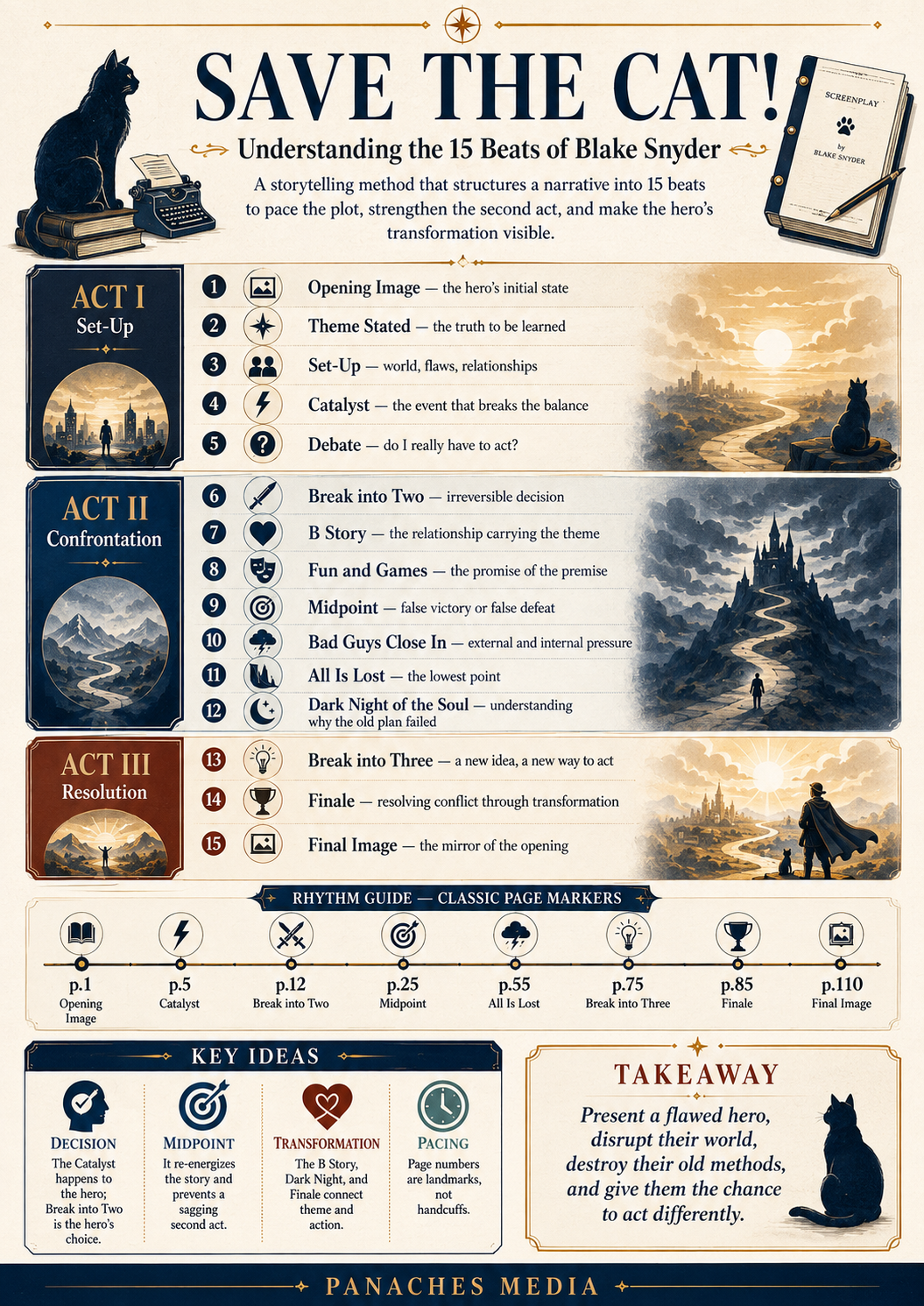
Save the Cat! by Blake Snyder
Understanding the 15 Beats of a Screenplay
A story may have an appealing concept, interesting characters, and several powerful scenes while still feeling as though it never truly moves forward.
The beginning drags on. The second act loses momentum. Obstacles repeat without changing the situation. The resolution arrives too quickly or feels disconnected from everything that came before it.
This is precisely the kind of problem the Save the Cat! method seeks to solve.
Created by screenwriter Blake Snyder and presented in his 2005 book Save the Cat! The Last Book on Screenwriting You’ll Ever Need, this approach organizes a narrative around 15 major beats. The French edition was published under the title Les règles élémentaires pour l’écriture d’un scénario. (Save the Cat!®)
These fifteen movements do not necessarily correspond to fifteen scenes. A beat is better understood as a significant moment that changes the direction of the plot, reveals information, alters the stakes, or shifts the character’s emotional state. A single beat may occupy a few lines, an entire scene, or a sequence made up of several scenes. (Save the Cat!®)
The method therefore provides a map of the story:
- the Opening Image presents the character before their transformation;
- the Catalyst destroys their equilibrium;
- the Break into Two forces them to choose action;
- the Midpoint changes the nature of the conflict;
- All Is Lost causes the collapse;
- the Finale allows the hero to prove that they have changed;
- the Final Image shows the result of that transformation.
Save the Cat! is often described as a highly rigid commercial formula. This reputation is not entirely undeserved: Snyder assigns each beat a specific position within the screenplay.
But the method’s real usefulness does not lie in mechanically respecting a page number.
It lies in the relationship between pacing, decision, conflict, and transformation.
Why Is the Method Called “Save the Cat”?
The expression literally means “save the cat.”
It refers to a moment, often placed near the beginning of the story, in which the hero performs an action that gives the audience a reason to care about them.
They might literally save a cat trapped in a tree.
But the principle should not be taken literally.
The character may also:
- protect someone vulnerable;
- demonstrate courage;
- reveal an exceptional skill;
- take care of someone;
- suffer an injustice;
- show vulnerability;
- defend a value;
- perform a generous act without expecting a reward.
The goal is to give the audience a reason to follow the protagonist before the main quest has even begun. The official website summarizes the idea this way: before asking the audience to accompany a hero, the writer must create a point of connection with them. (Save the Cat!®)
This does not mean that the protagonist must be morally irreproachable.
An antihero may be arrogant, violent, selfish, or manipulative. But the story must allow the audience to understand:
- what makes them human;
- what they desire;
- what causes them pain;
- where their particular value lies;
- why their evolution deserves our attention.
The “cat” is therefore less an animal than an emotional bridge between the character and the audience.
Before the 15 Beats: Make Sure the Story Has an Engine
Structure cannot save a premise that lacks conflict.
The supplied documents rightly emphasize several elements that should be clarified before constructing the beat sheet:
- a simple and recognizable concept;
- an evocative title;
- a concrete objective;
- meaningful stakes;
- sustained pacing;
- motivated characters;
- a flawed hero capable of changing;
- an opponent who creates genuine resistance;
- a satisfying conclusion;
- a story that can be clearly presented.
The Concept
The concept describes the story’s overall promise.
A musician who is unable to perform in front of an audience must replace the soloist of an international orchestra at the last minute.
This sentence already contains:
- a character;
- a weakness;
- an exceptional situation;
- an objective;
- a dramatic contradiction.
The Objective
The hero must pursue something visible.
They may want to:
- save a company;
- win a competition;
- find a missing person;
- solve a disappearance;
- protect a community;
- stop a wedding;
- survive until morning;
- expose a fraud.
The more concrete the objective, the more easily the audience can evaluate the character’s progress.
The Stakes
The stakes answer the question:
What happens if the hero fails?
They may lose:
- a relationship;
- their freedom;
- their status;
- their safety;
- their identity;
- the trust of those closest to them;
- their final opportunity to change;
- someone’s life.
The Transformation
Save the Cat! is not concerned only with what the hero obtains.
The method also asks:
Who must they become in order to obtain it?
The external plot and the internal transformation must move forward together.
Three Acts and Fifteen Beats
Save the Cat! preserves a three-act structure while developing the second act in particular.
| Part | Function | Beats |
|---|---|---|
| Act I — Thesis | Present the old world and provoke the departure | 1 to 5 |
| Act II — Antithesis | Explore the new world, increase the pressure, and destroy the old methods | 6 to 12 |
| Act III — Synthesis | Combine what has been learned and resolve the conflict | 13 to 15 |
In the original version designed for a screenplay of approximately 110 pages, Snyder suggests reference positions such as pages 1, 5, 12, 25, 55, 75, 85, and 110.
The official website now primarily uses percentages, allowing the method to be adapted to a shorter screenplay, a novel, an episode, or another format. The Opening Image occupies approximately 0 to 1% of the story, the Midpoint appears around 50%, All Is Lost around 75%, and the Final Image between 99 and 100%. (Save the Cat!®)
The page numbers should therefore not be treated as a stopwatch.
They are tools for diagnosing pacing:
- Does the conflict begin early enough?
- Does the hero genuinely commit?
- Does the second act contain a pivot?
- Does the collapse occur before the resolution?
- Does the Finale have enough room to develop?
Act I: The Set-Up
Act I presents the hero’s world, their internal problem, and the event that will make change unavoidable.
It covers approximately the first quarter of the narrative.
1. Opening Image
Indicative position: page 1 or 0 to 1%.
The Opening Image provides the first representation of the hero and their world.
It may establish:
- the tone;
- the genre;
- the atmosphere;
- the social situation;
- the protagonist’s weakness;
- their relationship with others;
- the initial imbalance.
It functions as a “before” photograph.
At the end of the story, the Final Image will answer it by showing what has changed. The official model explicitly presents these two images as the visual and thematic endpoints of the transformation. (Save the Cat!®)
Example
A business executive walks through an open-plan office without looking at anyone. Every employee stops talking as she passes.
In a few seconds, the story can show:
- her authority;
- her isolation;
- the fear she inspires;
- her inability to form sincere relationships.
Questions to Ask
- What first impression do we want to create?
- What should the audience understand without explanation?
- What weakness is already visible?
- What opposing image could conclude the story?
2. Theme Stated
Indicative position: around page 5 or 5%.
A character expresses, often without understanding its full importance, the lesson the hero will need to learn during the story.
This line may take the form of:
- advice;
- criticism;
- a joke;
- a question;
- a warning;
- an opinion rejected by the protagonist.
The theme does not need to be announced solemnly.
It should feel natural within the scene.
Example
A colleague might say to the executive who refuses to delegate:
“If you keep trying to control everything, eventually you won’t have anyone left to lead.”
At the beginning, she dismisses the remark.
By the end, she will understand that it identified the true problem in her life.
The official website describes Theme Stated as a line that points toward the hero’s deeper weakness or need for change. (Save the Cat!®)
Questions to Ask
- What moral or emotional idea does the story explore?
- Who can express it?
- Why is the hero not yet capable of hearing it?
- How will the Finale respond to this idea?
3. Set-Up
Indicative position: pages 1 to 10, or approximately 1 to 10%.
The Set-Up introduces the Ordinary World and the main elements needed to understand the story.
It should show:
- the hero’s daily life;
- their relationships;
- their work or environment;
- their strengths;
- their flaws;
- what they desire;
- what is no longer working;
- the people who will be affected by their transformation.
Snyder often associates this section with several problems the hero will need to resolve before the end.
Some are external.
Others are internal.
Show Rather Than Explain
Instead of stating that a character trusts no one, show them:
- checking everyone else’s work;
- secretly changing their team’s decisions;
- refusing to share information;
- completing alone a task intended for several people.
The official Set-Up presents the status quo, the flaws damaging the hero’s life, and the characters who populate their familiar environment. (Save the Cat!®)
Questions to Ask
- What is the hero’s old world?
- What behavior must change?
- Who is already suffering because of this weakness?
- Which elements will need to be resolved during the Finale?
- What is the character missing, even if they do not know it?
4. Catalyst
Indicative position: around page 12 or approximately 10%.
The Catalyst is the event that destroys the initial equilibrium.
It may be:
- an encounter;
- a disappearance;
- a dismissal;
- an attack;
- a diagnosis;
- an inheritance;
- an accident;
- a proposal;
- a revelation;
- an unexpected return.
Before the Catalyst, the hero can continue living according to their habits.
After it, the problem can no longer be completely ignored.
The Catalyst puts the story in motion, but it is not yet the protagonist’s definitive commitment. (Save the Cat!®)
Catalyst and Decision
An event does not automatically become a plot.
A distinction must be made between:
- what happens to the hero;
- what the hero decides to do about it.
The Catalyst creates the crisis.
Break into Two will transform that crisis into a quest.
Questions to Ask
- What event makes the old equilibrium impossible?
- Why does it affect this particular character?
- What immediate consequence does it produce?
- Why can the hero not resolve the problem immediately?
5. Debate
Indicative position: pages 12 to 25, or approximately 10 to 20%.
The hero reacts to the Catalyst.
They hesitate, resist, investigate, deny, prepare, or search for a solution that would allow them to avoid genuine change.
The Debate is often summarized by one question:
Do I really have to enter this story?
This phase may show:
- the hero’s fear;
- the dangers of the quest;
- their conflicting obligations;
- their lack of preparation;
- legitimate reasons to refuse;
- the possible consequences of failure.
The Debate gives weight to the future commitment. The official website notes that it may take the form of doubt, denial, avoidance, or even preparation. (Save the Cat!®)
The Hero Should Not Simply Be Pushed
An external force may increase the pressure.
But for the story to remain active, the protagonist must eventually make a decision.
The transition into the next act must belong to them.
Questions to Ask
- Why does the hero hesitate?
- What do they risk by accepting?
- What do they risk by refusing?
- What deeper fear lies behind their arguments?
- What will finally provoke their decision?
Act II: The Upside-Down World
The second act begins when the hero chooses to act.
They enter a new situation, apply their old methods, experience successes and failures, and eventually discover that their true problem is deeper than they believed.
Save the Cat! implicitly divides this act into two movements:
- Act II A: exploration and progression toward the Midpoint;
- Act II B: tightening conflict and collapse.
6. Break into Two
Indicative position: around page 25 or 20 to 25%.
The hero makes the decision that carries the story into its new world.
They may:
- accept a mission;
- leave their city;
- begin a relationship;
- infiltrate an organization;
- enter a competition;
- commit a transgression;
- publicly announce their commitment;
- adopt a new strategy.
This movement is irreversible.
The character is no longer merely reacting to the Catalyst. They are now pursuing an objective.
The official website describes this beat as a point-of-no-return decision separating the old world from the new one. (Save the Cat!®)
An Imperfect Decision
The hero enters Act II with their weakness still intact.
They therefore often choose the wrong method.
They act, but they have not yet understood how they must change.
This contradiction will fuel the conflict.
Questions to Ask
- What decision truly begins the quest?
- Why can the hero no longer turn back?
- What new world do they discover?
- How is their plan influenced by their weakness?
7. B Story
Indicative position: around page 30 or approximately 22%.
The B Story is a secondary plot closely connected to the theme.
It may involve:
- a romance;
- a friendship;
- a mentor-student relationship;
- a family relationship;
- a rivalry;
- personal reconstruction;
- a conflict with an ally.
Its function is not simply to add content.
It gives the hero another way of understanding their problem.
The B Story is often the space in which the theme becomes emotional.
The official website describes it as a thematic secondary plot, frequently built around love, friendship, or mentorship. (Save the Cat!®)
A Story and B Story
The A Story usually corresponds to the external quest.
Save the company.
The B Story may carry the internal transformation.
Learn to trust a colleague.
During the Finale, the two plots should ideally come together.
The hero solves the external problem through what they have learned internally.
Questions to Ask
- What relationship carries the theme?
- What can the hero learn through this plot?
- How does the B Story challenge their weakness?
- How will it help resolve the main quest?
8. Fun and Games
Indicative position: pages 30 to 55, or approximately 20 to 50%.
The name can be misleading.
This section does not necessarily have to be funny.
It represents the promise of the premise.
This is the part of the story where the audience gets what they came to see.
In a detective story:
- the investigation begins;
- suspects appear;
- clues accumulate.
In a romance:
- the characters grow closer;
- situations increase their attraction;
- their differences become visible.
In a fantasy story:
- the hero explores the new world;
- they discover its rules;
- they use their new abilities.
This section may contain the scenes most immediately recognizable in a trailer or in the story’s presentation. (Save the Cat!®)
The Risk of a Catalogue
Fun and Games should not become a series of interchangeable scenes.
Each sequence should:
- advance the objective;
- change a relationship;
- reveal a rule;
- prepare a consequence;
- move the hero closer to the Midpoint.
Questions to Ask
- What is the concept’s central promise?
- What scenes does the audience imagine when hearing the premise?
- How does each success prepare a future problem?
- What does the hero discover about the new world?
9. Midpoint
Indicative position: page 55 or 50%.
The Midpoint divides the story in two.
It is not simply a spectacular event placed at the center.
It changes the nature of the quest.
It often takes the form of:
- a false victory;
- a false defeat;
- a revelation;
- a change in status;
- a public commitment;
- an escalation of the stakes;
- the introduction of a time limit.
If the hero appears to win, the victory contains a hidden danger.
If they appear to lose, the defeat gives them information or renewed determination.
The official website associates the Midpoint with a false victory or false defeat, an increase in the stakes, and frequently the introduction of a ticking clock. (Save the Cat!®)
Before and After the Midpoint
Before:
The hero experiments.
After:
The conflict becomes personal and urgent.
The Midpoint narrows the objective.
It ends the phase of exploration and launches the true confrontation.
Questions to Ask
- What does the hero believe they have won or lost?
- What information changes their perception?
- How do the stakes increase?
- What new urgency appears?
- Why can they no longer continue in the same way?
10. Bad Guys Close In
Indicative position: pages 55 to 75, or approximately 50 to 75%.
The opposing forces tighten around the protagonist.
The “bad guys” may be external:
- an antagonist;
- an institution;
- an army;
- an investigation;
- a disaster;
- a rival.
But they may also be internal:
- fear;
- jealousy;
- pride;
- the need for control;
- doubt;
- obsession.
Relationships deteriorate.
Allies become divided.
The plan reveals its weaknesses.
The successes achieved before the Midpoint now produce their consequences.
The official model explicitly includes both external opponents and psychological “inner bad guys.” (Save the Cat!®)
Pressure From Several Directions
This section works particularly well when several problems converge:
- the opponent discovers the plan;
- an ally loses trust;
- the hero makes a mistake;
- time is running out;
- the objective proves to be different from what was expected;
- the internal weakness sabotages the action.
Questions to Ask
- What forces are closing in?
- How does the hero contribute to their own downfall?
- Which relationships are weakening?
- What part of the plan was doomed from the beginning?
- How does the pressure prepare the collapse?
11. All Is Lost
Indicative position: around page 75 or 75%.
The worst event feared by the hero appears to come true.
They may lose:
- their objective;
- a relationship;
- an ally;
- their status;
- their freedom;
- their reputation;
- their final opportunity to act;
- the confidence they had gained.
The story creates the impression that victory has become impossible.
Snyder often associates this moment with a whiff of death:
- a real death;
- a symbolic death;
- the destruction of an object;
- the disappearance of an old identity;
- a visual or verbal reference to death.
The official website describes All Is Lost as the hero’s lowest point, when what they feared most seems to have happened. (Save the Cat!®)
The Fall Must Come From the Story
The collapse is more powerful when it results from:
- the hero’s choices;
- their weakness;
- their incomplete plan;
- a previously prepared mistake;
- the opponent’s strategy.
An arbitrary disaster may be surprising.
But a disaster caused by the protagonist is transformative.
Questions to Ask
- What is the worst possible loss?
- How does the hero’s weakness contribute to it?
- What form of death appears?
- Why can the old plan no longer work?
- What remains when the objective appears lost?
12. Dark Night of the Soul
Indicative position: pages 75 to 85, or approximately 75 to 80%.
The hero reacts to the collapse.
They experience a period of despair, silence, confusion, or grief.
This stage should not be reduced to a scene in which the character sits alone in the rain.
It represents an internal process.
The hero must:
- acknowledge their failure;
- understand what they have lost;
- abandon a belief;
- reconsider their methods;
- finally hear the theme;
- integrate the lesson of the B Story.
The official website presents this phase as the reaction to All Is Lost and as the moment when the learning required for transformation can finally occur. (Save the Cat!®)
A Revelation Rather Than Mere Sadness
The Dark Night must prepare a new understanding.
The hero cannot return to the conflict with exactly the same plan and mindset.
Something must be abandoned.
Something must be accepted.
Questions to Ask
- What does the hero finally understand?
- What belief must they allow to die?
- What rejected advice now becomes useful?
- What has the B Story taught them?
- Why can they now act differently?
Act III: The Synthesis
The final act is not simply about defeating the opponent.
It must combine:
- the external desire;
- the thematic lesson;
- the relationships from the B Story;
- the acquired skills;
- the hero’s new way of acting.
13. Break into Three
Indicative position: around page 85 or 80%.
A new idea allows the hero to escape the dead end.
This solution may come from:
- discovered information;
- a memory;
- an ally;
- the B Story;
- an understanding of the theme;
- the combination of two previously separate elements.
The protagonist finally understands what they must do.
More importantly, they understand who they must be in order to do it.
The official website describes this beat as the discovery of information or a solution capable of resolving the problems created in Act II. (Save the Cat!®)
A Synthesis
Act I presented the old way of living.
Act II demonstrated its limitations.
Act III constructs a third path.
The hero does not simply return to their old behavior, nor do they remain trapped in the upside-down world.
They combine what they have learned.
Questions to Ask
- What idea makes the Finale possible?
- How does the B Story illuminate the main quest?
- What old method is abandoned?
- What decision proves that the hero has changed?
14. Finale
Indicative position: pages 85 to 110, or approximately 80 to 99%.
The hero carries out the new plan.
They confront the external obstacles and prove their internal transformation.
The Finale should resolve:
- the main objective;
- the conflict with the opponent;
- the stakes;
- the B Story;
- the thematic question;
- the important elements introduced during the Set-Up.
The protagonist should not succeed only because they are stronger or because a coincidence comes to their aid.
They should succeed—or fail in a meaningful way—because of the person they have become.
The official website defines the Finale as the confrontation in which the hero demonstrates that they have absorbed the lesson learned during Act II. (Save the Cat!®)
Proving the Transformation
At the beginning, the character may have:
- lied;
- run away;
- acted alone;
- controlled others;
- refused to take a risk;
- sacrificed their relationships in order to win.
During the Finale, they must make a different choice.
That decision may even cost them the objective they were pursuing.
A sincere transformation may be worth more than an external victory.
Questions to Ask
- What final plan uses the story’s lessons?
- What decision would the hero never have made at the beginning?
- How does the opponent test this transformation?
- Which elements from the Set-Up are resolved?
- What does the protagonist gain and lose?
15. Final Image
Indicative position: page 110 or 99 to 100%.
The Final Image shows the situation after the transformation.
It answers the Opening Image.
If the story begins with a character alone, it may end with a restored relationship.
If it begins in a chaotic environment, it may show a new order.
If it begins with a hero incapable of acting, it may show them making a decision.
The contrast does not have to be simplistic.
The Final Image may also reveal:
- a negative transformation;
- a failure;
- an ambiguous victory;
- an irreversible cost;
- a tragic repetition of the Opening Image.
The principle remains the same: provide the audience with visual or dramatic evidence of the journey completed. The official website defines it as the “after” photograph mirroring the opening. (Save the Cat!®)
Questions to Ask
- What image summarizes the transformation?
- How does it answer the opening?
- What has now become possible?
- What cost remains visible?
- What emotion should accompany the ending?
The Major Relationships Between the Beats
The fifteen movements do not function in isolation.
They form several structural pairs.
Opening Image and Final Image
They show the before and after.
Theme Stated and Finale
The theme is first proposed as an idea.
The Finale transforms it into action.
Catalyst and Break into Two
The Catalyst happens to the hero.
Break into Two is the response chosen by the hero.
B Story and Break into Three
The secondary relationship often conveys the idea that will make it possible to resolve the main quest.
Midpoint and All Is Lost
The Midpoint creates an incomplete victory or defeat.
All Is Lost reveals its true price.
Dark Night and Finale
The Dark Night produces understanding.
The Finale demonstrates that this understanding has become a capacity for action.
The Midpoint: The Method’s True Hinge
One of the most recognizable strengths of Save the Cat! lies in the division of the second act.
Without a Midpoint, the heart of the story can become a long succession of equivalent obstacles.
The hero tries.
They fail.
They try again.
The Midpoint prevents this stagnation by changing the rules.
Before the Midpoint
The hero explores the new world.
They may still believe their objective is relatively simple.
At the Midpoint
A victory, defeat, or revelation transforms their understanding.
After the Midpoint
The pressure intensifies.
The conflict becomes more personal.
The consequences draw closer.
This hinge allows the second act to contain two distinct movements instead of a single undifferentiated block.
Page Numbers Are Landmarks, Not Handcuffs
The use of precise page numbers is the most controversial aspect of Save the Cat!.
In a reference screenplay of 110 pages, the classic positions are approximately:
- Opening Image: page 1;
- Theme Stated: page 5;
- Catalyst: page 12;
- Break into Two: page 25;
- B Story: page 30;
- Midpoint: page 55;
- All Is Lost: page 75;
- Break into Three: page 85;
- Final Image: page 110.
But not every screenplay is 110 pages long.
A 90-page screenplay, a 45-minute episode, a comic book, or a novel requires adaptation.
The current official Beat Sheet uses proportions and provides a tool that recalculates the positions according to the project’s length. (Save the Cat!®)
The correct question is:
Does this stage arrive when the story needs it?
Not:
Am I on exactly the right page?
A Catalyst on page 14 is not automatically wrong.
But a Catalyst positioned one-third of the way through the story probably deserves examination.
How to Adapt Save the Cat! to a Novel
The method was designed for screenwriting, but it can also be used to structure other narrative forms. The official website now applies it to novels, television series, memoirs, plays, video games, and other long-form stories. (Save the Cat!®)
Replace Pages With Percentages
For an 80,000-word novel:
- Catalyst around 8,000 words;
- Break into Two around 16,000 to 20,000;
- Midpoint around 40,000;
- All Is Lost around 60,000;
- Break into Three around 64,000;
- Finale during the final 20%.
These figures remain indicative.
Develop Beats Across Several Chapters
The Set-Up, Fun and Games, or Bad Guys Close In may occupy long sequences.
A beat is not necessarily a chapter.
Preserve the Internal Progression
The main risk is applying the fifteen beats only to the plot.
In a novel, thought, memory, perception, and relationships can add greater depth to the transformation.
How to Adapt the Method to Comics or Manga
In a visual work, the beats can also structure:
- chapters;
- episodes;
- volumes;
- narrative arcs;
- page composition.
The Opening Image and Final Image become particularly powerful through visual language.
The Midpoint may correspond to:
- a double-page spread;
- a visual revelation;
- a change of setting;
- a physical transformation;
- a sharp break in the color palette or staging.
The method can also be used at several levels:
- one Beat Sheet for the entire series;
- another for each arc;
- a simplified structure for every episode.
How to Use the Method Without Making the Story Predictable
Do Not Confuse Function With Content
The Catalyst must disrupt the story.
But it does not always have to be an attack, a death, or a mysterious letter.
Hide the Structure Within Decisions
The audience should not feel:
Here comes the Midpoint.
They should feel:
The situation has just changed, and I want to know what happens next.
Vary the Form of the Beats
All Is Lost may be spectacular or quiet.
The Finale may be a fight, a negotiation, a concert, a trial, or an intimate decision.
Do Not Force a False Victory
The Midpoint must change the story.
A false victory or false defeat is a common tool, not an absolute requirement.
Let the Characters Breathe
An effective structure does not replace:
- individuality;
- emotion;
- contradictions;
- voice;
- human details;
- the unpredictability of relationships.
The Strengths of Save the Cat!
A Structure That Is Easy to Visualize
The fifteen beats make it possible to observe the entire narrative quickly.
A Better-Organized Second Act
The Midpoint separates exploration from escalation.
Constant Attention to Pacing
The landmarks help identify sections that are too long or too rushed.
A Visible Transformation
The opening and ending frame the character’s evolution.
A Clear Relationship Between Theme and Plot
Theme Stated, the B Story, the Dark Night, and the Finale all participate in the same progression.
An Effective Diagnostic Tool
Even when a writer does not follow the method during the first draft, they can use it to analyze the weaknesses of an existing version.
The Method’s Limitations and Criticisms
The Risk of Standardization
Applied mechanically, it can produce stories with very similar rhythms.
An Origin Strongly Connected to Commercial Cinema
Its original priorities—efficiency, clarity, pacing, and concept presentation—are particularly suited to screenplays intended to be read and evaluated quickly.
Positions That Can Be Too Restrictive
Some stories require a longer Set-Up, a diffuse Midpoint, or a very brief conclusion.
A Sympathetic Hero Is Not Always Necessary
An audience may follow a fascinating, unsettling, or morally repellent protagonist without that character performing an explicitly endearing action.
Structure Does Not Replace Causality
Placing an event on page 55 is not enough.
It must emerge from the choices, relationships, and conflicts established earlier.
Not Every Story Depends on a Clear Transformation
Some works are:
- contemplative;
- collective;
- fragmentary;
- cyclical;
- based on an absence of change;
- centered on the audience’s transformation rather than the protagonist’s.
They should not be distorted to fit the Beat Sheet.
A Practical Method for Building a Beat Sheet
1. Summarize the Concept
A solitary restaurant owner must organize the final banquet of a market threatened with demolition alongside her former neighbors.
2. Define the Theme
Preserving a legacy does not mean preventing it from changing.
3. Write the Opening Image
The restaurant owner eats alone in the empty kitchen of her establishment.
4. Find the Catalyst
She learns that the market where her family once worked will be demolished.
5. Build the Debate
She refuses to return to the neighborhood after an old family conflict.
6. Define Break into Two
She publicly agrees to organize the banquet.
7. Create the B Story
She must work with a childhood friend whom she once abandoned.
8. Develop Fun and Games
Searching for former traders, preparing dishes, collecting memories, and rediscovering the place.
9. Define the Midpoint
The banquet attracts media attention and appears capable of saving the market.
False victory.
10. Make the Bad Guys Close In
The organizers divide, the owner accelerates the demolition, and the heroine begins trying to control everything again.
11. Write All Is Lost
A fire destroys the archives, and several participants abandon the project.
12. Construct the Dark Night
She understands that she wanted to preserve a perfect image of the past rather than the people who kept it alive.
13. Find Break into Three
Her friend suggests transforming the banquet into a traveling event open to the entire neighborhood.
14. Write the Finale
The heroine gives up leading alone and allows everyone to rebuild part of their shared history.
15. Compose the Final Image
She shares a meal at a large communal table in a new location that is still unfinished.
Fifteen Questions for Testing a Story
- What Opening Image shows the hero’s initial state?
- What theme will they need to understand?
- What flaws and relationships are introduced during the Set-Up?
- What event destroys the status quo?
- Why does the hero hesitate?
- What irreversible decision opens Act II?
- What relationship carries the B Story?
- What is the promise of the premise?
- How does the Midpoint change the stakes?
- What external and internal forces are closing in?
- What loss makes it seem that everything is over?
- What truth emerges during the Dark Night?
- What new idea opens Act III?
- What action proves the transformation during the Finale?
- How does the Final Image answer the opening?
If the answers are clear but independent of one another, the story may feel artificially constructed.
Each beat should cause or prepare the next.
Save the Cat!, the Hero’s Journey, and John Truby
These three approaches do not ask exactly the same questions.
The Hero’s Journey
It organizes an initiatory passage:
How does the character leave their world, travel through the unknown, and return transformed?
John Truby
He seeks an organic structure built around weakness, desire, opponent, character web, and moral argument:
How does every element of the story participate in the same transformation?
Save the Cat!
It focuses especially on pacing, progression, and the placement of turning points:
When should each change occur in order to keep the story moving?
These methods can be combined.
A writer may use:
- Truby to design the deeper transformation;
- the Hero’s Journey to organize the initiatory cycle;
- Save the Cat! to control pacing and sequence progression.
The challenge is not to stack so many frameworks that the story is suffocated.
Conclusion
Save the Cat! is not simply about placing fifteen events on a timeline.
The method describes a complete movement.
An Opening Image presents a hero trapped within an imperfect equilibrium.
The theme points toward a truth they are not yet capable of hearing.
The Catalyst disrupts their everyday life.
After a period of hesitation, they choose to enter a new world.
They explore the promise of the premise, encounter a relationship capable of carrying the theme, and reach a Midpoint that transforms the stakes.
The pressure increases until everything appears lost.
During the Dark Night of the Soul, the hero finally understands why their old methods failed.
They enter the final act with a new solution, confront the conflict, and prove their transformation through a decision.
The Final Image shows the result.
The true strength of Save the Cat! therefore does not lie in pages 5, 25, 55, or 85.
It lies in the succession of four movements:
present a flawed character, disrupt their world, destroy their old methods, and give them the opportunity to act differently.
The fifteen beats provide the rhythm of this journey.
But they remain a map.
The story itself must always feel alive.