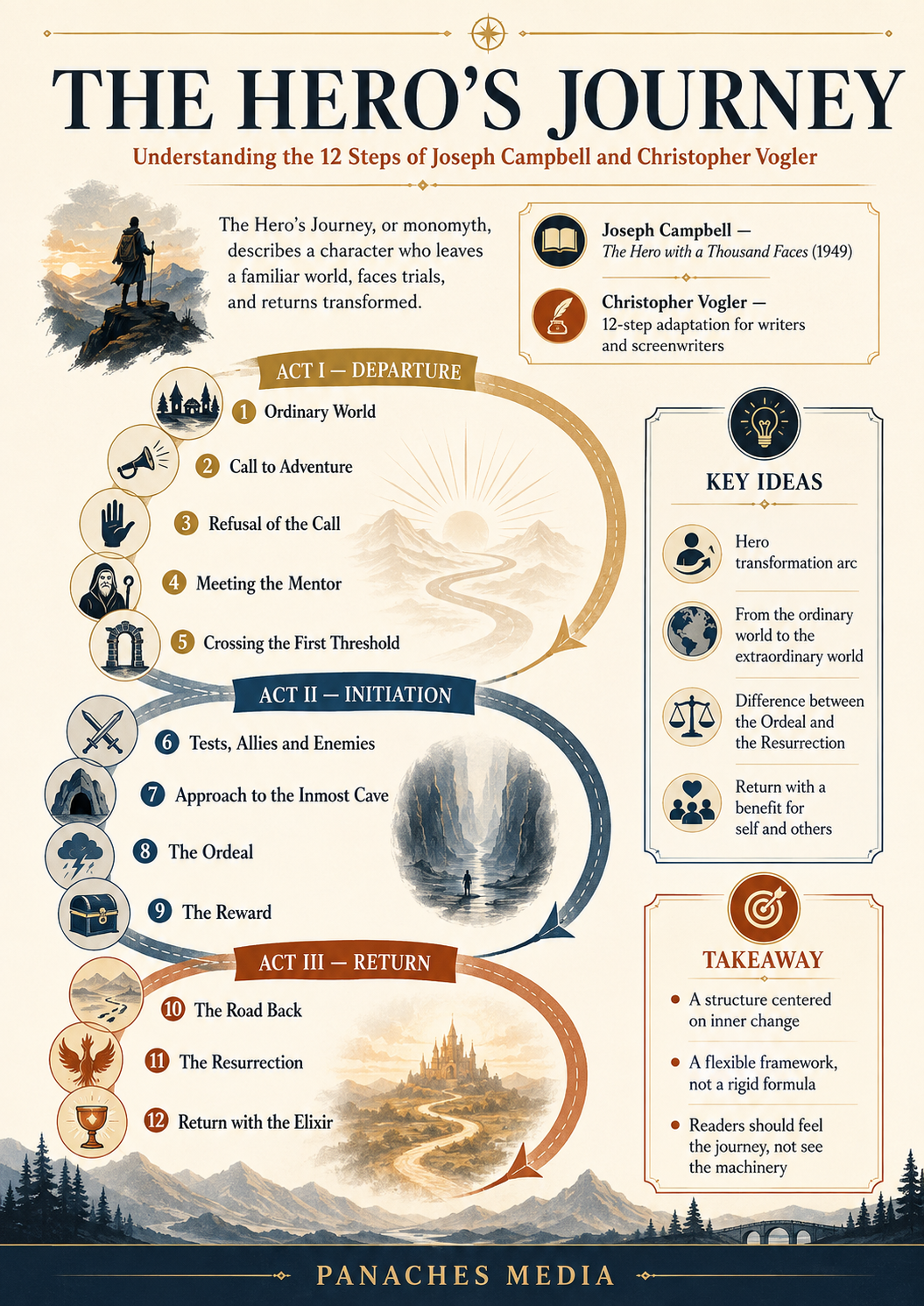
The Hero’s Journey
Understanding the 12 Steps of Joseph Campbell and Christopher Vogler
A character lives in a world they know.
An event disrupts that balance and calls them toward the unknown. They hesitate, cross a boundary, face trials, meet allies and opponents, and eventually confront an experience capable of transforming them.
If they survive this initiation, they return to their original world with something they did not possess before: knowledge, an ability, freedom, an object, a relationship, or a new way of understanding their own existence.
This trajectory is commonly known as the Hero’s Journey.
The model originates in the work of American mythologist Joseph Campbell, particularly The Hero with a Thousand Faces, published in 1949. Campbell compares myths from different cultures and historical periods and identifies a recurring movement that he calls the monomyth.
His central idea is not that all stories tell exactly the same events. It is that many initiatory narratives share a common dynamic:
- the hero separates from the known world;
- they undergo an initiation made up of trials and transformations;
- they return to the ordinary world with something beneficial to share.
The Joseph Campbell Foundation now emphasizes this distinction: separation, initiation, and return form the core of the model, while the numerous motifs described by Campbell are possible variations rather than compulsory and immutable steps. (JCF)
Christopher Vogler later adapted this thinking to contemporary writing. His 12-step model, developed in The Writer’s Journey, transforms the mythological cycle into a dramatic construction tool that can be used for film, literature, comics, television series, and narrative games. His publisher presents the method as a twelve-part synthesis derived from a professional memo on applying Campbell’s ideas to cinematic storytelling. (Michael Wiese Productions)
The Hero’s Journey should therefore not be understood as a magic formula. Above all, it is a way of organizing a character’s transformation.
A Structure Centered on Transformation
The Hero’s Journey is often represented as a circle.
This image matters.
The protagonist does not simply move in a straight line toward a goal. They leave an initial state, pass through an experience that destroys some of their certainties, and then return to their starting point in a new form.
The world may appear unchanged when they return.
But the hero is no longer the same.
The journey can naturally be physical:
- setting out to explore unknown territory;
- crossing a border;
- descending into an underworld;
- leaving one’s family;
- entering a war;
- joining an unfamiliar community.
But it may also be social, intimate, or psychological:
- beginning a new relationship;
- accepting a responsibility;
- entering professional life;
- facing an illness;
- revealing a secret;
- learning to create;
- abandoning an old belief;
- mourning a person or an identity.
The working document illustrates this through the example of Bilbo: the external journey accompanies an inner passage from fear to courage. It also shows that several characters may pursue their own quests at the same time.
The hero is therefore not necessarily a warrior, a chosen one, or an adventurer.
They may be a teenager leaving their family environment, an artist agreeing to show their work, a parent learning to let their child go, or an ordinary person facing a change they can no longer avoid.
Campbell and Vogler: Two Complementary Models
Joseph Campbell’s Monomyth
Campbell studies the Hero’s Journey as a mythological, symbolic, and psychological pattern.
His fundamental cycle contains three major phases:
Separation
The hero leaves the known world.
They answer a call, cross a boundary, and temporarily abandon the protections of ordinary existence.
Initiation
They enter an unknown world.
They face forces, trials, and figures that transform their consciousness.
Return
They return to the ordinary world.
But they bring back something beneficial, sometimes called an elixir, capable of renewing their own life or that of their community.
For Campbell, these three movements are more important than the exact number of intermediate motifs. The Hero’s Journey primarily describes a process of passage comparable to initiation rites: leaving one state, undergoing a transformation, and integrating a new state. (JCF)
Christopher Vogler’s 12-Step Adaptation
Vogler transforms this symbolic movement into a progression that writers can use more directly:
- the Ordinary World;
- the Call to Adventure;
- the Refusal of the Call;
- Meeting the Mentor;
- Crossing the First Threshold;
- Tests, Allies, and Enemies;
- the Approach to the Inmost Cave;
- the Ordeal;
- the Reward;
- the Road Back;
- the Resurrection;
- the Return with the Elixir.
This list corresponds exactly to the general structure of the supplied document.
These stages can be divided into three main sections:
- the departure, which leads the hero out of their world;
- the initiation, which confronts them with the rules and dangers of the unknown;
- the return, which tests their transformation and allows them to reintegrate into their former life.
Act I: The Departure
The first five stages introduce the hero, reveal the existence of a lack, and lead them toward an irreversible commitment.
1. The Ordinary World
The Ordinary World shows the hero before their transformation begins.
This stage helps establish:
- their situation;
- their habits;
- their relationships;
- their strengths;
- their frustrations;
- their fears;
- what is missing from their life.
The Ordinary World does not need to be peaceful or happy.
It is simply familiar.
A character may live in difficult circumstances and still cling to them because they know how to survive there.
This opening stage primarily prepares a contrast.
The audience should be able to measure the distance between:
- the person the hero is at the beginning;
- the extraordinary world they are about to discover;
- the person they will become upon returning.
An Imperfect World
The Ordinary World often contains signs of imbalance.
The hero may:
- feel trapped;
- repeat the same mistake;
- endure a toxic relationship;
- lack courage;
- reject responsibility;
- dream of another life without acting;
- behave in a way that hurts those around them.
This imbalance prepares the Call.
The Journey Is Not Always Geographical
The document includes examples in which the transition occurs between two social, family, or cultural environments. The extraordinary world may be a new school, a profession, a community, a relationship, or an activity the hero has not yet learned to navigate.
Questions to Ask
- What defines the hero’s daily life?
- What are they missing?
- What behavior prevents them from evolving?
- What do they risk losing by leaving this world?
- What contrast will the extraordinary world create?
2. The Call to Adventure
The Call to Adventure breaks the continuity of everyday life.
A problem, proposal, encounter, or threat introduces a new possibility.
The Call may take different forms:
- a mission;
- an invitation;
- a disappearance;
- an attack;
- a discovery;
- an inheritance;
- an accident;
- a romantic encounter;
- an inner need that has become impossible to ignore;
- someone asking for help.
The Call generally establishes the direction of the story.
It raises a dramatic question:
Will the hero agree to enter the unknown, and what will they have to face if they do?
In some narratives, the Call corresponds directly to the main objective.
In others, it merely opens the first door to a quest whose true stakes will be discovered later.
An External or Internal Call
The Call may be imposed by an event.
But it may also arise from a sense of absence or longing.
The character feels that their ordinary existence is no longer enough, even though they do not yet know what they are seeking.
The document presents the Call as the moment when the challenge, the rules of the game, and the objective begin to become visible. It also emphasizes that the Call may simultaneously carry a dramatic stake and a thematic question.
Questions to Ask
- What event destroys the routine?
- What objective appears?
- Why does this Call concern this particular character?
- What dramatic question is raised?
- What theme begins to emerge?
3. The Refusal of the Call
The hero hesitates.
They directly reject the quest or look for a way to return to their previous life.
This refusal may be caused by:
- fear;
- doubt;
- shame;
- a family obligation;
- a feeling of incompetence;
- the risk of losing a comfortable position;
- awareness of the danger;
- an old trauma.
The Refusal gives weight to the adventure.
If the character accepts immediately without concern, the passage into the unknown may seem too easy.
The Refusal reminds the audience that a genuine price will have to be paid.
Different Forms of Refusal
The Refusal does not always take the form of an explicit “no.”
The hero may:
- postpone their decision;
- minimize the problem;
- delegate the mission;
- accept while emotionally refusing to commit;
- try to solve the conflict without leaving their world;
- move forward and then attempt to turn back.
In some stories, the Refusal reappears throughout the adventure.
The character physically crosses the threshold while continuing to resist their transformation internally.
The document emphasizes this flexibility: the Refusal may be direct, subtle, or recurring, and when the hero does not express it, another character may be used to reveal the danger of the Call.
Questions to Ask
- Why does the hero refuse?
- What fear does the refusal reveal?
- What are they protecting by remaining still?
- What will ultimately make departure unavoidable?
- Will the Refusal return later in another form?
4. Meeting the Mentor
The Mentor prepares the hero to enter the unknown.
They may provide:
- a lesson;
- advice;
- an object;
- a technique;
- a map;
- protection;
- a warning;
- confidence the hero does not yet possess.
The Mentor does not complete the quest on the protagonist’s behalf.
Their role is to give the hero what they need to cross the first boundary.
Afterward, the hero will generally have to continue without them.
The Mentor Is Not Always a Person
This function may be fulfilled by:
- a teacher;
- a parent;
- a former opponent;
- a book;
- a memory;
- a recorded message;
- a tradition;
- a community;
- an inherited object;
- several successive characters.
The Mentor may also be flawed, manipulative, or motivated by personal interests.
What matters is less their moral status than their dramatic function: preparing the hero to act.
The document describes the Mentor as a figure who advises, trains, guides, reassures, or pushes the hero, sometimes through a powerful emotional relationship.
Questions to Ask
- What must the hero learn before leaving?
- What does the Mentor give them?
- Why can the Mentor not complete the quest themselves?
- What limitation does their teaching contain?
- At what point will the hero have to surpass the Mentor?
5. Crossing the First Threshold
The hero genuinely accepts the adventure.
They leave the Ordinary World and enter a space whose rules they do not yet understand.
The threshold crossing may be represented by:
- a door;
- a bridge;
- a border;
- a journey;
- a signature;
- a public declaration;
- a first transgression;
- entry into a new community;
- a decision that cannot be undone.
Before this stage, the hero may still hope to recover their former life easily.
After it, the story enters a new dimension.
A Decision With Consequences
The threshold crossing should ideally result from a decision made by the protagonist, even if an external force accelerates events.
The character chooses to act.
They accept that something must be risked.
This commitment turns them into the true driving force of the narrative.
The document emphasizes the visual and symbolic importance of the threshold: barriers, doors, rivers, bridges, or passages can embody the division between the two worlds.
Questions to Ask
- What action proves that the hero is committed?
- Why does an immediate return become impossible?
- What symbolic boundary is crossed?
- How do the tone or rules of the story change?
- What first price must the character pay?
Act II: The Initiation
The hero learns to survive in the extraordinary world.
They form relationships, face increasingly difficult trials, and move closer to the center of their fear.
6. Tests, Allies, and Enemies
The character discovers the rules of the new world.
They meet people who may:
- help them;
- deceive them;
- test them;
- admire them;
- compete with them;
- reveal different aspects of their personality.
This stage may contain several scenes and occupy a substantial part of the narrative.
It allows the hero to develop abilities, but also to make mistakes.
Progressive Tests
The difficulties should ideally intensify.
Each obstacle prepares the protagonist for a greater challenge.
A useful test may:
- reveal a weakness;
- develop a skill;
- create an alliance;
- introduce an opponent;
- change the plan;
- foreshadow the central conflict;
- force the hero to make a moral decision.
The document emphasizes this progression: if the hero overcomes a challenge greater than all later obstacles at the beginning of the story, the final ordeal will lose its power.
Allies as Mirrors
Allies should not merely make the action easier.
They may represent:
- a quality the hero must acquire;
- a weakness the hero risks developing;
- another way of responding to the theme;
- someone the hero must learn to protect;
- a voice capable of challenging their decisions.
Questions to Ask
- What rules must the hero learn?
- What abilities must they develop?
- Who becomes an ally, and why?
- Who becomes an enemy?
- How do these tests prepare the central conflict?
7. The Approach to the Inmost Cave
The hero moves closer to the center of the quest.
The “cave” may be a real place:
- a fortress;
- an arena;
- a courtroom;
- a laboratory;
- enemy territory;
- a forbidden house.
But it may also be internal:
- a traumatic memory;
- a confession;
- a fear;
- a family truth;
- an intimate decision;
- a relationship the hero can no longer avoid.
This stage is about preparation.
The protagonist and their allies organize their plan, assess the risks, and become aware of the power of the coming trial.
The Narrative Tightens
As the hero approaches the cave:
- the available options decrease;
- the danger becomes more concrete;
- relationships come under pressure;
- doubts reappear;
- some allies can no longer continue.
The hero often has to travel the final distance alone.
The document presents this phase as an approach to the most dangerous place in the quest, accompanied by preparation, growing fear, and a final test of determination.
Questions to Ask
- What does the cave represent?
- What deep fear is waiting there?
- What plan is being prepared?
- Why can some allies go no further?
- What doubt still threatens the character’s commitment?
8. The Ordeal
The hero encounters a form of death.
This death may be:
- physical;
- symbolic;
- social;
- emotional;
- related to identity.
The character may believe they are going to die, lose someone, see their plan destroyed, or understand that their former identity cannot survive.
The Ordeal is a crisis.
There is a clear before and after.
The hero confronts what they fear most and emerges transformed, even if their development is not yet complete.
Death and Rebirth
Symbolic death may correspond to:
- abandoning a belief;
- losing a status;
- destroying a relationship;
- confronting a trauma;
- acknowledging wrongdoing;
- losing the illusion that previously protected the hero.
By surviving, the character gains a new perspective.
The Ordeal and the Resurrection
These two stages are often confused.
The Ordeal is generally the great crisis of the initiation.
The Resurrection, which comes later, is the final examination: the hero must prove that the transformation created by the crisis is lasting.
The document specifically emphasizes the distinction between the central crisis and the final climax.
Questions to Ask
- What is the hero’s greatest fear?
- What form of death do they face?
- What must they abandon in order to survive?
- How does their perception change?
- Why is this victory not yet final?
9. The Reward
After surviving, the hero obtains something.
This reward may be:
- an object;
- a victory;
- a secret;
- knowledge;
- a power;
- reconciliation;
- proof;
- new confidence;
- a relationship;
- a form of freedom.
In mythological language, this reward often corresponds to the sought-after treasure or elixir.
But the hero does not always understand its true value immediately.
They may believe they have won an object when the real reward is the transformation that allowed them to obtain it.
A Moment to Breathe
This stage often creates a pause.
The characters may:
- celebrate;
- reunite;
- acknowledge their feelings;
- contemplate the journey they have completed;
- believe the adventure is over.
But the Reward is not yet the resolution.
The hero must still bring it home, protect it, or learn how to use it.
The document describes this stage as an emotional breathing space between the central Ordeal and the final movement of the story.
Questions to Ask
- What visible reward does the hero obtain?
- What inner reward do they receive?
- Have they understood what they truly gained?
- What danger remains?
- Why can the journey not end here?
Act III: The Return
The hero leaves the extraordinary world but must still face the consequences of their actions.
The transformation is not complete until it has been tested.
10. The Road Back
The hero begins returning toward their original world.
But the return is not a simple formality.
They may be:
- pursued;
- confronted with the consequences of victory;
- forced to protect the Reward;
- required to choose between two worlds;
- called back by a new responsibility;
- tempted to remain in the extraordinary world.
The Road Back restarts the story after the pause created by the Reward.
Victory Creates New Problems
Obtaining what one desired does not automatically solve everything.
Victory may cause:
- revenge;
- political collapse;
- separation;
- debt;
- a painful realization;
- a change the hero is not yet prepared to accept.
The document presents the Road Back as the beginning of the third act and as a form of symmetry with the initial threshold crossing.
Questions to Ask
- What are the consequences of the Reward?
- Why is the hero not yet safe?
- What must they bring back?
- What decision initiates the return?
- What force attempts to prevent them from returning?
11. The Resurrection
The Resurrection is the final test.
The hero confronts danger one last time, but now the stakes are at their highest.
This stage tests what they have learned.
The character must prove their transformation through action.
They cannot merely repeat the solution used during the Ordeal. They must apply it at a higher level or adapt it through their new understanding.
Proof of Change
At the beginning of the story, the hero might have:
- run away;
- lied;
- acted alone;
- sacrificed others;
- tried to control everything;
- refused to make a decision.
During the Resurrection, they choose a new response.
They may:
- remain;
- tell the truth;
- trust someone;
- sacrifice themselves;
- ask for help;
- abandon victory in order to protect another person.
This action provides dramatic proof of their development.
The Final Climax
The Resurrection is generally the highest point of tension in the narrative.
The Ordeal produced the transformation.
The Resurrection confirms that the transformation can survive the return of danger.
The document describes it as the hero’s final examination, often associated with sacrifice and the lasting demonstration of inner change.
Questions to Ask
- What is the final test?
- How does it echo the Ordeal?
- What makes the stakes higher?
- What action proves the transformation?
- What sacrifice may be required?
12. The Return With the Elixir
The hero returns to the Ordinary World with the result of their journey.
The Elixir may be material:
- a cure;
- a treasure;
- proof;
- an invention;
- a saved territory.
It may also be immaterial:
- knowledge;
- maturity;
- a new relationship;
- a story to pass on;
- a different way of governing;
- the ability to love;
- reconciliation with oneself.
The journey becomes truly complete when the transformation produces an effect in the Ordinary World.
The hero does not return only for themselves.
They bring something capable of renewing their surroundings, their community, or their way of living.
The document presents this final stage as a return with a treasure or lesson, accompanied by the feeling that a new life may begin.
A Visible Transformation
The new equilibrium should make it possible to compare the beginning and the end.
What was impossible at the beginning may now become possible.
The character:
- acts differently;
- perceives their world differently;
- repairs a relationship;
- accepts responsibility;
- passes on their experience;
- ends an old cycle.
Questions to Ask
- What is the Elixir?
- Who benefits from it?
- How has the Ordinary World changed?
- What visible difference exists in the hero?
- What new life becomes possible?
The Role of the Three Worlds
The Hero’s Journey can be understood as movement between three states.
The Initial Ordinary World
The hero lives in an imperfect equilibrium.
They do not yet know what they must learn.
The Extraordinary World
The rules change.
The usual protections no longer work.
The hero is forced to develop new abilities and confront their contradictions.
The Transformed Ordinary World
The character returns.
But their new understanding changes the way they inhabit this world.
The final Ordinary World resembles the first without being identical to it.
The circle has closed, but the hero now exists at a different level of awareness.
The Ordeal and the Resurrection: Two Different Crises
This distinction deserves particular attention.
The Ordeal Transforms
It confronts the hero with their fundamental fear.
They undergo a symbolic death and obtain a Reward.
The Resurrection Tests
It places the hero in front of a comparable danger, but with greater stakes.
It requires them to put what they have learned into practice.
Abstract Example
A character who refuses to trust anyone is forced, during the Ordeal, to entrust their life to an ally.
They survive and discover that trust is possible.
During the Resurrection, they must place not only their own life but the safety of their entire community in that ally’s hands.
The first stage produces realization.
The second proves that this realization has become a new way of acting.
The Hero’s Journey Is Not Limited to Fantasy Stories
The imagery of the model evokes quests, dragons, magical mentors, and caves.
But its functions can be translated into any genre.
In a Romance
- Ordinary World: the character lives in protective isolation;
- Call: they meet someone;
- Refusal: they refuse emotional attachment;
- Threshold: they accept the relationship;
- Tests: the couple faces their differences;
- Ordeal: a breakup or truth threatens the bond;
- Resurrection: the character chooses to love without repeating their old defenses;
- Elixir: a new kind of relationship becomes possible.
In a Social Narrative
- Ordinary World: the hero accepts an injustice as normal;
- Call: they become a direct victim or witness;
- Refusal: they fear the consequences of opposing it;
- Mentor: someone gives them tools or collective memory;
- Threshold: they take a public stand;
- Tests: they confront the institution and their own contradictions;
- Resurrection: they must defend their values despite a personal cost;
- Elixir: their actions transform the community.
In an Inner Journey
- Ordinary World: the character avoids a trauma;
- Call: an event reactivates the past;
- Refusal: they deny it or run away;
- Mentor: a person or work gives them language with which to understand;
- Cave: they return to the heart of the memory;
- Ordeal: they accept the truth;
- Resurrection: they act without being controlled by the wound;
- Return: they can finally resume their life differently.
The structure therefore describes a change of state more than a geographical movement.
How to Use the Hero’s Journey Without Creating a Predictable Story
The supplied document reminds us that the stages may be moved, removed, merged, or supplemented. The structure should remain discreet and serve as a framework rather than becoming visible as a mechanism.
Do Not Force Every Stage
Some stories do not need a clearly identifiable Mentor.
The Refusal may last for one scene or continue throughout the narrative.
The Extraordinary World may be internal.
The Elixir may remain ambiguous.
Adapt the Functions
The Mentor may become an opponent.
The Reward may be poisoned.
The Ally may refuse to help.
The hero may cross the threshold by mistake.
The return may be impossible.
Change the Order
A story may begin after the threshold has already been crossed and gradually reveal the Ordinary World.
The Refusal may occur after an initial commitment.
The Reward may appear before the hero understands their true quest.
Play With Expectations
The hero may fail to return.
The Elixir may be rejected by the community.
The Mentor may have been wrong.
The Resurrection may reveal that victory required abandoning the original objective.
The model becomes interesting when it helps writers ask questions rather than supplying every answer.
The Limits of the Monomyth
The Hero’s Journey has profoundly influenced contemporary storytelling practices, especially in cinema. But it should be used with several precautions.
A Structure Does Not Prove Universality
Observing similarities between different myths does not mean that every culture tells stories in the same way.
Narrative traditions possess their own forms, values, rhythms, and conceptions of the individual.
The word “universal” should therefore be used carefully.
The Model Favors an Individual Journey
The Hero’s Journey often highlights a single protagonist who separates from the group, transforms, and returns.
Some stories, however, are:
- collective;
- fragmented;
- cyclical;
- contemplative;
- centered on a community;
- devoid of a clearly defined individual transformation.
They should not be distorted merely to fit the model.
Transformation Is Not Always Positive
The hero may return broken.
They may reject the Elixir.
They may acquire power without developing the wisdom required to use it.
They may become what they once fought against.
The cycle can therefore produce tragedy, corruption, or an incomplete transformation.
Archetypes Are Not Stereotypes
A Mentor, Ally, or Opponent describes a narrative function.
This does not mean that a character should be reduced to that function.
The same character may successively act as a Mentor, rival, Ally, and threshold figure.
A Practical Method for Building a Hero’s Journey
1. Define the Ordinary World
Write a few sentences describing:
- the hero’s routine;
- their main lack;
- what they refuse to change;
- what they risk losing.
2. Identify the Call
Determine the event that makes remaining still impossible.
A young restaurateur learns that the market where his family once worked will be demolished in thirty days.
3. Define the Refusal
Why does he not want to act?
He left the neighborhood after a conflict with his father and refuses to return.
4. Create the Mentor
What must he receive before crossing the threshold?
A former market trader gives him the market archives and reveals the existence of a forgotten agreement.
5. Materialize the Threshold
What action makes the quest irreversible?
He publicly takes charge of a collective formed to save the site.
6. Organize the Tests
Each test should challenge a different quality:
- his ability to cooperate;
- his loyalty;
- his courage;
- his relationship with the past;
- his need for recognition.
7. Define the Cave and the Ordeal
What truth does the hero fear?
He discovers that his own father had agreed to sell the market in order to protect the family from debt.
8. Determine the Reward
What does he gain after accepting this truth?
He understands that preserving his family heritage does not mean reproducing every decision made by his parents.
9. Construct the Return
What consequence of his victory creates a final conflict?
Saving the building now requires transforming the market, at the risk of betraying those who wanted to preserve it exactly as it was.
10. Write the Resurrection
What decision proves his development?
He gives up imposing his project alone and entrusts the final decision to the community.
11. Find the Elixir
What does he bring back?
Not a market frozen in the past, but a living place capable of passing its history on to a new generation.
Twelve Questions for Testing Your Story
- What imbalance exists in the Ordinary World?
- What event calls the hero toward the unknown?
- Why do they refuse the Call?
- What does the Mentor provide?
- What decision marks the threshold crossing?
- What Tests teach the hero the rules of the new world?
- What fear is waiting at the heart of the cave?
- What symbolic death do they experience?
- What external and internal Reward do they obtain?
- What consequences complicate the return?
- What action definitively proves their transformation?
- What Elixir do they bring back to others?
If the answers describe only external events, the journey may lack depth.
For every external stage, search for its internal equivalent:
- what does the character understand?
- what belief do they lose?
- what new ability do they develop?
- what decision becomes possible?
The Strengths of the Hero’s Journey
It Creates a Clear Contrast
The Ordinary World and the Extraordinary World make the transformation visible.
It Organizes an Emotional Progression
The Call, the Refusal, the Tests, the crisis, and the rebirth accompany movements of fear, hope, and maturation.
It Connects Action With Inner Change
The hero does not merely overcome obstacles. They learn to become capable of overcoming them.
It Gives the Return a Function
Victory is not complete until the experience produces a concrete benefit.
It Can Be Adapted to Many Genres
The quest may be physical, social, artistic, moral, intimate, or spiritual.
Conclusion
The Hero’s Journey cannot be reduced to a succession of twelve boxes.
It describes a movement of transformation.
A character leaves a familiar world because a Call makes their former life insufficient.
They resist, receive assistance, and cross a boundary.
In the Extraordinary World, they learn new rules, face Tests, and move closer to the center of their fear.
They pass through a crisis, obtain a Reward, and begin their return.
But before reentering their world, they must still prove that their change is real.
They finally return with an Elixir: something that transforms not only their own life but also their relationship with others.
The heart of the model can therefore be summarized in three movements:
Leaving what one knows, being transformed by the unknown, and returning able to live differently.
Vogler’s twelve steps make it possible to construct this journey with precision.
But as with every narrative structure, they must remain at the service of the character.
The reader should not see the machinery.
They should feel the journey.