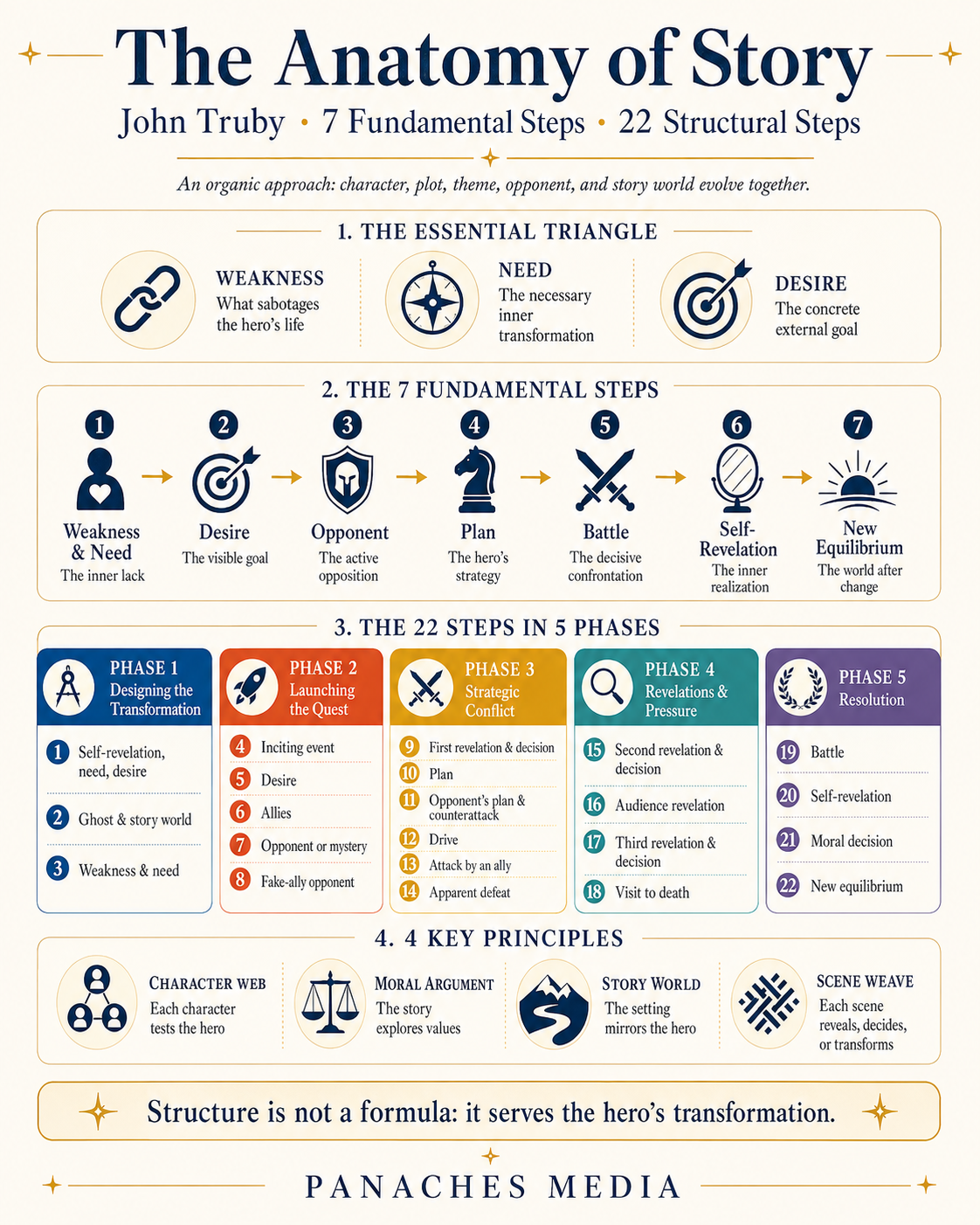
John Truby’s The Anatomy of Story
Understanding the 7 Steps and 22 Building Blocks of a Story
A story does not become compelling simply because it has a beginning, a middle, and an end.
It works when its protagonist pursues a goal, faces opposition capable of exposing their weaknesses, makes increasingly difficult decisions, and completes the journey in a different state from where they began.
This is the dynamic conception of narrative that John Truby develops in The Anatomy of Story.
Unlike methods that mechanically divide a story into three acts, Truby proposes building it like a living organism. Character, plot, theme, opponent, and story world should not be designed separately. They must evolve together and participate in the same process of transformation.
Truby’s approach is built on two complementary levels:
- the 7 fundamental steps, which form the story’s underlying logic;
- the 22 structural building blocks, which develop that logic into a more detailed dramatic progression.
The book is not intended exclusively for film screenwriters. Its method can be applied to screenplays, novels, short stories, and other narrative forms. It connects the premise, characters, plot, moral theme, story world, scenes, and dialogue.
Understanding this method is therefore not about memorizing twenty-two boxes. It is about understanding how a person pursuing an external desire can be forced to discover what they need to change within themselves.
An Organic Structure Rather Than a Mechanical Division
The three-act structure generally describes a broad movement:
- setup;
- confrontation;
- resolution.
This representation can be useful for observing the general shape of a narrative. But according to Truby’s approach, it remains too broad to explain how to build a story scene by scene.
Two screenplays may follow the same three-act structure and still produce radically different results. One may feel alive, dense, and coherent. The other may feel artificial, predictable, or empty.
The difference does not necessarily come from the number of acts. It comes from the way the elements of the story respond to one another.
In Truby’s method:
- the hero’s weakness influences their desire;
- their desire brings them into conflict with the opponent;
- the opponent attacks that specific weakness;
- the failure of the plan produces revelations;
- those revelations change the hero’s decisions;
- those decisions lead to a moral confrontation;
- the confrontation produces an inner transformation.
Each part therefore exists because of the others.
Structure should not be imposed on the story afterward. It should emerge from the particular nature of the character and the conflict.
John Truby’s 7 Fundamental Steps
The seven fundamental steps form the backbone of the narrative.
They do not necessarily correspond to seven specific scenes. One step may cover several sequences, develop gradually, or reappear in different forms.
Their purpose is to define the complete logic of the hero’s transformation.
1. Weakness and Need
At the beginning of the story, the main character suffers from a weakness that damages their life.
This weakness may be psychological:
- a lack of confidence;
- a fear of abandonment;
- an inability to accept failure;
- an excessive need for control;
- a tendency to avoid conflict.
It may also be moral when the hero’s behavior causes harm to others:
- they manipulate the people around them;
- they reject all responsibility;
- they use others to achieve success;
- they impose their decisions;
- they betray those who trust them.
The need is what the hero must understand or accomplish internally to overcome this weakness.
The weakness is the problem. The need represents the necessary transformation.
But the hero is generally unaware of this need. They may even be convinced that their behavior is perfectly justified.
Example
A brilliant lawyer trusts no one and manipulates her colleagues to win her cases.
Her weakness is her compulsive need for control.
Her deeper need is to learn to trust other people and recognize their value.
At the beginning of the story, she has no awareness of this.
2. Desire
Desire is the concrete goal that the hero consciously wants to achieve.
It is the visible engine of the plot.
The need is internal and often unconscious. The desire is external, precise, and identifiable.
The hero may want to:
- win a court case;
- find a missing person;
- protect their family;
- obtain a position;
- solve a murder;
- leave a city;
- conquer a territory;
- expose a lie.
An effective desire allows the audience to understand what the character is trying to do and to measure their progress.
Need and Desire Are Not the Same
The hero pursues what they want, but the story confronts them with what they need.
They may want to become famous while needing to recognize their own worth.
They may want revenge while needing to let go of hatred.
They may want to protect their child while needing to grant them independence.
This tension between conscious desire and deeper need is one of the most important engines of Truby’s method.
3. Opponent
The opponent is not simply an obstacle placed in the hero’s path.
They usually pursue a goal that is incompatible with the protagonist’s. The two characters come into conflict because they want outcomes that cannot coexist.
A strong opponent must also be capable of attacking the hero’s fundamental weakness.
They force the protagonist to rely on their old methods until those methods become inadequate or destructive.
The opponent may be:
- a rival;
- a family member;
- an institution;
- a criminal;
- a superior;
- a former ally;
- a character pursuing the same resource;
- a person defending an opposing moral value.
The most interesting antagonist does not necessarily consider themselves evil. They possess their own worldview, reasons for acting, and line of desire.
A Conflict of Values
The conflict becomes deeper when the hero and opponent are not merely fighting over an object or a victory, but over two different ways of understanding life.
One may defend freedom while the other prioritizes security.
One believes in cooperation while the other considers domination the only effective method.
One wants to preserve the past while the other wants to rebuild everything.
The final battle then also becomes a moral debate.
4. Plan
The plan is the strategy developed by the hero to achieve their desire and defeat the opposition.
Without a plan, the character risks remaining passive and merely reacting to events.
The plan gives direction to their actions:
- investigate several suspects;
- infiltrate an organization;
- seduce a character;
- assemble a team;
- steal a document;
- build an invention;
- force a negotiation;
- set a trap.
But this first plan is often based on the hero’s limited worldview.
Because they have not yet understood their weakness, they choose a strategy influenced by it.
A character obsessed with control will create a plan in which they delegate nothing.
A character who avoids conflict will search for a solution that requires no confrontation.
A character who trusts no one will hide information from their allies.
The failures of the plan therefore reveal the protagonist’s inner limitations.
5. Battle
The battle is the decisive confrontation between the hero and the opponent.
It does not necessarily take the form of a physical fight.
It may be:
- a trial;
- a debate;
- a negotiation;
- an artistic performance;
- a family confrontation;
- an election;
- a sacrifice;
- a public choice;
- the revelation of a truth.
The battle must confront the hero with the strongest form of the opposition.
It simultaneously tests:
- their ability to achieve their desire;
- the way they confront their weakness;
- the values they ultimately choose to defend.
The external confrontation and the internal transformation come together.
6. Self-Revelation
The self-revelation is the moment when the hero understands something fundamental about their own nature.
They discover:
- the true origin of their failures;
- the harm they have caused;
- the false belief directing their life;
- what they must abandon;
- the person they must become.
This revelation should not be a simple intellectual realization.
It must change the way the hero acts.
A character does not prove their transformation by announcing, “I have changed.”
They prove it by making a decision they would have been incapable of making at the beginning of the story.
7. New Equilibrium
The new equilibrium shows the consequences of the battle and the revelation.
The world returns to a certain degree of stability, but it does not return to exactly the same state as before.
The protagonist has changed.
They may have become:
- freer;
- more responsible;
- more honest;
- more humane;
- more dangerous;
- more isolated;
- more lucid.
The transformation is not necessarily positive.
In a tragedy, the hero may understand their mistake too late or reject the revelation offered to them.
The new equilibrium then shows the final cost of that failure.
The seven steps therefore form a chain: weakness and need, desire, opponent, plan, battle, self-revelation, and new equilibrium. The relationship between weakness, need, and desire lies at the heart of the preparatory work.
The Essential Triangle: Weakness, Need, and Desire
The distinction between these three concepts is essential to understanding Truby.
Weakness
It describes what currently prevents the hero from living well.
My character fails because they…
Need
It represents the necessary inner transformation.
To grow, my character must learn to…
Desire
It represents the external goal pursued throughout the story.
Concretely, my character wants to…
Complete Example
An archivist refuses to delegate because a past betrayal convinced her that trusting anyone leads to disaster.
- Weakness: she controls everything and pushes her colleagues away.
- Need: she must learn to trust and accept her vulnerability.
- Desire: she wants to recover a stolen register before it is destroyed.
The opponent might be a former colleague seeking the same register while defending an opposing view of the truth.
The external plot emerges from the desire.
The internal transformation emerges from the need.
The conflict between the two gives the story its depth.
John Truby’s 22 Structural Building Blocks
The twenty-two steps expand on the seven foundations.
They should not be treated as twenty-two compulsory scenes or as plot points that must appear at precise moments.
Instead, they form a scaffold for organizing:
- revelations;
- decisions;
- strategies;
- changes in desire;
- increasing pressure;
- moral transformation.
The order can be adapted, certain steps may be combined, and a single sequence may fulfill several functions. The method should support an organic story and remain at the service of the writer’s creativity.
Phase One: Designing the Transformation
Step 1. Self-Revelation, Need, and Desire
The first step paradoxically involves thinking about the ending.
Before organizing the events, the writer determines the hero’s final self-revelation.
What must they understand about themselves?
What weakness will this discovery allow them to overcome?
What inner need will then be fulfilled?
Once the final transformation has been identified, the writer can build the starting character in reverse.
Useful Questions
- What truth will the hero discover?
- What false belief do they hold at the beginning?
- What behavior does this belief produce?
- What external desire will force the hero to confront this problem?
This backward design prevents the transformation from feeling improvised in the final pages.
Step 2. Ghost and Story World
The ghost refers to an event from the past that continues to haunt the character.
It may be:
- a betrayal;
- an abandonment;
- an accident;
- a humiliation;
- a wrongdoing;
- a failure;
- a family secret.
The ghost often explains the origin of the weakness.
It does not necessarily need to be revealed immediately. The story can show its consequences before revealing its cause.
The story world should extend the hero’s problem.
The setting is not merely an aesthetic background. It is a social and symbolic arena in which the characters’ values can come into conflict.
A story about control may take place inside a suffocating administration.
A story about identity may unfold in a city where everyone changes their name.
A story about competition may be set in a school where every relationship is evaluated and ranked.
Step 3. Weakness and Need
The writer shows concretely how the weakness is already damaging the hero’s life.
It is not enough to state that a character is selfish, suspicious, or proud. The consequences of this behavior must be shown.
- Someone refuses to speak to them.
- A relationship deteriorates.
- An opportunity disappears.
- A conflict repeats itself.
- The character commits an injustice.
The need remains invisible to the hero, but it becomes perceptible to the audience.
Phase Two: Launching the Quest
Step 4. Inciting Event
The inciting event disrupts the initial situation and forces the hero to act.
Before this event, they can tolerate their weakness and continue living according to their habits.
After it, remaining still is no longer possible.
A document disappears.
A loved one is threatened.
An unexpected proposal is made.
A lie is discovered.
Someone returns.
The inciting event creates a crisis that pushes the character toward a goal.
Step 5. Desire
The hero transforms the crisis into a concrete objective.
They decide what they want to obtain.
The desire must be clear enough to organize the story, but difficult enough to generate a series of actions, obstacles, and decisions.
A vague desire such as “to be happy” is difficult to dramatize.
A visible desire such as “recover the register before Friday’s city council meeting” allows the audience to follow the progression.
Step 6. Allies
The hero meets or mobilizes characters who will help them in their quest.
But an ally should not be a simple assistant with no independent existence.
They should possess:
- their own desire;
- their own values;
- their own weakness;
- a personal reason for participating;
- the potential to enter into conflict with the hero.
A strong ally can support the protagonist while also challenging their methods.
They therefore contribute to the hero’s development rather than simply carrying out instructions.
Step 7. Opponent or Mystery
The main opposition becomes identifiable.
The opponent pursues a goal incompatible with the hero’s and generally possesses greater knowledge of the arena of conflict.
In some stories, their identity or intentions remain mysterious.
This uncertainty strengthens the plot:
- Who is really acting?
- Why?
- What does the opponent want?
- What do they know that the hero does not?
- What value do they defend?
The opponent becomes especially effective when they attack the protagonist’s weak point and force them to reveal their contradictions.
Step 8. Fake-Ally Opponent
The fake ally appears to help the hero but secretly works against them or pursues an incompatible objective.
This character introduces tension based on uncertainty.
They may be:
- a deliberate traitor;
- a spy;
- an opportunist;
- a character divided between two sides;
- someone genuinely attached to the hero but forced to betray them.
The fake ally becomes even more interesting when they may change sides or hesitate between competing loyalties.
These early detailed steps establish the final revelation, the ghost, the story world, the weakness, the inciting event, the desire, the allies, and the different forms of opposition.
Phase Three: Transforming the Goal Into Strategic Conflict
Step 9. First Revelation and Decision
The hero discovers an important piece of information that changes their understanding of the situation.
A useful revelation should not merely surprise. It must provoke a decision.
The character may:
- change strategy;
- redefine their goal;
- begin to doubt an ally;
- pursue a new lead;
- accept a greater risk.
The revelation relaunches the story because it changes the action.
Step 10. Plan
The hero develops a strategy to defeat the opponent and obtain what they desire.
This plan reflects their current psychological state.
Because the protagonist has not yet completed their transformation, the strategy often contains the seeds of its future failure.
They may underestimate the opponent, exclude their allies, lie, act too quickly, or repeat an old mistake.
Step 11. Opponent’s Plan and Main Counterattack
The opponent does not passively wait for the hero to act.
They also possess:
- a goal;
- a strategy;
- resources;
- allies;
- information;
- a schedule.
Their plan must be strong enough to force the hero to evolve.
Effective opposition does more than block a single action. It transforms the environment of the conflict and progressively reduces the protagonist’s options.
Step 12. Drive
This stage is often referred to by the English term Drive.
The hero carries out a series of actions to achieve their objective.
The narrative accelerates through:
- investigations;
- confrontations;
- attempts;
- alliances;
- failures;
- discoveries;
- counterattacks.
But this sequence should not become a mechanical repetition.
Every action must change the situation or the hero’s understanding.
The alternation between action and revelation creates narrative movement.
Step 13. Attack by an Ally
An ally confronts the hero about their methods or values.
They may criticize:
- their selfishness;
- their obsession;
- their violence;
- their lies;
- their inability to listen;
- the consequences of their decisions.
This attack matters because it comes from someone who normally wants the hero to succeed.
The hero cannot dismiss it as easily as the opponent’s accusations.
The external conflict begins to expose the internal problem.
Step 14. Apparent Defeat
The hero suffers a major failure.
Their plan collapses.
They lose an essential resource, an ally, their credibility, or the possibility of achieving their objective.
This defeat must be deeper than a simple setback. It should create the impression that the quest is over.
It also reveals the most extreme consequences of the character’s weakness.
The hero reaches rock bottom because their old methods no longer work.
This escalation includes the first revelation, the hero’s plan, the opponent’s counter-plan, the drive of actions, the challenge from an ally, and a devastating defeat.
Phase Four: Multiplying Revelations and Tightening the Pressure
Step 15. Second Revelation and Decision
New information transforms the defeat into an apparent defeat rather than a final one.
The hero discovers that victory may still be possible.
But their commitment often becomes obsessive.
They are prepared to go further, take greater risks, or sacrifice certain relationships.
Their desire may change form.
What they wanted at the beginning is no longer exactly what they are pursuing now.
Step 16. Revelation for the Audience
The audience learns something that the hero does not yet know.
This technique creates dramatic irony.
The audience may know:
- who the real opponent is;
- that a trap is being prepared;
- that an ally is lying;
- that a sought-after object has been moved;
- that the hero is misinterpreting the situation.
The tension no longer depends only on surprise, but on waiting for the moment when the protagonist discovers the truth.
Step 17. Third Revelation and Decision
The hero discovers one final essential piece of information before the ultimate confrontation.
This revelation may concern:
- the opponent’s weakness;
- the identity of the traitor;
- the true nature of the objective;
- the real price of victory;
- the method required to win.
It provokes the decision that commits the hero definitively to the battle.
Step 18. Gate, Gauntlet, and Visit to Death
The path narrows.
The possibilities gradually disappear until only one extremely dangerous route remains.
The hero encounters death, symbolically or literally.
They may:
- lose someone essential;
- believe they are about to die;
- abandon their former identity;
- confront the final consequences of failure;
- give up what had previously protected them.
This visit to death marks the end of the old character.
To move forward, the hero must abandon the version of themselves that dominated the beginning of the story.
The successive revelations therefore do more than create surprise. They alter the hero’s motivations, sometimes give the audience an advantage over them, and lead to a final ordeal in which the hero’s former identity can no longer survive.
Phase Five: Resolving the External and Internal Conflicts
Step 19. Battle
The hero and the opponent confront each other directly.
The battle determines who will achieve the external objective, but it must also confront their values.
The protagonist does not merely prove that they are stronger or more intelligent.
Through their actions, they demonstrate the way they have chosen to live.
The opponent often represents an opposing moral solution.
The final confrontation therefore answers two questions:
- Who will win the conflict?
- Which vision of the world does the story appear to defend?
Step 20. Self-Revelation
Through the confrontation, the hero finally understands the true nature of their weakness.
This revelation must be profound, but it does not necessarily need to be explained in a long speech.
It may be shown through:
- a look;
- a renunciation;
- a confession;
- an unexpected action;
- a decision opposite to the one made at the beginning;
- a sacrifice.
The audience understands that the character has finally seen themselves as they truly are.
Step 21. Moral Decision
The moral decision provides concrete proof of the transformation.
The hero must choose between several actions carrying different values.
They may have to choose between:
- revenge and justice;
- personal success and protecting someone else;
- control and trust;
- lies and truth;
- domination and cooperation;
- security and freedom.
The inner revelation becomes believable when this decision costs the hero something.
Step 22. New Equilibrium
The final step shows the state of the character and the world after the resolution.
The external desire may be fulfilled or abandoned.
The internal need may be satisfied or rejected.
Relationships have changed.
The new equilibrium allows a direct comparison between the final character and the person they were at the beginning.
In a positive story, the hero now acts with greater clarity.
In a tragedy, they may remain trapped by their weakness and cause their own destruction.
The battle, self-revelation, moral decision, and new equilibrium therefore form the true culmination of the method: the hero must not simply win or lose, but reveal through their choice what they have become.
Revelations as the Engine of the Plot
One of the distinctive features of Truby’s method is the importance given to revelations.
A complex plot is not based solely on a succession of obstacles.
It progresses when the hero repeatedly discovers new information that forces them to change their behavior.
A strong revelation produces three effects:
- it changes the understanding of the situation;
- it provokes a decision;
- it redirects the story.
Without a decision, the revelation risks remaining decorative.
Without new information, the decision may feel arbitrary.
The two must work together.
A Possible Progression
The hero initially believes that the opponent wants to destroy a document.
They later discover that the opponent actually wants to make it public.
Then they learn that the document proves a wrongdoing committed by their own family.
Finally, they understand that protecting it means preserving the very lie they claim to oppose.
Each revelation changes the nature of the desire and brings the hero closer to their moral decision.
The Character Web
In Truby’s method, secondary characters should not be imagined in isolation.
They form a network organized around the hero and the theme.
Each character may represent:
- a possible version of the protagonist;
- a different response to the moral problem;
- a consequence of the hero’s weakness;
- a temptation;
- a warning;
- a path toward transformation.
The Hero
The hero carries the main conflict and central need.
The Opponent
The opponent attacks the hero’s weakness and defends an opposing value.
The Ally
The ally helps the hero while also exposing their mistakes.
The Fake Ally
The fake ally introduces ambiguity, betrayal, or divided loyalty.
Secondary Characters
They explore the theme from different angles.
A story about freedom might therefore include:
- a hero who wants to escape;
- an opponent convinced that order protects people;
- an ally who confuses freedom with the absence of responsibility;
- a fake ally who claims to defend freedom while controlling others.
The theme then exists within the relationships, not only within the dialogue.
The Moral Argument
For Truby, a story generally explores a moral question.
This does not mean adding an explicit moral at the end or transforming the narrative into a lesson.
The moral argument appears through:
- the values defended by the characters;
- the consequences of their choices;
- the methods they use;
- the transformations they accept or reject;
- the hero’s final decision.
Example
A story might ask:
Can a community be protected by hiding the truth from it?
The hero may believe that lying is necessary.
The opponent may want to reveal the truth without caring about the consequences.
The allies may defend different intermediate positions.
The protagonist’s final decision then becomes the story’s dramatic response.
The narrative does not state an abstract thesis. It tests that thesis through action.
The Story World as an Extension of the Character
The story world does not merely locate the action.
It can physically and socially reflect the hero’s weakness.
A character unable to communicate may live in a world saturated with messages but devoid of real conversations.
A character obsessed with the past may inhabit a city transformed into a museum.
A character who rejects all responsibility may move through an institution where no one ever signs their decisions.
The world then becomes an expression of the theme.
It should also provide:
- rules;
- boundaries;
- places of power;
- spaces of safety;
- forbidden zones;
- a social hierarchy;
- recurring symbols.
When the hero transforms, their relationship with this world also changes.
The Scene Weave
After establishing the major steps, the writer can construct what Truby calls the scene weave.
This involves organizing every scene according to the structural logic of the narrative rather than following chronology alone.
A useful scene should generally produce at least one transformation:
- information is discovered;
- a relationship changes;
- a decision is made;
- a plan progresses or fails;
- a conflict intensifies;
- a value is tested;
- a character reveals a new side of themselves.
The scene weave is an organized list of the final scenes built from the structural steps. Their order should allow the progression to be driven by structure rather than by simple chronology.
Testing a Scene
For each scene, ask:
- What does the character want in this scene?
- Who or what prevents them from getting it?
- What strategy do they use?
- What new information appears?
- What decision is made?
- How is the final situation different from the initial one?
If nothing changes, the scene may not be necessary.
How to Use the 22 Steps Without Turning the Story Into a Formula
The main risk is transforming the method into a form to be completed.
A writer may try to artificially insert:
- a fake ally;
- three revelations;
- a visit to death;
- a moral decision;
- a battle.
But a step should not be included simply because it appears on a list.
It must respond to the particular needs of the story.
Not every narrative needs an identifiable traitor.
The visit to death may be intimate and symbolic.
The battle may be a quiet conversation.
The audience revelation may be unnecessary in a story told strictly from the hero’s point of view.
The twenty-two steps should therefore be used as questions.
- Does my hero have a clear objective?
- Does the opponent genuinely attack the hero’s weakness?
- Does the plan reflect the hero’s limitations?
- Do the revelations provoke decisions?
- Do the allies challenge the hero’s methods?
- Does the battle also resolve the moral conflict?
- Is the transformation proven through action?
- Does the new equilibrium show the consequences of that transformation?
The method then becomes a diagnostic tool rather than an imposed formula.
A Practical Method for Building a Story
Step 1: Summarize the Premise
Write the story in one sentence:
An archivist who is unable to trust anyone must recover a stolen register before its disappearance legally erases thousands of citizens.
Step 2: Define the Inner Triangle
- Weakness: she controls everything and refuses to delegate.
- Need: she must learn to trust.
- Desire: she wants to recover the register.
Step 3: Build the Opponent
- What do they want?
- Why does their objective compete with the hero’s?
- What value do they defend?
- How do they attack the protagonist’s weakness?
Step 4: Imagine the Battle and the Moral Decision
Before developing the entire middle, determine:
- the hero’s final choice;
- what they will have to sacrifice;
- the necessary inner revelation;
- the concrete proof of their transformation.
Step 5: Organize the Main Revelations
List the information that will progressively transform the understanding of the conflict.
Each revelation should provoke a decision.
Step 6: Distribute the Useful 22 Steps
Some will be developed across several scenes.
Others may be combined.
Remove those that do not organically serve the narrative.
Step 7: Construct the Scene Weave
Organize the scenes according to the escalation of conflict, the revelations, and the hero’s transformation.
Step 8: Rewrite From the Deep Structure
Then examine:
- the coherence of the desire;
- the strength of the opponent;
- the progression of the revelations;
- the development of the relationships;
- the clarity of the moral argument;
- the difference between the initial hero and the final hero.
The Strengths of Truby’s Method
It Connects Plot to Character
Events are not merely external. They progressively reveal the hero’s weakness.
It Gives the Opponent an Active Role
The antagonist possesses their own desire and strategy.
It Builds the Transformation
The character’s change does not suddenly appear at the end. It results from a sequence of failures, revelations, and decisions.
It Deepens the Theme
The story’s meaning appears through conflicts of values and moral choices.
It Adapts to Different Forms
The steps can be applied to a film, novel, comic book, series, narrative game, or short story, with different levels of development.
Limitations and Precautions
No method can guarantee a good story by itself.
A perfectly organized structure may still feel cold if the characters lack individuality.
A logical transformation may feel artificial if the emotions are not believable.
A multitude of revelations may exhaust the audience if they do not genuinely change the action.
Truby’s method also requires significant preparation. Some writers may prefer to discover their story during the drafting process rather than planning it completely.
The two approaches are not incompatible.
It is possible to write a first draft freely, then use the seven and twenty-two steps to analyze what has emerged.
Structure can intervene before, during, or after the first draft.
Ten Questions for Testing a Story With Truby’s Method
- What weakness damages the hero’s life?
- What inner transformation do they truly need?
- What external objective are they pursuing?
- Why does the opponent want an incompatible outcome?
- How does the opponent attack the hero’s weakness?
- Why must the protagonist’s first plan fail?
- What revelations will change their decisions?
- What moral conflict lies beneath the final battle?
- What action will prove their transformation?
- How does the new equilibrium differ from the initial world?
When the answers are connected, the story generally possesses a deep structure.
When they seem independent, certain elements have probably been added without participating in the same narrative organism.
Conclusion
John Truby’s method is not simply about dividing a story into twenty-two steps.
It proposes a conception in which the plot is the external expression of an internal transformation.
The hero pursues a desire.
The opponent prevents them from achieving it and attacks their weakness.
The hero’s plan fails because it is based on a limited vision of the world.
The revelations progressively change their understanding.
The battle finally forces them to choose between their old behavior and the person they could become.
This is why the seven fundamental steps remain more important than memorizing the twenty-two detailed building blocks.
They describe the heart of the story:
An imperfect person pursues something, faces opposition capable of transforming them, and discovers through their decisions who they truly are.
The twenty-two steps then help construct the path.
But like any scaffold, they are intended to support the story, not remain visible once the work is complete.