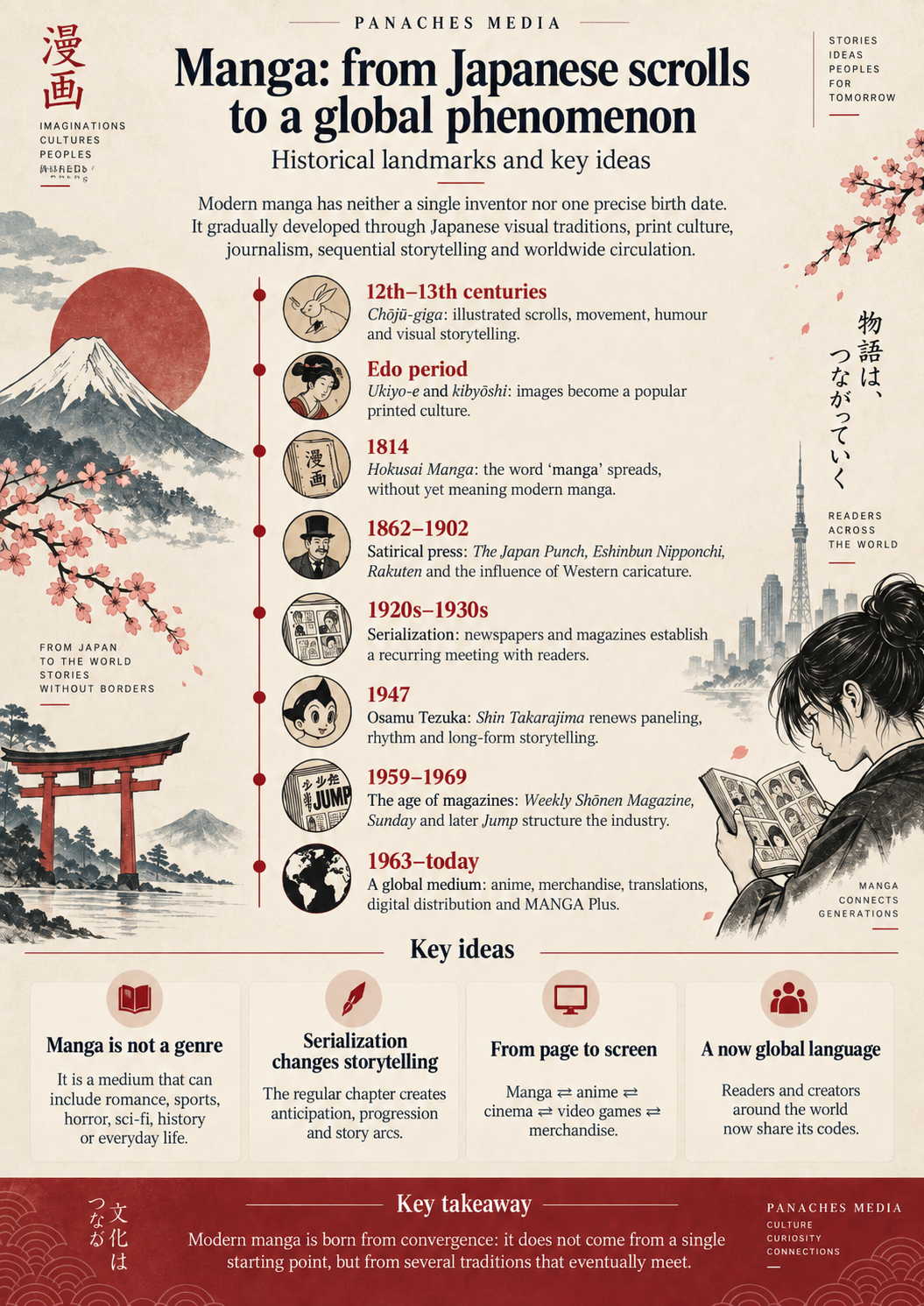
The origins of manga: a history of transformation
Pages often printed in black and white. Reading that begins on the right. Faces capable of shifting from realism to caricature within a few panels. Action scenes that seem to accelerate before giving way to silences that can suspend time across several pages.
Manga now possesses an immediately recognizable identity. Dragon Ball, Akira, Sailor Moon, Naruto, One Piece and Demon Slayer have long since moved beyond Japan’s borders. Their characters circulate between books, animation, video games, fashion, social media and conventions, while their visual codes influence artists who may never even have visited Japan.
This worldwide presence can nevertheless create a misleading impression: that manga is an ancient medium that has always existed in its present form.
As soon as we search for its origins, certainty disappears. Some trace it back to the illustrated scrolls of medieval Japan. Others choose Hokusai and his Manga, published from 1814 onward. Still others see Osamu Tezuka, after the Second World War, as the true starting point of modern manga.
None of these answers is sufficient.
Manga has neither a single inventor nor a precise date of birth. It developed gradually, at the intersection of Japanese graphic traditions, printing techniques, Western caricature, journalism, cinema, animation and a publishing industry that eventually became enormous.
Its history is therefore not one of sudden invention, but of continuous transformation.
Long before manga, Japan was already telling stories through images
The visual roots of manga reach much further back than the word itself.
In medieval Japan, emaki, or painted handscrolls, already combined text and image in long compositions. Viewing them had one important particularity: the work was not revealed all at once. The scroll was gradually unrolled, allowing scenes to appear one after another.
The eye therefore moved through the image. Characters reappeared, locations changed and situations evolved. This was not yet modern comics, but one fundamental idea was already present: graphic space can organize narrative time.
The famous Chōjū-giga, created between the twelfth and thirteenth centuries, occupy a special place in this history. Rabbits, frogs and monkeys run, fight and imitate human behaviour with remarkable vitality. Their dynamism explains why these scrolls are regularly described as distant ancestors of manga.
The comparison is appealing, but it should be handled carefully. Centuries separate these works from printed comics, their publishers, magazines and modern readerships. The Chōjū-giga mainly demonstrate an old Japanese tradition in which images are already used to narrate, exaggerate, caricature and suggest movement.
Edo: when images became popular culture
A development more directly connected to the future of manga appeared during the Edo period.
Between the seventeenth and nineteenth centuries, cities expanded, literacy increased and printing techniques made it possible to produce and distribute books and images on a much wider scale. A genuine popular print culture emerged.
Ukiyo-e prints circulated widely. They depicted kabuki actors, landscapes, urban scenes and famous figures. Alongside them flourished an enormous range of illustrated books, humorous narratives and satirical publications.
The kibyōshi, particularly popular in the late eighteenth century, reveal this development clearly. These small books combined abundant text, dialogue and illustrations in stories often aimed at an adult urban audience. Images no longer simply accompanied the text: they became part of the storytelling and the humour.
Modern manga still did not exist, but several of its foundations were already in place: publishers, an audience, reproducible images and a market capable of circulating works on a large scale.
Hokusai and the word “manga”
In 1814, Katsushika Hokusai published the first volume of what would become the Hokusai Manga.
The title almost seems to announce modern Japanese comics directly.
Yet these collections contain something very different. Hokusai gathered thousands of drawings: people at work, animals, landscapes, expressions, body movements, fantastic creatures and humorous scenes. He observed the world with an almost encyclopedic curiosity and transformed gestures, attitudes and situations into images.
The word manga is indeed there, but its meaning is not yet the one we use today.
The Hokusai Manga are generally not based on narratives built from a sequence of panels. They are closer to collections of varied drawings, intended in part to present forms, poses and movements.
Hokusai therefore did not invent modern manga.
His role nevertheless remains important. His collections helped spread the term and were fully part of a Japanese culture of printed, popular and reproducible imagery.
Rather than searching for a “father of manga” in Hokusai, it is more accurate to view him as one major stage among several traditions that would eventually converge.
A few milestones before modern manga
| Period | Development |
|---|---|
| 12th–13th centuries | The Chōjū-giga reflect an old tradition of narration and movement through images. |
| Edo period | Prints and illustrated books become part of a genuine popular print culture. |
| 1814 | Publication of the first volume of the Hokusai Manga. |
| 1862 | The Japan Punch introduces a new form of Western satirical journalism in Japan. |
| 1920s | Illustrated series take an increasingly important place in newspapers and magazines. |
| After 1945 | Narrative manga undergoes a major transformation with a new generation of creators. |
This timeline is not a straight line. Above all, it shows how several histories gradually begin to converge.
When Western caricature enters the picture
In the mid-nineteenth century, Japan’s gradual opening to international trade profoundly transformed the country.
The changes were political and economic, but also cultural. New newspapers and new graphic practices arrived with foreigners living in Japanese ports.
In Yokohama, British illustrator Charles Wirgman launched The Japan Punch in 1862, a magazine inspired by the famous British satirical publication Punch. His drawings used the conventions of Western caricature to comment on local life, foreigners and current events.
Japanese artists quickly began observing and transforming these new forms. Eshinbun Nipponchi appeared in 1874, followed a few years later by Marumaru Chinbun. At the beginning of the twentieth century, Kitazawa Rakuten developed newspaper comics influenced both by local traditions and by American comic strips.
The future manga was therefore already being built through hybridization.
Japanese artists did not replace their own graphic traditions with foreign models. They absorbed them, modified them and mixed them with their existing practices.
But the most decisive contribution of journalism may not have been immediately visible in the drawings.
It concerned rhythm.
A newspaper returns every week. A magazine returns every month. Characters can return as well.
The relationship with the reader changes: instead of discovering only a finished work, readers can now wait for the next installment.
Serialization changes storytelling
During the 1920s and 1930s, serialized comics took an increasingly important place in Japanese newspapers and magazines.
Characters returned from one episode to another. Adventures continued. Younger audiences became especially important, and several popular series began building lasting relationships with their readers.
Serialization created a mechanism that now seems obvious:
a story begins → the reader discovers an episode → they wait → the story continues
This publishing logic would deeply influence storytelling.
When authors know that their story must return regularly, they no longer think only in terms of a page or a handful of isolated images. They must maintain attention, develop characters, create expectations, build secondary plots and strike a balance between immediate satisfaction and the desire to continue.
Publishing time begins to shape narrative time.
This becomes one of the most important characteristics of modern manga: a story can grow alongside its audience.
The Second World War brutally interrupted this development. Then, after 1945, in a Japan rebuilding itself, a new generation would take this legacy and give it unprecedented scale.
Osamu Tezuka and the revolution of long-form storytelling
The name Osamu Tezuka dominates the history of postwar manga so strongly that he is sometimes presented as the inventor of modern manga.
Once again, the reality is more interesting.
Tezuka inherited an already rich graphic and publishing culture. What he transformed profoundly was the way images could organize movement and time.
In 1947, Shin Takarajima — New Treasure Island — created with Sakai Shichima, became a huge success.
Its visual rhythm particularly impressed readers. An action could be broken into several panels. Framing changed. A character might be shown from a distance, then in close-up. A reaction could be isolated. A moving car was no longer simply represented in a single image: the reader could almost feel its motion.
Cinema and animation strongly influenced this approach.
Tezuka used panel composition almost like editing. One second could last several panels; conversely, a much longer period could be condensed into only a few images.
Drawing no longer simply shows what happens: panel composition itself becomes a way of telling the story.
This development opened the way to much longer and more complex narratives. Characters could grow, change, lose, begin again and move through several stages of their lives.
Tezuka therefore did not create manga from nothing.
He demonstrated how far drawn storytelling could go when given more space.
The magazine becomes manga’s great engine
During the 1950s and 1960s, Japan’s economic growth and the expansion of publishing allowed manga to change scale.
In 1959, Weekly Shōnen Magazine and Weekly Shōnen Sunday were launched. A few years later, Shueisha introduced Shōnen Jump, which quickly became Weekly Shōnen Jump.
These magazines were far more than simple containers.
They organized an entire system: artists, editors, publishing schedules, audience reactions, regular chapters and later publication in collected volumes.
From chapter to volume
A chapter published in a magazine must function as an appointment.
It has to move the story forward enough to satisfy the reader while leaving enough tension, uncertainty or desire to justify waiting for the next issue.
When a group of chapters is later collected into a volume, the reading experience changes. What was discovered week by week becomes a continuous story.
This double form of reading partly explains the distinctive structure of long-running manga. A tension can last three pages, one chapter, a full volume or an entire narrative arc.
The publication format itself therefore becomes part of the narrative language.
There is no single “manga”
As the industry grows, manga becomes more diverse.
Manga aimed at young boys occupies a major place, but other currents develop alongside it.
Gekiga, associated in particular with Yoshihiro Tatsumi, began offering more realistic and dramatic stories for older readers from the 1950s onward.
Manga aimed at young girls also underwent profound change. During the 1970s, creators such as Moto Hagio and Keiko Takemiya helped renew shōjo manga, experimenting both with page composition and with the subjects they explored.
Science fiction, identity, human relationships, psychology and intimacy found new forms of expression.
Little by little, manga became capable of accommodating almost every kind of story.
Manga is not a genre: it is a medium.
It can tell a romance, a war story, a sports competition, a mystery, a cooking story, a historical epic, a fantasy adventure or simply everyday life.
Terms such as shōnen, shōjo, seinen and josei do not directly correspond to narrative genres either. They come first and foremost from publishing segmentation linked to the audiences magazines aim to reach.
Manga gradually leaves the page
From the 1960s onward, another force accelerated its distribution: animation.
In 1963, Tetsuwan Atomu — Astro Boy — became a regular television series. One of Tezuka’s iconic characters moved from the page to reach millions of viewers.
The relationship between manga and animation then took on a new scale.
A popular work could now circulate between several media:
manga ⇄ anime ⇄ cinema ⇄ video games ⇄ merchandise
An animated adaptation introduced characters to a new audience. That audience could then discover the printed volumes. Manga fed anime, and anime directed viewers back toward manga.
This circulation between media became one of the major engines of Japanese popular culture.
From the 1980s to a global phenomenon
From the 1980s onward, Japan’s publishing power encountered an ever-growing international audience.
Katsuhiro Otomo’s Akira played a major symbolic role. Its cyberpunk universe, highly detailed artwork and the impact of its animated adaptation showed many foreign viewers that a Japanese work could offer ambitious graphic and cinematic storytelling.
But manga’s worldwide expansion did not depend only on a few prestigious works.
Dragon Ball became an enormous popular phenomenon. Sailor Moon introduced a very different imaginative world. Then came many other series distributed through television channels, translations and the growth of specialist publishers.
During the 1990s and 2000s, the shift became cultural.
Foreign audiences gradually learned to read manga according to its own conventions.
The original Japanese reading direction was increasingly preserved. Words such as mangaka, shōnen and shōjo entered readers’ vocabulary. Some readers began following Japanese authors and magazines directly, rather than only their television adaptations.
Manga gradually stopped being perceived as an imported curiosity.
It became a reading culture in its own right.
The internet reduces the distance from Japan
The beginning of the twenty-first century accelerated this globalization even further.
One Piece, Naruto and Bleach became emblematic of an entire generation. Later, Attack on Titan, My Hero Academia, Demon Slayer, Jujutsu Kaisen and Chainsaw Man appeared in a landscape where international circulation had become almost immediate.
The internet transformed the relationship to time above all.
For decades, European readers might wait several months before officially discovering a new Japanese volume or chapter. Today, information, announcements and publications circulate almost instantly.
In 2019, Shueisha launched MANGA Plus, which makes it possible for selected series to be officially released in several languages at the same time as their Japanese publication.
The appointment once limited to a national magazine can now become global.
A chapter published in Tokyo can now be read almost simultaneously in Paris, Madrid or New York.
From Japanese medium to international language
This globalization also makes manga more difficult to define.
For a long time, the equation appeared simple: manga was comics produced in Japan.
But what happens when a French, Spanish or American artist creates a work directly influenced by Tezuka, Toriyama or Oda? If that work adopts panel composition, storytelling and sometimes even a reading direction associated with manga, where does the definition begin and end?
There is no universal answer.
This ambiguity mainly shows how far manga has spread.
What was once an essentially Japanese publishing form has become a visual language understood and reinterpreted by creators around the world.
A history without a single inventor
It would be tempting to summarize this entire journey through a few major names.
The Chōjū-giga would be manga’s ancestors. Hokusai would have given it its name. Tezuka would have invented its modern form.
That story fits into a few sentences, but it removes precisely what makes manga’s evolution so fascinating.
Modern manga emerged from the meeting of a long Japanese tradition of visual storytelling, a popular print culture already highly developed during the Edo period, influences from Western caricature and comics, serialization in newspapers and magazines, postwar narrative innovations and an industry capable of moving the same characters across several media.
None of these elements created manga on its own. Their combination gradually made modern manga possible.
This history also explains its ability to evolve without losing its identity.
Manga has absorbed new tools, formats, audiences and influences. Yet one thing remains at its centre: the ability to organize images in order to make readers feel time, movement and emotion.
A panel can freeze an instant. A few close-ups can increase tension. An almost empty page can create silence. A sequence of images can turn a few seconds into an entire scene.
And that is precisely where the next part of our exploration begins.
After tracing the history of manga, we now have to enter its pages and understand how its visual language works.
Main sources
To explore this history further: British Museum, Kyoto International Manga Museum, Shueisha archives, official resources dedicated to Osamu Tezuka, and MANGA Plus by Shueisha.