With Pong? With two spaceships firing at each other on the screen of a university computer? With an electronic game of tic-tac-toe? Or with an experimental cathode-ray tube device built by engineers who probably never imagined that millions of people would one day spend their evenings exploring fantasy kingdoms, building cities, or driving virtual cars?
The question sounds simple. The answer is much less so.
There is no single moment when video games suddenly appeared.
Like many technologies and cultural forms, they emerged gradually. One experiment introduced electronic display. Another added interaction. Elsewhere came rules, simulation, movement, multiplayer, commercialization, and finally mass adoption.
That is also why the question of the “first video game” still produces different answers depending on the definition being used.
What begins as a scientific curiosity eventually becomes a machine in a public venue. Then a box under the television, software running on a computer, a console carried in a pocket, an app on a phone, or a world shared by millions of players.
In just a few decades, video games stopped having a single form, a single audience, or even a single home.
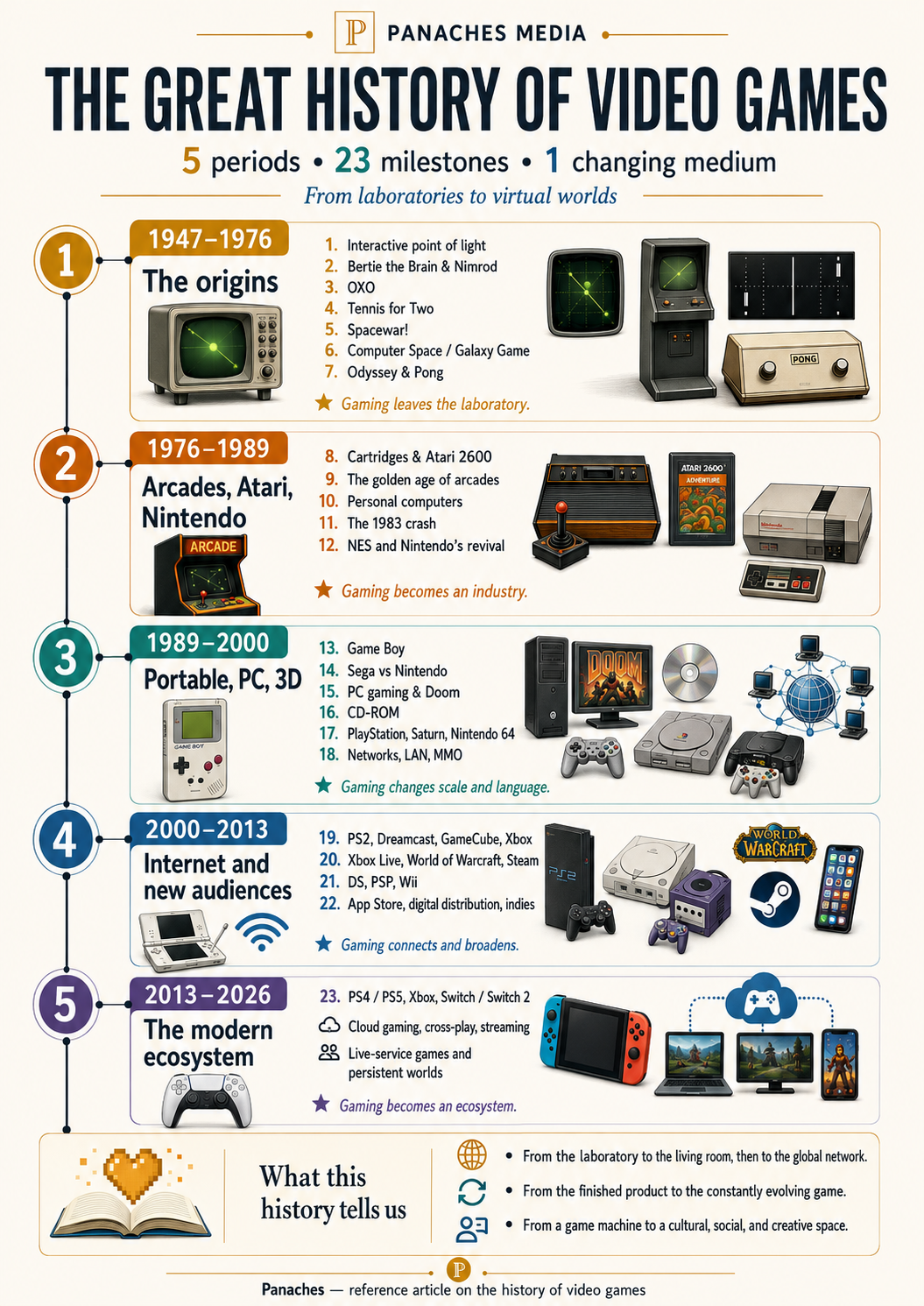
To understand that evolution without turning this article into an endless encyclopedia, we will follow it through five major periods and twenty-three milestones.
Not to tell everything.
But to understand how the movement was built.
1947–1976 — Before the industry, video games first had to be invented
Before Mario, Lara Croft, or Master Chief, there was no real “video game industry.”
There were engineers, researchers, enormous computers, experimental displays, and an idea that might have seemed almost frivolous given how rare and expensive these machines were: using some of that computing power to play.
That curiosity would prove remarkably important.
1. 1947 — A point of light can already become interactive
In 1947, Thomas T. Goldsmith Jr. and Estle Ray Mann filed a patent for a device using a cathode-ray tube to simulate firing at targets.
The system does not exactly match what we would now call a video game. It relies partly on analog electronics, and its design sits somewhere between several possible definitions.
But one fundamental idea is already present: an electronic display can become a space in which the user acts.
We are still far from the modern console or computer game, but one of their most basic principles is already taking shape.
2. 1950–1951 — Machines become opponents too
Early computers were primarily designed for scientific, military, or industrial calculation.
Researchers quickly discovered, however, that games were excellent testing grounds for machines. Chess, checkers, or the game of Nim offered precise rules, required decisions, and made it possible to observe how a computer responded to a human opponent.
Bertie the Brain in 1950 and Nimrod in 1951 notably demonstrated that a machine could participate directly in a game.
Games therefore revealed very early a property they would retain throughout their history: they could be entertainment and a laboratory for computing at the same time.
3. 1952 — OXO brings tic-tac-toe to the computer
At the University of Cambridge, Alexander S. Douglas developed OXO on the EDSAC computer.
The player competes against the machine at tic-tac-toe. Moves are entered using a telephone dial, and the current state of the board appears on a cathode-ray display.
From the perspective of 2026, the system looks extremely primitive.
Yet its structure is already familiar: the player provides an input, the machine interprets it according to a set of rules, then displays a new state to which the player must respond.
Action, calculation, response.
The loop underlying almost every modern video game is already visible.
4. 1958 — Tennis for Two turns calculation into shared movement
In 1958, physicist William Higinbotham created Tennis for Two at Brookhaven National Laboratory for a public exhibition.
On an oscilloscope, two players control a ball represented by a point of light moving over a net along a trajectory that simulates gravity.
The experiment remains technically modest, but it introduces something important: the machine is no longer simply solving a problem against a human.
It becomes the medium for an activity shared between two people.
Video games begin to reveal that they can be spaces for interaction between people, not merely computing problems.
5. 1962 — Spacewar! turns the computer into a playground
At MIT, Steve Russell and several other programmers developed Spacewar! on a PDP-1.
Two spaceships orbit a star, accelerate, turn, and fire at each other. The program later circulates through university and computing communities, becoming both a game and a spectacular demonstration of what the machine can do.
Spacewar! already contains many elements that would become familiar: competition, mastery of controls, simulated physics, graphical space, clear rules, and the desire to play again and improve.
Its importance also comes from a shift in how computers themselves are perceived.
An expensive machine built to process information can also become a machine for creating imaginary situations.
6. 1971 — Games gradually leave the laboratory
After years of experimentation, video games finally meet commerce.
In 1971, Computer Space, directly inspired by Spacewar!, becomes one of the first commercial arcade video games. The same year also sees Galaxy Game, based on a similar concept.
The change is essential: players no longer need to work at a university or gain access to an extremely expensive computer to encounter this kind of experience.
A machine can be installed in a public place.
A player can insert a coin.
That extremely ordinary gesture is about to become the economic engine of an entire industry.
7. 1972 — Odyssey and Pong bring games into popular culture
In 1972, two developments move the boundaries significantly.
The Magnavox Odyssey brings electronic gaming to the household television. At the same time, Atari commercializes Pong in arcades and other public venues.
Pong is visually minimal: two paddles, one ball, a few rules.
Its cultural impact is enormous.
The game becomes visible enough to enter the public imagination, to the point that it is still regularly described as the first video game even though it belongs to a history that began much earlier.
The real change in 1972 is therefore not only technical.
Video games are beginning to leave specialist circles and find a place in everyday life.
1976–1989 — Arcades explode, Atari collapses, and Nintendo rebuilds
By the end of the 1970s, video games are gradually ceasing to be a technological curiosity.
Arcade cabinets multiply in public spaces. Consoles begin appearing beneath televisions. Recognizable characters emerge, and the market attracts enough money that large numbers of companies want to participate in its growth.
The period will produce both spectacular expansion and one of the industry's first major crises.
8. The cartridge turns the console into a platform
The second generation of consoles introduces a fundamental change: the machine and the game can become separate products.
With the Fairchild Channel F and later systems such as the Atari VCS, eventually renamed Atari 2600, players buy a console and gradually expand their library through interchangeable cartridges.
This separation completely changes the economics of the market.
A machine is no longer limited to the experiences imagined when it was manufactured. It can remain in a household for years while regularly receiving new games.
The console becomes a true software platform.
The concept seems obvious today, but it is one of the most important economic and cultural innovations in the history of home gaming.
9. The golden age of arcades
While home consoles are developing, arcades enter a period of spectacular expansion.
Space Invaders arrives in 1978, Asteroids in 1979, Pac-Man in 1980, and Donkey Kong in 1981.
A few pixels are now enough to create silhouettes, sounds, and situations that people recognize immediately. Pac-Man becomes a cultural icon. Donkey Kong introduces a character who will soon evolve into Mario. Video games begin to exist beyond the machines that contain them.
Arcades also help establish part of the medium's vocabulary: scores, limited lives, increasing difficulty, leaderboards, and the constant temptation to try again.
The familiar phrase “one more game” takes on a particularly concrete economic meaning when every attempt costs another coin.
More importantly, arcades turn gaming into a social phenomenon. Players watch others, learn through observation, compare performances, and share the same physical space.
10. The microcomputer opens another branch of the story
While consoles increasingly occupy living rooms, the Apple II, Commodore 64, ZX Spectrum, Amstrad CPC, and IBM PC open a different path.
Computers can obviously run games, but they can also be programmed.
That difference becomes essential.
Amateurs can create their own software. Genres can adopt more complex interfaces and different rhythms. Text adventures, strategy games, simulations, and role-playing games find particularly fertile ground on computers.
The proximity between playing and making also begins to generate communities capable of modifying, sharing, or inventing their own experiences.
Video games discover very early that they will not have a single dominant platform or a single path of development.
11. 1983 — The North American market breaks
Rapid expansion eventually produces saturation.
By the early 1980s, the North American market contains too many consoles, too many games of wildly varying quality, and too much unsold inventory. Growing competition from personal computers adds further pressure.
In 1983, the console market collapses dramatically in North America.
Popular history has often reduced the crash to E.T. on Atari 2600, which became one of the most famous symbols of the excesses of the period. The real problem was much broader: the market as a whole suffered from insufficient control and declining consumer confidence.
Video games did not die.
Their center of gravity was simply moving.
12. Nintendo rebuilds confidence around the console
In Japan, Nintendo launches the Famicom in 1983.
The machine is later adapted for the North American market as the Nintendo Entertainment System, or NES.
Nintendo enters a context in which the word “console” no longer inspires complete confidence among American consumers. The company therefore introduces tighter control over software authorized for its platform and presents the product as an “Entertainment System.”
But the recovery is not based on marketing alone.
Super Mario Bros. and other major franchises give the machine a strong identity and a catalog capable of restoring enthusiasm.
From the mid-1980s onward, Nintendo plays a major role in rebuilding the North American home gaming market.
This period demonstrates something the industry will never entirely forget: video games can suffer a major crisis, lose the trust of their audience, and still return in another form.
1989–2000 — Games travel, become identity, and discover depth
The 1990s concentrate several transformations that could each have defined an entire decade.
Games become truly portable. Nintendo and Sega transform their hardware into cultural identities. PC technology accelerates. CD-ROM dramatically increases the amount of content developers can store, and polygonal 3D forces the entire industry to rethink its design habits.
In little more than a decade, the way games are played, sold, and even represented changes profoundly.
13. 1989 — Games now fit in a pocket
Nintendo launches the Game Boy in Japan in 1989.
Its screen is monochrome, and the hardware appears modest compared with some technically more ambitious competitors.
Yet its balance of battery life, durability, simplicity, and software proves remarkably effective.
Tetris, Super Mario Land, and later Pokémon help turn the machine into a worldwide phenomenon. The wider Game Boy family eventually surpasses one hundred million units sold.
Its historical importance goes beyond sales figures.
Video games have lost another constraint: they no longer need to wait for the player in the living room.
They can accompany journeys, fill a few minutes on a train or in a waiting room, and transform ordinary fragments of the day into moments of play.
14. Sega versus Nintendo — choosing a console becomes choosing an identity
The 16-bit generation turns competition into spectacle.
Mega Drive versus Super Nintendo. Sonic versus Mario. Aggressive advertising, slogans, and playground debates sometimes give the rivalry an intensity wildly disproportionate to what is, technically, a choice between electronic devices.
But that is exactly why the period matters.
Nintendo relies on established characters, family-friendly worlds, and continuity with its history. Sega builds an identity around Sonic that feels faster, more provocative, and more closely tied to contemporary ideas of being “cool.”
Marketing fully understands that a console is no longer sold only through technical power or software catalogs.
It can also become a sign of belonging.
That logic will accompany almost every major platform rivalry that follows.
15. PC develops cultures of its own
While consoles organize themselves around increasingly visible commercial wars, PC follows a far less centralized evolution.
SimCity, Civilization, Ultima, Monkey Island, Wolfenstein 3D, Doom, and Warcraft illustrate the diversity of experiences that flourish on computers.
In 1993, Doom plays a particularly important role. It strongly popularizes the first-person shooter while contributing to several parallel developments: digital distribution through shareware, network play, and a growing culture of modification.
That last element will profoundly distinguish PC gaming.
Players can sometimes browse files, modify data, install additional levels, or create their own content.
The computer becomes a place where a game can be played, taken apart, modified, and rebuilt by its own community.
16. CD-ROM changes the scale of content
Optical discs provide far more storage space than the cartridges used by many earlier machines.
That additional capacity opens new possibilities: more music, recorded dialogue, video, imagery, environments, and narrative content.
The period also produces many multimedia experiments featuring filmed actors whose artistic aging has, let us say, varied considerably over time.
Behind those sometimes awkward experiments, however, lies a much deeper structural change.
Developers now have enough space to imagine productions that are richer in content and include far more voice acting, music, and cinematic sequences.
Games move technically closer to other media while continuing to search for a language of their own.
17. PlayStation, Saturn, and Nintendo 64 — 3D forces everything to be relearned
Sony launches the first PlayStation in Japan on December 3, 1994, followed by North America and Europe in 1995.
Together with Sega Saturn and Nintendo 64, it participates in one of the great visual and conceptual shifts in the history of the medium: real-time polygonal environments become increasingly central.
Tomb Raider, Super Mario 64, Final Fantasy VII, Metal Gear Solid, Gran Turismo, and The Legend of Zelda: Ocarina of Time each explore this new space differently.
Moving from 2D to 3D does not simply mean adding polygons.
Developers must learn how to move cameras, guide the player's attention, control characters in depth, and build levels that can be seen from multiple directions.
Controllers themselves evolve as analog sticks become increasingly important.
3D therefore forces developers to invent new conventions and players to learn them.
A new grammar of video games is being built.
18. Networks begin to make distance less important
By the end of the 1990s, modems, LAN parties, proprietary online services, and early massively multiplayer worlds begin to redefine what multiplayer means.
Quake, Diablo, Ultima Online, and EverQuest all participate in that transition.
Multiplayer no longer requires sharing the same couch or even living in the same city.
Networks gradually turn the Internet into a playable space.
Physical distance begins to disappear between participants, replaced by a less visible technical infrastructure — until terrible ping suddenly reminds everyone that distance still exists.
2000–2013 — The Internet connects the pieces already in place
By the early 2000s, most of the major components of modern gaming already exist: consoles, computers, handheld systems, 3D graphics, multiplayer, and networking.
The next transformation is less about inventing each of those elements than connecting them and making them part of everyday life.
Games become more digital, more connected, and progressively less dependent on physical media.
19. The sixth generation brings consoles, computers, and multimedia closer together
Dreamcast, PlayStation 2, GameCube, and Xbox mark the beginning of a period in which consoles become more powerful but also more versatile.
Dreamcast explores online gaming unusually early.
PlayStation 2 contributes to the spread of DVD in many households, turning the console into a multimedia device as well as a gaming machine.
Microsoft enters the market directly with the Xbox, launched in North America on November 15, 2001.
The arrival is symbolic as well as commercial: one of the world's largest software companies is now joining the traditional console industry.
The boundaries between console, computer, network, and home entertainment become increasingly blurred.
20. Connected gaming gradually becomes the norm
As broadband Internet becomes widespread, online connectivity stops being an experiment reserved for enthusiasts.
Xbox Live strongly structures multiplayer on consoles. MMOs become persistent worlds players can return to for months or years.
World of Warcraft, launched in 2004, becomes one of the most visible examples of this new relationship with games.
On PC, Steam officially launches in September 2003. Initially closely linked to Valve's own ecosystem, it gradually contributes to a much broader transformation in digital distribution.
The disc is no longer essential.
The store itself can become software installed on the computer.
Permanent connectivity also makes updates and new content easier to distribute.
A new idea gradually takes hold: a game's commercial release no longer necessarily means that its development is finished.
21. Nintendo DS, PSP, and Wii expand the definition of the player
Nintendo DS and PSP continue the competition in handheld gaming.
At the same time, Nintendo makes a more radical move with the Wii.
Rather than competing only through graphical performance, the company emphasizes a different way of interacting with games through motion detection.
Nintendo DS follows a comparable philosophy through its touchscreen.
Wii Sports, Nintendogs, Brain Training, and many other titles become accessible to audiences who may never have considered themselves “gamers.”
The change is cultural as much as commercial.
For years, the industry had largely asked which audiences would buy video games.
This period begins suggesting a much broader question: how many different kinds of players can coexist within the same medium?
The answer will soon be: an enormous number.
22. Smartphones, downloads, and independent games change distribution
In 2008, the App Store launches with roughly 500 applications.
The smartphone gradually becomes an enormous software platform carried in the pockets of hundreds of millions and eventually billions of people.
Games quickly become one of its most visible forms of content.
At the same time, Steam, Xbox Live Arcade, PlayStation Network, and other digital stores reduce many of the constraints associated with physical distribution.
Reaching an audience no longer always requires manufacturing discs, printing boxes, and securing shelf space in a store.
That change creates more room for projects developed with smaller budgets.
Braid, Super Meat Boy, Limbo, Terraria, and Minecraft all illustrate different forms of this new visibility.
Independent games did not begin with the Internet.
Creators had been making their own games since the earliest microcomputers.
Digital distribution simply gave that creativity a global infrastructure capable of connecting authors and audiences much more directly.
2013–2026 — Video games become an ecosystem
From the 2010s onward, speaking about the video game as though it were a single unified practice becomes increasingly strange.
A round of Candy Crush during a commute, a League of Legends competition, an evening spent with Baldur’s Gate 3, a collaborative build in Minecraft, a session of Fortnite, an experimental indie game, and a cinematic PlayStation adventure all technically belong to the same medium.
Culturally, they can feel worlds apart.
Video games are no longer merely an industry divided into platforms.
They become a collection of ecosystems, communities, services, and creative forms that coexist.
23. From consoles to persistent worlds
The PlayStation 4 / Xbox One generation confirms the importance of digital stores, permanent multiplayer, updates, and connected services.
Nintendo then blurs one of gaming's oldest boundaries with the Switch in 2017, combining handheld and home console use in the same device.
At the same time, some games begin to resemble places people return to rather than products they simply finish.
Minecraft becomes a space for construction, creation, education, and sharing.
MOBAs and other competitive games help structure esports.
Streaming transforms how people watch others play and creates new relationships between players, content creators, and communities.
Then Fortnite Battle Royale, launched in September 2017, pushes the idea of the continuously transforming game even further. Seasons, events, collaborations, and regular changes turn the software into a space whose identity evolves over time.
Some players naturally come to win.
Others come just as much to meet friends, experience an event, or simply spend time together in the same digital space.
In 2020, Xbox Series X|S and PlayStation 5 arrive with fast SSDs, more complex graphics, ray tracing, higher frame rates, and increasingly deep integration with digital services.
At the same time, cloud gaming, subscriptions, cross-play, and online saves attempt to make the particular machine being used less important than the wider ecosystem the player belongs to.
Nintendo continues its hybrid approach with the launch of Switch 2 on June 5, 2025.
By 2026, the landscape is extraordinarily diverse.
Consoles still exist. So does PC. Arcades have not entirely disappeared. Mobile represents billions of potential devices. Portable PCs have adopted forms increasingly similar to handheld consoles.
Games may be purchased on disc, downloaded, streamed from the cloud, updated for years, or transformed season after season.
Some offer adventures lasting only a few hours.
Others appear to have signed a very long lease.
Twenty-three milestones, but one story
Step back from the detail and this dense chronology becomes easier to read.
| Period | Major transformation |
|---|---|
| 1947–1976 | Computers and electronics discover play |
| 1976–1989 | Video games become a mass-market industry |
| 1989–2000 | Games become portable, three-dimensional, and cultural |
| 2000–2013 | The Internet and digital distribution connect players |
| 2013–2026 | Gaming becomes a persistent, multiplatform ecosystem |
These transformations do not truly replace one another.
They accumulate.
A modern game still relies on the fundamental loop present in its earliest ancestors: the player acts, a system applies its rules, the machine responds, and the player decides what to do next.
Controllers have changed. Screens have changed. Computing power and world scale bear almost no resemblance to the earliest experiments.
Yet beneath Elden Ring, Fortnite, Minecraft, Mario Kart World, or a tiny independent game created in someone's bedroom, the same old idea remains:
I do something, the system responds, so I try again.
It may be one of the strongest threads running through the entire history of the medium.
What the history of video games really tells us
It would be possible to describe the evolution of video games as a sequence of technical achievements.
8 bits, 16 bits, 32 bits, faster processors, GPUs, teraflops, ray tracing.
All of that is real and has profoundly shaped what creators could build.
But that interpretation remains incomplete.
The most important shifts often happen when a new technology changes not merely the power of a machine, but the relationship between the game and the person using it.
Pong makes games visible to a broad audience.
Atari helps bring them into homes on a massive scale.
Arcades turn gaming into a social phenomenon.
Nintendo demonstrates that a more controlled software ecosystem can rebuild consumer trust after a major crisis.
Game Boy frees gaming from the television.
3D forces the industry to invent a new way of representing and navigating space.
The Internet reduces distance between players.
The smartphone turns an everyday object into a gaming platform.
Digital distribution brings creators and audiences closer together.
Persistent worlds eventually transform some games into places.
Each of these changes then produces new jobs, new artistic languages, new economic constraints, and new technical problems.
The main thread of video game history may therefore be less about a machine constantly becoming more powerful.
It is about a medium gradually gaining new kinds of freedom.
First freedom from the laboratory.
Then from the arcade.
Then from the living room.
Eventually from a single machine, a single screen, or a single territory.
At every stage, games gain another place they can go.
A history with no reason to stop
In less than a century, we have moved from points of light manipulated on cathode-ray tubes to digital worlds capable of gathering enormous communities.
The path between those two extremes has been anything but orderly.
It contains brilliant ideas and dead ends, dominant companies that later disappeared, industrial crises, console wars, concepts copied and transformed, technical limitations turned into artistic styles, and countless developers who built something simply because they wanted to know whether it could work.
And, obviously, a great many cables.
That disorder is exactly what makes video game history so interesting.
The medium continues to collide with 3D, networks, artificial intelligence, cinema, music, writing, design, and almost every other form of digital creation. Some of those encounters will probably produce nothing lasting. Others may eventually become so obvious that we forget they were ever new.
It is therefore difficult to seriously answer the question: how far can video games still evolve?
Their history has already demonstrated a remarkable ability to change form.
The more interesting question may be somewhere else.
Right now, somewhere in a laboratory, an independent studio, a university, or a cluttered bedroom full of hardware, someone is probably experimenting with an idea that still seems strange, unnecessary, or too limited.
Perhaps it will lead nowhere.
Or perhaps, without anyone realizing it yet, it is already playing the same role that Spacewar! played in 1962.
That is one of the pleasures of studying this history: we are very good at recognizing major turning points once they are behind us. Much less so when they are just beginning.