Inside an arcade cabinet? Under the television? On a computer? In a console you can slip into a bag? On a phone? Perhaps even on a server hundreds of kilometers away?
Today, the simplest answer would be: almost everywhere.
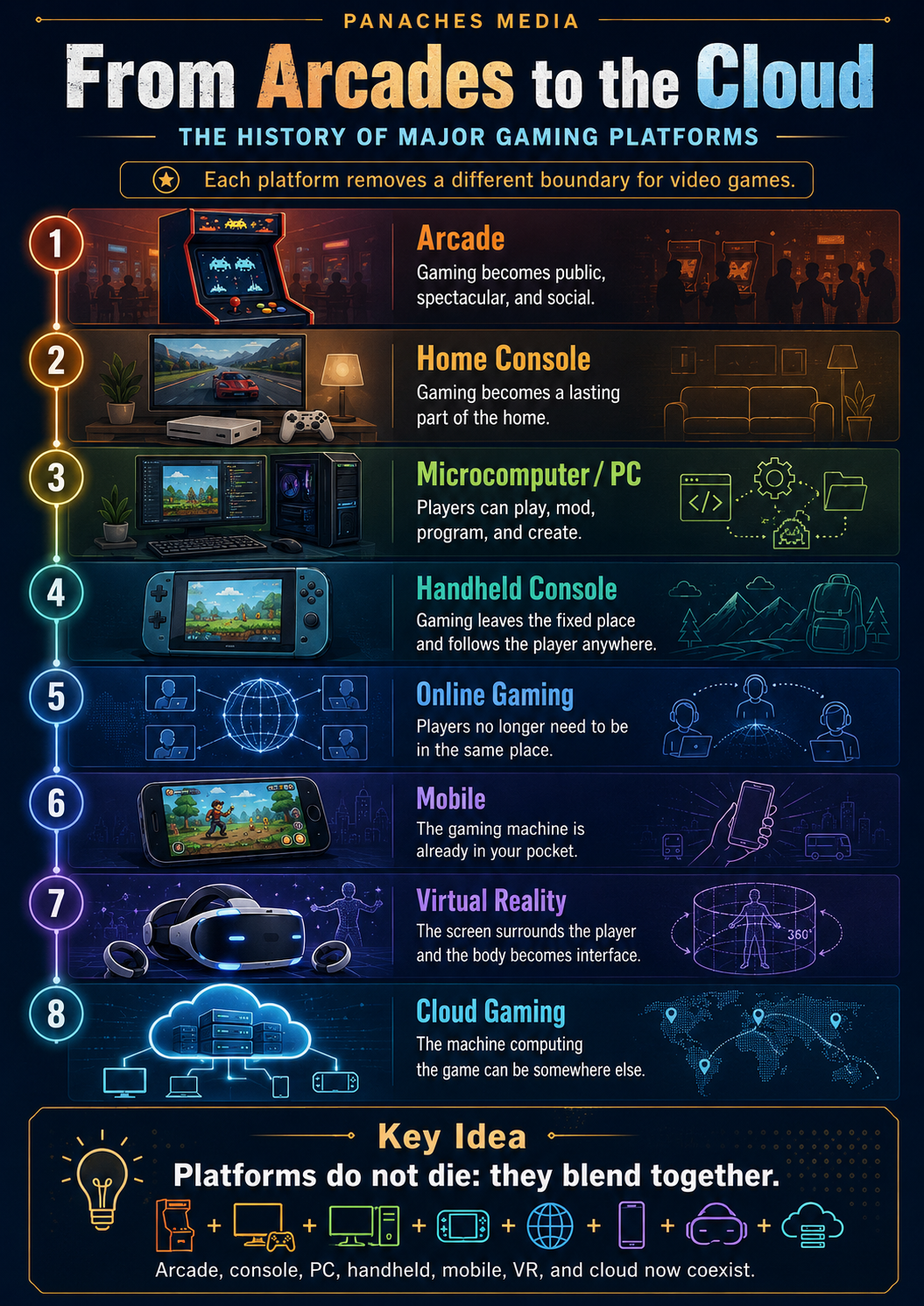
That was far from obvious when the medium first emerged. For decades, each new platform pushed back a particular boundary. Arcades placed games in public spaces. Home consoles brought them into the living room. Computers brought players closer to the tools of creation. Handheld systems detached gaming from a fixed location, the Internet removed distance between players, smartphones turned an everyday object into a gaming device, and virtual reality began challenging the boundary between screen and body.
Cloud gaming now pushes the idea even further: the machine actually running the game no longer needs to sit anywhere near the player.
Platforms are often reduced to hardware rivalries — PC versus console, Android versus iPhone, PlayStation versus Xbox — sometimes with an intensity bordering on domestic religion. Their history, however, tells a much more interesting story.
Every major platform has invented a new way of being a player.
A platform is more than a machine
Before exploring that history, we need to clarify what the word “platform” actually means.
It can refer to a physical device: an arcade cabinet, console, computer, smartphone, or VR headset. But it can also describe a broader technical and software environment such as Windows, Steam, PlayStation, Xbox, Android, or iOS.
A platform therefore combines several layers: the hardware, operating environment, controls, distribution system, services, and available games.
That combination is exactly why the boundaries have become less obvious over time.
A Nintendo Switch is a handheld console that can become a home console. A Steam Deck is still a PC, but one designed with the ergonomics of a handheld console. A smartphone can be connected to a controller. An Xbox game can be rendered in a data center and streamed to a phone. Even a PlayStation VR2 headset can, with the appropriate hardware, step outside its original ecosystem and work on PC.
The broad categories remain useful. They simply describe much softer boundaries than they once did.
Arcade — when playing meant leaving home
Before video games colonized bedrooms and living rooms, they lived in public spaces: bars, shopping centers, dedicated arcades, restaurants, and amusement venues.
The relationship between player and game was fundamentally different. You did not necessarily own the software or even the machine. You went somewhere to play it.
In 1971, Computer Space became one of the earliest commercial coin-operated video games. The following year, Pong achieved much greater success and helped accelerate the growth of the modern arcade industry.
Over the following years came games that would define entire generations: Space Invaders, Asteroids, Pac-Man, Donkey Kong, Galaga, Defender, and later Street Fighter II, Daytona USA, or Dance Dance Revolution.
But the importance of the arcade is not just about its catalog. The cabinet itself shaped the way games were designed.
When economics shapes game design
An arcade machine has to catch the eye among dozens of others, explain itself quickly, and make players want another attempt. Most importantly, another attempt usually means another coin.
That economic constraint encouraged design traits that became iconic: relatively short sessions, highly visible scores, rising difficulty, limited lives, leaderboards, and immediate audiovisual spectacle.
The familiar idea of “one more game” takes on a very concrete meaning when every attempt has a price.
Arcades therefore taught video games how to be designed not only for playing, but also for watching.
A social space before the network
Arcades were also places where people gathered. Players watched others, waited for their turn, learned techniques by observing more experienced players, and compared scores.
Fighting games made this particularly visible: your opponent could literally be sitting or standing a few centimeters away.
Video games were already digital, but the experience remained deeply rooted in a physical place.
As home consoles became powerful enough to reproduce more of the arcade experience, arcades gradually lost their central position. They never disappeared completely. In Japan and parts of Asia, arcades remained especially visible for decades; elsewhere, the format survived through gaming bars, retro arcades, rhythm games, simulators, and specialized installations that are difficult to reproduce at home.
Arcades left video games with something fundamental: the ability to become spectacle as well as personal experience.
The home console — when games enter the living room
Home consoles completely changed the ritual.
Instead of traveling to a machine and inserting a coin, players bought the hardware, placed it under the television, and turned gaming into a household activity.
Magnavox Odyssey, Atari 2600, NES, Mega Drive, Super Nintendo, PlayStation, Nintendo 64, Dreamcast, PlayStation 2, Xbox, Wii, and PlayStation 5 belong to very different eras, but all share the same basic idea: turn the family television into an interactive space.
The history of console generations tells us how these machines evolved technically. Here, the more interesting question is what the console itself changed about the way people play.
A more standardized experience
Unlike PC, where two players may have radically different configurations, consoles are built around known hardware. Every unit of the same model shares the same processor, memory architecture, general environment, and reference controller.
For developers, that stability makes highly targeted optimization possible. For players, it removes a large part of the technical friction.
The historical promise of the console is simple: plug it in, launch the game, and play.
Of course, in the modern era, this charming simplicity may first require downloading several dozen gigabytes of updates. Progress occasionally has a strange sense of humor.
From machine to ecosystem
Modern consoles are no longer merely devices that run games.
Nintendo, Sony, and Microsoft each organize user accounts, digital storefronts, subscriptions, friends lists, cloud saves, licensing systems, accessories, and online services.
The console has gradually become a gateway into an ecosystem.
That shift matters. Choosing a machine can now also mean choosing a library, social infrastructure, services, and sometimes a digital continuity that follows the player across several hardware generations.
While this logic became increasingly structured around the television, computers followed a much less disciplined path.
From microcomputer to PC — the platform that refuses to stay still
Apple II, Commodore 64, ZX Spectrum, Amiga, Atari ST, MS-DOS, and eventually Windows: the history of computer gaming has never quite resembled console history, largely because computers were never built exclusively for games.
They are also used to write, program, draw, work, communicate, and produce spreadsheets whose entertainment value generally remains below that of Doom.
That versatility would become one of the PC’s defining strengths.
Playing and making on the same machine
On PC, players often have much more direct access to the environment in which a game runs. They can browse files, change settings, install programs, create levels, write code, add mods, or host servers.
That proximity between consumption and creation became one of the most important historical characteristics of PC gaming.
Entire communities formed around moddable games. Amateur creators built maps, developed tools, and sometimes transformed modifications into standalone projects.
Counter-Strike began as a Half-Life mod. Dota traces part of its history back to a custom Warcraft III map. Entire genres grew or exploded in popularity through this culture of digital tinkering.
On PC, playing and making have never been completely separate activities.
A platform without clear generations
PC also differs from consoles because its evolution is continuous.
There is no official day when “the new PC” collectively replaces the old one. The platform changes piece by piece: a new graphics card, processor, more memory, a new version of Windows, new APIs, or different storage standards.
Two players can therefore own radically different machines while still participating in the same general platform.
That lack of a single generation makes PC less tidy than consoles, but also considerably more flexible.
The Internet reinforces that identity
Network gaming and later digital distribution gave the PC yet another dimension.
Steam transformed how players buy, install, and manage game libraries. MMOs, esports, mods, independent games, free-to-play models, demanding simulations, complex strategy games, and countless experimental projects all found particularly fertile ground on computers.
Then history produced an amusing loop: the platform traditionally associated with the desk became portable too.
Valve describes Steam Deck as an all-in-one portable gaming PC, giving players access to their Steam library in a device designed to feel closer to a handheld console.
At that point, the old categories begin to lose some of their discipline.
Handheld consoles — when games stop waiting at home
Being able to play at home and being able to play almost anywhere are very different experiences.
Portable electronic games existed before the Game Boy. Nintendo’s Game & Watch systems and various dedicated handheld devices had already explored the idea. But the launch of the Game Boy in 1989 brought the concept to an entirely different scale.
Nintendo combined relatively modest hardware with interchangeable cartridges, strong battery life, and an exceptionally effective catalog. Tetris, Super Mario Land, and Pokémon all contributed to its success, and the wider Game Boy family would eventually sell more than one hundred million units.
Portability changes our relationship with time
The handheld console did more than change where people played. It changed when they played.
A session no longer had to be organized around the living room. It could happen on a train, in a waiting room, in bed, while traveling, or during a break.
Gaming began occupying fragments of daily life that previously would not necessarily have been considered available for play.
Game Gear, Game Boy Advance, Nintendo DS, PSP, and PlayStation Vita continued this evolution in very different ways.
Then the boundaries shifted again.
From portable to hybrid
Nintendo Switch can function as a handheld and move to the television in seconds. Steam Deck carries a PC library in a form inspired by handheld consoles, followed by other portable PCs using similar designs.
The old division between home console, handheld console, and PC increasingly looks like a continuum rather than three separate worlds.
Portability is no longer necessarily a category of machine. It is becoming a property that several platforms can adopt.
Online gaming — when the platform also becomes a network
Online gaming is a special case because it is not really a machine. It is more accurately a technical and social layer that eventually crosses almost every other platform: PCs, consoles, smartphones, and even VR headsets.
Networks transform an experience that was often local into a shared space.
Connecting machines, then worlds
Early multiplayer experiments used terminals, university networks, modems, and local networks. MUDs — multiplayer text worlds — demonstrated very early that a game could become a persistent space inhabited by several people at once.
With Doom, Quake, Diablo, Ultima Online, EverQuest, Counter-Strike, and World of Warcraft, that idea gradually expanded in scale.
Multiplayer no longer meant only two people sitting in front of the same screen. It could mean thousands of players connected to the same world.
Consoles become connected too
Dreamcast experimented heavily with online connectivity. Xbox Live later structured the experience more clearly around accounts, player identity, friends, and centralized services. PlayStation Network and Nintendo’s own infrastructures further normalized that model.
Internet connectivity eventually became so ordinary that it is easy to forget how profoundly it changed games themselves.
A world can continue to exist after a player logs off. A game can receive updates for years. A competition can connect players on several continents. A studio can add, fix, rebalance, or even remove content long after launch.
This evolution gradually introduced an idea that would reshape the entire industry:
a game no longer has to be a finished object at the moment it is released.
It can become a service that changes over time.
Mobile — when almost everyone owns a gaming device
For a long time, playing video games meant owning something designed at least partly for that purpose: an arcade machine, console, computer, or handheld system.
Phones disrupted that logic because they did not begin as gaming devices.
Early mobile games were relatively simple, with Snake becoming one of the defining symbols of that era. The real transformation arrived with smartphones.
Touchscreens, permanent Internet connections, sensors, GPS, cameras, and app stores became part of a device already carried every day by hundreds of millions and eventually billions of people.
When Apple launched the App Store in July 2008 with roughly 500 applications, the smartphone began to emerge as a massive software platform on which games would quickly become one of the dominant forms of content.
New gestures for a new interface
A touchscreen is not a traditional controller. It does not necessarily have physical buttons or analog sticks.
Games therefore had to learn a different vocabulary of gestures: tapping, swiping, pinching, tilting the device, or sometimes playing entirely with one hand.
The context changed too. The player was no longer necessarily sitting in front of a screen for several hours. They might be standing on a subway with only a few minutes available.
That constraint naturally influences pacing, interfaces, and session length.
An enormous economic laboratory
Mobile also transformed business models.
Free-to-play, advertising, in-app purchases, gacha systems, energy mechanics, virtual currencies, and seasonal passes all found enormous room for experimentation.
Many of those systems later migrated to PC and console games.
The platform therefore changes more than where people play. It can also influence how a game is designed, distributed, and financed.
Virtual reality — when the screen tries to surround us
Since the earliest days of video games, we have generally observed interactive worlds through a window: television, monitor, handheld screen, or smartphone.
Virtual reality proposes something different: placing that window around the player.
Experiments go back decades, through military technologies, simulators, Virtuality systems in the 1990s, and Nintendo’s Virtual Boy — which, put kindly, did not quite trigger the revolution its name seemed to promise.
Modern VR gained new momentum through Oculus, HTC Vive, PlayStation VR, and several generations of standalone headsets.
When the body becomes part of the interface
Virtual reality changes certain actions fundamentally.
Looking means physically turning your head. Aiming may involve pointing your hand. Picking up an object can require a real movement, and leaning behind cover may actually mean leaning your body.
The body becomes a much more direct part of the interface.
Modern headsets combine spatial tracking, motion controllers, haptic feedback, three-dimensional audio, eye tracking, and foveated rendering. PlayStation VR2, for example, combines several of these technologies in an effort to strengthen the feeling of presence.
The difference is not merely graphical. It changes the relationship between perception and action.
An experience that still carries friction
VR continues to face several obstacles: price, size, comfort, motion sickness, required physical space, hardware demands, catalog depth, and physical isolation from the surrounding environment.
It therefore does not replace the traditional screen, and perhaps never will completely.
Its importance lies elsewhere. VR explores a relationship other platforms struggle to reproduce: no longer looking at the game world from outside, but feeling as though you have been placed inside it.
Cloud gaming — what if the machine is no longer in your home?
Cloud gaming may be the strangest platform in this entire history because it begins by making the platform itself less visible.
In this model, the game does not necessarily run on the device in the player’s hands. It may operate on a distant server that calculates graphics, physics, artificial intelligence, and game logic before sending the result back as an interactive video stream.
The player’s inputs travel in the opposite direction.
In theory, a relatively modest device can therefore display a demanding game without having enough local power to calculate it.
The machine leaves the living room
In the traditional model, the game runs locally:
Game
↓
Local machine
↓
Display
With cloud gaming, the chain looks more like this:
Game
↓
Remote server
↓
Internet
↓
Player display
Computing power can therefore leave the home.
Other factors become crucial instead: connection quality, latency, distance from the data center, service reliability, display, and control device.
Xbox Cloud Gaming illustrates this model by allowing compatible games to be accessed across several types of devices while maintaining continuity with the wider Xbox ecosystem.
When the network becomes part of the controller
This architecture has an immediate consequence: the Internet now enters directly into the interaction loop.
If the connection slows, image quality or responsiveness may suffer. If latency rises, the player’s actions arrive later. If a service disappears, the associated access may disappear with it.
A few hundred milliseconds can be almost invisible while watching a video. In a fighting game or competitive FPS, the same delay can completely change the outcome of an action.
Cloud gaming therefore does not yet mean “no more hardware.”
It means something closer to: the hardware can be somewhere else.
That distinction may become increasingly important.
Eight platforms, eight boundaries moved
Viewed as a whole, each major platform seems to have removed a different constraint.
| Platform | What it changes |
|---|---|
| Arcade | Games become public, spectacular, and social |
| Home console | Games establish themselves permanently in the home |
| Microcomputer / PC | Playing and creating can happen on the same machine |
| Handheld console | Gaming is no longer tied to a fixed location |
| Online gaming | Players no longer need to share the same physical space |
| Mobile | The gaming machine becomes an object already carried in a pocket |
| Virtual reality | The screen attempts to surround the player and involve the body |
| Cloud gaming | The machine running the game can be located elsewhere |
This should not be read as a sequence of eight stages where each new platform makes the previous one obsolete.
The real history is far more interesting.
Platforms do not disappear — they blend together
Arcades still exist. Home consoles remain major platforms. PC continues to evolve. Handheld gaming has returned in new forms, mobile occupies an enormous territory, VR is building its own ecosystem, and cloud services increasingly sit on top of everything else.
What has changed most is how easily their characteristics now overlap.
A Switch is both portable and domestic. A Steam Deck is a portable PC designed around console-like controls. A smartphone can use a gamepad. A console can stream a game to another screen. A VR headset can operate with different types of hardware. Cross-play allows multiple platforms to participate in the same game.
The old question:
“What platform do you play on?”
once invited a fairly simple answer.
Today, the answer might be: PC at home, Steam Deck while traveling, PlayStation for certain exclusives, Switch on the train, mobile when there are only ten spare minutes, and cloud when the main machine is unavailable.
The answer can now be longer than the question.
That shift may be one of the most important changes in the entire history of platforms.
What platforms really changed
We could tell the history of gaming platforms as a sequence of objects: arcade cabinet, console, computer, Game Boy, smartphone, VR headset, remote server.
That would be accurate, but incomplete.
Hardware is ultimately only the visible part. What each platform truly transforms is the context in which playing becomes possible.
Arcades give games a public space. Consoles create a ritual around the television. PCs bring users closer to creation and to the machine itself. Handhelds turn fragments of everyday time into playable moments. The Internet allows games to become meeting places and persistent worlds. Smartphones transform an ordinary object into a permanent gaming platform. VR brings the body further into the interface. Cloud gaming begins separating the experience from the hardware performing the calculations.
The history of platforms is therefore less about a permanent race toward greater power than about a medium constantly trying to remove another constraint.
First the laboratory, then the public venue, the living room, the fixed machine, physical distance, and perhaps now even the requirement for powerful local hardware.
And tomorrow, will we still need to choose a platform?
Probably, because physical differences are not going away.
A headset does not produce the same experience as a monitor. A mouse and keyboard do not offer the same gestures as a controller. A smartphone does not carry the same constraints as a PC. A network connection does not magically replace a graphics card when technical conditions are poor.
Hardware will therefore continue to shape the experience.
At the same time, digital libraries, shared accounts, cloud saves, cross-play, multiplatform engines, and streaming services are pushing in the opposite direction: making games easier to move.
From one machine to another, one screen to another, one place to another.
The future may therefore not belong to a single platform that defeats every competitor. It may instead belong to a video game medium flexible enough to move between platforms without constantly making the player feel as though they have entered a completely different world.
In a little over half a century, video games have gone from arcade cabinets sitting in bars to experiences that can be calculated inside distant data centers and displayed on a phone.
That is already quite a journey for a medium whose early ambitions included little more than making a bright dot bounce across a screen.