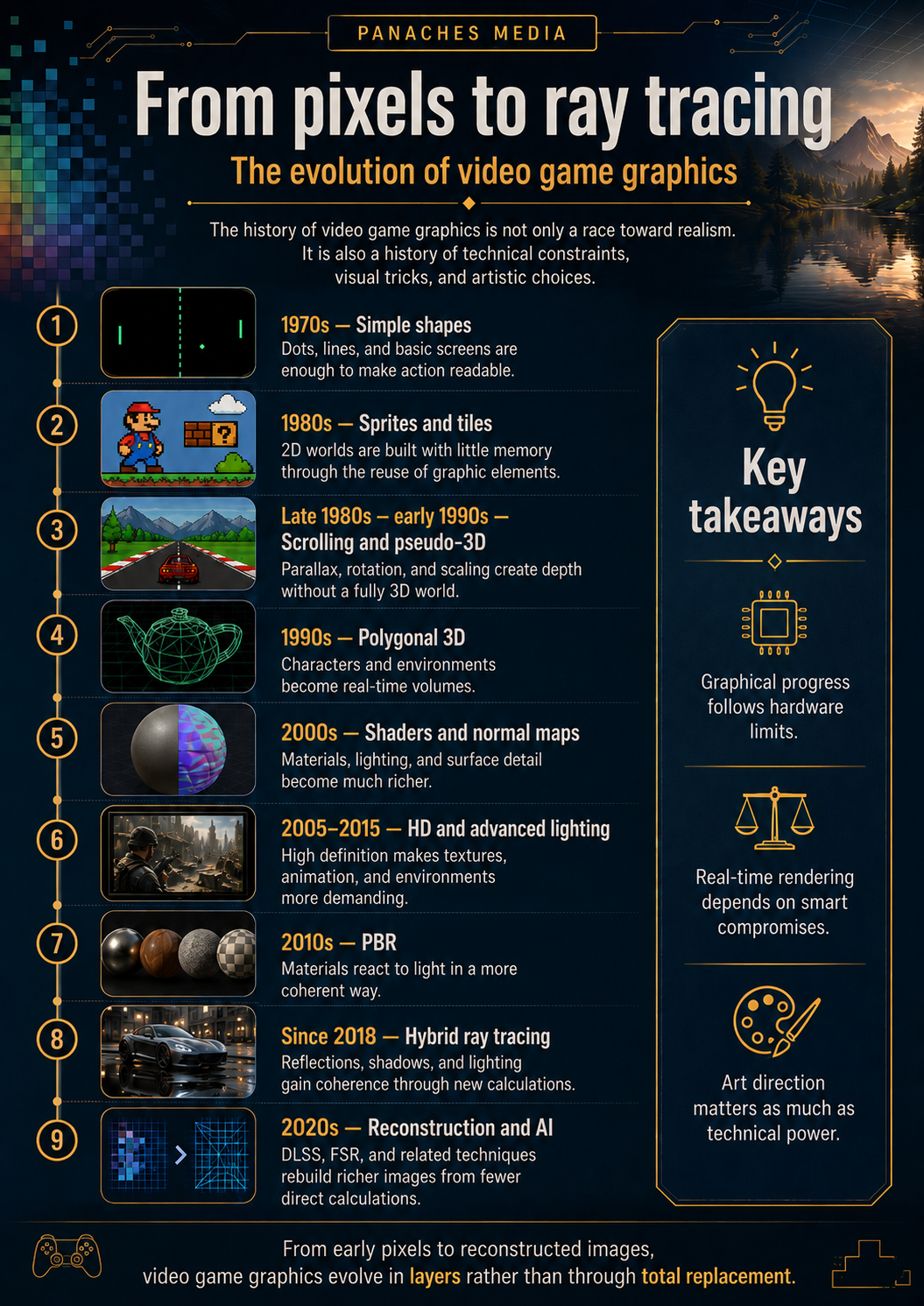
A history of constraints before a race toward realism
Comparing a game from the 1980s with a contemporary production can easily give the impression of continuous progress toward greater realism. Resolution increases, characters gain detail, environments become larger, and lighting increasingly resembles familiar physical behavior. This perspective is useful for measuring technical progress, but it does not fully explain what actually happened.
Since the beginnings of video games, the fundamental problem has remained fairly stable: producing an image convincing enough while recalculating it quickly enough for the player to act on what they see. A computer-generated image can take several hours to calculate when intended for a film. A game, by contrast, has to respond almost immediately to an input, update its world, and then display a new image only a few milliseconds later.
The history of video game graphics is therefore as much about hardware limitations as it is about the techniques invented to work around them. Each period developed its own compromises between available processing power, memory, resolution, animation, lighting quality, and artistic ambition. Progress does not only mean calculating more; it also means using what the machine can calculate more intelligently.
This relationship between hardware and imagery runs throughout the history of computer graphics. Advances in memory, processors, and display devices gradually made it possible to develop more complex techniques for modeling, texturing, animation, shading, reflections, and eventually ray tracing.
The first screens learn how to represent play
The earliest interactive graphical experiments had extremely limited resources. Some systems used cathode-ray tubes capable of directly drawing points and lines, while others gradually began constructing images as grids. In both cases, representing a rich environment remained far beyond reach.
Games therefore had to express their rules through elementary shapes. A ball could be a simple point of light, a paddle a rectangle, and a spaceship just a few segments. Yet the player could immediately recognize what needed to be followed, avoided, or controlled, because an image did not have to reproduce a real object faithfully in order to communicate its function.
This period established a principle that would remain essential: readability matters as much as precision. A visual element has to be identified quickly enough for the player to make a decision. Even when machines later became capable of displaying millions of additional details, that constraint never truly disappeared.
The beginnings of computer graphics already show this progression, from early interactive displays to research into modeling, shading, and computer-generated imagery. Video games would adopt part of that research, but with one additional requirement: preserving interactivity.
Sprites and tiles: building worlds with very little memory
By the late 1970s and especially throughout the 1980s, home machines and arcade systems became capable of displaying much richer visual worlds. Their available memory, however, remained tiny by modern standards. Artists and programmers therefore had to learn how to reuse the same elements intelligently.
Sprites made it possible to manipulate 2D images independently from the background. A character, projectile, or object could move without requiring the entire screen to be redrawn from scratch. Environments were often built from tiles, small graphical pieces assembled and repeated to form a level far larger than memory would have allowed as a single image.
This organization directly influenced how artists worked. Silhouettes had to be immediately recognizable, limited palettes required precise choices, and an animation sometimes had to suggest an action with only a few frames. What would later become a deliberately chosen artistic vocabulary under the name pixel art was, at the time, largely the result of constraints imposed by the hardware.
Artists nevertheless developed a wide variety of solutions within those limits. The same small texture could form several parts of an environment, a few carefully selected colors could give volume to a character, and repetition became far less visible when elements were assembled thoughtfully. Constraints did not automatically produce poor graphics; they mainly forced creators to decide what truly deserved to be represented.
Scrolling and parallax give depth to 2D
When machines learned to move the environment around the character, the apparent scale of game worlds changed significantly. The player was no longer confined to a fixed screen: the image followed their movement and progressively revealed new sections of the level. Scrolling became one of the fundamental tools of 2D game design.
Developers soon added several layers of scenery moving at different speeds. Elements close to the camera shifted more than those in the background, creating a parallax effect that suggested depth without requiring actual 3D geometry. The technique works because it reproduces a visual cue that we naturally perceive when moving through the real world.
Other systems made it possible to enlarge, shrink, rotate, or distort images. On the Super Nintendo, Mode 7 could transform a graphical layer to create perspective effects particularly visible in games such as F-Zero and Super Mario Kart. The image remained fundamentally 2D, but it began producing a much more dynamic sense of space.
Specialized chips extended this logic even further. The Super FX chip used notably by Star Wing enabled the Super Nintendo to handle polygonal graphics that would have been much more difficult for the console to produce on its own. These solutions show how much visual evolution at the time depended on a combination of additional processing power, specialized programming, and representational tricks.
Polygonal 3D changes how an image is built
During the 1990s, polygonal environments gradually became central in arcades, on PCs, and then on consoles. This transition changed far more than the appearance of games. It transformed the very way artists built what would eventually appear on screen.
In 2D, a large part of the final image could be drawn directly. In 3D, the artist constructed an object that had to remain coherent from multiple viewpoints. A character had volume, a car had to retain its shape while turning, and a building could be viewed from angles the artist no longer controlled completely.
Models used polygons for this purpose, generally arranged as triangles. Early generations had to work with very limited amounts of geometry, producing angular silhouettes and simplified faces. Textures added color and surface detail, but their resolution remained low and their distortions could be highly visible.
The arrival of machines such as the original PlayStation contributed significantly to spreading this new graphical language into the living room. Sony itself describes this generation as an important transition from traditional 2D experiences toward 3D worlds calculated in real time. The challenge was no longer simply to draw an attractive element; artists now had to build a coherent combination of shape, texture, camera, animation, and lighting.
Rasterization becomes the engine of real-time 3D
A 3D scene may contain volumes, but the screen remains a surface made of pixels. The engine therefore has to transform the geometry seen by the camera into a 2D image. Rasterization became the dominant method for performing this task efficiently enough for real-time gaming.
In simplified terms, the process projects visible triangles onto the screen and then determines which pixels they occupy. The engine can then calculate their colors, apply textures, and add information related to lighting or materials. This method avoids fully simulating the physical behavior of light, which for a long time would have required far too much computation.
Much of the graphical progress of the following decades therefore relied on an accumulation of techniques capable of enriching this rasterized image. Developers sought to produce believable shadows, reflections, surface relief, and atmospheric effects without paying the cost of a complete physical simulation.
This way of working explains why modern graphics engines contain so many different systems. Each solves a specific part of the image while seeking the best compromise between cost and visual result.
Shaders make rendering much more programmable
Early 3D GPUs relied on relatively rigid pipelines. As programmable shaders became widespread in the early 2000s, developers gained far greater control over how geometry and pixels were processed.
Vertex shaders notably made it possible to operate on the vertices defining geometry, while pixel shaders — also called fragment shaders in other environments — controlled part of the calculation of the final appearance of pixels. Microsoft places the introduction of vertex and pixel shaders in DirectX’s first Shader Model, before later generations greatly expanded their capabilities.
This development opened a vast field for technical artists and graphics programmers. Water could display ripples and reflections, surfaces could gradually dissolve, glass could distort what lay behind it, and stylized games could build lighting deliberately far removed from realism.
The shader thus became an essential intermediary between raw geometry and the final image. From this period onward, two objects with exactly the same shape could produce radically different visual results depending on the calculations applied to their materials.
Adding more detail without multiplying geometry
Increasing polygon counts made it possible to create more precise models, but this progression quickly encountered limits. Representing every wrinkle on a face, every seam in a garment, or every crack in a wall directly in geometry would require enormous amounts of resources.
3D pipelines therefore developed several methods for transferring some of this detail into textures. The normal map became particularly important: it changes how light is interpreted across a surface and can suggest relief much finer than what actually exists in the geometry.
A game character could then be designed in two broad versions. A highly detailed sculpt served as a reference, while a lighter model retained geometry compatible with real-time rendering. Part of the visual information from the complex version was then transferred into textures used by the final model.
This approach became characteristic of modern 3D production. The visible image no longer corresponded only to the geometry physically present in the scene; it resulted from a combination of actual shapes and information simulated through materials.
High definition increases both expectations and demands
The widespread adoption of high-definition digital displays made details visible that could previously go unnoticed. A texture flaw, an overly simple silhouette, or an imprecise interface became easier to spot as imagery moved from 480p to 720p, then 1080p and beyond.
Productions therefore had to increase texture resolution, enrich models, and improve animation. Surfaces occupied more pixels on screen, requiring details that could withstand closer observation. Interfaces also had to evolve in order to remain readable across different screen sizes and resolutions.
This improvement came with a direct cost. An image containing more pixels requires more calculations, while more detailed graphical assets consume additional memory. Every increase in definition therefore revived the same problem faced by previous generations: how can the image improve while maintaining a satisfactory frame rate?
Graphical progress continued to operate through compromise. Machines became more powerful, but the ambitions of artists and developers generally increased at the same pace.
PBR seeks to make materials more coherent
For a long time, creating digital materials relied heavily on recipes specific to individual engines or lighting situations. This became difficult to maintain as scenes grew more complex and objects had to work under very different lighting conditions.
Physically Based Rendering, or PBR, introduced a more coherent method. It does not aim to simulate the complete physics of matter perfectly, but to use properties inspired by real-world behavior so that materials respond to light in a more predictable way.
A common workflow describes a surface through information such as base color, roughness, metallic properties, and normals. Standards such as glTF therefore use a metallic-roughness PBR model to help materials retain a consistent appearance across different tools and rendering engines.
This approach does not restrict PBR to realistic games. A stylized world can use the same principles while exaggerating shapes, colors, or material properties. The main benefit lies in consistency: a correctly designed material should continue to react plausibly when moving from outdoor sunlight into a dark interior.
Modern lighting relies on several complementary techniques
As materials become more sophisticated, lighting quality increasingly determines their appearance. Engines need to represent shadows, light bounces, reflections, atmospheric volumes, and relationships between objects without having unlimited computing time.
Many solutions have been developed to address these needs. Some lighting information can be precalculated into lightmaps. Shadow maps generate dynamic shadows, ambient occlusion reinforces areas of contact, and different reflection techniques use the visible image or simplified representations of the environment.
These methods work well when used in situations they were designed for, but each has limitations. A reflection calculated only from the displayed image cannot precisely know what lies outside the camera view. Fully precalculated lighting does not adapt easily to scenes where every object and light source needs to change freely.
Modern rendering therefore gradually becomes an assembly of techniques. Final quality depends less on one single solution than on how these systems are combined and directed artistically.
Art direction remains more important than the amount of detail
Increasing graphical power regularly encourages comparisons based on resolution, polygon count, or lighting complexity. These measurements describe certain technical capabilities, but they are not enough to explain why an image works.
A highly detailed model can feel artificial if its animation lacks credibility or if its lighting contradicts its volumes. Conversely, a much simpler scene can establish a lasting visual identity through a coherent palette, strong composition, and immediately readable silhouettes.
This distinction explains why extremely different styles coexist today. Pixel art is still used even though the constraints that originally produced it have largely disappeared. Low-poly can become an aesthetic choice, just like hand-drawn 2D, digital painting, or deliberately simplified materials.
Graphical evolution therefore does not erase earlier visual languages. It often transforms former technical limitations into artistic tools available among many others.
Ray tracing introduces another way of calculating light
Rasterization remains extremely efficient, but some lighting phenomena require complex approximations. Ray tracing approaches the problem differently by mathematically following rays and their interactions with surfaces in the scene.
The technique existed long before its arrival in modern games, particularly in offline computer-generated imagery. Its broader use in gaming was limited by computational cost: every image has to be produced quickly enough to preserve interactivity, leaving very little time for extensive lighting calculations.
An important step came in 2018 with the arrival of GeForce RTX GPUs based on the Turing architecture, designed in part to accelerate certain ray-tracing calculations in hardware. Early applications focused on specific elements such as reflections, shadows, or indirect lighting rather than calculating the entire image in this way.
The main result was the establishment of a hybrid model. Rasterization continued to generate a large part of the scene, while ray tracing supplemented specific phenomena for which it could provide better coherence.
Hybrid rendering extends rather than replaces previous techniques
The arrival of ray tracing clearly illustrates how graphical technologies accumulate. Engines do not abandon several decades of rasterization techniques simply because a new method becomes available. Instead, they try to use each one where it offers the best balance between visual quality and cost.
A game may therefore rasterize its main geometry, use shadow maps for certain shadows, and rely on ray tracing for reflections or part of its global illumination. Other effects may still depend on precalculated data, textures, or screen-space techniques.
This hybrid approach also allows developers to target hardware with very different capabilities. Some effects can be enabled, reduced, or replaced depending on the available machine while preserving a shared artistic identity.
Contemporary rendering is therefore less a succession of technologies eliminating one another than a layering of methods. Many solutions invented for older machines remain useful whenever they remain efficient.
Path tracing pushes light simulation further
Path tracing extends the logic of ray tracing by simulating more light paths and more bounces between surfaces. It can produce highly coherent relationships between direct light, indirect light, reflections, and materials, but its computational cost remains considerable.
In offline rendering, a machine can accumulate many samples and spend more time reducing noise. A game does not have that freedom: the scene must continue responding to player input while producing new frames at a sustained pace.
Real-time implementations therefore use a limited number of rays and depend heavily on denoising and reconstruction techniques. The final result relies as much on the quality of the calculated data as on the way missing information is estimated.
This development directly connects ray tracing to another major transformation of the 2020s: image reconstruction.
Reconstruction changes the relationship between resolution and quality
Calculating a complete 4K image costs much more than a 1080p image because the engine has to process several times more pixels. Modern reconstruction techniques seek to reduce that cost by producing part of the image at a lower resolution and then using additional information to reconstruct a more detailed output.
These methods notably use previous frames, motion vectors, and engine data to estimate what the final image should contain. Some technologies now incorporate machine-learning models to improve this reconstruction.
Current solutions clearly illustrate this evolution. NVIDIA uses DLSS techniques such as Super Resolution and Ray Reconstruction to rebuild images or details from more limited information. AMD likewise offers with FSR Redstone reconstruction, frame-generation, and machine-learning functions for processing certain ray-tracing and lighting data.
The displayed resolution therefore no longer necessarily matches the resolution at which every part of the image was directly calculated. The final image becomes the result of data produced, reused, and reconstructed over time.
The modern image is an assembly of different calculations
A contemporary frame can combine information produced through many methods: rasterized geometry, PBR materials, traditional shadows, ray tracing, precalculated data, post-processing effects, temporal anti-aliasing, resolution reconstruction, and additional frame generation.
The player does not perceive these layers separately. The engine has to give them enough coherence to appear as part of the same moment and the same world. Poor temporal synchronization, unstable reconstruction, or inconsistent reflections immediately become noticeable because they break that continuity.
This complexity shows that modern rendering is not simply a more powerful version of 1990s rendering. Producing an image now depends on a large quantity of data distributed over time and calculated through very different methods.
The general principle nevertheless remains familiar: the engine is still trying to produce the most convincing image possible within the very short time separating two frames.
The major stages of graphical evolution
The periods overlap, and many techniques continue to be used long after later ones appear. This timeline therefore mainly identifies the major transformations in graphical language.
| Period | Dominant evolution | Main transformation |
|---|---|---|
| 1970s | simple shapes, basic vector and raster displays | clearly represent interaction |
| 1980s | sprites, tiles, and scrolling | build richer 2D worlds with little memory |
| Late 1980s – early 1990s | parallax, rotation, scaling, and pseudo-3D | create depth without a complete polygonal world |
| 1990s | polygons and textures | build real-time 3D environments |
| 2000s | programmable shaders and normal maps | enrich materials and simulate more detail |
| Mid-2000s – 2010s | HD, post-processing, and advanced lighting | increase precision and visual richness |
| 2010s | PBR and physically based material workflows | make materials more coherent under different lighting |
| Since 2018 | real-time ray tracing and hybrid rendering | improve selected shadow, reflection, and lighting calculations |
| 2020s | temporal reconstruction, machine learning, and frame generation | produce high apparent quality without calculating everything directly |
This chronology therefore does not describe a sequence of replacements. 2D continued after 3D, rasterization remains central after ray tracing, and traditional optimization techniques remain important despite machine-learning-based reconstruction.
Graphical professions evolve with the techniques
Every transformation in imagery also changes production methods. An artist working on an 8-bit console has to understand palettes, pixel grids, and tile reuse. The widespread adoption of 3D adds modeling, UVs, rigging, textures, and skeletal animation.
Normal maps encourage pipelines in which highly detailed sculpts provide information for lighter real-time models. PBR then changes how materials are created and verified, while modern engines directly integrate particle, terrain, lighting, and procedural-rendering tools.
Ray tracing and reconstruction do not eliminate these skills. They add new parameters to consider, especially in lighting, materials, and performance. Artists need enough understanding of the engine to know which decisions will be expensive or may produce unstable results.
The evolution of graphics therefore concerns more than the image seen by the player. It progressively transforms the tools, professions, and actions required to create that image.
Technical progress mainly expands artistic choice
The pursuit of realism occupies an important place in the history of rendering, but it is not a mandatory destination. The same technologies that allow artists to reproduce metal, skin, or light more accurately can also serve highly stylized worlds.
A modern engine capable of handling millions of triangles can deliberately display low-poly models. A PBR material can be used in a world with exaggerated proportions. Ray-traced lighting can serve a photorealistic environment just as easily as a scene built around unrealistic colors.
The real change therefore lies in the widening range of available choices. As technical constraints loosen, solutions that were once mandatory become options among many others. Pixel art is an obvious example: born from limited resolution and memory, it can now be chosen for its readability, character, or particular relationship with animation.
Graphical quality cannot therefore be measured only by the quantity of information calculated. It also depends on the coherence between the technique being used, the art direction, and the experience the game is trying to create.
A history built from calculated images and controlled illusions
Video game graphics often give the impression of moving toward an increasingly direct representation of the world. Their actual operation tells a more subtle story. Much of the image has always relied on approximations, reused information, and carefully constructed illusions.
Tiles made it possible to compose enormous environments from a small collection of images. Normal maps simulate relief absent from geometry. Screen-space techniques reconstruct certain effects from information already present in the image. Modern reconstruction systems use several frames and machine-learning models to produce details that were not all directly calculated at their final resolution.
Available processing power has changed on a scale that is difficult to compare with the earliest machines, but the underlying objective remains surprisingly similar. Developers still have to decide which information deserves to be calculated precisely, which can be approximated, and how to assemble everything into an image that is stable, readable, and convincing enough.
From the first point of light to ray tracing, graphical evolution therefore tells less a story of gradually eliminating visual tricks than one of making them increasingly sophisticated. Machines can calculate more, while artists and engineers continue learning how to decide what is actually worth calculating.