
Presentation
Team Cherry is an independent studio based in Adelaide, South Australia. Founded in 2014 around Ari Gibson and William Pellen, it belongs to a relatively rare category of studios whose worldwide reputation contrasts sharply with the size of their team. Its catalogue remains extremely focused: Hollow Knight, released in 2017, followed by Hollow Knight: Silksong in 2025. This small number of works does not reflect limited activity. Each project was developed over several years around large worlds, numerous characters, and a substantial amount of content created by a structure that still presents itself as a small independent team based in Adelaide.
Team Cherry's identity formed around a shared interest in adventure and exploration games, particularly titles such as Zelda II: The Adventure of Link and Faxanadu. These influences did not lead the studio to directly reproduce those works. They are more clearly reflected in the importance given to discovery, the freedom to travel through a world along different paths, and the feeling of gradually entering a universe whose workings are never fully explained to the player. Team Cherry has itself described its formation around the desire to create new adventures inspired by this type of experience.
The way the studio operates is just as important to understanding it as its catalogue. Team Cherry has remained a very compact structure and also relies on specialist collaborators. Ari Gibson and William Pellen are currently its co-directors, while Jasmine Vine is presented as a programmer and has notably contributed to console ports and technical development around Hollow Knight. This reduced organization has supported a process in which artistic creation, world design, and development can evolve in parallel over long periods rather than being divided rigidly between numerous specialized teams.
History
From a game jam to a full independent project
The origins of Team Cherry are directly linked to the practice of the game jam. In the middle of 2014, Ari Gibson and William Pellen worked on a small project created around the theme "Beneath the Surface". The initial idea involved a solitary character descending ever deeper into an underground world. The prototype failed to meet the competition's time limit, but enough ideas emerged for the pair to continue developing the concept beyond the event.
Team Cherry then formed around the development of what would become Hollow Knight. At the end of 2014, the project went to Kickstarter with a target of 35,000 Australian dollars. The campaign gathered 2,158 backers and 57,138 Australian dollars. Crowdfunding alone does not explain the existence of the game, but it represents a structural turning point: a prototype born from a game jam became a commercial production whose team could broaden its ambitions and continue development over a much longer period.
Several production principles were already visible during this first period. Team Cherry favored a relatively clean 2D rendering style and traditional animation. Ari Gibson explained that this visual simplicity made it possible to create new characters, enemies, and environments more efficiently. This choice helped make a particularly rich world compatible with the resources of a small team. Rather than pursuing graphical complexity for its own sake, the studio developed a visual language flexible enough to support many variations without losing coherence.
Hollow Knight and a change of scale
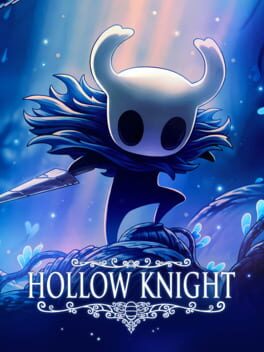
Hollow Knight was released on PC on February 24, 2017. What had initially been intended as a relatively contained project grew during development into a vast interconnected world. Team Cherry continued working on the game afterward through several free expansions and console adaptations, progressively extending its audience far beyond the community that had supported the Kickstarter campaign.
This period also revealed how strongly the studio works through the gradual expansion of ideas. Team Cherry has explained that it does not plan every detail of its worlds far in advance. Characters, areas, and situations emerge during development, and their relationships are refined by observing what they imply for the wider universe. This helps explain why Hollow Knight grew far beyond its starting point. The world was not simply executed from a completely fixed plan; it became denser as new possibilities proved interesting to the team.
The success of the game profoundly changed the material conditions in which Team Cherry could continue working, without leading the studio to transform into a large production structure. Instead, the team retained a compact organization and prepared its next project as a direct continuation of the universe it had just created.
From additional content to Silksong
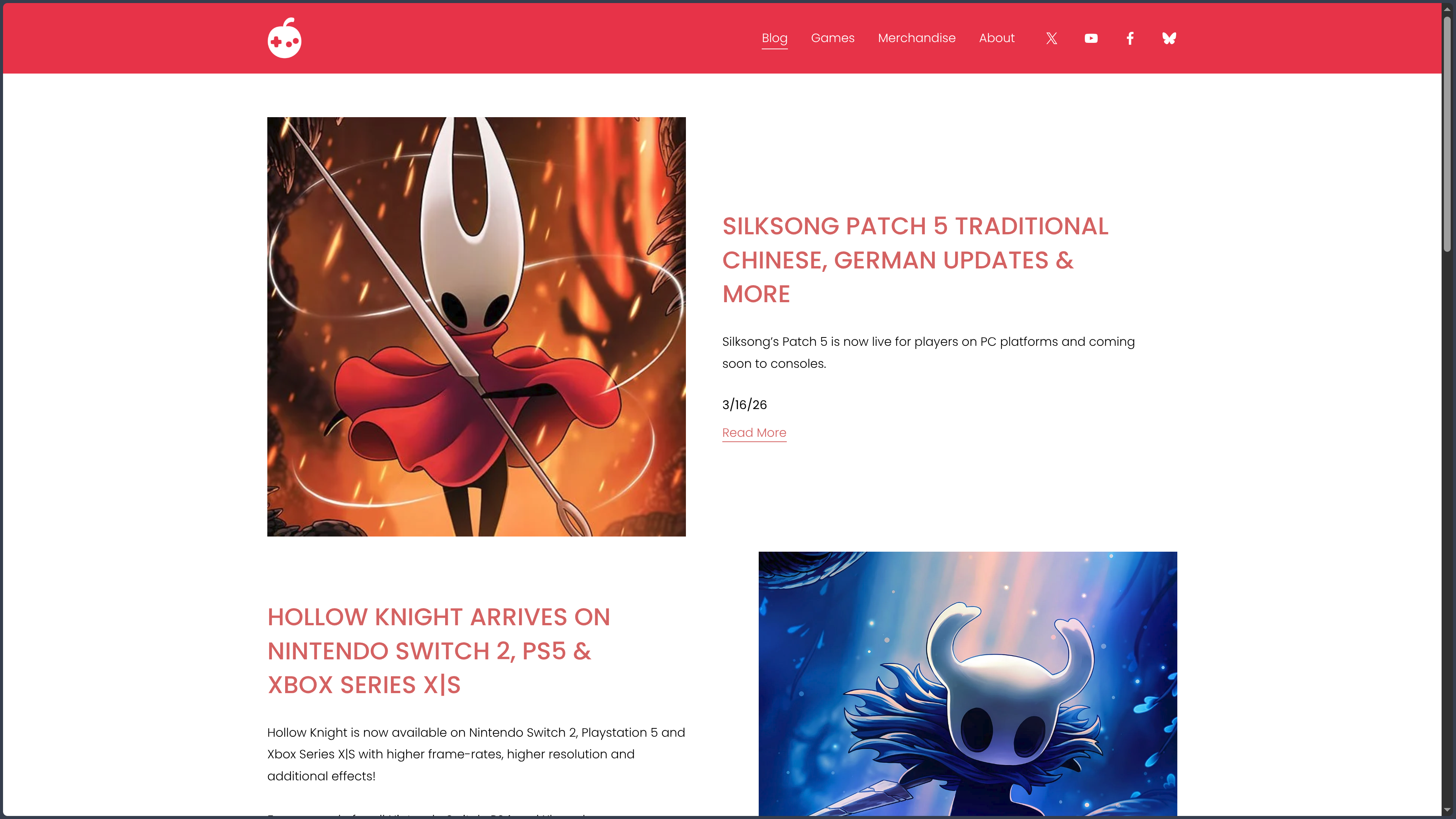
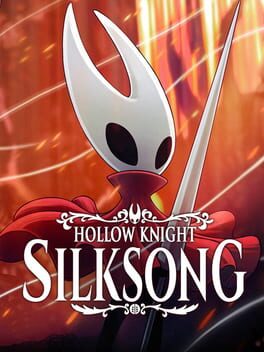
The project centered on Hornet illustrates particularly well Team Cherry's tendency to let an idea grow when it opens enough possibilities. A playable adventure built around the character was initially intended to extend Hollow Knight. Shortly after the release of the first game, however, Team Cherry began developing a new territory, new mechanics, and enough distinct content for the project to exceed the scope of an expansion. It gradually became a complete game: Hollow Knight: Silksong.
When it was publicly revealed, Team Cherry described Silksong as its second game and as a full sequel. The studio remained a three-person core development team despite the growing scale of the project. This situation explains part of the singularity of its production: the considerable expansion of the content was not accompanied by a comparable expansion of the organization.
Development continued for several years. Team Cherry gradually communicated less about its schedule and maintained a straightforward approach: announce a date only when the team was certain it could meet it, and continue developing the project until it reached the desired level of quality and scope. This freedom resulted directly from its independent position and the success of the first game, giving the studio conditions very different from those surrounding the 2014 Kickstarter campaign.
Hollow Knight: Silksong was finally released on September 4, 2025. With this second game, Team Cherry confirmed that its identity did not depend solely on the initial discovery of Hallownest. The studio transferred its approach to world construction into a new kingdom, a new protagonist, and systems redesigned around her. Silksong therefore represents more than the commercial continuation of Hollow Knight: it is the culmination of a development method that had already caused the first project to grow far beyond its original scale.
Since that release, Team Cherry has continued to maintain both games. The studio has notably continued updating Silksong and modernizing Hollow Knight for contemporary platforms. These activities extend the two existing productions rather than, at this stage, constituting a sufficiently distinct new period to redefine the studio's identity.
What sets it apart
Building the world as it is discovered
Team Cherry's method relies heavily on the organic construction of its universes. The studio does not describe its worlds as structures entirely determined before production begins. Characters, places, and situations are created because they appear interesting, and their implications gradually feed into other elements of the game.
This approach gives creation an exploratory quality that echoes the experience offered to the player. The developers themselves discover certain possibilities as production progresses and then select those worth pursuing. In the case of Hollow Knight, this method helped transform a game jam idea into a much larger universe. With Silksong, a planned extension centered on Hornet underwent a similar evolution until it became a new game.
An art direction designed for a small team
Team Cherry's hand-drawn style is one of the most immediately recognizable features of its games, but its importance goes beyond aesthetics. From the earliest presentations of Hollow Knight, the studio explicitly connected its relatively simple visual style and traditional 2D animation to a question of production capacity.
Clear shapes, characters built with an economy of detail, and animation suited to this aesthetic allow the team to create a large number of creatures and environments without losing the visual unity of the world. The constraints of a small structure therefore become part of the studio's language. The quantity of content does not rely on a pursuit of realism or maximum technical sophistication, but on a graphical system efficient enough to allow constant variation.
This consistency also extends to sound and music through long-term collaborations. Composer Christopher Larkin, already associated with the first Hollow Knight, returned for Silksong. Team Cherry therefore remains a small central structure while building around itself a group of specialist collaborators capable of extending the identity of its universes.
Exploration as a design principle
Exploration is a sufficiently consistent thread to characterize Team Cherry beyond the specific details of each game. The studio has explained that it wanted players to be able to choose different paths, leave an area that had become too difficult, and seek progress elsewhere. This approach turns the world into a space to be understood gradually rather than a simple succession of levels.
This philosophy connects with the references that initially brought Ari Gibson and William Pellen together when the studio was formed. Their interest in older adventure games does not result in a literal reproduction of their mechanics, but in the search for a feeling of curiosity: moving forward without fully knowing what lies ahead, gradually understanding the rules of a place, and retaining several possible directions.
This relationship between world and discovery makes Team Cherry more recognizable than any single mechanic. Combat, abilities, or the exact structure may evolve from one game to another; the idea of a world coherent and mysterious enough to make the player want to become lost within it remains central to the studio's work.
A small structure that preserves its independence
Team Cherry's size is not merely a biographical detail. It directly influences the way the studio produces games. After the considerable success of Hollow Knight, the studio could have evolved toward a much larger organization. Instead, it remained a small independent team in Adelaide, including throughout the much longer development of Silksong. Its official website still explicitly presents the studio as a small development team.
This continuity gives the studio considerable freedom over the pace and scope of its projects, but it also results in a production process where adding ideas can have direct consequences for development time. Both Hollow Knight and Silksong reveal this tension: the same freedom that allows their worlds to become richer ultimately forces the team to decide for itself when that expansion must stop.
Team Cherry therefore represents a particular form of independent development: not a studio seeking to quickly multiply its productions or significantly increase its workforce, but a small structure using time, team stability, and control over its works to deepen a very limited number of projects.
Good to know
- Team Cherry is an independent studio based in Adelaide, South Australia.
- The studio was founded in 2014, around the development of what would become Hollow Knight.
- The idea behind Hollow Knight originated during a game jam held in mid-2014 around the theme "Beneath the Surface".
- The Hollow Knight Kickstarter campaign raised 57,138 Australian dollars from 2,158 backers, against an initial target of 35,000 Australian dollars.
- Ari Gibson and William Pellen are the co-directors of Team Cherry.
- Hollow Knight is the studio's first commercial game and was released in 2017.
- The project centered on Hornet was initially intended as additional content for Hollow Knight before growing large enough to become a full game.
- Hollow Knight: Silksong is Team Cherry's second game and was released on September 4, 2025.
- Both games notably rely on hand-drawn 2D animation, while Christopher Larkin composed the music for both adventures.